INTRODUCTION
Neuropsychiatric disorders are often observed in cancer patients. In an initial study, Derogatis et al. (Reference Derogatis, Morrow and Fetting1983) reported that a psychiatric diagnosis was made in 47% of cancer patients, and adjustment disorders were the most frequent (68%), followed by depression (13%) and delirium (8%). A recent Japanese study of 1721 psychiatric referrals at a cancer center revealed that the most frequent psychiatric diagnoses, which were made according to the Diagnostic and Statistical Manual of Mental Disorders, fourth edition (DSM-IV; American Psychiatric Association, 1994), were adjustment disorders, followed by delirium, major depression, dementia, and schizophrenia (Akechi et al., Reference Akechi, Nakano and Okamura2001). Among the psychiatric referrals, neuropsychiatric conditions associated with adverse drug reactions are sometimes detected. These conditions are sometimes difficult to diagnose because of multiple complicating factors in patients undergoing cancer treatment and oncologists' unfamiliarity of these conditions. Medication-induced movement disorders, a DSM-IV diagnostic category, are one of these conditions. This category includes neuroleptic-induced acute akathisia, neuroleptic malignant syndrome, and so on.
Akathisia is characterized by subjective feelings of restlessness accompanied by objective signs of motor restlessness such as fidgety movements of the legs and an inability to sit or stand still (American Psychiatric Association, 1994). Antiemetic drug-induced akathisia in cancer patients has been reported previously (Fleishman et al., Reference Fleishman, Lavin and Sattler1994); a retrospective study confirmed that an antiemetic drug was one of the risk factors of akathisia in cancer patients (Gattera et al., Reference Gattera, Charles and Williams1994). But the incidence of akathisia among psychiatric referrals in a cancer center has not been published to date.
Subjects and Methods
This present study was a prospective study. The subjects of this study were 483 patients (225 males, 258 females; mean age ± SD = 58.9±13.5 years) with cancer who had been referred to the Department of Psychiatry in Kanagawa Prefecture Cancer Center from February 1, 2004 to November 30, 2005. The consultation was requested for psychiatric evaluation, diagnosis, and treatment. The prevalence of the various sites of cancer was as follows: head and neck, n = 60, 12.4%; lung, n = 58, 12.0%; breast, n = 55, 11.4%; leukemia, n = 50, 10.4%; stomach, n = 35, 7.2%; uterus, n = 33, 6.8%; rectum, n = 21, 4.3%; esophagus, n = 20, 4.1%; colon, n = 19, 3.9%; pancreas, n = 18, 3.7%; and others, n = 114, 23.6%.
The psychiatric interviews were consecutively conducted with the patients by well-trained psychiatrists. The past and current medications used in their cancer treatment were also examined in detail for an accurate evaluation. The psychiatric diagnoses were made according to DSM-IV.
This study was not referred to the ethics committee of the cancer center and informed consent was not obtained from the patients because psychiatric interview, assessment, and diagnosis were within our routine work and extraordinary burdens and intervention were not placed on these patients.
RESULTS
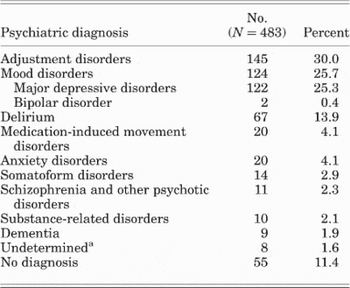
The prevalence of the various psychiatric diagnoses are listed in Table 1. A psychiatric diagnosis (axis I diagnosis of DSM-IV) was made in at least 420 of 483 cases (87.0%). Although the psychiatric diagnoses were diverse, the most frequent psychiatric diagnoses were adjustment disorders (30.2% of all subjects diagnosed) followed by depression (30.0%), and delirium (13.9%). Tied for fourth as most prevalent diagnoses were a medication-induced movement disorder (acute or tardive akathisia, 4.1%) and anxiety disorders (4.1%). Akathisia accounted for 4.8% of all psychiatric diagnoses. All patients with a movement disorder exhibited symptoms of akathisia, including a subjective feeling of restlessness and motor restlessness, such as an inability to sit and stand still. Half of these patients were diagnosed as having acute akathisia according to its onset after medication.
Psychiatric diagnoses (Axis I diagnosis of DSM-IV) in referred cancer patients

aEight patients were categorized as “undetermined” because of insufficient psychiatric interview time for a definitive diagnosis.
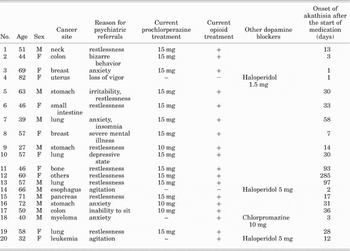
Table 2 shows the profiles of all the patients with akathisia (10 males and 10 females, mean age ± SD: 54.5 ± 14.2 years). Except for only two cases, akathisia had not been diagnosed until the psychiatric referral; these patients were referred to the psycho-oncologist because of their mental state, such as restlessness, anxiety, agitation, and so forth. Akathisia was induced by an antiemetic drug, prochlorperazine, in 16 of 20 patients; 3 were given 10 mg, and 13 were given 15 mg of prochlorperazine daily. In three cases, haloperidol, an antipsychotic agent, induced the akathisia. The onset of akathisia varied from 1 day to 9 months after the dopamine antagonist was prescribed.
Clinical characteristics of the 20 patients with akathisia

DISCUSSION
In this study, akathisia was the fourth most common psychiatric diagnosis among all the psychiatric referrals. In almost cases, the akathisia was induced by an antiemetic drug, prochlorperazine, which was given for treating the nausea caused by morphine. Prochlorperazine is a phenothiazine derivative, and its antiemetic effect is due to its blockade of the central dopaminergic system; this dopaminergic blockade possibly causes extrapyramidal symptoms at the same time (O'Hara, Reference O'Hara1958; Bateman et al., Reference Bateman, Darling and Boys1989). Prochlorperazine-induced akathisia in cancer patients has been reported previously. Fleishman et al. (Reference Fleishman, Lavin and Sattler1994) conducted a telephone interview of 24 cancer patients who had taken prochlorperazine and metoclopramide, another antiemetic drug, with chemotherapy and found that 50% of the patients had subjective motor restlessness. Gattera et al. (Reference Gattera, Charles and Williams1994) determined risk factors of akathisia in terminally ill patients by a retrospective control study; exposure to haloperidol, prochlorperazine, promethazine, or morphine was a factor that predisposed patients to akathisia, respectively. Akathisia should be considered in patients to whom antiemetic drugs are administered, and in the present study, the authors prospectively examined the prevalence of neuropsychiatric complications in cancer patients and found an unexpectedly high prevalence of akathisia among patients. Prior to the referrals, only two oncologists had suspected akathisia. They referred the patients because of “unexpected behavioral changes,” “bizarre behavior,” and so on, and therefore asked for a psychiatric evaluation.
Whereas the first, second, and third most common psychiatric disorders observed in cancer patients referred for psychiatric evaluation were consistent with observations in previous studies, akathisia was more frequent in our study compared to previous ones (Massie & Holland, Reference Massie and Holland1987; Grassi et al., Reference Grassi, Gritti and Rigatelli2000; Akechi et al., Reference Akechi, Nakano and Okamura2001). It is not clear why there are differences in the prevalence of various psychiatric diagnoses among the studies. Were most of the cases of akathisia overlooked or misdiagnosed in the previous studies? Although unlikely, the clinical impact of akathisia might have been underestimated. Another possibility is that akathisia was not categorized in the list of psychiatric diagnoses in the previous studies. Akathisia is not listed among the mental and behavioral disorders in the ICD-10 classification and DSM-III; DSM-IV newly adopted it as an axis I disorder. Another important factor is the misuse of prochlorperazine. Morphine was administered in 18 of 20 cases with akathisia in the present study. Nausea and vomiting is an initial adverse reaction in patients taking oral morphine. Prochlorperazine had been given to treat nausea induced by morphine, but its long-term administration was continued for no clear reason in almost all the cases.
Although psychotropic drugs are often used in palliative care, adverse drug reactions to psychotropics are sometimes overlooked. Two cancer patients who developed neuroleptic malignant syndrome, a potentially lethal adverse reaction of psychotropic drugs, have been reported previously. These patients developed neuroleptic malignant syndrome following bone marrow transplantation and in an intensive care unit on the day of surgery. The malignant syndrome was overlooked (Onose et al., Reference Onose, Kawanishi and Onishi2002; Kawanishi et al., Reference Kawanishi, Onishi and Kato2005). Diagnosing such adverse reactions is difficult due to multiple complicating factors associated with cancer treatment, its unfamiliarity to clinical oncologists, and occasionally the resemblance of these neuropsychiatric symptoms to those associated with cancer.
Akathisia is uncomfortable for patients; Atbaşğlu et al. (Reference Atbaşğlu, Schultz and Andreasen2001) found that the subjective awareness of akathisia is associated with suicidal ideation. Although akathisia is commonly observed in patients treated with neuroleptic drugs, it is sometimes overlooked or misdiagnosed (Weiden et al., Reference Weiden, Mann and Haas1987; Hirose, Reference Hirose2003). Akathisia often occurs without the coexistense of other extrapyramidal symptoms, and its characteristic symptoms, including inner restlessness, tend to be regarded as representations of a symptom of a primary psychiatric illness. Therefore akathisia can be overlooked or misdiagnosed sometimes even in psychiatric units.
Based on these results, the use of antiemetic drugs should be optimized. In addition, clinical oncologists should be aware of akathisia. The management of adverse drug reactions is necessary during palliative care and contributes to patients' quality of life.