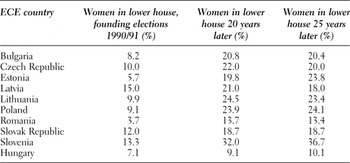
The collapse of communist rule in the Soviet Bloc led to a sharp initial decline in female representation in the newly democratized legislatures of East Central Europe (ECE), from a regional average of around 30% in the late socialist period to less than 10% in founding democratic parliaments (Montgomery Reference Montgomery, Matland and Montgomery2003). In the decades since, every country in the region except Hungary has at least doubled the proportion of women in parliament, and several have done far more than that (see Table 1). The 2010 elections for the Hungarian National Assembly marked the 20-year anniversary of democracy but produced just 9% female representation. This placed Hungary well below the world and European averages and behind every other former Soviet Bloc country.
Female underrepresentation in Hungary compared with the ECE trend

Sources: Inter-Parliamentary Union, “Women in National Parliaments,” http://www.ipu.org/wmn-e/world.htm, and archived data at http://www.ipu.org/wmn-e/classif-arc.htm (accessed June 3, 2015).
Few would argue that the presence of female faces in parliament guarantees women real voice or decision-making power. Scholars assert that gender parity in electoral politics is necessary to make use of women's resources for the good of society and “because of what it symbolizes in terms of citizenship and inclusion—what it conveys to us about who does and who does not count as a full member of society” (Phillips Reference Phillips2012, 517). We might also hope that women's descriptive representation makes a difference in terms of policy outcomes and agenda setting favoring women's interests. Even if the policy impact of female legislative presence is mixed or difficult to demonstrate, the goal of gender equity in electoral politics has become a global norm and a central policy initiative for international organizations and national governments (Celis and Childs Reference Celis and Childs2012; Krook and Norris Reference Krook and Norris2014; Wängnerud Reference Wängnerud2009).
That Hungary remains immune to these global and regional trends provides us with an interesting puzzle. Early research on women's underrepresentation in the new ECE democracies focused on common legacies of communism and missed opportunities for women during transition, a combination of “push and jump” (Einhorn Reference Einhorn1993; Funk and Mueller Reference Funk and Mueller1993). Male dissidents, eager to hold positions of power in the new order, were happy to push women to the sidelines during transition. Women, exhausted from the dual and triple burdens imposed by communist policies of “directive emancipation,” were skeptical of feminism and willing to withdraw from politics. Men therefore founded the political parties, shaped new constitutions, and monopolized the leadership positions in formal politics (Matland and Montgomery Reference Matland, Montgomery, Matland and Montgomery2003). At the same time, “the emergence of multi-party systems was under-pinned by a re-traditionalization of political space through calls for a ‘proper’ role for women” (Chiva Reference Chiva2005, 972).
It stands to reason that these common legacies might continue to reduce ECE women's ability to participate in politics on an equal footing with men for years to come. But common legacies cannot explain widening variations in women's descriptive representation across ECE parliaments. Nor can they tell us why, in Hungary, female parliamentary underrepresentation has become “perhaps the most stable feature of the post-communist political system, resisting government changes, transformation of the party system, and the recent constitutional reform” (Várnagy Reference Várnagy2013, 3).
To address these questions, we employ a pathway case analysis of the 2010 elections for the Hungarian National Assembly. Gerring (Reference Gerring2004, 342) defines the case study as “an intensive study of a single unit for the purpose of understanding a larger class of (similar) units.” A “pathway case” is a particular type of case study that allows the investigator to elucidate causal mechanisms when the causal hypotheses are already identified through cross-case investigation and the theoretical literature suggests more than one pathway to the same outcome (Gerring Reference Gerring2007). By comparing the 2010 elections to other post-transition elections in Hungary and to outcomes in other ECE countries, we can identify the pathway most responsible for keeping Hungary stuck in the basement on women's descriptive representation (Gerring Reference Gerring2004, 2007). Krook (Reference Krook2010a, Reference Krook2010b) has called for more in-depth case studies that can untangle the effects of various factors facilitating and hindering women's access to political office. We begin by grounding our case in the theoretical and empirical literatures.
WOMEN'S ACCESS TO ELECTED OFFICE: SUPPLY, DEMAND, AND CONTEXT
The dominant framework for understanding women's underrepresentation depicts legislative recruitment as a multistage process that involves individuals moving from a large pool of eligibles to a smaller pool of aspirants (those who seek office), to an even smaller pool of party-nominated candidates, and, finally, to a small cohort of elected officials (Krook Reference Krook2010a; Norris Reference Norris1997). Women might be winnowed out of this process at any stage, but two junctures appear to be particularly salient: the self-selection phase (the individual-level decision to move from eligible to aspirant) and the nomination stage, when party gatekeepers play the critical role (Krook Reference Krook2010a; Krook and Norris Reference Krook and Norris2014). The proportion of women represented in a legislature is therefore a function of the relative demand for female candidates and the supply of female aspirants with the attributes that party gatekeepers and voters find attractive (Matland and Montgomery Reference Matland, Montgomery, Matland and Montgomery2003; Norris Reference Norris1997).
The dynamics of supply and demand, in turn, are shaped by the broader political context within which the legislative recruitment process takes place. Three aspects of context appear to be particularly critical: cultural/developmental, party-political, and institutional (Krook Reference Krook2010b; Krook and Norris Reference Krook and Norris2014). Each of these contextual settings provides a different pathway to account for women's underrepresentation in Hungary. For analytical clarity, we frame these as separate causal hypotheses.
Cultural/Developmental Path
In their landmark statistical analysis of more than 60 countries, Inglehart and Norris (Reference Inglehart and Norris2003) show that women have greater access to elected office in societies that have undergone socioeconomic modernization, allowing women access to the social and economic roles and resources that may embolden them to become aspirants and make them attractive to party gatekeepers and voters. Socioeconomic modernization, in turn, correlates with egalitarian cultural values that are receptive to women in leadership positions. Societies differ in the degree to which the dominant gender norms uphold a public/private divide. Traditional gender ideology prescribes strict male breadwinner and female caregiver roles in society; modern gender ideology accepts and may even promote women's participation in public political and economic roles (Krook and Norris Reference Krook and Norris2014; Norris and Lovenduski Reference Norris and Lovenduski1995). When gender norms are traditional, party gatekeepers and voters may not see women as viable candidates; there may be little organized demand for gender equity, and women may lack the resources and motivation to step forward as aspirants. By contrast, cultural and developmental contexts that favor gender equity increase the supply of qualified female candidates and can create pressure on party gatekeepers to expand their recruitment practices to women.
We summarize this path for Hungary in the following causal hypothesis:
H1:
The socioeconomic and cultural context surrounding Hungarian elections limits the supply of female aspirants and the demand for gender equity in candidate selection.
Party-Political Path
Variations in the proportion of women to men can be greater across parties in a system than across countries (Kittilson Reference Kittilson2006). Research on Western Europe and North America finds that left parties are more likely than right parties to recruit female candidates because of differences in ideology and policy positions on women's rights (Krook Reference Krook2010b; Opello Reference Opello2006). Left parties are more likely to espouse a modern gender ideology, adopt voluntary gender quotas, and place women in leadership positions. In addition, because of the demographic composition of the electorate, the supply of female aspirants may be higher for left-wing parties (Kittilson Reference Kittilson2006; Norris and Lovenduski Reference Norris and Lovenduski1995). These differences appear to be particularly acute in comparisons of populist radical right (PRR) parties and New Left Green-style parties (Caul Reference Caul1999; Mudde Reference Mudde2007; Ramet Reference Ramet and Ramet1999; Rippeyoung Reference Rippeyoung2007).
The broader nature of party-political competition in a country is also important in shaping recruitment outcomes (Franceschet Reference Franceschet2005). Women are disadvantaged when politics is dominated by nationalist-traditionalist discourses and when recruitment practices are leader dominated and/or involve murky negotiations or financing (Kittilson Reference Kittilson2006; Mudde Reference Mudde2007; Opello Reference Opello2006). Masculine biases may be baked into existing party structures. Male party chairs tend to prefer stereotypically male traits in potential candidates as a kind of “information shortcut,” and male gatekeepers more often reach out to and encourage male eligibles (Lawless and Fox Reference Lawless and Fox2005; Niven Reference Niven1998). It is little wonder that Kittilson's (Reference Kittilson2006) study of Western Europe finds that women's presence among party leaderships is the single best predictor of increased female descriptive representation.
Based on the literature, we hypothesize the following:
H2:
The ideological and organizational characteristics of Hungarian political parties and the nature of post-transition political competition allow party elites to underselect female candidates and avoid altering their recruitment practices.
Institutional Path
Institutions set the opportunity structure and incentives for selecting female candidates (Krook and Norris Reference Krook and Norris2014; Norris and Lovenduski Reference Norris and Lovenduski1995). This is one of the most consistent findings of cross-national research. Party-list proportional representation (PR) electoral systems provide party gatekeepers with the opportunity to balance their tickets with women. Majoritarian elections in single-member districts (SMDs) force party gatekeepers to make zero-sum choices between nominating a female candidate or a more entrenched male interest. Overwhelming international evidence shows that electorates vote for women at equal or greater rates than for men, but what matters is perception (Murray, Krook, and Opello Reference Murray, Krook and Opello2012). If gatekeepers perceive that women are less qualified or committed candidates—or if that is what they think voters believe—they will discriminate against women in the selection process. Gender quotas offer a promising mechanism for overcoming this type of discrimination (Krook Reference Krook2009). Studies show that quotas, when structured properly, can force parties to open their recruitment practices to women even in unfavorable developmental and cultural contexts (Jones Reference Jones2009; Krook Reference Krook2009; Krook and Norris Reference Krook and Norris2014).
In postcommunist ECE, the two countries with the lowest levels of female legislative representation over time are Hungary and Romania. Those are also the only two countries to use majoritarian-leaning mixed-member PR electoral rules (Chiva Reference Chiva2005; Moser Reference Moser2001). All of the other ECE countries (except Latvia) use some form of party-list PR, and several have adopted a combination of legislated and voluntary party-based gender quotas.Footnote 1 Based on the literature and this cross-national ECE pattern, we hypothesize the following:
H3:
Majoritarian elements of Hungary's mixed-PR electoral system and the lack of meaningful gender quotas reduce the opportunities and incentives for parties to recruit women and explain the underselection of female candidates.
PATHWAY ANALYSIS OF HUNGARY'S 2010 ELECTION
Each of the three pathways identified here could explain the low proportion of women in the Hungarian parliament. The 2010 election to the Hungarian National Assembly took place at a watershed moment in the development of the postcommunist political system. The negotiated transition to democracy had produced a moderately plural multiparty system, but over the course of a decade, competition crystallized along cultural lines, with the Right defined as Christian-nationalist, anticommunist, populist, and morally conservative and the Left as postcommunist and cosmopolitan-urbanist (Cabada, Hloušek, and Jurek Reference Cabada, Hloušek and Jurek2014). The Alliance of Young Democrats-Hungarian Civic Alliance (Fidesz) began life as a liberal party but, under the leadership of Viktor Orbán, refashioned itself as the main conservative-populist alternative on the party spectrum.Footnote 2 The left-urbanist pole consolidated under the direct lineal descendant of the ruling communist party, the Hungarian Socialist Party (Magyar Szocialista Párt, MSzP).
Whereas party systems in other ECE countries were marked by fragmentation and volatility, Hungary's party system consolidated early into a bipolar, two-party dominant system (Medve-Bálint Reference Medve-Bálint, Gyárfášová and Mesežnikov2011). By 2002, the combined seat share of Fidesz and MSzP was 90%. In 2006, it remained around 85%. But beneath this stable surface, the bipolar system faced profound challenges from worsening economic conditions and a series of scandals involving MSzP leaders that created a crisis of public trust (Medve-Bálint Reference Medve-Bálint, Gyárfášová and Mesežnikov2011).
The 2010 elections revealed the severe erosion of the left pole. Despite leadership changes, the MSzP lost more than 130 seats compared to the previous election, and the liberal party of former dissidents, the Alliance of Free Democrats (Szabad Demokraták Szövetsége, SzDSz) ceased to be a viable party. Fidesz was able to expand its legislative dominance, and two new parties entered parliament for the first time: a populist radical right party, the Movement for a Better (or More Right) Hungary (Jobbik) and a New Left Green-style party, Politics Can Be Different (Lehet Más a Politika, LMP).
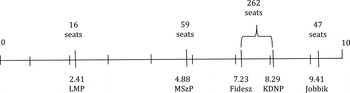
Figure 1 places the four parliamentary parties along a GAL/TAN (Green-Alternative-Liberal versus Traditional-Authoritarian-Nativist) continuum that closely approximates the cultural cleavage dominant in Hungarian politics (Bakker et al. Reference Bakker, de Vries, Edwards, Hooghe, Jolly, Marks, Polk, Rovny, Steenbergen and Vachudova2012).Footnote 3 As we would expect, the LMP, which articulates the same basic platform as most European Green parties, occupies the space closest to the pure GAL position. The larger left party, the MSzP, sits much closer to the middle. Every other parliamentary party is positioned at the TAN end of the spectrum. Jobbik stakes out the position closest to the pure New Right/TAN end, but Fidesz and its much weaker electoral partner, the Christian Democratic People's Party (Kereszténydemokrata Néppárt, KDNP), are not far off (Bíró-Nagy and Róna Reference Bíró-Nagy, Róna, Mesežnikov, Gyárfášová and Bútorová2012).
Ideological placement and seat share of parliamentary parties, 2010. 0 = GAL (Green-Alternative-Liberal), 10 = TAN (Traditional-Authoritarian-Nativist).

On most issues, Jobbik differs from Fidesz in degree more than substance.Footnote 4 Ideological proximity between mainstream and far right parties is not unique to Hungary. In postcommunist Europe, center-right parties often share the views of their more extreme counterparts (Minkenberg Reference Minkenberg2002; Mudde 2007). What is striking about Hungary in 2010 is the roughly 80% seat share of parties clustered at the TAN end of the spectrum and Jobbik's emergence as the third-largest party.
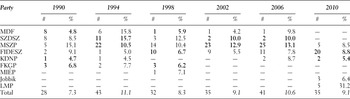
It is tempting to conclude that the collapse of bipolar competition (the terminal weakening of the MSzP, the meteoric rise of Jobbik, and the legislative dominance of Fidesz-KDNP) accounts for the dismal female recruitment outcome of 2010. But women's descriptive representation across the postcommunist period has remained stubbornly low regardless of the party in power (see Table 2). The left/liberal parties have a slightly better record on selecting female candidates, but the differences are nominal. This begs a central question: why have Hungarian parties across the ideological spectrum been able to resist changing their recruitment practices to be more open to women? To answer this, we analyze each of our hypothesized pathways.
Number and proportion of female MPs by party, 1990–2010 (government in boldface)

Note: MDF: Hungarian Democratic Forum (Magyar Demokrata Fórum); SzDSz: Alliance of Free Democrats (Szabad Demokraták Szövetsége); MSzP: Hungarian Socialist Party (Magyar Szocialista Párt); Fidesz Hungarian Civic Union (Fidesz—Magyar Polgári Szövetség); KDNP: Christian Democratic People's Party (Kereszténydemokrata Néppárt); FKgP: Independent Smallholders, Agrarian Workers and Civic Party (Független Kisgazda, Földmunkás és Polgári Párt); MIÉP: Hungarian Justice and Life Party (Magyar Igazság és Élet Pártja); Jobbik Movement for a More Right Hungary (Jobbik Magyarországért Mozgalom); LMP: Politics Can Be Different (Lehet Más a Politika)
Deep Politics—Cultural and Socioeconomic Barriers
A 2011 mail survey of party activists in Hungary asked respondents about the main obstacles to women's participation in elected office.Footnote 5 The majority of responses highlighted cultural and socioeconomic barriers—what one respondent called “deep politics.” Right-wing respondents tended to frame this as a problem of supply: women simply do not want to be politicians. A Jobbik respondent claimed, “Women are equal with men. They can take part actively in the job if only they want to.” Other conservatives asserted that “politics is not a usual feminine pursuit,” and “for most of their lives women's most important priority is family.” When asked why Fidesz ran so few women in the SMDs, the male parliamentary faction leader answered that it was because district campaigns are more of a competitive “manly sport” (Csipke Reference Csipke2009). Respondents on the Left emphasized socioeconomic and structural barriers: “As a result of their family duties and involvement, women use less scheming and aggressive career techniques,” and “Women have more complicated roles and fewer resources.”
It is true that Hungary has one of the lowest female labor force participation rates in the European Union, with less than half of working-age women employed as of 2009. Mothers of children under the age of 12 are especially absent from paid labor, and the gap between mothers’ and nonmothers’ participation in paid work is the second largest in the EU (Fodor Reference Fodor2011). These realities reinforce the perception that Hungarian women, whether by choice or by necessity, put family before politics. The unavailability of family-friendly work hours and arrangements, the lack of child care options, and reductions in paid maternity leave represent real structural barriers for women, particularly young women with children, to enter politics (Fodor Reference Fodor2011; Várnagy 2013).
A 2010 elite survey asked successful candidates across the parliamentary parties how much time they spent on various aspects of campaigning.Footnote 6 Women reported spending less time than their male counterparts on every single activity. They also started their campaigns later than men. These findings suggest that men are more likely than women to have the resources, time, background roles, party support, and motivation (ambition, confidence, and interest) necessary to think of politics as a career. Men are also more likely than women to stay in parliament for more than one term and to develop the prized “incumbency advantage” (Kurtán and Ilonszki Reference Kurtán and Ilonszki2011).
When Hungarian women do step into the political arena, they face a sexist institutional culture. It is not uncommon to find accounts of male members of parliament (MPs) jeering at their female colleagues during parliamentary work. Agnes Osztolykán, a Roma woman in the LMP parliamentary group, published an account on her blog in which she describes racist and sexist taunts from a group of her male colleagues.Footnote 7 Men in the right-wing benches will shout down female members of the opposition when they try to speak, and women's issues within the parliament, such as domestic violence, are often treated in a patronizing or sexualized manner. Given this climate, we might conclude that the main bottleneck for female access to power occurs at the aspirant stage. But research shows that women's share of the candidate pool has risen over time, more than doubling since 1990 (Ilonszki Reference Ilonszki and Tremblay2012).
Much has been made of the retraditionalization of the political discourse in Hungary and the rise of nationalist-conservative and PRR parties that prescribe traditional roles for women (Chiantera-Stutte and Pető Reference Chiantera-Stutte and Pető2003; Egedy 2009; Pető Reference Pető, Kahlert and Ernst2010; Ramet 1999). This seems a reasonable explanation of the growing right/TAN legislative dominance in Hungary and the low levels of female representation. But Hungary has not been alone in producing strong populist-nationalist parties. In Poland, for instance, the PRR parties are mainstream and very gender traditional, but that has not stopped Poland from increasing women's presence in the Sejm (Mudde 2007).
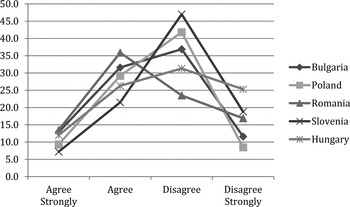
In fact, Hungary's gender ideology appears to be no more traditional than other comparable ECE countries that have improved women's access to elected office. The majority of Hungarian survey respondents in Figure 2 disagreed with the statement that men make better political leaders than women. That is consistent with the reaction in Poland, Bulgaria, and Slovenia; in fact, Hungarian respondents were actually more likely to “strongly disagree” with the statement (25%). Only 8% of Polish respondents strongly disagreed that men make better political leaders than women, but Poland has twice the proportion of women in its legislature as Hungary. But perhaps women have access to fewer of the resources and educational credentials that would embolden them to step forward as candidates and make them attractive to party gatekeepers and voters.
Cross-national ECE attitudes toward women in leadership.

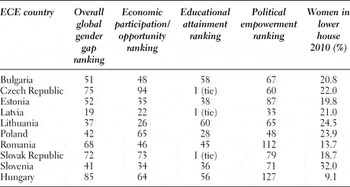
Table 3 provides information on gender gaps across the region.Footnote 8 As mentioned previously with regard to labor force participation, women in Hungary face substantial gender inequalities; but so do women in other ECE countries. If we look at the subindex categories for male-to-female differences in economic participation/opportunity and educational attainment, Hungary actually ranks higher on one or the other measure than several countries that post higher levels of female recruitment (notably, Poland, the Czech Republic, and Slovakia). The gap between Hungary's ranking on economic and educational gender inequalities, on one side, and its basement ranking on gendered inequalities in political empowerment, on the other, suggests that institutional and party-political contexts may introduce significant distortions in the electoral marketplace (Krook 2010a). We turn now to those factors.
Gender gap in Hungary compared with selected ECE cases

Source: Ricardo Hausmann, Laura D. Tyson, Yasmina Bekhouche, and Saadia Zahidi, “The Global Gender Gap Index,” Global Gender Gap Report 2011, http://reports.weforum.org/global-gender-gap-2011/#section=the-global-gender-gap-index-2011 (accessed June 2014).
Gender Ideology, Male Leaders, and Weak Women's Sections
The early consolidation of Hungary's party system limited access for new party entrants and new elites, including those that might articulate and promote a gender equality agenda (Ilonszki Reference Ilonszki and Tremblay2008). New actors can seek to mobilize new voters without losing support from an old constituency and may consequently introduce new values and strategies (Caul Reference Caul2001). In 2010, Hungary got two new party actors, but that did not improve women's access to elected office for several reasons.
Parties Fail to Prioritize Gender Equality
The 2010 party programs for each of the parliamentary parties show that in spite of broad differences between the two ideological camps, none of the parties advocated a modern gender ideology as an electoral appeal.Footnote 9 Fidesz, KDNP, and Jobbik staked out a mostly traditional position. Jobbik's program referenced women in terms of a demographic crisis and offered as solutions an institute for stay-at-home mothers and a stay-at-home mother's subsidy to replace the existing system of child benefit/child support. Fidesz and KDNP raised similar priorities but in less overtly nativist terms. Both programs contained separate sections for social policy that stressed the importance of strengthening families, particularly large families. The KDNP document mentioned children (gyermek and variants) 10 times and women (nők and variants) only once, and then only to assert that women's priority should be childrearing. The 49-page Fidesz document mentioned women only five times, the family (család and variants) 14 times, and children nearly 60 times. All three platforms essentialized women's biological role as mothers.
The MSzP and LMP programs were “modern” only by comparison. They said nothing about a demographic crisis or women's special role in strengthening the family. In fact, the MSzP's 15-page document mentioned children and the family only as part of a discussion about the family allowance (pótlék), a key area of welfare policy. The LMP did launch a separate program for gender equality in April 2010 that highlighted inequalities in pay and promotion, but the party used its first official program to focus on issues other than gender equality (the environment, Roma rights, foreign policy, and political transparency).
The fact is, none of the parties elected to parliament in 2010 made gender equality a priority issue. Only one respondent in our party activist survey (an LMP woman) placed “women's participation in the economy and politics” among the most important issues facing the nation and identified women as an underrepresented group in Hungarian politics. In a 2010 TÁRKI survey of 1,000 voters, only around 30% of respondents were willing to identify any parliamentary party as having a woman-friendly policy program (Várnagy and Ilonszki Reference Várnagy and Ilonszki2012). Only 3% of respondents in that survey thought that the largest left party, the MSzP, had a positive gender program. The views of LMP (6%) and Fidesz (18%) were slightly better. When asked whether their own preferred party had a woman-friendly program, around 30% of MSzP, LMP, and Fidesz voters and 15% of Jobbik voters said yes.
Clearly, the right/TAN parties faced no electoral pressure to emphasize gender parity in recruitment. Conservative voters either did not care about gender equality as an issue (Jobbik) or believed that their party's program expressed policies friendly to women as mothers (Fidesz-KDNP). On the left/GAL side, the LMP's late adoption of gender equality as an issue reflected the party's newness and the circumstances of its birth as an alternative to the bitter bipolar competition and lack of transparency within the political establishment. The MSzP's failure to modernize its gender approach has older roots. The “soft” mode of communist rule in Hungary allowed the Socialists to retain legitimacy and a substantial share of power in the transition. This left the patriarchal organization and underlying beliefs of the pretransition party more or less intact.
Male Dominance across Party Leaderships
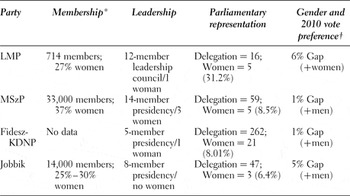
The low priority afforded to gender in 2010 was abetted by the attributes of the party leaders empowered to select candidates. Table 4 compares the four parliamentary parties in terms of gender composition of the leadership, membership, party group, and electorate. Jobbik clearly fulfills its role as a TAN party, with no women in the party leadership and sharp female underrepresentation among members, voters, and MPs. But none of the parties comes across as especially woman friendly. The MSzP (the largest and oldest party on the Left) had only three women in the top leadership and sent only five women to parliament. Ideological opposites, Fidesz and LMP, each had only one woman in the top leadership. Cheng and Tavits (Reference Cheng and Tavits2011) argue that the absence of women in leadership has a negative impact on the selection of women.
Gender composition of party membership, leadership, parliamentary delegation, and electorate

* Official estimates (2011) provided by LMP (Orsolya Kovács, Assistant to MP Gergely Karácsonyi); Jobbik (József Dúró); and MSzP (András Bíró-Nagy). We were unable to get official estimates from Fidesz or KDNP. Based on the anecdotal testimony of two women working in Fidesz regional offices, the percentage of women in the party membership might be as high as 50%, as women are heavily involved in the day-to-day work in party regional headquarters and other offices. We could not confirm this.
† TÁRKI pre-election survey (April 2010), N = 1,000. The question asked, “If you were to cast your vote tomorrow for the national legislative election, which party would you prefer?” The gap refers to the difference between the proportion of men and the women who said they would vote for a given party. Direction of the gap provided in parentheses (+men or +women).
This comes as dispiriting news given the importance of strong female leaders for seeing through legislation on gender equity. The repeated failure of efforts to achieve gender quotas in Hungary illustrates the point.Footnote 10 Some of these efforts have enjoyed support among the public and across civic gender organizations. The ultimate failure of each attempt owes to the combined effects of a political elite that opposed gender-based quotas, insufficiently organized pressure from the public and civil society organizations, and an absence of strong female leaders interested in promoting quota legislation and ushering it through to a positive vote (Papp 2008; Várnagy 2013).
Lack of Transparency and Weak Women's Groups
Across the parties in 2010, women were placed at a disadvantage by the lack of transparency in recruitment processes and the prevalence of informal negotiations and murky internal financial practices (Várnagy 2013; Várnagy and Ilonszki Reference Várnagy and Ilonszki2012). Often women were not present when the “boy's clubs” met, and women's sections within the parties lacked clout. As an MSzP respondent to the activist survey explained, “We have an active women's section, but it doesn't have influence. It basically works on traditional social fields, like social support, children's affairs…women are on loose footing in the leadership.” Much has been written about the weakness of women's organizations in Hungary and their tendency to avoid organizing around political issues (Fábián Reference Fábián2007). This remained true in 2010. The male-dominated parties faced little pressure—from within or without—to nominate women and place them in winnable positions.
Successful Candidate Attributes
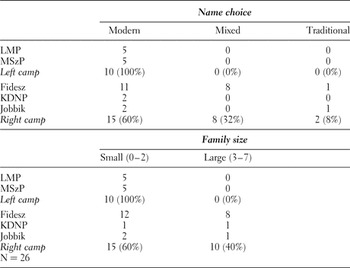
The parties did recruit some women, however. Who were those women? How likely were they to press for proequality legislation and parliamentary changes to improve the climate for women MPs? Table 5 provides data on the name choice and family size of married female MPs broken down by party affiliation.Footnote 11 As we might expect, only Fidesz-KDNP and Jobbik women use the most traditional married form (husband's full name plus -né) and report large family sizes (three to seven children). All of the married leftist party women use the most modern form of address and report family sizes ranging from zero to two children.
Name choice and family size of married female MP by party, 2010

Note: Kendall's tau-b measure of association for name choice and ideological camp is .330 (sig. .01); for family size and ideological camp, it is .400 (sig. .001).
Source: Országgyűlési képviselők 2010: képviselői almanach (Állami Nyomda Nyrt: Budapest, 2010).
As we have seen, conservative women voters agree with the valorization of motherhood and the protection of traditional family values and forms that their parties espouse. Women with children also have something to offer to the TAN parties by projecting a family values image and embodying the common right-wing argument that there are no longer systemic barriers to women's participation. A woman MP with six children must prove it is possible to have a family and make a career in a male sphere!
Some women were selected for their personal connections to male party leaders. The three women recruited by Jobbik, for example, possessed highly particular résumés: one was married to a party notable also elected as an MP, another was married to a Reform minister associated with the party, and the third epitomized the Jobbik ideal for a female candidate (a blonde, Christian mother of three with an education in finance, work experience in a family-owned business, and early organizational work for the party in her home region).Footnote 12
In 2010, of the 35 women who made it into parliament, the majority (25) came from right/TAN parties that have rejected positive action to recruit more women. Some of those women were tokens. Some were recruited for their local bona fides or for the image of conservative womanhood they projected. None was interested in pressing a pro-equality legislative agenda. As a female KDNP respondent to the activist survey explained, “There are two women in our parliamentary group…we do not support a gender quota in Parliament, because that is the real discrimination. Conservative women would like to hold onto their family, give birth to children and raise them.”
As a final argument for a focus on the parties as barriers to women's descriptive representation, we may look to the fact that Hungarian women are making gains in local politics. The proportion of female mayors nearly doubled between 1990 and 2010, but those women were mostly in small settlements where they could run as independents. As soon as we move up the territorial hierarchy, where the stakes are higher and parties play the key gatekeeper role, women and independents largely disappear (Várnagy 2013; Várnagy and Ilonszki Reference Várnagy and Ilonszki2012).
Electoral Institutions: A Narrow Path
Scholars have never placed sole blame for women's underrepresentation in Hungary on the electoral rules, but prior research does indicate the dampening effect of majoritarian elements of the hybrid PR system on selection of female candidates (Chiva 2005; Ilonszki and Montgomery Reference Ilonszki and Montgomery2002; Montgomery and Ilonszki Reference Montgomery, Ilonszki, Matland and Montgomery2003; Moser 2001). Lacking an effective gender quota, the main features of the opportunity structure from 1990 to 2010 were set by the electoral rules, which provided three tiers of access: 176 seats in the 386-seat unicameral National Assembly allocated through two-round simple majority elections in SMDs; a maximum of 152 seats allotted through a proportional distribution of votes on closed party lists in the 19 historical counties and the capital; and all remaining seats distributed on the basis of “scrap votes” (votes that were insufficient to secure a regional list seat or SMD) in compensatory nationwide party lists.
As we hypothesized, the majoritarian SMD portion of the system reduces the opportunities for party gatekeepers to balance their tickets with women. The party-list components of the system ought to be more woman friendly, but much depends on the district magnitude (number of seats allocated) and party magnitude (size of party delegation in a given constituency) (Matland and Montgomery Reference Matland, Montgomery, Matland and Montgomery2003; Norris 1997). Under the 1990–2010 electoral law, district magnitudes for the territorial lists ranged from 3 (in the smallest counties) to a minimum of 58 on the national lists. In the small-magnitude constituencies where multiple parties were competitive, the effective party magnitude might have been no better than one—a top slot that would be reserved for a party leader, most likely a man. Compensatory national lists should have been friendlier to women, but various features made it difficult for gatekeepers to predict which positions might represent mandate-winning slots (Ilonszki and Montgomery Reference Ilonszki and Montgomery2002; Montgomery and Ilonszki Reference Montgomery, Ilonszki, Matland and Montgomery2003).
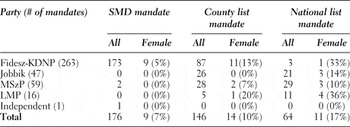
Data presented in Table 6 confirm that in 2010, the proportion of women recruited through the two PR tiers was more than twice the number of women recruited through SMDs. This supports H 3 (institutional path) but also H 2 (party-political path). Institutions shape the opportunities and incentives for parties to recruit women. Parties will only use those opportunities to balance the ticket with women if they have an ideological commitment to gender equality and/or face pressure from within or outside the party—if they see recruiting women as a winning strategy. In 2010, Fidesz won 98% of all the SMD mandates but used that landslide to recruit just nine women.
Distribution of 2010 parliamentary mandates by tier, party, and sex

Note: Kendall's tau-b measure of association of gender (male = 0, female = 1) with electoral tier is .117 and significant at the .01 level.
Source: Országgyűlési képviselők 2010: képviselői almanach (Állami Nyomda Nyrt: Budapest, 2010); and Inter-Parliamentary Union parline database, http://www.ipu.org/parline-e/reports/2141_E.htm (accessed March 7, 2012).
There has always been a large gap between the resources of male and female candidates in Fidesz, with women only having an advantage in one area: local background.Footnote 13 In 2010, Fidesz gatekeepers only ran women in the district contests if they had local connections. These were not strong party leaders whom the gatekeepers sought to ensure a seat in parliament. These were women who had the one resource the party could use to strategic electoral advantage. The party's lack of commitment to gender equality is even more clear in the PR components of the system. Fidesz won 87 seats through the regional lists and recruited only 11 women. The few national lists slots Fidesz received were treated as “gravy” for top party leaders, including Orbán.
The two new entrants to parliament failed to win any of the SMD contests, but ideological differences shaped how they approached opportunities provided through the party list tiers. Jobbik received 26 seats through the county lists, and all those seats went to men. The three women the party recruited all came through the national list and had strong connections to male party leaders. By contrast, the LMP used a voluntary 30% gender quota and brought in one woman from the county pathway and four from its national list, bringing the party's total to five women out of a 16-member delegation. Ultimately, neither party was large enough to substantially alter the gender balance in parliament—if it wanted to (LMP) or not (Jobbik).
With the second-highest seat share, the MSzP might have been able to improve women's descriptive representation. The party had adopted a voluntary quota in 2002, stipulating that women must make up at least one in every five nominees on the lists. But when it came time to formulate lists for the 2010 election, the MSzP placed only six women in the first 75 slots on its high-magnitude national list. Most women were placed from the 90th position on down (Csipke Reference Csipke2009). Neither major party has a strong record of placing women in mandate-winning positions (the top slot on each of the 20 territorial lists), but in 2010, only one female candidate was able to win from an MSzP territorial list (from the first position); 20 MSzP men came in through either the first or second position (Ilonszki Reference Ilonszki2014).
Multiple ridings improve a candidate's likelihood of entering parliament and reflect the level of party commitment to a candidacy. Across the 2002, 2006, and 2010 elections, Fidesz and MSzP placed men in multiple tiers, on average, 37% of the time compared to women's 16% (Ilonszki Reference Ilonszki2014). In the past, the MSzP had several strong female politicians who were able to run and win, even in SMDs. But in 2010, the pundits were predicting a landslide Fidesz victory, and Jobbik was making political hay from the Socialists’ demise. In the context of uncertainty, the MSzP's mostly male leadership sought to preserve itself through the PR party-list components of the electoral system, and women were pushed to the sidelines (Ilonszki Reference Ilonszki and Tremblay2012, 219).
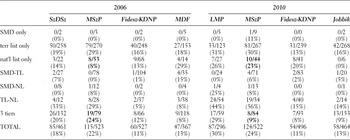
Table 7 compares the gendered distribution of candidates across parties and ridings in the 2006 and 2010 elections. The MSzP's proportion of female candidates remained about the same in 2010, but its strategy toward female candidates changed in at least two deleterious ways. First, women's proportion of the “national list only” category jumped substantially in 2010. This is the least predictable tier and only would have helped women if they had been placed in mandate-winning and competitive slots. They were not. The second change is in the most desirable form of multiple riding, running simultaneously in all three tiers. Women's proportion of that category dropped sharply in 2010.
Number and proportion of female candidates by party and riding, 2006 and 2010

Note: Top figures in each cell represent the number of women candidates/the total number of candidates put forth in the riding. The bottom figure in each cell represents the proportion (%) of women candidates.
The LMP was the most woman-friendly party in 2010; before that, it was the liberal SzDSz. But the MSzP has always been the party with the greatest potential to initiate increases in female representation. The MSzP's unwillingness to use the opportunities it had to balance its ticket and promote women in 2010 was particularly detrimental because cross-national research finds that a strong pro-equality left party can overcome the disadvantages of a majoritarian electoral system (Krook 2010b).
CONCLUSIONS
Pathway case analysis of female recruitment outcomes in 2010 leads us to deemphasize the cultural-developmental pathway (H 1 ) and stand with demand-side accounts that emphasize parties as key barriers to women's representation (H 2 ). Deep politics may shape the gender stereotypes of party gatekeepers in ways that lead to discrimination at the nomination stage. But it is ultimately party elites who have chosen to resist quotas and opening up leadership circles to women and party leaders who have refused to build women's capacity as candidates or reform parliamentary practices to make legislative politics more inviting to women.
In 2010, the electoral rules were the same as they had been since the founding election of 1990. Those rules limited opportunities for ticket balancing in the SMDs and low-magnitude territorial lists (H 3 ). As in the past, the dominant conservative party, Fidesz, had “ideological and structural reasons to resist placing women in competitive slots” (Montgomery and Ilonszki Reference Montgomery, Ilonszki, Matland and Montgomery2003, 126). The right-wing insurgent, Jobbik, was even worse; the only party that emphasized gender equality in its candidate decisions, the LMP, was too small and too new to make much difference. The left party that might have done the most to promote women in 2010 was the MSzP, but, faced with electoral crisis, the party leadership circled the wagons and emphasized preservation of entrenched male interests over gender equality.
Earlier work on transitional settings (e.g., Franceschet 2005) suggests that early male domination of party leaderships and the nature of post-transition party-political competition can lock in disadvantages for women. Our research confirms that in the Hungarian case, but the literature also suggests that contextual circumstances can lead to unexpected openings for women to enter elected politics in larger numbers (Franceschet 2005; Krook 2010a). Hungary has had several such opportunities and missed each one: democratic transition, European ascension, and, most recently, party system transformation.
We argue that Hungary has missed opportunities that other ECE countries have exploited because of early freezing of a bipolar party system in which voters had two main choices: conservative-nationalist parties that view women primarily as mothers and a Socialist Party carried over from the previous regime that sees the “woman problem” as either resolved or of tertiary importance when stacked against economic and political crises. Neither of these two main party alternatives faced real pressure to emphasize gender parity in their recruitment strategies, and so they did not.
Finally, then, our pathway case analysis highlights the complex ways that factors associated with each path interact and combine. This follows a growing trend in the literature to emphasize causal complexity (Krook 2010a, 2010b; Krook and Norris Reference Krook and Norris2014). Further, it suggests that any diagnoses or interventions for Hungary, or any other low representation case, must be sensitive to the combination of conditions that have produced women's exclusion.