INTRODUCTION
Gray whales (Eschrichtius robustus) (Lilljeborg 1861) were once found in the coastal waters of both the North Pacific and the North Atlantic. However, while historical sources indicate that gray whales were recorded on both sides of the North Atlantic until 1700, the North Atlantic population(s) seems to have been eradicated a few decades later (Lindquist, Reference Lindquist2000). The southernmost specimen of gray whale in the eastern North Atlantic was found on the southern coast of England (Mead & Mitchell, Reference Mead, Mitchell, Jones, Swartz and Leatherwood1984), while the southernmost western record is from Florida, USA (27°04.6′N 080°07.7′W) (Odell, Reference Odell1983). While the latter record implies that a part of the North Atlantic population may have bred and calved in the lagoons of the central and south-eastern Florida coasts, the breeding and migratory habits of the gray whales that once inhabited the North Atlantic are not known.
In the North Pacific, two populations currently exist. These are a large (18,000) eastern North Pacific stock and a small (125), remnant western North Pacific stock (Swartz et al., Reference Swartz, Taylor and Rugh2006). Both populations migrate northward through coastal waters in spring and summer to high latitude feeding grounds. The eastern population summers in feeding grounds in the northern Bering and southern Chukchi Seas (Moore et al., Reference Moore, Grebmeier and Davies2002), yet some whales of this population have been reported to reach longitude 174°E off the northern Chukotka coast, Russia (Berzin, Reference Berzin, Jones, Swartz and Leatherwood1984) and east to longitude 130°W in the Beaufort Sea, Canada (Rugh & Fraker, Reference Rugh and Fraker1981). In autumn, this population migrates south along the eastern Pacific coast primarily to the west coast of Peninsula de Baja California, but also into the Gulf of California (Mead & Mitchell, Reference Mead, Mitchell, Jones, Swartz and Leatherwood1984). The western population summers on feeding grounds primarily on the shallow-water shelf of north-eastern Sakhalin Island, Sea of Okhotsk (Weller et al., Reference Weller, Burdin, Würsig, Taylor and Brownell2002), but also off the south-eastern coast of the Kamchatka Peninsula (Vertyankin et al., Reference Vertyankin, Vladimirov, Tyurneva, Yakovlev, Andreev and Burkanov2007). The wintering grounds of the western population are currently unknown, but may be in Asian coastal waters at latitudes as low as 20°N (Zhu, Reference Zhu2002).
The gray whale is the only baleen whale known to regularly consume benthic resources (Mead & Mitchell, Reference Mead, Mitchell, Jones, Swartz and Leatherwood1984). They bottom-feed by using suction to take in food, water, and sediment, then expelling the water and sediment, while trapping the prey on the inside of their coarse baleen plates. However, gray whales are flexible foragers and respond to a variety of feeding opportunities throughout their coastal range (Moore et al., Reference Moore, Wynne, Kinney and Grebmeier2007). For example, while most gray whales forage primarily upon the shallow benthic communities of the northern seas (Nerini, Reference Nerini, Jones, Swartz and Leatherwood1984), whales spending the summer in lower latitudes (e.g. off Vancouver Island, Canada) can rely heavily on planktonic prey (Dunham & Duffus, Reference Dunham and Duffus2001).
In this paper, we report on a record of an individual gray whale from two locations in the Mediterranean Sea in May 2010. Three possibilities are suggested for the population of origin of this whale:
(1) it represents a vagrant individual from the larger extant population of gray whales found in the eastern North Pacific;
(2) it represents a vagrant individual from the smaller extant population found in the western North Pacific; or
(3) it represents a surviving individual from an extant (rather than extinct) North Atlantic population.
Of the three, the first was deemed to be the most plausible, and a route analysis was done to suggest how the whale travelled to the Mediterranean and to account for its movements therein. The implications of this record for both our understanding of gray whale behaviour and the potential impacts of climate change on marine ecosystems in the North Atlantic and the North Pacific are also considered.
MATERIALS AND METHODS
Sighting records from the Mediterranean Sea
Sightings of a gray whale were recorded first off Israel and later Spain during routine cetacean surveys conducted in May 2010 in the Mediterranean Sea. During each sighting, information was gathered on the size of the individual, its body condition, behaviour such as speed and direction of travel, and photographs were taken to confirm species and individual identification, as gray whales are characterized by unique pigmentation patterns (Darling, Reference Darling, Jones, Swartz and Leatherwood1984).
Investigating potential routes from the North Pacific to the North Atlantic and within the Mediterranean
In order to assess how a gray whale could have reached the Mediterranean, a geographical information system (GIS) was created in Arcview 9.3. Information entered into this database included water depth (ETOP02, 2006), land forms and the minimum Arctic ice extent in September 2009 (from the National Snow and Ice Data Center, http://nsidc.org/data/seaice_index/), as it was assumed the odyssey began at this time. This information was then used to estimate the position and length of a number of likely migration routes from a starting point in the Bering Sea to Israel, and within the Mediterranean, for two separate scenarios. The lengths of time taken to traverse these possible routes were assessed using typical gray whale migration swimming speeds recorded in the eastern North Pacific (Mate & Harvey, Reference Mate, Harvey, Jones, Swartz and Leatherwood1984).
Individual identification attempts
Several eastern and western gray whale biologists were contacted and asked to review their photographic catalogues of individual gray whales in an attempt to find a match to the gray whale sighted in the Mediterranean Sea. Western population: the Russia–US western gray whale research program catalogue, 1994–2009 (181 individuals), and in two catalogues of the A.V. Zhirmunsky Institute of Marine Biology, Russian Academy of Sciences (Vladivostok, Russia): (1) The Western Pacific Gray Whales of Sakhalin Island, 2002–2009 (177 individuals); and (2) The Pacific Gray Whales of Kamchatka Peninsula, 2004 & 2006–2009 (116 individuals). Eastern population: Cascadia Research Collective's catalogue of ‘seasonal resident’ gray whales that feed in the summer and autumn off California, Oregon, Washington and British Columbia (approximately 1000 individuals); the catalogue of Cape Caution in northern British Columbia (approximately 100 individuals); the catalogue of Vancouver Island (approximately 200 individuals); and the catalogue of Laguna San Ignacio Ecosystem Science Program (LSIESP) and Programa de Investigacion de Mamiferos Marinos (PRIMMA–UABCS) representing the Mexican breeding lagoons (approximately 6500 individuals).
RESULTS
Description of the sightings
Israel: a ~13 m long gray whale (estimated visually relative to the length of a boat) was spotted on 8 May 2010 2 km off Herzliya Marina (32°11.5′N 034°47.4′E) at 9:00 hours and followed for an hour and 10 minutes, southward along the coast. It maintained a distance of 2 km offshore, travelling at a constant speed of 5–7 km/h and performing a continuous series of short (3–5 minutes) dives occasionally displaying its flukes. A few reports of a whale near the shore had been received by the IMMRAC (Israel Marine Mammal Research and Assistance Center) stranding network two weeks before the documented sighting, suggesting that the whale was not simply transiting the area. Assessing the whale's body condition following the scale of Bradford et al. (Reference Bradford, Weller, Ivashchenko, Burdin and Brownell2008), scapular condition scored 1, post-cranial condition scored 1 and lateral flank condition scored 1, for an overall inclusion in the ‘poor condition’ category; however, the whale did not appear to be in critical condition (i.e. near starvation) (J. Calambokidis, personal communication).
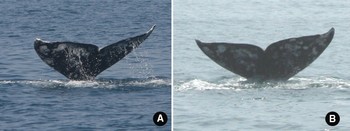
Spain: a gray whale was spotted by a sailing vessel at 16:30 hours on 30 May 2010 0.9 km away from the coast of Barcelona (41°21.32′N 002°12.2′E; north-east Spain). The whale was swimming in shallow waters of about 40 m deep, at an average speed of 7.2 km/h. The sighting lasted 20 minutes. During this period, the whale was diving constantly and displayed its flukes 4–5 times. The whale was moving southwards during the sighting period. Photographs of the tail fluke confirmed that this was the same individual previously sighted in Israel (Figure 1).
The pigmentation patterns of the flukes photographed in (A) Israel and (B) Spain, confirm that the two sightings are of the same individual. Photographs: (A) ©A. Scheinin/IMMRAC; (B) © R.Barahona/SUBMON.

Investigating potential routes from the North Pacific to the North Atlantic
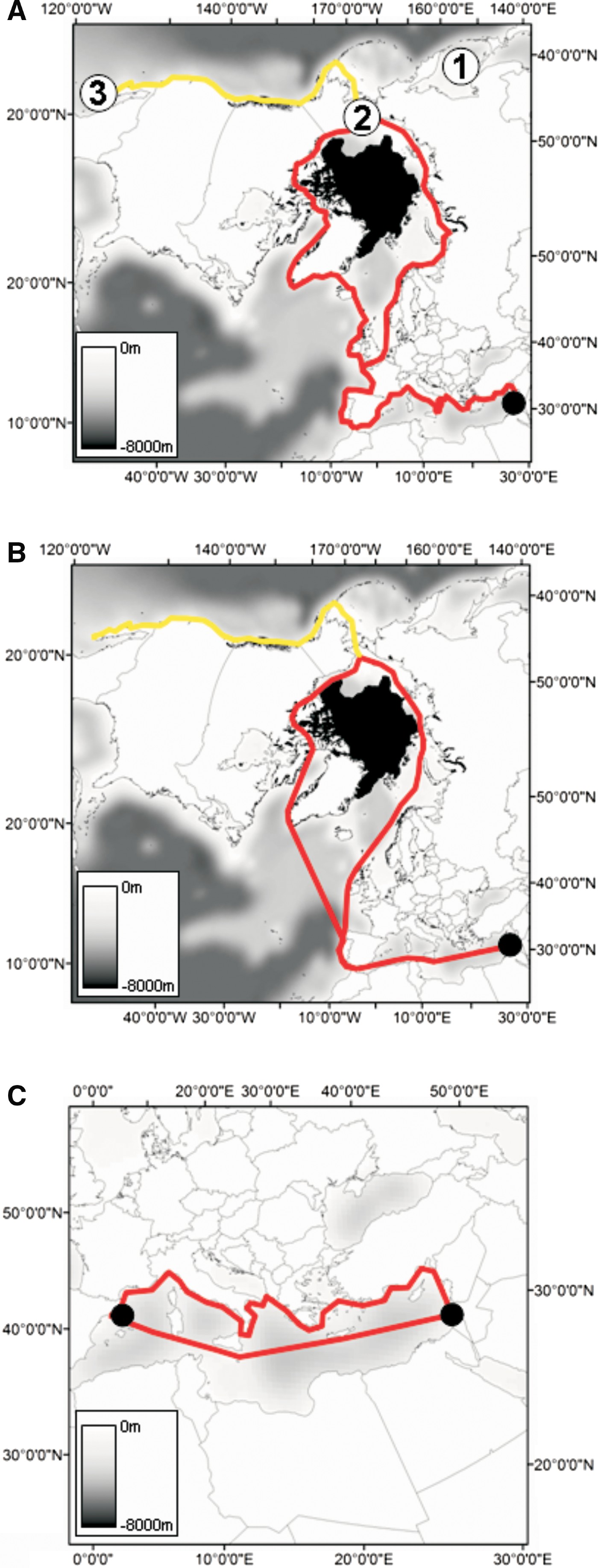
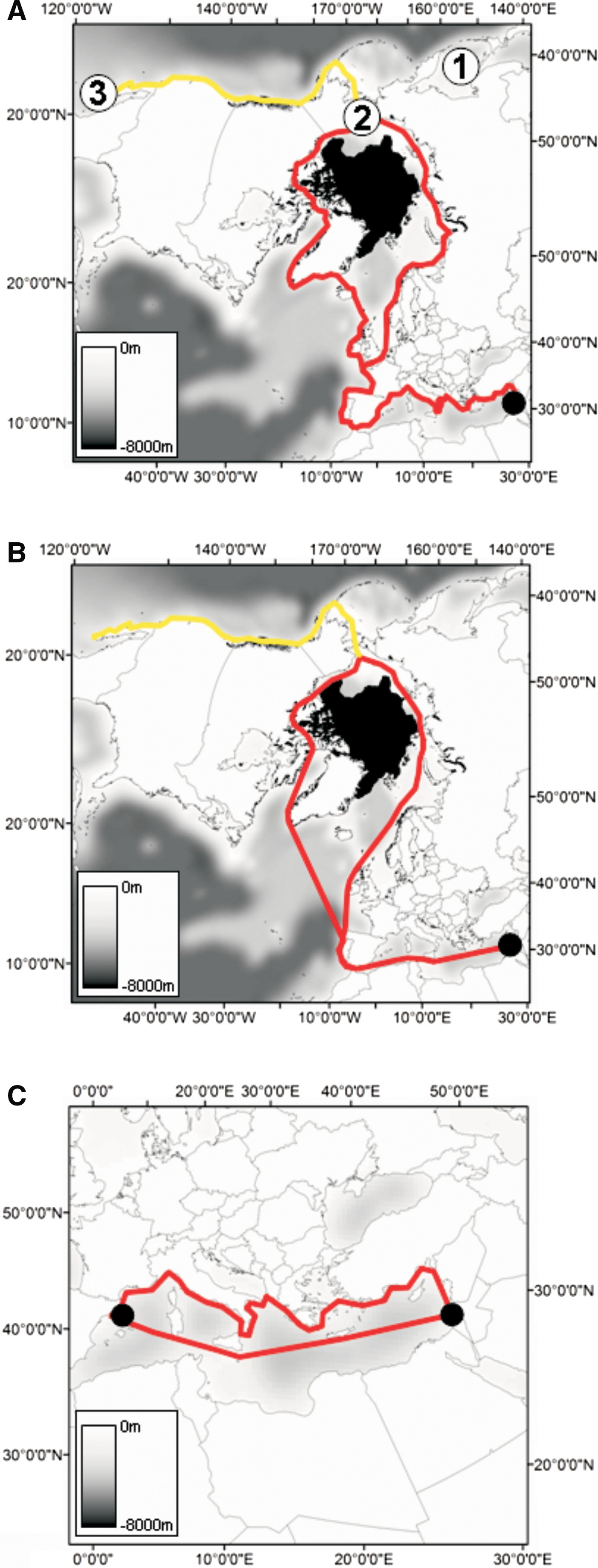
While we cannot entirely rule out the possibilities of a wintering east Pacific gray whale passing through the lock systems of the Panama Canal or around Cape Horn in order to reach the North Atlantic, nor that of a wintering west Pacific gray whale traversing the South Pacific, Indian Ocean and Red Sea to enter the Mediterranean through the Suez Canal, these highly unlikely possibilities were not considered. Consequently, we considered the two most likely routes of summer-feeding whales from the Bering Sea to the North Atlantic and from there to the Mediterranean: one along the northern coast of Eurasia and the other along the northern coast of North America. Passage along either route would require that it is not blocked by sea ice. In summer 2009, of these two possible routes, the one across the northern coast of Eurasia was the most open and ice free (Figure 2), potentially making it more likely. In addition, if gray whale movements during migration are restricted to shallow shelf waters, with minimal deep-water crossings, the route via the Northwest Passage has a number of large barriers in the form of the Faroe–Iceland Rise and the Faroe–Shetland channels, while the Eurasian route does not require any deep-water crossings. On average, an eastern gray whale migrating south travels 127 km per day or 5.3 km/h (Mate & Harvey, Reference Mate, Harvey, Jones, Swartz and Leatherwood1984). At this speed, these two coastal routes would take a whale more than 100 days to travel between the Bering Strait and Israel. In contrast, if substantial deep-water crossings are not a barrier to migration, both routes shorten to around 85 days.
(A) Possible routes from the typical summering ground of eastern gray whales in the Bering Sea if the whale remained in shelf waters as much as possible and restricted travel over deep water to a minimum; (B) possible routes allowing for extensive crossing of deep-water areas to minimize the distance travelled; (C) comparison of coastal versus shortest route between the sighting in Israel and the sighting near Barcelona 22 days later. Yellow lines: usual migration route for eastern Pacific gray whales; red lines: possible routes to reach the Mediterranean and to move between sighting locations; black circles: sightings locations in the Mediterranean; (1) summer feeding area for western Pacific population; (2) summer feeding area for eastern Pacific population; (3) winter breeding area for eastern Pacific population. Background shading represents depth. The solid black is the ice extent in September 2009.
Investigating routes of movements within the Mediterranean
We considered two possible routes between the locations in Israel and Spain where this gray whale was recorded. One is a direct route over deep water, while the other is a coastal route passing only through shallow shelf waters. The former route is around 3000 km in length, while the latter is almost twice as long (Figure 2). As a result, while it would take an average swim speed of around 5.7 km/h to complete the direct route within 22 days, it would take an average swim speed of around 11 km/h to complete the coastal route. This is twice the typical migration speed for gray whales, making this route unlikely. As a result, the length of time between these two sightings suggests that this gray whale made substantial deep-water crossings during its movements.
Individual identification
The attempts to find a photographic match of the Mediterranean individual to catalogued eastern and western gray whales were unsuccessful. This might partly be due to the fact that we have good quality images of the fluke and of the left dorsal ridge while many photo-identification catalogues are based on the right dorsal ridge and reflect surveys in shallow water areas where individuals do not regularly show their flukes.
DISCUSSION
Of the three considered points of origin, it is least likely that the gray whale observed in the Mediterranean is a remnant of a previously thought extinct North Atlantic population. In particular, given the extensive whaling and cetacean research conducted in the North Atlantic in the last 100 years, it seems unlikely that a population of shelf-foraging, large baleen whales could have survived almost 300 years without being detected.
Of the two possible North Pacific origins, the most likely origin is that of the eastern North Pacific. This population is much larger than the western Pacific population and eastern gray whale summering grounds penetrate higher into the Arctic waters to both the east and the west of the Bering Strait (Figure 2). As a result, vagrant individuals which moved further east or west than usual during the summer feeding period could end up in the North Atlantic. In contrast, the known summering grounds of the western population are at lower latitudes in the Okhotsk Sea and the eastern side of the Kamchatka Peninsula (Figure 2). This hypothesis is supported by the results of the photo-identification catalogue comparison. Given the high photographic coverage of the small western gray whale population and the more limited coverage of the larger eastern population, the fact that a match was not made suggests that the Mediterranean vagrant was not a western gray whale.
For a gray whale from the eastern population to migrate to the Mediterranean, it requires that there is an ample ice-free passage between the North Pacific and the North Atlantic, either across the top of Eurasia or North America. Therefore, the occurrence of a gray whale within the Mediterranean suggests that ice barriers to the movements of species between these two oceans have weakened to the point where passage between them is possible (MacLeod, Reference MacLeod2010). While it is not yet clear whether such passage will become a regular event as sea ice continues to decline in response to climate change, this event suggests that such exchanges are becoming more feasible.
Thus, as this species and others (such as fin, humpback, and minke whales and harp, hooded, ribbon, and spotted seals) are already predisposed to disperse and become established further northward if the current overall trend toward a warmer Arctic climate continues (Moore & Huntington, Reference Moore and Huntington2008), the Arctic could soon become a dispersion corridor between ocean ecosystems. Therefore, the presence of a gray whale in the Mediterranean Sea concurrently with an ice-free summer Arctic passage could potentially be considered the first manifestation of such biome mixing between the North Pacific and the North Atlantic due to global climate change.
The occurrence of new species in non-native regions is thought to negatively impact marine ecosystems in many parts of the world (Ruiz et al., Reference Ruiz, Carlton, Grosholz and Hines1997; Hayes & Sliwa, Reference Hayes and Sliwa2003) and the spread of such species may be facilitated by changes in climate (Stachowicz et al., Reference Stachowicz, Terwin, Whitlatch and Osman2002). Specifically, the breakdown of barriers between previously isolated oceans as a result of climate change, such as that which allowed a gray whale to move into the Atlantic, could result in species moving between ocean basins with implications for the well-being of native marine ecosystems (Stachowicz et al., Reference Stachowicz, Terwin, Whitlatch and Osman2002). The record of this gray whale suggests that this species could potentially provide an easy-to-detect indicator of such potential exchange between the North Pacific and the North Atlantic as the Arctic ice-cap continues to shrink in response to climate change. In particular, since gray whales are a seasonally migrant species for which sea ice can act as a barrier, climate change impacts on sea ice might result in noticeable effects in their migratory behaviour, which is a conspicuous sign of ecosystem change (Laidre et al., Reference Laidre, Stirling, Lowry, Wiig, Heide-Jørgensen and Ferguson2008). As such, gray whales are already considered ideal sentinels of the effects of climate change on Arctic ecosystems (Moore & Huntington, Reference Moore and Huntington2008) and this capacity could be extended to include their use as an indicator of the ease of movement of marine mammal and other species between the Pacific and Atlantic Oceans through the currently warming Arctic corridor.
The presence of this whale within the Mediterranean also provides us with novel information about gray whales. In particular, in order to make the passage between Israel and Spain in 22 days, it is likely that this individual whale made substantial directional movements over deep-water areas where it could not forage benthically. We fully acknowledge the fact that this whale was in extraordinary circumstances, likely unfamiliar with its surroundings, such that its behaviour cannot be presumed as normal. Yet, its performance suggests that gray whales, when faced with such circumstances, can utilize and potentially forage in deep water. These observations support the concept of gray whales as the most adaptable and versatile of the mysticete species (Moore & Huntington, Reference Moore and Huntington2008).
Finally, the arrival of this individual to the Mediterranean also suggests that gray whales may be capable of much longer movements than are exercised during their routine migrations. If we take the breeding grounds of the eastern population as a starting point and Israel as being the south-eastern extent of this individual's migration route, the whale covered a minimum distance of between ~22,000 km and ~23,500 km, depending on the exact starting point in the eastern Pacific wintering grounds. Stevick et al. (Reference Stevick, Neves, Johansen, Engel, Allen, Milton, Marcondes and Carlson2010) report on a humpback whale that travelled more than 9800 km from breeding areas in Brazil to those in Madagascar, setting a record for the largest geographical displacement ever documented in a mammal. Our results suggest that the Mediterranean gray whale travelled more than twice that distance, resulting in what is by far the most extreme vagrancy known to have been exercised by a mammal.
ACKNOWLEDGEMENTS
The authors wish to thank Sea-Gal Sailing Club, Herzliya, and IMMRAC volunteers. Thanks are also due to Rodrigo Barahona and to the crew of ONAS sailboat for documenting the sighting off Barcelona. Special thanks are due to Phillip J. Clapham for valuable comments on the manuscript. We are grateful to all the catalogue-searching colleagues: Amanda Bradford, John Calambokidis, Dave Duffus, Alejandro Gómez-Gallardo U., Sergio Martinez, William Megill, Jorge Urbán-Ramirez, Steve Swartz, Olga Yu. Tyurneva, Yuri M. Yakovlev and Dave Weller and to two anonymous referees whose comments greatly helped to improve the manuscript.