Lecanora orosthea (Ach.) Ach. is a sorediate, saxicolous species with a yellow-green, continuous, areolate thallus. Soralia form at the margins of the areoles and can fuse and cover the whole thallus surface. Usnic acid is the main secondary lichen metabolite, but zeorin and skyrin can also be commonly produced (Barreno & Peréz-Ortega Reference Barreno Rodríquez and Pérez-Ortega2003; Edwards et al. Reference Edwards, Aptroot, Hawksworth, James, Smith, Aptroot, Coppins, Flechter, Gilbert, James and Wolseley2009). According to Edwards et al. (Reference Edwards, Aptroot, Hawksworth, James, Smith, Aptroot, Coppins, Flechter, Gilbert, James and Wolseley2009), L. orosthea is a member of the L. polytropa group, but despite its usually saxicolous habit, it is phylogenetically related to L. symmicta (Ach.) Ach. (Arup & Grube Reference Arup and Grube1998; Pérez-Ortega et al. Reference Pérez-Ortega, Spribille, Palice, Elix and Printzen2010). The species is widely distributed but uncommon, and so far known only from the Northern Hemisphere, mainly Europe, but rarely also reported from Africa, Asia and North America (e.g., Egea et al. Reference Egea, Torrente and Rowe1990; Hafellner Reference Hafellner1995; Egea Reference Egea1996; Fryday & Coppins Reference Fryday and Coppins1997; Aptroot & Seaward Reference Aptroot and Seaward1999; Hafellner & Türk Reference Hafellner and Türk2001; John & Breuss Reference John and Breuss2004; Santesson et al. Reference Santesson, Moberg, Nordin, Tønsberg and Vitikainen2004; Edwards et al. Reference Edwards, Aptroot, Hawksworth, James, Smith, Aptroot, Coppins, Flechter, Gilbert, James and Wolseley2009).
During our ongoing study of sorediate crustose lichens occurring in Poland (e.g., Kukwa & Kubiak Reference Kukwa and Kubiak2007; Kukwa Reference Kukwa2008, Reference Kukwa2012; Kukwa et al. Reference Kukwa, Łubek, Szymczyk and Zalewska2012; Zduńczyk & Kukwa Reference Zduńczyk and Kukwa2012), we found a few sterile specimens that we suspected represented Lecanora orosthea, but the identity of those samples was not certain without a comparison with authentic collections. We therefore decided to compare them with the type material and, for this purpose, we searched for the original samples of Lichen orostheus Ach., the basionym of the name (Acharius Reference Acharius1799), among the Acharius collections. As a result, we found that the name requires lectotypification, which is presented in this paper.
The type material from BM-ACH and H-ACH was studied, together with additional specimens from BM, KRA, UGDA and WRSL. The anatomy of the apothecia, including all measurements, was studied under a light microscope in preparations mounted in water. The solubility of granules was tested with 25% KOH (K) and 65% nitric acid (N) carried out on separate sections. Thin-layer chromatography (TLC) was performed in solvent systems A and C to detect lichen substances according to the method of Orange et al. (Reference Orange, James and White2001). The description presented below is based only on type specimens studied.
Lecanora orosthea (Ach.) Ach.
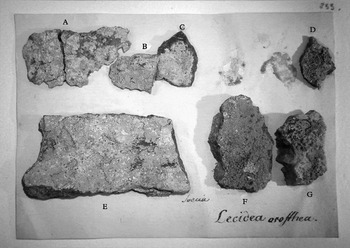
Lichenogr. Univer.: 400 (1810).—Lichen orostheus Ach., Lichenogr. Suec. Prodr.: 38 (1799) [1798].—Lecidea orosthea (Ach.) Ach., Method. Lich.: 72 (1803); type: Suecia (H-ACH 233E!—lectotype, designated here, Fig. 1; H-ACH 233A, B, C! Fig. 1, BM-ACH 498!, two upper specimens—isolectotypes).
Type material of Lecanora orosthea in H-ACH. A, B & C, isolectotypes; E, lectotype; D, F & G, esorediate Lecanora thalli. Denotation of specimens following the rules used for the collection in H-ACH.

Thallus brownish due to the age of material, crustose, continuous, areolate, sorediate, usually with bluish white to blue, sometimes fibrillose, prothallus. Soralia paler than the thallus, developing at the edge of areoles and in cracks between areoles, sometimes a few soralia from neighbouring areoles form one larger soralium covering the upper part of the areoles.
Apothecia up to 0·6 mm diam., flat or becoming convex, with heavily or slightly pruinose, grey to brown discs. Margin biatorine, present in young apothecia, but later excluded, rather hyaline, devoid of algae, composed of radiating, branched and anastomosing, up to 2 μm wide hyphae, not forming any cortex-like structure in the outer part, with K soluble and N insoluble crystals. Hymenium hyaline, up to 50 μm high. Epihymenium with K soluble and N insoluble crystals on the top of paraphyses, grey in K. Paraphyses simple, up to 2 μm wide, rarely slightly widened at the apex, but never capitate. Asci 8-spored, Lecanora-type. Ascospores 0(–1) septate, 9–15×4–6 μm.
Chemistry of the type material
Usnic acid (+), zeorin (+), skyrin (+), unknown fatty acid (±) and trace of atranorin (±). The chemical composition is generally in agreement with that reported by Edwards et al. (Reference Edwards, Aptroot, Hawksworth, James, Smith, Aptroot, Coppins, Flechter, Gilbert, James and Wolseley2009); however, we also found fatty acids and atranorin in specimens from H-ACH.
Habitat
The type material is saxicolous like most of the other records, however the species sometimes grows also on wood or bark (e.g., Fink Reference Fink1935; Fryday & Coppins Reference Fryday and Coppins1997; Barreno & Peréz-Ortega Reference Barreno Rodríquez and Pérez-Ortega2003; Santesson et al. Reference Santesson, Moberg, Nordin, Tønsberg and Vitikainen2004; Edwards et al. Reference Edwards, Aptroot, Hawksworth, James, Smith, Aptroot, Coppins, Flechter, Gilbert, James and Wolseley2009).
Comments
The species was described by Acharius (Reference Acharius1799) as Lichen orostheus Ach., later transferred to Lecidea Ach. (Acharius Reference Acharius1803), and finally to Lecanora Ach. (Acharius Reference Acharius1810), where it is currently placed. The main part of the Acharius collection is stored at the University of Helsinki (Kärnefelt & Thell Reference Kärnefelt and Thell2007; Vondrák & Vitikainen Reference Vondrák and Vitikainen2008), where we found the herbarium sheet (H-ACH 233) annotated as Lecidea orosthea with seven rock fragments (one secondarily broken into two pieces) and the locality given as ‘Suecia’ (Fig. 1). Although the name presented on the sheet is not Lichen orostheus but Lecidea orosthea, we regard this as the type material, as it is probable that during his lifetime, Acharius renamed samples in the collection according to his latest concepts (see e.g., Vondrák & Vitikainen Reference Vondrák and Vitikainen2008).
Four of the rock pieces glued on the left-hand part of the sheet (H-ACH 233A, B, C & E) (Fig. 1) are covered with thalli, the characteristics of which perfectly agree with the present circumscription of Lecanora orosthea presented by Barreno & Peréz-Ortega (Reference Barreno Rodríquez and Pérez-Ortega2003) and Edwards et al. (Reference Edwards, Aptroot, Hawksworth, James, Smith, Aptroot, Coppins, Flechter, Gilbert, James and Wolseley2009). Three remaining rock fragments on the right-hand part bear fertile, esorediate Lecanora thalli, which we did not study further. As the material is heterogeneous and consists of more than one specimen, lectotypification appears necessary. The biggest fragment of rock in the lower left-hand corner (H-ACH 233E), with a well-developed, fertile thallus of L. orosthea, is designated here as the lectotype. Three remaining fragments with L. orosthea are almost identical to the lectotype in terms of the thallus morphology and rock substratum, and therefore can be regarded as isolectotypes as they most probably originate from the same locality.
We also examined a collection in BM-ACH, which was sent by Acharius to the Linnean Society of London in 1807 and which might represent duplicates of the collection currently stored in H-ACH (Galloway Reference Galloway1988; Vondrák & Vitikainen Reference Vondrák and Vitikainen2008). In BM-ACH we found sheet no. 498 annotated as “Lecanora orosthea Achar. Lichenogr. universal. (Lecidea orosthea. Meth. Lich.)” with 5 rock fragments. Two larger pieces on the upper part of the sheet agree morphologically with the thalli of Lecanora orosthea in the lectotype, and also the rock substratum looks the same. Therefore, it can be assumed they are duplicates of the collection stored in H-ACH and are also considered here as isolectotypes.
We are very grateful to the curators of BM, H, KRA, UGDA and WRSL for making the specimens available for study. We are also very grateful to Scott LaGreca (formerly London) and Leena Myllys (Helsinki) for their hospitality and help during the visits to BM and H, Leena Myllys additionally for the information on how to cite the type material in H-ACH, and Irwin M. Brodo (Ottawa) and an anonymous reviewer for helpful comments on the manuscript. This work was supported by the SYNTHESYS grant GB-TAF-1013 in 2005.