Implications
This study explored the factors believed by livestock transporters to impact on ease of sheep handling, offering an improved understanding of stockmen’s perceptions of sheep behaviour. In addition, a number of areas for further research and development were identified, including a need for improvement of facilities, particularly on farms.
Introduction
Animals which are difficult to handle require more labour and are more prone to injury (Gregory, Reference Gregory2008), affecting both profitability and welfare. This highlights the importance of understanding the factors impacting on ease of handling. In a quantitative survey of French cattle breeders, farmers believed the most important factors in ease of handling were regular contact with the handler and good facilities followed by genetic factors (Boivin et al., Reference Boivin, Marcantognini, Boulesteix, Godet, Brule and Veissier2007). However, no such study, either quantitative or qualitative, has investigated the factors that are perceived to affect ease of handling in sheep.
As the handling of livestock involves people, there is a social component, and it has been documented in sheep (Coleman et al., Reference Coleman, Rice and Hemsworth2012), cattle (Hemsworth et al., Reference Hemsworth, Coleman, Barnett, Borg and Dowling2002; Mounier et al., Reference Mounier, Colson, Roux, Dubroeucq, Boissy and Veissier2008; Coleman et al., Reference Coleman, Rice and Hemsworth2012) and pigs (Hemsworth et al., Reference Hemsworth, Barnett, Coleman and Hansen1989) that attitudes held by stockmen affect the behaviour of livestock. It is also understood that many other factors, including breed, age, sex and rearing conditions, may contribute to animal behaviour during handling, although traditionally these factors have been assessed in isolation under experimental conditions (Romeyer and Bouissou, Reference Romeyer and Bouissou1992; Viérin and Bouissou, Reference Viérin and Bouissou2003; Boissy et al., Reference Boissy, Bouix, Orgeur, Poindron, Bibé and Le Neindre2005). The use of traditional quantitative approaches to understand this social phenomenon was deemed unlikely to be adequate as there are no previous studies in this area, so a qualitative approach was used. Qualitative interviews aim to explore and describe a spectrum of attitudes and experiences within a field, rather than presenting a representative sample to quantify opinions (Patton, Reference Patton1990). It is not uncommon for qualitative research on any topic to involve small sample sizes, with as few as three participants (Kollinsky and Simonds, Reference Kollinsky and Simonds2012; Cleaver and Ballantyne, Reference Cleaver and Ballantyne2013; Paton et al., Reference Paton, Roberts, Bruce and Marsden2014). Through a qualitative approach, researchers are able to capture the social aspects of a phenomenon to improve understanding of how people perceive the relationships between variables (Patton, Reference Patton1990). The aim of this study was to gain a deeper understanding of the perceived importance of factors affecting ease of handling, and the interactions between these from the perspective of the livestock transporter. This work also aimed to identify potential areas for further research and development in the sheep transport industry.
Methods
Selection of participants
Interviews were conducted with livestock transporters (people who both drive the truck and handle sheep during loading and unloading) as this group observe and participate in sheep handling on a regular basis. The Livestock Transporters Association of South Australia was asked to identify livestock transporters who were willing to be interviewed. The transporters represented four geographical regions of South Australia: the far north and west coast (n=2), mid north (n=2), upper south east (n=1) and lower south east (n=1). All primary interviewees were male. Family members of the primary interviewee were present for two of the six interviews, and participated in one. While six seems a small number, new interviews were conducted until the point of saturation, when no new information or opinions were arising from the data (Glaser and Strauss, Reference Glaser and Strauss1967; Patton, Reference Patton1990). This occurred relatively quickly so it was deemed that six interviews were able to provide representative and rich information.
Qualitative semi-structured interviews
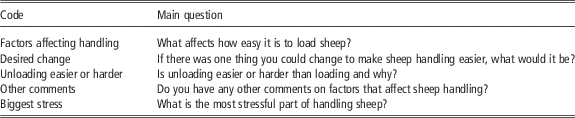
The interviews followed a semi-structured interview guide and lasted an average of one hour (range 18 to 95 min). Immediately before the interview, participants were given verbal and written summaries of the study and were asked to sign a consent form as approved by the University of Adelaide Human Research Ethics Committee. Interviews used the general opening question ‘Could you tell me about your business?’ and progressed through questions about the transporters experiences of handling sheep. Open-ended questions were used to investigate the perceived relative importance of factors including facilities, breed, previous handling, weather and farmer attitudes in the ease of handling of sheep. Triangulation was achieved by asking a variety of non-specific questions to allow livestock transporters to raise issues without prompting (Table 1).
Non-specific questions used to create unprompted discussion of factors affecting ease of sheep handling

Transcript analysis
All interviews were recorded, transcribed in full and coded using NVivo 10 qualitative data analysis software (QSR International Pty Ltd.). The process of analysis was iterative and cyclical; ideas developed during transcription and coding of early interviews informed subsequent interviews. A thematic analysis of the transcripts was conducted using a grounded theory approach, whereby codes were identified as they arose from the data, rather than using a pre-defined list (Glaser and Strauss, Reference Glaser and Strauss1967). An open coding technique was used, examining each transcript in detail to identify as many codes as possible. These were then categorised under a series of main themes. Cross-checking of coding by a second researcher was used to achieve analytical triangulation (Patton, Reference Patton1990).
Results
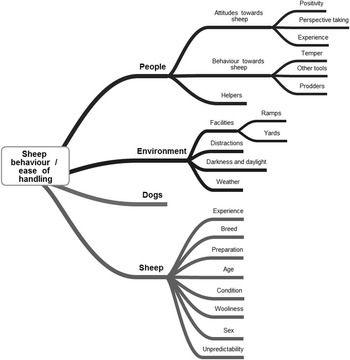
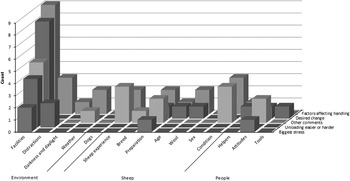
From the interviews, six transcripts totalling 58 933 words were coded under 19 codes, forming four main themes describing factors that affect ease of handling of sheep (Figure 1). Five additional codes grouped answers to questions that were not issue-specific, used by the interviewer to allow livestock transporters to raise issues without prompting (Table 1) and to achieve triangulation of sources by checking for consistency of what transporters said over time within the interview (Patton, Reference Patton1990). The following section describes the ideas and opinions of the livestock transporters captured within the themes identified, raised both when prompted and without prompting (Figure 2). Further detail of each of the themes, including quotes is contained in Supplementary Material S1.
The hierarchy of themes generated using a grounded theory approach to coding of livestock transporter interviews on factors affecting the ease of handling of sheep.

The frequency with which livestock transporters, without prompting, mentioned each effect on the ease of handling of sheep when asked a variety of non-specific questions (see Table 1 for explanation of questions).

The transporters interviewed had all been transporting livestock for at least 10 years, with two transporters having transported livestock for more than 30 years. Four of the six transporters got their stock handling experience from a family farm prior to taking up work as a transporter; the remaining two learned on the job. A lack of formal training available to the industry, either by employers or as part of a formal course, was described by the majority of interviewees. Some participants expressed a desire to see an accredited stock handling course developed for the livestock transport industry and for this to be part of a broader quality assurance programme. Regardless of where their experience was obtained, the transporters believed that good stock-handling skills develop over time from experience and that this learning was ongoing. The average journey length was described as around 400 km, including transport of stock to and from farms, feedlots and saleyards, and to abattoirs. On average, transporters described doing six to seven journeys per week. Typical Australian sheep loading facilities consist of yards with one or more holding pens and one or more ramps. Ramps may be fixed height or adjustable. Loading and unloading of sheep is primarily the task of the transporter, although assistance may be given by livestock owners, agents or farm hands.
People
Positivity
The livestock transporters interviewed all had positive attitudes towards sheep transporting, stating that they loved and derived enjoyment from their jobs.
Perspective taking
Perspective taking, during which the livestock transporter attempted to cognitively view the situation and motivation as a sheep might, was common to all of the interviews, with up to 5% of each interview transcript coded to that topic.
Patience and experience
When asked to define ‘difficult sheep’, transporters described animals that refused to move or were stubborn, but did not identify these as a source of stress to themselves. Overall there was a strong indication from transporters that patience and experience were key factors in determining how well a person might deal with difficult sheep and that a lack of these attributes resulted in sheep being more difficult to handle (n=5).
Temper
Although transporters acknowledged that sheep handling can sometimes be frustrating, transporters (n=3) believed that behaviours associated with losing their temper, such as yelling and swearing, generally had negative results, making the stock harder to handle and wasting time and energy.
Prodders
The use of tools such as electric prods and sheep rattles was not mentioned by transporters without prompting. When asked about prodder use, most (n=4) indicated that electric prodders were widely used in the sheep transport industry.
Other tools
Other tools were rarely mentioned. Four of the six transporters indicated that sheep rattles are a common tool for transporters but sticks and polyethylene pipes were not used by transporters.
Helpers
Transporters indicated that the people assisting during handling, including farmers, farm hands and stock agents, were usually helpful, having a positive impact on ease of sheep handling (n=5).
Environment
Facilities
Transporters were unanimous in declaring facilities, particularly loading ramps, as the biggest single factor influencing the ease with which they handled sheep (Figure 2).
Distractions
Distractions, such as shadows and noises were described as a very important factor influencing sheep handling.
Darkness and daylight
Time of day was perceived to be moderately important by most (four) of the transporters. There was a strong preference for working in daylight, and it was observed that sheep are more difficult to move in the dark.
Weather
Hot weather was perceived to be less of a problem for sheep handling than cold or wet weather (n=3). Transporters observed that wet sheep were hesitant to move and reluctant to touch each other, making them more difficult to handle in inclement weather.
Dogs
Livestock transporters did not mention dogs without prompting and were generally dismissive of their impact (Figure 2). The consensus was that a good dog could make handling sheep much easier but the presence or absence of a dog did not appreciably impact on the behaviour of the sheep.
Sheep
Sheep experience
After facilities, sheep experience and breed were the most important factors influencing ease of sheep handling. Transporters expressed a preference for sheep that had been handled or trucked at least once or twice before to those that had never been handled. Transporters considered that naive sheep appeared not to know what was expected of them (n=5).
Breed
Although breed was only raised once without prompting (Figure 2), transporters emphatically indicated a strong breed component to the behaviour of sheep (n=6), differentiating Merinos, White Suffolks and cross-bred sheep from Dorpers and Damaras.
Preparation, age and condition
A number of closely interacting sheep factors were reported as minor impacts on the ease of handling, including preparation and curfew (n=6), age (n=6) and body condition (n=5). Transporters suggested that sheep that were not curfewed from feed and water for long enough before loading tended to be slower and more stubborn during handling and more often lay down in the truck during transport.
Wooliness
A high degree of wooliness was reported to be a problem for handling by four of the six transporters, in part due to the effects of wool blindness on willingness to move.
Sex
Transporters never raised the topic of sheep sex without prompting (Figure 2) and when asked about its impact on handling, three of the six transporters stated that it was not important.
Unpredictability
In addition to the factors described above, transporters described an innate characteristic of sheep that gave a degree of uncertainty to their handling.
Discussion
Limitations
This was a small exploratory study based on a limited number of livestock transporters. While the attitudes and experiences of these transporters cannot be said to be representative of livestock transporters across Australia, the speed with which thematic saturation was reached gives the authors confidence that the opinions expressed were genuinely shared by those interviewed. Some factors were less discussed by the transporters, including dogs and weather. While this may indicate that saturation was not reached for these factors, transporters did not present disparate views and it was felt that this minimal discussion was more a reflection of the lower perceived importance of these factors. Due to small sample sizes, samples in qualitative research are never representative and are prone to selection bias. While all transporters in this study had been transporting livestock for many years, with the least time transporting reported as ‘almost 10 years’, it was felt that it was important to interview those who were more likely to have extensive experience and established opinions regarding sheep handling and behaviour.
Interviews were conducted with livestock transporters to take advantage of their varied experience in regards to range of sheep handled (age, condition, breed, previous experience) and conditions of handling (weather, yards, availability of helpers). As transporters generally only handle sheep during loading and unloading of trucks, this limited the study in terms of the types of interactions between handlers and sheep. Alternatively, interviews could have been directed to sheep farmers, but it was felt that farmers were more likely to only handle a limited variety of sheep in respect to breeds, condition and experience. Interviewing transporters allowed comparisons to be made between these different types of sheep, but potentially limited the study in respect to observations regarding behaviour of individual sheep (i.e. personality or temperament) as transporters generally only handle any animal once in its lifetime.
A limitation of qualitative research is that it relies on what people say, rather than independent observation of what they actually do. Some respondents may feel the need to ‘prove’ their expertise by highlighting many factors and placing strong emphasis on factors that may not actually be that important. However, probing questions were repeatedly used during the interviews in an attempt to verify the findings and enhance the credibility of this study. Triangulation resulted in similar strength of statements around each factor both within and across interviews (Patton, Reference Patton1990).
Main themes
Livestock transporters described a range of factors that had varying impacts on the ease of sheep handling. These fell into the four categories of people, environmental, dog and sheep factors (Figure 1). Overall, facilities were believed to have the most impact, followed by sheep experience and breed. Transporters considered patience and experience to be key factors determining how a person might deal with difficult sheep.
People
The impact of stockman (non-gender specific) attitude on handling behaviours towards sheep has been demonstrated previously (Coleman et al., Reference Coleman, Rice and Hemsworth2012) and it is reasonable to imply that this could have flow-on effects on ease of handling. The use of perspective taking among the transporters and equating sheep feelings with human ones demonstrated empathy and care for the animals. The broad range of factors described by the transporters also indicated that they are very aware of how a wide range of circumstances can affect sheep behaviour and thus their ease of handling.
Some transporters expressed a desire for some formal stock handling training, specific to transporting, to be available to the industry as part of a broader quality assurance programme. There was a degree of scepticism regarding the content of such a course as some transporters felt that the complexity of sheep behaviour would mean that not enough material could be covered in any kind of formal course. Interviewees agreed that any training had to be practical and one suggested that training for new transporters could involve spending a set amount of time in a truck with a more experienced transporter. Another participant recommended that the choice of trainer would also be important, indicating that someone perceived to be young and inexperienced would be poorly received.
Environment
Many of the principles of efficient and effective livestock facility design are reported by Grandin (Reference Grandin1990). Transporters indicated that while facilities in saleyards and abattoirs were generally quite good, yards and ramps on farms were often in a state of disrepair or poorly designed. Transporters’ observations regarding the important aspects of yard design match with what are presented in the literature, and transporters indicated that there is a slow but noticeable change towards better facilities in all sections of the industry (abattoirs, saleyards and farms), often coinciding with a generational change in ownership. Some transporters described helping farms design new yards and loading ramps and, although rare, some (not interviewed) transporters had portable ramps that were used for loading off farms in their local area. However, given the emphasis put on the impact of facilities on ease of handling by transporters and their descriptions of the poor facilities still common on many farms, it appears that this is an area in need of further improvement.
The majority of other environmental factors described by transporters have not been investigated previously. It is unlikely that further research is necessary into the effects of shadows, lighting and noise levels on livestock stress and ease of movement as they have been well described anecdotally and are well accepted by much of the industry and research community (Grandin, Reference Grandin1990; Weeks, Reference Weeks2008). There is little evidence regarding the impacts of time of day and weather, but transporters described these as being of minimal importance, indicating that experimental trials are unnecessary.
Sheep factors
Transporters emphasised the importance of previous experience for sheep, and this is supported by evidence from a number of experimental studies. Sheep that have had positive experiences during handling are easier to move through facilities (Hutson, Reference Hutson1985) and previous exposure to humans decreases fear reactions (Markowitz et al., Reference Markowitz, Dally, Gursky and Price1998; Viérin and Bouissou, Reference Viérin and Bouissou2003; Erhard et al., Reference Erhard, Elston and Davidson2006). Sheep are able to habituate to human handling, and by reducing fearfulness, sheep are more likely to react calmly and consistently to handling, as reported by the transporters interviewed.
In addition to experience, breed was also an important factor to transporters. Breed differences in fearfulness and reactivity to humans have been demonstrated experimentally (Romeyer and Bouissou, Reference Romeyer and Bouissou1992; Le Neindre et al., Reference Le Neindre, Poindron, Trillat and Orgeur1993; Viérin and Bouissou, Reference Viérin and Bouissou2003). Le Neindre et al. (Reference Le Neindre, Poindron, Trillat and Orgeur1993) reported variation between breeds in ease of movement through facilities, and differences in reaction style to stressors have also been described (Boissy et al., Reference Boissy, Bouix, Orgeur, Poindron, Bibé and Le Neindre2005). Shedding ‘hair’ breeds such as the Dorper and Damara have grown in popularity over the last 15 years due to reduced labour requirements compared with more traditional breeds such as the Merino (Almeida et al., Reference Almeida, Kilminster, Scanlon, Araujo, Milton, Oldham and Greeff2013; Alemseged and Hacker, Reference Alemseged and Hacker2014), and quantitative differences in avoidance behaviours between Dorpers and Merinos have been found (Njisane and Muchenje, Reference Njisane and Muchenje2013). Consequently, breed differences in behaviour are likely to become more apparent and more important for efficient handling of sheep as the balance of breeds changes.
Transporters indicated that weakness in sheep, caused by poor preparation, over- or under-fatness and advancing age, had a minor negative impact on the ease of handling. New Australian Animal Welfare Standards for the Land Transport of Livestock were introduced in 2012, which included specific requirements in relation to which animals are fit to load (Australian Government, 2012). It is likely that this campaign has resulted in fewer sheep in poor condition being transported, contributing to the lack of impact of condition on sheep behaviour reported by transporters. Body condition has been shown to affect activity in cattle, with animals in poor condition less active than those in good condition (Fordyce and Goddard, Reference Fordyce and Goddard1984), although the effect of over-fatness has not been examined. No such studies appear to have been done in sheep. Likewise, the observation that sheep in full wool are more difficult to move has not been explored previously and these could present valuable directions for future research.
Sex differences in the reactivity of sheep have been reported repeatedly (Vandenheede and Bouissou, Reference Vandenheede and Bouissou1993; Viérin and Bouissou, Reference Viérin and Bouissou2003; Boissy et al., Reference Boissy, Bouix, Orgeur, Poindron, Bibé and Le Neindre2005). However, participants in the present study repeatedly indicated that sex was not an important factor in ease of handling sheep. This disparity may be partly due to the infrequency with which the transporters reported transporting rams, but is likely to be primarily a function of the situations in which sex differences were demonstrated in the previous studies compared with the present one. Arena tests have been the most commonly used test, in which sheep are socially isolated and exposed to additional stressors such as surprises, novel objects and human presence. While these types of stressors can be present during loading and unloading, sheep are generally handled in flocks and rarely isolated. When compared with isolated ewes, grouped ewes show far less fear behaviours when presented with these stressors (Kilgour and Szantar-Coddington, Reference Kilgour and Szantar-Coddington1997).
Transporters described an innate characteristic of sheep as individuals that gave a degree of unpredictability to handling, using phrases such as ‘it comes down to the sheep’. Transporters commonly used perspective taking and personification of the sheep, attributing them with human-like personalities and using this to explain the unpredictable nature of sheep. In one instance, a transporter specifically said that the differences between sheep that he did not understand were due to differing temperament. The concept of temperament in livestock is not new, and is generally understood to be an animal’s inherent potential to respond in a particular way to stimuli, consistent from early in life across various situations and over the course of time (Lansade et al., Reference Lansade, Bouissou and Boivin2007; Dodd et al., Reference Dodd, Pitchford, Edwards and Hazel2012). French cattle farmers described temperament as the first trait considered when culling (Boivin et al., Reference Boivin, Marcantognini, Boulesteix, Godet, Brule and Veissier2007), illustrating the importance of the individual animal’s temperament for ease of handling. A variety of behavioural tests exist to measure behavioural reactivity, the phenotypic expression of temperament, in sheep (for review, see Dodd et al., Reference Dodd, Pitchford, Edwards and Hazel2012). These tests reveal variability between animals in their reactions to different stimuli, such as isolation, restraint and novelty, and are generally both repeatable and heritable, demonstrating that individuals behave differently to each other in a given situation, that these differences are consistent over time and have some genetic basis.
Conclusion
Livestock transporters described a range of factors that had varying impacts on the ease of sheep handling. Overall, facilities were strongly believed to have the greatest impact, followed by sheep experience and breed. Transporters also discussed the effects of distractions, time of day, weather, dogs, other people, sheep preparation, body condition and sex on ease of handling. The concept of individual sheep temperament was indirectly expressed. Transporters considered patience and experience to be key factors determining how a person might deal with difficult sheep and demonstrated their care and professionalism in their attitudes towards sheep.
A number of areas for further research and development were identified. A need for improvement of facilities, particularly on farms, was described, as was a desire for an accredited stock handling course designed for livestock transporters. There is scope for further research to explore the impacts of body condition and wooliness on behaviour of sheep. An interview study to investigate the factors affecting sheep handling should also be conducted with stockmen working on farms, feedlots, saleyards and abattoirs to validate what was observed in this study and gain deeper insight into the behaviour of individual sheep and how amenable this group are to change in both practice and facilities.
Acknowledgements
This study was funded by Meat and Livestock Australia, with a scholarship from The University of Adelaide and the Cooperative Research Centre for Sheep Industry Innovation for C.L. Burnard. The authors gratefully acknowledge the participation and support of the Livestock and Rural Transporters Association of South Australia.
Supplementary material
To view supplementary material for this article, please visit http://dx.doi.org/S1751731115000543