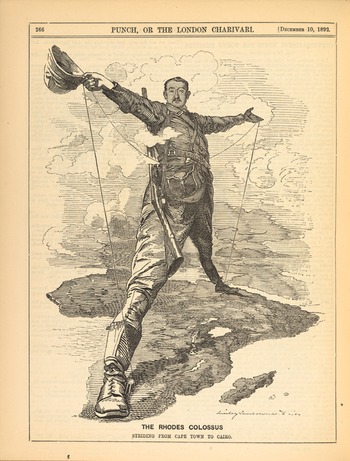
In Edward Sambourne's 1892 Punch cartoon ‘The Rhodes Colossus’, the booted feet of Cecil John Rhodes are planted in Cairo and Cape Town (Figure 1) – the British empire's terminal cities on the continent.Footnote 1 The cartoon was emblematic of a vision for Africa that saw British commerce and political dominance exploit the vast potential of the continent. Rhodes was hard at work for British interests; the cartoon in fact parodies his particular (unfulfilled) wish to install a Cape-to-Cairo telegraph line. While he was empire-building in the south, the British strategy in Egypt was to secure a puppet monarchy and to buy the state by extending credit to the failing Muhammad Ali dynasty, particularly in relation to the construction of the Suez Canal. The opening of the canal was to debut the refurbished European-style capital, and a new work by Verdi would be the crowning event at one of the city's new centrepieces: the opera house. The year after ‘The Rhodes Colossus’ appeared in Punch, the British inaugurated an opera house at the location of Rhodes's other boot, in Cape Town. The context of each opera house's birth was the overweening pursuit of profit in the scramble for Africa.
Edward Linley Sambourne's ‘The Rhodes Colossus’, parody of the over-reach of empire manifest in one man's ambitions, appeared in Punch (10 December 1892). (colour online)

This article reflects on these two opera houses as signs of discontinuity as well as legacy in their cities, their symbolic presence as public buildings. In their respective cities, the opera houses monumentalise the aspirations of several generations and numerous regimes. The cities struggle and thrive under the accumulated weight of colonial histories, strident nationalisms and contemporary aspirations towards social justice, with pockets of extreme wealth and desperate poverty in close proximity. Here I reflect on their stories up to the present, with a focus on the historical and social conditions that they have survived and by which they have been transformed.
Each of the current opera houses in these cities replaces a nineteenth-century predecessor built during or (in the case of Cairo) just prior to a period of British occupation. The old Cairo Opera House had held its first performance in 1869, ten years before the British wrested de facto control from the Muhammad Ali dynasty. The old opera house in Cape Town opened its doors in 1893, twenty-one years into self-governance under Britain as the Cape Colony. For most of both of their existences, these opera houses were persistent public statements of colonial cultural imperialism in the British Protectorate of Egypt and the British-ruled dominion state of the Union of South Africa. These symbolic statements were, I argue, far from hegemonic or stable; competing ideas about the cultural identities of Egypt and South Africa were a tectonically unstable ground under each season while the tastes of a European middle class rippled across the surface.
My study draws on a rich body of recent work on opera houses in other colonial contexts. Analogous struggles for ownership of the symbolic value of an opera house can be seen in the case of the Teatro Colón in Buenos Aires. Ronald Dolkart has tracked the transition from the immediate postcolonial moment all the way through to the apparent democratisation of the Colón under Perón through the ‘elitelore’ governing its opera production.Footnote 2 The Colón emerged as a national symbol from amongst a number of theatres and was treated in literature and popular culture as a gauge for the shifting power and nascent identity of the new Argentina, particularly the urbane population of Buenos Aires.Footnote 3 With a more global perspective, Suzanne Aspden's edited collection Operatic Geographies combines contemporary cultural geography with the now well-established cultural studies approach to opera, producing a multi-disciplinary reading of opera and its houses in which topography and spaces are read through social, economic and political lenses.Footnote 4 Kerry Murphy's description of the reception of touring opera companies in Australia in the early twentieth century is one such operatic geography that reveals the genteel competition between imperial ambition and scope and the development of national identity in Australia.Footnote 5
Though often overlooked in this circuit of British touring opera, Cairo's and Cape Town's histories as colonial entities make them part of a particular narrative in Africa. The British connection sets them apart from the cultural legacies and operatic traditions of continental European colonisers in Africa, continuing in some ways to this day.Footnote 6 Most of these European colonial buildings were quickly repurposed and are mostly singular musical projects with little long-term impact in the musical history of the Africa states in which they are built. Spaces continuously housing opera in Africa constitute a much narrower field of study. For the present work, I examine the chronology of these buildings that have endured, rather than the performances within them or indeed the history of opera as performance in Egypt or South Africa. In both countries, other cities – Alexandria, Pretoria and Johannesburg among others – have parallel and unique operatic histories, although these are more circumscribed and less essential to overt displays of power in these centralised states.Footnote 7 Far from experiencing a final curtain post-independence, as relics of a colonial past, the South African and Egyptian Western art music scenes, and opera in particular, have maintained a consistent presence and are still today a vantage point for shifting stances towards the West.
The endurance of the houses in both Cape Town and Cairo – long after the broader colonial project of their respective founding regimes had failed – suggests an entrenched presence in these cities. Their value as public buildings, regardless of what went on inside them as performance, was significant enough that, on their destruction, the respective cities felt compelled to replace them. Their successors, multi-purpose and up to date in many respects, are still known as opera houses. Through changes in programming, in what counts as opera and what constitutes an opera audience, these buildings continue to play a significant role in their cities. Their survival and repurposing trace changes in their respective societies, relating to the direction of their postcolonial identities and their decolonial projects.
Not by coincidence, both countries are often at odds with the tides of their regional politics and outlook. Egypt is widely perceived by its neighbours as being less Arabic than the rest of the Maghreb, and South Africa as less sub-Saharan African. The tropes of South African exceptionalism stem from apartheid-era isolationism and have often coloured South Africa's own perception, too, that it faces problems unique in Southern Africa, usually to the detriment of regional unity.Footnote 8 Egypt, meanwhile, has variously been viewed by its Arab neighbours as too cosmopolitan and too interested in the opinion of the West. In the late twentieth century, Anwar Sadat's Intifah – the opening up of Egypt – and its attendant switch to alliance with the United States following the October War in 1973 seemed only to confirm this.Footnote 9 Roughly a century earlier, Khedive Ismail's cosmopolitan revamping of Cairo, and disregard for the needs of most Caireans, helped to fix the image of Cairo as westward-facing among its Maghrebi neighbours.Footnote 10 Connecting these two eras is a long-standing nostalgia for the Cairean belle-époque among certain well-heeled Caireans, a nostalgia that goes some way towards accounting for the persistent presence of an opera house in a city with a relatively small operagoing public.Footnote 11 Before entering these opera houses it is worth taking a moment to view what is left from the contexts that necessitated them and what material works speak in a similar register of the late nineteenth-century push towards the future, a future defined at the time by a relationship with Britain. Opera houses do what their name implies: they shelter and contain fictional ‘works’; artifice and fabrication are held behind the proscenium for a (largely) passive audience to consume. The relationship of this ‘great house at the heart of the city’Footnote 12 to the external world is at best tangential; it is set up to be an escape from the world or, perhaps in its earliest days, to allow the double performance of a fiction on stage for a finely stratified slice of the middle and upper classes.Footnote 13 To determine their place in the societies that raised them, it helps to look outside their walls.
The old house in Cairo: the Pasha's playhouse
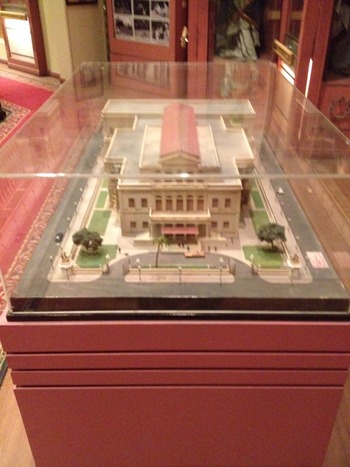
The life span of the old opera house in Cairo begins with the ambitious redesign of Cairo by Khedive Ismail, who came to power in 1863. By 1869 his opera house was built as the cultural centrepiece of this redesign (Figure 2).Footnote 14 When the Western world turned its focus to Egypt at the opening of the Suez Canal in 1871, the opera house's character, as the sophisticated heart of a cosmopolitan, modern city, was already established.Footnote 15 Urbane cosmopolitanism would persist as the public face of Egypt until the overthrow of the monarchy. The fires of Black Saturday in 1952, which raged in buildings adjacent to the opera house, announced the beginning of public and popular nationalism in Egypt and the end of bohemian enclaves such as the theatre districts of Attaba and Azbakeya. These fires foreshadowed the blaze that finally destroyed the opera house itself in 1971.
Maquette of the Khedivial Opera House at the museum in new Cairo Opera House. (colour online)

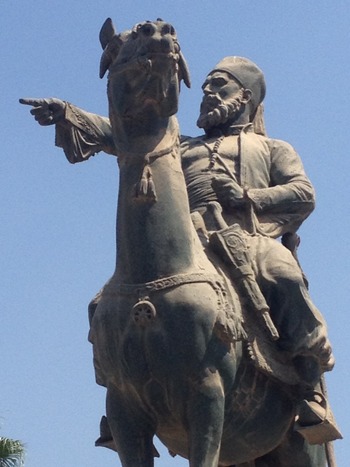
In front of the site of the old Cairo Opera House, on what is still called the Midan al-Ubra (Old Opera Square), is an equestrian bronze of Ibrahim Pasha, the father of Khedive Ismail, who raised the opera house. Ibrahim secured the Muhammad Ali dynasty after Muhammad Ali had won Egypt back from the Ottoman sultan, as a province attached to Istanbul almost symbolically; the sultan was unable to demand complete submission. Ibrahim's son Ismail gained a new official title – garnering international recognition as the Khedive (viceroy) as opposed to Pasha (high-ranking officer or official), and thus changing his status in relation to the sultan; but the dynasty began its decline with Ismail's excesses. In front of the old opera house, unveiled twenty-five years after his death in 1873, Ibrahim Pasha's hand extends towards the future and towards the ‘new’ Cairo, with the horse's hindquarters towards the maze of Islamic Cairo. Charles Henri Joseph Cordier's sculpture captured the birth of modern Egypt as imagined by the late Muhammad Ali dynasty, gazing ‘westward’ under the rule of Ismail (Figure 3).
A copy of Cordier's statue of Ibrahim Pasha, at the National Military Museum in the Citadel of Cairo. The original stands in front of what was the Khedivial Opera House. (colour online)

As the tide of Egyptian nationalism turned on the dynasty in the early twentieth century, the statue was removed and then reinstalled. Later, its anti-Ottoman bas-relief friezes were removed at the request of the Turks and then they too were replaced.Footnote 16 The statue of Ibrahim is now backed by the Ubra car park, retaining a reference to the old opera house.
This opera house and other theatres were in the district of Attaba (bordered by the Azbakeya District), from which a modern Cairo would emerge. Waiting in the wings, the British would become the power behind the throne in part through extending Khedive Ismail necessary credit to build and guild this new, European-style Cairo. His opera house, often called the Khedivial Opera House, was the centre of his personal and political playground, the social counterpart to his scientific endeavour, the Khedivial Geographic Society.Footnote 17 Both buildings represented aspiration and progress to Khedive Ismail, if to no one else. Attaba has itself been overtaken now by the modernising projects of New Maadi, New Cairo and Heliopolis, also known as Masr el Gedidah (‘New Egypt’), the places furthest from the Nile and most detached from the architectural styles and modes of life in the older parts of the city.
Like Ismail's reign, the Khedivial Opera House was not built in the sturdiest manner. In a mishmash of nouveau-riche enthusiasms, the Khedive's Haussmannian, Paris-on-the-Nile vision was for an Italianate 800-seat theatre, modelled on the Teatro alla Scala, as the centrepiece of the larger Azbakeya theatre area east of the Nile. The Italian architect Pietro Avoscani had a solid enough design but one made largely of wood, which would later prove fatal. Cairo was to have lakes, boulevards, museums, a modern plan and gas lighting.Footnote 18 This would all be showcased to the world at the opening of the Suez Canal in November 1871. But the big-spending Khedive was setting himself up to exceed any possibility of repayment from the cotton revenues.Footnote 19 When his debt was called in, the opera house was mortgaged,Footnote 20 and by the mid-1870s Egypt had effectively been handed over to British bankers. Britain's own Khedive Tewfik was installed in 1882, placing Egypt under its complete control as a protectorate,Footnote 21 accomplishing a distancing from Istanbul far beyond the plans of the earlier Muhammad Ali rulers.
Verdi had not yet agreed to accept a commission from the Khedive, but Rigoletto was staged to open the theatre in 1869. As is well known, Aida was commissioned for the opening of the Suez Canal two years later. There would eventually be many more productions of Aida in Cairo, some of a scale that would challenge the imagination even of the Khedive Ismail. If the Contessa della Sala is to be believed, in one instance a 3,000-strong cast was given great authenticity by the inclusion of real Ethiopian slaves. She also claimed effigies of Egyptian gods used as props were the genuine article ‘borrowed’ from the Museum of Cairo. The Contessa herself was on a payroll for down-on-their-luck European aristocrats, generously provided by Ismail in exchange for their padding of his court.Footnote 22 Paul Draneht Bey, a former pharmacist loyal to the Khedive, managed the visiting French and Italian opera troupes from 1869 to 1879. In addition to Bey's equation of Western theatre with progress (he was central to the Aida commission), other efforts were made to encourage the Khedive to regard Arab-language theatre as equally progressive, seemingly with little success.Footnote 23
The Contessa's story hints at the order of the extravagance, but after the excesses of Ismail's tastes, the opera house settled into a polyglot round of performances. By the 1920s it was part of modern Cairo, although remaining deferential to the country's tradition of providing gauze screens for the more modest Cairean women, separating them from the men. In the 1929–30 season you could have seen three amateur productions in English and one in Turkish, twenty-two plays and comedies in Arabic, twenty-five operettas in French and fifty-five operas in Italian.Footnote 24 This is the vivid Cairo given life in Naguib Mahfouz's Palace Walk (1956), the first in his Cairo Trilogy following the fortunes of a Cairean family through the first half of the twentieth century. In Palace Walk the protagonist's father is a man caught between the traditional role of Egyptian patriarch and the alluring world of Egyptian entertainments coupled with Western permissiveness on offer in the Azbakeya district.Footnote 25 Of particular interest in the novel is the entertainment district adjacent to the opera house, still the preserve of a very small elite, and already falling into social irrelevance after the First World War. Nevertheless, the bones of modernising Egypt all articulate around the opera house.Footnote 26 Egyptian musicians trained on Western instruments were by then a long-standing tradition stemming from the establishment of music schools and the commissioning of brass and wind players for military bands by Muhammad Ali a century earlier.Footnote 27 Although players came from the lower classes, however, the audience at the opera consisted of pashas, local and expatriate. More than anything else, the old Cairo opera's place in the broader Egyptian imagination was cemented by its use as a glamourous location in early Egyptian film of the 1930s.Footnote 28 I will return to Egyptian music, and to this era, shortly.
It is an indication of the exclusivity of the old opera house that when Hassan Hassan, grandson of Ismail, returned to Egypt in the 1940s, the opera house was not only in its original state but still presenting the same performances on stage and in its audience:
Most of the important activities that needed a stage were held at Cairo's Opera House, built by Avoscani and Rossi. Many buildings had changed on my return to Cairo, but the Opera House had remained much the same as when it had been built for the inauguration of the Suez Canal, except that when gas light had been replaced by electricity a great chandelier in the centre of the house had been replaced by a crystal plafonnière. There one could see Aida in its original costumes and sets … The decoration was all in a traditional white and gold and red plush, a delightful background to set off the elegance of a glittering audience. Cairo glittered in those days; it could muster up an extraordinarily decorative assembly of attractive and elegant women of foreign or Egyptian nationalities.Footnote 29
The social role of the opera in the late eighteenth and nineteenth centuries in Europe is evoked here in the late twentieth century in Hassan's wistful look back at mid-century Cairo. The familiar language of Europeans nostalgic for the world pre-First World War is echoed in this Egyptian nostalgia for the glittering world of Cairo right up until the overthrowing of the Muhammad Ali dynasty in 1952. Professor Azza Madian explains the particularly Egyptian coining of ‘La Belle Époque’ – rendered in the vernacular as Alzaman Al Gameel – as referring to this nostalgia for the late colonial period, in spite of its ties to oppressive and exploitative Pashas, local and foreign;Footnote 30 the social spectacle and the cultural milieu of the audience were at least as important as the performance.
Adam Mestyan has suggested that the project of constructing the Khedivial Opera House was part of a larger plan that did more than trope European urbanism – that the regional competition with the sultan in Istanbul, who had also constructed an opera house, was at least as important to the Khedive.Footnote 31 A space was opened for the intra-European competition between Italian and French opera (a comédie theatre had already been built) but instead of being the central statement, this competition was a sideshow to the extension of the Khedive's power in his own regional context. Even after Ismail's reign, with power in the hands of the British, the Khedivial family and Ottoman-Egyptian elite continued to frequent the opera house, making it a site for greater proximity to the elites by ordinary Egyptians, but which also gave a taste of European urbanism. Mestyan identifies this as the intertwining of modernity with notions of progress and pleasure.Footnote 32
As noted previously, the opera house survived the first tide of Egyptian nationalism in the twentieth century, the riots and fires of Black Saturday in 1952. It would, however, fall to flames in a most unoperatic fashion with an ostensibly accidental fire in 1971, and a few disorganised attempts to extinguish it. The recent subject of a documentary by Kamal Abdel Aziz (The Burning of the Cairo Opera),Footnote 33 this fire has long been believed to be the result of arson connected to a pending inventory.Footnote 34 It took with the largely wooden structure one of the last symbols of Khedive Ismail's ‘Paris on the Nile’, as well as the nucleus of the Western-facing entertainment district that fostered local talent right up until the boom in urban building following the 1952 Revolution. Fires, particularly when they break out on poorer or older suburbs, serve as a complex symbol in Egyptian discourse today, a nexus of critique of government neglect, failed local administration and conspiracy theories around terrorist activity. A 2016 blog on fires in the Attaba district still recalls the burning of the old opera house, linking it discursively to fires in the adjacent bohemian district.Footnote 35 Today, if you ask a taxi driver to take you to the opera square you are most likely to be taken to the multi-storey car park on the site of the old house, rather than the new opera complex on Gezira Island.
The old opera house in Cape Town
Some 10,000 kilometres to the south in Cape Town, in contrast to the grasping aspirations of a cosmopolitan city such as Cairo, the indomitable Victorian amateur was flourishing. The 500-seat theatre that was eventually constructed did not have a permanent company but instead hosted touring opera companies from the late nineteenth century into the twentieth and amateur productions staged by the local community. Prior to this, the French presence in Cape Town in the early nineteenth century had brought visits from touring companies, often on their way to Mauritius or Australia.Footnote 36 Once more firmly under British cultural dominance, Cape Town became the departure point for entertainments touring into the hinterland as the interior opened up.Footnote 37 Throughout the nineteenth and twentieth centuries, operatic numbers and performances formed part of broader entertainments.
The lifespan of this opera house was relatively short. Following a slow public fundraising, the opera house opened in 1893. Unlike the old house in Cairo, this was driven not by the vision of one man but by the broader civic concerns of a growing city. The opera house commanded a central position on the Grand Parade Ground, and quickly adapted to a number of public uses far beyond staging operas. Though ultimately a multi-purpose venue, the old opera house's central position was eventually its downfall. Pressure mounted to put the centralised location to better use, and in 1937, the opera house was demolished to make room for a new post office.
Thomas Ertman outlines two European historical models for running opera theatres: the statist and the impresarial.Footnote 38 Cairo and its theatre operate on the statist model exclusively, whereby government – first the Khedivial administration and then the ministry of culture – decides what is produced and how. In this model, permanent institutions populate the theatre. Cape Town (like the rest of South Africa) seems to have operated on the impresarial model, whereby the state provides the legal and contractual framework for impresarios to produce opera, reflecting the tastes and preferences of a paying audience. An exception to this is the hybrid model of the apartheid era, characterised by increasing state involvement in what was produced in theatres. During late apartheid, an entirely statist model prevailed that was run through the provincial arts councils.
The colonial audience in the opera house in nineteenth-century Cape Town was much more monolithic. In the city there were Afrikaans-speaking descendants of Dutch colonisers, a cosmopolitan slave population, Afrikaans-speaking communities that would later be classified as ‘coloured’ in the twentieth century, black Africans and the British ruling class.Footnote 39 Formal entertainment catered almost exclusively to the latter, and in fact early in the nineteenth century, theatre meant variety shows put on for the entertainment of officers on leave, on their way home from posts in India. It was a much more homely affair than the spectacle of power unfolding in Cairo. An improvement on the existing theatres, the Grand Parade Building Company spent £90,000Footnote 40 to build a 500-seat theatre in 1893. The Cape Town opera house was always about a small community making its own entertainment, and in fact featured very little actual opera, always provided by the travelling companies that toured the colonies. Staggeringly, though, the enthusiasm of Anders Ohlsson, chairman of the Grand Parade Building Company, and his Wagnerian bent, saw a staging of Tännhauser at the old opera house in 1899.Footnote 41 His interest in the opera in Cape Town seems to have been part of a much larger endeavour to work his way up the political and class ladder as ‘new money’ in Cape Town. His charitable and civic pursuits, among which was his patronage of the opera, seem to have worked.Footnote 42 The opera that happened at the old opera house was driven by individual tastes rather than a wildly enthusiastic opera audience, though Knox suggests that visiting musicians generated far more excitement than visiting theatre groups or actors.Footnote 43 It was primarily a public space; Mark Twain spoke there to a packed house,Footnote 44 and Baden Powell was feted there after the victory at Mafikeng. In fact, it was in vogue to talk about wild, uninhibited celebration as a verb-form of the town name; they were said to be ‘maffikeng’ at the opera house.Footnote 45
This opera house served as a centre of light entertainment, a lecture hall, and, by the 1920s, a cinema theatre.Footnote 46 It was viewed as a necessity in the cultural life of Cape Town, and an almost century-long struggle to fundraise enough for a permanent theatre was encouraged and discursively linked, as in Cairo, with the installation of gas lighting. The poetics of bringing ‘enlightening’ to Cape Town is a constant in these calls.Footnote 47 The transition from settlement to city included permanent structures with designated purposes, as opposed to the rough and ready nature of entertainment on the frontiers of the hinterland. When the Kimberley Hole was being excavated for diamonds out to its current monumental size, the town of Kimberley was constantly shifting as parts of it were undermined and slumped into the pit. The town was a hive of entertainment venues, many multi-purpose and housing gambling and even shooting ranges. Music Hall and variety flourished and one prominent theatre, a corrugated iron structure, was a collapsible one, that simply moved with the city as the excavations swallowed up more permanent structures.Footnote 48 Though never an opera theatre, such buildings, generally disreputable, needed to be replaced with fixed and purpose-built ones as markers of a place's development.
Records from the 1930s indicate that numerous amateur, student and professional productions were held in the old opera house, including Toad of Toad Hall, The Gondoliere (sic) and Peter Pan by amateurs, Don Pasquale by music students, and La Bohème, I Pagliacci and The Mikado under the baton of Signor Giuseppe Paganelli.Footnote 49 These were supported by the growing talents of the musicians trained at the South African College of Music in Cape Town,Footnote 50 and supplemented by visiting opera stars and companies.Footnote 51 Giuseppe Paganelli, later ex-prisoner of war Gregorio Fiasconaro and finally Angelo Gobbato were a sustaining force for Italian opera in South Africa between the monolithic dominant cultures of the British and the rising Afrikaner identity. They worked at the nexus of the South African College of Music, municipal musical organisations and amateur music-making in Cape Town. As in Cairo for decades before, beginning with Pietro Avoscani himself, expatriate Italians did much to promote Italian opera in this Anglocentric colonial state. While the Khedivial opera in Cairo seems a perfect example of Ruth Bereson's ‘operatic state’ – in which the opera house is a locus of demonstrations of power and prestige – there seems to have been a much more relaxed approach to the broader entertainments on offer at the Cape.Footnote 52 Serious opera was the exception rather than the norm at the old opera house, and the community that it primarily served participated in its development both on- and offstage. By the 1930s, its audience and amateur producers were writing to the press and to the local administrators with complaints and requests for permission. The archives are packed with letters of complaint and debate about almost everything except music, reflecting a lively interest in entertainment and its social role: though the orchestra is ‘beautiful’, the chairs in the nearby City Hall are fit only for those condemned to a life-sentence in a penal colony, according to one Mr Pickerill, director of the Cape Town orchestra, in a letter to the Cape Argus on 17 February 1930.Footnote 53 There are snide letters of complaint and backbiting between the amateur producers and house officials of Peter Pan Footnote 54 and Toad of Toad Hall,Footnote 55 too, as they fought over stage time in the early twentieth century.
I suggest that there are a number of reasons for the broader scope of production at the Cape Town opera house. First is its distance from the colonial metropole: a large part of the Khedive's push to modernise Cairo was precisely so that it could be assessed by visiting European dignitaries attending the opening of the Suez Canal and earn a place in their estimation as a capital on a par with European capitals. Cape Town had no such aspirations. Though the civic pride of the city saw a growing desire for the quality training of musicians that came to pass with Professor Hahn and the establishment of the College of Music in 1910,Footnote 56 Cape Town was, in the early days of its colonial era, a place to stop and move on, a far-flung city in service of those in transit between outposts of the empire in the Indian Ocean. Related to this is arrogance of empire: that a city can have one role of service and be confined to that role, developed only as far as is necessary.Footnote 57 One way to assess this is in the placement of the theatre in relation to buildings around it, discussed in the following pages. The strategic and military focus of the Cape meant that the interests of soldiers and officers dominated.
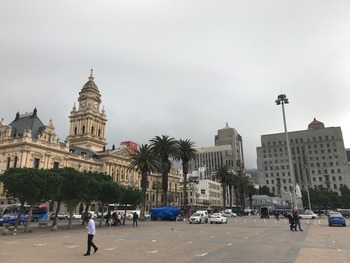
The old opera house occupied a central position in the public and commercial life of Cape Town. On the corner of Graves Street (now Parliament Street) and Darling Street, it faced the Grand Parade Ground. The commercial exchange had stood on the same side of the square until 1892, a year before the opera house was built, when it had been torn down to make room for the post office. The new railway station was also opened in the same area in 1892.Footnote 58 The opera house was behind the imposing neoclassical Standard Bank building. The Grand Parade ground itself was the central meeting place in Cape Town, a site of protests, circuses and public celebration, often across class divides.Footnote 59 Firmly on the commercially focused side of the Grand Parade ground, and the last of those buildings to be erected, the opera house would have faced the Castle of Good Hope across the Grand Parade and was just south of the main barracks, the military symbols of the city (Figure 4).
Cape Town general post office. The grey building in the far right of the image, replaced the old opera house; to the left is the city hall. The castle is behind the viewer. (colour online)

The opera house was at that time close to the shoreline of Table Bay, which would be extended with reclaimed land in the 1920s. Like the Khedivial Opera House in Cairo, the opera house in Cape Town held a central position, adjacent to open public space, in the company of prominent and important public buildings. In the course of its life, however, the Cape Town Opera House operated along much more mundane lines than the Khedivial, with varied, flexible and responsive programming. A similar strategic positioning and multi-purpose life would await the new opera house in Cape Town, built on land that was literally new ground. The old opera house was demolished in 1937 to make way for the central post office building, with no immediate plans to replace it.
The new house: Cairo
The new opera house in Cairo was inaugurated in 1988. The overthrow of the monarchy in the 1950s and birth of postcolonial Egypt moved the focus of government to basic infrastructural concerns. There was, however, enough interest in the cultural cache of an opera house to accept the generosity of the Japan International Cooperation Agency and build a monumental house. The new opera house, in form and function, would have to represent a new Egypt.
In 1932, a few years before the old Cape Town opera was torn down, the Cairo Congress of Arab Music had set its delegates the task of bringing Western and Eastern (or at least Arabic) music together with two ambitions: to formally acknowledge the historical link, and to set an agenda for modernising Arab music. This was not to be; the Arab delegation wanted progress and the Westerners, in a spectacular moment of orientalist zeal, wanted to freeze Arabic music in the past. The West would take care of the modern (or so the assumption ran), though it thanked the East for its historical contribution.Footnote 60 Talks broke down and the rift between agendas played out subsequently in Egyptian music. The few exceptions to this were patrician, Western-trained Egyptian composers such as Yusef Greis, Hasan Rashid and Omar Khairat in the first half of the twentieth century, considered the first generation of Egyptian art music composers; and from the 1960s onward, Aziz El-Shawan, Mohamed Garrana and Gamal Al-Rahim.Footnote 61 Arab music and Western music would not organically form hybrids, at least in the art-music sphere, for much of the twentieth century.Footnote 62 In the audience at the congress was a young Umm Kulthum, who would dominate the Arab musical imagination as no other in the mid-century and beyond. A statue of her stands today in the new opera house complex. She and the opera Aida are considered (bizarrely in the case of the opera) twin manifestations of Egyptian creativity that cast an extremely long shadow.
This was the state of affairs up to the 1980s. President Hosni Mubarak was not interested in grand-scale building projects; rather, he focused on fixing Cairo's infrastructural problems. If it had not been for the above-mentioned gift from the Japan International Cooperation Agency, and the preference of then-minister of culture Farouk Hosny, there would have been no new opera house after the fire. So in the same decade that three-quarters of the city was linked to water mains for the first time, it also received a massive new opera house.Footnote 63
Dr Reda El Wakil, director of the current opera house (literally translating as ‘The Egyptian Opera House’ from the Arabic Dar el-Opera el-Masreyya), has spoken about the attempt to make the house blend architecturally into the surroundings, with its dome modelled on a nearby planetarium.Footnote 64 Many orders of magnitude bigger than anything around it, its aim was nonetheless to blend in, where the Khedivial house and its Parisian-styled square did so much to stand out. Professor Azza Madian, commenting on the unlikely gift-horse of Japanese funding to build another opera house after the wave of nationalism that tainted European institutions, suggested that the same impulse at work on Khedive Ismail, to appear modern and in step with a wider world, underpinned this choice.Footnote 65 But the substance of this modernity mirrored the tensions in Egyptian cultural life: a desire to rebalance the representation of Western art music and Egyptian art and popular musics. At the time of its opening, the New York Times ran an article interviewing then-dismissed artistic director Magdah Saleh.Footnote 66 Though not leading the plans for its inaugural performances, she articulated the struggle between the clear nostalgia for ‘cultural life’ lost in the fire that consumed the old opera house and the need to represent the ‘neglected’ traditional cultures of Egypt:
when it burned down in 1971, cultural life suffered. We can blame the decline of cultural life in Egypt on the burning of the opera, but that may not be wholly the case … The country is going through great changes, changes of focus, changes of interest.Footnote 67
These changes necessitated a stronger focus on Egyptian identity, and it would seem the identity politics of the new building complicated the already-rushed programming of the opening. Added to that, the funding from Japan had generated pressure to bill kabuki theatre on its own for the opening. Cowell expressed the pressing need to accommodate and balance the various political imperatives at play in the opening events, labelling the ‘identity crisis’ as key to the final mixture of events for the opera house's opening: kabuki, alongside a ‘thin Western crust’ and ‘a native traditional core’.Footnote 68
The new house opened with a kabuki performance in the presence of the Japanese emperor's younger brother, and the complex as a whole was intended to house much more than just classical music and dance. The Arab Oud House had originally been located in the broader grounds of the national cultural centre, but was moved into the old town.
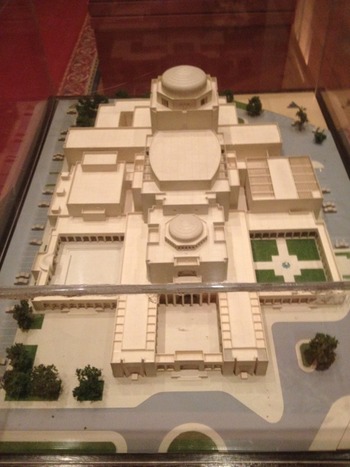
The Cairo Opera House is the centrepiece of the National Cultural Centre, and expresses monumentality in a way that echoes Pharaonic architecture, massive and geometric in its broad gestures and footprint in the city (Figure 5). Architect Kochiro Shikida had suggested a Pharaonic style, but at the insistence of the Egyptian authorities, Islamic style would dominate.Footnote 69 It also features detailed latticework in metal window grills and inlaid marble floors, lanterns in graceful arcades and open courtyards that echo vernacular Islamic architecture and decorative styles. The interior space transforms the geometric quality of the exterior into art-deco-inspired restraint. Taken together, these three architectural and stylistic ingredients draw on an epic past and pause at a significant moment in one of the outward-looking moments of Cairo and Egypt's history, encompassing ancient Egypt, Islamic Cairo and the cosmopolitan Cairo of the 1930s.
A maquette of the new Cairo Opera House in the Opera House Museum. The front facade of the building is at the bottom of the picture and illustrates the successive climbing levels of the buildings. (colour online)

Modern Cairo throngs around the complex. Caireans stream in and out of the adjacent concentration of sports facilities, among them the Al Ahly sports grounds and the former Khedive's gardens of Al Zohriya. A capacious parking lot and security point mark the entrance to the grounds of the theatre complex. The space reserved for the activities of this cultural complex is extraordinary in a city well known for its voracious appetite for space. Sims has written extensively on the urban culture that has built up over centuries under the pressure to make maximum use of the land adjacent to the Nile.Footnote 70 Here, prime land on a river island lies vacant for most of the day, ready to receive traffic for the evening events. This extends the reputation of the island as the home of pleasure pursuits, remnants of which exist in the democratised pleasure gardens and sports grounds, once accessible only to Pashas and influential Westerners.
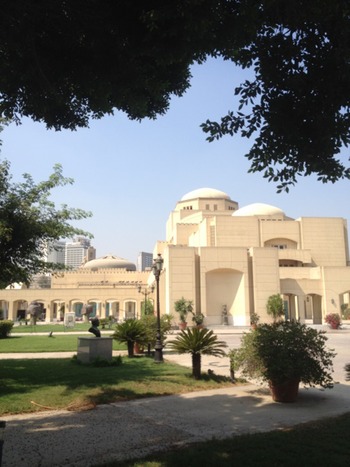
Approaching the complex from the east, side-on to the main building, the opera house dominates the visual horizon, though the Palace of Arts (a secondary theatre) and Museum of Modern Egyptian Arts, in a hybrid late twentieth-century Western and Islamic style, mirror aspects of the main building. Rounding the building to face the main facade, the surface treatment and scale of the approach trope the grandeur of ancient Egyptian structures; painted a soft honey colour, with large blocks delineated on the plaster surface, it can be read as referencing the limestone and sandstone of the Giza and Karnak complexes, while the structural language is that of cyclopean cubes and rectangles piled high. Though these are softened by arches that form a compromise between Islamic pointed arches and the flat lintels of ancient Egyptian hypostyle architecture, the overall effect is that of climbing cubes and mass, rather than light or floating domes (which do in fact cap the two central buildings). The front facade also features a modified pylon design, with twin pylons enclosing the smaller central entrance. Between the tarred road network and the main building is a band of well-tended lawn with a few trees (Figure 6). Here, some statuary signals the cultural tides lapping the great theatre. The bronze of Umm Kulthum faces the library. There is also a more recent gift of a bust of Pyotr Tchaikovsky, with plaques dedicating it to the Egyptian Association for Graduates of Russian and Soviet Universities. The Tchaikovsky monument is closely linked with ongoing debates about the place of Western art in Egypt (discussed in the following). Finally, set into one of the niches on the main entrance, there is a New Kingdom diorite stone sculpture of Sekhmet, lioness-headed protector of the pharaohs. Together, they mark (respectively) the twentieth-century high point of radio-powered Arab modernity, the contemporary diplomatic rapprochement in the arts between Europe and Egypt, and the patrimony of a classical civilisation.
Lawns and statuary in front of one side of the main facade. The main entrance is to the right of the picture and the west wing, the outdoor theatre, is to the left. (colour online)

The ascending levels of the building rise in concentric, crenelated walls towards the two main domes that come into their own when viewed from the interior. The three sides of the main lobby feature generous courtyards, one laid to lawn with a small fountain, another a floored open-air performance venue and the central courtyard a marbled atrium. The courtyards in large historical mosques, called sahn (singular) in Arabic, are used by locals and visitors in Cairo as places of rest and reflection outside of main prayer and sermon times. This can be experienced in the Sultan Hassan, Muhammad Ali and Al-Hussein mosques. The connection with Islamic architecture continues in the use of domes to cap the main buildings, the full or half dome – qubba in Arabic – often used in mosque architecture to represent the vault of heaven. The use of large encased lamps in the arcades of each courtyard also echoes the extensive historical use of lamps in mosques for pre-dawn and night prayers.Footnote 71 The courtyard on the west side of the building is used as an outdoor venue, frequently booked for open-air Arabic music concerts. A visit to the box office in the central courtyard prepares the visitor for the next code-switch, with signage and a polite caution from the box office reminding all ticket holders that events in the main hall are accessible with a tie only. It is an unexpected condition for the tourist when, internationally, dress-codes are increasingly being relaxed for concertgoers in an attempt to lessen the forbidding aura of elitism around ‘classical music’. The distinctions in access and usage between the external and accessible courtyards that take their functional cue from the mosque courtyard, and the permission-required inner parts of the theatre, are mirrored in their programming: generally, Arabic and Egyptian music for external concerts and Western classical music within.Footnote 72
On entering the main lobby, there is one final security point, with the passport check of the daylight hours replaced with the ticket-and-tie access rule for patrons. At 160 Egyptian pounds ($9.70) for the best seats at the September 2019 Aida, the hall is economically accessible to many, but there is dissonance between the theatre of spectacle in dressed patrons entering the imposing bastion of the main building and the ignoble security check, tattle and body search. The performance of the lobby compresses the mixed message often encountered in Cairo, welcoming Caireans constrained by increasing securitisation and indeed privatisation of access to the city's sights. Bombings in the tourist areas of Giza in 2018 and 2019 have dampened hopes that the Grand Egyptian Museum will boost tourism. Back at the opera, cosmopolitan, silk-tied patrons are respectfully patted down and tasselled ladies’ clutches are spat out of the suspicious baggage check. Airport-style security reminds all who enter of the broader security threats that cannot be ignored even during a night at the opera.
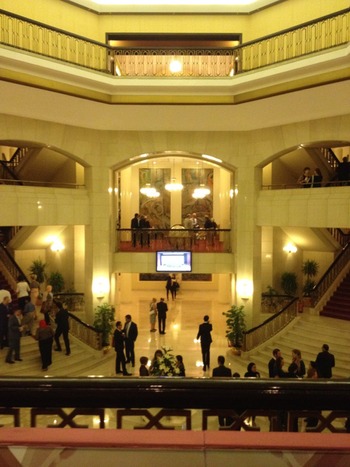
The interior continues the soft green colour palette, but we are not in Islamic or Pharaonic Cairo. The stark verticality of the exterior and aniconic Islamic decoration of the courtyards is synthesised here into art deco modernity (Figure 7). An octagonal dome floats over a plain marble stone floor, coffered and pared-down pilasters replace columns and sinuous twin staircases snake into a mezzanine. On the mezzanine a red velvet drape marks the semi-circular museum, a few metres in diameter of concentrated history. And here nostalgia is unleashed in an otherwise reserved art deco lobby. Sepia and monochrome pictures recall the old opera house and its long list of illustrious directors, polyglot names that through time trade in their tarbush, redolent of the Pashas, for dapper suits in modern cuts. Maquettes of the old and new house celebrate a continuing legacy; Kulthum looks out from the walls, as do presidents and diplomats. An augmented piano features two additional keyboards to reach the interstitial quartertones of Arabic maqamat.
A view of the lobby from the museum mezzanine. The flattened arches and block tracing of the exterior facade are echoed in the interior, with polished stone facing. Latticework and abstract hangings, wall sconces and slightly curved stairways reference art-deco abstractions of natural forms. (colour online)

One final statement of place marks out the otherwise-familiar layout of raked seats and boxes, with a red velvet and pale cream palette that in a less democratic time would have been gilt. The chandelier and its ceiling are the calling cards of any opera house: the raising of the lights in New York's Met receives applause, the glass Liceo in Barcelona and the Chagall ceiling in Palais Garnier lend cathedral-like qualities to the space of operatic ritual, and the falling of the fictional chandelier in the ‘Phantom of the Opera’ signals the climactic moment of opera's irruption into the real world. In opera houses subscribing to the ancien régime ideal of opera in conversation with a stratified society, the chandelier is the last light of the outside world to be dimmed before the light of the performance occupies the experiential field of the audience. In Cairo a luminous lotus hangs from the ceiling. Suspended beneath the second and larger dome of the opera house, it brightens and dims on a cycle of performances that has changed little in thirty years.
The desire for a building of such imposing heft to blend in (as noted earlier) signals the contradictions with which it lives. As a visual statement, the building plays with scale to create impression. But the content of that impression is comfortably within the Western imaginary. Nothing in the building disturbs the perceived Western history of Egypt: the fantasised ancient, the gentle courtyard, and the deco – that moment of the Mediterranean cosmopolitan that Mahfouz grappled with. The main hall and the performances within it speak to what Kay Dickinson has described as the systematic (and to some extent successful) attempts to ‘fix and dehistoricize Arab music’Footnote 73 – a refusal to allow a hermeticised Egypt of the past to be broken open. In the main venue, contemporary or avant-garde music is not as likely to be billed as Scheherazade and Aida, themselves the results of the imagined sonic palette and exotica of Egypt and the region. Spatially, Arabic music, Egyptian and otherwise, occupies the periphery, courtyards and the exterior buildings. In practice, politics and music have moved on since the building's opening. Nevertheless, the city sits with a spatially decentred Egyptian identity in its major opera venue, a snapshot of another push for modernity imagined as a house for opera that would not challenge international sensibilities.
Today the centre houses the Cairo Symphony Orchestra, Opera Company, Opera Ballet Company, Opera Orchestra, Modern Dance Theater, Cairo Opera Choi, the National Arab Music Ensemble, Abdel Halim Nowera Ensemble and the Heritage Ensemble for Arab Music. It seats 1,200 in its main hall, but much of the most popular activity happens in the outside theatre, where Arabic music is performed. The centre is entirely funded by government, and one of the frustrations of Egyptian–Western classical artists is the endless productions of Aida, which, along with the cult of Kulthum, enshrined in the opera's main museum, stifles any contemporary expression. Attempts at utilising opera as a living medium have been made outside the opera house, such as Neveen Allouba's work on a vernacular translation of Les Misérables, performed at El-Tahrir Square not long after the Arab Spring.
Within a varied programme of Western and Eastern classics, chamber orchestral and ballet performances, Aida and numerous commemorative performances dedicated to the memory of Umm Kulthum featured prominently in the 2014–15 season. Aida played again in May 2017. The opera house maintains its artistic links with the West (the ubiquitous Met Live transmissions happen there) but the voice of an Egyptian art music not connected to canonical Western or Eastern practice is difficult to hear. Performances often draw censure from the religious right, and during the lead-up to Mohamed Morsi's deposition, the opera's director, now the minister of culture, was regularly threatened.Footnote 74
In 2013, Ines Abdel Dayem, a musician and director with strong links to the opera house, was withdrawn as chair of the opera house in what she describes as an attempt to ‘brotherhoodise’ culture expansion. Her promotion of dance and music was seen as a direct threat by ultra-conservative parties (particularly Nour, who objected to her appointment). The backlash from artists saw her offered a ministerial job, which she declined in order to remain at the opera house. Opera, ballet and the symphony orchestra in Cairo retain symbolic value at the vanguard of politics, a gauge of the role of politically moderate Egyptians who support it with a sense of great urgency.Footnote 75
The new house: Cape Town
The new opera house in Cape Town was built on new ground, reclaimed from the sea in the 1920s.Footnote 76 By the 1960s, the new land had settled sufficiently to be developed. Also sufficiently settled, the post-war apartheid regime was systematising its cultural institutions. In the 1963, the Performing Arts Councils created the framework for new venues across South Africa. By the late 1960s, space in Cape Town was reshaping around the dominant ideology of segregation. At the same time that District Six was being uprooted, the new theatre, the Nico Malan, was sinking deep roots into the new land of the Foreshore. Finally desegregated in 1975, it would receive a new lease on life in 2001 with extensive rebranding.
While Cairo waited for seventeen years (from 1971 to 1988) for its new opera house, in Cape Town there was a much longer gap between the demolition of the old opera house in 1937 and the opening of the Nico Malan Theatre Centre in 1971 – the same year that the Khedivial Opera House in Cairo burned down. There was no dedicated house during that time; however, opera maintained a strong presence, with concert performances and radio broadcasts from City Hall from the 1920sFootnote 77 right through to the operatic concerts leading up to opening of the Nico Malan.Footnote 78 Regular stagings at the Alhambra Theatre served the operatic audiences.Footnote 79 Both of these venues were racially segregated during apartheid. The building of the Nico Malan precipitated a boom of opera-house construction all over South Africa in a fevered attempt by the newly formed apartheid arts councils to prove their worth. These performing arts councils (PACs) were formed in 1963, with one council for each of the then-four provinces. They were formed to provide steady work for white artists in the specific fields of drama, music, ballet and opera. Throughout the late 1970s and 1980s the value of so many opera venues in South Africa was debated and tracked in the theatre journal Scenaria. Its editor, the opera fan Julius Eichbaum, regularly critiqued the misspending of money in what he considered the backwaters of Bloemfontein in the Free State,Footnote 80 the neglected, Cinderella status of JohannesburgFootnote 81 and the poor choice in the spending of the Performing Arts Council of the Transvaal (PACT) funds to erect a theatre in Pretoria.Footnote 82 Fierce competition at the provincial level seems to have outstripped logic in a spending frenzy already some time after the height of the Rand's buying powers, when the beginning of the end of apartheid was being clearly signalled by changes in the country.
Before the end of its first decade, the Nico Malan, along with other theatres in the country, was hard-pressed to justify its existence. By that time the apartheid regime was redirecting its spending towards the essentials of ‘defence’ and the luxury of multiple theatres was already problematic. The spending spree was over almost as soon as it had begun, and recourse to the ‘civilising’ role of white culture would be a temporary crutch. Eghard van der Hoven, a notable actor and first head of the drama company at the Performing Arts Council of the Transvaal, wrote a letter that was published in Scenaria, expressing the highest ideals for the role of the arts at the time:
When times are hard and money is being spent only on essentials, many people are of the opinion that the performing arts are a luxury which can be put aside until times are better. It is too easily forgotten that our struggle today – on the economic, political and military fronts – is precisely the struggle to maintain our way of life and our cultural achievements, to develop both, not to stagnate.
26 April 1977
Eghard van der Hoven
Director, PACTFootnote 83
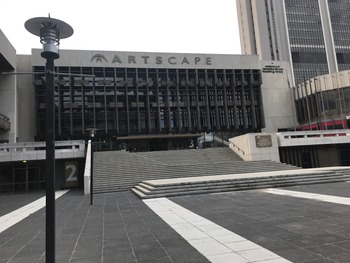
The Nico Malan Theatre Centre's genesis was in the economic boom of apartheid; it was built on new land as far as possible from the colonial heart of the city and was to set the seal on Cape Town as the cultural capital. The mountains and sea have always limited the expansion of the city of Cape Town, prompting the move in the 1920s to reclaim land from the sea. The purpose of the reclamation was to add square kilometres to the city but more importantly to expand the harbour area for sea traffic. Following the reclamation, a period of settling ensued and by the time the land was ready to support buildings, a new Afrikaner nationalist dispensation was poised to present its republic in its own way. Distancing themselves from the Dutch-built colonial fort (the Castle of Good Hope) and the Edwardian city centre around the Grand Parade to the southwest (its own opera house replaced by the post office), the Afrikaner nationalists developed the newly available Foreshore as a space for their future, with new civic and cultural buildings proclaiming an advanced, modern city. The Nico Malan Theatre Centre was central to this building boom, with a 1,500-seat opera theatre, a 450-seat theatre and a few smaller performance spaces. The theatre would be the production house of the Cape Performing Arts Board's (CAPAB) opera, ballet, orchestra and theatre companies.Footnote 84 Through an extensive rebranding exercise post-apartheid (discussed in the following), the Nico Malan theatre became the current Artscape Theatre Centre. Though the political dispensation has changed, a unique confluence of national, provincial and municipal money continues to support the activities of the Artscape Theatre Centre. The Nico Malan was established by funding conditional upon completing the opera house and civic centre in time for the 1971 decennial anniversary of the formation of the South African Republic and the break with the British Commonwealth in 1961 (Figure 8). The city of Cape Town would provide the land, originally donated by the railway company; the Cape Province would provide the funding, loaned from government at interest; and the salaries would be paid through the arts councils. This arrangement persists in the current division of responsibilities between city, province and state. This established the Nico Malan as an organ of state, an example of the operatic state promoting the performance a particular nationalism. Although by 1975 the stage at least was desegregated, this legacy continues to play a part in perceptions of the theatre.Footnote 85
Front entrance of Artscape, formerly the Nico Malan, with the Civic Centre's administrative wing visible to the right of the image. (colour online)
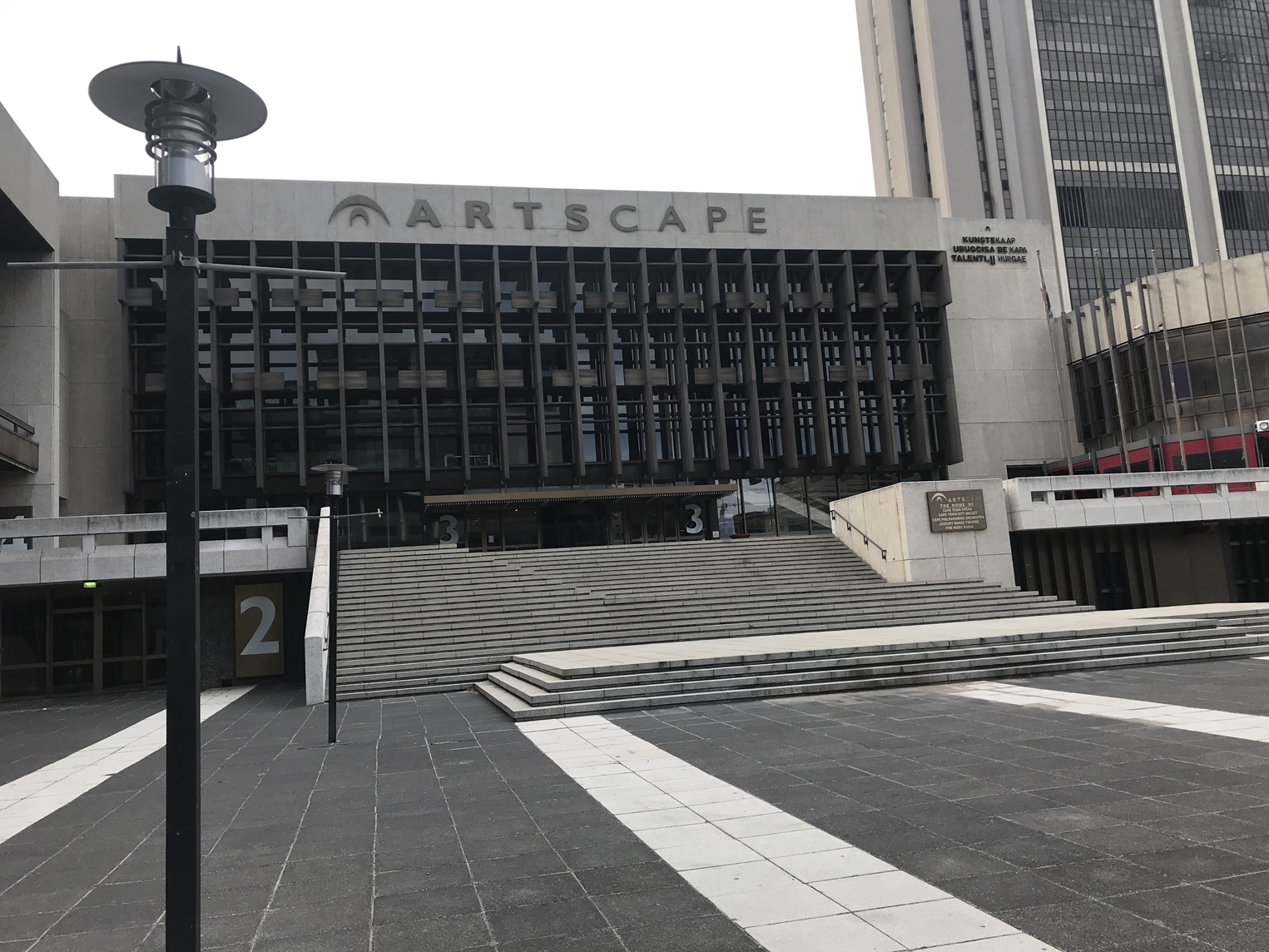
Binding the opera house to the civic centre is the physical administrative wing, across Hertzog Boulevard, and a shared basement parking, imagined for the double use of the business of running the city by day and entertainment at night – a neat division of business and leisure now also dated. The naming of streets and cites in the area proclaims its arrival: Nico Malan was administrator of the Province of the Cape of Good Hope from 1960 to 1970, and promoted the idea of a theatre for Cape Town on a national level. The street that theatre is built on is D.F. Malan Drive, named for the first nationalist post-war prime minister, and Hertzog Boulevard for General J.B.M. Hertzog, the Boer-war general and prime minister of the Union of South Africa. Each one was a fervent Afrikaner nationalist in his time. Though new names for sections of these roads have been proposed and some have changed, they remain largely intact and map a context for the theatre today.Footnote 86
Conceptualised at the height of grand apartheid's confidence in the late 1960s, the city would be presented in an ordered and visually coded way, bounded by the sea and the mountain with the new buildings climbing from the historical cradle but still deferring to the mountain as the ultimate visual limit of the city. The rest of the city would be largely obscured; this may be an example of laager architecture, symbolic of Afrikaner nationalism and troping the defensive circle of pioneer wagons – identifiable here in inward-facing buildings.Footnote 87 Earlier colonial conceptions of Cape Town fall into familiar port-city discourses: a liminal space between sea and land that facilitates communication between a hinterland and the wider world. James Ford's fantasy painting Holiday Time in Cape Town in the Twentieth Century (1899) projects a vision of Cape Town with a Venice-like reception at the docks: imagined classical buildings and public fountains that welcome visitors to an elegant port advertising a rich theatre life, with numerous visiting stage personalities among the recognisable dignitaries represented in the painting.Footnote 88 The view from the harbour extends unbroken to tended fields and then the mountain, a seamless transition from urbanity to arcadia. Jamal has critiqued the still largely undisturbed image in the painting of Cape Town as a haven for white pleasure.Footnote 89
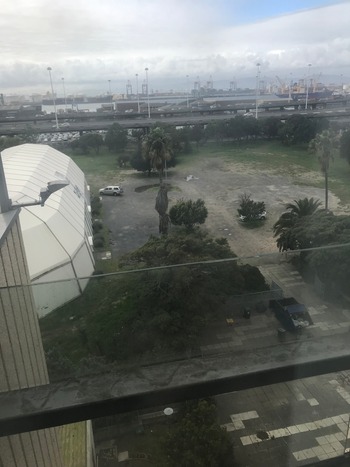
In the 1920s, when the plans for reclaiming the land were first made, it was imagined that most guests to the city of Cape Town would arrive by sea, and so approach the city from the harbour, through a formal garden styled ‘The Gateway to Africa’. Ambitions to green the land reclaimed from the sea to form this garden did not work out, however. High levels of salinity in the soil and incessant wind made it impossible to sustain. Today, two palm trees are all that remain of the garden that never grew: towering over an empty lot, they stand in what is effectively the back of the theatre (Figure 9). Ingress from the harbour now is cut off from the sea by Nelson Mandela Boulevard, a terminating section of the N1 Highway that connects Cape Town to the rest of the interior, a highway itself imagined as part of the ‘Cape to Cairo’ road route.
View of the back of Artscape showing remains of the ‘Gateway to Africa’, the motorway and the harbour beyond. (colour online)

In reality a contrasting vision of South Africa played out on the Foreshore, which, while centrally located, is in many ways cut off from the rest of the city and indeed the sea. Today it is embroiled in the struggle for access to land and work that plays out across South Africa: the need to make land available in or within reach of cities has prompted calls for mixed income housing under the N1 highway at the Foreshore and for high-rise development, which has in turn prompted a backlash from established property owners wishing to maintain the skyline and, ultimately, the exclusivity of their property. Robert Silke, architect of the failed bid for a Foreshore revitalisation, has articulated rumours of prejudice and corruption at play working against the proposed plans.Footnote 90 Such plans, now indefinitely stalled, would have placed the Artscape complex within the traffic of a living community. The tourist traffic, which now more often flies than sails into Cape Town, is directed to the V&A Waterfront further down the Foreshore. This development capitalises on the city's Victorian heritage as well as anti-apartheid struggle tourism, another change in direction for the branding of Cape Town. Today the street traffic of Cape Town rushes past the Artscape on the adjacent motorway.
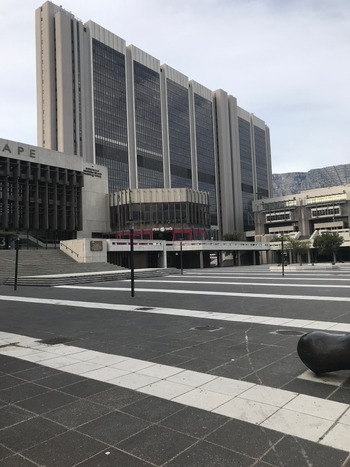
Some of the early hopes for the visual impact of the progress from sea to opera house can be appreciated when approaching the theatre from the north by road, where the view is of three consecutive horizontal planes: the natural table-top of Table Mountain, the slender administrative wing of the Civic Centre and the low profile of the Artscape Theatre complex. The latter two respond to the mountain and create a hierarchy of unequal visual steps towards the iconic natural vista (Figure 10).
Artscape, the Civic Centre administrative wing, and Table Mountain. (colour online)

The architectural language created by Macio Miszewski and KMH Architects employed a post-war approach to theatre construction that was popular at the time. Although in visual terms the theatre is relatively low lying and emphasises the horizontal, it shares with the David Geffen Hall of Lincoln Centre in New York City (Max Abramowitz, completed 1962) a dynamic relationship between lighting design that extends from the entrance lobby into the public piazza and a light-coloured, single-medium exterior cladding that seems to be the hallmark of mid-century opera theatres. It also resonates strongly with elements of post-war German opera-house architecture, particularly that of Fritz Bornemann's German Opera Berlin (1961), the Cologne Opera (1957) and the Hamburg State Opera (1955). The impact of the ambitious civic vision at Cape Town has been lost in the construction boom the city has since undergone. Restricted in its day to a 70% land usage policy that resulted in the broad piazza at the front of the building, no such restrictions seem to have been imposed on later buildings that tower over the theatre, creating a wind tunnel vulnerable to the notorious south-easterly that seasonally whips through the city. This crowding effect and persistent wind, along with the severity for which this mid-century style is often criticised, have not helped the Artscape to shake its historical baggage (about which more later).
The price of building on new land was that drainage wells and a state-of-the-art pump system would need to form part of the foundations and ground-level workings of the theatre. These complex architectural feats, the first for public buildings in the country, were well met by South African engineering, having cut its teeth on the stabilisation of underground spaces in the country's main industry: mining. The narrative of a republic building its way into the future, with home-grown expertise, was enhanced by this project of heroically wresting a new civic and cultural centre out of challenging terrain. In its very construction, ‘the Nico’ brought the tropes of operatic lore and South African history together. The melodramatic image of a haunted theatre with a subterranean body of water is well worn, and the dark and light of the creative process has found expression in the phantom-of-the-opera trope, a multi-genre literary phenomenon of opera as social signifier explored by John Snelson and others.Footnote 91
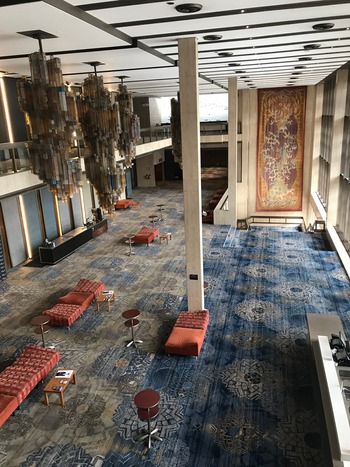
In South African historiography, the metaphor of mining spaces within South Africa – the struggle of the largely black world underground and the superficial world of white, apartheid-era respectability – has been treated by Nadine Gordimer and David Goldblatt in On the Mines.Footnote 92 The Nico Malan fuses these narratives; a project of hubris and grasping aspiration belies the deeply violent process that bubbles and churns at the building's roots. The space and place of the theatre have changed; now the venue is fully racially integrated, and the pump room lies idle following years of drought. The skeleton of the main stage and its technology went up, and then the walls and roof. To complete the building, a uniform cladding of travertine stone was added to the internal walls, a large-scale tapestry woven for the wall of the reception area and a complex set of Murano chandeliers were commissioned for the reception and echoed in the wall sconces of the main opera theatre (Figure 11).Footnote 93
The main theatre's lobby with Murano chandeliers and tapestry by Eleanor Esmonde-White. (colour online)

In the months preceding its opening a scandal erupted: the designation of the Foreshore as Whites Group Area meant that there would be no access to the area for Black or ‘coloured’ audiences. In combination with the laws preventing ‘non-white’ productions and audiences in an area reserved for whites under the Reservation of Separate Amenities Act, the new theatre would open with two drawbacks: it would have lost potential audiences and would also stand as a symbol of the ludicrous social engineering of the system. Both of these drawbacks were detrimental to an artistic venue that was to celebrate an urbane civilization.Footnote 94 The debate raged in a series of letters from academics, fans and political administrators in statements for and against the bans running in the Afrikaans Die Burger and the English-language papers The Argus and Cape Times. The hard-line exclusion of ‘coloured’ and Black audience members created in Cape Town a permanent rift in audience that extends to this day. Though it has been rebranded, there are those who will still not attend performances at the former Nico Malan.Footnote 95
The broader context explains the explosive scandal of the theatre's segregated beginnings. The same regime that was investing in cutting-edge technology to secure the highest quality concrete to resist the corrosive salinity and seepage, importing mining engineers to sink wells and battling the new earth to lay its deep foundations, was also dismantling the existing culture of Cape Town. Less than two kilometres from the site of the Nico Malan, the multi-racial District Six was being taken apart, renamed, whitewashed and erased from the records. Concerns about hygiene and crime, by then familiar smokescreens for racist discourse, were mobilised under protection of the Group Areas Act that criminalised mixed-race residential areas. It was the question of the place of ‘coloured’ identity in apartheid Cape Town that informed the eradication of District Six and the banning of Black and ‘coloured’ audiences from the Nico Malan. Whereas in other areas of the country the differentiation and division of Black and white was signalled through a fabricated rubric of racial optics, the centuries-old, established mixed-race community at the Cape, labelled ‘coloured’, consistently troubled the segregation policies.Footnote 96 Events surrounding the powerful work of ‘coloured’ philosopher and theatre writer Adam Small eventually broke the segregation of the audience with his seminal theatre work Kanna Hy Kô Hystoe.Footnote 97 The play deals explicitly with personal and communal ‘coloured’ identity in the context of the apartheid system, and its powerful message was amplified by the fact that its author would not be welcome in the audience of his own play. In 1971 he had already suffered the indignity of having to apply for special permission to attend the play's performance in the province of the Orange Free State, where his presence for more than twenty-four hours would be illegal.Footnote 98 Small's refusal to attend the Nico Malan premiere set events in motion that eventually led to the desegregation of the audience in 1975. They built on vociferous calls in the press for lifting the ban on ‘non-whites’ at the theatre, calls that had been raised since its opening year by renowned creatives such Uys KrigeFootnote 99 and Supreme Court judge Leslie Blackwell.Footnote 100 By 1974, key city councils, including those of Cape Town and Johannesburg, undertook to remove petty apartheid restrictions, effectively allowing the Nico Malan to shift policy.Footnote 101 By 1975, a specific government declaration made the theatre open to all races.Footnote 102
South African soprano Emma Renzi was booked to open the theatre in 1971 with Aida but fell ill, and, with no understudy in place, the opera was abandoned and a ballet became the headline billing for the opening performance. The nation-state glamour of Aida, conceived for such a different nation over 7,000 kilometres away, was to fulfil the same role in announcing the maturing of a regime. And, like the Egypt of Khedive Ismail, South Africa was announcing its arrival when its own collapse was already unfolding.
The alienating effect of its now-less-fashionable location and a political baggage that is difficult to shake made the rebranding of Artscape a challenge. By the late 1990s the arts councils had been disbanded, and the various departments of the Nico Malan had to become independent entities, applying for centralised arts funding from government on their own merit.Footnote 103 Along with the cuts in funding and shedding of jobs, there was a reduced focus on large productions and an increase in finding ways to allow the public to use the venue, in ways partially funded but with a strong commercial focus.Footnote 104 In March 2001 the name change from Nico Malan to Artscape was effected, and ever since, large-scale remodelling and modernisation of the facilities has supported this shifting identity. The current team, conscious of their exclusionary legacy, are working through substantial outreach programmes, a much wider diversity of regional and local content and a lot more than opera – including musical theatre, pantomime, prose theatre and popular review shows. The theatre complex has also become a home for Cape Town Opera, one of a number of production companies that have had to become self-sustaining post-apartheid. The standard repertoire opera season is contained, and apart from notable commissions including the Mandela Trilogy (Peter Louis van Dijk and Mike Campbell, 2010) or more recently Imivumba YamaQuawe: The Scars of Our Heroes (Siphumzo Lucwaba, 2019), it produces standard-fare opera: La Bohéme, Mozart, and so on. It sits with the problems of its pedigree – the austere and alienating entrance has always signalled brutal power and inaccessibility – but a new vision aims to change all that. This idea was first publicly discussed in the media in 2012: a key visual aspect of the proposed revamp is to enclose, add colour to and make welcoming the broad and intimidating entrance facade, presumably with a view to drawing in patrons from the street.Footnote 105 These plans, like the broader Foreshore rejuvenation, are mired in the city's often static politics, although the theatre continues to present high-quality works, with opera as one aspect of a much broader vision for the role of theatre in Cape Town's city centre.
When the name change was proposed in the late 1990s, Achmat Adams, a set-builder, had never seen a show at the theatre:
in the old days we worked in the factory, but we couldn't go to the plays. We were allowed to go and see a rehearsal, but we weren't allowed to use the front entrance; we had to go through backstage. But I never went – it was my personal policy. If we couldn't see the end product in the proper way, I didn't think it was worth going in any other way.Footnote 106
Today a wide range of audiences view an equally wide range of shows, ranging from Shakespeare and the St Petersburg Ballet Theatre to plays in isiXhosa The range of shows is matched by a range in price, from R80 ($5.14) for the aforementioned play in isiXhosa to R690 ($44.30) for the St Petersburg Ballet. Today, the theatre is an informal space, filled with student- and child-centred programming, with extensive holiday programming available to a range of income groups. Opera remains, but as one part of the experience, compressed and repurposed as part of broader vision of theatre.
* * *
In these two African cities, building opera houses was the sine qua non in the nineteenth-century imagination of what a city should be. The opera houses in Cairo and Cape Town set in motion a conversation about the place of opera, and by extension Western culture, that far exceeds the actual presence of opera in the respective countries. Turning to cinema and many other forms of entertainment long before they were demolished, the old houses pulled back the grand drapes that had admitted a limited audience and quickly adapted their programmes.
Opera houses in Africa were established not as a nod towards tradition, however, but as pointers towards modernity. The Khedivial Opera House was one anchor in a plan to set up a new Cairo. Only just connected to Azbakeya as an entertainment district, the Khedivial Opera House would always hold itself at arms length from the Arabic café chantants, the sign of a benevolent, modern Arab leader.Footnote 107 Achieving with culture what Ibrahim had achieved from the saddle, Ismail connected his dynasty with modernity and performed that connection regularly at the opera. Gamal Nasser would continue to use the theatre for this purpose.Footnote 108 When the world had changed to such an extent that very few Egyptians would publicly seek advancement in the rituals of Western theatre, a fire would solve one of the problems of a passé institution. It would be replaced later with a mammoth statement of Egyptian nationalism, in style and character an externalisation of Arabic and Pharaonic fantasy. The complex sings and plays in a number of Egyptian vernaculars and still performs the rituals of Western classicism in its main auditorium. Aida and Kulthum dominate as successive personifications of the country. Now they face censure once again as a youthful Egypt reconsiders its place in the Maghreb, looking for new stories. In Egypt, opera still stands as signifier of what Western-facing progress could be. As a cultural practice it connects Egyptians to a broader Mediterranean world, but cannot shake its belle-époque connotations, something that still rankles national pride in a state that prevaricates over its place in the Mediterranean and Maghreb. What remains of opera sits side-by-side in Cairo with well-defined practices of contemporary and traditional Arab musics.
Cape Town took longer to establish a formal, permanent theatre space, but placed it alongside its commercial institutions, a new and shining statement of permanence for the arts, near railway and bank and parade. There, the amateur and the visiting professional, music student and touring personality could all have the opportunity to impress the small English community. When the needs of that urban community pressed for a new central post office, the opera house (already a part-time cinema) was demolished. The operatic state of late apartheid, concerned as it was with appearances and particularly those that emphasised civilisation, would use the new land, wrested from the sea, to establish a whites-only theatre in what was arguably South Africa's most ethnically diverse city. Opera would be predominantly European, and even when South African white talent was used, it would reflect European culture as ‘best practice’. Today the theatre stands, and plans for its future are ambitious.
Classical music has a widespread presence across demographics in South Africa, spread in particular through the system of massed choral music competitions but also through the rise of Black South African art-music composers. As a result, much more of what occupies the operatic stage is experimental and hybrid.Footnote 109 But many of the colonial associations still apply. Added to this is the persistent problem of Artscape's struggle to shed its alienating Nico Malan pedigree, manifested so directly in its location and architecture. As the terms of inclusion and exclusion in modernity became apparent to postcolonial regimes, the opera houses seem to have been rebuilt simply because a city without them seemed backward. What to produce in these houses is a matter that continues to develop in fits and starts.