Implications
The stage of maturity at harvest and chopping affects the size dimensions of the swallowed forage particles, which may affect the passage rate kinetics in the rumen. The decreased particle size dimensions along the digestive tract strongly confirm the selective retention of long and width particles within the rumen. The structural value of alfalfa silage fed to cattle in terms of mean ruminating time and number of jaw movements per kg NDF decreases due to chopping and early harvest.
Introduction
There are anatomical differences between grasses and legumes that affect the physical and chemical characteristics of the structural fibre (Hoffman et al., Reference Hoffman, Combs and Casler1998). Intake of legumes is often higher than those of grasses at same digestibility (Wu et al., Reference Wu, Kanneganti, Massingill, Wiltbank, Walgenbach and Satter2001). Legume crops like alfalfa are characterized by a lower content of structural fibre (NDF), higher ratio of indigestible NDF (INDF), a lower potential digestibility of NDF (DNDF), a higher rate of digestion of DNDF and more lignified and rigid NDF fibre compared with grass silages at the same level of organic matter digestibility (Dewhurst et al., Reference Dewhurst, Fisher, Tweed and Wilkins2003).
A certain intake of physically effective fibre is required for promoting optimal rumen function and to avoid digestive disorders such as rumen acidosis (Mertens, Reference Mertens1997). Mertens (Reference Mertens1997) reported a maximum NDF intake (NDFI) of 1.1% of BW and Nørgaard et al. (Reference Nørgaard, Nadeau, Randby and Volden2011) recommended a minimum chewing index (CI) of 32 min/kg dry matter (DM). The mean chewing time per kg forage NDF has been used for characterization and ranking the structural value of feeds for dairy cattle.
In the Nordic ration formulation system (NorFor), the CI values of the individual forages depend on the content of NDF, the particle theoretical cutting length (TCL) value and the INDF to NDF ratio. The CI value is calculated as the sum of an eating and ruminating index (Nørgaard et al., Reference Nørgaard, Nadeau, Randby and Volden2011). The INDF to NDF ratio is used to reflect the resistance against physical degradation during mastication during ruminating in NorFor.
The particle size in forage, digesta and faeces has been measured by use of wet and dry sieving techniques (Allen et al., Reference Allen, Robertso and van Soest1984), and the image analysis technique (Luginbuhl et al., Reference Luginbuhl, Fisher, Pond and Burns1991; Nørgaard and Sehic, Reference Nørgaard and Sehic2003). Arithmetic and geometric mean particle size obtained from the sieving technique appears to be a poor descriptor of particle size distribution in feed and digesta because of a left skewed distribution of particle size values. Use of the image analysis technique makes it possible to characterize the distribution of particle length (PL) and particle width (PW) values of forage, boli, rumen and faeces particles (Nørgaard, Reference Nørgaard2006).
There is limited knowledge available about chewing activity and the breakdown characteristics of alfalfa particles from alfalfa silage at different stages of maturity and chopping lengths and especially alfalfa grown at Nordic latitudes. Further, studies where the pure forage effect is studied are scarce, as high-yielding dairy cows are fed concentrated rations and thereby the digesta and faeces contain residues from both concentrates and forages.
The objective of this study was to study the effect of harvest time and chopping on the structural value of alfalfa silage in terms of chewing activity and the changes in particle size distributions along the digestive tract in cows.
Material and methods
Alfalfa silage
The alfalfa (Pondus) was grown in 2005 and harvested with a disk mower (JF-STOLL, Sønderborg, Denmark) at two stages of maturity in primary growth (Early bud and early flowering (Kalu and Fick, Reference Kalu and Fick1981)): 7 June 2005 and 21 June 2005. The index used for terminating the wilting period was to attain a DM of 35%. Half of the crops from each harvest time were chopped at a TCL of 19 mm with an exact chopper (TAARUP 602, Herning, Denmark) built together with a baler (Hesston 4700, Herning, Denmark). The long treatment was cut with a traditional cutter on the baler (GMS 100; JF-STOLL, Sønderborg, Denmark).
The treatments were alfalfa silage harvested at two stages of growth (early, late) fed in a chopped (TCL = 19 mm) or long physical form (∼50 cm). The crops were baled with 200 to 600 kg per bale and wrapped with 10 layers of plastic film within 2 h after baling. A silage agent (DoubleAction ECOSYL from DLF-Trifolium, Roskilde, Denmark) with Lactobacillus Plantarum and potassium sorbate (one million live bacteria per gram forage) was applied (2 l/ton) with a pump and sprayer system on the swath, immediately in front of the pick-up during baling.
Animals, experimental design and housing
Four non-lactating rumen cannulated Jersey cows with an average initial live weight of 391 (±26) kg were assigned to a 4 × 4 Latin square design with four dietary treatments assigned to four experimental periods with a length of 3 weeks each. The cows were kept in individual temperate tie stalls with rubber mats. The animals had access to separate, automatic water bowls and a manger for forage. BWs were measured before the experiment began and after each experimental period. The experimental procedures used in this study were approved by the Research Animal Ethics Committee (The Animal Protection Law – The Danish Ministry of Justice).
Feeding and management
Each experimental period consisted of an adaptation period from day 1 to 14, and a recording and collection period from day 15 to 20. The animals were fed ad libitum from day 1 to 11 and 80% of ad libitum from day 12; feeding twice daily at 0730 and 1530 h. A restrictive feeding level intake was chosen to avoid selection of late-harvested long alfalfa stems. Individual daily intake of alfalfa silage was recorded for all cows. One silage bale per treatment was used in each recording period. Mineralized salt containing biotin (12 mg/kg), manganese (190 mg/kg), iron (210 mg/kg), copper (80 mg/kg), cobalt (12 mg/kg), zinc (300 mg/kg), iodine (50 mg/kg) and selenium (20 mg/kg) was available during the adaptation period.
Sampling of feeds
A sample of 1 kg was taken from each silage bale with a silage spear for chemical analyses. The samples were pooled to one sample per treatment per period (16 samples). Forage, rumen content and faeces were analyzed for DM, ash, CP, NDF, ADF and ADL. The forage was further analyzed for crude fat, crude fibre and SCFA (short chain fatty acids) concentration.
Chewing activity
Chewing activity was measured 96 h continuously from day 1 in the recording period. Jaw movements (JM) and oscillations (JMO) were recorded by the use of a chewing halter (Nørgaard and Hilden, Reference Nørgaard and Hilden2004). The JMO values were sampled at 15 Hz on a memory card. The JM identified from the JMO were clustered into crude cycles (CC) and CC were clustered into crude periods of eating and ruminating. The chewing rate and basic chewing rate (BCR) within each cycle were estimated according to Schleisner et al. (Reference Schleisner, Nørgaard and Hansen1999). The individual crude periods were classified as either rumination periods, eating periods, idling periods or licking as described by Schleisner et al. (Reference Schleisner, Nørgaard and Hansen1999). The daily time spent eating and ruminating was estimated as the accumulated daily duration of identified eating and rumination crude periods. The daily chewing time was estimated as the daily eating time plus the daily rumination time. The cycle time was estimated as the time from the first JM to the last JM in a CC +1/BCR. The effective eating and rumination times within the corresponding periods were estimated as the sum of cycle time values. The inter cycle times (ICT) between the individual rumination cycles (the time from swallowing to regurgitating a bolus) was estimated as the difference between total rumination time and effective rumination time divided by the daily number of ruminating cycles minus one cycle per period (Schleisner et al., Reference Schleisner, Nørgaard and Hansen1999).
Eating rate
Eating rate at restricted feeding was measured at day one in the recording period during four meals of 20 min. 20% of the daily ration was offered at 0730, 0755, 1530 and 1555 h. Eating behaviour was observed during the 20 min periods and orts and the remaining 10% were weighted and re-fed after meal two and four. The eating rate was calculated as silage consumed per time spent eating (g DM/min and g NDF/min).
Boli, rumen and faeces sampling
Faeces samples (200 ml) were collected rectally at day 1, 2, 3 and 4 in the recording period in the morning, at noon and in the afternoon, respectively and stored in a freezer. The three samples from each day were homogenized and frozen. Samples from all 4 days were pooled to one representative sample per cow and period. At day 20, rumen samples were collected from the ventral rumen sac. One sample before the morning meal, one half an hour after the cow finished eating and all forages were gone and one at 1200 h. The rumen contents were evacuated at noon at day 20. The rumen material was separated into a liquid and a solid phase and three samples of (1.5 kg) of each phase were stored at −20°C. Before returning the contents to the rumen the cow was fed 5 kg of its daily feed and the first 25 boli were collected and weighed.
Chemical analysis
The DM determination was performed at 60°C to constant weight. For chemical analyses, samples were freeze-dried and ground through a 1 mm screen in a Cyclotec sample mill (Foss, Hillerød, Denmark). The ash content was determined by incineration at 525°C for 10 h in a Heraeus furnace (type MR 260 E, Gemini, AG Etten-Leur, The Netherlands). Fresh samples were analyzed for total nitrogen (N) following the Kjeldahl procedure (Association of Official Analytical Chemists (AOAC), 2002) and CP was calculated as N × 6.25. Crude fat was determined after hydrolysis with hydrochloric acid and extraction with petroleum ether in a Soxtec system (Foss, Hillerød, Denmark). NDF, ADF and ADL were analyzed sequentially according to van Soest et al. (Reference Van Soest, Robertson and Lewis1991) with the use of α-amylase and corrected for ash. Crude fibre was analyzed by boiling in sulphuric acid followed by sodium hydroxide. All fibre analysis was carried out by the use of Fibrecaps (Foss Electric, Hillerød, Denmark). The INDF was determined in sacco and incubated for 288 h in the rumen after being ground through a 1.5 mm screen in a cutter mill (Heavy-Duty Cutting Mill SM 2000, Retsch, Haan, Germany; Åkerlind et al., Reference Åkerlind, Weisbjerg, Eriksson, Thøgersen, Udén, Ólafsson, Harstad and Volden2011). Sugar, Klasons lignin and uronic acid were measured by methods described by Knudsen (Reference Knudsen1997). Silage fermentation products were analyzed in extracts from samples of alfalfa silage. Water (1 l) was added to thawed samples (100 g). The samples were blended in a Bosch Chopper (Type: CNCM13ST1, Ballerup, Denmark) and 40 ml of homogenized sample was centrifuged. The pH was measured in the supernatant before stabilizing with 5% meta phosphorus acid. Acetic, propionic, butyric and lactic acid and ammonia were quantified as described by Nielsen et al. (Reference Nielsen, Kristensen and Weisbjerg2007).
Washing and sieving of samples
Faeces (30 g), boli (30 g), rumen content (30 g) and rumen fluid samples (90 g) were washed in nylon bags (10 μm) in a washing machine added 4.0 ml of liquid soap (Biotex color, Copenhagen, Denmark) and washed for 2 h at 40°C. The measuring of particles from the digestive tract by the use of Image Pro plus depends on dry and easily separated particles. If the particles are dried in an oven, a hard protein shell will cover the particles and prevent them from separating. This is avoided by washing out the protein and easily hydrolysable carbohydrates (e.g. starch) of the particles, followed by freeze-drying. The samples were freeze-dried and dry-sieved into six fractions (4.750 (T), 2.360 (O), 1.000 (M), 0.500 (S), 0.212 mm (D) and a bottom bowl) by the use of a vertical sieve shaker (Retsch AS 200; Retsch GmbH, Haan, Germany). Entangled particles were separated by use of a brush. The mass proportion of particles of each sieve and the mean geometric (GPS) faecal particle size were calculated according to Waldo et al. (Reference Waldo, Smith, Cox, Weinland and Lucas1971).
Image analysis
After sieving particles, image analysis was used for measuring the particle size distribution in boli, rumen content, rumen fluid and faeces. From sieve fraction T and O all the materials were scanned and from sieve fraction M (0.016 to 0.02 g) and S (0.0065 to 0.007 g) two subsamples were scanned. The particles were placed on a HP Scanjet 8300 Scanner (Allerød, Denmark) and scanned at 2400 dpi in multicolour with a blue background. From bottom bowl B (0.0006 to 0.001 g), one subsample was distributed on a Scan Mate F8Plus (Brøndby, Denmark) and multicolour scanned at 4800 dpi against a blue background. The particle dimensions were measured in Image Pro Plus (version 5.5; media cybernetics, 2007). A gamma distribution function (γi) was estimated for PL and PW values for each sieving fraction. The overall probability density distribution functions (PDF(PL), PDF(PW) and PDF(PL : PW)) were estimated as composite functions of γi by weighing with the proportion of particle mass within each sieving fraction. The most frequent length (mode PL), width (mode PW) and PL : PW (mode PL : PW) values were estimated by step wise identification of peaks on PDF(PL) and PDF(PW) functions. In this study where two peaks in the probability density distribution are present, the mode value is the first peak value at the x-axis. The predicted median length (MPL), width (MPW) and PL : PW ratio and the 95 percentile of length, width and PL : PW were estimated from the cumulative distribution functions (CDF) of CDF(PL), CDF(PW) and CDF(PL : PW), respectively, as described by Nørgaard (Reference Nørgaard2006). The arithmetic mean particle length (APL) and width (APW) and the geometric particle length (GPL) and width (GPW) were estimated for each sieving fraction as described by Nørgaard and Hilden (Reference Nørgaard and Hilden2004).
Statistical analysis
All experimental data were analyzed using the PROC MIXED of SAS® (SAS system for Windows, release 9.2; SAS Institute Inc., Cary, NC, USA). Intake, eating rate, chewing activity and particle size data were analyzed according to the following model:
 $$\[ {{{Y}_{ijklm}}\,{\rm{ = }}\,\mu \,{\rm{ + }}\,{{M}_i}\,{\rm{ + }}\,{{F}_j}\,{\rm{ + }}\,{{P}_k}\,{\rm{ + }}\,{{C}_l}\,{\rm{ + }}\,M{{F}_{ij}}\,{\rm{ + }}\,M{{P}_{ik}}\,{\rm{ + }}\,F{{P}_{jk}}\, \cr \quad{\rm{ + }}\,{\rm{(}}{{N}_m}\,\times \,{{X}_{ijklm}}{\rm{)}}\,{\rm{ + }}\,{{e}_{ijklm}} \eqno\$$
where Yijklm = dependent variable, μ = overall mean, Mi = fixed effect of harvest time of alfalfa silage (i = 1 to 2), Fj = fixed effect of physical form of alfalfa silage (j = 1 to 2), Pk = fixed effect of period (k = 1 to 4), Cl = random effect of cow, MFij = interaction between harvest time and physical form, MPik = interaction between harvest time and period, FPjk = interaction between physical form and period, Nm × Xijklm = NDFI per kg BW (covariate) and eijklm = residual error. Effects were declared significant at P < 0.05 (P < 0.05 (*), P < 0.01 (**) and P < 0.001 (***)) and as a tendency to significance (TS) at 0.05<P < 0.10 in the F-test.
Results
Silages
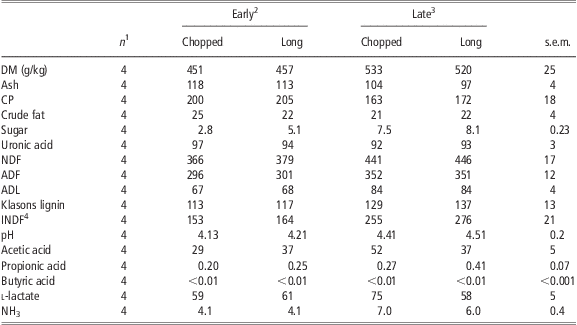
The chemical composition and nutritional characteristics of the silages are presented in Table 1. The late chopped silage had a higher DM content compared with the early chopped silage due to a longer wilting period. The fermentation products were primarily lactic and acetic acid (Table 1). All the silages were of good fermentation quality. The pH value of the silages ranged from 4.1 in chopped early to 4.5 in late long silage. The lowest ammonia concentration was achieved by early harvest despite the higher DM content at late harvest. The content of butyrate was below 0.01 g/kg DM in all samples.
Chemical composition and pH of alfalfa silage harvested at different stages of growth and in long and chopped form – all values are in g/kg DM, unless stated otherwise
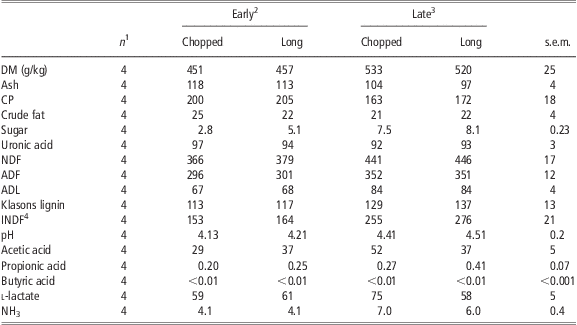
DM = dry matter; INDF = indigestible NDF.
1Number of samples per treatment.
2Early: harvested before blooming.
3Late: harvested at blooming.
4Determined in situ (288 h) on pooled samples of chopped and long silages.
Intake, eating rate and eating activity
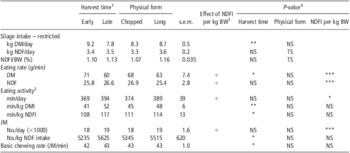
Data on feed intake, eating rate and eating activity are given in Table 2. The eating activity is expressed as the effective eating activity, for example, the ICT are not included. The ad libitum silage dry matter intake (DMI; kg/day) was 18% higher in the early harvested silage compared with the late (P < 0.01) and 7.8% higher in the long compared with the chopped silages (NS).
Effects of harvest time (early or late) and physical form (chopped or long) of alfalfa silage on eating activity in cows

NDFI = NDF intake; DM = dry matter; TS = tendency to significance; DMI = dry matter intake; JM = jaw movements; NS = non significant.
1Early: before blooming; Late: at blooming.
2Effective eating activity.
3+: increased value due to increased NDFI per kg BW.
4No interaction between harvest time and physical form.
***P < 0.001, **P < 0.01, *P < 0.05, TS 0.05<P < 0.10.
Early harvest of the alfalfa silage increased the eating rate (g DM/min; P < 0.05) and decreased the mean effective eating time (min/kg DMI and min/kg NDFI) and the number of JM (No./kg NDFI). The chopping did not affect the eating rate or eating activity significantly. Increased NDFI per kg BW increased the eating rate (g DM/min, g NDF/min) and the number of JM per day. There was no interaction between harvest time and chopping.
Ruminating and total chewing
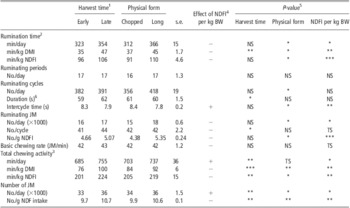
The ruminating and total chewing time is presented as the effective time, which does not include the duration of the ICT. Chopping the silage decreased the daily and daily effective rumination time (min/day) (P < 0.05), the mean ruminating time per kg DMI, kg NDFI (P < 0.05), number of rumination cycles per day (P < 0.05) and number of JM per day and per kg NDFI (P < 0.05), and increased the ICT value from 7.8 to 8.4 s (P < 0.05; Table 3). Delaying harvest increased the mean effective rumination time from 35 to 47 min/kg DMI (P < 0.01), the duration of cycles and the number of JM per cycle (P < 0.05).
Effects of harvest time (early or late) and physical form (chopped or long) of alfalfa silage on ruminating and total chewing activity in cows

NDFI = NDF intake; DMI = dry matter intake; JM = jaw movements; NS = non significant; TS = tendency to significance.
1Early: before blooming; Late: at blooming.
2Effective ruminating activity.
3Effective total chewing activity.
4+: increased value due to increased NDFI per kg BW; −: decreased value due to increased NDFI per kg BW.
5No interaction between harvest time and physical form.
6Duration includes intercycle time.
***P < 0.001, **P < 0.01, *P < 0.05, TS 0.05<P < 0.10.
A covariance analysis showed that a high mean ruminating time per kg DMI and NDFI correlated with lower ICT values. Short daily ruminating time (min/day) resulted in lower mean chewing time per boli and longer ICT with an R 2 = 0.97. The ICT was negatively correlated with the mean number of JM per cycle (R 2 = 0.42), the mean duration of ruminating cycles (s; R 2 = 0.58), the effective ruminating time (min/kg NDF; R 2 = 0.52) and JM per kg NDF (R 2 = 0.54). The ICT values were positive correlated with the NDFI per kg BW (data not shown).
Early harvest of the alfalfa silage decreased the daily total effective chewing time from 755 min to 685 min/day (P < 0.01), the mean effective chewing time per kg DMI (P < 0.001) and chewing time per kg NDFI (P < 0.01), the daily number of JM (P < 0.01) and the mean number of JM per kg NDFI (P < 0.01). Chopping of the silages decreased the mean effective rumination time per kg DMI (P < 0.01) and per kg NDFI (P < 0.05), the daily number of JM (P < 0.05) and the mean number of JM per NDFI (P < 0.01).
The NDFI relative to BW is included in the statistical model as a covariate. With this covariate it is possible to see the consequences of changing the NDFI per kg BW on the chewing and particle size parameters. For the eating parameters, there is a highly significant increase in the eating rate (g DM/min, g NDF/min) and the number of JM at increasing NDFI per kg BW (P < 0.001; Table 2). The rumination time (min/day, min/kg DMI, min/kg NDFI) is decreased significantly at increasing NDFI per kg BW (Table 3). There was no interaction between harvest time and physical form regarding any of the chewing parameters.
Particle DM
Table 4 shows the mean content of particle DM (PDM) in DM for boli, rumen content and faeces. The PDM values ranged from 37% in rumen fluid from cows offered early harvested silage to 76% in rumen contents from cows offered late-harvested silage. Late harvest caused a higher PDM value in feed boli (P < 0.001), rumen content (P < 0.01), rumen fluid (P < 0.001) and faeces (P < 0.01), whereas chopping did not affect the PDM values significantly. Also between the four types of digesta there was a significant difference with the highest DM content in rumen content and the lowest in rumen fluid.
Particle DM relative to total DM (%) in the different types of digesta

DM = dry matter; NS = non significant; TS = tendency to significance.
1Early: before blooming; Late: at blooming.
2Rumen content refers to the solid material collected on a wire net during rumen evacuation.
3No interaction between harvest time and physical form.
a–dMeans within a column with different superscripts differ (P < 0.05).
***P < 0.001, **P < 0.01, TS 0.05<P < 0.10.
Particle size distribution in boli, rumen content and faeces measured by image analysis
The TCL of the chopped forage was 19 mm. The most frequent PL was 12.5 and 13.5 mm for early and late chopped alfalfa silage, respectively. The median PL was 23.5 mm for both early and late chopped alfalfa silage. The unchopped silages were too long for image analysis.
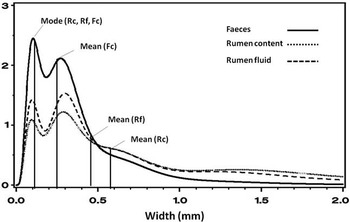
Two distinct local peaks on the probability density functions of PL and PW value in boli, rumen content, rumen fluid and faeces were identified at each of the four treatments. The lowest identified local peak was considered as the Mode value (Figure 1).
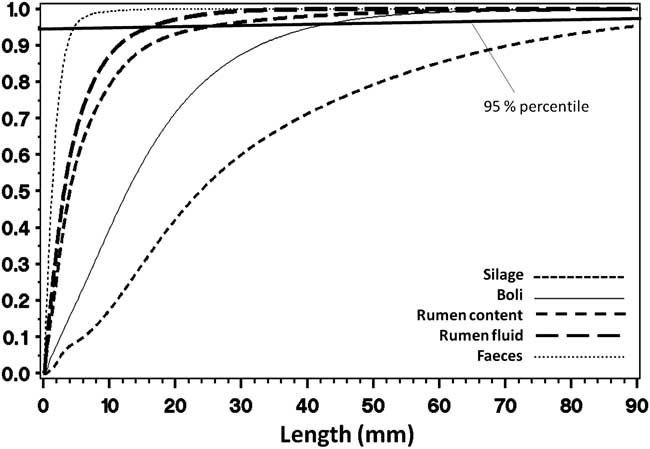
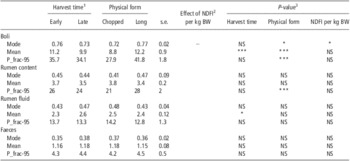
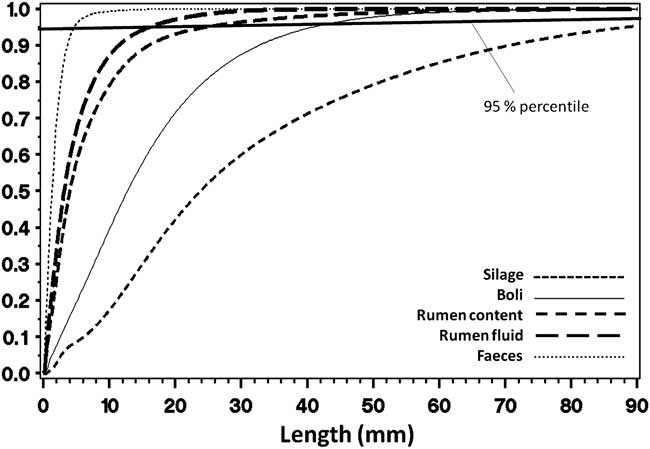
The distributions of PL, PW and PL to PW ratio values in feed boli, rumen content and faeces are left skewed with many short and thin particles and few large particles as illustrated in Figure 1 (only PW for rumen fluid, rumen content and faeces are shown). The distributions of PL and PW values in feed boli, rumen contents and faeces are characterized by two local peaks, a geometric mean and a 95 percentile values as illustrated in Figures 1 and 2. Chopping caused a significantly lower mean PL value of feed boli particles and a lower 95 percentile of values of particles in feed boli and rumen content (Table 5). The early harvest caused higher mean PL values in feed boli (P < 0.001) and lower PL values in rumen fluid (P < 0.05). The NDFI per kg BW did only affect the mode PL value in boli with a decrease with increasing NDFI per kg BW (P < 0.05). The CDF(PL) values in chopped silage, feed boli, rumen content and faeces illustrate the gradually decreasing PL values from forage to feed boli, rumen content and to faeces (Figure 2).
Probability density functions of particle width in solid rumen content (Rc), fluid rumen content (Rf) and faeces (Fc) from Jersey cows fed alfalfa silage.

Cumulative distribution functions of particle length in chopped silage, boli, solid rumen content, fluid rumen content and faeces from Jersey cows fed chopped alfalfa silage.
Effect of harvest time (early or late) and physical form (chopped or long) of alfalfa silage on PL (mm) in boli, rumen content (solid and fluid) and faeces measured by image analysis

PL = particle length; NDFI = NDF intake; NS = non significant.
Mode: most frequent particle length.
Mean: the geometric particle length.
P_frac-95: the 95% percentile, the critical particle length.
1Early: before blooming; Late: at blooming.
2+: increased value due to increased NDFI per kg BW; −: decreased value due to increased NDFI per kg BW.
3No interaction between harvest time and physical form.
***P < 0.001, *P < 0.05, TS 0.05<P < 0.10.
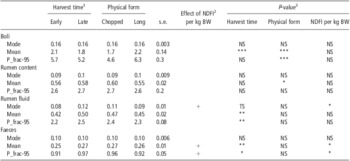
Chopping caused a lower mean PW in feed boli (P < 0.001) and a lower 95 percentile PW value in feed boli (P < 0.001) but a higher mean PW values in rumen content (P < 0.05; Table 6). Late harvest caused a higher mean PW value (P < 0.01) and a higher 95 percentile PW (P < 0.01) value in rumen fluid and faeces (P < 0.05), but the mean PW in feed boli decreased from 2.1 to 1.8 (P < 0.001). Increased NDFI per kg BW increased the mode PW value in rumen fluid, the mean PW and the 95 percentile PW value in faeces.
Effect of harvest time (early or late) and physical form (chopped or long) of alfalfa silage on PW (mm) in boli, rumen content (solid and fluid) and faeces measured by image analysis

PW = particle width; NDFI = NDF intake; NS = non significant; TS = tendency to significance.
Mode: most frequent particle width.
Mean: the geometric particle width.
P_frac-95: the 95% percentile.
1Early: before blooming; Late: at blooming.
2+: increased value due to increased NDFI per kg BW; −: decreased value due to increased NDFI per kg BW.
3No interaction between harvest time and physical form.
***P < 0.001, **P < 0.01, *P < 0.05, TS 0.05<P < 0.10.
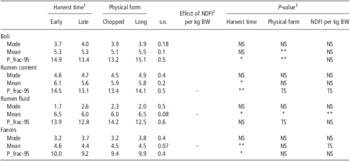
Feeding early harvested alfalfa silage caused a higher mean PL to PW ratio (PL : PW) in rumen content, rumen fluid and faeces and a higher 95% percentile in rumen content and faeces (Table 7). Chopping caused a significantly lower mean PL : PW value of boli and rumen fluid particles.
Effect of harvest time (early or late) and physical form (chopped or long) of alfalfa silage on PL : PW ratio in boli, rumen content (solid and fluid) and faeces measured by Image analysis

PL = particle length; PW = particle width; NDFI = NDF intake; NS = non significant; TS = tendency to significance.
Mode: most frequent particle length : particle width.
Mean: the geometric particle length : particle width.
P_frac-95: the 95% percentile.
1Early: before blooming; Late: at blooming.
2+: increased value due to increased NDFI per kg BW; −: decreased value due to increased NDFI per kg BW.
3No interaction between harvest time and physical form.
**P < 0.01, *P < 0.05, TS 0.05<P < 0.10.
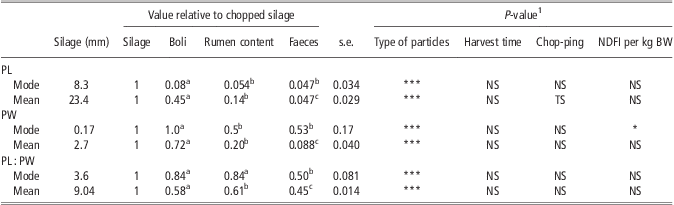
The mode PL and PW values decreased from feed boli to rumen content, but the mode PL and PW values in rumen content and faeces did not differ significantly (Table 8). The mean PL and PW decreased (P < 0.001) from boli to rumen content and from rumen content to faeces. The mode PL : PW ratio of particles in feed boli and rumen content did not differ significantly, but the mode PL : PW ratio was lower (P > 0.001) in faeces compared with rumen content. The mean PL : PW ratio of particles increased from feed boli to rumen content (P < 0.05) and decreased from rumen content to faeces (P > 0.01). Figure 1 shows a more detailed picture of the mode PW values in rumen fluid, rumen content and faeces. The mean PW values and the PL : PW ratio of faeces particles was significantly lower compared with rumen content.
The particle dimensions along the digestive tract relative to the particle size in chopped silage
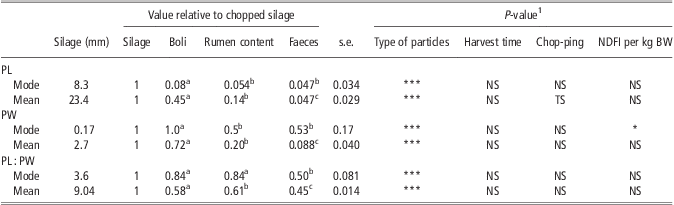
NDFI = NDF intake; PL = particle length; NS = non significant; TS = tendency to significance; PW = particle width.
Chopped silage is not included in the statistical model because of fewer samples.
Mode: most frequent particle size.
Mean: the geometric particle size.
1No interaction between harvest time and physical form.
***P < 0.001, *P < 0.05, TS 0.05<P < 0.10.
The mode, mean and the 95% percentile (PL, PW and PL : PW values) of the 1st, 5th, 10th, 15th and 25th feed boli did not differ significantly (data not shown). There was no interaction between harvest time and physical form regarding any of the particle size parameters.
Particle size distribution in boli, rumen content and faeces measured after dry sieving
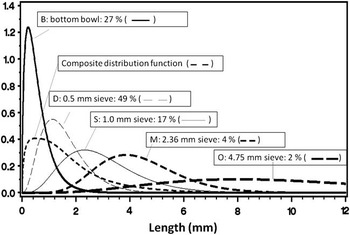
As an illustration the PL distribution of washed and dried particles from the five sieving fractions are shown in Figure 3. Early harvest treatment caused a higher proportion of PDM retained on the sieves >1 mm in boli (P < 0.001) and a lower in rumen content (P < 0.05), rumen fluid (P < 0.05) and faeces (P < 0.10). Early harvested alfalfa silage caused a lower proportion of boli PDM, but a higher proportion of rumen fluid particles retained in the bottom bowl (P < 0.01). Early harvest increased the mean particle size in boli (P < 0.001), but lead to smaller mean particle size in rumen fluid (P < 0.05) and faeces (P < 0.10).
Particle length distribution of washed and dried faeces particles from the five sieving fractions (O (4.75 mm), M (2.36 mm), S (1.0 mm), D (0.5 mm) and bottom bowl), the mass proportion of sieve fraction and the composite distribution function (G) for the overall distribution of particle length from Jersey cows fed alfalfa silage.

The mean particle size and the proportion of PDM retained on the 1 mm sieve size in boli decreased due to chopping (P < 0.001). The proportion of boli particle mass retained in the bottom bowl decreased due to chopping (P < 0.001). Chopping increased mean particle size and the proportion of particle mass retained on the 1 mm sieve size (P < 0.01). Approximately 30% of the mass of faeces particles was collected in the bottom bowl (data not shown).
Discussion
Method and material
Luginbuhl et al. (Reference Luginbuhl, Pond, Burns and Russ1989) found increasing mean ruminating and mean chewing time (min/kg NDF) due to feed restriction in growing steers and a slightly increased NDF in the orts compared with hay DM at increasing feeding level from 88% to 99% of ad libitum of low quality grass hay. A feeding level of 80% of ad libitum intake was chosen in the present experiment to avoid selection of late-harvested long alfalfa stems.
Intake, eating rate and chewing activities
Voluntary DMI is limited by fill to a greater extent for forages with low digestibility and high fibre contents (Allen, Reference Allen1996). The ad libitum intake of NDF ranged from 1.07 by feeding chopped silages to 1.16% of BW when unchopped silage was fed (Table 2). These values do not disagree with the values found by Mertens (Reference Mertens1994) in cattle fed forage ad libitum. The NDFI per kg BW was not affected by chopping in accordance with Rustas et al. (Reference Rustas, Nørgaard, Jalali and Nadeau2010). Feed intake was expected to be highest for chopped silage. However, in this study the ad libitum DMI was unaffected by PL as also seen in experiments of Clark and Armentano (Reference Clark and Armentano2002).
A high eating rate and a short eating time (min/kg DMI and min/kg NDFI) correlate with wider and longer swallowed boli particles from the early harvest crop (P < 0.001) as seen in experiments by Luginbuhl et al. (Reference Luginbuhl, Pond, Burns and Russ1989). Likewise significantly more particles from boli were retained on the sieves with a pore size larger than 1 mm and fewer retained in the bottom bowl from the early harvested silage and the long silages. The rate values correspond to 14 to 17 min eating time per kg DM, which is much lower compared with the mean effective eating time throughout the 24 h period ranging from 41 to 52 min/kg DMI (Table 2). These eating rate values are measured in the beginning of a meal when the cows are hungry and in this experiment the cows are fed restrictive, which may stimulate the rate of eating according to Baumont et al. (Reference Baumont, Malbert and Ruckebusch1990). Baumont et al. (Reference Baumont, Malbert and Ruckebusch1990) showed in an experiment with ewes that the eating rate was highest in the beginning of a forage meal. Chopping did not affect rate of eating or mean eating time in agreement with observation in dairy cow fed alfalfa silage (Bhandari et al., Reference Bhandari, Li, Ominski, Wittenberg and Plaizier2008) or whole crop barley silage (Beauchemin and Yang, Reference Beauchemin and Yang2005), whereas Deswysen et al. (Reference Deswysen, Bruyer and Vanbelle1984) observed a higher rate of eating in heifers fed grass silage due to chopping.
The lower proportion of particles retained on the 1 mm sieve size and the lower mode, mean and 95 percentile PL and PW values in swallowed silage boli in cows fed chopped silage (Tables 5 and 6) in combination with no effect of chopping on rate of eating and mean eating time per kg NDF indicate that the masticative activity during intake is not only controlled by the particle size. By plotting the eating rate against the mean PL and PW in boli, there was a positive correlation between eating rate (g DM/min, g NDF/min) and mean PW or mean PL values (P < 0.01) (data not shown) in agreement with the findings in steers by Luginbuhl et al. (Reference Luginbuhl, Pond, Burns and Russ1989). Furthermore, a covariance analysis showed that as the size of the particles in boli increased at increasing rate of eating NDF (P < 0.001), and the particles were generally smaller when chopped silage was fed (P < 0.001; data not shown).
The chewing times presented in Tables 2 and 3 are effective chewing times exclusive pauses between cycles. However, it must be noted that monitoring JM might have lead to an overestimation of eating time and chews because of the inability to distinguish between movements related to prehension and mastication of feed and those related to other activities such as licking, grooming and drinking (Beauchemin et al., Reference Beauchemin, Zelin, Genner and Buchanan-Smith1989).
The restrictive feeding has most likely decreased the mean eating time per kg NDF. Beauchemin et al. (Reference Beauchemin, Farr, Rode and Schaalje1994) reported that the particle size of silage caused a lower mean ruminating time without affecting eating time in lactating cows. The extent of this reduction is variable and depends on particle size distribution in the silage.
The daily eating time reflected the intake of structural fibre in the diet as found by Beauchemin (Reference Beauchemin1991) in an experiment with dairy cattle. The higher lignification of NDF in the late-harvested alfalfa silage has most likely increased the INDF/NDF of the alfalfa stems and caused longer mean eating time min/kg NDFI and consequently a lower mean particle size in the swallowed boli. The ‘soft’ fibre in, for example, immature grass crops are very flexible and easy to swallow, whereas the fibre in late-harvested alfalfa crops require a longer mastication period during eating before the particles are ready for swallowing. Nørgaard et al. (Reference Nørgaard, Nadeau, Volden, Randby, Aaes and Mehlqvist2010) found a decreasing mean eating and ruminating time per kg NDF at increasing NDFI relative to BW in different experiments and using meta-analysis found that the ratio between eating and ruminating time increases at increasing intake of forage NDF per kg BW. From Nørgaard et al. (Reference Nørgaard, Nadeau, Volden, Randby, Aaes and Mehlqvist2010), the ratio can be estimated to 0.95 for small primiparous Holstein cows (∼500 kg) fed alfalfa hay, which is slightly lower compared with ratio of 1.13 in the present study.
The results from this study confirm the hypothesis that chopping decreases chewing activity and these results have been reported in many experiments (Mooney and Allen, Reference Mooney and Allen1997; Clark and Armentano, Reference Clark and Armentano2002).
Ingestive and ruminative mastication are the major processes responsible for particle size reduction. For forages that are not chopped before feeding, concentration of dietary NDF is considered the major dietary factor affecting rumination time (Beauchemin and Iwaasa, Reference Beauchemin and Iwaasa1993). Consequently, adjusting ruminating times for NDFI compensated for the differences between forage maturities. The mean time spent ruminating per kg DMI increased when forages with increasing NDF content were fed, but when expressed in per kg NDFI, rumination times are relatively constant (Beauchemin and Iwaasa, Reference Beauchemin and Iwaasa1993; Rinne et al., Reference Rinne, Huhtanen and Jaakkola2002).
The mean rumination time (min/kg DMI, min/kg NDFI) decreased when the NDFI relative to BW were increased in accordance with Nørgaard et al. (Reference Nørgaard, Nadeau, Volden, Randby, Aaes and Mehlqvist2010). Increasing NDFI leads to increasing rumen motility, which again leads to an increasing passage rate and shorter retention time in the rumen. This means that at a high NDFI more of the large particles might pass out before they are regurgitated for rumination. Furthermore, this indicates that the higher NDFI the less they ruminate and as a consequence the ICT increases. This indicates a substitution of masticative activity during ruminating for mastication during eating and that is seen as a reflection in the particle size in boli. Nørgaard et al. (Reference Nørgaard, Nadeau, Randby and Volden2011) found in a meta-analysis that a higher daily eating and ruminating time but lower mean ruminating time (min/kg forage NDF) increased intake of forage NDF.
Higher daily ruminating time is associated with longer ruminating periods rather than more periods, which generally range between 16 to 20 per day (Beauchemin, Reference Beauchemin1991) like observed by Beauchemin and Iwaasa (Reference Beauchemin and Iwaasa1993). Chopping of forage has been shown to affect the daily chewing pattern in terms of fewer and shorter rumination periods. In this experiment, a daily number of 16 to 17 ruminating periods were found, which is within the range of typical reported values (Deswysen et al., Reference Deswysen, Ellis and Pond1987; Broom and Fraser, Reference Broom and Fraser2007).
The ICT during ruminating is the time from when a bolus is swallowed until the next regurgitation, which ranged from 7.8 to 8.4 s and increased due to chopping in agreement with the findings in growing steers fed whole crop barley silage (Rustas et al., Reference Rustas, Nørgaard, Jalali and Nadeau2010).
The mean total chewing time (min/kg NDF) in this experiment corresponded well with the theoretical upper limit for chewing of 200 to 300 min/kg forage NDFI (Mertens, Reference Mertens1997). Both in min/kg DMI and NDFI there was an effect of harvest time and chopping length on the total chewing time. Mooney and Allen (Reference Mooney and Allen1997), Teimouri et al. (Reference Teimouri Yansari, Valizadeh, Naserian, Christensen, Yu and Eftekhari Shahroodi2004) and Rustas et al. (Reference Rustas, Nørgaard, Jalali and Nadeau2010) also found lower mean total chewing time per kg DMI and NDFI due to chopping. The mean total chewing time per kg NDFI increased due to late harvest in agreement with Rustas et al. (Reference Rustas, Nørgaard, Jalali and Nadeau2010), who fed growing steers whole crop barley silage. However, in the studies by Beauchemin et al. (Reference Beauchemin, Zelin, Genner and Buchanan-Smith1989) and Rinne et al. (Reference Rinne, Huhtanen and Jaakkola2002) no significant effect of state of maturity at harvest was found on mean total chewing time per kg NDFI. In addition, we also found a significantly higher mean rumination time per kg NDFI due to late harvest of alfalfa with a higher INDF/NDF ratio in accordance with the Nordic Structure Evaluation System (Nørgaard et al., Reference Nørgaard, Nadeau, Randby and Volden2011).
The daily number of recorded JM during rumination and total chewing was lowered due to chopping, and similar results are reported in cattle (Clark and Armentano, Reference Clark and Armentano2002; Beauchemin and Yang, Reference Beauchemin and Yang2005). In this experiment, no significant correlations were found between the mean PL in faeces and the mean number of JM per kg NDFI during ruminating or total chewing activity.
Particle size distribution
In this experiment, the particle dimensions were measured both by sieving and by image analysis. The probability density functions of length and width values of the individual boli (not shown in Figure 1), rumen and faeces particles showed two local peaks (Figure 1). However, only one peak was found in the studies by Nørgaard and Sehic (Reference Nørgaard and Sehic2003) and Nørgaard and Kornfelt (Reference Nørgaard and Kornfelt2006) who also used the image analysis technique, which measured the PL and PW dimensions in rumen contents from cattle fed grass silage, barley straw or whole crop barley silage. This might be related with some specific characteristics of the alfalfa crop. The alfalfa crop is an upright plant, whose stems are more lignified compared with the leaves (Coblentz et al., Reference Coblentz, Fritz, Fick, Cochran and Shirley1998). Therefore, the alfalfa crop, compared with grass, has a high content of lignin, and the lignification is restricted to the xylem tissue. The xylem tissue consists of about 32% of the volume of the alfalfa crop (Wilson et al., Reference Wilson, Deinum and Engels1991). The xylem tissue only constitutes 2.2% of the leave tissue, so the majority of the lignin is concentrated in the alfalfa stem. The first and second peak on the PDF(PL) probably represent the most frequent PL or PW values for the leaf and stem residues, respectively. It is noteworthy that these results can only be seen because the particles are scanned.
Feeding early cut silage in a long physical form appears to result in the longest and widest boli particles (Tables 5 and 6). Mtengeti et al. (Reference Mtengeti, Wilman and Mosely1996) describes anatomical differences in connection to the degradation of the crop during eating. He found that the shortest and widest particles were those derived from leaflets of the legume species. Shaver et al. (Reference Shaver, Nytes, Satter and Jorgensen1988) did observe effect of cutting on particle of swallowed forage boli. Ulyatt (Reference Ulyatt1983) describes the idea that all forages are masticated during eating until it gets a length where it is easy to swallow. By this way of thinking, the PL in boli should be the same regardless of forage type, which is not supported by the results of Nørgaard and Sehic (Reference Nørgaard and Sehic2003).
The mode PL and PW values of particles in rumen content and fluid did not differ significantly as illustrated in Figure 1. The mean PW in the rumen content increased due to chopping, which is just opposite to boli particles (Table 6). One might expect that feeding early harvested long silages should lead to a higher mean ruminating time per kg NDFI compared with late harvested and chopped silages due to longer boli particles. This is found in the long silage treatments, which causes a significantly higher mean rumination time per kg NDFI; the mean rumination time per kg NDFI was significantly lower at the early harvested treatment. The low lignification of the NDF fibre in early harvested silage might have caused softer fibre particles, which might be easier to swallow during eating and easier to masticate during rumination.
With regard to faeces, no significant differences were found for the mode, mean and 95% PL. With regard to the PW, wider particles were found when the late-harvested silage was fed. This is further depicted in the mean PL : PW where the value is significantly lower in the late-harvested silage treatment.
Regarding the two harvest times, the largest relative reduction in mean PL and PW value from boli to rumen content and to faeces is seen in the early harvested silage (Table 8). In contrast, the greatest reduction in PL and PW from boli to rumen content is in the long silage and from rumen content the largest reduction is in the chopped silage. Looking at the Mode values in the different types of digesta, it appears that the PL and PL : PW value decreases from boli to rumen content and fluid and further to faeces, whereas the mode PW value decreases from boli to rumen without further decrease in faeces. These results give an indication of whether it is the length or/and the PL : PW that most likely control the outflow of the particles from the rumen. The mean and mode PL : PW ratio of particles increased from feed boli to rumen content (P < 0.05) and decreased from rumen content to faeces (P > 0.01). An explanation for that could be that the passage rate of long particles with a high PL : PW ratio maybe lower than for relatively shorter particles with a low PL : PW ratio.
There was a close positive correlation between mean chewing time per kg NDF and the particle size distribution in the digestive tract. When feeding chopped silage the mean total chewing time per kg NDF was reduced and that was reflected in a shorter mode PL and mean PL, PW and PL : PW in boli even though the eating time per kg NDF was not significantly different between chopped and long silage. Also the 95 percentile value of PL, PW and PL : PW in boli were shorter in the chopped silage. The mean PW in rumen material and the mean PL:PW in rumen fluid were highest in the chopped silages. The difference seems to disappear in the faeces where no significant differences are found. The mean eating and total chewing time per kg NDF were significantly lower in the early harvested silage. The shorter mean time spent mastication during eating per kg NDF is related with both wider and longer particles in the swallowed feed boli particles when early harvested silage was fed. In the rumen fluid the particles are both shorter and thinner in samples from the early harvested samples and in faeces the particles are thinner.
Another characteristic for the samples is that the late harvest increased the proportion of PDM to total DM. This is a characteristic that is not seen when the silage is chopped. Similar results have also been found by Jalali et al. (Reference Jalali, Nørgaard, Weisbjerg and Nielsen2011) in faeces from llamas, sheep and goats fed forage harvested at different stages of maturity.
The mean total chewing time (min/kg NDF) is strongly dependent on the intake of NDF, the physical form and lignification of the NDF in agreement with the Nordic CI system, but higher lignification of NDF due to later harvest significantly increased the mean eating time (min/kg NDF) but not mean ruminating time (min/kg NDF). This study provides new information about the dimension size of forage particle in swallowed forage boli, rumen content and faeces, which might contribute to a better understanding of particle passage dynamic in the reticulo-rumen system.
Conclusion
The stage of maturity at harvest and chopping affected the degradation of alfalfa silage particles along the digestive channel in non-lactating cows fed sole alfalfa diets at 80% of ad libitum, therefore, care should be taken in extrapolating the results to those for lactating cows or cows fed concentrate-based complete diets at ad libitum levels. The mean total chewing activity per kg NDF increased by about 10% due to chopping and early harvest time probably due to low lignified forage structural fibre. Chopping decreased in the mean PL and PW and mode PL value of swallowed boli particles. Early harvest caused longer and wider boli particles, thinner and higher length to width ratios of the particles in rumen fluid and faeces. The mean length and width values of fibrous particles decreased along the digestive channel by 95% and 90% relative to chopped silage, respectively, but without significant effect of harvest time or chopping. The probability density functions of length and width values of boli and rumen content particles showed two peaks and they are most likely related to the leaves and the stems, respectively. Even light chopping caused lower mean total chewing time per kg NDF, a lower mode PL and PW without significant effect on eating time per kg NDF.
Acknowledgements
This work was supported by ‘Mælkeafgiftsfonden’, The Faculty of Agricultural Science at Aarhus University and Research School for Animal Production and Health (RAPH) at the University of Copenhagen, Denmark.