

In 1963, when the “linguistic turn” had evidently taken hold of New Testament studies, Albert Vanhoye, a linguistically trained Catholic priest, published a monograph entitled La structure littéraire de l'épître aux Hébreux.Footnote 1 The manifold reactions to his refined literary-rhetorical approach and conclusions in favor of a concentric structure oscillated between euphoric approval and offensive disapproval. Along with its translation into German (1979/1980) and a decade later into English (1989), Vanhoye's study influenced and stimulated Hebrews scholarship like none other in the twentieth century.
Vanhoye and the so-called French school of Hebrews scholarship carried out what the “linguistic turn” had heralded: the turn to language. From the very outset of this philosophical movement, however, language was studied along two lines: the structuralist line focused on the structure and logic of language, and the pragmatic line maintained interest in its use. The first section of this essay provides a short history of ideas and highlights issues relevant to biblical studies.
While the French school engaged mainly in structuralism, the two subsequent schools, the German and the American, turned to pragmatics. Each school made key contributions to advancing the scholarly understanding and interpretation of the Epistle to the Hebrews. Section two considers their history, methods, structures, and main theological emphases.
Based on the distinction between structure and pragmatics and on the three key insights of Hebrews scholarship—concentric structure, homiletic form, and covenant theology—the third section formulates a new structural proposal. I aim to demonstrate that the argumentation on the macrostructural level follows a concentric catena (or anadiplosis iterata), whereas that on the microstructural level operates in terms of concentric circles of thought (Gedankenkreise) throughout the entire book. The generated result allows for an interpretative comparison of sister paragraphs and generates a hermeneutical key capable of placing all parts of the book into a logical and coherent whole.
History of Ideas
“Linguistic Turn”
Linguistics claims cult status in biblical exegesis. Given the nature of this literary craft, this propensity seems to suggest itself. The circumstances leading up to it, however, reside in the so-called “linguistic turn” that originated in England and subsequently took hold of philosophy in the first two decades of the twentieth century. Shifting from neoidealistic to scientific concepts, the “linguistic turn” initially resembled the attempt to resolve traditional philosophical problems by analyzing the meaning of related terminology and subsequently of human language per se. This procedure, however, came at the price of eventually forsaking the long believed unity of language and its represented reality.
Generally speaking, we can distinguish two traditions: on the one hand, analytical philosophy—represented chiefly by Bertrand Russell (1872-1970), Rudolf Carnap (1891-1970), and Willard Van Orman Quine (1908-2000)-attempted to clarify philosophical language by means of formal logic. On the other hand, ordinary language philosophy—exemplarily represented by George Edward Moore (1873-1958), Ludwig Wittgenstein (1889-1951), Gilbert Ryle (1900-1976), and John Langshaw Austin (1911-1960)—sought to provide clarification by analyzing the colloquial use of philosophical terminology.
The two traditions revealed early two possible viewpoints with regard to language analysis: 1) language itself—its system, its logic, and its structure—and 2) language for its use and pragmatics. Avram Noam Chomsky (1928—) introduced a third aspect: the capacity of language production or language competence.Footnote 2
Structuralism
The analysis of language as a structured system became important in the 1950s and 1960s within the intellectual movement of structuralism, which originated in France. Published posthumously and edited as early as 1916 following its reconstruction by two of his former students on the basis of lecture manuscripts and student notes taken at the University of Geneva, Ferdinand de Saussure's (1857-1913) Cours de linguistique générale became generally regarded as the seminal structuralist work.Footnote 3 The acceptance of the Cours, however, took a long time.
Whereas linguists had traditionally looked at the history or etymology of language to explain its meaning, the Cours so to speak performed a Kantian turn immanent to language by placing the production of meaning and regulations into language itself. Saussure considered language—langue—a structured system from which he distinguished the individual linguistic utterances—parole.
Modern linguists widely accept this central idea of language as a structured system. Notwithstanding this common denominator, various schools emerged from linguistic structuralism: for instance, the Prague school and its theory of functionalism (Roman Jakobson, Nikolaj S. Trubetzkoy), the Copenhagen school and its theory of glossematics (Louis Hjelmslev), and the American school with its descriptivism and distributionalism (Leonard Bloomfield).
Apart from linguistics, structuralism proved profoundly influential in other areas within humanities as well. First and foremost, it affected the study of literature, as evidenced by the work of Roland Barthes (1915-1980),Footnote 4 Algirdas Julien Greimas (1917-1992),Footnote 5 and Vladimir Yakovlevich Propp (1895-1970),Footnote 6 who laid foundations for narrative criticism. It also influenced the anthropology of religions, where Claude Lévi-Strauss (1908—)Footnote 7 applied Saussurian ideas to the description and analysis of myths in prephilosophical societies. Finally, it helped to shape sociology, where Barthes (once more) and Umberto Eco (1932—)Footnote 8 proceeded to apply structuralistic ideas to modern societies, arguing that here too the meaning of cultural forms becomes evident in relation to a structured system of signs for which the term semiotics was coined.Footnote 9
Poststructuralism
Structuralism, the last modern scientific attempt to devise an interpretational system of the cosmos, which assumed metaphysical dimensions in Lévi-Strauss's version, provoked criticism and gave rise to poststructuralism.
The protagonists of the methodologically heterogeneous poststructuralism dismissed the idealistic consequences of classical structuralism albeit without discarding its instruments wholesale. They critiqued both the concept of a closed structure being in effect beyond history as well as the idea of a center existing above this structure. Instead, they tried to think of the existence of decentered structures, such as that of Barthes in the field of text theory, Jacques Derrida (1930-2004) in the field of philosophy (by applying deconstruction), Michel Foucault (1926-1984) in historiography (by analyzing power discourses), and Jacques Lacan (1901-1981) in the field of psychoanalysis. They asserted that neither the identity of the subject (author) nor the identity of signs are certain, and that meaning instead relates to context. This insight substantiated the rhetoricity of all communication, which engendered the new rhetorical criticism in the 1980s and furthermore instigated a shift from the analysis of language as a structured system toward the analysis of language in its contextual and pragmatic use.Footnote 10
Cultural Turn
Poststructuralism was succeeded by the cultural turn, and the cultural turn itself includes a variety of turns, of which the last one seems to be the so-called iconic turn.Footnote 11
But I shall focus on the “linguistic turn” and shall now consider biblical criticism to show how this philosophical concept has influenced Hebrews scholarship in the twentieth and twenty-first centuries.
Hebrews Scholarship in the Twentieth and Twenty-First Centuries
History
Historical critical exegesis arrived as a much-needed rationalistic response to the dogmatic and single-verse-oriented approach of German Protestant orthodoxy.Footnote 12
The historical interest subsequently taken in Hebrews scholarship occurred as an expression of this intellectual climate. Yet this historical quest circled mainly around the ancient dilemma of the authorship of Hebrews and culminated in Friedrich Bleek's outstanding two-volume introduction and commentary (1828-1840) in which he unquestionably proved that Paul was not its author. At the same time, however, Bleek quickly exhausted the historical quest.Footnote 13 Some forty years later, this prompted another eminent scholar—a friend of Friedrich Nietzsche's—to draw a symptomatic and pessimistic conclusion, with which most Hebrews scholars will be familiar (or at least with the italicized passage):
Es liegt im Wesen aller Kanonisation ihre Objecte unkenntlich zu machen, und so kann man denn auch von allen Schriften unseres neuen Testamentes sagen, dass sie im Augenblick ihrer Kanonisirung aufgehört haben verstanden zu werden. Sie sind in die höhere Sphäre einer ewigen Norm für die Kirche versetzt worden, nicht ohne dass sich über ihre Entstehung, ihre ursprünglichen Beziehungen und ihren ursprünglichen Sinn ein dichter Schleier gebreitet hätte. Was sich aber in dieser Beziehung von den meisten neutestamentlichen Schriften nur unter gewissen Einschränkungen behaupten lässt ist vom Hebräerbrief, einer der eigenthümlichsten unter ihnen, im strengsten Sinne wahr. Man kann von diesem Brief, mit Anwendung einer seiner eigenen seltsamsten Allegorien auf ihn, sagen, dass er im Kanon vor dem nach seiner historischen Entstehung fragenden Betrachter wie ein melchisedekitisches Wesen ohne Stammbaum dasteht. Wer hat ihn geschrieben? Wo und wann ist er geschrieben worden, und an wen ist er ursprünglich gerichtet gewesen?—Man weiß es nicht. Auf alle diese Fragen hat die Tradition entweder gar keine Antwort, oder sie beantwortet sie doch in anderer Art als bei den übrigen Schriften des Neuen Testaments. Sie sind daher, wovon aus der neueren Geschichte der Auslegung des Hebräerbriefs nur zu viel zu erzählen ist, gänzlich der Hypothese preisgegeben und werden mit dem gegenwärtigen Bestände der Quellen zur Geschichte des Urchristenthums niemals mit Gewissheit zu beantworten sein.
All canonization by nature makes its object unrecognizable. Thus one can say that all New Testament writings stopped being understood at the moment of their canonization. Canonization shifted them into the higher sphere of an eternal norm for the church where a thick veil spread over the circumstances of their emergence and their original relations and meaning. What one maintains with respect to most New Testament writings only under certain conditions, however, holds true in the strictest sense in regard to the Epistle to the Hebrews as one of the most characteristic among them. Concerning the historical emergence of this letter, one can apply its own inherent and most peculiar allegory: it stands in the canon like a Melchizedekan being without genealogy. Who wrote it? Where and when was it written? At whom was it originally addressed? We do not know. The tradition has either no answer at all to these questions or answers them in view of the other New Testament writings. These questions are therefore wholly exposed to the hypothesis about which the newer history of interpretation of Epistle to the Hebrews tells only too much and, with the present inventory of sources on the history of early Christianity, may never be answered with certainty.
Franz Overbeck wrote these lines in 1880 in Basel where he became professor of New Testament Exegesis and Old Church History after his departure from the University of Jena.
The “linguistic turn,” that is, the turn toward the text occurring at this time, proved useful for Hebrews scholarship. It gave rise to the first of three schools that made an impact in the twentieth and twenty-first centuries. I shall outline the achievements of these schools and their shortcomings below.Footnote 14
Under the influence of structuralism, the French school—starting in 1902 with F. ThienFootnote 15 and followed by Leon Vaganay,Footnote 16 Albert Descamps,Footnote 17 and Rafael GyllenbergFootnote 18—introduced new and important insights into the study of the Book of Hebrews. They observed the announcement of themes, hook words, thematic words, and changes in genre. Their method—literary-rhetorical criticism—was implemented in its most refined fashion in the work of Albert Vanhoye in 1963, who added two further observations, namely inclusion and symmetry.Footnote 19 As many argued, the work of Louis Dussaut in 1981 led their method ad absurdum. Footnote 20 Vanhoye, the French Catholic, had studied linguistics—prior to theology—just as de Saussure's Cours began taking hold of French intellectuals.Footnote 21 Their prioritizing of the text at the expense of historical and theological aspects was, as it were, revolutionary. While their accomplishments lay definitively in the area of textual composition, the chief theological thrust remained to this day exclusively Christological.
By contrast, their compositional accomplishments did not thoroughly convince scholars. The missing correspondence of form and content underwent critique in particular, and that created momentum for the German school during and especially after the Second World War in the early 1960s. In reaction to the French school, scholars such as Ernst Käsemann,Footnote 22 Otto Michel,Footnote 23 Wolfgang Nauck,Footnote 24 and later Erich GräßerFootnote 25 emphasized content and applied thematic criticism. This allowed them to raise awareness of the paraenetic material. The main theological emphasis subsequently shifted from Christology to paraenesis. This shift produced the form-critical side effect—which influenced the American school—that perceived Hebrews as a sermon mainly in the context of the ancient synagogue.
Against the backdrop of the rise of rhetorical and new rhetorical criticism in the 1980s, the early American school appeared most closely associated with the accomplishments of the German and French schools with regard to the rhetorical character of Hebrews. Scholars such as George W. Buchanan,Footnote 26 Harold W. Attridge,Footnote 27 and Craig R. KoesterFootnote 28 applied rhetorical criticism and frequently disregarded the rather simplistic structural solutions of the German school. They opted instead for a five-partite structure similar to the French school, albeit on the basis of ancient rhetorical paradigms. In the tradition of Buchanan, the main achievement of the early American school was the rehabilitation of covenant theology in Hebrews, which—beginning with Attridge—expressed itself in a dual covenantal-Christological emphasis. Notwithstanding the discovery of Jewish covenant theology, their method of rhetorical criticism—except for that of Buchanan, a Jewish scholar—focused more on Hellenistic-Roman traditions at the expense of Hellenistic-Jewish literary traditions. Probably due to the triumph of pragmatics in the context of structural and poststructural linguistics since the late 1980s, members of the younger American school have further elaborated the rhetoricity of Hebrews first postulated by the early school. Scholars such as Linda Lloyd Neeley,Footnote 29 George H. Guthrie,Footnote 30 Kenneth Schenck,Footnote 31 and most recently Cynthia Long WestfallFootnote 32 have applied discourse analysis or text-linguistics and narrative criticism with its particular interest in the rhetorical effect of the text on its addressees. Another group of younger scholars—such as John Dunnill (cultural anthropology),Footnote 33 David A. deSilva (socio-rhetorical criticism),Footnote 34 and Ellen Bradshaw Aitken (political-ideological criticism)Footnote 35—has applied methods of nonliterary structuralism.
With the exception of a few approaches adopted by female scholars such as Mary Rose D' Angelo,Footnote 36 Cynthia Briggs Kittredge,Footnote 37 Ulrike Wagener,Footnote 38 and Gabriella Gelardini,Footnote 39 who apply methodological insights from poststructuralism—namely feminist biblical hermeneutics—Hebrews scholarship, as might have become clear, remains a stronghold of structural methods.
While taking into account that it is a method that generates a structure and a structure that generates one or multiple textual centers, that is, main theological emphases, what can we learn from these three schools with regard to the structure of Hebrews?
Methods
The demarcation of texts requires a method. We see such a method even applied in antiquity, for instance, considering the kephalaia, the practice of inserting titles into manuscripts. I mention this because not every Hebrews scholar considered it necessary—James Moffatt and his colleague Theodore H. Robinson, for instance, explicitly opted for an agnostic approach.Footnote 40
The application of methods ought to be explicit. Astonishingly, most scholars fail to address what seems obvious, instead they apply their methods implicitly, especially in relation to thematic criticism.
The application of a method must be thorough. For instance, while most thematic approaches demarcate subsections, they frequently neglect to demonstrate the relation or the logic linking of certain subsections to a section and of certain sections to a main section.
The application of multiple methods is part of common sense in Hebrews scholarship. One of the first scholars to demonstrate this was Walter G. Übelacker (1989).Footnote 41 The application of multiple methods, however, must be performed in a transparent and comprehensible manner, something that is lacking in some socio-rhetorical and textlinguistic approaches. Only interpretations that disclose their underlying presuppositions and the various analytical and interpretive steps taken are fair and ethical.
The choice of a method or methods must consider the function that it or they ought to serve. Thus, thematic and/or literary-rhetorical criticism is useful if the focus lies on textual logic and structure. Discourse analysis best serves a pragmatic interest, that is, an interest in the addressee. A joint textual and pragmatic focus calls for the application of both methods (and possibly even of additional methods). A thorough understanding of the text remains indispensable, and all findings arrived at through the application of various complex methods must ultimately measure up to the text.
Structures
Current Hebrews scholarship assumes the integrity of the text. Most scholars have thus proposed a text center or—beginning with Vanhoye—a concentric three- or five-partite structure on the basis of production aesthetics.Footnote 42 With the exception of Westfall,Footnote 43 all scholars—Vanhoye,Footnote 44 Neeley,Footnote 45 Guthrie,Footnote 46 Gelardini,Footnote 47 as well as John W. WelchFootnote 48—who have undertaken detailed structural analyses, have observed symmetries on the macrostructural level; numerous scholars, moreover, have observed symmetries on the microstructural level. Without any doubt, however, Hebrews scholarship owes the most fruitful impact regarding structure to Vanhoye, and subsequent scholarship is strongly advised not to dismiss his original insight of a concentric composition.
By contrast, both the beginning and the end of the supposed centric part remain subject to dispute. Simplistically speaking, the largest group of scholars holds that the center commences either in Heb 4:14, arguing mostly for a wide-spanning inclusion with a correspondence between Heb 4:(11)14—16 and 10:19-23(25),Footnote 49 or in Heb 7:1. Correspondingly for most scholars, the centric section ends either in chapter 10 at verse 18—or in chapter 12 at verse 29. These scholars usually perceive the climax somewhere in the central section in either chapter 8 or 9. Interestingly however, those three scholars, who have applied discourse analysis—Neeley, Guthrie, and Westfall—all identify the climax in the final section or rather in Heb 12:18-24(29).Footnote 50
The structural proposals presented so far seem to fall short in one or several of the following areas: the correspondence between structure and content, the relation between structure and the many and important quotations from the Hebrew Bible, and the correspondence between structure and genre on the basis of ancient production and reception aesthetics. This seems odd, especially in light of the fact that scholars by and large perceive the theological message of Hebrews as a unity.
Main Theological Emphases
Generally speaking, Hebrews scholarship has overcome Christocentric exclusivity with regard to the choice of its main theological emphasis. Covenant theology in particular has attracted, and quite rightly continues to attract, growing attention, among others in the work of Attridge, Dunnill, Koester, Knut Backhaus, and Gelardini.Footnote 51
Certain methods and their resulting structures do not necessarily produce a typical theological emphasis. For instance, Thien's five-partite structure emphasizes paraenesis,Footnote 52 and Eduard Riggenbach's three-partite structure highlighted Christology.Footnote 53 Rather, a scholar's particular milieu or context would appear to influence where he or she places the main theological emphasis. Along these lines, it is hardly accidental that the French-Italian Catholic context promotes a high-priest Christology up to this day, or that paraenesis is advanced mainly by scholars based in post-Second World War Germany, and that a Jewish scholar, Buchanan, was the first to propose covenant theology in the mostly Protestant American context since the 1970s.
In conclusion, the following new proposal takes into account the three great accomplishments of twentieth-century Hebrews scholarship: the concentric structure of the French school, the homiletic form of the German school, and the covenant theology of the American school (see History). The method applied to generate the structure I consider to be explicit, thorough, transparent and considerate of the function that it ought to serve (see Methods). The subsequently generated structure demonstrates the correspondence between structure and content, between structure and the central quotations, and between structure and homiletic form (see Structures). And finally, the resulting theological emphasis is considered logical and corresponding to method and structure (see Main Theological Emphases).
Structural Analysis: A New Proposal
The following structural analysis and subsequent proposal is only one out of seven methodological steps that I took in interpreting Hebrews.Footnote 54 Although I started out from structure, this analysis continually developed, along with its interpretation, as I proceeded through the various steps. The results allowed me additionally to draw conclusions between structure and homiletic form.Footnote 55
Method
Presupposing the text's integrity, the structural analysis served the function of gaining an initial interpretive understanding of the text and its compositional logic. This approach helped to transcend—where necessary—the medieval chapter and verse divisions. From the viewpoint of structural text theory, a text is a text because the elements of the linguistic expressions contained therein refer to each other, and they can only be understand in relation to each other as well as to the immediate intertext.Footnote 56
In my first reading—the structural analysis—I applied a combined method, which allowed me to demarcate sections in respect to content (including the central quotations) and form: first and foremost, I paid attention to three thematic aspects of content, and second, I looked at three formal, literary-rhetorical aspects.
With regard to the thematic aspects, and in relation to keywords (or Leitworte), I first found myself in agreement with what Nauck—summarizing other commentators—termed “stufenweises Vorgehen” (step-by-step action).Footnote 57 This expression refers to a step-by-step composition or procedure, which affords a two-dimensional view of the text. This scheme named Anadiplosis refers to a repetition of the final word (or phrase, or clause, or concept) of the previous line (or phrase, or clause) at the beginning of the next one. As a well-described rhetorical figure of speech, even within the New Testament, it often appears repeated, and is hence termed anadiplosis iterata.Footnote 58 We often find it combined with climax and/or chiasm.Footnote 59 Second, I paid much attention to the intertext and especially to the longer quotations in Hebrews 3—4 and 8 along with its interpretations and applications. Hereby I wanted especially to take into account the story from Numeri 13—14 to which Hebrews 3—4 referred by means of Psalm 95. Both author and addressee recall the story in the absence of a numerical reference system not just as narrative but as a narrative in context. Thus, the breaking in Kadesh-Barnea of the renewed Sinai covenant between God and the exodus generation lead to their disinheritance of the land. Third, I paid attention to the specific text-semantic and narrative logic.
Regarding literary-rhetorical aspects, I first paid attention to hook words in their natural relationship to the rhetorical figure of anadiplosis iterata, second to thematic transitions (rather than changes in genre), and finally to symmetries on the microstructural level, that is, with regard to concentric circles of thought (Gedankenkreise), and to symmetries on the macrostructural level.
Macrostructure of Hebrews
The application of a combined method, an approach that serves to understand the logic of the text, resulted in a macrostructure consisting of a five-partite two-dimensional and concentric step-by-step arrangement with a climax at the center along with rhetorical accents at the beginning and at the end of the text.

Following the diagram above, close analysis revealed the subsequent concentric structure on the horizontal macro level.
A. Heb 1:1-2:18: The first main section (= A) compares the Son with the angels in chapter 1, in explicit favor—in quality and locally—of the elevated Son. The addressed abasement of the Son under the angels in chapter 2 serves to save the sons. The keywords “Son” and “angels” establish the coherence of this first main section, which we consider structurally the least disputed part in Hebrews.
B. Heb 3:1-6:20: The intertext of Numbers 13-14 dominates the second, more heterogeneous main section (= B). That text compares the faithless fathers at Kadesh-Barnea in chapters 3, 4, and 6,Footnote 60 that is, their disobedience toward the law as specified in the Sinai covenant, with the sons and addressees in a warning manner. The keywords “disobedience” and “faith” establish the coherence of this main section. One may wish to contest my suggested coherence of this main section by pointing out the introduction of the Son as a high priest in chapters 4 and 5. By way of response, I would argue that Hebrews 3 starts out by comparing the Son to Moses, both of whom are deemed “faithful.” According to the intertext from the Septuagint, Moses' faithfulness comes from the fact that as the servant of God's house (the fathers), he once again atones for the sin(s) of the fathers at Kadesh-Barnea and thereby saves them from impending death. This deed qualifies him as “faithful.” Similarly, as introduced in chapter 2, Jesus' faithfulness also arises from his atoning for and thereby saving of God's house (addressees) from impending death; this action qualifies him as “faithful” and “obedient.” Hence the talk about the Son in chapters 4 and 5 deals with his predisposition, his aptness—his “faithfulness” and “obedience”—for the atoning work discussed in section C. The theme of “faith(fulness)” and “disobedience” belongs to section B and does not appear in section C at all but reappears in the corresponding section B'.
C. Heb 7:1-10:18: The third and central main section (= C) introduces God's new covenant in chapter 8 as mediated through his Son. Since a covenant by necessity introduces or requires a cult institution, cultic vocabulary, located mainly in various semantic fields, such as “priesthood” (ch. 7), “sanctuary” (chs. 8 and 9), and atoning “sacrifice” (chs. 9 and 10) establishes the coherence of this central main section.
B'. Heb 10:19-12:3: The fourth main section (= B´) again compares the faithful Son and faithful sons in spe in chapter 10 with the faithful fathers in chapter 11. The keyword “faith,” establishes the coherence of this main section and hence establishes its inverse correspondence with its sister paragraph B.
A'. Heb 12:4-13:25: After introducing atonement, the fifth and last main section (= A´) addresses the abasement of the sons via discipline in chapter 12 and their elevation—locally and in quality—in chapters 12 and 13. The keywords “sons” and “angels” establish the coherence of this main section and hence establishes its inverse correspondence with its sister paragraph A.
Close analysis revealed the following concentric structure on the vertical macro level:
a-a´. Heb 2:1—4 and 12:25-29: Only the transitional sections a-a´ contain the word “escape” (Heb 2:3a; 12:25b: ἐκῷεύγω).
b-b´. Heb 3:1-6 and 12:1-3: Only the transitional sections b-b´ contain the invitation to look up at Jesus (Heb 3:1; 12:2).
c-c´. Heb 4:12-13 and 11:1-3: Only the transitional sections c-c´ contain the stem ῷαίν- (Heb 4:13a; 11:3b), which stands in the context of the word of God once as “invisible” and once as “visible.”
d-d´. Heb 6:13-20 and 10:19-23: Only the transitional sections d-d´—apart from one other occurrence (Heb 9:3)—contain the word “curtain” (Heb 6:19b; 10:20a: καταπἐτασμα).
e-e´. Heb 8:1-6 and 9:11—14: Finally, only the transitional sections e-e´ address the heavenly tabernacle (Heb 8:2a; 9:11a: σκηνή).
Heb 4:(11)14-16 and 10:19-23(25)?: It has become evident that there is more than just one wide-spanning inclusion (see Structures), and that the passages Heb 4:(11)14-16 and 10:19-23(25) fail to correspond in the above scheme. While they may do so on the surface, they do not correspond on a deeper structural level. At least four criteria support my thesis: a semantic, a compositional, a contextual, and an intertextual one.Footnote 61
Microstructure of Hebrews 3:1—6:20
To display the microstructural symmetries existing throughout the entire book would go beyond the scope of this essay. Nonetheless, I would like to demonstrate how I generated the three formal, literary-rhetorical aspects inductively by means of the concentric circles of thought (along with hook words and transitions) or the so-called “waves” (ondes concentriques) that Ceslas SpicqFootnote 62 had already intuited in the 1950s. The reader may find it surprising to see how nicely one concentric thought circle lines up to the next one. This occurs throughout the entire book, including that main section considered the most heterogeneous out of all (= B):
3:1-6 Chiastic transitional element: look up to the faithful Jesus
3:7-4:11 Section: Faithless fathers
3:7-11 Chiastic subsection, quotation: Ps 95:7-11 The father's rebellion
3:12-19 Chiastic subsection, interpretation/application a: warning of such rebellion
4:1-11 Chiastic subsection, interpretation/application b: thus, do not miss to enter rest
4:12-13 Chiastic transitional element: for nothing is hidden from the judging word of God
4:14-6:12 Section: Faithless sons
4:14-5:10 Chiastic subsection, interpretation/application c: faithless people need high priest's redemptive interaction
5:11-6:12 Chiastic subsection, interpretation/application d: repeated sin after such redemption leaves only godly judgment
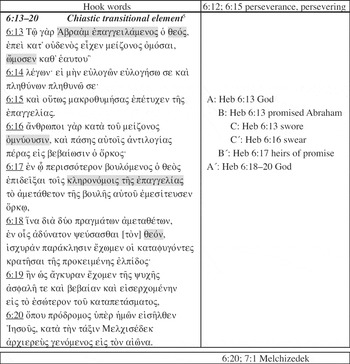
6:13-20 Chiastic transitional element: thus, hold on to God's oath given to Abraham that reaches behind the curtain.
The following chart displays the symmetries in each element, the transitions and the hook words linking these elements, and the semantic overlaps occurring only in the corresponding sister paragraphs:


Notes to the Readings
1. Lexeme occurring only in the transitional elements Heb 3:1-6 and 12:1-3: witness, witnesses (Heb 3:5; 12:1).
2. Lexemes occurring only in the sections Heb 3:7—4:11 and 11:4-40: Egypt (Heb 3:16; 11:26, 27), disobedient/disobedience (Heb 3:18; 4:6, 11; 11:31), David (Heb 4:7; 11:32), saw (Heb 3:9; 11:5,13, 23), wilderness (Heb 3:8, 17; 11:38), foundation (Heb 4:3; 11:11), left (Heb 4:1; 11:27), people of God (Heb 4:9; 11:25),fall (Heb 3:17;4:11; 11:30), wander (Heb3:10; 11:38), come short (Heb 4:1; 11:37), be afraid (Heb 4:1; 11:23,27).
3. Lexemes occurring only in the transitional elements Heb 4:12-13 and 11:1-3: invisible/visible (Heb 4:13; 11:3), word of God (Heb 4:12; 11:3).
4. Lexemes occurring only in the sections Heb 4:14—6:12 and 10:24—39: love (Heb 6:10; 10:24), judgment (Heb 6:2; 10:27), Son of God (Heb 4:14; 6:6; 10:29), enlightened (Heb 6:4; 10:32), need (Heb 5:12; 10:36).
5. Lexeme occurring only in the transitional elements Heb 6:13-20 and 10:19-23: curtain (Heb 6:19; 10:20).
Main Theological Emphasis and Interpretation
The Center in Section C: The logic of a concentric structure necessarily unfolds from its center. Unlike Vanhoye, I locate the center not in Heb 9:11, with Christ's high priesthood,Footnote 63 but instead in Heb 8:7-13 (9:10), which contains God's promise of a covenant renewal as expressed in the longest quotation of the Hebrew Bible in the New Testament from Jer 31:31-34. Contrary to the opinions of Neeley (Heb 10:19-13:21), Guthrie (Heb 12:18-24), and Westfall (Heb 12:1-28), moreover, the center proposed here does not lie either in Hebrews 12, which issues the invitation to approach the heavenly sanctuary.Footnote 64 From a pragmatic point of view, we could consider locating the center in Hebrews 12—indeed plausible—and commend the latter three scholars for their analyses. Yet from a logical, structural point of view, the center must lie in Hebrews 8 in which God and not the Son promises a new covenant. This proposal in turn disqualifies a center in Hebrews 9. Rhetorically speaking, this center forms the logical and necessary precondition for the appointment of the Son as mediator and for the invitation to the addressees to approach God's throne in the aftermath of the high priest's atoning endeavor. Hence, rather than judging either the one or the other proposed center as flawed, we can—based on the insights from the “linguistic turn”—distinguish the center in Hebrews 12 as the pragmatic and therefore paraenetic one, yet the center in Hebrews 8 as the logical, structural, and therefore theological center. This approach not only allows an interpretative comparison of sister paragraphs but also generates the hermeneutical key that allows us to place all the parts of the book into a logical and coherent whole:
Main Section C: This central section speaks of a new covenant inaugurated by God and mediated by Christ. Hence, God, the central persona and considered more important than the Son, initiates the covenant renewal. We can confirm this when analyzing the semantic inventory related to God, which appears slightly higher than that related to the Son. Commentators frequently neglect this fact. Along with the new covenant, this section describes the new—actually old and original (see Exod 25:40 in Heb 8:5)—celestial cult institution. Beautifully reflected in the mountain-like-shaped climactic structure, the passage relates the new covenant to the celestial mount Zion.
Relation of Main Section C with B: Chiasm serves not merely an ornamental function, but rather, its power lies in the potential to unify what seems incompatible.Footnote 65 In this chiastic sense, the relation of B—covenant breaking—with C—covenant renewal—appears logical. Both of the long quotations related to the Hebrew Bible express well-established polar concepts in early Jewish texts, liturgy, and culture.Footnote 66
Relation of Main Section B with A: I did not immediately perceive the relation of B with A, and only extensive intertextual search made clear to me that Kadesh-Barnea finally ends the renewed Sinai covenant on account of the people's sin. This one final sin in a series of ten (Num 14:22; cf. also Pss 78; 106), appears most similar to the idolatry with the golden calf committed at Sinai in Exodus 32-34. This context makes plain that the existence of angels occurs as the natural consequence of God's absence (Exod 33:2-3). Haggadic literature from the first century on widely reflects not only the danger that angels of revenge present for the people but also Moses' saving role. This narrative structure interlocks Hebrews with the narrative matrix of the Hebrew Bible, it further confers Moses' office upon Jesus, and vice-versa relates the intended listener to the fathers of the Hebrew Bible.
Relation of Main Section A with B': The understanding of section A leads smoothly over to B'. The faithful fathers and mothers (in past and present) become entitled as “witnesses.” This legal term makes clear that their mentioning before God by Moses in the golden calf pericope (Exod 32:13-14) helps to save the lives of the sinful people. Likewise, the protecting and even salvific function of the faithful fathers in the interests of the sinful people appears also as a well established motive in Hellenistic-Jewish, protorabbinic, and rabbinic literature, beginning with the writings of Philo (see, for instance, Praem. 166).
Relation of Main Section B'with A': In the latter section (= A´), we see the sons invited to the celestial cult and ethically and legally equipped for an existence under a renewed covenant. I have argued elsewhere that the location of the cult in heaven does not serve supersessionist needs, but rather, liturgical (for instance, the fast day of Tisha be-Av) and/or historical reasons (for instance, the destruction of the second temple in the year 70 c.e., which implies God's absence on earth and consolidates the broken covenant) might have necessitated this rhetorical strategy.Footnote 67 In making up for the earthly loss, the author invites his addressees to the one remaining legitimate temple, according to Exod 25:40, which is quoted in Heb 8:5, the celestial and original one to which God withdraws from earth in times of broken covenants. He takes them there step-by-step and relativizes possible apprehensions while empowering them at the same time mentally and spiritually to transcend their experiences of a disheartening present.


