Health technology assessment (HTA) was introduced in Kazakhstan through a joint project of the Ministry of Healthcare and the World Bank named “Kazakhstan Health Sector Technology Transfer and Institutional Reform” which started in 2009. The main organization conducting HTA at the national level in Kazakhstan is the Center for Rational Use of Medicines and Health Technologies, located in the structure of the Republican Center for Health Development. The initial reports for the Ministry were prepared in 2013.
The main purpose of HTA is to provide objective information for the possibility of making managerial decisions at the system level (1). Hospital-based HTA (HB-HTA), in turn, gives an opportunity to make informed managerial decisions about the viability of implementing and using a variety of health technologies in hospital practice (Reference Sampietro-Colom, Lach and Cicchetti2).
HTA reports developed at the national level often do not correspond the specific requirements of hospitals in the field of practical information value. This is reflected in the difference of priorities in evaluated technologies (Reference Kidholm, Ehlers and Korsbek3), nonconformity of the content of HTA reports with the requirements of hospitals and lengthy time frame of the HTA reports (Reference Cicchetti, Marchetti, Dibidino and Corio4;Reference Sampietro-Colom, Morilla-Bachs, Gutierrez-Moreno and Gallo5). Also national HTA Agencies seldom evaluate new (innovative) technologies and medical devices (including intragroup evaluation of medical devices from different manufacturers). This greatly reduces the applicability of their findings to the hospitals’ practice. To be able to make informed managerial decisions at the hospital level, the results of HTA reports should be directed to the local features of hospitals (Reference Martin6).
Another indication for HTA at the hospital level is the need to provide a barrier to restrict the use of ineffective and even dangerous health technologies in clinical practice (Reference Nielsen, Funch and Kristensen7). This can occur through inadequate evaluation of clinical efficacy and safety of implemented health technologies, a lack of transparency in decision making in healthcare organizations, conflict of interest, or disguised marketing pressure.
At the opening of a new building of the Medical Center Hospital of the President's Affairs Administration in Astana, Kazakhstan (Hospital of the President's Affairs Administration) in March 2015 it was decided to establish an HB-HTA Unit. The main functions of the unit are (i) clinical and economic analysis of the viability of implementing new health technologies in practice; (ii) monitoring and analysis of the effectiveness of using different health technologies in practice; and (iii) the formation of proposals for the rational and effective use of available hospital medical equipment and machinery.
The HB-HTA Unit in the Hospital of the President's Affairs Administration is one of the first examples of the implementation of the Hospital-based HTA system into the practice of Kazakhstani hospitals (Reference Sharip, Tabarov and Avdeyev8). Only one previous experience in the use of HB-HTA in practice was published (First City Hospital, Astana) (Reference Kosherbayeva, Hailey and Kurakbaev9).
In this article, we describe the development and activities of the HB-HTA Unit and an analysis of the effectiveness of mini-HTA reports in promoting informed managerial decisions about the viability of implementing and using new health technologies in hospital practice.
Methods
Information on the development of the HB-HTA Unit were obtained from Hospital records and discussions with staff. The records of the Unit and Hospital administration were reviewed to confirm details of its organization and the decision process for technology implementation following an HTA recommendation.
Details of the completed HTA reports were obtained from Unit records and outcomes of their recommendations from Hospital administration and discussion with different departments. Estimates of savings through decisions not to implement and of payback periods for implemented technologies were obtained through the Hospital information system, consideration of Hospital workload, and data submitted by manufacturers and distributors for the costs of medical equipment in Kazakhstan.
Background information on approaches to HB-HTA were obtained from the European Project AdHopHTA (Reference Sampietro-Colom, Lach and Cicchetti2).
Results
Development and Operation of the HB-HTA Unit
In developing an organizational basis for the Unit we analyzed international experience of implementing and using different types of the HB-HTA Units. As a basis model we used “Stand-alone HB-HTA Unit” from the recommendation of European Project AdHopHTA (Reference Sampietro-Colom, Lach and Cicchetti2). The HB-HTA Unit consists of five members with knowledge and skills in the use of systematic search strategy, analysis of reliable information from evidence-based medicine databases, clinical and economic analysis, and calculation and analysis of diagnosis-related groups.
The main tool of the HB-HTA Unit's work was the preparation of rapid- and mini-HTA reports which are the main instruments of HB-HTA (Reference Kidholm, Ehlers and Korsbek3;Reference Sampietro-Colom, Morilla-Bachs, Gutierrez-Moreno and Gallo5). The AdHopHTA Mini-HTA Template was used as a model. A rapid- or mini-HTA report is a short and structured assessment of the necessary conditions and consequences for using specific health technologies in hospital practice for a specific group of patients. The results of these reports are the basis for making managerial decisions about the viability of implementing new health technologies in hospital practice.
For the purpose of regulating relations associated with the implementation and use of new health technologies in the hospital practice, a guideline was established in 2015. This includes description of the stages of submission and consideration of proposals for the use of new health technologies, making decisions about the viability of implementing these, the order of the preparatory activities, and evaluation of the effectiveness of using the technologies in hospital practice. New health technologies are understood to be those not previously used at the hospital, both original items and upgraded versions of those previously used.
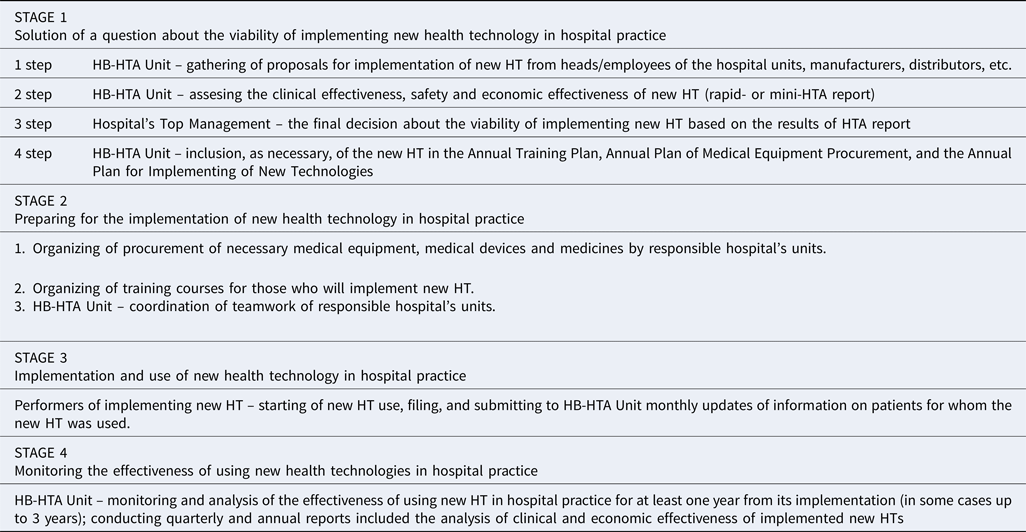
Every new health technology proposed for implementation in hospital practice must pass the clinical and economic assessment of the viability of its use. Assessment is by a rapid- or mini-HTA report, preparation of which on average takes 2–4 weeks. The implementation of new health technologies into practice is carried out in several stages. It takes 1–2 years from the date of a proposal for the implementation to be completed. A schematic description of the process of implementation of new health technologies is shown in Table 1. HB-HTA should not be limited only to the initial assessment of the clinical and economic effectiveness of new health technologies. Further monitoring of the effectiveness of implemented technologies is needed.
Algorithm for Implementation of New Health Technologies in Hospital Practice

HB-HTA Unit, Hospital-Based Health Technology Assessment Unit; HT, Health Technology
In this regard, in 2016, we developed a reporting form of clinical and economic effectiveness of in-use health technologies, which was integrated with the hospital's medical information system. This form includes key clinical indicators and all the costs for one case treated. These include the costs for hospital stay, intensive care, used drugs and medical devices, used treatment and diagnostic services, remuneration of medical staff, amortization of equipment, and other expenses associated with using the technology. Clinical and economic indicators are validated both by external sources and by internal assessment through the hospital's specialists. Expensive and high-tech technologies have priority for monitoring.
A further activity of the HB-HTA Unit was standardization of the structure of HTA reports. Classical mini-HTA reports do not make a direct comparison between several health technologies. In this regard, it was decided to integrate the principles of Multiple Criteria Decision Analysis (MCDA) into the structure of the mini-HTA report. Earlier studies have confirmed the importance of the practical use of MCDA principles in HTA and its further development (Reference Thokala and Duenas10;Reference Diaby and Goeree11).
MCDA is an approach to aid decision making where more than one criterion is relevant, which makes explicit the impact on the decision of all the criteria and the relative importance attached to them. It provides a consistent, reproducible and transparent decision-making process. At any level of decision making, a standardized set of criteria and its meanings is available (Reference Sussex, Rollet and Garau12).
Integration of the principles of MCDA in the structure of mini-HTA report gave the opportunity to (i) make comparative assessment of implementing new health technologies based on standardized criteria; (ii) determine the priority for implementation of new evaluated health technologies; and (iii) avoid the influence of subjective factors on the managerial decision-making process in hospital.
On the basis of the recommendations of the International Society for Pharmacoeconomics and Outcomes Research (ISPOR) on the use of MCDA principles to assist in informed decision-making process in hospitals (Reference Thokala, Devlin and Marsh13;Reference Marsh, IJzerman and Thokala14) and analysis of international experience, a managerial decision-making model was created and implemented in hospital practice in 2017. This model includes five standardized criteria: (i) Novelty/innovation; (ii) Comparative clinical effectiveness and safety; (iii) Relevance (demand); (iv) Economic effectiveness; (v) Payback period (Reference Avdeyev, Tabarov, Kaptagayeva and Makalkina15).
Also, the HB-HTA Unit annually analyzes the profitability of health technologies used in the hospital practice to optimize the hospital's costs for patients’ treatment.
The improvement of hospital activity in the field of HTA is an integral part of the hospital's strategic development. It contributes to the improvement of hospital management through improving quality and safety of health care; increasing the range of high-technology health care; the rational use of human and material resources; effective investment; and improving the marketability of domestic and external markets of medical services.
Preparation and Outcomes of HB-HTA Reports
Over the 3-year period from 2015 to 2017 the HB-HTA Unit prepared fifty-one rapid/mini-HTA reports (16 in 2015, 23 in 2016, and 12 in 2017). Brief descriptions and assessment results are shown in Supplementary Table 1.
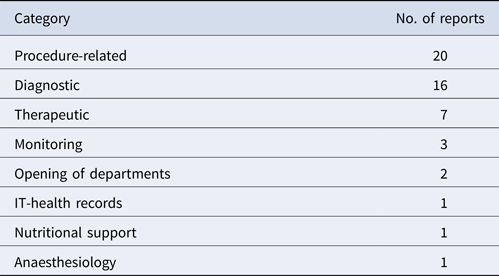
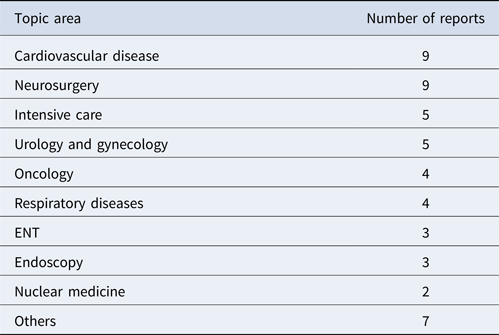
Most of the assessed health technologies were connected with medical equipment and devices (31/51). Categories of matters covered in the reports are shown in Table 2, and topic areas are listed in Table 3.
Categories of Assessed Technologies

IT, information technology.
Topic Areas Assessed by the HB-HTA Unit

HB-HTA Unit, Hospital-Based Health Technology Assessment Unit; ENT, ear, nose, and throat.
Seventeen health technologies (33 percent) were not recommended for implementation in hospital practice. Of these, hospital decision makers decided not to implement sixteen technologies (94 percent), an indication of the high value of the HTA reports in the decision-making process at the hospital. The refusal to implement these technologies saved approximately 1,053,500 USD.
Of the thirty-four recommended health technologies twenty-four (67 percent) were implemented in hospital practice from 2015 to 2017 and used to treat or diagnose 1,376 patients. A further eight technologies (24 percent) were included in the Plan for Implementing of New Technologies for years 2018–20. The decision for one technology was deferred because of the high investment cost. Another technology was not implemented due to lack of suitable patients.
Twelve of the twenty-four implemented health technologies did not require additional investments. For the other twelve implemented technologies the payback period of investments is not more than 3 years for six, and less than 5 years for four technologies. Only two technologies have a payback period of more than 10 years. This characterizes implementation of these technologies as an effective strategy for investment and rational use of hospital resources.
However, it should be noted that with the high clinical effectiveness of five of the implemented technologies, there were a negative financial result because of imperfections in the governmental reimbursement system for mini-invasive and simultaneous (hybrid) technologies. But no additional investments were made to implement these technologies.
Discussion
The HB-HTA Unit, which is the most complex organizational structure of hospital-based HTA, has several advantages from the depth, high quality, and rigor of the HTA process (Reference Gagnon, Abdeljelil and Desmartis16;Reference Mitchell, Williams, Brennan and Umscheid17). The fact that the HB-HTA Unit works in partnership with all stakeholders in the field of health technologies, and its relative independence from the medical and administrative staff of the hospital, also highlights the advantages of this type of structure.
Before the creation of the HB-HTA Unit in the hospital, decisions at the hospital on the selection of health technologies were not made on the basis of a systematic assessment of clinical and economic viability. There was always a risk that proposals from charismatic and persistent applicants would be supported. The current system, providing objective assessments on proposals for adoption of health technologies, gives a stronger basis for well-informed decisions. The experience of the HB-HTA unit in responding to requests for information on potential acquisition of technologies by the hospital has been similar to that for hospital HTA programs in other countries, such as those in Argentina, Australia, Canada, and France (Reference Demerdjian18–Reference Bodeau-Livinec, Simon and Montagnier-Petrissans22).
Decisions taken on most of the assessed technologies were consistent with the conclusions of the HTA reports. However, HTA will always be one of several inputs to decisions, and other perspectives from administrators and clinical staff may lead to different outcomes. The general experience with hospital HTA programs is that other matters in the local context of a hospital will commonly be considered, including relevant caseload, case mix, and availability and suitability of the hospital's current technology.
The Kazakhstan experience with HB-HTA also resembles that in other countries in that the cost to the hospital of establishing and maintaining an HTA program has been more than offset by demonstrated savings through not acquiring ineffective technologies, and efficiencies gained through the appropriate allocation of resources to different areas of the hospital.
The initial operation of the Kazakhstan Unit has been shown to have had an important influence on decisions, over 90 percent of which were consistent with both positive and negative HTA recommendations. One health technology, for use with neurosurgery, was included in the Procurement plan for 2018, although the HTA recommendation was negative. This technology has been rated as a low priority, and procurement may be carried out only if there is sufficient financial capacity of the hospital.
Two health technologies, which were recommended by the HB-HTA Unit, were not implemented. In the first case, a decision was delayed because of the high investment costs which currently cannot be paid by the hospital. In the second, there was a lack of suitable patients in the hospital's current case mix. This technology does not require additional investments and can be implemented immediately if necessary.
Limitations of this study include lack of information on details of some of the decisions taken on HTA recommendations, and a lack of data on longer term follow up of relevant indicators following implementation of health technologies.
In conclusion, establishment of the HB-HTA Unit in the Hospital of the President's Affairs Administration created the basis for making informed managerial decisions; identifying key directions for strategic development; and improving hospital management.
The refusal to implement clinically ineffective and/or uneconomic health technologies helped to optimize the hospital's financial expenses, to ensure effective investment and the rational use of human and material resources.
Supplementary Material
The supplementary material for this article can be found at https://doi.org/10.1017/S0266462318003744
Supplementary Table 1: https://doi.org/10.1017/S0266462318003744
Conflicts of Interest
The author have nothing to disclose.