“On November 5th the BBC in New York will hold a party. It is the first party of its kind and may never be repeated. From it we hope will be broadcast the greatest swing programme that has ever happened. It will be a real ‘jam session,’” announced Felix Greene, the BBC's North American representative, in October 1938.Footnote 1 Hosted by the British Broadcasting Corporation at the exclusive St. Regis Hotel, the event offered free champagne to a large and boisterous gathering. For British listeners, who heard the jam session in a live transatlantic relay, it represented an historic opportunity to hear “a galaxy of swing stars,” including Sidney Bechet, Tommy Dorsey, and Eddie Condon, who “are never likely to be heard again at one and the same time.”Footnote 2 In the United States, Greene anticipated that press coverage of the event would demonstrate “to the great American public that we are not quite as stuffy an organization as we are often made out to be.”Footnote 3 The ambitious Saturday evening broadcast succeeded sufficiently for a second (and less boisterous) relay, featuring Harry James, Jack Teagarden, Teddy Wilson, and others, to be arranged for Friday, 20 January 1939.
This article examines the context, planning, content, and reception of the 1938/39 BBC jam sessions as a case study in how traditional understandings of authenticity in jazz were rearticulated when a jam session occurred in a public, mediated, and transnational space. In brief, could a famously “stuffy” British institution convey to listeners the spontaneity and artistry of a live jam session? Addressing this question necessitates a consideration of the relation between liveness, authenticity, and the ephemeral. Although a growing body of scholarship has articulated the role of radio in shaping big band swing as mass culture and examined its role in reinforcing white hegemony in the music industry, attention to historic jazz broadcasting still falls behind that devoted to recordings.Footnote 4 Much of the difficulty lies in radio's ephemeral nature: as physical objects, records could be collected, catalogued, and heard repeatedly, whereas broadcasts usually vanished into the ether, impeding analysis for both past critics and current historians.Footnote 5 Moreover, radio was associated closely with commercialized forms of jazz, rather than “lasting” canonical performance. Broadcasting shared its ephemeral temporal existence with live performance, however; and jam sessions were valued as authentic, not only for their originality and atavism, but also because they were unrepeatable. In many ways, discourse about live jam sessions anticipated (and continues to resonate with) the claims of many performance studies scholars, who have privileged live over mediated and recorded performances.Footnote 6 The 1938/39 jam session relays represent a special point of entry into the fragmentary archive of jam sessions and jazz broadcasting, for the BBC preserved both recordings and extensive supporting documentation, an act of validation that has enabled this study.
Together, the American Jam Session relays were highlights in the BBC's détente with jazz and swing during the late 1930s.Footnote 7 The public service Corporation, with its twin aims of enlightening and uniting the nation, regarded mass entertainment from the United States, particularly jazz (broadly understood to include dance music), as a potential threat to a distinctly British common culture. Although the BBC had long promoted live dance music played by British “name” bands as respectable entertainment and aired occasional jazz broadcasts, like those featuring Louis Armstrong and Duke Ellington's Orchestra during their 1933 British tours, the policy under its first director-general, Sir John Reith, was generally to eschew hot jazz, with its low class and “Negroid” associations.Footnote 8 The BBC as a whole began to increase its light entertainment offerings during the late 1930s (especially after Reith's 1938 departure) in response to competition from American-style commercial stations on the Continent and growing criticism of its monopoly; however, the impetus for more jazz programming came from young members of the Gramophone Department: Leslie Perowne, Harman Grisewood, and later Charles Chilton.Footnote 9 “The BBC became jazz-conscious in about 1937,” Perowne later observed.Footnote 10
During the late 1930s, the Corporation began treating American swing as a specialized genre that appealed to a minority audience of connoisseurs, an approach well within its mandate of serving diverse tastes.Footnote 11 In special series featuring gramophone records, such as the jazz critic Leonard Feather's Swing Time, presenters framed their playlists with informational talks, a format that recalled the “records recitals” given in Britain's rhythm clubs.Footnote 12 Perowne also worked with Greene to produce America Dances, a series of live swing relays, “giving us something we cannot get in England, i.e. Swing Music.”Footnote 13 Running intermittently from 1938 until the summer of 1940, the series exposed British listeners to extended performances from leading bands like Count Basie's and Tommy Dorsey's.Footnote 14 Opportunities to hear these groups were rare, for the Ministry of Labour had barred virtually all bands and individual musicians from the United States from touring in Britain since 1935, and in 1937 the price for U.S. swing discs had spiked, putting records—the lifeblood of Britain's jazz subculture—beyond the reach of many fans.Footnote 15
As much as critics and fans welcomed the BBC's gramophone series and America Dances, they recognized the 1938/39 jam sessions as exceptional. “Detector,” the radio critic for Melody Maker (Britain's leading dance music, jazz, and swing publication), announced the first session as “the most ambitious broadcast of swing the Corporation has ever attempted.”Footnote 16 The relays represented a significant financial investment by the notoriously thrifty BBC. Whereas it devoted £30,000 to (live) dance music programming in 1938, averaging £43 per program, fees for the November 1938 relay reportedly totaled $374 (or about £94) and $275 for the January 1939 relay.Footnote 17 In New York, the BBC relays formed part of a growing wave of public jam sessions. The guitarist and “jazz activist” Eddie Condon, whom Scott DeVeaux identified as a pioneer in the public jam session's “transition from smoky back room to concert stage,” cited the November BBC session as inspiring his first series of jam sessions in “respectable” venues, first at the Park Lane Hotel in early 1939, and ultimately at Town Hall, starting in 1942.Footnote 18
Similar to their U.S. counterparts, the excitement for British fans came not only from the relays’ famous personnel but also from the status of jam sessions as sites of non-commercialism, artistic freedom, and spontaneous, personal musical exchange.Footnote 19 Particularly for the vocal segment of the rhythm club subculture that valorized recordings by small-group improvisers of Golden Age jazz, a live jam session represented the paragon of authenticity in jazz.Footnote 20 As Hugues Panassié—who attended the November session—wrote his 1942 book, The Real Jazz: “A ‘jam session’ is a reunion of musicians, outside of their regular work, at which they play the music they enjoy with complete liberty. . . . [In the jam session] jazz music is returned to its natural state and is delivered of all preparations and artifice.”Footnote 21 The BBC jam sessions, which Greene organized in collaboration with Joe Marsala, the clarinetist and bandleader at the Hickory House on 52nd Street, fulfilled Panassié's conditions, at least superficially: they brought together musicians from leading big bands in a comparatively relaxed setting and featured often extended improvisation on standards like “Honeysuckle Rose” rather than tightly arranged commercial hits. More notable still, the sessions promised to bring together a stylistically and racially diverse group of musicians.
Thanks to the medium of radio, British enthusiasts would hear a satisfying dose of live jazz in the BBC jam sessions. The concept of liveness, as Philip Auslander has argued, emerged during the 1930s, spurred by radio itself, “a communications technology that put the clear opposition of the live and the recorded into a state of crisis.” Because of radio's status as a strictly aural medium, in which listeners were temporally but not spatially co-present with performers, the distinction between broadcast recordings and broadcast “live” performances needed to be made explicit in discourse.Footnote 22 At the BBC, liveness was privileged as a hallmark of quality while it also smoothed relations with a Musicians’ Union that was understandably wary of mechanical reproduction. In this economy of liveness, announcers played critical roles in transforming broadcasts into what Chadwick Jenkins has called “virtually visual event[s],” in which listeners were offered the imaginative experience of co-presence at the site of performance.Footnote 23 For British enthusiasts, who experienced American jazz as an almost exclusively recorded phenomenon, the BBC relays provided a rare opportunity to act as distant, yet seemingly intimate, witnesses to a real-time jam session taking place in the jazz center of New York.
Although Marsala recruited the players for both sessions and a young Alistair Cooke acted both times as compère (i.e., emcee), British audiences did not receive the two broadcasts with equal enthusiasm. For “Detector” the first jam session was a “washout,” a controversial judgment for Melody Maker readers, whereas the second session was “grand.”Footnote 24 The divergent reception demonstrated the challenges of maintaining the jam session's status as a paragon of authenticity as it underwent three key transitions during the late 1930s: the transformation from an in- and inter-group activity to a public event for paying audiences; the transmission from New York's jazz and swing cultures to Britain's enthusiast subculture; and the transmutation from live performance to live broadcast. These shifts, it is important to note, represented not teleological changes but rather an expansion in the scope, purpose, and audience for jam sessions, which was mapped onto a field shaped by differences of race, musical style, nationality, gender, and access to cultural and economic capital. In many ways, the transitions spanned the poles of authenticity (in-group, American, live) and inauthenticity (public, British, broadcast), and they would be revisited throughout the 1940s with the emergence of bebop, Britain's wartime swing boom, and the traditional jazz revival on both sides of the Atlantic.
Ultimately, the sessions were significant not only for their content but also for their role in advancing Anglo-American relations. Although the BBC jam sessions were largely motivated by a desire to serve British listeners, they also represented an attempt to reshape attitudes in the U.S. toward the BBC as an institution and Britain as a nation. The latter was of crucial concern at the BBC during the 1930s and early 1940s, as Britain cultivated the isolationist United States as an ally. Occurring less than a year before the start of World War II, the initial planning for the first jam session took place when Europe seemed to be on the brink of war. Showing Americans that the BBC could be less stuffy—that is, less stereotypically British—was no mean side effect for a jazz broadcast.
Transition 1: Jam Sessions as Public Events
On 29 August 1938, Joe Marsala and his band made their second appearance in America Dances, earning a rave review from “Detector,” who praised their extended improvisations, musicianship, and “stupendous physical urge.”Footnote 25 It is likely that Marsala suggested the idea for a jam session relay at the time of this broadcast, for soon afterward Felix Greene cabled Broadcasting House in London, proposing a special program of America Dances, expanded from thirty to forty minutes, that would feature a “real informal jam session” by players from “several bands . . . with commentary [by] Alistair Cooke[.] No added cost.”Footnote 26 Cooke, a habitué of Sunday jam sessions and 52nd Street clubs, was an inspired choice as announcer, but as Greene insisted, the concept and organization for the BBC's American Jam Sessions came from Marsala, “who is a friend of all the leading swing musicians.”Footnote 27 As resident bandleader at the Hickory House on 52nd Street from 1937, Marsala was committed to improvised, small group jazz, cultivating a blending of Dixieland and swing styles within his band and hosting a series of often-interracial Sunday jam sessions.Footnote 28 Marsala's collaboration on the BBC sessions meant not only that top players would be persuaded to participate for the union minimum but also that the sessions would reflect his engagement with stylistic and racial diversity. Indeed, the personnel for the BBC relays represented a cross section of musicians involved in New York's public jam sessions during the late 1930s, a context this section will sketch while attending to the raced and gendered ideologies of authenticity.
Whereas in Britain the 1938 and 1939 BBC jam session relays were regarded as groundbreaking, in New York (and in other cities in the United States), they were part of a trend that made jam sessions an increasingly public phenomenon through concerts, broadcasts, recording sessions, and even coverage in mainstream publications like Life magazine.Footnote 29 The proliferation of public jam sessions took place in the context of what Patrick Burke called two “contradictory and intertwined” trends: “(1) the increasing consolidation and commodification of swing as an industry and (2) a continued fascination among musicians and audiences with jazz as a symbol of authentic self-expression.”Footnote 30 Jazz enthusiasts and collectors of 1920s “hot jazz” recordings played significant roles in the development of public jam sessions, as Scott DeVeaux has argued.Footnote 31 A key figure was Milt Gabler, the proprietor of the Commodore Record Shop, who in 1935 collaborated with Eddie Condon to organize a series of “Sunday afternoon jam sessions” in vacant recording studios, which soon moved to the Famous Door on 52nd Street.Footnote 32 Other 52nd Street clubs began offering their own Sunday jam sessions, led by Marsala at the Hickory House; “They even got a WNEW wire,” Gabler recalled.Footnote 33 Public jam sessions functioned paradoxically as a means of resisting the commercializing effects of mainstream swing and of transforming jamming itself into a commodity, which was then promoted to audiences as a distinctly authentic form of jazz.
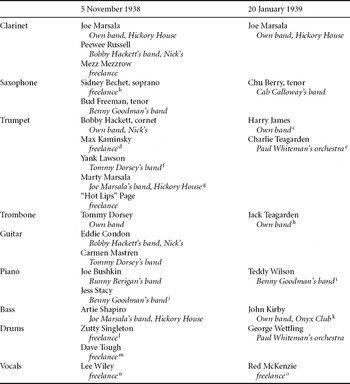
Marsala straddled the commercial/authentic divide in his recruiting for the BBC jam sessions. Just over half of the sessions’ players were currently or recently employed in big swing bands (or led them, in the case of Tommy Dorsey); the rest freelanced or played with less lucrative small combos at clubs like Nick's in Greenwich Village and the Onyx Club on 52nd Street (Table 1). Many of the musicians who filled out the roster for the two BBC relays, and who participated in the emerging scene for jam-style playing, were part of the loose cohort known as the Condon mob. Overwhelmingly, they were white, male musicians who shared a commitment to collective improvisation in a two-beat Dixieland style, known generally at the time as Chicago-style jazz.Footnote 34 Marsala also recruited African American musicians, who comprised a quarter of the players for the sessions and who spanned a wide stylistic gamut, ranging from the New Orleans legend Sidney Bechet to the contemporary swing star Teddy Wilson.Footnote 35 Indeed, Marsala's personnel offered a number of intriguing juxtapositions, not only of style, race, and home ensemble, but also of past and present.Footnote 36 Current swing stars played alongside musicians revered by collectors for recordings made a decade earlier.
Personnel for the 1938/39 BBC American Jam Sessions.a

a Many of the players in the relays had recently, or were about to, change bands. The instances in which a player's current affiliation differed from that listed in the Radio Times or BBC Programmes as Broadcast log entry are noted here. The Radio Times also listed several players who did not appear in the first broadcast: Dave Bowman of Hachett's band, Teddy Wilson of Goodman's band and George Wettling of Red Norvo's band (both of whom appeared in the January broadcast), Fats Waller, and Goodman himself, who was described as “hop[ing] to be present.” Programme Listings, Radio Times, 28 October 1938, 86; Programme Listings, Radio Times, 13 January 1939, 60; and National Programme, 20 January 1939, Programmes as Broadcast, British Broadcasting Corporation Written Archives Centre.
b The Radio Times listed Bechet as belonging to Noble Sissle's band, with which he played until October 1938. James Lincoln Collier, et al. “Bechet, Sidney.” in The New Grove Dictionary of Jazz, 2nd ed., ed. Barry Kernfeld, Oxford Music Online, http://www.oxfordmusiconline.com.
c The Radio Times and Programmes as Broadcast log listed James inaccurately as “recently with” Whiteman's band. He had been “recently with” Goodman. Peter Levinson, Trumpet Blues: The Life of Harry James (New York: Oxford University Press, 1999), 93.
d Kaminsky was not listed in the Radio Times.
e Charlie Teagarden was not listed in the Radio Times or logged in the Programmes as Broadcast.
f Lawson was not listed in the Radio Times.
g Marty Marsala was not listed in the Radio Times.
h The Radio Times and Programmes as Broadcast log listed Jack Teagarden inaccurately as a member of Whiteman's band. James Lincoln Collier, et al. “Teagarden, Jack.” in The New Grove Dictionary of Jazz, 2nd ed., ed. Barry Kernfeld, Oxford Music Online, http://www.oxfordmusiconline.com.
i The Radio Times and Programmes as Broadcast log listed Wilson inaccurately as belonging to Whiteman's band.
j Stacy was not listed in the Radio Times.
k The Radio Times and Programmes as Broadcast log listed Kirby inaccurately as resident at the Famous Door.
l Singleton was not listed in the Radio Times.
m The Radio Times listed Tough as belonging to Goodman's band—which had been the case until late October, when Goodman fired him. “Goodman Fires Tough, Freeman; Bands Shift Men,” Metronome, December 1938, 14.
n Wiley was not listed in the Radio Times.
o McKenzie was not listed in the Radio Times or logged in the Programmes as Broadcast.
The BBC jam session broadcasts, particularly the first, thus entered into a discourse of jazz authenticity that celebrated public jam sessions as sites of historical recovery and revival. According to Condon, Gabler described public jam sessions as “missionary work”; their aims were to increase demand for re-issued records, make live Dixieland a paying proposition for musicians, and, paradoxically for a genre they were trying to render profitable, strike a blow against commercial swing.Footnote 37 The BBC relays supported this historical and revivialist project in several ways: through repertory that favored canonical Golden Age numbers like “China Boy” and “Someday Sweetheart”; ensemble playing that privileged collective improvisation; and iconic guests, including W. C. Handy, who observed on air, “I have seen the influence of my work of about a quarter of a century ago here today more than ever.”Footnote 38 Arguably, the most significant indication of the broadcasts’ engagement with jazz authenticity was the sizable contingent of players who had pioneered and continued to sustain Chicago-style jazz.
The roots of Chicago-style jazz went back to the Austin High Gang, a network of teenaged friends in West Chicago, who in the early 1920s had admired and emulated the playing of African American musicians, like Louis Armstrong and Jimmy Noone, who had migrated to Chicago's South Side. Several musicians associated with the Austin High Gang appeared in the BBC sessions: the tenor saxophonist Bud Freeman, the clarinetist and hipster Mezz Mezzrow, the drummers George Wettling and Dave Tough, the pianist Jess Stacy, Condon, the trumpeter Max Kaminsky, and the singer and comb player Red McKenzie. In the late 1920s, most of the group moved to New York, where they met other white musicians adept at playing hot, improvised jazz, including the trombonist Tommy Dorsey, the clarinetist Pee Wee Russell, and Jack and Charlie Teagarden (trombone and trumpet). Joe and Marty Marsala (clarinet and trumpet) also matured musically in Chicago, reaching New York in the mid-1930s. Throughout the 1930s, many of the Chicagoans found work in the big commercial bands, but some, most notably Condon and McKenzie, “clung doggedly to their hot-music-or-nothing credo.”Footnote 39 Tastemakers like Gabler and Hugues Panassié celebrated this attitude and praised the Chicagoans’ early recordings.Footnote 40 Reissuing out-of-print recordings, organizing new small group recordings, and arranging public jam sessions were acts of musical revival, which also “solidified the identification of Chicago jazz” with white musicians.Footnote 41
Although this account of public jam sessions as rooted in white male nostalgia, anti-commercialism, and small group Chicago-style jazz captures a significant strand of jazz criticism at the time—and one that was especially influential in Britain—it deserves to be complicated on several counts. First, it overlooks Harlem's innovative jamming scene, out of which bebop emerged in the early 1940s.Footnote 42 Although the scene was still largely underground in the late 1930s, individual musicians did participate in public jam sessions. For example, the first BBC relay featured the trumpeter Orin “Hot Lips” Page, an alumnus of Basie's Kansas City band, who in March 1938 had begun appearing in Marsala's Sunday jam sessions at the Hickory House.Footnote 43
Page's appearances at the Hickory House were not unique. Many public jam sessions that featured Chicago-style jazz, ranging from Gabler's Commodore sessions to Condon's Town Hall Concerts, were integrated. The November BBC relay included three black musicians associated with Condon's mob: Page; Bechet, who began playing in Marsala's Sunday jam sessions that fall; and Zutty Singleton, a drummer with solid New Orleans and Chicago credentials, who was “the first African-American musician to be regularly employed at” Nick's, where he appeared in Bobby Hackett's small band.Footnote 44 Although the presence of such players in a session of mostly white players could be described as tokenism, any degree of integration challenged segregation and notions of white superiority.Footnote 45 For example, according to the co-organizer Paul Smith, the residency of Condon's Friday Club at the Park Lane Hotel was terminated because a resident objected when she encountered Billie Holiday in “the downstairs ladies’ lounge.”Footnote 46 Even if his politics were not explicitly integrationist, Marsala's recruiting for the BBC relays and Sunday jam sessions demonstrated his commitment to interracial music making. As the critic Leonard Feather reflected, “Marsala was responsible in his quiet and unpublicized way for more attempts to break down segregation in jazz than Benny Goodman—and he didn't have John Hammond to push him.”Footnote 47
Finally, many musicians and bands associated with Dixieland style were far more hybrid in their approach than critical rhetoric of the time suggested. A key example was Marsala's Hickory House “jam band,” which aficionados celebrated for its incorporation of Dixieland repertory.Footnote 48 Marsala's style was more eclectic than the Dixieland label allowed, however, incorporating not just two-beat rhythms and collective improvisation but also swing elements like Art Shapiro's four-in-the-bar bass lines, longer soloing, riff-based accompaniments, and tighter arrangements, as well as commercial pop numbers and the playing of the harpist Adele Girrard.Footnote 49 This stylistic code switching found its way into the BBC sessions, particularly the second, in which nearly every number featured swing-style soloing but closed with a Dixieland-style chorus.
During the late 1930s, jam sessions were dominated by men and functioned as sites of masculine performativity and homosocial bonding and community.Footnote 50 The few women involved in subcultural jamming scenes, like Mary Lou Williams, tended to be understood in exceptional terms.Footnote 51 Such was the case with the singer Lee Wiley, who participated in the first BBC relay. Wiley had begun her career in New York as a popular singer in 1930 but moved into jazz and an association with Condon's mob by the late 1930s. Will Friedwald observed, “When Wiley stepped up from canary to chanteuse and the selective audience replaced the mass one, everything about her work improved.” Although her musicianship was inscribed (and continues to be interpreted) through her gender, sexuality, and race, she was also recognized for sharing with Condon and others a commitment to authenticity that involved a rejection of mainstream success.Footnote 52 As Kaminsky remarked, she'd rather “just be a barrelhouse chick, singing with a bunch of guys whose playing she liked.”Footnote 53
Although still understood through discourses of authenticity, anti-commercialism, and revival, public jam sessions reached audiences during the late 1930s by becoming spectator events, recorded commodities, and even “virtually visual events” on radio. The BBC relays, airing in late 1938 and early 1939, occurred at a crest of public jam session activity: Hammond's “Spirituals to Swing” Concert at Carnegie Hall, weekly jam sessions on New York's WNEW, offering “solid jam, the likes of which have seldom been pushed out over the air-waves,” and the beginning of Condon's Friday Club at the Park Lane Hotel.Footnote 54 Meanwhile, Gabler's Commodore recordings were beginning to circulate, along with reissues of earlier small group recordings. Kaminsky later reflected, “People all over the world were beginning to collect our records and idolize us as the stalwart, pure-hearted artists fighting against the commercial music world.”Footnote 55 Certainly, as will be discussed below, they enjoyed a following in Britain.
Transition 2: Jam Sessions for British Enthusiasts
“This is no concert for people who don't like swing,” declared Alistair Cooke in his introduction to the November 1938 BBC relay. “If you aren't converted, you'd better switch off now and turn to another station.”Footnote 56 Despite the BBC's only recently relaxed opposition to jazz, the Ministry of Labour's restrictions on visiting bands from the United States, and a mainstream for which “jazz” usually meant polished, unimprovised dance music, a jazz subculture—the audience of converts whom Cooke addressed—had been thriving in the United Kingdom for over a decade. Most British enthusiasts regarded authentic jazz as a U.S. phenomenon; as one correspondent wrote to Melody Maker in 1939, “Whatever efforts may be made in this country they cannot help but fall short of the inspired playing of the transatlantic geniuses.”Footnote 57
With live performance a rare phenomenon, gramophone records and collecting assumed a central place in British jazz fandom during the 1930s. This situation led, as the anthropologist and jazz critic Ernest Borneman observed, to “a peculiar shift of values”: recordings, even by otherwise obscure musicians, became primary signifiers of importance.Footnote 58 At the start of the decade, the Chicagoans and white, New York–based musicians like Red Nichols, comprised the core repertory for many collectors, who learned more slowly of African American musicians like Louis Armstrong and Duke Ellington.Footnote 59 Whether played by “[European-]American,” “American Negro,” or “Mixed” groups (the categories into which Gramophone placed U.S. jazz recordings), a significant number of the discs featured improvised jazz played by small bands, which, according to the eminent British discographer Brian Rust, seem “to have been more popular generally in Britain than in American” during the period.Footnote 60 Thus, the novelty of the 1938/39 BBC jam session relays rested less in their personnel or approach than in the opportunity they afforded British enthusiasts to hear real-time improvising that extended beyond the 3 to 4 minutes available on a 78-rpm record side.
During the 1930s, British jazz enthusiasts evolved a distinct sense of their field and their community. The most determined developed an encyclopedic knowledge of the repertory as they haunted junk shops, searching for “gems” of jazz history, which had been “haphazardly” issued under a range of pseudonyms on minor labels throughout the 1920s by British companies with ties to U.S. labels.Footnote 61 For those lacking mastery of obscure matrix numbers, several of the major labels in Britain (especially HMV, Columbia, Parlophone, Vocalion, and Brunswick) maintained large back catalogs and included reissued recordings in special series dedicated to jazz.Footnote 62 “Little else was to be heard than those tough brassy Parlophone reissues of the twenties and thirties,” recalled Borneman of the experience of punting on the River Cherwell, crowded with “unstable flat crafts” and portable gramophones, during his time at Oxford.Footnote 63 (Although jazz fandom spanned the class spectrum, it was particularly visible with the university set.) Another key development was the founding in 1933 of London's No. 1 Rhythm Club, the first of many to form around the country.”Footnote 64 Offering records recitals and conviviality, the clubs helped members discover new recordings, learn about old ones, and develop a sense of community with other enthusiasts.
In addition to reissues, British gramophone companies sought out new recordings, many of which featured small American bands and pickup groups, for their jazz series.Footnote 65 As a survey of Gramophone's jazz columns indicates, nearly all of the musicians who broadcast in the BBC jam session relays appeared on British labels throughout the 1930s.Footnote 66 Among others, Regal Zonophone released recordings of Joe Marsala playing with Wingy Manone (1934–36); Parlophone released recordings by the cooperatively run Bob Crosby band, featuring Yank Lawson (1936–38); and HMV released recordings of several sessions organized by Mezz Mezzrow, which included Bud Freeman, John Kirby, and Max Kaminsky in their personnel (1936 and 1937). Many British enthusiasts prized records by “mixed” recording bands, such as the discs on which John Hammond encouraged Benny Goodman to include musicians like Teddy Wilson and Billie Holiday. Indeed, Hammond, who in 1933 began producing recordings for Columbia Records in Britain, played a key role in making small-group jazz played by African American and interracial pickup groups available to British enthusiasts.Footnote 67
Beyond the major labels, collectors could sometimes obtain imported gramophone records. For example, the first releases on Milt Gabler's Commodore label, featuring sessions led by Eddie Condon, reached Britain in late October 1938. The critic Edgar Jackson played them on the BBC National Programme, just three days before the first BBC jam session from New York.Footnote 68 Indeed, with the BBC's new openness to jazz from around 1937, radio offered an important supplement to record collecting and rhythm clubs, both in the form of on-air gramophone recitals and in relays from North America. The inauguration of America Dances in early 1938 gave British fans opportunities to hear bands and musicians, already familiar from recordings, in the live and potentially more expansive medium of radio, although the broadcasts were sometimes marred by atmospherics (i.e., weather and other disturbances that interfered with the signal) and technical difficulties.Footnote 69 That year, America Dances featured a number of leading bands, including those of Count Basie, Bob Crosby, Red Norvo, and Joe Marsala.Footnote 70
Although the number of visiting musicians from the United States declined during the 1930s, some live hot playing, and even jam sessions, did take place in Britain. A few bandleaders, such as Nat Gonella, embraced the style while several musicians in mainstream dance bands, including the trombonist George Chisholm and the trumpeter Tommy McQuater (both members of Bert Ambrose's much admired band), were recognized for their hot improvising skills, not only in Melody Maker, but also in the columns of Metronome, where British fans wrote spirited rejoinders to those who claimed that Britain lacked hot players.Footnote 71 Although large public jam sessions did not come into vogue until 1941, with the much hyped Melody Maker–HMV session at Abbey Road, British hot players found venues for informal jamming in London nightclubs, like the Bag o’ Nails, Shim Sham, and Nut House.Footnote 72 By the end of the 1930s, rhythm clubs also began hosting regular jam sessions. Featuring amateurs and specially invited professionals, the sessions usually took place after the records recital and were regarded as being especially attractive to young, swing-oriented fans.Footnote 73
Even the BBC aired a handful of jam sessions with British musicians. In the spring of 1937, it broadcast two sessions organized by Jackson with a small audience of No. 1 Rhythm Club members.Footnote 74 Its pioneering television service also carried a jam session series. Devised by Eric Wilde, the trumpeter for the BBC Television Orchestra, the sessions offered real improvising by a decent sextet, featured the much admired swing singer Diana Miller, and a scene in which “one by one [the musicians] enter, take off their coats, light up cigarettes and start vamping snatches of tunes.”Footnote 75 “Detector” praised the casual atmosphere, the improvised choruses, and the spontaneous chatter for its “complete naturalness.”Footnote 76 The series satisfied the popular vision of jam sessions as sites of casual, convivial, non-commercial music making.
The small but knowledgeable audience for the BBC's 1938/39 jam session relays, therefore, had been well primed for the broadcasts. British jazz enthusiasts recognized the broadcasts as historic, both because they were versed in the musicians’ playing through years of gramophone listening and because they had begun to embrace the informal conventions of live jamming. The relays promised listeners what many believed to be a more deeply authentic listening experience than that offered in British rhythm clubs: the opportunity to hear American musicians—regarded as the true experts at improvisation—in an unusually relaxed, intimate setting.
Transition 3: Jam Sessions on the Air
In the late 1930s, live broadcasts, like public jam sessions, promised audiences unprecedented access to performers and the sense of an intimate, unique encounter. As Chadwick Jenkins observed, “Unlike the portable reproducibility offered by the phonograph, the people associated with the social networks of radio emphasized the immediacy and unrepeatability of the moment captured by the broadcast.”Footnote 77 Radio technologies, as well as the aural and imaginative practices that accompanied them, collapsed social and geographical distance, bringing crooners, persuasive speakers, sporting events, and dance bands into the home.Footnote 78 In contrast to the insistent materiality of the gramophone, the wireless offered the possibility of co-temporality and the illusion of unmediated listening. Similarly, public jam sessions promised audiences the chance to share in the communion of music making, to hear jazz at the moment of creation, and to bypass the predictable performances of commercial swing bands. Thus, jam session broadcasts in the United States and the United Kingdom represented another step in the missionary project of bringing authentic jazz to a larger audience while also building upon affinities between public jam sessions and live broadcasting. They recreated the conditions under which the best jazz flourished: “in an informal atmosphere, where there may be spontaneous enthusiasm among players of mutually stimulating talent,” as Wilder Hobson asserted in his influential 1939 book, American Jazz Music.Footnote 79
For many observers, an “informal atmosphere” was essential to an authentic jam session. Certainly, informality became a defining theme for the BBC's jam session relays: the BBC North American representative Felix Greene's correspondence with the producer Leslie Perowne, the BBC program guide, Radio Times, and even the continuity announcing emphasized the relays’ status as “informal parties.”Footnote 80 As such, the jam session broadcasts represented a significant departure from BBC precedent. Whereas commercial radio in the United States was known for its informal address (coupled with “slick” production standards), the BBC was famed for its formality. Its newsreaders and announcers wore dinner jackets in the evening, and it presented music in the format of recitals and concerts, which its publications urged listeners at home to audit in a manner that echoed the attentive, physically passive attitude of the concert hall.Footnote 81
Although the BBC had begun to recognize jazz and swing as appealing to a special “connoisseur” segment of the dance music audience and offered one or two airings a week of the music, such broadcasts were still expected to fall within the bounds of propriety. The matter became urgent after Edgar Jackson's live jam sessions of 1937, which attracted the condemnation of the controller of Programmes Cecil Graves.Footnote 82 BBC administrators quickly instituted new policies to regulate the presentation of jazz and swing on air, emphasizing that they were specialized programming intended for attentive listeners. Following the template of serious music (and echoing the approach to records recitals cultivated in rhythm clubs), swing and jazz announcing was “to interest, not to entertain.”Footnote 83America Dances, which aired in cooperation with the Columbia Broadcasting System (CBS), represented an exception to the rule. In surviving sound transcriptions from 1939 and 1940, the U.S. announcers adopted a casual tone, peppering their informative scripts with superlatives and slang (e.g., “swingeroo,” “favs,” “take off”).Footnote 84 If America Dances brought a degree of relaxation to swing broadcasting at the BBC, the 1938/39 jam session relays pushed the limits at an institution where the very term, “jam session,” had been condemned as an Americanism.Footnote 85
Whether regarded a treat for connoisseurs or an example of exotica, the central challenge for both relays was translating the “informal party” atmosphere of an authentic jam session into a coherent experience of relaxation and spontaneity for listeners at home. British enthusiasts would be listening for improvisation that at least approximated the level of inspiration they heard on recordings, but they also expected the sense of immediacy and intimacy that they experienced with radio broadcasting in other contexts, particularly in Outside Broadcasts of sport, pageantry, and live music.Footnote 86 Of course, being informal and performing informality live on radio were not necessarily the same enterprise.Footnote 87 Thus, beyond the music, the success of the broadcasts depended upon whether Greene and Perowne had done their logistical homework, whether Alistair Cooke would succeed in offering enriching commentary, and whether atmospherics during the transmission would cooperate. The two relays reflected changing understandings, on the part of the BBC's staff and its listeners, of what a jam session should be and how it could best be represented in a radio broadcast.
Relay 1: November 1938
In 1973, Eddie Condon offered a gloss on Hugues Panassié's definition of a jam session as “reunion of musicians, outside of their regular work”: “You often have the best time when you get a bunch of guys together who don't play together regularly. . . . The best ones were often in the homes of musicians or their friends . . . Sometimes the music turns out bad, sometimes awful, but if the mood is good and there is enough drink only the good memories last.”Footnote 88 The BBC's first American Jam Session, with its wide range of players and convivial atmosphere, embraced the “informal party” spirit of Condon's definition. Alistair Cooke emphasized the session's loose organization and spontaneity in his introduction: “Nobody in this room has any idea how or what notes he'll be playing during the next 35 minutes. They'll . . . just throw the music around in the air and hope that you like it.”Footnote 89 For those present at the event, the good memories seemed ready to last; following the session, Greene telegraphed, “Players delighted . . . anxious repeat.”Footnote 90 For many in Britain, however, the memories were anything but happy. “Since the last note of the relay died away I have had a night's sleep on it . . . only to awake like a man stunned to find himself surrounded by the wreckage of an idolized edifice,” wrote “Detector.”Footnote 91 Even when broadcast live, the perception of a jam session's success differed markedly among those who were physically present and those listening in. The reasons why may be found in a postmortem of the broadcast's planning and in an analysis of the broadcast and its reception.
The planning for the program, which took place during the Munich Crisis (or “war scare,” as Metronome called it) that gripped the world as Germany threatened to invade Czechoslovakia, was striking both for its speed and for its decentralization.Footnote 92 Joe Marsala recruited the musicians while Felix Greene, working in New York, and Leslie Perowne, working in London, coordinated the broadcast's logistics. They remained committed to the outline in Greene's early September cable (likely reflecting his conversations with Marsala) of a “real informal jam session,” lasting 40 minutes and featuring several leading jazz soloists and commentary by Cooke.Footnote 93 Feather and other British listeners welcomed the choice of the “gaunt, energetic young man with the engaging radio personality” as compère.Footnote 94 Cooke had established his credentials as a broadcaster skilled at explaining U.S. music and mores for British listeners in the well-received folk music series I Hear America Singing.Footnote 95 He also “[took] an intelligent interest in jazz”: with his wife, he attended 52nd Street and Harlem jam sessions, and he was friendly with a number of musicians, including “Joe and Marty Marsala, Jack Teagarden, Art Tatum, Buddy Rich and Benny Goodman.”Footnote 96 Thus, Cooke promised to be an assured and knowledgeable commentator, familiar with jam session conventions and the improvisatory approaches of the participants.
The BBC's Variety Department moved quickly in response to Greene's proposal of a special broadcast at a bargain rate: by 19 September, the jam session had been scheduled for 5 November, and Perowne was requesting a list of musicians so that he could prepare “a good billing” for the Radio Times.Footnote 97 In early October, Greene responded with a list of sixteen musicians, who had “definitely promised to play—provided they [were] in town and free of other commitments.” (All but four appeared in the broadcast, joined by another six players; see Table 1.)Footnote 98 Perowne was “thrilled” by the list, which Melody Maker announced as a “Swingsters’ Debrett.”Footnote 99 Reconciling jam session conventions, BBC protocols, and the expectations of British enthusiasts, Greene then requested that Perowne devise a list of thirty tunes to be pre-approved for copyright purposes, from which the musicians would choose on the spot to play. Perowne avoided specific requests, suggesting only that the list comprise “jazz classics with [a] good sprinkling [of the] blues.”Footnote 100 The list of thirteen tunes sent to Programme Copyright a few days before the broadcast fulfilled Perowne's criteria, as did two more numbers, “Sugar” and “Someday Sweetheart,” which were added the day before, likely to accommodate two newly committed participants, Lee Wiley and Tommy Dorsey, respectively.Footnote 101
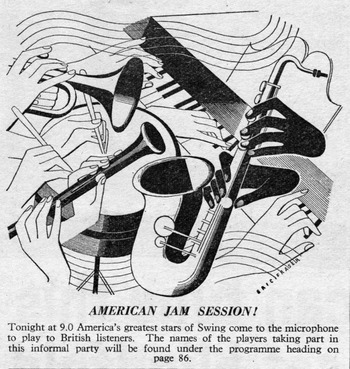
If Greene and Perowne seemed content to leave the details of repertory and personnel in Joe Marsala's hands, they were more proactive about the broadcast's other logistics, aiming to impress audiences on both sides of the Atlantic. Greene organized a lavish party for his guests in New York, to whom he sent “gold-embossed invitations [that] advertised champagne all round.”Footnote 102 Finding a venue was challenging because he envisioned not a small Spartan broadcasting studio, but a large venue with a posh atmosphere that served alcohol.Footnote 103 Greene finally settled on the Viennese Room on the roof of the St. Regis Hotel, a luxurious society hotspot only a few minutes’ walk from the jazz clubs on 52nd Street.Footnote 104 Meanwhile, Perowne regarded the broadcast, with its assembly of stars, as a “high-spot” for British listeners. He arranged for the program to be recorded for the BBC's archives (and as insurance if “atmospheric conditions” interfered with the relay over CBS's W2XE transmitter).Footnote 105 The independent Radio Pictorial promoted the session, as did the BBC's Radio Times, which called attention to the session with a stylized illustration of instruments played by four pairs of white hands and one prominent black pair, highlighting its interracial personnel (see Figure 1).Footnote 106Melody Maker was especially enthusiastic, announcing details of the “spell-binding” session on its front page, four weeks before the airing took place.Footnote 107 Anticipation ran so high that Leonard Feather mentioned the upcoming broadcast in his monthly report from London for the U.S.-based Metronome.Footnote 108 Despite Greene and Perowne's planning for the broadcast, the fundamental uncertainties of a jam session remained—notably, the question of whether all of the invited players would materialize for the Saturday afternoon broadcast. “These things always have an element of risk when they are arranged as informally as this one has been,” Greene wrote.Footnote 109
Radio Times illustration for the 5 November 1938 American Jam Session. (Programme Listings, Radio Times, 28 October 1938, 84).

As a party, the 5 November Jam Session was a spectacular success. Variety's report portrayed a boisterous affair, suggesting that Greene had fulfilled his aim of demonstrating to Americans “that we are not quite as stuffy an organization as we are often made out to be.” His promise of free champagne attracted a celebrity-laced audience of “several hundred invited listeners who kept bartenders busy.” The attendance of Panassié, who was on his first (and extensively reported) visit to New York, was a particular coup: the critic went frequently “into spasms of delight” and praised “this new kind of swing broadcast” when Cooke interviewed him on air.Footnote 110 Not everyone in attendance had received Greene's personal invitation, however: Cooke recalled the bartenders “dispensing free champagne to every agent and relative of Fats Waller, W. C. Handy and the rest” and observed, “I still remember . . . my own growing panic as everyone from Prince Obolensky [the socialite who had remodeled the St. Regis] to Lee Wiley's charwoman heard there was a free champagne party going on at the St. Regis. Happy days!”Footnote 111 The gathering also attracted “a flock of cameramen,” who covered the event with zeal, “stopping just short of swinging from one of the cut glass chandeliers for an angle shot.”Footnote 112
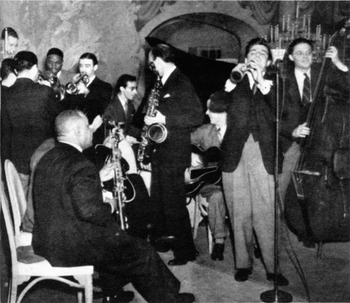
Undistracted by champagne and spectacle, listeners in Britain may have understood the jam session relay as a virtually visual event, but their impressions were wholly dependent upon what they heard—and both the crowd and the quality of the transmission undermined the music's intelligibility, even for seasoned jazz listeners.Footnote 113 Managing the balance between ambient sounds, which could add a desirable on-the-spot flavor, and the main musical or spoken content of the program was a key challenge in outside broadcasts. Like most non-studio broadcasts of the period, two microphones appear to have been used for the jam session, one for Cooke's announcing and one for the band (with a possible third for Wiley's singing), and an on-site engineer to oversee balance. In contrast to typical outside broadcasts, the band was not positioned on a raised stand; rather, the musicians clustered about the microphone at the same level as the audience, which sustained the volume of its revelry to the point that the thrum of voices sometimes overpowered the music (see Figure 2). Cooke added to the cacophony when he shouted into the microphone: “I hope you can hear me. I can't hear myself.”Footnote 114 Atmospherics, a perennial problem in shortwave radio transmissions, played further havoc with the relay's audibility. An imperfect signal did not automatically ruin a broadcast for keen fans because their knowledge of the repertory allowed them to discern at least the outlines of the performance. In the November relay, however, the atmospherics had an especially disruptive effect, for, despite the session's familiar repertory, each number featured original improvisation and nearly all were played in the densely textured Chicago jazz style, which came across poorly in low fidelity environments. “Fading and surging tended to obscure much of the accompaniments, leaving sometimes only the solo instrument playing up on the mike and a mumble of bass and drum rhythm audible,” wrote “Detector.”Footnote 115
The 5 November 1938 American Jam Session at the St. Regis Hotel. From left to right: Yank Lawson, Max Kaminsky (back to camera), Marty Marsala (back to camera), “Hot Lips” Page, Sidney Bechet, Bobby Hackett, Carmen Mastren (partly hidden), Dave Tough, Bud Freeman, Eddie Condon, Joe Marsala, and Art Shapiro. Photograph by Sam Andre. (Wilder Hobson, American Jazz Music [1939; reprinted New York: Da Capo Press, 1976], 91).

Even allowing for atmospherics, most critics declared the jam session relay to be aurally and musically confusing. Metronome described the airing as “too much of a hodge-podge” while “Detector” criticized the session's musicianship as frenzied, “like a rugger scrum.” (Perhaps the unlimited champagne played a role.) The “all-in” jam on the final number, “I've Got a New Baby,” epitomized the charges of a musical “melee.”Footnote 116 According to Variety's tolerant reviewer, the number featured a “Mexican standoff” between the two drummers, Zutty Singleton and Dave Tough, along with, according to Metronome, “the five trumpets blasting out with terrific fury.”Footnote 117 Although “I've Got a New Baby” was apparently not preserved, the final chorus of the penultimate “You Took Advantage of Me” gives a sense of its potential cacophony: not only did the trumpets blast but the three clarinets screamed an obbligato characterized by hair-raising timbres and intonation.Footnote 118 Citing the “chaotic” results of “indifferent reception,” a “noisy audience,” and “confus[ed] ensembles,” Feather reported to Metronome's U.S. readers that the relay was, “in the opinion of everyone who heard it over here [in Britain], a complete flop.”Footnote 119
Feather overstated his claim, however. If the relay failed musically for some, it succeeded for many listeners in offering a visceral experience of an informal—and, thus, authentic—jam session. “Despite indifferent reception and a noisy audience, the virility of the music was not lost,” countered the budding critic Stanley Dance.Footnote 120 Indeed, two weeks after “Detector's” 12 November review of the jam session, Melody Maker devoted its letters section to four readers who considered the broadcast to be a “complete success” and who took exception to “Detector's” scathing tone. For “Larry,” “Detector” had missed the point: the broadcast was an “informal party,” and it was unrealistic to expect it to be as “polished as a series of recordings.” Jeff Aldam (the founding chairman of London's No. 1 Rhythm Club) praised the “real feeling” of the “eighteen first-rank musicians” while Allan Freeman described the “unexpected pleasure” of hearing comments by “such celebrities as Handy and Panassié.”Footnote 121
“Detector,” who had already described the session as “pandering to the hysteria” of “jitterbugs” and “self-style jazz enthusiasts,” had sharp words for his critics: they had succumbed to “the glamour of names” and “a bit of tear-up hot playing.” More kindly, he continued, given the distance of British fans from “the real thing,” “we are often too ready to overestimate the merit of what we do hear,” but he chided, “It's high time some of you acquired a little more taste and discernment.” Urging the ignorant readers who had appreciated the session to spend more time studying jazz on gramophone records, he amplified a perspective on jazz that would become more explicit in Britain during the war: Americans could be carried away by the emotional excesses of live performance, but British fans had better taste, honed by the objectivity of the gramophone.Footnote 122 In the case of both radio jam sessions and recordings, according to “Detector,” the paramount concern was excellent musicianship, which was characterized by relaxation, inventiveness, spontaneity, and the rejection of “superficial excitement.”Footnote 123 In contrast, his critics embraced the session's party atmosphere as itself embodying spontaneity and accepted less polished playing as authenticating the players’ relaxation.
The debate over the relay's musical success focused not only upon its atmosphere but also upon the performances of individual players—a discussion that touched upon both the challenges of broadcasting jam sessions and conflicting understandings of authenticity in jazz. A recurrent complaint was that outstanding players, like Bobby Hackett, “fell by the wayside” whereas less deserving musicians—most notably, the “polariz[ing]” tenor saxophonist Bud Freeman—played too much.Footnote 124 With eighteen musicians to play eight numbers during a forty-minute broadcast, it was difficult to ensure adequate airtime for everyone. Spontaneity alone would not suffice: “someone [had] to indicate solo order and direct traffic,” a job that fell to the session's musical organizer, Joe Marsala.Footnote 125 Despite the complaints, Marsala was reasonably effective at rotating musicians into and out of the lineup for each number. Although three musicians—Sidney Bechet, Dorsey, and Wiley—performed in only one number, they were all featured at the heart of the broadcast. Further, the clarinetists, trumpeters, and drummers did divide the numbers fairly equally between them whereas, in Freeman's case, it was hardly surprising that the only tenor instrumentalist (barring Dorsey) would play in six numbers.Footnote 126 The main factor that undermined Marsala's leadership was the poor transmission quality, which muddied the complex Chicago-style accompaniments and, as “Detector” complained, obscured the rhythm section. Further, Marsala did not always manage to rein back musicians who began to overwhelm the soloist: it was the resulting jumbled textures and uneven balance that inspired many charges of disorganization and bad playing.Footnote 127
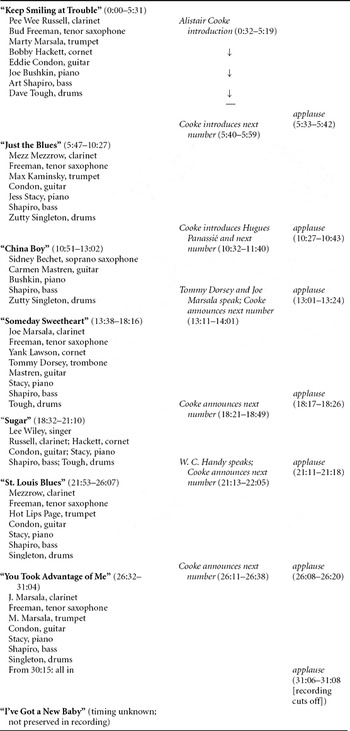
Indeed, the personnel assignments and order of numbers in the broadcast were more organized than words like “hodge-podge” suggested. The Bechet, Dorsey, and Wiley features of “China Boy,” “Someday Sweetheart,” and “Sugar,” respectively, comprised the heart of the broadcast. Featuring some of the most consistent playing and best-organized ensemble work, the central numbers attracted the warmest critical response. They were framed by two unevenly received blues numbers, Mezzrow's “Just the Blues” and Handy's “St. Louis Blues.” Although the playing of individual musicians was praised in the opening number (“Keep Smiling at Trouble”) and closing numbers (“You Took Advantage of Me” and “I've Got a New Baby”), significant portions were obscured by Cooke's commentary and the muddying effect of too many players.Footnote 128 (See Table 2.)
Set List and Timings for BBC American Jam Session, 5 November 1938.a

a The timings are based on the most complete recording of the relay that is available, Alistair Cooke, et al., Alistair Cooke's Jazz Letter From America (Avid Entertainment compact disc AMSC 855, 2006).
As the session's fastest and most explicitly virtuosic performance, the third number, “China Boy,” represented an early climax in the airing. Accompanied by only a rhythm section of Carmen Mastren's driving guitar, Joe Bushkin, Art Shapiro, and Singleton, Bechet played three technically brilliant choruses, interspersed by solo choruses for Bushkin and Singleton. Although Cooke interviewed Panassié during the first two choruses, obscuring Bechet's solo over Singleton's woodblock and Bushkin's feature, Bechet's other two choruses were audible—and impressive. Embellishing the tune with running eighth notes, arpeggios, and rapid registral leaps, Bechet's solos recalled New Orleans–style clarinet obbligatos, now transformed into virtuosic ends in themselves.Footnote 129 As his biographer John Chilton noted, Bechet's final chorus in particular drew upon “pre-set variations,” an approach rooted in early jazz performance practice that involved “phrases he practiced to perfection, knowing that whenever he performed them in public they always impressed his audiences.”Footnote 130Metronome responded approvingly by including Bechet in its short list of “high-lights” for the program, along with Freeman, Hot Lips Page, and Hackett.Footnote 131 “Detector,” however, did not mention Bechet at all. The critic's scoffing reference to Cooke's appellation for Singleton as “the greatest coloured drummer alive” during his tom-tom–heavy “China Boy” solo, along with his rant about “superficial excitement” in the session, reinforced his refusal to be impressed.Footnote 132
In contrast, “Detector” had warm words for Dorsey and Wiley in the next two numbers. Dorsey's feature, “Someday Sweetheart,” was prefaced by an interchange that highlighted the occasion's informality:
Tommy Dorsey: Joe, it's a real pleasure to be here at such a grand swing session. I'm glad you called on me, and anything you want us to play, Joe, just speak right up.
Joe Marsala: Thanks, Tommy. [mumbling a little] I'm sure glad all the boys are here. [more clearly] “Someday Sweetheart”?
Dorsey: “Someday Sweetheart.” Well, all right then. [speaking away from the mike] How about the intro, Jessie [Jess Stacy]?Footnote 133
The number represented a reunion of sorts between Dorsey and several musicians who were, or had been, members of his band and his band-within-a-band, the Clambake Seven: Mastren, Dorsey's long-time guitarist; Dave Tough, who had just been fired by Goodman and was on the cusp of returning to Dorsey; Yank Lawson, whom Dorsey had recently wooed away from the cooperatively run Bob Crosby band; and Freeman, whose solo playing Dorsey “loved” but who had, at Tough's urging, left the band for Goodman earlier in the year.Footnote 134 Supported by sometimes assertive riffing and Tough's swinging ride cymbal, Dorsey, Freeman, and Lawson offered a relaxed, mid-tempo interpretation of the number, with soloing that hewed closely to the melody.Footnote 135 “Dorsey gave us some real music,” opined “Detector.”Footnote 136 The final chorus evoked an approachable Dixieland style with Lawson's arpeggiated version of the melody, tailgate trombone from Dorsey, and inner fill by Freeman.Footnote 137
With little pause, the musicians launched into “Sugar,” a virtual signature tune for Wiley. Stacy, Tough, and Shapiro remained at their posts to accompany her, joined by Pee Wee Russell, Hackett, and Condon; the personnel foreshadowed that on several small label recordings she made in the coming years, as well as her regular appearances in Condon's Town Hall Concerts.Footnote 138 “This girl has it all,” raved “Detector,” “and she didn't fall for the racket”—referring perhaps to Hackett's and Russell's assertive countermelodies which competed with “the enticingly husky Wiley contralto” in the second chorus. Wiley sang behind the beat with a knowing confidence that balanced emotional reserve and sensuality, in a manner reminiscent of Ethel Waters (to whom she had listened assiduously as a girl).Footnote 139 Not everyone agreed with “Detector's” assessment, however. “Those whose idea of the ultimate in jazz is Mildred Bailey's ‘Elsie Carlisle’ act or Goodman's band blaring out a movie hit, may, like ‘Detector,’ have disliked the all-star jam session,” wrote “Larry,” comparing Bailey's light, swinging delivery unflatteringly to that of the British flapper vocalist.Footnote 140
“Larry's” comment hinted at the growing controversy over the relative merits of Golden Age jazz versus swing, as well as competing notions of racial authenticity in jazz. For both “Detector” and the Melody Maker readers who criticized his review, commercialized swing was unacceptable; however, they differed on what constituted the most authentic alternative. One side valorized the polished playing of the white musicians whose recordings had first exposed them to jazz over a decade earlier. “Thank the Lawd for Bix [Beiderbecke], [Eddie] Lang, the Five Pennies and Arkansas Travelers [both bands led by Red Nichols], etc.,” wrote one Melody Maker correspondent, who compared the relay to “Hades.”Footnote 141 The other side followed John Hammond, the British critic Spike Hughes, and Panassié in celebrating African American musicians, like Louis Armstrong, Duke Ellington, and Jimmy Noone, as the creators and most authentic exponents of the genre (joined by a few exceptional white musicians, like Mezz Mezzrow, whose playing Panassié deeply admired).Footnote 142 Panassié and a vocal segment of Britain's rhythm club subculture held a primitivist regard for looser arrangements, expressive improvisation, and rougher, more timbrally complex tones as indicating a spontaneous and vital “Negro” sensibility.Footnote 143 “[T]he true expression of jazz means to Panassie [sic] the soulful crying of the American negro as exemplified, more than in any other way, by the playing of the blues,” Metronome explained.Footnote 144
No pieces in the November relay better illustrated the racially charged “polished versus rough” debate than the two blues numbers. With nearly identical personnel (only the trumpeter was different), they both included Freeman, Singleton, and Mezzrow, the players at whom “Detector” directed his harshest criticism.Footnote 145 Mezzrow exerted clear leadership in “Just the Blues,” particularly in the transition from the first seven, deliberately paced choruses, supported by Singleton and Stacy's steady four-to-the-bar rhythm, to the ragged, double-time rendition of the tune that ended the number.Footnote 146 The two-tempo device represented “a capsule history of the birth of New Orleans music,” according to Mezzrow, “going from the low-down blues of the gallion [sic] slave to the high-spirited strutting of New Orleans.”Footnote 147 Mezzrow's soloing on the number, which ranged from a chorus in the chalumeau register to two choruses at the top of his range, full of pitch bending and trills, attracted the scorn of “Detector,” who could not see past the clarinetist's challenging tone: “I have heard some horrible clarinet tones, but Russell's and Mezzrow's beat them all.”Footnote 148 Jeff Aldam (of London's No. 1 Rhythm Club) argued back, “These two, in common with Marsala and only too few others, have derived their inspiration direct from the great coloured pioneers.”Footnote 149 For those who regarded polish with suspicion, Mezzrow's and Singleton's roughness signified their authenticity. As Metronome (offensively) explained, “Zutie . . . inculcates a savage simplicity (typically negroid) into his playing.”Footnote 150
Recalling the musical atavism of “Just the Blues,” Cooke introduced “St. Louis Blues” with a gesture toward the past in the person of “the grand old man of swing,” W. C. Handy. The fast, swing-oriented version that Page led looked less to the past, however, than to the future. Page's extended “hot trumpet solo” (which Cooke announced as such) over Stacy's stride piano and assertive habanera accompaniment elicited an adventurous response from Freeman. Nearly harmonically unmoored at times, it likely inspired “Detector's” criticisms of the saxophonist as “at his worst—horrible tone, out of tune, and mostly playing a string of notes for the sake of it.”Footnote 151 In contrast to Freeman's and Mezzrow's underwhelming performances on the number, Metronome greeted Page's playing as a “high-light” of the broadcast.Footnote 152 “Detector,” however, remained silent.
Indeed, despite striking performances by Page, Bechet, Mezzrow, and others, it was the polished performances of Dorsey, Wiley, and Mastren (all white musicians) that were, for “Detector,” the most worthy of praise—and even mention. Not only did the critic deplore the relay's “frenzy of jazz rhetoric,” but he also criticized most of its players for a lack of originality, a problem rooted in the fact that, in the United States, extemporized swing's “exponents are so near to each other that they have all got into a rut” (an oblique reference to Condon's interconnected mob). “Detector's” explanation overlooked the close relationships between the players in Dorsey's feature, “Someday Sweetheart”; it also contrasted markedly with Panassié's contention that stylistic and even personal affinities yielded the best collective improvisations.Footnote 153 For Aldam, “Detector's” review betrayed his “complete lack of feeling for the true spirit of jazz”—or at least his allergy to “rough,” spontaneous, and fiery playing.Footnote 154 Their differences outlined a divide, over rough and polished, black and white, that would become more pronounced in British jazz criticism during the coming years. Live jam sessions promised spontaneity, immediacy, and musical brilliance, but British listeners and critics disagreed over whether the merits of a broadcast were best assessed holistically as events or by focusing upon their musical ideas and execution.
Beyond poor reception and scrappy musicianship, “Detector” identified Cooke's “abortive” compèring as a final cause for the relay's failure: “he just didn't know how to cope.”Footnote 155 Cooke was responsible for imparting to listeners in Britain both the atmosphere of the live event and the visual cues that they would otherwise miss. In his lengthy introduction, Cooke effectively conveyed the setting (“It's a beautiful, hot, sunny day outside”), but when it came to the mechanics of introducing the numbers and their personnel, he was less assured. With a new lineup for each number, he was often left naming players well into the first, and even second, choruses. In slower numbers, Cooke identified soloists as they played, but in faster numbers he was sometimes lost, as when he attributed Freeman's solo to Dorsey in “Someday Sweetheart.” The biggest problem was Cooke's often frantic-sounding delivery: rattling off personnel or making a few comments in the middle of a solo chorus, he evoked a horse race rather than an intimate jam session.Footnote 156
All in all, the jam session failed on a musical level for many British listeners and for the discerning Americans in the audience. “I tremble to think of the harm such an exhibition may have done to the cause of real jazz,” “Detector” concluded.Footnote 157 Whereas those in attendance had at least been impressed with the BBC's ability to throw an entertaining party, Cooke had, for many listeners in Britain, alienated rather than incorporated them, turning them into distant bystanders rather than invited guests. Meanwhile, the party—or, rather, the bar tab and fees for the players—received a cold reception from BBC administrators.Footnote 158 “The bill . . . hit Broadcasting House like a block-buster,” Cooke recalled, “There was a short and fearful row but . . . Felix Greene . . . was always above such vulgar things as money. He merely conveyed to London that he found the whole topic deeply painful, and they blushed and shut up.”Footnote 159 Feather's prediction that the flop would not be repeated proved premature, however. In the same telegram in which Greene described the players’ delight, he suggested, “Repeat much smaller scale halfhour program with six or seven top rank players only no party cost twohundred fifty dollars.”Footnote 160 By 7 December, the next broadcast was confirmed.Footnote 161
Relay 2: January 1939
The second American Jam Session relay offered a version of “jazz in its natural state” that was radically different from the first. Although more modestly conceived and diffidently promoted than the November session, the January relay was an unmitigated success. “Detector” enthused, “[I]n place of what can only be described as last November's gin party we had on this occasion music that was as captivating in its artistry as it was thrilling in its swing.”Footnote 162 Billed in the Radio Times as “another informal party,” the relay this time emphasized an intimate atmosphere, which accorded more closely with Wilder Hobson's “four-in-the-morning” spirit of an authentic jam session, “when players from different bands gather in small resorts for their own pleasure after work.”Footnote 163 Several factors contributed to the marked improvements of the second broadcast, but they all clustered around its embrace of intimacy, not only in the context of the jam session itself but in its address to listeners in Britain.
The planning for the second relay began even as the critics were lambasting the first broadcast and the BBC hierarchy was reacting to its excessive costs. Ballyhoo seemed ill advised: Felix Greene cabled no updates on his search for a venue while the Variety producer Philip Brown, who appears to have assumed Leslie Perowne's responsibilities on the relay, issued no calls for publicity.Footnote 164 By 8 December, the broadcast was set for Friday, 20 January, but no musician other than Joe Marsala, who was again securing the players, had been named. Alistair Cooke agreed in mid-December to compère the session.Footnote 165 On 4 January 1939, Maurice Gorham, the Radio Times editor, complained that he had only just been informed of the jam session broadcast; the tardy notification meant that he was unable to adjust the layout to promote the relay.Footnote 166 Even Melody Maker, which had engaged in a month-long buildup to the first relay, announced the second session only two weeks before it aired.Footnote 167
In the announcement, Melody Maker identified a crucial difference between the two broadcasts: “Instead of inviting all the big stars at random, Alistaire [sic] Cooke [actually, Joe Marsala] has assembled a specially picked band which will perform the entire programme.” Featuring only seven players (two additional musicians, the trumpeter Charlie Teagarden and vocalist Red McKenzie, were added at the last minute) would do much to fix the problems that had contributed to the disorganization of the first broadcast. Fewer players forestalled charges of “overcrowding of talent”; spared Cooke the task of announcing personnel for each number, which had contributed to his often frantic delivery; and allowed the ensemble to jell as the session progressed. Moreover, Marsala's “specially picked band” would avoid “the indiscriminate mixing” of the previous broadcast.Footnote 168
Melody Maker must have been referring to the inclusion of more marginal and timbrally challenging musicians, like Mezz Mezzrow and Pee Wee Russell, in the November relay, for the “amazing mixed-colour” personnel of the second broadcast represented a diverse cross section of New York's top small and large bands (see Table 1).Footnote 169 Chu Berry played with Cab Calloway, Teddy Wilson played with Benny Goodman, and George Wettling and Charlie Teagarden played with Paul Whiteman's band. Marsala and John Kirby led small bands on 52nd Street while Harry James and Jack Teagarden had just left Goodman and Whiteman, respectively, to start their own big bands.Footnote 170 Although some of the players (Wettling, McKenzie, and Jack Teagarden, most notably) were associated with Eddie Condon's mob and some, particularly Marsala, cultivated a hybrid Dixieland approach, the instrumentalists could all function at a high level in swing contexts. Further, whereas the November relay was promoted with interracial imagery but was dominated by white musicians, the second broadcast offered thoroughly integrated music making, which so many British enthusiasts prized. Where Sidney Bechet and Hot Lips Page had received one feature apiece, Berry soloed extensively; where Zutty Singleton had split drumming duties with Dave Tough, Wilson and Kirby now anchored the rhythm section. Finally, nearly all of the players were at or near the height of their popularity, with Berry, James, Jack Teagarden, and Wilson all recently named to Metronome's 1938 All Star Band.Footnote 171
Of course, a roster of famous musicians did not guarantee an outstanding event, as the first American Jam Session had demonstrated, but through chance and calculation the January relay managed to surpass the earlier broadcast. Reception was always chancy for transatlantic relays; indeed, the high percentage of low quality transmissions for America Dances during the autumn had led “Detector” to question the wisdom of relaying the series, rather than recording it on transcription disc.Footnote 172 Fortunately, “the reception was excellent” for the 20 January session; as “Detector” observed, “The performance might have been coming from the London studios.”Footnote 173 This time, the wireless technology had succeeded in being “self-effacing,” collapsing the distance between the performers in New York and listeners in Britain and giving an illusion of proximity.Footnote 174
Greene also changed the venue and audience to convey in the January relay a different sort of “informal party” atmosphere than that of November's “gin party.”Footnote 175 Whereas the first jam session cast British listeners in the role of interlopers, overhearing a large and ebullient party, the second session addressed them as participants in an intimate gathering. As Cooke explained in his introduction, over a muffled blues, “This time our jam session is a much more, much more intimate thing. We haven't got an enormous jamboree on top of a roof. We've got just about thirty people in a little room here, and it's much more in the nature of a genuine jam session.”Footnote 176 Here, intimacy rather than abandon was cast as the ultimate guarantee of authenticity. Indeed, although one can hear the occasional spoken encouragement to a musician and applause, the babble of a champagne-animated crowd is nowhere to be heard.Footnote 177 The focus was on the music unfolding in real time, whether the auditor was in the studio or listening at home.
Listeners were rewarded for their close attention. Perowne was unrestrained in his praise: “the playing was—as the jargon has it—out of this world.”Footnote 178 For “Detector,” recordings remained the benchmark for individual musicianship (“if you go through your records you may find some where Teagarden, Wilson and the rest have played better”); however, he recognized the broadcast as greater than the sum of its parts: “this was one of the greatest swing airings I have ever had the pleasure of hearing.”Footnote 179 As Melody Maker had predicted, the reduced personnel helped greatly. “There was at no time a confusion of noise. Everything came through perfectly clear,” wrote Perowne.Footnote 180 The clarity stemmed not simply from the smaller number of players but in how they played. In contrast to the first session, in which nearly every solo chorus was accompanied by Dixieland-style countermelodies or riffing, soloing in the second session was tethered only by the three-piece rhythm section and, only occasionally, by riffed figures in the melody instruments. All-in Dixieland-style improvisation was limited to first and last choruses.
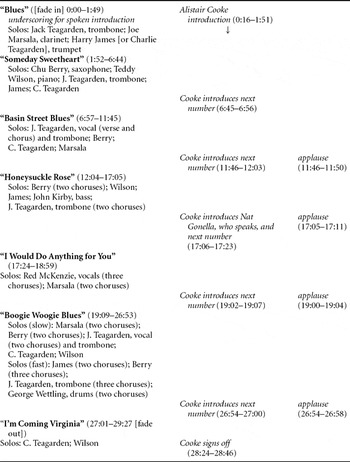
Almost as a challenge, the musicians for the January relay began their session with “Someday Sweetheart,” Dorsey's feature in the first relay. At 164 beats per minute, their version was twenty “ticks” faster than Dorsey's version, a tempo that energized the Dixieland-style first chorus, in which James and Charlie Teagarden recalled the two-trumpet instrumentation of King Oliver's band with Louis Armstrong. The mood switched sharply when Berry began the next chorus, improvising a swinging, forward flowing melody over the understated rhythm section. Whereas Tough had turned assertively to the cymbals, Wettling remained unobtrusive, occasionally punctuating the phrase with a snare hit on the fourth beat. In subsequent choruses, Wilson, Jack Teagarden, James, and Charlie Teagarden followed Berry's suit, emphasizing horizontal motion over New Orleans verticality in their solos. Both versions had their strengths, but the second relay's “Someday Sweetheart” was a model of on-a-dime code switching, with assured swing soloing sandwiched between two glossy Dixieland choruses.Footnote 181
The restrained accompaniments allowed individual players to shine in a way that had not occurred in the first session, and “Detector” was generous in his praise, particularly toward Jack Teagarden and Berry, who together played (and sang) more solo choruses than the rest of the musicians combined (Table 3). The critic offered his “biggest bouquet” to Jack Teagarden for his “simple but entrancing melody” and “unique sense of rhythm”—qualities that were especially striking in his languorous vocal and trombone solos, which opened “Basin Street Blues.” “Detector” was nearly as enthusiastic about Berry's melodic and rhythmic inventiveness, which sometimes challenged the other players. In “Honeysuckle Rose,” for instance, Berry opened with a rhythmically displaced statement of the tune, which momentarily flummoxed the melody players, who took half the chorus to settle into their riffed accompaniment. Marsala assumed a secondary role through much of the broadcast, but he played three hot choruses (encouraged by McKenzie's hollers and backbeat handclaps) in the energetic bonbon “I Would Do Anything for You,” which featured the iconic singer in what Cooke announced as “possibly” one of his last appearances before he retired.Footnote 182 Finally, “Detector” praised the “interesting contrast” between the trumpeters: James, with his technical accomplishment and “glorious tone,” and Charlie Teagarden, who was “the stylist every time.”Footnote 183 Although James took more solos, Teagarden, who had been hailed by Metronome a few months earlier as an inheritor of Bix Beiderbecke's mantle, offered an assured cornet solo in the closing number, “I'm Coming Virginia,” which was associated closely with the legend.Footnote 184
Set List and Timings for BBC American Jam Session, 20 January 1939.a

a The timings are based on the most complete recording of the relay that is available, Alistair Cooke, et al., Alistair Cooke's Jazz Letter From America (Avid Entertainment compact disc AMSC 855, 2006).
Thanks to good reception and thinner musical textures, British listeners heard the rhythm section—Kirby, Wettling, and Wilson—much more clearly in the second broadcast than they had in the first. “Detector” called the playing “grand, if not always as exciting . . . as one could wish” (forgetting, perhaps, his harsh words for Singleton's brand of excitement in the first broadcast). Although he praised Wilson's artistry, he also asserted that the pianist's “refinement” acted as “a rather unnecessarily subduing influence.”Footnote 185 If Wilson's soloing lowered the temperature of the room, it also reinforced the jam session's relaxed, intimate atmosphere: “Teddy Wilson playing a solo now while Jack Teagarden lights up a cigarette and just looks over his shoulder,” Cooke observed during “Honeysuckle Rose,” while in “Boogie Woogie Blues” the band was “all leaning over the piano, watching Teddy Wilson.” The rhythm section also engendered some anxious moments for Cooke and Greene: “Fifteen minutes ago we didn't know even if there would be two of the players along,” Cooke announced in the introduction. “Teddy Wilson thought he was going to make a record.” Wilson made it to the broadcast on time, but Kirby arrived during “Basin Street Blues.” “In the middle of that one, John Kirby walked in with his overcoat on. He thought he was attending a clambake. He's decided, however, that this is a jam session. He's taken his overcoat off, and he's sitting down there now,” narrated Cooke. Perhaps Kirby was still catching his breath when in the next number, “Honeysuckle Rose,” Wilson and Wettling were left vamping for four bars as Cooke explained, “John Kirby. He didn't want to take a solo, but he's decided he will.”Footnote 186
In the January broadcast, Cooke finally displayed the “engaging radio personality” with which Feather had credited him the previous October.Footnote 187 No longer confined by the need to recite personnel for each number, Cooke offered brief yet penetrating sketches of the scene before him, drawing in radio listeners. As “Detector” explained, “His little gag at Kirby for playing in his overcoat lent those touches of intimacy and naturalness which mean so much.”Footnote 188 Rather than a crisis, Kirby's late arrival became evidence of the jam session's authenticity, recalling “Detector's” approving account of the sessions on BBC television, in which the musicians took off their overcoats as they arrived.Footnote 189 Cooke regularly announced soloists mid-number, maintaining a relaxed tone whether he simply gave a name or engaged in brief description (“Now our old friend, Joe”). Although less relaxed, his rapid delivery between numbers (along with the subdued and businesslike applause) reinforced the relay's musical focus.Footnote 190 Perowne attributed the broadcast's success to Cooke's “straightforward and simple” compèring, in tandem with the excellent reception and playing.Footnote 191
The number that best embodied Hobson's “four-in-the-morning” spirit of sympathetic musicianship and informality was the penultimate “Boogie Woogie Blues.” Still early in the boogie woogie revival, Albert Ammons had recorded his version for Blue Note two weeks earlier, and Count Basie had broadcast the number from the Famous Door the previous July.Footnote 192 Taking advantage of the temporal freedom afforded by live radio, the musicians in the BBC jam session offered an extended, eight-minute version of the number that ran to twenty-two choruses, eight at a slow tempo (102 bpm), which recalled Ammon's deliberate pace, and thirteen fast choruses (225 bpm), which recalled Basie's tempo. The expansive treatment allowed extended soloing for nearly all the musicians, beginning with two well-received choruses for Marsala, played in the chalumeau register over a chugging accompaniment, followed, according to Cooke, by “Jack Teagarden taking a vocal he's just thought up.”Footnote 193 Wettling's clean transition initiated a series of hot choruses by James, Berry, and Jack Teagarden, and the number closed with five choruses of Dixieland-style collective improvisation, complete with a two-chorus solo for Wettling over stop time accompaniment.Footnote 194 It was, for “Detector,” the relay's “most exhilarating number.”Footnote 195
Listening to the archival recording of the second session, especially with the first in mind, “Detector's” and Perowne's enthusiasm seems justified. Rather than spectacle, this broadcast offered an intimate encounter with musicians who performed with relaxed, searching spontaneity. As H. B. Fisher wrote to Melody Maker, “The occasional weaknesses here were more than outweighed by the good taste and mutual understanding of these sincere musicians, and the plenty they all had to say. It was a pleasure to listen to it.”Footnote 196 Unfortunately, the relay's limited promotion resulted in scant coverage of it beyond Melody Maker, although the BBC rebroadcast the session in May 1939.Footnote 197 With its convivial blending of U.S. jazz and BBC earnestness, one wishes that this attempt at airing a jam session had been reported in the press in the United States.
Conclusion: Mediating Authenticity
In their work on live broadcasting, both Philip Auslander and Chadwick Jenkins articulate how radio offered a pleasurable sense of immediacy and access while also, through a mixture of “antiseptic electrical space” and the discursive practices of announcers, limiting the threat of contamination by cultural Others.Footnote 198 As has been demonstrated throughout this article, the BBC's two jam session relays (like public, non-broadcast jam sessions) thrilled enthusiasts because they promised unprecedented access for those who were prevented by geography or social constraints from attending “true” jam sessions. The excitement rested not only in collapsing transatlantic space but also in the recovery project of bringing iconic players and the historic strains of Chicago jazz to the microphone. Rather than fearing contamination, many British enthusiasts welcomed the sessions for their informality and interracial personnel and celebrated the “rough” playing of musicians like Mezz Mezzrow as authentic.
And yet, despite live broadcasting's seeming transparency, it took careful planning and no small dose of atmospheric luck to convey a sense of spontaneity, intimacy, and immediacy. Although the November 1938 relay transmitted a real, champagne-fueled jam session party, the large audience, unwieldy number of players, and frantic announcing alienated listeners, bombarding them with chaotic sound. In contrast, the January 1939 relay, with half the players and a studio setting, was far more circumscribed; however, the controlled environment (and personnel) facilitated more cohesive playing and descriptive announcing, drawing listeners intimately, cleanly into the jam session. British listeners understood both sessions as authentic, but they were far more unified in assessing the second relay as good, in both musical and broadcasting terms. Musical failure may have been a reasonable risk in jam sessions among friends, but when an audience was involved, when in a concert hall or over the wireless, the performance of authenticity became an exercise in planned spontaneity.
The BBC's efforts to relay the American Jam Sessions, which were at once intimate and mass-mediated, atavistic and up-to-date, coincided with the Munich Crisis and its short-lived resolution. During the war that followed, jam sessions—featuring British musicians—became a frequent feature in Radio Rhythm Club, a special program that the BBC aimed at jazz enthusiasts, whom it now recognized not only as connoisseurs but also as members of the fighting forces. The decisions its producers made about the role of audiences, the announcer, venue, and selection of players revealed the formative influence of the 1938/39 relays. After the United States entered the war, Radio Rhythm Club was one of the few BBC-produced shows that appealed to U.S. troops stationed in Britain, who disdained most of its programming as dull and stuffy.Footnote 199 As Anglo-American relations moved from transatlantic awareness to the concrete challenges of stationing over a million GIs in Britain (involving sustained, large-scale encounters with the Other), jazz and jam sessions became crucial tools for establishing goodwill between the allies. In a war where jazz became a potent symbol of democracy, jam sessions, as presented by the BBC, offered a powerful model for cooperation, community, and Anglo-American understanding.