



I
The expansion of monetization and monetary transactions in pre-industrial societies invariably led to a demand for diverse monetary denominations. These denominations, catering to various transactions from large-scale international trade to daily local market exchanges, often vary in metal content. High-denomination coins for international trade were typically minted in gold, intermediate transactions used silver coins and daily transactions were facilitated by using small change (silver or bronze coins).
In systems where denominations are minted from the same precious metal, the metal content traditionally aligns proportionally with the face values, a practice prevalent from antiquity through the early modern period (1500–1800). For instance, in the English silver coinage system initiated in 1279, the silver content in groats, pennies, halfpennies and farthings (quarters) adhered to this proportional rule.
However, the production of small change in commodity monetary systems historically encountered a significant challenge: the high relative cost of producing smaller denominations. This often resulted in a reluctance by mints to produce sufficient small change, leading to shortages. Cipolla (Reference Cipolla1956) and Sargent and Velde (Reference Sargent and Velde2002) identified a ‘standard formula’ that policymakers sometimes followed to address this issue: mint small change as credit money but ensure its convertibility by exchanging it on demand at a pegged rate for large full-bodied coins.Footnote 1 Credit coins are typically overvalued, with a face value far above the intrinsic value. This means that the government cannot allow free minting, where individuals – against a fee – bring metal to the mint in exchange for coins. Instead, small coins should be minted on the government's account. Thus, the government monopolizes the minting of small coins and purchases metal on the market or sources metal from the government's mines. This approach allows the government to regulate the supply and value of small coins, ensuring their convertibility and stability on the market.
This study investigates how minting authorities in the early and late Middle Ages addressed the issue of small change shortage. Our research provides empirical evidence demonstrating that the standard formula was not always applied, yet no shortage was evident. Specifically, our analysis of coin hoards reveals that a nearly costless solution of dividing main denominations into smaller units in the early and high Middle Ages effectively averted shortages. Additionally, during the late Middle Ages, mints in central, eastern and northern Europe produced ‘hohlpfennigs’ as small change. Utilizing cost-effective bracteate technology,Footnote 2 these uniface coins were produced in large quantities, effectively circumventing the small change scarcity. Written documents, our analysis of the literature on stray finds and coin hoards, and observations on the collectors’ market indicate that there was no scarcity of hohlpfennigs. Our findings underscore the importance of these two alternative strategies in ensuring a stable supply of small denominations in the early and late Middle Ages, providing valuable insights into the supply-side solutions to small change production.
The article is structured as follows: Section II presents the leading theory about small change shortages. Section III analyses historical approaches to multiple coinage systems and their small change challenges. Section IV focuses on the issuance of hohlpfennigs, investigating their abundance, the cost-efficiency of their production and reasons for their eventual decline in the early sixteenth century. The final section summarizes our conclusions.
II
How the standard formula solves shortages of small coins
Why do problems of small change shortage appear? The scarcity of small change in monetary systems often originates from the indivisibility of coins. Wallace (Reference Wallace2003) implies that if coins were fully divisible, shortages could be mitigated by simply cutting larger denominations into fractions. However, Sargent and Velde (Reference Sargent and Velde2002) highlight that small change shortages are prevalent in a proportional coinage system – where denominations have proportional intrinsic value, and thus are full-bodied – with free minting and market-determined exchange rates. This is due to both supply-side and demand-side factors:
• On the supply side, the production cost of a coin is generally independent of its denomination, excluding the metal's intrinsic value. Thus, there are fixed costs of producing a coin, irrespective of denomination. All production steps, such as engraving dies, preparing blanks of standardized weight, size and fineness, and striking coins, are as time-consuming for small as for large coins. This leads to disproportionately high production costs for smaller denominations. In such a case, the minting of small coins must either be subsidized by the mint or the mint price must be adjusted so that people handing in silver for coinage must pay the production cost. Otherwise, there is a risk that mints may avoid producing small coins altogether (Sargent and Velde Reference Sargent and Velde2002, pp. 29, 50–3; Claridge et al. Reference Claridge, Delabastita and Gibbs2023, p. 23).
• On the demand side, small change offers more liquidity services than large denominations due to its usefulness in both small and large transactions (Palma Reference Palma2018, p. 374). Sargent and Velde (Reference Sargent and Velde2002) argue that this allows small coins to be dominated by large ones in terms of rate of return, as large coins tend to appreciate more relative to small ones.Footnote 3
The shortage of small change could have several consequences (Cipolla Reference Cipolla1956, pp. 27–37). First, transaction costs for small daily transactions increased. For example, transactions could take longer to clear, or larger denominations could be exchanged at a loss. Second, the lack of small change could inhibit or slow down trade. This inefficiency could discourage market participation and reduce overall economic activity.
The demand-side argument that small coins can be used for large transactions, such as real estate purchases, can be questioned. In such cases, prices would have to be reckoned and paid in terms of possibly tens of thousands of coins, making small coins cumbersome and inadequate (Cipolla Reference Cipolla1956, p. 40). There is also a negative aspect of the demand for full-bodied small change, which refers to small change containing the same proportion of precious metal relative to its value as large coins. This issue, which was not discussed by Sargent and Velde, involves handling problems. If small coins are made of silver, they are easily lost due to their small size.Footnote 4 Conversely, suppose small coins are full-bodied and made of base metals. In that case, they occupy significant space and are difficult to transport.Footnote 5 Estimating whether these handling issues outweigh the liquidity benefits is theoretically and practically challenging. However, it is likely that they partially offset each other, leading to a natural focus on the supply-side analysis.
Cipolla (Reference Cipolla1956, p. 27) and Sargent and Velde (Reference Sargent and Velde2002, pp. 5–7, 366) suggest a standard formula to avoid the shortage problem of small change: mint small coins as credit money on the government's account, limit overissuance and ensure their convertibility, by directly promising to exchange them for large, full-bodied coins at a pegged rate. Therefore, free minting of small denominations should be terminated.Footnote 6 Moreover, if the government accepts small change as payment for taxes at a pegged rate, this would be an indirect way of exchanging small change at par and, hence, similar to the standard formula. There must also be technology for producing counterfeit-proof small-denomination coins since overvalued coins are more attractive to counterfeiters. By moving from a commodity to a fiat money standard for small change, the government can then – at no cost in inflation – collect one-time revenues equal to the value of the precious metal in its small-denomination coinage.
The implementation of the standard formula means that small coins were debased but would circulate at a face value far higher than their intrinsic value. The government would guarantee this value by accepting them as payment for taxes. However, medieval thought about money and the true value of goods and services put obstacles in the way of such a monetary strategy. This might partly explain why the standard formula took such a long time to be implemented (in nineteenth-century England).
Medieval economic thought was heavily focused on the intrinsic value of the metal in coins, often connecting debasement with sins and other concepts with negative religious or moral connotations and other forms of immoral behaviour (Naismith Reference Naismith and Butcher2020, pp. 199–204). The medieval church also weighed in on the issue, with many theologians condemning debasement as morally wrong. The practice was often seen as a violation of the principle of just price and fair trade, crucial concepts in medieval economic thought influenced by Scholasticism (Langholm Reference Langholm1992, pp. 158–60). By the sixteenth and seventeenth centuries, this viewpoint was gradually abandoned, paving the way for more flexible monetary strategies. Geminiano Montanari argued that it was unnecessary for petty coins to have a metal content corresponding to the full-face value, provided that not too many were minted. In 1607, Thesauro argued for restricting quantities of small change, followed by Serra in 1613, who made similar arguments (Cipolla Reference Cipolla1956, pp. 28–30). Finally, in 1661, Slingsby proposed a complete version of the standard formula, thus fully describing that solution to the problem of small change Cipolla (Reference Cipolla1956, pp. 28–30).
The model
Sargent and Velde (Reference Sargent and Velde2002) construct a simple theoretical model for the free minting case. In their model, the price level of goods, the purchasing power of the coins and the gross seigniorage (monetagium), i.e. production costs and net seigniorage (profits of the coin issuer), of the minting authority together determine which coins will circulate in the economy (Sargent and Velde Reference Sargent and Velde2002, pp. 18–21). If the price level for goods is so high that coins’ face value falls below their intrinsic value, people will melt down or hoard their coins. When coins disappear, this pushes prices downwards and guarantees they will not increase again. Thus, the measure of intrinsic value sets an upper bound for price levels in the economy.
On the other hand, if the difference in market value between minted and unminted silver is larger than the gross seigniorage (i.e. consumer prices are low), people will have incentives to let the coin issuer mint all their silver. The increased quantity of coins on the market would then push consumer prices upwards until mint bullion is no longer profitable. The gross seigniorage of the coin issuing authority sets a lower bound for how much prices can fall.
Formally, how the melting and minting of coins depend on the consumer price level in a free minting system can be illustrated in Figure 1. Let p be the number of coins per good (i.e. the price), b the measure of the silver content in grams per coin and Φ the measure of grams of silver per good (raw silver price). Then, the price level p must obey p ≤ Φ/b. If p rises above this level (ratio), people will melt down their coins and exchange silver for goods on the market. The reduction of coins in circulation would drive prices down. Φ/b is the ‘upper bound’ or ‘melting point’ of the consumer price level.
Minting and melting point for coins under free minting

Also, the expression (1–σ)Φ/b ≤ p must hold, where σ is the gross seigniorage – consisting of production costs and net seigniorage – as a percentage the coin issuer charges when people bring their bullion for minting. Here, we assume that the production costs as a percentage are higher for small than for large coins due to fixed costs as defined above. However, the net seigniorage as a percentage is the same for small and large coins. If p falls below this ratio, people have incentives to bring silver to the mint to purchase coins. More coins in circulation would then cause prices to increase. Hence, (1–σ)Φ/b is the consumer price level's ‘lower bound’ or ‘minting point’.
Now, consider an example where we have two denominations in the economy, a large coin L and a small coin S. The official exchange rate e is the number of small coins for one large coin. The large coin contains e times more silver than the small one, i.e. bL/bS = e. Since it is more costly to produce the small coin than the large coin, then σS > σL, given that the net seigniorage is the same for both coins. Both coins will have the same melting point: p ≤ Φ/b, taking into account that p ≤ e Φ/bL = Φ/bS, given our choice of exchange rate. However, the small coin will have a lower minting point than the large one, i.e. (1– σS)Φ/bS < e(1– σL)Φ/bL. Simplifying that bL/bS = e, the minting and melting points for large and small coins are illustrated in Figure 2.
Minting and melting points for large and small coins
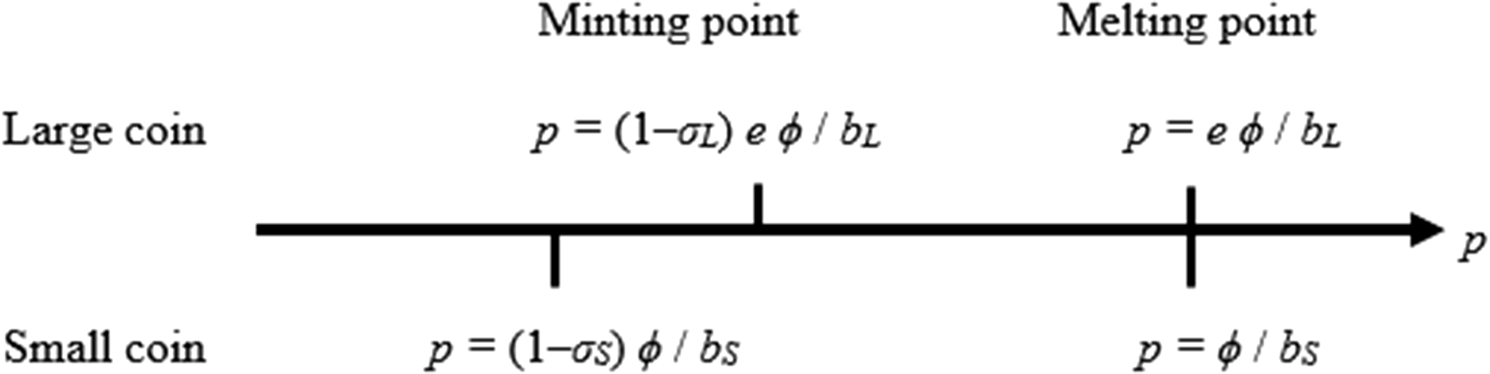
A key problem is that the minting point for large coins is larger than that for small coins (see Figure 2). Suppose various disturbances (for example, caused by changes in income due to variations in harvests) tend to push the price level lower between the minting points. In that case, minting large coins but not small ones is profitable. This tends to reduce the relative supply of small coins in the longer term. Suppose the mint charges a fee to compensate for the higher production costs of small coins (i.e. the mint price is lower for small coins) when individuals bring bullion to the mint. If the price level falls between the minting points of small and large coins, only large coins will be minted. To mint small coins, either cross-subsidizing small coins by larger ones or subsidizing the mint by the government is required. Another option is for people who bring bullion to the mint to bear the costs of small change.
Cures to solve shortages
To solve this problem, a few methods have been used extensively besides the standard formula. One is to reduce the production cost of small coins. This can be undertaken by cutting the main denomination in halves or quarters (see Section III). Another method is to use a minting technology with lower costs for small change, which cannot be used for large coins. This can then align the lower interval for small coins with that of large for an appropriately selected cost reduction. This, in turn, can lead to the minting of small coins when the price level decreases below the minting points. In Section IV, we will show that bracteate technology, which can only be used for small coins, has substantially lower production costs than traditional minting technology.
A third method is to debase small coins so that the silver content is δbS, which implies that the minting point is (1 – σS) Φ / δbS. By choosing δ appropriately, the minting points can be aligned. This can also be achieved using a base metal, such as copper. However, variations in the relative price of silver compared to copper tend to cause fluctuations in the minting points, potentially creating problems with this solution.
All these three methods will reduce the production costs for small coins: in Figure 3, this is mirrored by the fact that σS is reduced to σ'S, which moves the minting point of small coins to the right.
Moving the minting point of small coins to the right

Even though a minting system where the government's mint purchases the metal on the market, i.e. without free minting, is not based on profit maximization of private actors in the economy regarding mintage and melting of coins, such a system would probably face similar types of incentives. If it is very profitable to mint for the private sector, it would also be for the government, and vice versa. Hence, minting and melting points would also be relevant in a government-run system. Then, using a system with debased or base metal small coins with relatively well-aligned minting points should alleviate the shortage problem. The monetary system during the Roman principate is such an example (Harl Reference Harl1996, pp. 73–96).
Alternative explanations for shortages
While the supply-side explanation for small change shortages is central to our argument, it is important to consider alternative explanations proposed in the literature. These alternative views help contextualize the issue and offer a broader understanding of the factors that might contribute to small change scarcity.
According to Redish and Weber (Reference Redish and Weber2011), small change helps agents to achieve better trades (i.e. yielding higher bilateral welfare). Using only large coins leads to large differences in the quantities traded. Hence, small change can yield better outcomes if trades using only larger coins are far from bilateral efficiency. In cases where a government issues only large coins, introducing small change can be welfare improving, which is how Redish and Weber (Reference Redish and Weber2011) define a small coin shortage. Wallace (Reference Wallace2003) argues that in a model where agents have different productivity, coins can end up only in trades with high-productivity agents, where the coins buy more goods and, with more than one denomination, shortages of small coins can arise in equilibrium.Footnote 7
Although these alternative explanations provide valuable insights, they tend to complement the supply-side challenges we focus on. Understanding these perspectives enhances our analysis by acknowledging the multifaceted nature of small change shortages but in no way contradicts the significance of production costs and minting practices in shaping monetary outcomes.
III
Greek world: transition in coinage
In the Archaic Greek world up to 480 bc, small change primarily consisted of tiny silver coins, fractions of the silver staters.Footnote 8 Notably, a hoard from the late sixth century bc included numerous small silver coins weighing just 0.21 g, equivalent to 1/48 of a Lydian stater. Such small coins were made for local use and are seldom found far from their issuing state (Kroll Reference Kroll and Harris2008, pp. 22–3). Small silver coins were impractical both from a production perspective – the small diameter made them difficult and costly to produce – and from a user perspective – they were easily lost.
The mid fifth century bc heralded a pivotal shift. Small fractional silver coins were gradually phased out, giving way to overvalued base metal coins like bronze and brass (Von Reden Reference Von Reden2010, p. 32; Elliott Reference Elliott, Battilossi, Cassis and Yago2020, p. 71).Footnote 9 Syracuse in Sicily was a forerunner in experimenting with token bronze coins. This practice soon gained widespread adoption in the Greek world (Ashton Reference Ashton2006; Thonemann Reference Thonemann2015, p. 128). By the mid fourth century bc, bronze coins became the standard for small transactions. In the late Hellenistic period (third to first century bc), many cities issued four or even five bronze denominations. Since the face value of the bronze coins was far above their intrinsic value, the use of bronze coins was imposed by law (Ashton Reference Ashton and Metcalf2012, pp. 201–2; Thonemann Reference Thonemann2015, p. 128).Footnote 10
Interestingly, stray finds rather than coin hoards provide a clearer picture of small change circulation. Due to their low intrinsic value, overvalued small coins were rarely hoarded, making stray finds (coins accidentally lost in daily transactions) a more reliable source for analysis. Small coins are overrepresented in stray finds because, due to their low value and small size, people were less likely to search for them or pick them up when lost. As a result, they accumulated in greater numbers in the archaeological record (Harl Reference Harl1996, p. 16). Stray findings suggest that small coins were predominantly local, with limited cross-city circulation (Kroll Reference Kroll and Harris2008, p. 23). Excavation data from the Athenian Agora and Priene corroborate this, showing that most small change was local. However, some degree of intercity exchange value persisted.Footnote 11
Small change in Rome
Over time, the Roman monetary system underwent significant changes, partly in its approach to small change. In the early third century bc, a full-weight commodity monetary system existed with silver (didrachma) and bronze coins (aes grave). The aes grave coins were issued in various denominations. However, they were so heavy (up to 340 g) that casting was necessary.Footnote 12 However, during the Second Punic War (218–201 bc), the weight of silver and, more notably, bronze coins was significantly reduced. This reduction marked the beginning of a transition for the bronze coins, moving from commodity-based to partially credit-based, i.e. bronze coins had a higher face value than their intrinsic value.
A coinage reform in 211 bc established a new standard for full-bodied silver and bronze coins, where the silver denarius became the main denomination.Footnote 13 However, later reforms further modified the Roman coinage. The denarius, for instance, experienced a weight reduction in 187 bc.Footnote 14 The weight of the bronze coins fell even faster and they could soon be struck traditionally instead of cast.Footnote 15 In 140 bc, the bronze coins were devalued against the denarius, highlighting a shift towards overvaluation of smaller denominations.Footnote 16 The smaller bronze coins gradually assumed the role of credit coins.
When Emperor Augustus reformed the Roman coinage system around 27–23 bc, the base metal coins became officially real credit coins. The silver denarius continued as the main denomination, and all other gold, silver and base metal coins were exchanged at fixed rates according to an imperial decree (Harl Reference Harl1996, pp. 76–7). Old bronze coins from the Republic were retired and reminted. All base metal coins (brass and copper) were now overvalued, especially the brass sestertii and dupondii, and exclusively minted on the government's account.Footnote 17 But by making them convertible, they were accepted in society.Footnote 18 The minting of gold and silver coins was centralized in Rome and Lyon. In contrast, base metal coins were minted at several provincial mints.Footnote 19 The design and iconography of all coins were also improved; perhaps to increase confidence. It also made the cost of counterfeiting higher. Thus, the emperor Augustus already used a system similar to the standard formula when minting small change.
The Romans never invented a fully counterfeit-proof technology for their base metal coins. Imitations were frequent for base metal coins. However, the government might have ignored these imitations because mints often could not supply enough small change needed in the markets (see e.g. Kenyon Reference Kenyon1992, pp. 30ff; Harl Reference Harl1996, p. 89; Harper Reference Harper2010; Bland Reference Bland2018, pp. 79, 98).
The standard formula also seems to have been used in the Byzantine empire. For example, the follis copper coin of Justinian (527–65) introduced in 538 was overvalued relative to its metal content.Footnote 20 Similarly, when the silver hexagram coin was introduced by Heraclius (610–41), the copper follis remained significantly overvalued.Footnote 21
This fact that a system with strong similarities to the standard formula was employed in ancient Greece and Rome was never observed by Cipolla (Reference Cipolla1956) and Sargent and Velde (Reference Sargent and Velde2002).
Coin division in the early and high Middle Ages
From the establishment of Charlemagne's denier c. 800 until 1250, there were few denominations other than the silver penny (abbr. = d for denarius) in medieval Europe. Although higher denominations like the shilling (abbr. = s for solidus), equivalent to 12 pennies, and the pound (abbr. = £), equivalent to 20 shillings, were used in accounting, they were not physically minted.Footnote 22
The standard use of the penny as a monetary unit does not mean the medieval coinage was homogeneous across regions. Rather, it was the opposite; the penny in different regions varied in weight and fineness as much as the feudal society was decentralized in Europe.Footnote 23 Small change in the form of round halfpennies or obols was rarely coined, as evidenced by the high rarity of these coins in hoards, stray finds and on the collectors’ market. Instead, smaller denominations were created by cutting one penny coin into two halves or four quarters. The division of the coins was made practical because medieval coins were significantly thinner than their ancient predecessors.Footnote 24 The cutting was probably mainly performed by mint staff since most divided coins have cleanly cut edges, indicating that the cutting was performed with a precisely positioned and sharp tool (Naismith Reference Naismith2017, p. 221). Based on the main design, the halved coins are almost always cut into a left and a right half (from 12 to 6 o'clock). In England before 1279, the voided cross on the short-cross (1180–1247) and the long-cross (1247–79) pennies was chosen to facilitate cutting the coins into halves or quarters to get small change to the penny. When new denominations were introduced in 1279, all had a single-lined cross on the reverse, making cutting into halves more difficult.
In England, cut halfpennies and quarters from 973 to 1279 constitute a significant share in the coin hoards and single finds.Footnote 25 The coin hoards from Germany also show that halved bracteates were considerably more common than official round halfpennies. Halved bracteates could constitute up to a third of all coins in hoards (Svensson Reference Svensson2013, p. 139 table 13).Footnote 26
The rationale for creating halfpennies by cutting one-penny coins in half is that the production costs of small change as a share of the nominal value are the same for the halved and the full pennies (excluding the cost of the cutting). Thus, in Figure 2, the minting and melting points for the penny and its fractions are aligned. This also addresses the divisibility problem of coins, as Wallace (Reference Wallace2003) discussed. Thus, empirical observations from coin hoards from the early and high Middle Ages provide evidence that the shortage of small change primarily results from a supply-side problem, when mints adopted a minting technology that made small change costlier to produce, leading to a misalignment of minting and melting points.
New denominations in the late Middle Ages
After 1150, Europe witnessed the introduction of several new denominations, particularly in Italy, with the advent of gold coins like the florin (Florence), genovino (Genoa) and ducat (Venice) around 1252–84 (see Spufford Reference Spufford1988, pp. 267–88). These coins served large-scale trade and the international market (Eichengreen Reference Eichengreen, Battilossi, Cassis and Yago2020, pp. 342–3).Footnote 27 Meanwhile, higher-denomination silver coins (ranging from 4d to 24d) were introduced in northern Italy from the mid twelfth century and were mainly intended for local trade.Footnote 28
The introduction of these new denominations was influenced by the significant debasement of pennies in Italy and Spain, leading to a disparity in silver content compared to those in northern Europe. For instance, an Italian grosso's (12d) silver content was similar to a penny from England or Cologne, indicating a devaluation of the Italian penny.Footnote 29 The Italian grosso was soon adopted in western (gros tournois) and central Europe (Prague groschen), but with considerably higher silver content.Footnote 30
In northern Germany, the Hanseatic League cities minted higher silver denominations like witten (4d), sechslinge (6d) and dreilinge (3d) as well as unifaced bracteates like hohlpfennigs from 1365, with the latter becoming prominent in the fifteenth century.Footnote 31 These hohlpfennigs were issued as penny (1d), double penny (2d) and halfpenny (scherf), which highlighted a regional approach to small change.
Scandinavia lagged in introducing higher denominations, with örtug (8d) and hvid (4d) appearing only in the late fourteenth century. The absence of minted halfpennies in this region is notable.
England's introduction of groats (4d), halfpennies (½d) and farthings (¼d) in 1279 marked a significant step. However, their full-scale issuance was delayed until the mid fourteenth century.Footnote 32 This delay and mints’ reluctance to produce smaller denominations despite government callsFootnote 33 most likely led to a shortage of small change.Footnote 34 Instead, lead tokens, issued by private merchants since the eleventh century, were used as small change in England during the late medieval period to compensate for the shortage of small change (Allen Reference Allen2012, pp. 362–3).
The late Middle Ages were characterized by a mostly proportional silver content in coins across regions, with variations in the silver-to-face value ratio in different parts of Europe. For example, England and France had proportional silver contents of their coins to their face values until 1672 and the mid sixteenth century, respectively.Footnote 35 However, small change in Italy, Spain and the low countries could result in 10–20 per cent less silver content than proportional to higher denominations.Footnote 36
Of course, the production costs as a percentage of the face value were higher for lower denominations (see Section II). As can be seen in Table 1, estimates show a huge variation in production costs across face values in the late Middle Ages: 0.1–1.6 per cent of the face value for gold coins, 1.2–9.7 per cent for silver coins with a silver content of more than 1.0 g, 3.0–12.5 per cent for coins with 0.1–1.0 g silver and 15.6–43.7 per cent for coins with less than 0.1 g silver.Footnote 37
Production costs for different denominations in the late Middle Ages

Source: Data on eastern Prussia from Volckart (Reference Volckart1996), p. 99; the remaining countries from Sargent and Velde (Reference Sargent and Velde2002), p. 51.
An equal mint price across denominations would require either cross-subsidizing lower denominations with larger ones or subsidizing the mint by the government. The former was applied in France and the Netherlands, where the mint masters deducted production costs from gross seigniorage for each denomination (Sargent and Velde Reference Sargent and Velde2002, p. 52). Thus, the net seigniorage from larger denominations was used to subsidize the production costs of small ones. In practice, this meant that mint masters had incentives to produce high denominations if they could influence the mix and volumes of denominations. In Florence, the mint paid different mint prices across denominations, meaning that people who brought bullion to the mint had to bear the costs for small change (Bernocchi Reference Bernocchi1976, pp. 38–40).
Thus, the higher production costs are an important cause of shortages of small coins when the intrinsic values of the different denominations are proportional to their face values.
Monetary challenges and token solutions in the early modern period (1500–1800)
Rich empirical evidence from the late Middle Ages and early modern period supports the theory of small coin shortages. In response, minting authorities debased small coins to overcome high production costs and alleviate shortages. However, due to non-convertibility or mistrust caused by overissuance, the debased coins depreciated relative to large coins. Evidence of this phenomenon can be found in late medieval and early modern France, late medieval England, Florence, Venice and the Iberian kingdoms (see below).
Countries like England and Florence, grappling with small change shortages, often found their domestic currencies replaced by lower-value foreign coins (Sargent and Velde Reference Sargent and Velde2002, chs. 8–11). Venice and France attempted to issue token copper coins. However, overissuance and the lack of convertibility into larger denominations led to inflation (Sargent and Velde Reference Sargent and Velde2002, pp. 174–81). By the early modern period, authorities and scholars had started to understand the inflationary consequences of overissuing debased small change. In this way, they became familiar with the quantity theory of money (Cipolla Reference Cipolla1956, pp. 28–30).
Locally issued token coins made from base metals or paper emerged as small change substitutes in regions like England, Flanders, northern Italy, northern France and Catalonia but were frequently counterfeited. Catalonian cities issued convertible hammered tokens between 1481 and 1576, marking early attempts to address small change shortages. However, the ease of counterfeiting limited their success (Sargent and Velde Reference Sargent and Velde2002, pp. 216–18, 222–4). The introduction of cylinder press technology around 1600 improved the production of copper token coins, setting higher counterfeiting barriers.
England was the country that solved the problem of small change and adopted the standard formula. However, the approach to small change underwent several changes. From 1613 to 1644, a private monopoly on token issuance existed, but counterfeiting issues and the Civil War led to its abandonment (Sargent and Velde Reference Sargent and Velde2002, pp. 264–6). After 1660, the government produced its copper farthings and halfpennies, but counterfeiting remained a problem. During the laissez-faire era after 1740, the government avoided minting small change. It encouraged, or at least did not discourage, private suppliers of token coins. More than 10,000 private token coins were issued by city councils, owners of firms and local retailers in more than 1,700 towns. Using a steam-driven process, tokens issued in Birmingham became more difficult to counterfeit. The government nationalized and administered the system from 1817 (Sargent and Velde Reference Sargent and Velde2002, pp. 266–7, 271).
The standard formula requires that a large-denomination coin is the unit of account if there is a bimetallic coinage system. Britain had already transitioned to this system before 1817. The gold guinea had already become the unit of account in the eighteenth century. Britain was de facto on a gold standard at the end of the eighteenth century (Sargent and Velde Reference Sargent and Velde2002, pp. 292–8).
More countries followed Britain. In 1838, the German Monetary Union implemented the standard formula. It remained on a silver standard but switched to gold in 1871 when Germany unified. The United States and France used important parts of the standard formula but kept a bimetallic system. Eventually, they moved to a gold standard (Sargent and Velde Reference Sargent and Velde2002, pp. 306–9).
IV
In this section, we will show that the late medieval society had a unique solution to the small change problem – in contrast to the standard formula. As shown in Figure 2, the main reason for the scarcity of small coins is their higher production costs, which implies that the minting point of small coins is far to the left of that of large coins. By adopting a novel minting technology – bracteate technology – with lower production costs for small coins, it was possible to reduce σS and move the minting point of small coins to the right (see Figure 3). In the next subsection, we will show empirical evidence that regions that minted so-called ‘hohlpfennigs’ – a type of small uniface bracteates – and used them as small change did not experience any shortage of small change. We then show why bracteate technology costs less than traditional minting technology for biface coins.
Empirical evidence of high supply of late medieval small coins
There are three methods to determine whether there was a shortage or surplus of small change in the form of hohlpfennigs in the late Middle Ages. First, information from stray finds or coin hoards. Second, written sources that mention a shortage of small change. Third, the current collectors’ market situation: whether there are many small-denomination hohlpfennigs and their price level.
In northern Germany, unifaced bracteates (1d) had been the main denomination since the late twelfth century. When smaller denominations were needed, the bracteates were simply cut into halves. When the two-sided witten (4d) was introduced in Hamburg and Lübeck c.1365, pennies (1d) in the form of hohlpfennigs became the small-change denomination. This system was widely used in almost all north German cities belonging to the Hanseatic League and Mecklenburg and Pomerania until the early sixteenth century (Jesse Reference Jesse1965, pp. 65–82, plates 8–12). From the fifteenth century, hohlpfennigs in the denominations scherf (½d) and blaffert (2d) were also issued. Lübeck, Hamburg, Lüneburg and Mecklenburg were the most frequent issuers of hohlpfennigs during this period. Written sources indicate an oversupply of hohlpfennigs in cities like Lübeck and Hamburg in the fifteenth century (Volckart Reference Volckart and Naismith2019, p. 21). The penny is very common on the collectors’ market today and sells for only 30–50 euros, which reflects its abundance.Footnote 38 Scherf and blaffert are less common, but still not very rare.
The Brandenburg region also minted hohlpfennigs in the denominations of penny and scherf (Bahrfeldt Reference Bahrfeldt1889) and these coins are also common on the collectors’ market today. The Teutonic Order in Prussia minted small bracteates as the main denomination in the 1230s. From 1364, the vierchen (4d) was introduced as the main coin. Soon, the schilling (12d) and the half-scoter (16d) took turns to become main coins, implying that the penny (1d) became a small change coin until 1520. Both the Brandenburg and Teutonic hohlpfennigs from 1350–1520 are very common on the collectors’ market with a price of around 30–70 euros. From the 1420s to the 1440s, written documents show that the Prussian estates repeatedly complained about the oversupply of small change (hohlpfennigs) (Volckart Reference Volckart1996, pp. 92, 99–101). There are no indications that small change in the form of hohlpfennigs from northern Germany, Brandenburg or the Teutonic Order were rare during the late Middle Ages.
In Thuringia (eastern Germany), many towns struck small bracteates, called hohlpfennigs, as small change in 1330–1490. Such minting started in Erfurt in the 1330s, then in Nordhausen, Gotha, Mühlhausen and Weissensee, as well as in other mints. In the 1350s and 1360s, the minting of hohlpfennigs had spread all over Thuringia. In most of the region, hohlpfennigs were abandoned in the late fifteenth century. However, in the economically important towns of Erfurt and Mühlhausen, hohlpfennigs were minted until the sixteenth century (Arnold Reference Arnold2003, p. 104). No higher denomination was minted in Thuringia between 1340 and 1460. However, foreign groschens from Bohemia and Meissen were imported and used as regular coins. They had a fixed exchange rate to the hohlpfennigs; 1 groschen equalled 8–9 hohlpfennigs. When the Meissen groschen was debased c. 1400, the fineness of the hohlpfennigs was also reduced (Arnold Reference Arnold2003, pp. 104–5).
A few towns – like Eisenach, Erfurt, Gotha, Jena, Naumburg, Nordhausen, Saalfeld, Schmalkalden and Weissensee – dominated and supplied the whole region with small change. In contrast, other towns had only sporadic minting.Footnote 39 The supply of hohlpfennigs seems to have increased from the fourteenth to the fifteenth century because there are more die variants in the latter period. Furthermore, there are more coin hoards with hohlpfennigs dating from 1420–70 (Arnold Reference Arnold2003, pp. 111–12). Also, ‘Landsberger hohlpfennigs’ from Saxony have been frequent in hoards since the mid fifteenth century (Steguweit Reference Steguweit1991; Steguweit and Stoll Reference Steguweit and Stoll1991).
The frequency of Thuringian hohlpfennigs in coin hoards is shown in Table A1 in the Appendix. In many hoards, hohlpfennigs are predominant, except for a few that are almost pure groschen hoards. This observation is surprising, as it is not common to find small coins in coin hoards (see Section II). The most frequent Thuringian hohlpfennigs sell for 40–60 euros on the collectors’ market.Footnote 40
Why bracteate technology is more cost-effective
The left side of Figure 4 shows the traditional coin-striking technology. With traditional technology, both the lower and upper dies are normally engraved. Two important observations for traditional coin-making are that, before the coin is struck, (1) the flan is thicker than the depth of the engraved dies, and (2) the flan is made of a softer material (silver) than the die. When the hammer hits the cylinder, the flan is compressed and fills the gap in the engraved dies, and a motif is created on both sides of the coin.Footnote 41
Difference between traditional coin technology and bracteate technology

Bracteate technology is depicted on the right side of Figure 4. Both technologies use the same engraved lower die. However, a flat cylinder is used instead of an engraved upper die. Furthermore, soft material, such as lead or leather, is placed between the thin flan and the cylinder. The silver flan is harder than the soft material. Note also that the bracteate flan is thinner than the depth of the engraving of the lower die. When the bracteate is struck, the soft material is compressed, and some of the power from the hammer strike spreads horizontally.Footnote 42 If the hammer strike has enough power, the silver flan will bend and fill the gap in the engraved die. The thickness of the flan is unchanged.Footnote 43 Since the flan is thinner than the depth of the engraving, a mirror image of the engraving will appear on the reverse of the bracteate. Thus, in both technologies, the softest material (flan in traditional technology and soft material in bracteate technology) becomes thinner and increases in diameter. In bracteate technology, the motif is not pressed into the flan. Instead, the bracteate gets its design by the bending of the flan.
There are several reasons why bracteate technology is more cost-effective than traditional coin technology. Firstly, only one die is needed for the bracteate technology. Engraving dies is one of the most expensive steps in the minting production.
Secondly, whether a coin is biface or uniface, a lower die will last longer than an upper die. As shown in Figure 4, the lower die rather than the upper die is engraved when striking bracteates. This is intentional. Striking two-sided coins destroys the upper die more frequently than the lower one. It is the top part (which is not tempered) of the upper die where the hammer hits that is typically damaged. This damage occurs because of the impact of the hammer and the recoil upwards that follows.Footnote 44 Thus, when striking bracteates, it is economical to use an engraved lower die and a flat cylinder as the upper die, as it is far cheaper to produce a new cylinder than an engraved die. This conclusion is empirically supported by the fact that almost all preserved bracteate dies from the Middle Ages are lower (Svensson Reference Svensson2013, p. 128).
Thirdly, since a soft material is used to cushion the strike, a lower bracteate die will last longer and can strike more coins than a lower die for biface coins. The reason is that the soft material cushions the hammer strike, and the recoil is smaller. Furthermore, the thin silver flan and the soft material require a much weaker strike.
Finally, there is a possibility that multiple bracteates were simultaneously struck by placing several flans on top of each other, increasing the coining efficiency (Kühn Reference Kühn2000, p. 13).Footnote 45
The big disadvantage of bracteates is that they are so thin and fragile; they break or crack easily. When bracteates were introduced in the twelfth century, they were not intended to circulate for long periods. They were heavily linked to a monetary taxation system, ‘periodic recoinage’, which meant that old coins were declared invalid and had to be exchanged for new ones at pre-announced fees and dates. This system was widely used in central, eastern and northern Europe in the period 1140–1300 and required a limited money supply (so that recoinage could be done on a timely basis), and foreign coins could be excluded from circulation. Therefore, cheap bracteate technology is practical and economical if many coins are struck quickly. Thus, it is no surprise that the peak of bracteate technology and periodic recoinage coincided. When money supply and international trade expanded, periodic recoinage was abandoned c.1300–50 and the bracteates lost their role as a main denomination.
However, this was not the end of the bracteates; they survived in the form of smaller hohlpfennigs and were used as small change for a larger denomination such as groschen (central Germany), witten (northern Germany), schilling (eastern Prussia), örtug (Sweden), hvid (Denmark) or artig (Baltic countries).Footnote 46 The hohlpfennigs had a smaller diameter (15–20 mm) and a higher relief than their precursors. The latter characteristic would be useful if coins were to circulate as small change for longer periods.
Limitations and demise of bracteate technology
Why was the low-cost bracteate technology not also used to produce large coins? The answer to this question is that bracteate coins had some limitations. The hohlpfennigs, with a weight of 0.3–0.4 g, diameter of 15–20 mm, thickness of 0.2 mm and a high relief, had an ideal size for such fragile coins to circulate for longer periods. Bracteates from the twelfth and thirteenth centuries had a higher weight between 0.5 and 1.0 g. However, they were intended to circulate for only a short period (max one year) due to periodic recoinage. Even with these sizes below 1.0 g, they often cracked or were damaged when they changed hands in daily trade. The main late medieval (two-sided) denominations in northern and central Europe (where hohlpfennigs were used as small change) had considerably higher weights: Prague groschen c. 3.6 g (Bohemia-Moravia and eastern Europe), Meissen groschen c. 3.8 g (Thuringia and Saxony), witten c. 1.4 g (Northern Germany and Hanseatic League), schilling c.1.7 g (eastern Prussia), örtug 1.3 g (Sweden), artig c. 1.3 g (Balticum).Footnote 47 There is no doubt that coins with such weights would be impractical as bracteates.
The hohlpfennigs were gradually abandoned as small change in the period 1500–40. This issue must also be explained. The main reason is that silver prices fell sharply relative to other commodities when large amounts of silver were imported from America (Edo and Melitz Reference Edo and Melitz2019). The European silver stock was 3,600 tons in 1492, but 7,500 tons were imported in the sixteenth century (Palma Reference Palma, Battilossi, Cassis and Yago2020, p. 365). Prices of main commodities like grain multiplied in silver in the sixteenth century (Maland Reference Maland1982, pp. 155–8; Edvinsson and Söderberg Reference Edvinsson, Söderberg, Edvinsson, Jacobsson and Waldenström2010, pp. 425–9, 444–5). While tiny hohlpfennig coins with a weight of 0.3–0.4 g and a fineness of c. 40–60 per cent had been an appropriate amount of silver for small-scale daily transactions in the fourteenth and fifteenth centuries, it was not enough in the sixteenth and seventeenth centuries, because the fall in silver required a substantial increase in weight for a coin with a similar value as bracteates, making the bracteate technology infeasible. This means that areas that had minted hohlpfennigs in the period 1300–1500 soon faced the shortage problem of small change in the subsequent centuries. The demise of hohlpfennigs was not only due to practical limitations and the influx of New World silver but also influenced by the changing economic ideology of the time. As credit money gained acceptance, traditional commodity-based coins like the hohlpfennigs were increasingly viewed as outdated. This problem was partly solved through private issuance of tokens (see Section III).
V
This study explores the persistent challenge of small change shortages within multi-denominational coinage systems, primarily resulting from high production costs. Cipolla (Reference Cipolla1956) and Sargent and Velde (Reference Sargent and Velde2002) suggested a standard formula to address this issue: mint small coins as credit money on the government's account and make them convertible, for example, by accepting them as payment for taxes. However, contrary to this formula, our historical review uncovers alternative, innovative strategies employed across different epochs.
During the early and high Middle Ages, a cost-efficient method was employed, which involved dividing the main denomination, the penny, into smaller units. This practice is supported by coin hoards that show no shortage, providing evidence that the shortage of small change is primarily a supply-side issue.
The study particularly focused on the late medieval and early modern periods when another unique method was applied to solve the shortage problem. Hohlpfennigs, uniface coins, were minted as small change in large quantities in central and northern Europe during the late Middle Ages. The coins were not credit money but commodity money, and they did not suffer from a shortage due to their low production costs. The low cost of hohlpfennigs was achieved through bracteate technology, which saved time, labor and equipment costs. However, hohlpfennigs were abandoned in the early sixteenth century due to massive silver imports from the New World and lower silver values, leading to the return of the small change shortage problem.
Medieval economic thought, which emphasized the intrinsic value of metal in coins, posed a significant obstacle to implementing the standard formula. Coins were often valued according to their metal content, and debasement was considered immoral and against the principles of just price and fair trade. This ideological barrier is likely to have delayed the adoption of credit money systems that could have alleviated small change shortages. By the sixteenth and seventeenth centuries, this viewpoint was gradually abandoned, paving the way for more flexible monetary strategies.
Furthermore, our article extends the economic literature on small change, providing a comparative historical analysis. We demonstrate the long-standing nature of this issue with varied solutions over time. Notably, the Roman approach under Augustus mirrors the standard formula, yet it failed to address counterfeiting challenges. The fact that ancient mints used the standard formula was never observed by Cipolla (Reference Cipolla1956) or Sargent and Velde (Reference Sargent and Velde2002).
We anticipate this work will spark further research into the crucial role of small change in monetary system evolution, emphasizing that solutions often lie on the supply side. To support the demand-side argument suggested by Sargent and Velde (Reference Sargent and Velde2002) – that the shortage of full-bodied small change in a proportional coinage system can lead to the depreciation of small change, as discussed in Section II – empirical evidence is needed. We have not found any examples of non-debased small coins depreciating during the late medieval or early modern periods. Instead, all instances of depreciated small coins pertain to debased coins, thus conflating the demand-side argument with supply-side factors.
Appendix
Number and percentage of hohlpfennigs in Thuringian coin hoards, 1330–1490



