Introduction
Digenetic trematodes are implicated in several important parasitic diseases of humans and animals, such as schistosomiasis, clonorchiasis, opisthorchiasis, fascioliasis and diplostomiasis. This is due to the capability of their developmental stages to adapt to completely different environments or both poikilothermic and homeothermic hosts (Solis-Soto & De Jong-Brink, Reference Solis-Soto and De Jong-Brink1995). Trematodes also produce neurosubstances that enable them to evade the immune activities of the hosts (Duvaux-Miret et al., Reference Duvaux-Miret, Stefano, Smith, Dissous and Capron1992). Since the neurosubstances originate from the host in response to the parasitic stimulus (De Jong-Brink, Reference De Jong-Brink1995), and the release of neurosecretory material accords with the parasite's change from poikilothermic to homeothermic hosts (Gustafsson & Wilkgren, 1981), the study of the whole nervous system would contribute greatly to the knowledge of the phylogeny of trematodes (Grabda-Kazubska & Moczon, Reference Grabda-Kazubska and Moczon1981).
The catfish, Clarias gariepinus, is the host to three Tylodelphys species metacercariae co-existing in the cranial cavities (Musiba & Nkwengulila, Reference Musiba and Nkwengulila2006; Chibwana & Nkwengulila, Reference Chibwana and Nkwengulila2010). Morphologically, the three diplostomid metacercariae are easily separated. Tylodelphys mashonense has a flat, oval body with fore- and hindbody distinct, though not as distinct as in the European congeners, and well-developed pseudosuckers (Beverley-Burton, Reference Beverley-Burton1963). Metacercariae of two other Tylodelphys species, designated as Tylodelphys spp. 1 and 2, are morphologically similar. They have a dorsoventrally flattened forebody and a small, conical and translucent hindbody, with no clear separation between them, and the pseudosuckers are lacking (Chibwana & Nkwengulila, Reference Chibwana and Nkwengulila2010). They can be differentiated based on size and the presence of gonadal enlargen in Tylodelphys sp. 2. Furthermore, molecular analysis of the three morphotypes revealed the presence of three clearly distinct species (Chibwana et al., Reference Chibwana, BlascoCosta, Georgieva, Hosea, Nkwengulila, Scholz and Kostadinova2013). Since the three Tylodelphys metacercariae types co-exist in the same locality within the fish host, it seems interesting to study whether their nervous system structures are similar with respect to the similar function they perform.
Studies of the nervous system of diplostomids are commonplace in Europe; those of Diplostomum pseudospathaceum in particular – its nervous system has been well documented in all stages of the life cycle (Niewiadomska & Moczon, Reference Niewiadomska and Moczon1982, Reference Niewiadomska and Moczon1984, Reference Niewiadomska and Moczon1987, Reference Niewiadomska and Moczon1990). In Africa, on the other hand, knowledge of the nervous system of diplostomid species is missing, with the exception of the partially studied T. mashonense (Beverley-Burton, Reference Beverley-Burton1963). Accordingly, the aim of the present study was to examine the nervous systems of the metacercariae of the three Tylodelphys species occurring in the cranial cavity of C. gariepinus, in order to better understand the biology of these parasites and thus provide information for taxonomic purposes.
Materials and methods
Fish collection and parasite recovery
Fish were bought from artisanal fishermen from the Ruvu River. The metacercariae were recovered from the brain cavity of C. gariepinus by opening the cranial cavity using a strong and sharp scalpel. Metacercariae were removed from their sites in the front of the brain and along the nasal cavity by squirting tap water using a pipette. They were left for 3 h in water in a watch glass in order that the immature ones died and were removed before subsequent treatments (Shigin, 1986, cited in Musiba & Nkwengulila, Reference Musiba and Nkwengulila2006). All subsequent examinations were carried out on mature metacercariae as described below.
Examination of the nervous system
For histochemical investigation of the nervous systems, the metacercariae were placed in physiological saline to which a trace amount of 4% formaldehyde (formic acid and methanol free) was added (0.01 ml per 1 ml saline) in order to paralyse the muscle system, thereby preventing rapid and irreversible contraction of the body caused by the higher concentration of formaldehyde added subsequently. This pre-fixation was controlled visually. Immediately after the relaxation of the muscles, the saline medium was replaced by 4% formaldehyde buffered to pH 7.0 with 0.05 m cacodylate buffer (Niewiadomska & Moczon, Reference Niewiadomska and Moczon1982).
Materials were left in the fixative for about 1 h at room temperature, then washed several times with distilled water to remove all traces of fixative, and incubated in a medium consisting of 20 mg acetylthiocholine iodide (AcThI) dissolved in 1 ml of water and added to 10 ml of stock solution containing 0.3 g copper sulphate (CuSO4), 0.38 g glycerine, 1 g magnesium chloride (MgCl2), 1.75 g maleic acid, 30 ml of 4% aqueous sodium hydroxide (NaOH) and 170 ml of 40% aqueous (saturated) sodium sulphate (Na2SO4). Material was then washed in three changes of 40% Na2SO4, followed by dilute yellow ammonium sulphide (NH4)2S for 2 min, and then thoroughly washed in distilled water. The material was then counterstained in 0.5% aqueous eosin. The counterstained metacercariae were mounted in glycerine jelly and line drawings were made with the help of a camera lucida. Photographs were taken with the aid of a Motic microscope camera with Motic Image Plus 2 software (Motic®, Xiamen, China). Terminologies were adopted from Niewiadomska & Moczon (Reference Niewiadomska and Moczon1982, Reference Niewiadomska and Moczon1984, Reference Niewiadomska and Moczon1987, Reference Niewiadomska and Moczon1990).
Results
The central nervous system (CNS) of the three metacercariae from C. gariepinus consists of a pair of cerebral ganglia (CG), from which anterior and posterior neuronal pathways arise and inter-link by cross-connectives and commissures. The peripheral nervous system (PN) includes innervations of the alimentary tract, reproductive organs, attachment and digestive organs (ventral sucker, oral sucker, pseudosuckers and Brandes organ) and the sub-tegumental muscles. Both the CNS and PN are bi-laterally symmetrical and better developed ventrally than laterally and dorsally. However, cholinesterase enzyme activity (ChE) revealed remarkable anatomical differences of the nervous system among the three metacercariae.
Metacercariae of Tylodelphys spp. 1 and 2
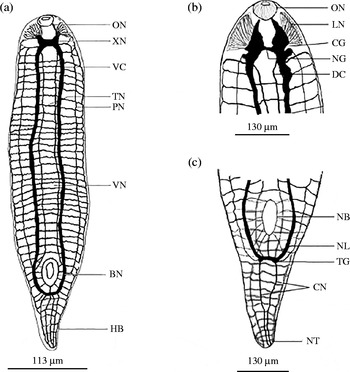
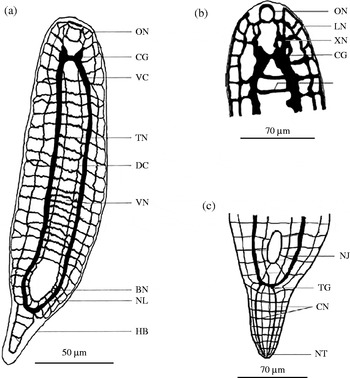
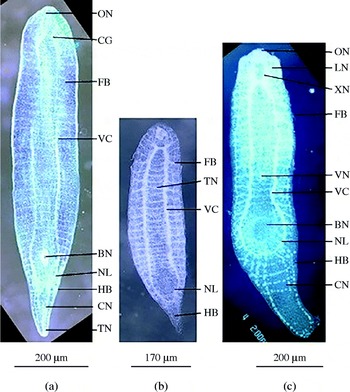
The nervous system of metacercariae of Tylodelphys spp. 1 and 2 (Figs 1, 2 and 3) is composed of a pair of cerebral ganglia, as in most digenetic trematodes, from which two large ventral longitudinal nerve cords (VC) run posteriorly to form a loop around the Brandes organ. The ChE activity also showed two minor dorsal longitudinal nerve cords (DC) and two peripheral longitudinal nerves (PN). The considerably thin dorsal nerve cords are connected to the lateral nerve cords via dorsolateral connectives, while they are linked to the ventral nerve cords via dorsoventral connectives. The longitudinal nerve cords are joined by transverse commissures (TN). However, there are more transverse nerves in Tylodelphys sp. 1 (30) than in Tylodelphys sp. 2 (21). In both species the central transverse nerves (TN) are more concentrated on the ventral sucker region. The ChE activity showed more nerves in the hindbody of Tylodelphys sp. 1 than in the Tylodelphys sp. 2. Both species have caudal ganglia (TG) that coordinate the hind nerve to the nerve loops. The anterior and suprapharyngeal nerves supplying the oral region also vary: in Tylodelphys sp. 2 ChE activity showed a network of nerves supplying the oral region while in Tylodelphys sp. 1 there are nerves from the cerebral ganglia supplying the oral region, as in T. mashonense.
The nervous system of the metacercaria of Tylodelphys sp. 1 from Clarias gariepinus to show (a) the entire body, (b) the forebody and (c) the hindbody; BN, nerves supplying Brandes organ; CG, cerebral ganglion; CN, caudal ventral nerves; DC, dorsal nerve cord; HB, hindbody; LN, nerves supplying pseudosucker region; NB, Brandes organ nerves; NG, nerve connecting cerebral ganglia; NL, nerve loop; NT, nerves supplying excretory pore; ON, nerves supplying oral region; TG, caudal ganglion; PN, peripheral longitudinal nerve cord; TN, transverse nerve; VC, longitudinal ventral nerve cord; VN, nerves supplying ventral sucker; XN, suprapharyngial nerves.

The nervous system of the metacercaria of Tylodelphys sp. 2 from Clarias gariepinus to show (a) the entire body, (b) the forebody and (c) the hindbody. NJ, nerves connecting Brandes organ. See Fig. 1 for the key to the rest of the lettering.

Inverted photographs of entire (a) Tylodelphys sp. 1, (b) Tylodelphys sp. 2 and (c) Tylodelphys mashonense from Clarias gariepinus to show the cephalic and caudal nervous systems. FB, forebody. See Fig. 1 for the key to the rest of the lettering.

Metacercariae of Tylodelphys mashonense
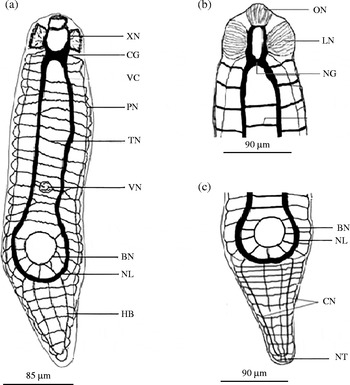
The nervous system of metacercariae of T. mashonense (Figs 3 and 4) is composed of two thick and prominent longitudinal ventral nerve cords (VC) originating from the cerebral ganglia, running posteriorly, one on each side of the body, and joining to form a loop around the Brandes organ. The longitudinal nerve cords are connected by 16 transverse commissures (TN). The ventral nerve cords also communicate with the lateral nerve cords by means of ventrolateral connectives. Two considerably thick nerve cords (LN and ON) arise from the cerebral ganglia and run anteriorly, to innervate the pseudosuckers and the oral region, respectively. The ventral sucker is innervated by nerves branching from the 11th transverse nerve (VN). In the hind body, two considerably thin branches of nerves arise, one from each ventral nerve cord, at the holdfast region, and re-connect at the level of the excretory pore. Two other thin branches originate dorsally from the posterior region of the ventral nerve cord loop (NL) and join the ventral thin cord at the excretory pore. Seven ventral transverse nerves connect the ventral and dorsal nerve cords.
The nervous system of the metacercaria of Tylodelphys mashonense from Clarias gariepinus to show (a) the entire body, (b) the forebody and (c) the hindbody. See Fig. 1 for the key to the lettering.

Discussion
The application of the s-acetylcholine iodide staining technique was crucial for determining the arrangement of the nervous system of the diplostomid metacercariae infecting the catfish, C. gariepinus. As in other studies on digeneans (see Niewiadomska & Moczon, Reference Niewiadomska and Moczon1982, Reference Niewiadomska and Moczon1984, Reference Niewiadomska and Moczon1987, Reference Niewiadomska and Moczon1990; Halton et al., Reference Halton, Shaw, Maule, Johnston and Fairweather1992; Pax & Bennett, Reference Pax and Bennett1992; Gustafsson et al., Reference Gustafsson, Halton, Kreshchenko, Movsessian, Raikova, Reuter and Terenina2002; Arafa et al., Reference Arafa, El-Naggar, El-Abbassy, Stewart and Halton2007), it was shown to be an ‘orthogon’, a rectilinear, ladder-like configuration of longitudinal nerve cords connected at intervals by transverse ring commissures. The structure and functions of the nervous system in Diplostomum species have been documented in detail by Niewiadomska & Moczon (Reference Niewiadomska and Moczon1982, Reference Niewiadomska and Moczon1984, Reference Niewiadomska and Moczon1987, Reference Niewiadomska and Moczon1990). Niewiadomska & Moczon (Reference Niewiadomska and Moczon1982, Reference Niewiadomska and Moczon1984), studying the nervous system of D. pseudospathaceum, concluded that the structure of the nervous system in the metacercaria was modified from that of the cercaria, which consisted of the cerebral ganglia and three pairs of stems joined by eight commissures, and that it grew with the increasing body dimensions of the metacercaria after penetration of the intermediate host. The nervous system differentiates and forms numerous commissures simultaneously with differentiation of the metacercarial body. This suggests that the observed differences in the nervous system of the three metacercariae Tylodelphys spp. 1 and 2 and T. mashonense described here reflect three systems of three different cercariae yet to be described.
The nervous system of the metacercaria of T. mashonense, as described here, closely resembles that of D. pseudospathaceum studied by Niewiadomska & Moczon (Reference Niewiadomska and Moczon1984). Nerves are more distributed to the vital organs such as the oral and ventral suckers (ventral surface), to enable the metacercariae to exercise the needs of a parasitic life (attachment). The significance of the concentration of nerves on the ventral surface is better explained by the features revealed by chaetotaxy and scanning electron microscopy (SEM), i.e. the papillae on Diplostomum species (Niewiadomska & Moczon, Reference Niewiadomska and Moczon1984; Field & Irwin, Reference Field and Irwin1995; McKeown & Irwin, Reference McKeown and Irwin1995). The SEM of T. mashonense was undertaken by Nkwengulila (Reference Nkwengulila1995), who reported an increased number of papillae on the ventral surface and around vital organs such as the Brandes organ, oral and ventral suckers. The findings of the present study are consistent with Nkwengulila's (Reference Nkwengulila1995) findings. Both chaetotaxy and SEM studies have shown that in Diplostomum species a greater number of sensillae (papillae), which are thought to be tango- or chemoreceptors, occurs on the ventral surface, most likely due to the need to have close contact with the host.
However, Tylodelphys spp. 1 and 2 and T. mashonense show some differences in the number and the compactness of transverse commissures in comparison to the descriptions of D. pseudospathaceum by Niewiadomska & Moczon (Reference Niewiadomska and Moczon1984). In the material under study, the transverse commissures are more compacted, especially in Tylodelphys spp. 1 and 2, and possess a large nerve loop joining the ventral longitudinal cords. It is from this loop that the nerves innervating the hind bodies originate. However, in both T. mashonense (present study) and D. pseudospathaceum (Niewiadomska & Moczon, Reference Niewiadomska and Moczon1984) nerves also innervate the pseudosuckers.
There are too few studies on the nervous system of Diplostomum species and other flatworms in general for one to make comparisons. This has been attributed to the difficulty in studying flatworms (Halton et al., Reference Halton, Shaw, Maule, Johnston and Fairweather1992; Pax & Bennett, Reference Pax and Bennett1992). The small sizes of most parasitic flatworms, the physiological problems of maintaining them in vitro and difficulty in maintaining the histochemical reactions are the reasons for the difficulty in detailing the nervous system using light microscopy (Halton et al., Reference Halton, Shaw, Maule, Johnston and Fairweather1992; Pax & Bennett, Reference Pax and Bennett1992). Therefore, increased efforts need to be made to study the nervous system of more diplostomid species and other digeneans.
In conclusion, although the studies on the nervous systems of trematodes are difficult to perform under light microscopy, the present study has shown their usefulness in the delineation of species. This proposition is corroborated by the fact that the observed differences in the nervous system of the three metacercariae infecting C. gariepinus were enough to clearly separate them into three species, i.e. T. mashonense, Tylodelphys spp. 1 and 2, as reported using DNA methods (Mwita & Nkwengulila, 2010; Chibwana et al., 2013). In addition, the presence of nerve networks around the pseudosucker regions of both Tylodelphys sp. 1 and Tylodelphys sp. 2, although these species lack pseudosuckers, is an indication that the absence of pseudosuckers could be an advanced evolutionary state in the family Diplostomidae.
Acknowledgements
We are indebted to the Departments of Chemistry and Microbiology and Biotechnology of the University of Dar es Salaam for permission to use some of their chemicals for preparation of cacodylate buffer.
Financial support
This work was supported financially by the Swedish International Development Cooperation Agency (SIDA) – Department for Research Cooperation (SAREC) through the Faculty of Science, University of Dar es Salaam, Tanzania.
Conflict of interest
None.