Antimicrobial stewardship, consisting of coordinated interventions to improve appropriate use of antimicrobials, is increasingly important for hospitals. In 2014, the Centers for Disease Control and Prevention (CDC) recommended that all acute-care hospitals implement an antimicrobial stewardship program (ASP).Reference Fridkin, Baggs and Fagan 1 The structure of these programs has to be flexible; however, the CDC does recommend the incorporation of specific core elements. 2
An emerging development and increasingly popular ASP action is to collaboratively develop real-time interventions with rapid diagnostic technology: peptide nucleic acid fluorescent in situ hybridization (PNA-FISH),Reference Forrest, Roghmann and Toombs 3 polymerase chain reaction tests,Reference Bauer, West, Balada-Llasat, Pancholi, Stevenson and Goff 4 , Reference Banerjee, Teng and Cunningham 5 matrix-assisted laser desorption-ionization/time-of-flight mass spectrometry (MALDI-TOF MS),Reference Huang, Newton and Kunapuli 6 and microarray tests.Reference Roshdy, Tran and LeCroy 7 – Reference Box, Sullivan and Ortwine 9 As new diagnostic tests become available, the Infectious Diseases Society of America recommends outcomes research to document the effect of these tests on patient care.Reference Caliendo, Gilbert and Ginocchio 10
The Verigene Gram-positive blood culture (BC-GP) test (Nanosphere, Northbrook, IL) utilizes microarray technology to detect specific bacterial DNA from positive blood cultures. This test can identify 12 Gram-positive bacterial targets within 3 hours: Staphylococcus aureus, S. epidermidis, S. lugdunensis, Staphylococcus spp., Enterococcus faecalis, E. faecium, Streptococcus pneumoniae, S. pyogenes, S. agalactiae, S. anginosus, Streptococcus spp., and Listeria spp. In addition, BC-GP can identify 3 resistance markers (including mecA for staphylococci, and vanA/B for enterococci), which can aid in the selection of appropriate antimicrobials in a more rapid fashion than traditional antimicrobial susceptibility testing.
Prior reports have demonstrated use of rapid microarray technology, and ASPs have been shown to reduce the time to appropriate antimicrobial use and hospital length of stay (LOS).Reference Roshdy, Tran and LeCroy 7 – Reference Box, Sullivan and Ortwine 9 Most reports are limited to a single genus or species, do not include an active stewardship component, or have small sample sizes. In this study, we evaluated the impact of the rapid microarray technology and ASP intervention on clinical outcomes. In addition, for the subset of S. aureus isolates, we compared the use of PNA-FISH technology without stewardship to microarray technology with stewardship.
METHODS
Study Design
This pre-intervention/post-intervention study was conducted at Cleveland Clinic over 12 months. The study protocol was reviewed and approved by the local institutional review board.
All patients with blood cultures positive for S. aureus, E. faecalis, E. faecium, S. pneumoniae, S. pyogenes, S. agalactiae, S. anginosus, Streptococcus spp., and L. monocytogenes from February 15, 2014, to February 14, 2015, were included. Patients were excluded if they had polymicrobial blood cultures, died, or were discharged before cultures were finalized or grew coagulase-negative staphylococci, including S. lugdunensis. For patients with repeat positive blood cultures during the same admission, only the first positive culture was included. Patients with coagulase-negative staphylococci were not included in this retrospective evaluation due to inherent challenges in distinguishing contaminants from true pathogens, especially in immunocompromised patients and patients under intensive care.
Blood cultures were incubated using the BacT/ALERT 3D (bioMérieux, Durham, NC) automated microbial detection system. Bottles flagged as positive underwent Gram staining, and laboratory personnel relayed the results to the nursing unit by telephone. Broth from positive-blood-culture bottles was subcultured to solid media according to routine laboratory protocols. Species-level identification using matrix-assisted laser desorption ionization–time-of-flight mass spectroscopy (MALDI-TOF MS) and antimicrobial susceptibility testing using Vitek 2 cards (bioMérieux) or Sensititre trays (ThermoFisher Scientific, Cleveland, OH) were performed on colonies growing on solid media. During the pre-intervention period, PNA-FISH (AdvanDx, Woburn, MA) technology was utilized for blood cultures with Gram-positive cocci in clusters to differentiate S. aureus from coagulase-negative staphylococci within 3–4 hours. If PNA-FISH was positive for S. aureus, broth was inoculated to Remel Spectra MRSA agar (ThermoFisher) to allow differentiation of methicillin-resistant S. aureus (MRSA, blue colonies) from methicillin-susceptible (MSSA) isolates after overnight incubation. There was no ASP intervention associated with this technology, and no rapid diagnostic technology was utilized for blood cultures with Gram-positive cocci in pairs or chains.
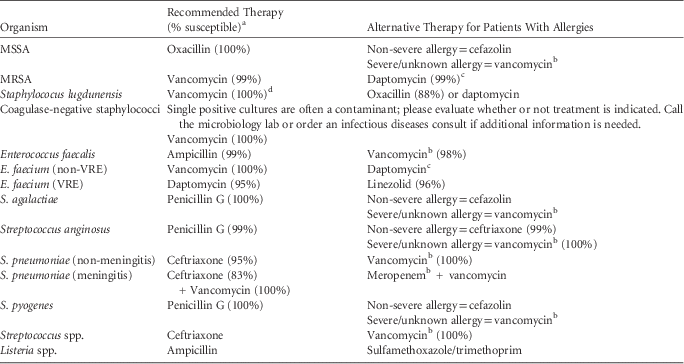
The intervention arm of this study was a combination of implementation of the Verigene BC-GP test and an ASP intervention. The BC-GP was performed 24 hours per day, 7 days per week by clinical microbiology staff starting September 15, 2014, and was not batched. Testing was not repeated for 7 days on subsequent blood cultures with similar Gram stain results. The BC-GP results were entered into the laboratory information system (Sunquest) and were transmitted to the electronic medical record (Epic), which triggered a real-time electronic notification to an antimicrobial stewardship in-basket reviewed by 1 of 3 pharmacists trained in infectious diseases. The entry of results also generated pager notification monitored by the pharmacists on weekdays between 7:00 a.m. and 4:30 p.m. After notification, the pharmacist assessed the current therapy and contacted the primary teams with recommendations. The pharmacists referenced a guideline developed in collaboration with the Infectious Diseases and Microbiology departments for therapy recommendations (see Appendix). During time periods when the pager was not monitored, the laboratory personnel notified the nursing unit of the BC-GP results and the pharmacist reviewed the results the next business day with additional communication to the primary care team only if a change in antimicrobial therapy was recommended. The results of the BC-GP were confirmed with conventional identification and antimicrobial susceptibility testing as described above.
Data Collection and Study Definitions
A retrospective chart review was performed in which data regarding patient demographics, comorbidities, microbiology, antimicrobial use, and clinical outcomes were collected. The Charlson comorbidity index was collected electronically using International Classification of Disease, Ninth Revision (ICD-9) codes. Active therapy was defined as an antibiotic with in vitro activity against the pathogen. Optimal therapy was defined as a narrow-spectrum antimicrobial in accordance with the institution guidelines for recommended therapy (see Appendix).
Outcomes
The primary objective of this study was to assess the time from blood culture to antibiotic switch. Antibiotic switches included escalations to active therapy and de-escalations to optimal therapy. Secondary objectives included time from Gram stain to antibiotic switch as well as time to active and optimal therapy for specific pathogens. Clinical outcomes including hospital LOS and mortality were also evaluated.
Statistical Analysis
Categorical variables were analyzed using χ2 or Fischer’s exact test as appropriate. Continuous and ordinal variables were analyzed using the Student t test or the Mann-Whitney U test, respectively. All tests were 2-tailed, and a P value of ≤0.05 was considered statistically significant. Analyses were performed using SPSS, version 15.0 for Windows.
RESULTS
During the study period, 619 patients were identified with blood cultures positive for the organisms of interest. The following patients were excluded: 10 patients for polymicrobial cultures, 61 patients who died or were discharged before the cultures were finalized, and 35 patients for duplicate blood culture. Overall, 300 patients were included in the pre-intervention group and 213 patients were included in the post-intervention group.
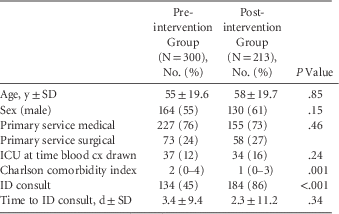
Patient demographics are listed in Table 1. Most patients were on a medical service, and some were in an intensive care unit at the time blood was drawn for culture. The patients in the pre–BC-GP group had significantly higher Charlson comorbidity scores than those in the post–BC-GP group: median 2 versus 1, respectively (P<.001). There were significantly more patients in the post–BC-GP group who received an ID consult than in the pre–BC-GP group: 86% versus 45%, respectively (P<.001).
Patient Demographics and ComorbiditiesFootnote a

NOTE. SD, standard deviation; ICU, intensive care unit; cx, culture; ID, infectious diseases.
a Data are presented as n (%), mean±standard deviation, or median (IQR).
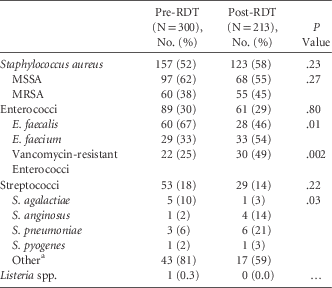
The organisms identified are displayed in Table 2. Overall, 55% of the organisms identified were S. aureus (41% of these were MRSA); 29% were Enterococcus sp. (35% of these were VRE); and 16% were Streptococcus spp. Significantly more E. faecium were identified in the post–BC-GP group than in the pre–BC-GP group: 33 of 213 patients (54%) versus 29 of 300 patients (33%), respectively (P=.01). In addition, the percentage of E. faecalis and E. faecium identified as VRE was higher in the post–BC-GP group than in the pre–BC-GP group: 49% versus 25%, respectively (P=.002). In addition, the percentage of streptococci identified between the 2 groups was not different.
Microbiology Results

NOTE. RDT, rapid microarray-based diagnostic technology; MSSA, methicillin-sensitive Staphylococcus aureus; MRSA methicillin-resistant S. aureus.
a Other streptococci included 53 in the viridans group of streptococci, 6 in the S. bovis group, and 1 S. dysgalactiae.
An antimicrobial switch was performed in 155 of 300 patients (52%) in the pre–BC-GP group and in 107 of 213 patients (50%) in the post–BC-GP group. The primary outcome of time from culture to antimicrobial switch was significantly faster in the post–BC-GP group than in the pre–BC-GP group: mean±standard deviation 48±41 versus 75±46 hours, respectively (P<.001). The time from Gram stain to antimicrobial switch was also significantly faster in the post–BC-GP group than in the pre–BC-GP group: mean±standard deviation 24±42 versus 48±48 hours, respectively, (P<.001). De-escalation was more common than escalation; it occurred in 126 of 155 patients (81%) in the pre–BC-GP group and 73 of 107 patients (68%) in the post–BC-GP group. The time to de-escalation was also significantly shorter in the post–BC-GP group than in the pre–BC-GP group: time from blood culture was 53±41 hours versus 82±48 hours, respectively (P<.001), and time from Gram stain was 29±43 hours versus 54±49 hours, respectively (P<.001). Escalations occurred in the remaining 29 of 155 patients (19%) in the pre–BC-GP group and 34 of 107 patients (32%) in the post–BC-GP group. The time to escalation to active therapy was numerically but not significantly faster in the post–BC-GP group than in the pre–BC-GP group: time from blood culture was 36±41 hours versus 50±29 hours, respectively (P=.17), and time from Gram stain was 14±39 hours versus 21±30 hours, respectively (P=.413).
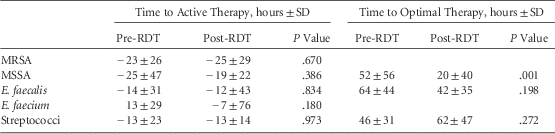
Overall, the time from Gram stain to active therapy was −17±38 hours in the pre–BC-GP group compared with −16±12 hours in the post–BC-GP group. A significant number of patients were on active therapy at the time of the Gram stain, as demonstrated by the negative time to active therapy. Organism specific subgroup analysis were also performed (Table 3). The time from Gram stain to active therapy was not significantly different between groups for any specific organism. However, the time from Gram stain to optimal therapy, which was calculated for organisms for which narrow-spectrum antibiotics were recommended by the institutional guidelines, was significantly different for patients with MSSA bacteremia. For those patients, the time to optimal therapy with a β-lactam was significantly shorter in the post–BC-GP group than in the pre–BC-GP group: 20 hours versus 52 hours, respecively (P=.001). The percentage of patients treated with a β-lactam was also higher in the post–BC-GP group than in the pre–BC-GP group: 91% (62 of 68 patients) versus 77% (75 of 97 patients), respectively (P=.02). There was also a trend in shorter time to optimal therapy for patients with E. faecalis bacteremia: 64 hours in the pre–BC-GP group versus 42 hours in the post–BC-GP group.
Antimicrobial OutcomesFootnote a

NOTE. RDT, rapid microarray-based diagnostic technology; MSSA, methicillin-sensitive Staphylococcus aureus; MRSA methicillin-resistant S. aureus.
a Data are presented as mean±standard deviation.
Clinical outcomes were not different between the 2 study groups. Hospital LOS was a median 21±28 days in the pre–BC-GP group and was 25±45 days in the post–BC-GP group (P=.27). Hospital mortality occurred in 16.5% of the overall population, in 15% (46 of 300) of the pre–BC-GP group, and in 18% (39 of 213) of the post–BC-GP group (P=.40).
DISCUSSION
In the largest known sample size to date, the use of rapid microarray technology coupled with an ASP intervention significantly decreased time to antimicrobial switch. This finding agrees with those of other studies that have demonstrated positive clinical outcomes when combining rapid diagnostics and antimicrobial stewardship.Reference Forrest, Roghmann and Toombs 3 , Reference Bauer, West, Balada-Llasat, Pancholi, Stevenson and Goff 4 , Reference Huang, Newton and Kunapuli 6 – Reference Box, Sullivan and Ortwine 9 A recent systematic review and meta-analysis concluded that rapid molecular testing with direct communication likely improves timeliness of targeted therapy.Reference Buehler, Madison and Snyder 11 However, the researchers noted that many of the included studies had small sample sizes, which limited the precision of the findings and their external applicability. With more patients included in this study than all prior rapid microarray and stewardship intervention studies combined, the sufficiently large sample size should enhance the accuracy and precision of the results.
Specific studies evaluating the microarray technology and stewardship interventions have demonstrated decreases in time to therapy with in vitro activity for patients with both streptococcal and enterococcal bacteremia.Reference Roshdy, Tran and LeCroy 7 , Reference Sango, McCarter, Johnson, Ferreira, Guzman and Jankowski 8 Specifically for patients with enterococcal bacteremia, Sango et alReference Sango, McCarter, Johnson, Ferreira, Guzman and Jankowski 8 reported the average time from Gram staining to active antibiotic therapy decreased from 48.5 hours to 25.1 hours (P=.0054) with the BC-GP and stewardship. In a study including patients with streptococcal and enterococcal bacteremia, the combination of ASP and BC-GP reduced the time from Gram staining to an antibiotic with in vitro activity from 13.2 hours to 1.9 hours (P=.04).Reference Roshdy, Tran and LeCroy 7 These numbers are difficult to directly compare to our study because the investigators considered time to be 0 days if patients received therapy before the Gram staining was performed. Our study did not demonstrate a significant difference in overall time to active therapy, likely because most patients were on antibiotics prior to Gram staining. In fact, 337 of 513 patients (66%) were on active therapy at the time of Gram-stain positivity, likely due to the high acuity and large immunocompromised population at our institution, which encourages providers to begin empiric therapy soon after blood cultures are drawn.
The value of this combined ASP intervention was in de-escalating antimicrobial use to optimal narrow-spectrum agents, as has been reported for other rapid diagnostic tests paired with stewardship. In a randomized trial evaluating a rapid multiplex polymerase chain reaction (rmPCR)-based identification and susceptibility method, the time from Gram stain to de-escalation was fastest in the rmPCR plus ASP (21 hours) compared with the rmPCR alone (38 hours) or standard blood culture processing (34 hours; P<.001).Reference Banerjee, Teng and Cunningham 5 This finding is similar to our study finding that overall time to de-escalation was significantly faster in the post-BC-GP group, which included antimicrobial stewardship. Specifically for patients with MSSA, the time to optimal therapy was also significantly different, with more patients in the stewardship intervention arm receiving therapy with a β-lactam, the drug group of choice. The same was not true for patients with bacteremia due to streptococci; for these patients, the time to optimal therapy was numerically but not significantly longer in the post–BC-GP group. It is unclear why this occurred; our exploratory analysis did not identify any differences in patient characteristics (data not shown), but the finding could have been influenced by small numbers in this subgroup analysis.
Importantly, almost 50% of patients in both the pre- and post-intervention groups did not undergo an antimicrobial switch (either de-escalation or escalation). This finding was likely due to patients already being prescribed the most optimal therapy (eg, vancomycin for MRSA infections) or because many of the patients transferred to our tertiary medical center had prior microbiology results allowing for targeted therapy.
Another unique component of this study was the subset of patients with staphylococcal bacteremia. The pre- versus post-intervention analysis was a comparison of 2 different rapid diagnostic technologies, 1 with and 1 without an ASP intervention. In the pre-intervention group, all isolates underwent PNA-FISH and MRSA agar testing to differentiate S. aureus from coagulase-negative staphylococci and MRSA from MSSA. Although the PNA-FISH assay was performed promptly, the MRSA agar testing required microorganism growth. Laboratory personnel called the nursing floor with test results, but no other interventions with pharmacy or ID physicians were performed. In the post-intervention group, the rapid diagnostic technology was the BC-GP microarray coupled with an ASP intervention. For patients with MRSA bacteremia, the time to active therapy was not different in the pre- and post-intervention groups, likely due to the similar turnaround times of the rapid tests, in addition to the widespread use of empiric vancomycin. For patients with MSSA, however, more patients in the post–BC-GP group ultimately received the drug of choice, a β-lactam, and had a faster time to optimal therapy. These findings demonstrate the value of a rapid diagnostic test that can provide information about resistance determinants and the importance of an ASP intervention arm.
In this study, we did not find any significant differences in clinical outcomes, including LOS or hospital mortality. Prior studies have demonstrated significant differences in hospital LOS.Reference Sango, McCarter, Johnson, Ferreira, Guzman and Jankowski 8 , Reference Box, Sullivan and Ortwine 9 However, these studies may have been influenced or biased by extreme outliers, differences in time periods patients were enrolled, or types of patients excluded.
Our study is not without limitations. First, certain imbalances in baseline characteristics are difficult to explain. The Charlson comorbidity score was higher in the pre-BC-GP group; however, there was no difference in hospital mortality or LOS. The reason for the higher number of VRE isolates in the post-BC-GP group is also unclear; there was no known outbreak during the study period. This finding may, however, partly explain the higher number of ID consults due to an institutional formulary restriction for linezolid and daptomycin. The increase in ID consults may have been driven by pharmacist recommendations during the stewardship intervention. While including multiple possible intervention arms (ie, rapid diagnostic results, pharmacist recommendations, ID consults) may have confounded the true effect each had on the primary outcome, the end result was improved through multidisciplinary teamwork, which is a key foundation of antimicrobial stewardship. In addition, the antimicrobial stewardship review was only performed from 7:00 a.m. to 4:00 p.m., Monday through Friday, which may have limited the effect observed. An exploratory analysis of the primary outcomes during and after stewardship hours did not detect a difference. Additionally, our analysis did not include an assessment of the patients with blood cultures positive for coagulase-negative staphylococci due to the challenges deciphering pathogens from contaminants; however, other researchers have demonstrated the important role rapid diagnostics and antimicrobial stewardship can have in this clinical scenario.Reference Forrest, Mehta, Weekes, Lincalis, Johnson and Venezia 12 , Reference Nagel, Huang and Kunapuli 13
In conclusion, this study demonstrates that the use of rapid microarray technology coupled with an ASP intervention significantly decreased the time to antimicrobial switch, especially for de-escalation to narrow-spectrum therapy. Those implementing ASPs should evaluate the potential value in providing an intervention coupled with rapid diagnostic technology.
ACKNOWLEDGMENTS
Financial support. No financial support was provided relevant to this article.
Potential conflicts of interest. S.S.R. has received research funding from bioMerieux, Nanosphere, BioFire, BD Diagnostics, OpGen, Forest Laboratories, Pocared, and Roche. All other authors have no conflicts of interest relevant to this article.
APPENDIX
Guidelines for the Treatment of Positive Blood Cultures