


Introduction
Although the importance of linguistic simultaneity has long been recognized (Woolard Reference Woolard1998), the concept is underexamined in recent analyses of language use in globalized, digital contexts such as social media (but see Arnaut & Spotti Reference Arnaut and Spotti2014). Drawing from an analysis of everyday Facebook posts from youth in Belgrade, Serbia, this article proposes that at least four types of simultaneity—of features (i.e. bivalency; Woolard Reference Woolard1998), of indexical operations (when signs both work within and disrupt taken-for-granted semiotic associations), of effects, and of scale (Blommaert Reference Blommaert2015a)—are key to making sense of the intricate semiotics of language and identity online. As I argue here, recognizing multiple kinds of simultaneity is crucial for acknowledging the complexity and open-endedness that comes with the increased global connection and uncertain participation frameworks of social media (cf. Blommaert & Rampton Reference Blommaert and Rampton2011; Varis & Blommaert Reference Varis and Blommaert2015), without losing the ability to make specific claims about what kind of semiotic work a particular digital utterance may achieve or attempt.
The analysis is based on Facebook posts from a group of Serbian high school students who have come of age in the wake of ethnic tension and war, the dissolution of Yugoslavia and accompanying regime change(s), and a climate in which nearly every aspect of language use has been overtly politicized (R. Greenberg Reference Greenberg2004; Alexander Reference Alexander2006). In that context, students’ linguistic choices on social media platforms such as Facebook—where technological and ideological concerns exert multiple and sometimes conflicting pressures—are significant. In the context of a shaky and often ambivalent relationship with the ‘West’, (Bakić-Hayden & Hayden Reference Bakić-Hayden and Hayden1992), what does it mean to use English (or not)? When Cyrillic, one of Serbia's two official writing systems, has been so intimately tied to Serbian identity and tradition, when and why do students either use or avoid it online? How should analysts interpret posts that mix writing systems and languages in seemingly innovative ways?
In this article, I argue that Serbian youth use the affordances of digital writing—particularly the ability to layer multiple codes and writing systems in a single utterance—to create or share witty, irreverent material that comments on, criticizes, or pokes fun at both traditional symbols of national pride and language and images associated with global popular culture. In so doing, they index fluency and assert participation in multiple spheres while distancing themselves from allegiance with any one group, stance, or social world. In the process, young people's online utterances become icons of their refusal to choose between an isolating ethnic fundamentalism (Fisher Reference Fisher1984; Koonz Reference Koonz2003) on the one hand and a complete pandering to the West on the other. In other words, their language use becomes enregistered (Agha Reference Agha2005, Reference Agha2007) for a group of young, urban, educated Serbs who wish to avoid the perceived extremes of either ethnic nationalism or European conformity. Young Serbs’ refusal to choose between perceived opposites is not necessarily new, but rather a newer manifestation of a historically rooted sense of liminality in the Balkans (Bakić-Hayden & Hayden Reference Bakić-Hayden and Hayden1992; Simić Reference Simić2008), which led many Yugoslavs to seek to engage with, while remaining independent from, both ‘Eastern’ and ‘Western’ cultural and political spheres (Jansen Reference Jansen2009).
A framework of simultaneity allows us to consider the many possible semiotic effects of students’ online practices. The simple act of juxtaposing and mixing different codes and writing systems imbues each with some of the flavor of the other and over time might alter their semiotic associations. At the same time, such acts do not necessarily disregard offline norms for language use nor do they collapse or ignore the boundaries between languages in ways that other theorists have suggested is common in contemporary polylingual (Jørgensen Reference Jørgensen2008) or superdiverse (Vertovec Reference Vertovec2007; Blommaert & Rampton Reference Blommaert and Rampton2011) situations (see also Rampton Reference Rampton2003; Jacquemet Reference Jacquemet2005). Even the most deeply ‘mixed’ utterances highlight perceived differences between languages and writing systems, drawing their humor from assumed affective, cultural, or political distance between varieties. Students’ utterances, while involving a ‘playful inversion of standard language hierarchies’ (Jones & Schieffelin Reference Jones and Schieffelin2009:1050), also work within and reinforce dominant attitudes about language and identity. The posts thus make use of language ideological assemblages, in which multiple attitudes can ‘complement, contest, or otherwise dynamically interact with each other’ (Kroskrity Reference Kroskrity2018:134).
The article seeks to account for the increased fluidity and intermingling of codes and writing systems online while also recognizing that such practices are still often grounded in more traditional notions of language and identity—where, for example, widespread conceptions of Serbian and English as separate codes that signify distinct social groups, worldviews, or affects still prevail. It aims to make explicit when and how the use of particular signs helps build new identities and/or undermines or reconfigures old ones. A framework based on multiple types of simultaneity, I argue, allows us to better consider a fundamental dynamic recognized by scholars of superdiversity (Vertovec Reference Vertovec2007; Blommaert & Rampton Reference Blommaert and Rampton2011): the complex interplay of the conventional and the innovative, the structured and the agentive. A focus on simultaneity, I argue, also enables us to propose multiple, concrete interpretations of specific semiotic moments on globalized social media, no matter how complex, uncertain, or fast-moving such spaces might initially seem. By highlighting and analyzing the multiple (and sometimes contradictory) forms of semiotic work going on at once, a framework based on simultaneity encourages both a recognition of complexity and a commitment to clarity and specificity.
The current study
The analysis draws from ethnographic fieldwork conducted in 2010 and 2011 among high school students in Belgrade, Serbia. Students in the study were born in 1993 and 1994, in the wake of the breakup of the Socialist Federalist Republic of Yugoslavia (SFRY). They had grown up amidst war, sanctions, and stigma, as the international community blamed Serbia for the worst atrocities of the 1990s Balkan Wars and punished them with a decade of sanctions and a sustained NATO bombing campaign (J. Greenberg Reference Greenberg2011). They were coming of age as Serbia was considering a possible future in the European Union and debating how to reconcile a difficult past and move forward. In order to examine how students were taking on, reworking, or rejecting particular political, ethnic, and linguistic identities, I observed and recorded classrooms, informal socializing among students, and schoolwide and public events. I also interviewed students and their teachers, analyzed textbooks and other classroom materials, and, as detailed below, followed a subset of students on Facebook. One major finding of the study was that many students, like their parents and teachers, approached Serbia's history, current political climate, and future prospects—as well as their own ethnic and linguistic identities—with a great deal of ambivalence. Facebook was a space where students could use a wide range of linguistic resources to rework ambivalence into something humorous and a bit subversive.
In 2019, Facebook boasts over two billion users worldwide,Footnote 1 and by 2012 over half of Serbia's 7.2 million citizens had a Facebook profile (Balkan Insight 2012). In 2010–2011, Facebook was nearly ubiquitous in the social lives of the students in the study. It was a space where students chatted with friends both publicly and privately and where they posted media clips and quotes from local and international novels, movies, and television shows (often used as thinly veiled messages aimed at previous or current romantic partners or love interests). On Facebook, students often played with the boundaries between English and Serbian and between Cyrillic and Latin, the two scripts of the Serbian language. In a country where debates about orthographic and other linguistic choices have figured centrally in discussions of ethnic and national identity in politics and the popular press, Facebook became a site where ideologies met the constraints and possibilities of technologies.
Although I cite and discuss authors who use a wide range of ethnographic and other methods online, in the current study Facebook is one of many (on- and offline) sites for cultural practice and is simply one part of a more traditional ethnographic project that includes sustained, on-the-ground engagement. The excerpts analyzed here come from a collection of daily postings from about ten focal youth, the same students I interviewed and observed in civics, history, and literature classes, as well as outside of school. The posts collected include students’ messages on each other's Facebook ‘walls’ (now called ‘timeline’); comments on photos; shared media, including memes; quotes from famous authors, musicians, or other public figures; news articles; jokes; and requests for assistance with schoolwork. These students checked a box on their consent forms allowing me to collect and analyze such information, from which I removed all identifying markers. In addition, I also collected images, jokes, and other media circulated by other members of my two focal classrooms, totaling around sixty students. I did not collect original or personalized content from those students. I used screenshots to capture posts, allowing me to amass, sort, and code hundreds of images.
Since the study's primary focus was the socialization of students as citizens of a new nation and the changing language politics of the region, I captured three main categories of posts: (i) commentary on historical and/or current political events, (ii) metalinguistic commentary, and (iii) posts that mixed languages or writing systems, as well as any posts that used Cyrillic (because its use was marked on Facebook, as I explain later). For the purposes of the article, I have chosen to transcribe the posts rather than include screenshots in an effort both to ensure utmost privacy and confidentiality and to avoid any copyright issues that might arise from using images of Facebook's platform. Where I share memes (or perhaps more accurately, captioned image macros) that students shared but did not create, I have used a reverse image search feature (dragging the image itself into a search engine) to try to cite its original creator or at least its earliest appearance on the web. For images that likely originated on Facebook, however, sourcing the image is not always possible.
Brief historical background and current language situation
Although a full treatment of the complex history of the former Yugoslavia is impossible here, two points are key for understanding the relevance of students’ linguistic choices on Facebook. First, as mentioned, many Serbs continue to feel ostracized internationally and resentful at what many see as an undeserved negative international reputation (J. Greenberg Reference Greenberg2011). They recall that NATO and the United Nations defended Croatia, Bosnia, and Kosovar Albanians during the conflicts of the 1990s, imposed a decade of sanctions under the Milošević regime, and bombed Serbia for several months in 1999. They also know that the European Union has, until very recently, continued to set barriers to Serbia's candidacy for membership. As argued elsewhere (George Reference George2014, Reference George2020), many participants in the current study perceived a tension between pride and pragmatism as they hoped to engage economically and culturally with the rest of the world without sacrificing their own traditions or dignity.
Second, relevant to students’ code and orthographic choices is Serbia's historically tumultuous relationship with neighboring Croatia (Glenny Reference Glenny2000) and debates about the relation between the two countries’ very similar languages. Such debates have ensured that everything from the choice of writing system to the spelling and pronunciation of a single vowel carries strong ideological weight and can index ethnic, political, or even class positions (R. Greenberg Reference Greenberg2004; Alexander Reference Alexander2006). Tension between Serbia and Croatia was often accompanied by controversy over whether Serbian and Croatian were separate languages or regional varieties of one language. The languages are mostly mutually intelligible, but a few key differences have become icons for each ethnic group (R. Greenberg Reference Greenberg2004). One such distinction concerns Latin and Cyrillic, the two official writing systems of Yugoslavia. In the years leading up to and during the breakup of Yugoslavia and the Balkan Wars of the 1990s—as in earlier times of tension—Cyrillic became a key index of Serbian national pride and a political tool used to assert Serbian dominance in border towns and other contested territory, while in Croatia, it came to signify Serbian oppression. Serbia accused Croatia of denying linguistic heritage and rights to Serbian minorities and vice versa, adding to the sense of mutual victimhood that fueled the conflict. Following the breakup of Yugoslavia, Serbia has continued to recognize both writing systems, while according higher status to Cyrillic.Footnote 2
Today, the orthographic landscape in Belgrade is thoroughly mixed, with businesses and products advertising in various combinations of Latin and Cyrillic. Because of Cyrillic's association with Eastern Orthodoxy (and, by extension, Russia) and because Serbia is often seen as less ‘Western’ than many other former Yugoslav countries such as Croatia (Bakić-Hayden & Hayden Reference Bakić-Hayden and Hayden1992; Simić Reference Simić2008), Cyrillic can also index distance from the West—and, by extension, the modern and the global—as it is perceived locally. As shown in the examples below, however, uses and connotations of the script are more complex than they initially seem and can participate in multiple kinds of semiotic work simultaneously.
In an exploration of online script choice, Ivković (Reference Ivković2013:347) found that many Serbian citizens use the Latin script for ‘practical’ reasons: because the keys on their keyboard are in Latin, Latin is dominant on the internet, and the system facilitates code-switching to other languages with Latin writing systems. Similarly, in interviews, I found that students and teachers often pitted technological considerations—what was considered simplest and most practical on the computer—against ideological concerns. They nearly always extolled the virtues of Cyrillic before explaining why they did not use it in particular contexts (or, for a few, did not use it at all). A high school student, for example, explained that she preferred to use Cyrillic in her everyday life because (i) she is used to it, (ii) it is a unique and indisputable marker of Serbian identity, and (iii) it might disappear if not actively used. Shortly after, however, she explained that she always posted in Latin on Facebook because she was not ‘crazy’ (i.e. an extreme nationalist) like her ex-boyfriend and because switching between Facebook and YouTube was easier when she used the Latin script. Two teachers from her school also characterized those who insisted on using Cyrillic online and in text messages as somehow going too far. Where the student glossed this tendency as ‘crazy’, one of the teachers characterized it as ‘not comfortable’ for her fingers to reach the extra keys on a Cyrillic keyboard.
In both cases, interviewees claimed to prioritize the practical over the ideological when choosing a writing system (a claim that is itself ideological, as Ivković (Reference Ivković2013) points out). Using Cyrillic online is perhaps not actually as difficult as people claim, however: the Cyrillic and Latin keyboards have more letters than the English ones (see Figure 1); when people describe Cyrillic's ‘extra’ keys, they are likely contrasting it to using an English keyboard to approximate a Latin script, which many people did (as discussed further below). Nonetheless, explanations from students and teachers alike suggest that script choice is a topic about which people still feel strongly (whether or not they justify their choices according to the dominant debates of the past few decades), a site where they experience the conflicting pull of affective and practical concerns.
Keyboard layouts of Cyrillic (upper left), Latin (upper right), and English (American) layout (bottom).

Observations of Facebook postings mirrored what students and teachers said in interviews: that Cyrillic was limited on social media and was marked as out of the ordinary when it did appear. In addition to using Cyrillic to make overt political (sometimes anti-West) statements, honor Serbian holidays, or express national pride (when Serbian tennis star Novak Djokovic took home a world title, for example), students used Cyrillic to satirize Serbian tradition, for intralingual puns and creative re-spellings of English phrases, and in juxtaposition with global popular cultural images.
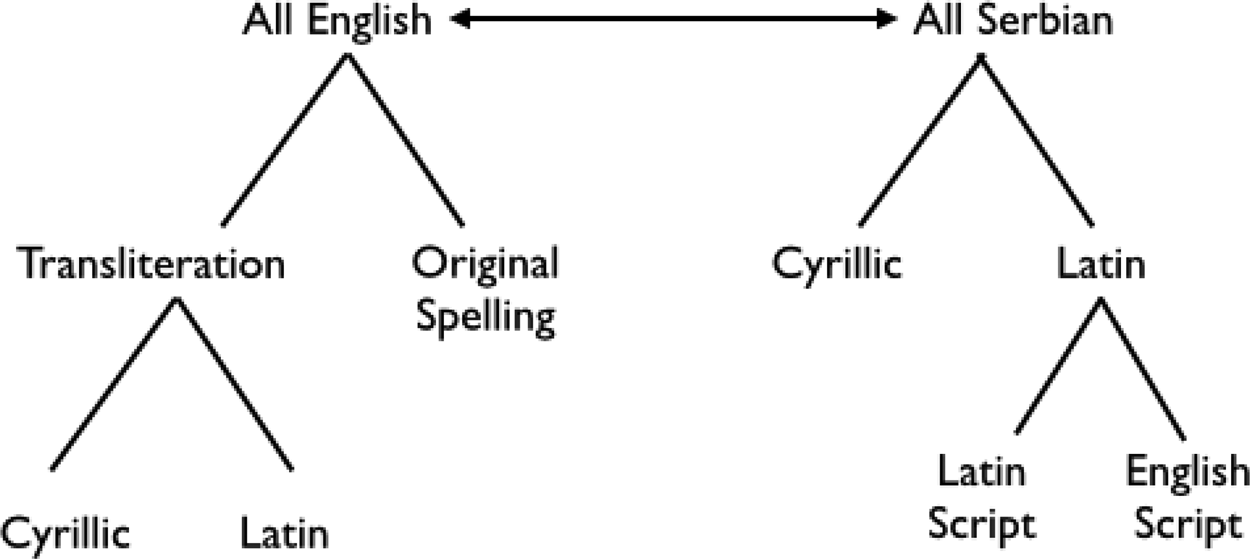
When they typed, students made a number of choices (see Figure 2 below): Serbian versus English, Cyrillic versus Latin, and, for those who typed on English-based keyboards, switching their script to a full Latin script with diacritic marks (e.g. including letters such as š and č) versus using some kind of English approximation for Latin. They could bring together these choices in unconventional mixtures, such as using Cyrillic or Latin to represent English words or phrases (what Spiloti (Reference Spiloti2019), writing about Greek, has termed trans-scripting) or borrowing from English spelling rules to create a visually distinct form of Serbian.
Uses of Serbian and English/Cyrillic and Latin on Facebook.
In what follows, I present a framework for analyzing the complex semiotics of identity work involved in such linguistic choices on Facebook. As I introduce each new type of simultaneity, I apply it to one or more examples. The examples used in this section represent two broader phenomena: (i) the use of Cyrillic to represent English or part-English/part-Serbian phrases, and (ii) the approximation of Serbian phonemes using the English script.
Social media and simultaneity: A framework
Facebook is a social media site, a digital environment characterized primarily by interaction between or among participants (Seargeant & Tagg Reference Seargeant, Tagg, Seargeant and Tagg2014:4). Many well-documented characteristics of social media lend themselves to a focus on simultaneity, including their affordances for bi- and multilingual language play, tendency to foster meticulous self-presentation, dispersed and often uncertain participation frameworks, and global reach—all of which bring the potential to alter linguistic and cultural boundaries and hierarchies. After describing some of these characteristics in more detail, I propose four types of simultaneity—of linguistic features, indexical operations, effects, and scales—that together form a framework for analyzing the complex semiotics of identity work in globalized, digital contexts.
First, many scholars have long asserted that social media affords play (cf. Danet Reference Danet2001). In particular, it can encourage speech play (Sherzer Reference Sherzer2002), especially in multilingual settings that allow for interlingual puns, plays on semantic or phonological overlap, visual parody, and so on (Su Reference Su, Danet and Herring2007; Thurlow Reference Thurlow and Jones2012; Luk Reference Luk2013). Although play might seem freeform and (almost by definition) nonserious, play can participate in counterhegemonic resistance and can occupy ‘a significant role in the invention, the imagination, and the construction of selves and communities’ (Sherzer Reference Sherzer2002:154). Further, the asynchronicity of social media—its tendency to foster interactions that do not unfold in real time—gives users time to compose their utterances carefully and to consider how certain stylistic choices might align them with or distance them from particular identities or stances (Leppänen, Kytölä, Westinen, & Peuronen Reference Leppänen, Kytölä, Westinen, Peuronen, Leppänen, Westinen and Kytölä2017:9). Seemingly casual, playful, and humorous social media posts, then, can mask complex kinds of semiosis and self-making.
In addition, the complex participant frameworks (Goffman Reference Goffman1981; Goodwin & Goodwin Reference Goodwin, Goodwin and Duranti2004) on social media may affect the ‘audience design’ (Bell Reference Bell1984) of utterances as well as adding to uncertainty about how a given post might be received. Social media can bring together family members, friends, and acquaintances who otherwise occupy separate social worlds (boyd Reference boyd2011). If one's audience on social media is thus ‘overimagined and underdetermined’ (Varis & Blommaert Reference Varis and Blommaert2015:42), then active and nonactive ‘friends’ (or, more precisely, networked connections), as well as the broadly imagined internet public, can affect the linguistic choices of a speaker (Tagg & Seargeant Reference Tagg, Seargeant, Seargeant and Tagg2014). As a result, speakers are immersed in a ‘plethora of contingent particulars’ where ‘indexical signs can communicate independently of speakers’ intentions’ (Blommaert & Rampton Reference Blommaert and Rampton2011:9).
The characteristics of social media discussed so far—its affordances for play and creativity, the flexibility with which its users can employ various linguistic resources and (re)make themselves online, and the uncertain participation frameworks that might strengthen or undermine any attempt to use linguistic features toward particular semiotic ends—mean that any analysis must start from an assumption of complexity, instability, uncertainty, and multiplicity. Indeed, Varis & Wang (Reference Varis and Wang2011:17) call the internet a superdiverse space ‘par excellence’, where people and codes intermingle at a level unseen before or elsewhere, perhaps further disrupting the very notion of language as a discrete, bounded entity (cf. Blommaert & Rampton Reference Blommaert and Rampton2011).
First coined by Vertovec (Reference Vertovec2007), the term superdiversity draws from and contributes to a number of fairly recent theoretical tendencies, including: (i) Moving from notions of multilingualism, which implies the existence of bounded and separate languages, to concepts such as polylingualism (Jørgensen Reference Jørgensen2008) or transidiomatic practices (Jacquemet Reference Jacquemet2005), which emphasize the use of all linguistic features at a speaker's disposal, with decreased attention to the traditional, formal boundaries between codes or the groups usually associated with them; (ii) Accepting that ‘diversity is likely to pluralize indexical interpretation’ (Blommaert & Rampton Reference Blommaert and Rampton2011:6)—that is, that there will be a huge range of nonshared, asymmetrical assumptions about the semiotic force of utterances, which will render analysis of indexes more difficult than ever; (iii) Redefining communicative competence (Hymes Reference Hymes, Pride and Holmes1972) as ‘the capacity to acquire multiple normative orientations’ (Blommaert Reference Blommaert2013:194, emphasis added); and (iv) Expanding notions of community to include multiple, overlapping, and often fleeting gatherings of people around specific interests, events, or practices, particularly online (Varis & Blommaert Reference Varis and Blommaert2015:43).
As argued further below, the conditions described under the umbrella of superdiversity inform, but do not fully account for, the examples analyzed in this article. On the one hand, students in this study did mix English—a language they learn in school but rarely use in verbal interactions outside the classroom—playfully and almost seamlessly with Serbian in ways that could, in theory, make irrelevant the formal boundaries between the two languages and/or multiply or destabilize the possible associations each code carries. On the other hand, much of the humor of such mixtures relied on perceived distance and distinction between English and Serbian and the imagery and identities associated with each. Indeed, theorizations of superdiversity do acknowledge this reality: they note that superdiversity does not imply that previously relevant boundaries and categories cease to matter, but that a macro-category such as ethnicity or national language becomes one resource among many for making sense of utterances (Blommaert Reference Blommaert2015b:85). The question, then, is when notions such as national language bring order to diversity online versus when diversity might destabilize or destroy those very notions (Blommaert & Rampton Reference Blommaert and Rampton2011:13). A simultaneity framework allows us to recognize both possibilities at once and weigh their likely relative impact in specific instances.
A framework needs to help schematize posts that are both conventional and innovative, both local and cosmopolitan, both rule-bound and subversive, both boundary-blurring and boundary-reinforcing. It must enable us to make sense of the kind of semiotic cross-pollination from which new identities can emerge. To help explain the examples below, it needs to address: (i) exactly which codes, writing systems, or other linguistic features, are being combined, layered, or juxtaposed; (ii) what kinds of indexical work are happening; and (iii) who might be involved in the negotiation of such work, and to what effect(s). The following section lays out the four types of simultaneity and applies them to specific examples.
Bivalency: Simultaneous linguistic features
We can use the notion of bivalency to understand better the kinds of utterances Serbian teens post and share. Bivalency describes linguistic features seen to be in more than one language simultaneously (Woolard Reference Woolard1998). In Woolard's example, when speakers mix Castilian Spanish and Catalan, some words or phrases seem to belong equally to both languages, which complicates any attempt to assign them to one or the other. Because bivalent utterances are not fully segmentable into separate languages, they can be resources for bilinguals who can use linguistic ambiguity to ‘renegotiate their linguistic and social position’ (Woolard & Genovese Reference Woolard and Nicholas Genovese2007:505–506)
As shown below, young people mixed Serbian and English writing in order to create visually bivalent utterances; rather than strategically leveraging already bivalent forms, they transformed utterances, words, and graphemes to create a layered, visual bivalency. For example, they used English scripts to write Serbian utterances or creatively substituted letters from one alphabet into another, thereby producing forms that sound like monolingual utterances if read aloud but that index two codes simultaneously when read on a screen. In so doing, students engaged in bilingual or biscriptal word play, where the simultaneity lies ‘not just in the duality of linguistic forms, but in its invocation of two voices, role sets, relationships, or identities’ (Woolard Reference Woolard1998:20).
As noted, one such method involved using Cyrillic for English or part-English phrases. In the following image (see Figure 3), for example, two lions jump toward each other in the air.
‘Lav is in di er’ (http://www.buzzsmile.com/love-is-in-the-air/).

The caption renders ‘Love is in the air’ in the Cyrillic script and plays on the similarity between the Serbian word lav ‘lion’ and the English word love. Read as an intralingual pun, the caption is both a literal description of the image (‘the lion is in the air’) and a poetic/idiomatic interpretation of it (‘love is in the air,’ i.e. the lions are in love). To produce or make sense of such an utterance, one must know sufficient English and Serbian vocabulary to parse the lav/love wordplay and recognize love is in the air as an English idiom. In addition, the choice to render the phrase in Cyrillic and, thus, according to Serbian pronunciation rules, means that it also uses orthography to express ‘accent’, as it mimics the sound of English spoken with Serbian phonology. The pun thus becomes a sophisticated display of bilingual competence and a commentary on the interplay between English and Serbian pronunciation. Cyrillic and English are literally simultaneous in the phrase lav is in di er, and English and Serbian are further simultaneous in the ‘lion/love’ pun. Both a Cyrillic transliteration of an English phrase and an intralingual pun, the phrase is bivalent in at least two ways.
Simultaneous indexical operations
The lion example includes simultaneous linguistic features, but bivalency is not the only kind of simultaneity it exhibits. This example also demonstrates how youths’ playful Facebook language simultaneously flouts and works within dominant attitudes about standard language. Many in Belgrade told me that while the Serbian language was brilliant in its phonological simplicity, it was also restrictive and overly rule-based. A teacher, for example, blamed Vuk Karadžić, the linguist-hero who reformed the language and simplified its orthography (R. Greenberg Reference Greenberg2004), for creating a language that was easier to understand but, by virtue of strict grammatical and phonological rules, more resistant to playful manipulation (this explicit attitude persisted even though jokes and wordplay in Serbian were pervasive and, in my view, very funny). By including Serbian in mixed-language play, students challenge dominant characterizations of Serbian as restrictive and serious. By contrast, by marshaling English to achieve a playful tone, they might also support the view that ‘pure’ Serbian is not amenable to play and needs assistance from other linguistic systems.
Another way to think of it is that the captioned image performs multiple indexical operations at once—that is, it simultaneously reinforces and challenges associations between Serbian language use and a rigid approach to grammar and phonology. The index, a sign that gets its meaning by evoking it in a particular context (Peirce Reference Peirce1932:170), has long been used by linguistic anthropologists to analyze the complex ways in which various linguistic features and other symbolic resources may come to signify social types in particular contexts. The very presence of a tattoo, for example, indexes different social meanings in different times and places (evoking criminality in one context, a whimsical persona in another, to name just a couple). Indexes exist in a field—a constantly changing, ideologically construed world of possible meanings and associations (Eckert Reference Eckert2008). They are often indirectly tied to identity (that is, linguistic features index stances that, in turn, can index social identities; Ochs Reference Ochs, Duranti and Goodwin1992, Reference Ochs, Gumperz and Levinson1996). They can change over time—accruing new associations built upon previous ‘indexical orders’ (Silverstein Reference Silverstein2003; Johnstone, Andrus, & Danielson Reference Johnstone, Andrus and Danielson2006; Johnstone & Kiesling Reference Johnstone and Kiesling2008), ‘hitchhiking’ with ‘more overtly ideologized and stereotyped phenomena’ (Mendoza-Denton Reference Mendoza-Denton2011:261) until recognizable on their own as evoking a particular attitude or social type, or becoming ‘bleached’ of a particular flavor, association, or force (Squires Reference Squires2014). Indexes are the backbone of processes of enregisterment (Agha Reference Agha2005, Reference Agha2007), whereby complexes of signs become recognizable as relatively coherent wholes, tied to particular personas, social groups, times, or places. In short, indexes often link language and identity indirectly, change over time, and work in concert with other signs.
Expanding on Silverstein's (Reference Silverstein2003) insight that indexes always presuppose and entail—that is, they build on some aspects of context while enabling others—we might argue that indexing is almost always simultaneously conventional and innovative. Indeed, most theoretical extensions of indexicality recognize this in some way. Ochs (Reference Ochs, Duranti and Goodwin1992), for example, notes that a speaker can use particular linguistic features to index an affective stance not usually associated with their social identity (e.g. when a man indexes a deferential stance by using linguistic features normally associated with femininity), thus recognizing that utterances can simultaneously preserve some indexical associations (e.g. between a given feature and stance), while disrupting others (e.g. between such stance and identity). Simultaneity is also implicit in Barrett's notion of indexical disjuncture, the indexing of ‘an interactional component not normatively associated with the context involved’ (Barrett Reference Barrett2017:16), which includes both the conventional use of indexes necessary to invoke the context in the first place together with the innovative signs that create the disjuncture. When we look at the semiotics of identity on social media, we can use the notion of indexical operations to examine how a given utterance or post draws upon widely accepted indexical associations in order to assert an identity, or attempts to denaturalize (Bucholtz & Hall Reference Bucholtz, Hall and Duranti2004) or challenge those very associations, or both at once.
Another example further clarifies the simultaneous indexical operations at play in a single post. Here, a student shares a photo that juxtaposes Snoop Dogg, a global popular culture icon, with a traditional Eastern Orthodox Christmas greeting, written in Cyrillic, attaching the comment ‘hahahahahahahahah, tako nekako (‘hahahahahahahahah, something like that’)’ to the picture (see Figure 4).
‘Hristizl se rodizl; vaistinizl se rodizl’ (original source unknown).

Here, the standard Serbian Christmas greeting and response, Hristos se rodi/Vaistinu se rodi ‘Christ is born/Indeed he is born’ have been rendered in ‘Snoop talk’, a style that is said to have originated in the Harlem Renaissance but became a worldwide phenomenon via Snoop Dogg (Connor Reference Connor2014). Snoop talk consists of adding an -iz or -izl infix or suffix to a word or using the affixes to replace a vowel. Thus, in this example, Hristos se rodi/Vaistinu se rodi becomes Hristizl se rodizl/Vaistinizl se rodizl.
In the image, the association of Cyrillic with the Eastern Orthodox church and its perceived affective distance from American rap culture are both essential. To work aurally the joke did not need to be in Cyrillic. The caption would have sounded identical when read aloud if it had been written in Latin. But by using a writing system that is visually distinct from English, the caption more distinctively points to two different languages and highlights the contrast between Cyrillic and English and the affective and cultural associations that each carries. Moreover, both Cyrillic and the white ‘impact’ font common to memes function as graphemic contextualization cues, ‘which signal certain attitudes or evoke[s] certain frames of interpretation’ and can index social identities (Androutsopoulous Reference Androutsopoulos2000:517); their juxtaposition mirrors and reinforces the unexpected juxtaposition of hip hop with Eastern Orthodox Serbian identity.
The Snoop example is the clearest demonstration of using linguistic features to both work within and challenge a given indexical field simultaneously. The joke relies heavily on associations between Cyrillic and national identity/tradition/religion on the one hand and between a particular English register and hip hop (and, by extension, global popular culture) on the other. At the same time, bringing Cyrillic and Snoop talk together in a recognizable meme format can also be read as a form of indexical disjuncture, a ‘challenge[s] to normative associations between indexical fields’ (Barrett Reference Barrett2017:16), that works to resist commonplace understandings of who can and cannot assert particular identities. In Ochs's (Reference Ochs, Duranti and Goodwin1992, Reference Ochs, Gumperz and Levinson1996) terms, using Snoop talk and imagery in humorous juxtaposition with Cyrillic draws upon the indexical relation between language varieties and stances or social acts (i.e. between Snoop talk and participation in global popular culture) while simultaneously challenging the exclusive link between such stances or acts and types of speakers (i.e. that only teenagers from particular parts of the world would engage in it). Denaturalizing widespread associations of hip hop with the West might also broaden the indexical field around Cyrillic, such that it might eventually develop a semiotic association with a particular brand of online humor and, by further association, the subset of Serbian youth who use it. Thus, the second type of simultaneity—that of indexical operations—enables a detailed analysis of the ways in which bivalent social media posts might both uphold and begin to dismantle systems of semiotic meaning.
Simultaneous effects
The framework has thus far made claims about what indexes do—or attempt to do—without discussing who might be involved in their negotiation, evaluation, or interpretation. In Austin's (Reference Austin1962) terms, we have discussed simultaneous forms of locutionary and illocutionary force—that is, the ways in which the utterances themselves as well as the acts they are thought to perform might be multiple and even contradictory—but not yet considered their possible perlocutionary force, or actual effects. To address this, the framework includes examining simultaneous effects, in terms of both an utterance's immediate indexical force and its broader and longer-term possible effects on linguistic and cultural boundaries and categories.
In both examples, we have to keep in mind how an audience is involved in negotiating the indexical force of the utterance. Many linguistic anthropologists and sociolinguists alike have increasingly emphasized individuals’ agency in using language to assert, create, or deny group membership (Bucholtz & Hall Reference Bucholtz, Hall and Duranti2004; Eckert Reference Eckert2012), moving away from earlier work suggesting that individuals were marked by language in ways largely (though never entirely) out of their control (Labov Reference Labov1972), subject to various forms of stigma (Goffman Reference Goffman1963) in a given linguistic marketplace (Bourdieu Reference Bourdieu1977). They and others have nonetheless noted that speakers’ intentions are not the only, and maybe not even the primary, factor in interpreting indexes (Ochs Reference Ochs, Duranti and Goodwin1992, Reference Ochs, Gumperz and Levinson1996; Duranti Reference Duranti1993, Reference Duranti, Fardon, Harris, Marchand, Nuttall, Shore, Strang and Wilson2012; Barrett Reference Barrett2017). Instead, indexical force often emerges from both speakers’ intentions and the interpretations of hearers and other audiences, who respond not only to individual indexes, but to a ‘multi-modal barrage of other semiotic signs (accent, style of speaking, posture, dress, etc.)’ that an interlocutor can interpret in ways the speaker does not anticipate (Duranti Reference Duranti, Fardon, Harris, Marchand, Nuttall, Shore, Strang and Wilson2012:20–21). Individuals, thus, do not only engage in active identity work when they post online; they also simultaneously subject themselves to various kinds of identifications over which they might have little control (Kulick Reference Kulick2003). How, then, might the proposed framework examine the extent to which individuals on social media can control the indexical force of their utterances? That is, when can individuals use established indexical connections successfully to assert a particular identity, and when do they have the agency to alter an indexical field, to effectively call into question aspects of the indexical order in which they operate?
As mentioned, the lion pun most clearly targets a trigraphic, bilingual community of Serbian youth, but other audiences in the students’ networks may encounter the image differently. Those who do not speak Serbian may recognize only the impact font and thereby affirm their participation in meme circulation without realizing that the Cyrillic caption incorporates English (and thus will not interpret the joke as a marker of cosmopolitan bilingualism). Serbian monolinguals, by contrast, will be able to pronounce, but not necessarily translate, the mostly English phrase rendered in Cyrillic (but will, of course, recognize lav as a description of the animals). As for the Snoop talk meme, an English-speaking audience might recognize the artist and see him juxtaposed with Cyrillic; particularly observant non-Serbian speakers might also see the repetition of a Cyrillic z sound (з) together with Snoop Dogg's image and recognize that the writing in some way evokes Snoop talk. The juxtaposition of Cyrillic and Snoop Dogg may register among multiple audiences, but only Serbian speakers well-versed in popular Hip Hop Nation Language (Alim Reference Alim2009) will fully ‘get’ the joke. Layers might be lost at different levels of social organization, thus challenging the ability of the social media user to fully control the indexical force of their posts for the various possible audiences involved.
As argued below, high school students in Belgrade mixed Serbian and English—and Cyrillic and Latin—in an attempt to assert both fluency in and critical distance from both Serbian tradition and (Western) global popular culture. In other words, they appealed to a kind of rooted cosmopolitanism—where orthographic signs can ‘enable a simultaneous appeal to local rootedness and a transcendence of that rootedness’ (Hillewaert Reference Hillewaert2015:195). Who decides, however, whether students’ performances of both fluency and critical distance are legitimate, whether they have indeed indexed a rooted cosmopolitan identity successfully? These questions are particularly weighty in Serbia, where many young people are preoccupied with their international reputation. Emphasizing simultaneity, then, means noting that semiotic effects—that is, how different indexes ‘land’ and are interpreted by others—can be multiple and contradictory. Addressing the potential simultaneity of indexical force represents another way of thinking about the interplay of the conventional and the innovative, of examining ‘who has the capacity to create voice, to be a creative meaning-maker in the eyes of others’ (Blommaert Reference Blommaert2015a:113).
In addition to examining indexical force, we might also consider the broader possible effects of repeated utterances on the linguistic and semiotic universe(s) in which they occur. In other words, we might ask how linguistic practices might be reinforcing and/or disrupting notions of discrete, bounded languages and the cultural and political worlds they supposedly represent. For both the lion and the Snoop Dogg examples, the effect on linguistic boundaries and categories is unclear: much of the humor in the Serbian social media posts relies on the perceived distinctness (and, perhaps, even incommensurability) of the various languages and writing systems and the political and cultural worlds they index. At the same time, Cyrillicized English is also a common way of joking online and could conceivably become part of a flexible repertoire for bilinguals, its semiotic force decreasingly dependent on longstanding associations of English and Serbian. In other words, Cyrillized English might weaken the perceived boundaries between the two languages, thereby contributing to the superdiversity of global social media worlds, while also reinforcing more entrenched categories such as national languages. Put yet another way, including broader simultaneous effects in the framework helps us analyze and make claims about how (and to what extent) repeated utterances may both strengthen and collapse the traditional boundaries between languages.
A final example illustrates all three of the types of simultaneity discussed so far. It involves using English script to approximate the Serbian Latin alphabet. As shown below, such posts are bivalent (in that they layer writing systems and languages), work within and flout dominant ideas about proper Serbian writing (i.e. are both conventional and innovative vis-à-vis dominant Serbian writing norms), and bring multiple and uncertain possible effects to the linguistic/cultural boundaries from which they derive meaning.
On Facebook, as mentioned, English keyboards are often used to approximate Serbian spelling, particularly when users do not have access to a Serbian keyboard and do not know how (or do not want) to download the Latin script. In 2010–2011 many computers in Belgrade had either American or European English-language keyboards, without keys for letters with diacritic marks, such as š, đ, ž, č, and ć. Many Serbian users of English keyboards usually made one of two choices: eliminate the diacritic marks altogether or borrow from English spelling conventions, as shown below in (1).
(1) č, ć → c or ch
š → s or sh
ž → z or zh
To use an example with many diacritic marks, the phrase učešće u istraživanju ‘participation in research’ could be rendered using English script as either ucesce u istrazivanju (with the diacritic marks simply removed) or ucheshche u istrazhivanju (with h added to approximate the sounds using English spelling rules).
As the excerpt below shows, different students make different decisions. In one example, a student addresses a friend on her timeline in (2a), and her friend replies in (2b).
(2) a. Sto si me zaboravila, bona?
‘What, did you forget me dear?’
b. Ti znash da ja tebe nikada ne mogu da zaboravim…shta ima
‘You know that I would never forget you… what's up?’
Here the first poster renders što ‘what’ as sto, without a diacritic mark. Her friend uses sh to approximate the š sounds in znaš ‘know’ and šta ‘what’, writing them as znash and shta.
The post is arguably bivalent, but in a different way from the previous example. Rather than bringing together words or phrases from multiple languages, it brings two sound and spelling systems into simultaneous use, so that an English spelling, sh, is brought into Serbian while continuing to point, if weakly, at English. Second, while the choice of s vs. sh may seem random, unmotivated or, at most, purely aesthetic, each choice interacts with attitudes about ‘proper’ Serbian in different ways simultaneously. When an š is rendered as sh, it breaks Serbian spelling rules (the pronunciation of s + h in Serbian is not the same as it is in English). This rendering violates a fundamental tenet of dominant Serbian language ideology that holds that Serbian language is superior because of its (supposed) one-to-one phoneme to grapheme relation, which allows its user to piši kao što govori ‘write like you speak’ (R. Greenberg Reference Greenberg2004). The supposed phonological simplicity of Serbian is also cited as a key distinction from Croatian, where the dominant maxim has been to piši za oko a ne za uho ‘write for the eye and not for the ear’ (Alexander Reference Alexander2006:383); Croatian newspapers, for example, often render foreign names in their original spellings while many Serbian newspapers assimilate them into Serbian phonology/spelling (e.g. the rapper Jay-Z's name would be written as Džej zi (Latin) or Џеј зи (Cyrillic) in many Serbian newspapers). By introducing English spelling, using sh would seem to violate the perceived phonological consistency at the heart of dominant Serbian attitudes about language.
But simply eliminating the diacritic marks (that is, using s for š) would also violate the ‘write like you speak’ maxim by introducing ambiguity into an otherwise phonologically consistent writing system, forcing the reader to determine from context whether s should be read as s or š. In choosing sh over s young people may actually be adhering to the ‘write like you speak’ maxim by ensuring that they do not have one character, such as s, representing more than one sound; using s instead of sh would have created the exact sort of ambiguity that ‘write like you speak’ aims to avoid. Thus, both choices have an uncertain relationship to dominant norms of language use, adhering in some ways while diverging in others. The use of either sh or s, then, can both work within and challenge associations of Serbian with rigid rules and phonological clarity.
Moving to questions of semiotic effect, we might ask what such orthographic choices index for the various social media audiences that might see them. What might different groups perceive in the selection of s or sh? By the end of 2011, sh already carried uncertain indexical force; it seemed to be falling out of favor with the high schoolers, even if many teachers (and other young adults I knew) still used it, suggesting that it might index different affective stances—and, by extension, different types of Serbian subcultural identity—among different groups. The broader possible effects on the linguistic landscape are similarly opaque: because sh was used less for overt play and more as an everyday solution to a technical problem, perhaps it carried less ideological weight and more potential for superdiversity: the possibility that a language's orthography becomes more porous in response to technological contingency and frequent use by bilinguals online.
Scalar simultaneity and simultaneous (re)scaling
The final focus for simultaneity, scale, underlies and enables the other three. As noted, on social media users are always operating at various levels of social organization at once. Different utterances may target and make relevant different audiences simultaneously, and an individual's ability to index a particular stance or identity ‘successfully’ may vary depending on the many individuals positioned to interpret or assess their utterances. For that reason, scale, defined as ‘the scope of communicability’ of particular signs (Blommaert Reference Blommaert2015a:105), is relevant to a framework based on simultaneity in at least two ways.
First, the very concept of scale implies simultaneity (Arnaut & Spotti Reference Arnaut and Spotti2014), as various levels of meaning-making and recognition are always going on at once. For our framework, scale refers to the various nested or overlapping levels at which semiotic meaning is negotiated simultaneously. The notion of scale reminds us that a sign that relies straightforwardly on established indexical connections at one level might be altering the semiotic landscape at another. In the Snoop talk and lion images, for example, the mere use and incorporation of English and global popular culture by Serbian teens may appear a straightforward index of cosmopolitanism and elite education to their international audience (that is, their non-Serbian Facebook ‘friends’ and others who encounter their profiles), while simultaneously denaturalizing the connection between English and a pro-West stance to their multilingual Serbian peers. In the online social worlds of the Belgrade students, where multiply positioned audiences come with uncertain and highly variable linguistic competencies, what is seen as creative/innovative at one scale may be seen as utterly conventional, incomprehensible, or worse, incompetent at another (see Blommaert & Rampton Reference Blommaert and Rampton2011:12). At one scale, using English and/or hip hop language to do local Serbian identity work may be edgy and groundbreaking. At another, it may become unremarkable (if, for example, memes like the Snoop talk image become commonplace markers of age, social class, education, or aesthetic style in particular social circles even as they continue to surprise, amuse, or offend others who encounter them).
Second, if the students are in some ways re-ordering (or, at least, attempting to re-order) the semiotic world(s) in which they live—and thereby rejecting the perceived restrictiveness of the linguistic and political categories available to them—then they are not only orienting to multiple scales, but also re-scaling the world around them, using language to make distinctions and re-organize their social worlds (Summerson Carr & Lempert Reference Summerson Carr, Lempert, Summerson Carr and Lempert2016). Thus, simultaneity works in at least two ways with regard to scale: semiotic identity work is happening (and its force being negotiated) at multiple scales, and—at the same time—scales themselves are being altered via simultaneous language practices, as when notions of the local and global are brought closer or redefined so as not to be mutually exclusive. Returning one more time to the Snoop example, it is not only that is has different ‘scopes of communicability’ among differently scaled (e.g. local/global) audiences; it may also reconfigure and/or bring together those very audiences.
Simultaneity and the refusal to choose
Overall, the framework proposed above allows us to examine individuals (i) using a set of simultaneous linguistic features (bivalency) in order to (ii) perform various semiotic operations at once (i.e. activating some semiotic connections while challenging others in order to claim particular social identities), (iii) oriented to and potentially altering multiple scales at once, with (iv) multiple, simultaneous possible effects, both on the immediate indexical force of an utterance and the larger linguistic and semiotic universe. If register change depends on new forms of semiotic congruence over many encounters (Agha Reference Agha2007)—that is, where semiotic forms usually associated with one social group or in combination with a particular group of signs are used in a sustained and recognizable way by another group or in combination with different signs—individual posts can be seen as building blocks that may collectively cohere into a register specific to a new generation of multilingual, urban Serbian youth and young adults. They may, thus, help define and delimit a new kind of elite Serbian youth culture whose literacy and membership are defined by the ability to use and understand playful and creative bivalent forms, to display an ‘edgy, bilingual aesthetic’ typical of many social media communities (Lamarre Reference Lamarre2014). The postings display a kind of ‘indexical selectivity’ (Agha Reference Agha2011:44)—presupposing and targeting an audience that is bilingual, trigraphic, literate, and well-versed in various local and global popular culture tropes. Thus, young people's bivalent Facebook practices create new, distinctly local boundaries at the same time that they transverse national linguistic ones.
Though distinctly local, students’ Facebook practices may also provide an opportunity to address a ‘vaguely-imagined wider world of cosmopolitan interlocutors’ (McIntosh Reference McIntosh2010:343), to participate in global popular culture in ways that were more difficult a generation earlier when teenagers lived under heavy sanctions that limited the kinds of products they could buy, media they could consume, and international connections they could forge (J. Greenberg Reference Greenberg2011). In participating in global spheres in distinctly Serbian ways, students signal disregard for (or at least reimagine) the dilemma of how to gain the material advantages of international engagement without giving up ‘traditional’ values. In Spring 2012, thousands of young Serbs invalidated their presidential ballots by, among other things, drawing pictures of American cartoons and writing in the names of fake candidates. Later that year, local online newspapers (cf. Cabrić Reference Cabrić2012) reproduced and shared examples of invalid voter ballots, which included (i) the words ‘CTRL+ A, shift + DEL YES!’ (i.e. erase all candidates); (ii) a picture of cartoon character Spongebob Squarepants, labeled with his Serbian name, Sundjer Bob Kockalone, written in Cyrillic, Сунђер Боб Коцкалоне, and (iii) Barack Obama's famous campaign slogan written in Latin according to Serbian spelling rules (Jes vi ken), among others.
Notably, in many of the ballots, voters used the same irreverent mixtures of English and Serbian—thereby signaling the same bilingual competence and global engagement—that they did online. These playful and consequential acts of rebellion communicated a refusal to choose among unpalatable options (most of whom were either radical and embarrassing nationalists or Western sellouts, in many people's descriptions). Perhaps students’ Facebook posts were another way to resist the choice between cosmopolitanism and ethnic fundamentalism.
Hillewaert (Reference Hillewaert2015) describes similar social media practices among youth from Kenya's Lamu Archipelago. Writing with an accent, as she calls it, ‘entails the uptake and use of ‘accents’ as indexical icons, as emblems of simultaneous participation in global and local contexts, not as two discrete settings but as interpenetrating across a range of scales’ (Reference Hillewaert2015:208). Such writing, she argues, allows young people to assert some qualities associated with local ways of writing while defying other, more stigmatized ones (Reference Hillewaert2015:202), thereby altering not only the semiotic value of the varieties, but also the entire semiotic universe in which they occur. Following Hillewaert, then, bivalency on Facebook may ‘introduce a new regime of value… that allows for redefined claims to the local’ (Reference Hillewaert2015:203) and provide an alternative to undesirable political choices, allowing young people to participate in local and global spheres on something closer to their terms.
While Facebook certainly provides opportunities to reassert and redefine participation in global and local spheres, young Serbs’ refusal to choose between so-called tradition and globalization is less of a departure from previous generations than it might initially seem. Many Belgraders have long based their national pride on educated worldliness rather than unreflective notions of ethnic superiority (Dragović-Soso Reference Dragović-Soso2002; Steinberg Reference Steinberg2004; Živković Reference Živković2007). I often heard Belgraders reminisce fondly about a Yugoslav past in which cosmopolitan Serbian elites enjoyed international respect and traveled freely with passports that guaranteed access to the Eastern and the Western bloc (see also Jansen Reference Jansen2009). As much as bivalent Facebook posts may signal new forms of political, cultural, or linguistic engagement, they also hearken back to an imagined past when a position on the border between East and West was an asset rather than a liability. To the extent that young people mix Serbian and English words and orthographies to identify as both proud Serbs and competent cosmopolitans, they adhere to the upper-middle-class ‘Belgrader’ identity espoused by their parents and teachers.
Perhaps this refusal to choose—this simultaneous double-distancing from Serbian tradition and global assimilation—is not so much a symptom of contemporary superdiversity or new complexity brought about by social media and globalization, but rather a newer manifestation of an older phenomenon: a widespread sense of being caught between yet independent from cultural spheres, a desire for adaptability without conformism, and a sense of ambivalence about one's place in the world that has deep roots in the Yugoslav past and has been experienced as alternately paralyzing and enabling.
Conclusion
In her original piece on bivalency, Woolard (Reference Woolard1998:21) speaks to the many possible implications of recognizing simultaneity in language contact situations.
I am not being especially Derridean when I say that the simultaneous use of more than one linguistic system in a multilingual zone can give rise to fundamentally undecidable texts and messages. These messages (like all others) can be undecidable because they are multifunctional, doing various kinds of referential, expressive, and rhetorical work at one time… they can also be undecidable because of the social and linguistic positioning of participants. In the intentional stylistic hybrids of bilinguals, there is an argument between languages (Bakhtin Reference Bakhtin and Bakhtin1981:76). Identifying a winner can depend on the linguistic and ideological position of the audience.
Here, she alludes to several kinds of simultaneity mentioned here: that bivalent utterances can function in multiple ways, subject to multiple interpretations by multiple, differentially positioned participants, with multiple possible effects on the perceived boundaries between linguistic systems.
In this article, I have argued that the very types of simultaneity recognized by Woolard become newly important for analyzing language and identity in the kinds of contemporary, globalized social media practices often described as superdiverse or complex. Examining Belgrade high school students’ Facebook practices in light of historical struggles over the definition of Serbian national language as well as in the context of current political concerns, I argued that Facebook affords a kind of layered bivalency, in which utterances can point visually to multiple languages while ‘sounding’ when read aloud as if they are monolingual. Students use these forms to simultaneously work within and flout dominant ideas about language and identity. The bivalent forms produced can be interpreted as a refusal to choose between ethnic fundamentalism and Western conformism, which is not completely new, but a newer manifestation of an older Yugoslav tendency—to engage with multiple spheres while maintaining a sense of independence.
I have used Belgrade students’ Facebook practices to construct a framework for studying language and identity on global social media—one that emphasizes the importance of examining the multiple, complex, and simultaneous semiotic moves that come with seemingly simple and playful social media posts. A framework that recognizes and schematizes multiple and contradictory possible semiotic meanings and effects is particularly important in contexts like Serbia, marked by (i) ambivalence and discomfort with available political choices and social categories, and (ii) a history of international stigma, resulting in many citizens’ desire to wrest some control over their image, both personal and collective. In such contexts, dissatisfaction with available categories (including those for linguistic, political, and/or ethnic identity) implies dissatisfaction with the existing indexical order(s); increased attention to international reputation may imply increased effort to control the indexical force of one's linguistic choices. The analysis presented here thus ties abstract questions about semiotics to the very concrete and tangible concerns of those who find themselves caught between worlds (e.g. ‘East’ and ‘West,’ ‘local’ and ‘global,’) constructed as separate, absolute, and comprehensive. The idea that people can be and do multiple things simultaneously is nothing new, particularly among migrants and other people whose identities are readily identifiable as ‘mixed’ according to widely accepted social and political typologies. But taking simultaneity seriously as a theoretical consideration also helps us understand how individuals negotiate ideological landscapes that are always incomplete no matter how coherent and homogenous they may appear from the outside.



