Numerous studies confirm that the incumbent candidates in two-party elections possess a significant advantage over the challenger. Their superior position is rooted in the resources they control (Fouirnaies and Hall Reference Fouirnaies and Hall2014; Levitt and Wolfram Reference Levitt and Wolfram1997; Schleiter and Belu Reference Schleiter and Belu2018), their visibility and quality as candidates (Carson et al. Reference Carson, Engstrom and Roberts2007; Spälti et al. Reference Spälti, Brandt and Zeelenberg2017), media attention bias (Prior Reference Prior2006) and campaign strategies they can employ which are not available to the challengers (Ashworth and de Mesquita Reference Ashworth and de Mesquita2008; da Fonseca Reference da Fonseca2017; Peskowitz Reference Peskowitz2019). The point of departure for this study lies in the findings of James Druckman et al. (Reference Druckman, Kifer and Parkin2009, Reference Druckman, Kifer and Parkin2020) that incumbent candidates are more inclined to highlight their accomplishments and competence than the candidates that challenge them in the election, because they prefer to avoid risks associated with other strategies, such as negative campaigning, for example. When the electoral campaign unfolds, the incumbent has been in office for a certain period of time, responsible for policies aimed at solving certain social problems, while the challenger has not. Accomplishments in office constitute means of differentiation from other candidates and can serve to convince the voters that the incumbent is fit for public office. The incumbent can use these arguments to gain advantage over the opponent. It is also the safest available strategy to employ.
The majority of research on incumbency advantage so far has been limited to the context of local and congressional elections in the US. The relationship between participation in government and the campaigning strategy associated with arguments pertaining to the ability to perform well in office by political parties in multiparty elections remains untested in the field of comparative political research to date. Multiparty systems are considerably different from two-party settings in regard to the strategic incentives they create for competitors. Parties can only rarely expect to win a majority; they have to be prepared to form coalitions to rule. They also need to show restraint when turning to negative campaigning, as this could harm their own electoral results (Walter Reference Walter2014). This article is aimed at filling the above-mentioned gap by testing whether governing parties in European party systems are more likely than their competitors to make attempts to convince voters about their ability to govern by referring to competence in their campaigning rhetoric.
Due to the incumbency advantage, incumbent candidates in the US are, in general, more likely to win the election than their opponents are. This creates a reliable expectation on their part that they will continue their service in office, suggesting that their strategic campaigning choices are linked to their chance of winning. It is of utmost importance to the candidates who are likely to take the office that they convince voters about their ability to govern, as it is crucial for the well-being of society.
The hypotheses tested in this article remain in line with the literature on the mechanisms of incumbency advantage (Druckman et al. Reference Druckman, Kifer and Parkin2009, Reference Druckman, Kifer and Parkin2020) and the spatial model of valence campaigning (Schofield and Sened Reference Schofield and Sened2006). I expect parties with previous record in office, just like candidates in personalized elections, to capitalize on their experience and use it to substantiate their claims about possessing the qualities necessary to govern. I also argue that parties' position in the pre-electoral polls is yet another element which constitutes a powerful incentive to make attempts at convincing voters about the parties' future performance in office. If the party's position in the polls is good, its representatives are led to believe that the party possesses a valence advantage. Thus, it will put more efforts into maintaining its reputation. Good results in the polls also enhance the probability of participation in the formation of the government after the election. Competence is crucial for the performance in the future government, which is why convincing voters that a candidate possesses this trait becomes an important argument during the campaign.
I test these hypotheses using the Comparative Campaign Dynamics Dataset (CCDD; Debus et al. Reference Debus, Somer-Topcu and Tavits2018), based on party statements published in newspapers in the last 30 days of 21 campaigns in 10 European countries between 2005 and 2015. The period encompasses the serious economic destabilization that began in 2008 and as such provides an opportunity to test the hypotheses associated with the strategic use of arguments pertaining to competent leadership.
The data analysis confirms the expectations associated with pre-electoral polls and disproves the ones regarding the effect of parties' past participation in the government. Parties are more inclined to emphasize being fit to perform in office when they are positioned well in the polls. However, parties which participated in the government during the recent parliamentary term are as predisposed to use arguments linked to their ability to govern as their competitors are. The obtained results contribute to the scarcely studied subfield of research on the determinants of strategic use of valence characteristics during electoral campaigns. They imply that what matters for emphasizing competence by political parties in Europe is the prospects of participation in the government, not past experiences associated with it, as the literature on incumbency advantage in the US suggests.
The article is structured as follows. The first part summarizes the existing research and theoretical approaches to the use of arguments pertaining to performance in office during electoral campaigns, and it formulates the tested hypotheses. The second section introduces the CCDD and describes how the data were used and what additional information on political parties and the social and economic context was collected. Data analysis follows. The final part summarizes and discusses the results.
The theory and hypotheses
The quality of performance in public office is determined by, among other characteristics, competence, which is one's capability to enact ones intentions regardless of what they are and includes qualities such as intelligence, skill and efficacy. The trait can be associated with an individual or a group of people (Carrier et al. Reference Carrier, Louvet, Chauvin and Rohmer2014: 348). In light of the theory developed by Stokes (Reference Stokes and Kavanagh1992: 144), competence belongs to the valence dimension of politics ‘on which parties or leaders are differentiated not by what they advocate, but by the degree to which they are linked in the public's mind with conditions or goals or symbols of which almost everyone approves or disapproves’. All the voters are expected to agree that a competent leader is better than an incompetent one (Stokes Reference Stokes1963, Reference Stokes and Kavanagh1992). Contemporary research usually follows the definition developed by Clark (Reference Clark2009: 113), whose concept of valence embraces general characteristics of parties or candidates which refer to ‘non-policy related aspects, namely parties’ images with respect to competence, integrity, and unity’. Competence also remains an important component of issue ownership, as it determines the ability to deal with certain policy issues, which is crucial for parties' electoral success (Petrocik Reference Petrocik1996). Parties and candidates gain popular support when the issues they ‘own’ become salient among the general public. Lanz (Reference Lanz2020) has demonstrated that this mechanism influences electoral outcomes across numerous democracies, and competence is decisive for evaluating political competitors.
Unlike explaining the emphasis put on policy issues by political competitors (Budge and Farlie Reference Budge and Farlie1983; Holian Reference Holian2004; Petrocik Reference Petrocik1996; Riker Reference Riker and Riker1993), devoting campaigning efforts to promoting one's own valence characteristics, including competence, has received very limited scholarly attention. There are, however, two research articles that corroborate the conclusions by Druckman et al. (Reference Druckman, Kifer and Parkin2009, Reference Druckman, Kifer and Parkin2020). Bleck and van de Walle (Reference Bleck and van de Walle2012: 1400–1402) and James Adams et al. (Reference Adams, Scheiner and Kawasumi2016) suggest that incumbents are the ones who remain vague regarding their policy propositions and concentrate on the performance of their outgoing government. None of these studies, however, tests this expectation in a comparative setting. The former explores weakly institutionalized African party systems and the latter focuses on Japan. It is also argued that valence campaigning can be affected by the level of programmatic differentiation across the parties, which is assumed to be higher in larger party systems (Green Reference Green2007). Moreover, Bleck and van de Walle (Reference Bleck and van de Walle2012: 1398) also suggest that ‘the predilection for broad general valence competition is reinforced by the newness of electoral systems, the inexperience of parties and the resulting uncertainty facing individual politicians’, and thus can influence the intensity of valence campaigning.
The underpinnings of campaigning based on references to valence characteristics have been thoroughly analysed only in regard to negative campaigning. It has been demonstrated that challengers (in comparison to incumbents), Republicans (v. Democrats) and candidates operating in two-party settings are more inclined to criticize their competitors than in multiparty systems (Hassell and Oeltjenbruns Reference Hassell and Oeltjenbruns2016; Lau and Pomper Reference Lau and Pomper2002; Sanders and Norris Reference Sanders and Norris2005; Skaperdas and Grofman Reference Skaperdas and Grofman1995). Apart from Druckman et al. (Reference Druckman, Kifer and Parkin2009, Reference Druckman, Kifer and Parkin2020), who attribute campaigning on accomplishments to risk-avoidance, none of the publications about the determinants of valence campaigning gives a satisfactory explanation of when and why parties are more inclined to highlight traits influencing their own ability to govern.
For the purposes of this analysis, I define ‘competence’ as a valence trait determining parties' efficaciousness in office. Arguments pertaining to this trait include: (1) literal assurances about being competent; (2) discussions of past performance in office; and (3) promises of future effectiveness in attaining goals. Examples of such references from the CCDD are given in the ‘Data and variables’ section. For the sake of simplicity and cohesiveness, I refer to all of them as ‘competence’ in the remainder of the article.
Based on the literature on the electoral advantage related to the position of the incumbent candidate in two-party elections, I argue that similar strategic incentives apply also to those parties in multiparty systems that have recently participated in the government. This argument remains in line with other studies of issue-emphasis strategies of incumbent and opposition parties (Greene Reference Greene2016), and of the mainstream and challenger parties (van Heck Reference van Heck2018).
The expectation derived from the works of Druckman (Reference Druckman, Kifer and Parkin2009, Reference Druckman, Kifer and Parkin2020) regarding the incumbent party being more inclined to discussing its competence than the challenger relies also on the theoretical contribution by Hayes (Reference Hayes2005). Hayes extended the notion of issue ownership (Petrocik Reference Petrocik1996) to valence traits by demonstrating that candidates representing certain parties can derive their images from stereotypes associated with a ‘typical’ republican or a ‘typical’ democrat. They can use them to their advantage as a point of departure for modeling their public image in order to gain attention and votes. Convincing voters about possessing a certain trait, such as competence, requires displays of actions that exhibit the trait, because, as argued by Popkin (Reference Popkin1994: 76), ‘When we judge the behavior of others, we assume that it reveals character.’ Thus, parties need to devote attention in their campaigns to their actual accomplishments, such as introduced reforms or policy effects, or publicly discuss their ability to govern in the future. In order to make such claims convincing for the public, the party needs to have a record in office. Incumbents are the ones who possess such a recent experience on which to capitalize. They are also expected to report on their performance in office (see also Butt Reference Butt2006) so that they can be held accountable for the policies introduced. These prerequisites lead to the main hypothesis of this study:
Hypothesis 1: Parties that participated in government during the parliamentary term preceding the election devote more attention during the campaign to their competence than opposition parties do.
Hypothesis H1 refers to any mention of the party's own competence – positive, negative or neutral. Obviously, positive references are the most common ones – in the unaggregated data set used in this study, they constitute 79.21% of all references to one's own competence. The specific rationale behind this hypothesis is that incumbents employ this strategy because they can refer to recent accomplishments in office, sometimes even to explain their let-downs. H1 is based on the assumption that experience in office matters for the current campaign strategy. Similar logic leads to the formulation of expectations about campaigning strategies employed by parties which have nominated the prime minister during the ending parliamentary term, participated in the government at any time in the past, served in the government for a longer period of time than others, or were in the party system longer than other parties. Consequently, I formulate the following hypotheses:
Hypothesis 2: The party that nominated the prime minister during the parliamentary term preceding the election devotes more attention during the campaign to its competence than other parties do.
Hypothesis 3: Parties that participated in the government at any time in the past devote more attention during the campaign to their competence than other parties do.
Hypothesis 4: Parties that held offices in the government for a longer period of time devote more attention during the campaign to their competence than less experienced parties do.
Hypothesis 5: Parties that were in the party system for a longer period of time devote more attention during the campaign to their competence than newer parties do.
Taking one more step along this line of reasoning, it should be expected that incumbent parties, having had the most recent experience in office, praise their competence more than the opposition parties, in particular when the economic situation is good, since the economy is considered to be the most important dimension for evaluating the government (Duch and Stevenson Reference Duch and Stevenson2008). When there is an economic crisis, however, parties of the outgoing government would avoid praising themselves more than other parties, as this might not be seen as a credible argument by the electorate. In order to test this possibility, I propose the following hypotheses:
Hypothesis 6: Incumbent parties are more inclined to praise their competence than opposition parties when the GDP is increasing.
Hypothesis 7: Incumbent parties are more inclined to praise their competence than opposition parties when unemployment is low.
Hypothesis 8: Incumbent parties are more inclined to praise their competence than opposition parties when unemployment is decreasing.
Moreover, making attempts to convince voters about one's ability to govern is a strategy that should be expected from parties that have a higher chance of leading the formation of the government after the election – that is, those occupying a better position in the pre-electoral polls. Those parties expect to fill the majority of ministerial posts and the competence of their cadres becomes of utmost importance for the quality of the implementation of policy. Smaller parties, even the ones that often act as junior coalition partners, cannot reliably set this kind of expectation. Therefore, convincing the voters about their competence is decisive for the final electoral results of leading parties. This anticipation remains in line with results showing that parties modify the campaigning strategies based on polls (Pereira Reference Pereira2019). It is also supported by the fact that achieving good results in the polls indicates that the party is, in general, positively evaluated by the voters (Schofield and Sened Reference Schofield and Sened2006), as well as corroborated by the argument that parties possessing electoral advantage ought to avoid risky campaign strategies (Druckman et al. Reference Druckman, Kifer and Parkin2009). The fact that parties tend to emphasize the issues and traits they ‘own’ leads to their greater inclination to devote attention to competence as well. Larger parties also tend to belong to the ideological mainstream, which is why their position in the policy space is close to where the preferences of large groups of voters lie. David Sanders et al. (Reference Sanders, Clarke, Stewart and Whiteley2011)have demonstrated that people's perceptions of competence are affected by positional policy considerations:the smaller the distance between the voter's position and party's position, the higher the perceived competence in the issue. This suggests that voters can evaluate a party as more competent because of its position (Vegetti Reference Vegetti2014: 232). Based on this consideration, I formulate the following hypothesis:
Hypothesis 9: The higher the expected vote for the party in the pre-electoral polls, the greater its emphasis on competence during the campaign.
To summarize the hypotheses, I suggest that parties in multiparty systems are more inclined to emphasize competence during electoral campaigns due to two main factors associated with their strategic position during the campaign, namely their experience in office and the likelihood of their future participation in the formation of the government. Both parties with more experience, in particular incumbents, and those with higher results in pre-electoral polls are expected to devote more attention to competence during the campaign when compared with their competitors. The incumbent parties should be particularly inclined to praise their competence when the condition of the economy is good.
Data and variables
The empirical analysis was conducted using the Comparative Campaign Dynamics Dataset (Debus et al. Reference Debus, Somer-Topcu and Tavits2018) created as a part of the ‘Where Is My Party? Determinants of Voter Agreement about the Ideological Positions of Political Parties’ project, funded by the Deutsche Forschungsgemeinschaft (DFG) and appended with additional data about competing parties, countries and elections. The main data were collected in a process of comprehensive coding of the content of press articles released in the last month before the elections in 10 European countries: Czechia, Denmark, Germany, Hungary, the Netherlands, Poland, Portugal, Spain, Sweden and the United Kingdom. In each of the countries, data on two elections were gathered, except for the UK, where three elections were included. In each country, one right-leaning and one left-leaning daily newspaper were selected from among those with the highest circulation (for details, see Baumann and Gross Reference Baumann and Gross2016: 8). For each newspaper during every included electoral campaign, at least 60 articles were coded, which makes at least 240 articles included in the study in each of the countries. All front-page articles related to the campaign were coded along with a random sample of articles from further pages. The press articles were coded in regard to their policy- and valence-related contents in party campaign messages. Coding rules and original data structure have both been described by Baumann and Gross (Reference Baumann and Gross2016). The data have already been used in other publications (e.g. Baumann et al. Reference Baumann, Debus and Gross2021; Somer-Topcu et al. Reference Somer-Topcu, Tavits and Baumann2020).
Main variables and data structure
References to party and leader competence were coded along with other valence traits, such as integrity/character, unity and charisma. Only those claims made by politicians about their own party were included in the analysis. The main dependent variable does not differentiate between leader and party competence, and disregards whether the claim was made in relation to a concrete policy issue or pertained to general competence. The following are some examples of quotes coded as references to competence. All of them have been taken from the data set created based on the publications during the 2015 election in the UK.
• a positive reference to the Labour Party's own future performance, associated with a programme issue and implying a claim about the party's competence regarding social policies: e.g. ‘Labour has a better plan to control the costs of social security.’
• a negative reference to the Conservative Party's leader's performance, associated with the issue of Scottish autonomy and made by a Conservative Party representative: e.g. ‘Lord Forsyth of Drumlean accused the prime minister of having “shattered” the pro-UK alliance in Scotland and stirring up English nationalism after the Scottish independence referendum last year.’
• a positive reference to the Conservative Party's own performance, not associated with a program issue and implying that the party knows what is best for the country: e.g. ‘We have made difficult decisions over these last five years and I accept not every decision has been easy for people.’
• a positive reference to the Conservative Party's leader's performance, not associated with a programme issue and aimed at convincing voters about the ability to form an efficient government: e.g. ‘It's that simple – an inescapable choice: me leading a strong and stable government, or, with him, the chaos of being held to ransom by the SNP.’
All these references pertain to the performance of the party or its leader, and they convey a claim about their competence. They were coded as ‘1’ in the variable denoting references to competence, while all other valence- and policy-related claims were coded as ‘0’. The variable denoting positive reference to competence was coded as ‘1’ only when the reference to competence was an appraisal; all other statements were coded as ‘0’.
After the data on statements had been collected and coded, they were aggregated to the party level so that each observation could represent a party during a single electoral campaign. Therefore, the ‘Competence’ and ‘Competence Positive’ dependent variables represent fractions of references made by the party to its competence as well as positive references to these topics, respectively, among all the statements included in the data set for that party during an electoral campaign; they were calculated as a mean of the original dummy variables. Thus, parties represent the level-1 observations. Each party's behaviour is being investigated during certain pre-electoral campaigns embedded within the institutional, economic and social context of the country. The elections are level-2 observations. Accounting for the data structure requires the use of a multilevel modelling strategy with random intercepts. The dependent variable is a fraction, and fractional logit or probit models are often used under such circumstances. However, for the purposes of the current study, I employ a linear model, which enables a more straightforward interpretation of the estimated coefficients and interaction terms. The values of the dependent variable predicted by all the models in the study remain between 0 and 1, which is why they do not violate the assumption as to the properties of the dependent variable.
The variables representing the experience in office were coded as dummies based on Klaus Armingeon et al. (Reference Armingeon, Wenger, Wiedemeier, Isler, Weisstanner and Knöpfel2018). Parties that participated in the formation of any of the governments in power during the parliamentary term preceding the election were assigned the value ‘1’ regardless of whether they were still a part of the coalition at the end of the term when the actual campaign unfolded. Others were coded as ‘0’. The variable was labeled ‘Incumbent’. Parties that nominated the prime minister during the term that preceded the election – labeled ‘Prime Minister Party’ – or participated in the government at any time in the period after World War II – ‘Ever in Government’ – were coded accordingly. The period of time when the party ever participated in the formation of a government – ‘Days in Office’ – is represented by the number of days that the party held ministerial positions after World War II; parties with no government experience were assigned ‘0’. Party age was represented by either of the two variables: the number of years since the party was registered – ‘Party Foundation Age’ – or the number of years since the party won seats in the country-level parliament for the first time – ‘Party Parliament Age’.
Parties' expectations regarding their electoral results are represented by the ‘Poll One Month Before’ variable that includes results of pre-electoral polls that had been published 30 days before election day. If a report from the exact time point was not available, results from up to few days preceding that day were used instead (see Table A1 in the Online Appendix for information on data availability and the reports published by polling companies used). The 30-day advance publication coincides with the campaigning period covered by the CCDD. Polls ordered and publicized by the media easily become common knowledge. They can influence not only the behavior of the core of party strategists and party leaders, but also rank-and-file members whose voices were likewise included in the data set as long as they had been reported by the press and were selected into the sample. There was no preference given to any of the polling companies in the studied countries. A slightly different selection of the polling figures to be included in the study would not influence the substantial results of this study, because reports published by various companies at a certain time did not differ significantly. In order for the robustness tests to be performed, information on the pre-electoral polls published three months before was also collected and included in the data set as the ‘Poll Three Months Before’ variable. The ‘Poll Change’ variable was calculated by subtracting ‘Poll Three Months Before’ from ‘Poll One Month Before’.
In order to test the hypotheses about the conditional effects described in H6–H8, macroeconomic indicators were selected from among the World Bank Development Indicators (World Bank 2016). The values of ‘GDP Growth’ and ‘Total Unemployment’ were included in the data set for the year preceding the election.Footnote 1 The change in unemployment was calculated as the difference between the rate in the year preceding the election and five years earlier in order to denote the most common four-year period of parliamentary term.
It needs to be noted that the number of level-2 observations is small. This undermines the assumption about the normality of the distribution of the variables representing economic indicators. Therefore, the values of the three macroeconomic indicators were further recoded into dummy variables denoting good economic situation – that is, whether the GDP growth was positive, whether unemployment was below the median value for the countries in the study, and whether unemployment was decreasing (each condition coded as ‘1’ respectively). This procedure also helped to avoid limiting the sample size due to the necessity of excluding from the analysis the outliers with high unemployment (e.g. Spain). These variables are correlated to a certain extent. Nonetheless, they can be treated as independent sources of information about the context of the campaign (for details, see Table A2 in the Online Appendix).
Controls
The overall level of the economic development of a country is represented in the model by the GDP per capita.Footnote 2 Its values were obtained from the World Bank Development Indicators (World Bank 2016). Each election was also characterized by the Effective Number of Electoral Parties (Laakso and Taagepera Reference Laakso and Taagepera1979), representing party system fragmentation, labeled ENEP, and a dummy variable denoting whether the election took place in a newer post-communist democracy (value ‘1’) or in a Western European country. I do not control for the overall number of statements present in the sample, because media pay most attention to incumbents and parties that are leading in the polls, and these variables are already included in the model as main predictors.
The availability of data on main and control variables, as well as excluding outlier observations, has limited the size of the data set to N1 = 83 parties in N2 = 15 campaigns. This should be attributed to missing data on polls published one month before three of the elections in the CCDD (the 2007 and the 2011 elections in Denmark, and the 2010 elections in both the Netherlands and Sweden). Data on two more elections was excluded from the data set due to the unavailability of information necessary for the ‘Poll Three Months Before’ variable, which was used to construct the ‘Poll Change’ variable (the 2009 elections in Germany and the 2014 elections in Sweden; for more details, see Table A1 in the Online Appendix). Few party-level observations were omitted due to unusually high or low values of the ‘Poll Change’ variable.
Data analysis
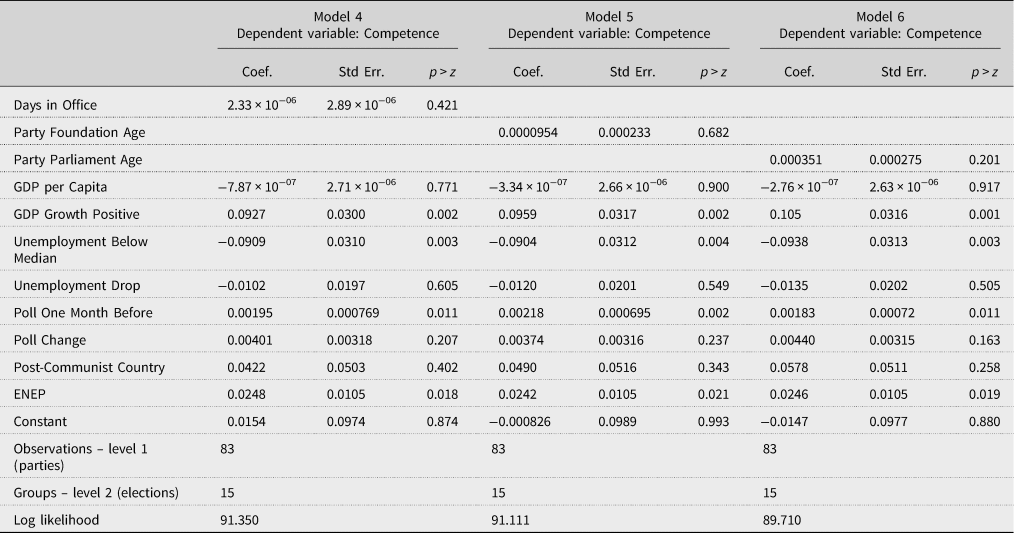
I begin the data analysis by exploring the impact of various indicators of parties' previous experience in policymaking on the emphasis put on competence during electoral campaigns, as expressed in hypotheses H1–H5 (Tables 1 and 2). The coefficients associated with the variables Incumbent, Prime Minister Party, Ever in Government, Days in Office, Party Foundation Age, and Party Parliament Age (Models 1–6) are far from being statistically significant. These results consistently disprove H1–H5. None of the indicators of party experience seems to affect the emphasis put on competence during the campaign.
The Determinants of Parties' Emphasis on Competence During an Electoral Campaign: Models 1 to 3

Source: Own calculations.
Note: For each variable in each model, the row contains unstandardized linear regression coefficients, standard errors and statistical significance.
The Determinants of Parties’ Emphasis on Competence During an Electoral Campaign: Models 4 to 6

Source: Own calculations.
Note: For each variable in each model, the row contains unstandardized linear regression coefficients, standard errors and statistical significance.
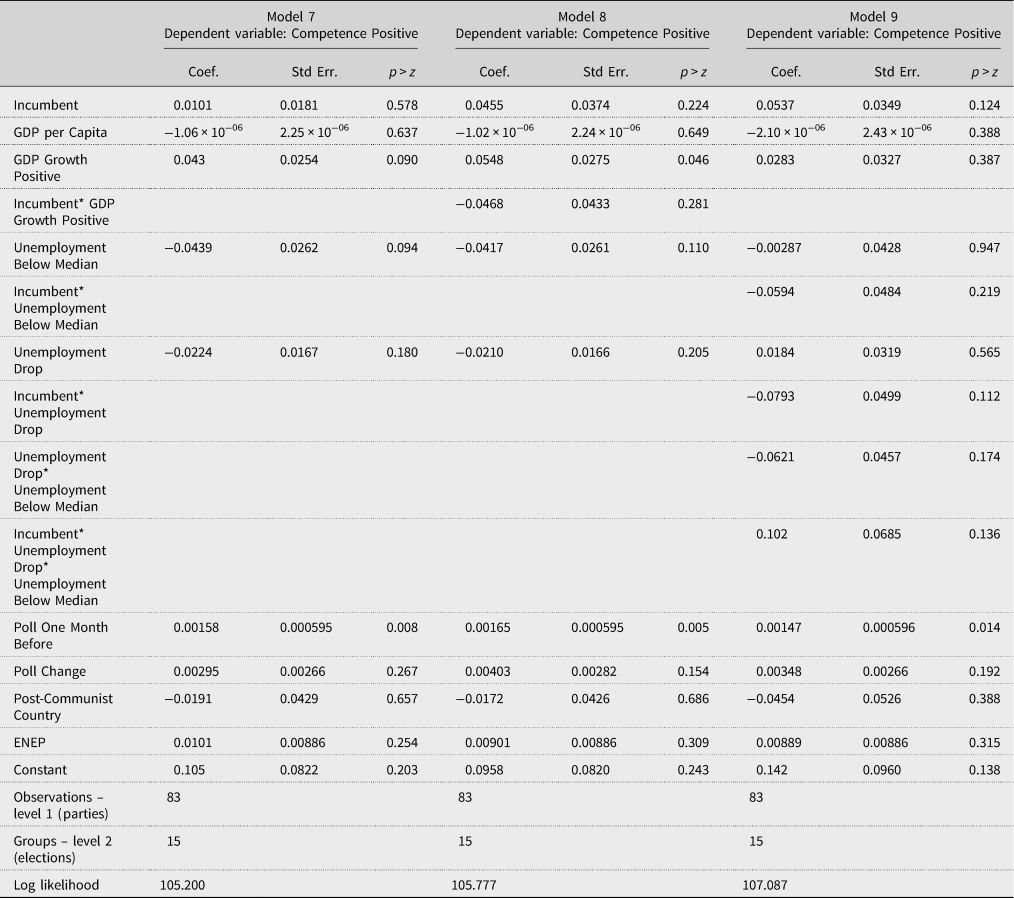
The analysis of the sample of observations available for the current study also leads to the conclusion that the influence of previous participation in the government on the parties praising their competence cannot be detected (Model 7 in Table 3).
The Determinants of Parties Praising their Competence During an Electoral Campaign: Models 7 to 9

Source: Own calculations.
Note: For each variable in each model, the row contains unstandardized linear regression coefficients, standard errors and statistical significance.
In order to verify the hypotheses H6–H8, Models 8 and 9 were estimated (Table 3). They include the same set of dependent, explanatory and control variables as Model 2, but they were expanded with interaction terms. Model 8 enables one to predict the conditional effects of a recent government participation of the party and the dummy representing the direction of GDP change. Model 9 includes the three-way interaction between the former and the ‘Unemployment Below Median’ and ‘Unemployment Drop’ dummy variables, because their influence can be tangled and moderated by each other, and should thus be tested in a single equation. A model with a four-way interaction of the variables representing the condition of the economy plus the ‘Incumbent’ variable cannot be estimated due to the multicollinearity of interaction terms.
Models 8 and 9 do not exhibit any statistically significant influence of the ‘Incumbent’ variable, which leads to the rejection of H6–H8. All of its estimated marginal effects are far from surpassing any conventional levels of statistical significance, which is why I do not present them. Supplementary analyses demonstrating that party system size and the ideological affiliation of parties and newspapers do not moderate the statistical relationship between government participation and emphasizing competence are included in the Online Appendix.
The coefficients associated with parties' performance in the polls 30 days before the election are statistically significant, at least p < 0.05, in all of the models predicting the emphasis put on competence in general (Models 1–6 in Tables 1 and 2). They indicate a positive influence of the variable and confirm hypothesis H9. According to Model 1, a one-percentage-point rise in the pre-electoral polls increases the share of references to competence by 0.0021096 (p = 0.003). It might seem very little at first glance, but the leading parties usually have much higher results in the polls than smaller niche parties do. For instance, an advantage of 20 percentage points in the poll translates into the share of references to competence being greater by 0.042192, which is more than four percentage points.
The robustness of the main results
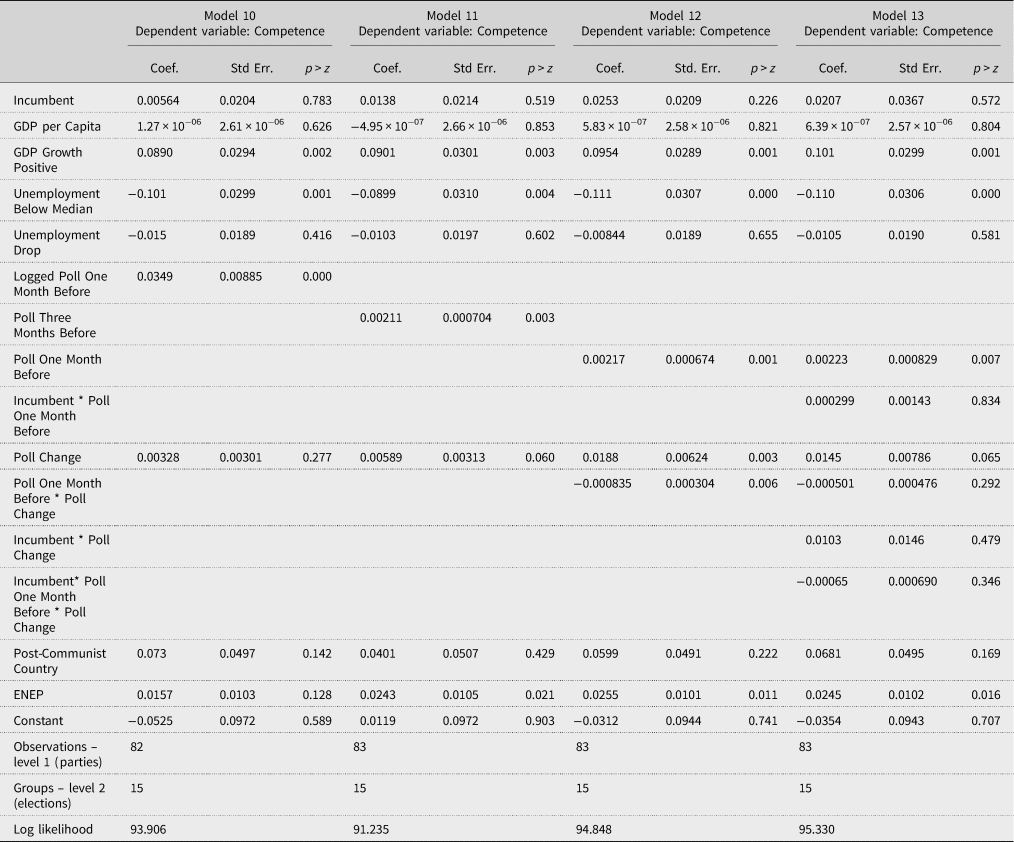
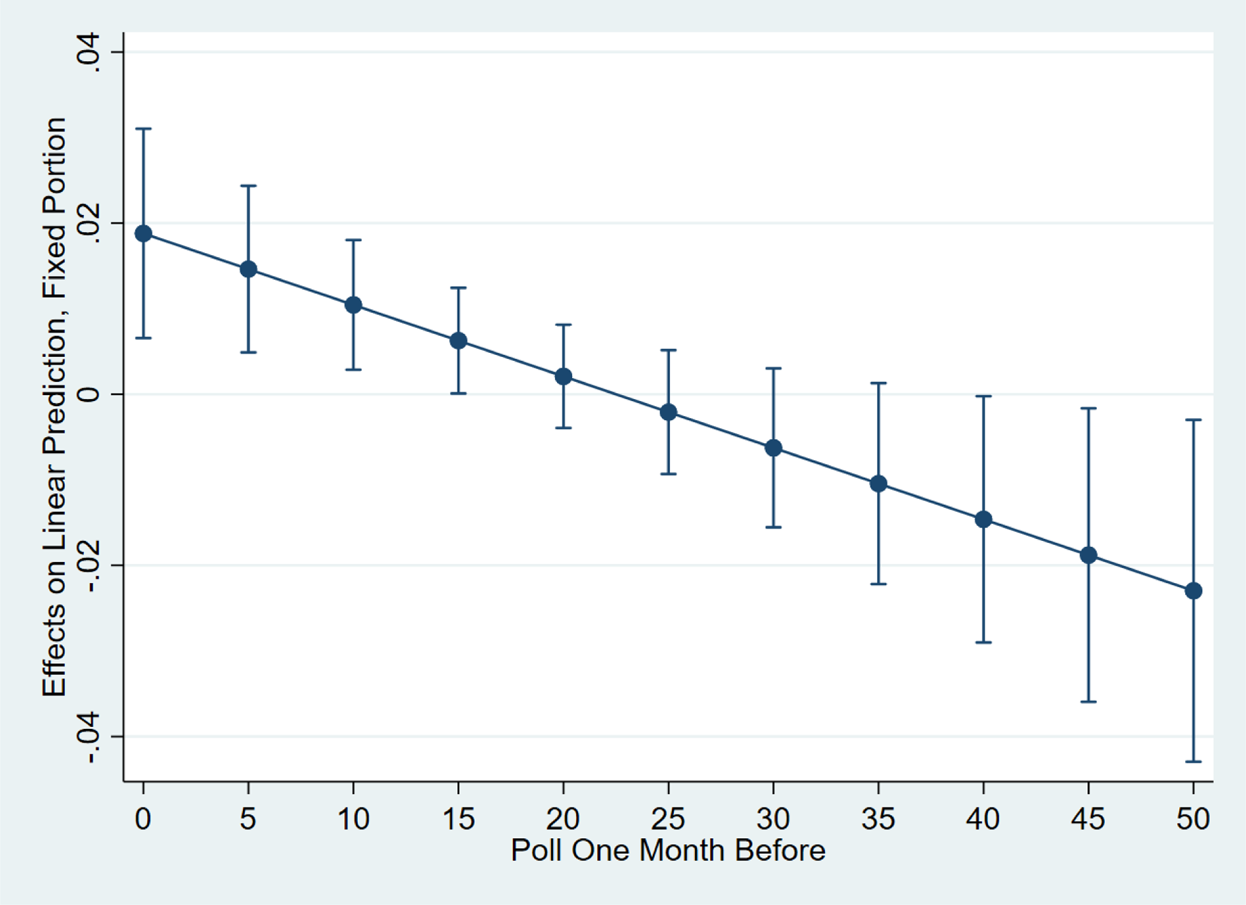
Table 4 includes Models 10–13, which examine the robustness of the obtained results regarding parties' positions in the polls. Models 10 and 11 demonstrate that replacing the ‘Poll One Month Before’ variable in Model 10 with its logged version or with the ‘Poll Three Months Before’ variable in Model 11, respectively, does not alter the substantial result associated with the confirmation of H9. The coefficient of the logged version of the ‘Poll One Month Before’ variable is significant at p < 0.001, and ‘Poll Three Months Before’ is significant at p = 0.003. Furthermore, Model 12 explores the interaction between the ‘Poll Change’ and the ‘Poll One Month Before’ variables in order to advance a better understanding of the influence of these variables. The interaction between the two variables is statistically significant at p = 0.006, and negative. Based on the marginal effects estimated using Model 12, ‘Poll One Month Before’ has a statistically significant influence on emphasizing competence if the party had lost some electoral support during the two months preceding the period for which the data was gathered (Figure 1). The rise of a party's support in pre-electoral polls is a statistically significant predictor of the dependent variable when the party's support in polls published one month before the election remains below 15% (Figure 2). This means that greater emphasis on competence during campaigns should be observed in the campaigning strategies of: (1) small parties gaining support in pre-electoral polls and (2) large parties whose polls are decreasing.
The Determinants of Parties’ Emphasis onCompetence During an Electoral Campaign: Models 10 through 13

Source: Own calculations.
Note: For each variable in each model, the row contains unstandardized linear regression coefficients, standard errors and statistical significance.
Marginal Effects of ‘Poll One Month Before’ Dependent on the ‘Polls Change’ Variable.

Marginal Effects of ‘Polls Change’ Dependent on the ‘Poll One Month Before’ Variable.

The last of the tests presented in the main article includes a three-way interaction between the following variables: ‘Incumbent’, ‘Poll One Month Before’, and ‘Poll Change’. It is aimed at establishing whether pre-electoral polls moderate the impact of participation in the government on emphasizing competence during the campaign (Model 13). None of the estimated interaction terms or marginal effects of the ‘Incumbent’ variable is statistically significant, which is why the results of the polls do not affect the strategies employed by the incumbent and their challengers differently. Nor does incumbency moderate the effects of polls in a statistically significant way.
In the final step, the robustness of the confirmation of the presented results has been assessed by restricting the sample by filtering out the observations from the studied countries one by one and re-estimating each relevant model. In a separate set of tests, the dependent variables ‘Competence’ and ‘Competence Positive’ were replaced by their logged versions in each of the presented models. Every time, the estimated results led to the same substantial conclusions. See the Online Appendix for some supplementary analyses.
Conclusion and discussion
The study demonstrates that in multiparty European democracies, contrary to expectations arising from research conducted in the context of two-party races in the US, parties participating in the government during the parliamentary term that is about to end do not put more emphasis on their competence than their opponents do. Instead, as the study shows, parties leading in pre-electoral polls have a greater proclivity to make claims pertaining to this trait and its manifestations during the campaign. By employing this strategy, they provide the voters with information relevant for the electoral choice, as they are the ones most likely to form the future government. Their competence is of utmost importance to the voters, which is why they discuss it.
The study also reveals that the proposed dependence associated with incumbent parties cannot be unveiled even when the condition of the country's economy is accounted for. Incumbents are as likely to praise their competence as their competitors are to praise their own competence, regardless of economic growth and unemployment. Nor does the position of the incumbent in pre-electoral polls differentiate their emphasis on competence from that of their challengers.
The failure to obtain results supporting the conditional hypotheses associated with this expectation can be, to a certain extent, attributed to data unavailability and the size of the final sample, which encompassed only 15 elections and 83 party-level observations. It might be the case that unveiling the relationship between economy and referring to competence requires a sample encompassing a greater number and variety of countries. Supplementary analyses demonstrate that the studied relationship is not moderated by the number of parties in the system, which is the most striking feature that differentiates elections in Europe from those in the US.
The positive influence of pre-electoral polls on emphasizing competence by parties in Europe is robust and evident regardless of the functional form of the variable as well as irrespective of how recent the considered polls are. Not only do parties which expect to receive higher shares of votes rely on competence in their campaigning to a large extent; this is also true for smaller parties which experience an upward trend in the polls.
The results of the study imply that what matters in the context of attempts made to convince voters about parties' competence in Europe is what the parties expect from the future. It does not matter if they have accomplishments in policymaking to refer to, as neither recent nor previous participation in government matters. Even the amount of time spent in government, or the number of years in politics, does not influence the inclination to refer to competence. Parties seem to be future oriented. This can pose a question as to whether the higher proclivity to refer to competence – demonstrated by Druckman et al. (Reference Druckman, Kifer and Parkin2009, Reference Druckman, Kifer and Parkin2020) – is indeed related to experience in office, or whether it results from the fact that in the US incumbents are usually the ones expecting to win anyway due to their usual advantage, which is why the choice of a campaign strategy is also motivated by expectations, not actual achievements. However, the results obtained in this study remain in line with the conclusion drawn by Druckman et al. (Reference Druckman, Kifer and Parkin2009), who stated that parties possessing an electoral advantage would emphasize competence, which is the least risky campaign strategy available to them.
However, an important caveat has to be made here. The present study uses data collected from mainstream daily newspapers, while Druckman et al. (Reference Druckman, Kifer and Parkin2009, Reference Druckman, Kifer and Parkin2020) used party websites. It might be that journalistic framing influences the relative salient traits in party rhetoric. This possibility cannot be ruled out with the use of the CCDD. The mechanism behind publishing more claims about competence made by parties leading in pre-electoral polls would be, however, similar to the one motivating the parties themselves. Journalists can identify the future winners of the election based on the polls. They know that the competence of these parties matters the most for the future of the country, which is why they devote more attention in their publications to informing readers about the traits crucial for the formation of the government. The discrepancy between the results of the current study and the ones obtained by Druckman et al. (Reference Druckman, Kifer and Parkin2009, Reference Druckman, Kifer and Parkin2020) can also be attributed to different coding strategies. The latter study focused predominantly on parties' references to actual accomplishments in office, as exhibited on their websites, while the CCDD uses a wider conception of references, whereby they, first, are indicative of the competence of a political actor and, second, also encompass discussions of future performance. Unfortunately, the CCDD does not make it possible to account for whether the claim regarding a party's competence is based on its past accomplishments or is simply a pledge of efficiency in policymaking for the future. Obtaining this information would require the recoding of the entire data set. It might be that having experience in office matters for the salience of references to past performance, while good results in pre-electoral polls encourage discussions of future actions.
Accounting for the ideological orientation of newspapers and parties in the quantitative analysis does not show any systematic bias in regard to how many references to competence made by the incumbents are reported (see Online Appendix). Also, it is worth noting that citing a politician praising their competence is not tantamount to aiding their self-promotion. Journalists can use such excerpts in order to reveal hypocrisy hidden in these claims and to criticize the candidate based on this. The comments made by the journalists were not included in data used in this article, as analyzing them would constitute a separate study.
Future research on the underpinnings of the emphasis put on competence during electoral campaigns should explore whether actual accomplishments in office are being used as arguments during the campaign in a different way from the way pledges regarding the future competent government are used. A systematic coding preceded by a qualitative analysis of all the attempts at convincing the voters about one's ability to govern could help resolve the question about why incumbency matters for campaigning on competence in the US, but does not matter in Europe. Indeed, it might be that campaigns in Europe are more future oriented, while, in the US, having a record in office constitutes the crucial resource in the struggle for electoral support. Collecting comparable data on the contents of American and European campaigns could further aid the understanding of the phenomenon and the obtaining of answers to the remaining questions. Comprehending the issue thoroughly would also require the collection of data not only about what parties ‘say’, but also about what citizens tend to take into account when they evaluate the candidates.
Supplementary material
The supplementary material for this article can be found at https://doi.org/10.1017/gov.2021.38.
Acknowledgements
The author would like to thank Margit Tavits for her helpful comments at the early stages of the development of the study during his research visit at the Washington University in St Louis, funded by the Fulbright Senior Award. I also wish to express gratitude for suggestions regarding some of the robustness tests and additional analyses to Michał Kotnarowski and Adam Gendźwiłł. Finally, I am grateful to the three anonymous reviewers, whose constructive comments helped to improve this article.