1. Introduction
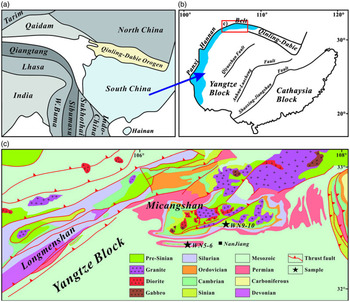
The assembly of Gondwana commenced after the break-up of the Rodinia supercontinent in Neoproterozoic time and was completed in early Palaeozoic time, with most of the constituent continents of Rodinia involved (Meert, Reference Meert2003; Cawood & Buchan, Reference Cawood and Buchan2007; Boger, Reference Boger2011; Xu et al. Reference Xu, Cawood, Du, Zhong and Hughes2014b). According to a large number of detrital zircon age, palaeontological and geochemical studies, the South China Block (SCB), consisting of the Yangtze Block to the northwest and the Cathaysia Block to the southeast (Fig. 1b), has long been recognized as a part of the Rodinia supercontinent (Li et al. Reference Li, Zhang and Powell1995, Reference Li, Bogdanova, Collins, Davidson, DE Waele, Ernst, Fitzsimons, Fuck, Gladkochub, Jacobs, Karlstrom, Lu, Natapov, Pease, Pisarevsky, Thrane and Vernikovsky2008a); however, the position of the block within Gondwana, or whether it was a part of Gondwana remains uncertain. It has been placed along the northern margin of East Gondwana, in the general region of North India (Jiang et al. Reference Jiang, Sohl and Christie-Blick2003; Hughes et al. Reference Hughes, Peng, Bhargava, Ahulwalia, Walia, Myrow and Parcha2005; Wang et al. Reference Wang, Zhang, Fan, Zhang, Chen, Cawood and Zhang2010), with more specific locations including near to the western Himalaya (McKenzie et al. Reference McKenzie, Hughes, Myrow, Choi and Park2011; Burrett et al. Reference Burrett, Zaw, Meffre, Lai, Khositanont, Chaodumrong, Udchachon, Ekins and Halpin2014), and adjacent to the eastern Himalaya with a nexus of India, Antarctic and Australia (Duan et al. Reference Duan, Meng, Zhang and Liu2011; Cawood et al. Reference Cawood, Wang, Xu and Zhao2013; Xu et al. Reference Xu, Cawood, Du, Hu, Yu, Zhu and Li2013, Reference Xu, Cawood, Du, Huang and Wang2014a; Chen, Q. et al. 2018). Cocks & Torsvik (Reference Cocks and Torsvik2013) considered that the SCB was shifted from west to east along the Himalaya via strike-slip faulting. The SCB was even suggested to be part of Laurentia, instead of Gondwana, based on the absence of Gondwanan detritus in the upper Neoproterozoic – Ordovician strata in the Wuyishan area (Wu et al. Reference Wu, Jia, Li, Deng and Li2010). Moreover, the relative positions of the constituent Yangtze and Cathaysia blocks in Gondwana are variable among some reconstruction models (Wang et al. Reference Wang, Zhang, Fan, Zhang, Chen, Cawood and Zhang2010; Duan et al. Reference Duan, Meng, Zhang and Liu2011; Xu et al. Reference Xu, Cawood, Du, Hu, Yu, Zhu and Li2013, Reference Xu, Cawood, Du, Huang and Wang2014a; Yao, W. H. et al. 2014; Yao & Li, Reference Yao and Li2016; Cawood et al. Reference Cawood, Zhao, Yao, Wang, Xu and Wang2018; Chen, Q. et al. 2018).
(a) Sketch map showing the main tectonic units of eastern Asia with the location of the SCB (Chen, Q. et al. 2018). (b) Map showing the SCB consisting of the Yangtze (eastern, central and western parts) and Cathaysia blocks, with the distribution of Neoproterozoic intrusions along the western and northern margins of the Yangtze Block, termed the Panxi–Hannan Belt (Chen et al. Reference Chen, Sun, Long, Zhao and Yuan2016). (c) Simplified geologic map of the Micangshan–Longmenshan region along the western margin of the SCB (modified from Sichuan Geological Map at 1:200 < 2 > 000 scale). Location of samples in this study (represented by black stars).

Lower Palaeozoic stratigraphic successions along the northern margin of Gondwana, such as those in the Himalaya, Qiangtang, Lhasa and Western Australia (Myrow et al. Reference Myrow, Hughes, Goodge, Fanning, Williams, Peng, Bhargava, Parcha and Pogue2010; Metcalfe, Reference Metcalfe2013), are characterized by an unconformable contact relationship between the Cambrian and Ordovician strata. This unconformity, which is also widespread in the southern (Hainan and Yunkai domains) and western (Longmenshan–Micangshan region) parts of the SCB (BGMRGP, 1988; BGMRSP, 1991), was probably coeval with, and perhaps correlated with, the final Gondwana assembly (Cawood & Nemchin, Reference Cawood and Nemchin2000; Cawood et al. Reference Cawood, Johnson and Nemchin2007; Cawood & Buchan, Reference Cawood and Buchan2007; Myrow et al. Reference Myrow, Hughes, Goodge, Fanning, Williams, Peng, Bhargava, Parcha and Pogue2010; Zhu et al. Reference Zhu, Zhao, Niu, Dilek, Wang, Ji, Dong, Sui, Liu, Yuan and Mo2012; Metcalfe, Reference Metcalfe2013; Wang, Y. J. et al. 2013; Zhou, Y. et al. 2015).
A large number of Cambrian–Ordovician detrital zircon studies have been focused on the Cathaysia Block, while only a few coeval detrital zircon studies have been carried out in the Yangtze Block (Wang et al. Reference Wang, Zhang, Fan, Zhang, Chen, Cawood and Zhang2010; Chen, Q. et al. 2018). This paper presents a study of detrital zircon U–Pb geochronology of the Cambrian–Ordovician sandstones on the northern margin of the western Yangtze Block, and places constraints on the early Palaeozoic affinity of the SCB within Gondwana. According to the comparison of detrital zircon age patterns of the Cambrian–Ordovician strata from different parts of the SCB, a more precise position and configuration of the SCB within Gondwana is obtained.
2. Geologic background and sampling
The SCB is generally divided into two different crustal elements: the Yangtze Block to the northwest and the Cathaysia Block to the southeast, which were welded together along the Jiangnan Orogen (Li et al. Reference Li, Zhang and Powell1995, Reference Li, Li, Zhou and Kinny2002; Zhao & Cawood, Reference Zhao and Cawood2012). Some geologists have suggested that the Jiangnan Orogen belongs to part of the worldwide Grenvillian orogenic belts associated with the assembly of the Rodinia supercontinent (Li et al. Reference Li, Zhang and Powell1995, Reference Li, Li, Zhou and Kinny2002, 2Reference Li, Bogdanova, Collins, Davidson, DE Waele, Ernst, Fitzsimons, Fuck, Gladkochub, Jacobs, Karlstrom, Lu, Natapov, Pease, Pisarevsky, Thrane and Vernikovsky2008a,b; Greentree et al. Reference Greentree, Li, Li and Wu2006; Ye et al. Reference Ye, Li, Li, Liu and Li2007), whereas others have considered that the amalgamation lasted until ~820 Ma or even younger (Li, Reference Li1999; Zhao & Cawood, Reference Zhao and Cawood1999; Zhou et al. Reference Zhou, Kennedy, Sun, Malpas and Lesher2002a,b, 2007, 2009; Yan et al. Reference Yan, Hanson, Wang, Druschke, Yan, Wang, Liu, Song, Jian, Zhou and Jiang2004; Wang et al. Reference Wang, Zhou, Qiu, Zhang, Liu and Zhang2006, Reference Wang, Zhou, Griffin, Wang, Qiu, O’Reilly, Xu, Liu and Zhang2007, Reference Wang, Zhao, Zhou, Liu and Hu2008; Wu et al. Reference Wu, Zheng, Wu, Zhao, Zhang, Liu and Wu2006; Zheng et al. Reference Zheng, Zhang, Zhao, Wu, Li, Li and Wu2007; Yao, J. L. et al. 2014; Zhao, Reference Zhao2015; Lin et al. Reference Lin, Peng, Jiang, Polat, Kusky, Wang and Deng2016; Kou et al. Reference Kou, Liu, Huang, Li, Ding and Zhang2018). The Anhua–Luocheng and Qiyueshan faults divide the Yangtze Block into three individual structural segments from west to east (Fig. 1b) (Wang et al. Reference Wang, Zhang, Fan, Zhang, Chen, Cawood and Zhang2010, Reference Wang, Zhou, Griffin, Zhao, Yu, Qiu, Zhang and Xing2014; Zhao & Cawood, Reference Zhao and Cawood2012; Dong et al. Reference Dong, Zhang, Gao, Su, Liu and Li2015).
Archaean–Palaeoproterozoic crystalline basement of the Yangtze Block is sporadically exposed and is represented by the Douling Complex, which has yielded ages of ~2.5 Ga (Hu et al. Reference Hu, Liu, Chen, Qu, Li and Geng2013; Wu et al. Reference Wu, Zhou, Gao, Liu, Qin, Wang, Yang and Yang2014; Nie et al. Reference Nie, Yao, Wan, Zhu, Siebel and Chen2016), the Kongling Complex, yielding ages in the ranges of 3.2–2.9 Ga, 2.7–2.4 Ga and 2.1–1.8 Ga (Gao et al. Reference Gao, Ling, Qiu, Lian, Hartmann and Simon1999; Qiu & Gao, Reference Qiu and Gao2000; Zheng et al. Reference Zheng, Griffin, O’Reilly, Zhang, Pearson and Pan2006), the Phan si Pan Complex, yielding ages in the range of 2.9–2.8 Ga (Lan et al. Reference Lan, Chung, Lo, Lee, Wang, Li and Van Toan2001; Nam et al. Reference Nam, Toriumi, Sano, Terada and Thang2003), the Yudongzi Complex, yielding ages in the range of 2.8–2.45 Ga (Zhang et al. Reference Zhang, Zhang, Tang and Wang2001, Reference Zhang, Xu, Song, Wang, Chen and Li2010; Wang et al. Reference Wang, Xu, Chen, Yan, Li and Zhu2011; Hui et al. Reference Hui, Dong, Cheng, Long, Liu, Yang, Sun, Zhang and Varga2017), and the Zhongxiang Complex, yielding ages in the range of 2.9–2.6 Ga (Wang et al. Reference Wang, Wang, Du, Deng and Yang2013a,b, 2018; Zhou, G. Y. et al. 2015). The ~850–720 Ma plutonic complexes, termed the Panxi–Hannan Belt, extend along the western and northern margins of the Yangtze Block (Fig. 1b) (Zhao & Zhou, Reference Zhao and Zhou2007; Zhao & Cawood, Reference Zhao and Cawood2012). These plutonic complexes consist mainly of tonalite-trondhjemite-granodiorite (TTG) gneisses, granites, diorites and gabbros, the genesis of which still remains controversial, with some interpreting them as the products of subduction (Zhou et al. Reference Zhou, Ma, Yan, Xia, Zhao and Sun2006a,b), whereas others argue that they resulted from mantle plumes (Li et al. Reference Li, Li, Ge, Zhou, Li, Liu and Wingate2003). The basement is unconformably overlain by an upper Neoproterozoic to Middle Triassic marine sedimentary sequence (Yan et al. Reference Yan, Hanson, Wang, Druschke, Yan, Wang, Liu, Song, Jian, Zhou and Jiang2004; Zhao & Cawood, Reference Zhao and Cawood2012). The exposed basement rocks are mostly of Proterozoic age in the Cathaysia Block. The oldest Palaeoproterozoic (1.9–1.8 Ga) granitoids and supracrustal rocks, known as the Badu Complex, are distributed in the Wuyishan area (Yu et al. Reference Yu, O’Reilly, Wang, Griffin, Zhou, Zhang and Shu2010, Reference Yu, O’Reilly, Zhou, Griffin and Wang2012; Zhao & Cawood, Reference Zhao and Cawood2012). The composite basement rocks are unconformably overlain by middle to upper Neoproterozoic sequences.
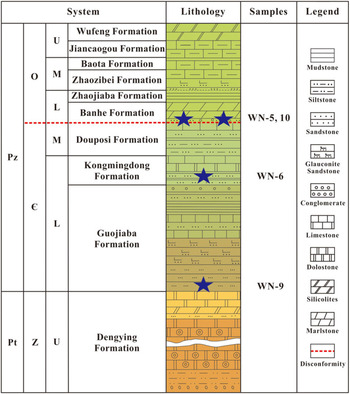
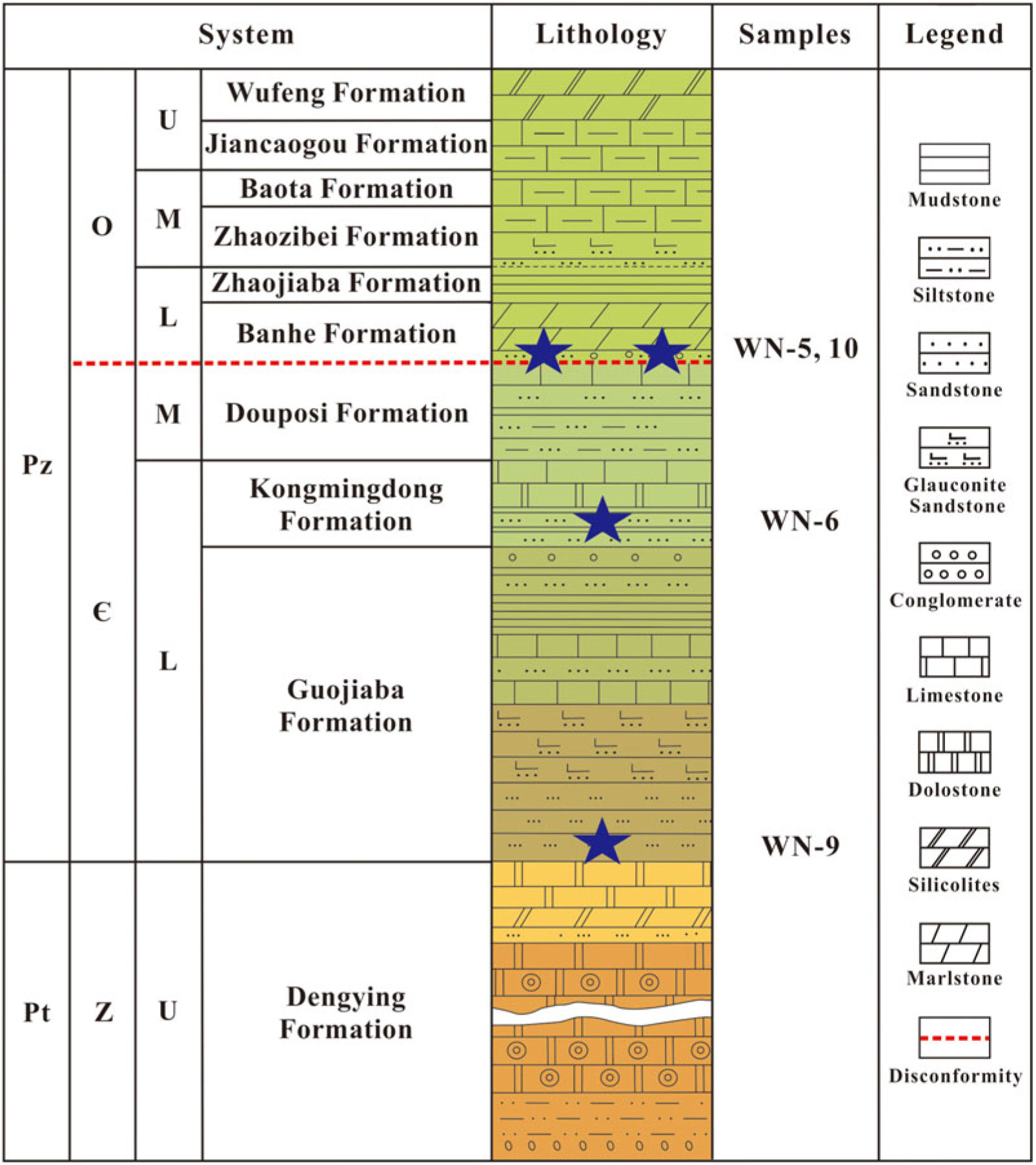
We have studied the Cambrian–Ordovician strata that are distributed in limited areas owing to an early Palaeozoic phase of shortening and denudation in the Micangshan fold–thrust belt located on the northern margin of the western Yangtze Block (Fig. 1c). Within the Nanjiang area, the lower and middle Cambrian sequence mainly consists of marine carbonate and siliciclastic rocks, and includes the Guojiaba, Kongmingdong and Douposi formations from base to top (Fig. 2). The Ordovician sequence, which includes the Banhe, Zhaojiaba, Zhaozibei, Baota, Jiancaogou and Wufeng formations from base to top, is dominated by carbonate rocks (Fig. 2). The disconformably overlying Banhe Formation consists of coarse-grained sandstone with gravel in the lower unit passing up into sandstone, marl and dolomitic limestone. Four samples were collected from exposures of sandstone for detrital zircon U–Pb age analysis, including one sample from the lower Cambrian Guojiaba Formation (WN9), one sample from the Kongmingdong Formation (WN6) and the other two samples from the Lower Ordovician Banhe Formation (WN5 and WN10). Their lithology and locations are summarized in Table 1, and are shown in Figures 1c and 2.
Schematic stratigraphy of the front of the Micangshan fold–thrust belt, northern margin of the western Yangtze Block. The blue stars indicate sampling locations.
U–Pb dating results for detrital zircons from the Cambrian–Ordovician strata on the northern margin of the western Yangtze Block

3. Analytical methods
3.a. Zircon separation and CL imaging
Zircons were extracted from whole-rock samples by using conventional techniques that include crushing, sieving, and magnetic and heavy liquid techniques and were then handpicked under a binocular microscope with a comprehensive consideration of size, clarity, colour and morphology. The selected crystals were cast in an epoxy mount, which was then polished down to expose their centres. Prior to U–Pb dating, the internal structure of the zircons was studied in detail with cathodoluminescence (CL) imaging and was used to select the appropriate positions for laser ablation inductively coupled plasma mass spectrometry (LA-ICP-MS) analysis.
3.b. U–Pb dating
U–Pb dating and trace-element analysis of the zircons was conducted synchronously by LA-ICP-MS at the Wuhan Sample Solution Analytical Technology Co., Ltd. Detailed operating conditions for the laser ablation system and the ICP-MS instrument and data reduction are the same as described by Liu et al. (Reference Liu, Hu, Gao, Günther, Xu, Gao and Chen2008a, 2010). Laser sampling was performed with a GeoLas 2005. Ion-signal intensities were acquired by an Agilent 7700e ICP-MS instrument. Helium was used as the carrier gas. Argon was applied as the make-up gas and mixed with the carrier gas via a T-connector before entering the ICP. A ‘wire’ signal smoothing device is included in this laser ablation system, by which smooth signals are produced even at very low laser repetition rates down to 1 Hz (Hu et al. Reference Hu, Liu, Gao, Xiao, Zhao, Günther, Li, Zhang and Zong2012). Each analysis incorporated a background acquisition of approximately 20–30 s (gas blank) followed by 50 s of data acquisition from the sample. An in-house Excel-based software ICPMSDataCal (Ver. 10.0) was used to perform off-line selection and integration of background and analyte signals, and time-drift correction and quantitative calibration for trace-element analysis and U–Pb dating (Liu et al. Reference Liu, Zong, Kelemen and Gao2008b, 2010).
Zircon 91500 was used as the external standard for U–Pb dating, and was analysed twice every five analyses. Time-dependent drifts of U–Th–Pb isotopic ratios were corrected using a linear interpolation (with time) for every five analyses according to the variations of 91500 (i.e. two zircon 91500 + five samples + two zircon 91500) (Liu et al. Reference Liu, Gao, Hu, Gao, Zong and Wang2010). Preferred U–Th–Pb isotopic ratios used for 91500 are from Wiedenbeck et al. (Reference Wiedenbeck, Alle, Corfu, Griffin, Meier, Oberli, Quadt, Roddick and Spiegel1995). Concordia diagrams and weighted mean calculations were calculated in-house by using Isoplot software (Ludwig, Reference Ludwig2003).
4. Results
4.a. Zircon CL images and Th/U ratios
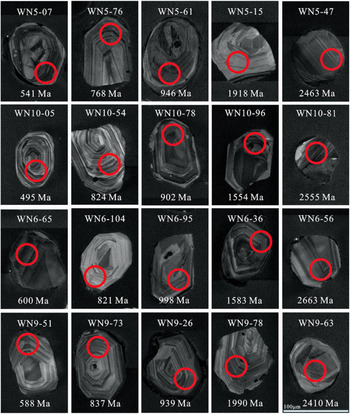
The internal structure of the zircons was examined using CL imaging via a scanning electron microprobe at the Wuhan Sample Solution Analytical Technology Co., Ltd. The detrital zircon grains show a wide range of morphologies and complex internal structures. Zircons range in size from 75 μm to 150 μm (Fig. 3). Some zircon grains are well rounded, implying long-distance transportation. CL images show that most zircons are characterized by a euhedral prismatic shape and concentric oscillatory zoning (Fig. 3), and the Th/U ratios of all of the analysed zircons are >0.1 (Table 1), indicating an igneous origin.
Representative CL images of the Cambrian–Ordovician zircon samples from the northern margin of the western Yangtze Block showing internal structure and morphology.

4.b. U–Pb zircon ages
Zircon U–Pb isotopic compositions of a total of 382 analyses on the zircon cores are presented in Table 1. Uncertainties on individual analyses in the data table and on concordia plots are presented at 1σ, whereas errors on averages of multiple analyses are given at the 2σ level. All analyses are shown on concordia plots (Fig. 4); however, analyses that show discordance greater than 10 % were not included in frequency diagrams, and ages less than 1000 Ma are based on the 206Pb/238U ratio whereas older ages are based on the 207Pb/206Pb ratio.
Concordia plots for zircons from the Cambrian–Ordovician sedimentary rocks from the northern margin of the western Yangtze Block. Grains yielding ages with more than 10 % discordance are represented by blue ellipses.

4.b.1. Age pattern of zircons from the Lower Ordovician samples (WN5 and WN10)
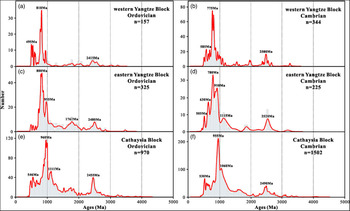
A total of 157 of 183 analyses on 183 zircons display 90 % or greater concordance, and range in age from 3229 Ma to 486 Ma (Table 1), indicating multiple sources for the zircons. Most ages fall into five groups: 2.6–2.3 Ga, 1.0–0.9 Ga, 0.9–0.7 Ga, 0.7–0.55 Ga and 0.55–0.47 Ga, with peaks at 2415 Ma, 942 Ma, 818 Ma, 595 Ma and 495 Ma (Fig. 5). Two older grains yield concordant ages of 3006 ± 39.2 Ma and 3229 ± 24.7 Ma. CL images and Th/U values indicate that most zircons are of magmatic origin.
Probability density distribution curves of ages showing the results of LA-ICP-MS dating of detrital zircons from the Cambrian–Ordovician samples from the northern margin of the western Yangtze Block.

4.b.2. Age pattern of zircons from the lower Cambrian samples (WN6 and WN9)
Detrital zircon U–Pb ages were determined on 199 grains. Almost all of the analyses plot on or near concordia and give a wide age range from 3087 Ma to 518 Ma (Table 1), suggesting multiple source regions for the lower Cambrian sequence in the study area. The most significant age cluster, constituting 67 % of the analysed grains, lies between 900 Ma and 700 Ma and shows an age peak at 775 Ma (Fig. 5). Most grains are euhedral, suggesting a near-source region. Subordinate age peaks at 2480 Ma and 933 Ma can also be seen. CL images and Th/U values indicate that most zircons are of magmatic origin.
5. Discussion
5.a. Age pattern comparison
The detrital zircon age spectra of the Cambrian strata from the Cathaysia, eastern Yangtze and western Yangtze blocks are similar to those of Ordovician strata from the same regions (Fig. 6), which suggests that there was probably no change in provenance from the Cambrian to Ordovician periods. However, some differences are obvious from the detrital zircon age spectra for the Cambrian and Ordovician rocks among the Cathaysia, eastern Yangtze and western Yangtze blocks. The most notable difference is manifested in the age distribution between 1000 Ma and 700 Ma. Only one dominant peak at ~950 Ma in the Cathaysia Block and ~800 Ma in the western Yangtze Block was shown, respectively, whereas these two peaks were both prominent in the eastern Yangtze Block (Fig. 6). The detrital zircon age distribution of the Cambrian and Ordovician sedimentary rocks in the Cathaysia Block is characterized by a major age group between 2000 Ma and 1000 Ma, which peaks at ~1100 Ma. The percentage of detrital zircons with ages of 2000–1000 Ma gradually decreases from the Cathaysia Block to the western Yangtze Block (Fig. 6).
Detrital zircon age distributions for (a) Ordovician sedimentary rocks from the western Yangtze Block (this study); (b) Cambrian sedimentary rocks from the western Yangtze Block (this study; Chen, Q. et al. 2018); (c) Ordovician sedimentary rocks from the eastern Yangtze Block (Wang et al. Reference Wang, Zhang, Fan, Zhang, Chen, Cawood and Zhang2010; Xu et al. Reference Xu, Du, Cawood, Zhu, Li and Yu2012; Yao et al. Reference Yao, Shu, Santosh and Li2012; Li et al. Reference Li, Jia, Wu, Zhang, Yin, Wei and Li2013); (d) Cambrian sedimentary rocks from the eastern Yangtze Block (Wang et al. Reference Wang, Zhang, Fan, Zhang, Chen, Cawood and Zhang2010); (e) Ordovician sedimentary rocks from the Cathaysia Block (Wang et al. Reference Wang, Zhang, Fan, Zhang, Chen, Cawood and Zhang2010; Wu et al. Reference Wu, Jia, Li, Deng and Li2010; Yao et al. Reference Yao, Shu and Santosh2011; Xu et al. Reference Xu, Cawood, Du, Huang and Wang2014a); (f) Cambrian sedimentary rocks from the Cathaysia Block (Wang et al. Reference Wang, Zhang, Fan, Zhang, Chen, Cawood and Zhang2010; Wu et al. Reference Wu, Jia, Li, Deng and Li2010; Xu et al. Reference Xu, Cawood, Du, Huang and Wang2014a; Yao, W. H. et al. 2014).

5.b. Provenance of detrital zircons in the SCB
The oldest age population with a peak at ~2500 Ma is widely distributed in the Cambrian–Ordovician detrital zircons in the SCB (Fig. 6) (Yu et al. Reference Yu, O’Reilly, Wang, Griffin, Zhang, Wang, Jiang and Hu2008, Reference Yu, O’Reilly, Wang, Griffin, Zhou, Zhang and Shu2010; Wang et al. Reference Wang, Zhang, Fan, Zhang, Chen, Cawood and Zhang2010; Wu et al. Reference Wu, Jia, Li, Deng and Li2010; Yao et al. Reference Yao, Shu and Santosh2011; Duan et al. Reference Duan, Meng, Zhang and Liu2011, Reference Duan, Meng, Wu, Ma and Li2012; Chen, Q. et al. 2018). However, direct evidence of widespread late Archaean – early Palaeoproterozoic basement for the SCB has not been reported. The Douling, Kongling, Phan si Pan, Yudongzi and Zhongxiang complexes, which represent the oldest rocks of the Yangtze Block, are only distributed along the northern and southern Yangtze margins (Qiu & Gao, Reference Qiu and Gao2000; Lan et al. Reference Lan, Chung, Lo, Lee, Wang, Li and Van Toan2001; Zhang et al. Reference Zhang, Zhang, Tang and Wang2001, Reference Zhang, Xu, Song, Wang, Chen and Li2010; Nam et al. Reference Nam, Toriumi, Sano, Terada and Thang2003; Zheng et al. Reference Zheng, Griffin, O’Reilly, Zhang, Pearson and Pan2006; Jiao et al. Reference Jiao, Wu, Yang, Peng and Wang2009; Gao et al. Reference Gao, Yang, Zhou, Li, Hu, Guo, Yuan, Gong, Xiao and Wei2011; Wang et al. Reference Wang, Xu, Chen, Yan, Li and Zhu2011, Reference Wang, Li, Dong, Cui, Han and Zheng2018; Hu et al. Reference Hu, Liu, Chen, Qu, Li and Geng2013; Wu et al. Reference Wu, Zhou, Gao, Liu, Qin, Wang, Yang and Yang2014; Nie et al. Reference Nie, Yao, Wan, Zhu, Siebel and Chen2016; Hui et al. Reference Hui, Dong, Cheng, Long, Liu, Yang, Sun, Zhang and Varga2017). In addition, most ~2500 Ma zircons identified in this study show a rounded shape (Fig. 3). Consequently, an exotic source that was once connected with the SCB or an unexposed Neoarchaean – early Palaeoproterozoic basement beneath the SCB was suggested to be the provenance. The age peak at ~2500 Ma correlates with similar ages reported for the end Archaean – early Palaeoproterozoic event of global continental growth (Yao et al. Reference Yao, Shu and Santosh2011). Neoarchaean crustal generation in the Yilgarn Craton, Western Australia, took place at ~2.8–2.6 Ga (Griffin et al. Reference Griffin, Belousova, Shee, Pearson and O’Reilly2004) but with some activity as young as ~2.5 Ga along the northern and southern margins of the craton (Cawood & Tyler, Reference Cawood and Tyler2004; Cawood & Korsch, Reference Cawood and Korsch2008). Such growth occurred at ~2.6–2.4 Ga in India (Mondal et al. Reference Mondal, Goswami, Deomurari and Sharma2002).
Grenvillian-aged detrital zircons with a peak at ~1100 Ma are abundant in the Cambrian–Ordovician samples from the Cathaysia and eastern Yangtze blocks (Fig. 6). Recently, the magmatic ages of some igneous rock units from the Yangtze Block and Shaoxing–Jiangnan Fault zone have been determined to be ~1100 Ma (Qiu et al. Reference Qiu, Ling, Liu, Kusky, Berkana, Zhang, Gao, LU, Kuang and Liu2011; Gao et al. Reference Gao, Liu, Ding, Song, Huang, Zhang, Zhang and Shi2013; Chen, W. T. et al. 2014, 2018; Du et al. Reference Du, Wang, Wang, Deng and Yang2015; Zhang et al. Reference Zhang, Li, Gao, Geng, Ding, Liu and Kou2015; Zhu et al. Reference Zhu, Zhong, Li, Bai and Yang2016). Li et al. (Reference Li, Li, Zhou and Kinny2002) also reported Grenvillian metamorphism (1.3–1.0 Ga) from Hainan Island. However, the limited areal extent and mafic composition indicate that these rocks may not be the major source. The rounded shape of these zircons supports a relatively long transport distance from source to sink (Fig. 3). Grenvillian-aged belts are widespread globally, including in eastern North America and Baltica (Rivers, Reference Rivers1997; Bingen et al. Reference Bingen, Nordgulen and Viola2008), South America (Tohver et al. Reference Tohver, Van Der Pluijm, Scandolara and Essene2005) and south-central Africa and Antarctica (Boger et al. Reference Boger, Carson, CJL and Fanning2000; Fitzsimons, Reference Fitzsimons2000; Harley & Kelly, Reference Harley and Kelly2007). These belts are suggested to be the major source for the Grenvillian-aged detrital zircons in the SCB.
A large number of zircon grains in the Cathaysia and eastern Yangtze blocks yield earliest Neoproterozoic ages, which peaked at ~950 Ma (Fig. 6). Several rock units from the Yangtze Block have been reported to be of 1000–900 Ma age, which includes the Yanbian and Bikou groups in the western Yangtze Block (Yan et al. Reference Yan, Hanson, Wang, Druschke, Yan, Wang, Liu, Song, Jian, Zhou and Jiang2004; Zhou et al. Reference Zhou, Ma, Yan, Xia, Zhao and Sun2006a; Sun et al. Reference Sun, Zhou, Gao, Yang, Zhao and Zhao2009), trondhjemites and metapelites in the Kongling area, and amphibole and biotite granulites in the Xichang area (Qiu & Gao, Reference Qiu and Gao2000; Xu et al. Reference Xu, Liu, Wang, Yu, Li, Wan and Fang2004; Zheng et al. Reference Zheng, Griffin, O’Reilly, Zhang, Pearson and Pan2006). Yao et al. (Reference Yao, Shu and Santosh2011) suggested that the Jiangnan Orogen is likely to be part of the Grenvillian orogen and that a major Grenvillian orogenic belt probably existed in the southern part of the Cathaysia Block. In addition, the Rayner–Eastern Ghats province, with an age of 990–900 Ma, is widespread in Antarctica and India (Fitzsimons, Reference Fitzsimons2000; Boger et al. Reference Boger, Wilson and Fanning2001). Moreover, the 1000–900 Ma zircons identified here show various shapes, from euhedral to rounded (Fig. 3). Therefore, the earliest Neoproterozoic zircons are suggested to be mainly derived from both the SCB and the Grenvillian orogens within Gondwana.
The most prominent age population in the eastern and western Yangtze blocks is middle Neoproterozoic, with a peak at ~800 Ma (Fig. 6). Middle Neoproterozoic igneous rocks, represented by the Jiaoziding (~790 Ma; Pei et al. Reference Pei, LI, Ding, Li, Feng, Sun, Zhang and Liu2009) and Xuelongbao granite intrusions (~750 Ma; Zhou et al. Reference Zhou, Yan, Wang, Qi and Kennedy2006b) in the Longmenshan Belt, and the Gongcai (~860 Ma; Zhou et al. Reference Zhou, Yan, Kennedy, Li and Ding2002b; Chen et al. Reference Chen, Sun, Long and Yuan2015) and Qinganlin (~830 Ma; Chen et al. Reference Chen, Sun, Long and Yuan2015) felsic plutons in the Danba region, are well exposed in the Panxi–Hannan Belt (Duan et al. Reference Duan, Meng, Zhang and Liu2011). Additionally, upper Neoproterozoic strata distributed in the western Yangtze Block also contain abundant zircon grains of ~900–700 Ma age (Sun et al. Reference Sun, Zhou, Gao, Yang, Zhao and Zhao2009; Wang et al. Reference Wang, Yu, Griffin and O’Reilly2012). In view of the younger ophiolite mélange, middle Neoproterozoic peraluminous granite intrusions and basement depositions, the Jiangnan Orogen was recently considered to be formed at ~860–820 Ma or ~760–750 Ma (Li, Reference Li1999; Li et al. Reference Li1999, Reference Li, Zhu, Zhong, Wang, He, Bai and Liu2010; Yan et al. Reference Yan, Hanson, Wang, Druschke, Yan, Wang, Liu, Song, Jian, Zhou and Jiang2004; Wang et al. Reference Wang, Zhou, Qiu, Zhang, Liu and Zhang2006; Zhou et al. Reference Zhou, Li, Ge and Li2007, Reference Zhou, Wang and Qiu2009; Shu et al. Reference Shu, Deng, Yu, Wang and Jiang2008; Zhao et al. Reference Zhao, Zhou, Yan, Zheng and Li2011, Reference Zhao2015; Yao et al. Reference Yao, Shu, Santosh and Li2013; Zhang et al. Reference Zhang, Santosh, Zou, Li and Huang2013; Zhao, Reference Zhao2015; Lin et al. Reference Lin, Peng, Jiang, Polat, Kusky, Wang and Deng2016). Moreover, most 900–700 Ma zircons in this study show a euhedral shape (Fig. 3). Thus, it is likely that the middle Neoproterozoic zircons were sourced from a local supply within the SCB, and mainly from the Panxi–Hannan Belt.
The Cambrian–Ordovician samples from the SCB also show an age population of 700–470 Ma (Fig. 6). Coeval magmatic rocks are rare in both the Yangtze and Cathaysia blocks. Metavolcanic rocks with an age of ~528 Ma (Ding et al. Reference Ding, Xu, Long, Zhou and Liao2002), and mafic igneous and volcaniclastic sedimentary rocks with ages of 520–440 Ma, have only been reported from Hainan Island (Xu et al. Reference Xu, Xia, Li, Chen, Ma and Zhang2007, Reference Xu, Xia, Bakun-Czubarow, Bachlinski, Li, Chen and Chen2008). In contrast, such an age is comparable to the timing of major thermo-tectonic events that affected much of Gondwana. These include the 650–550 Ma East African Orogen (DeCelles et al. Reference DeCelles, Gehrels, Quade, Lareau and Spurlin2000), the 600–500 Ma Prydz–Darling Orogen (Cawood & Buchan, Reference Cawood and Buchan2007), the 530–480 Ma Ross–Delamerian Orogen (Cawood, Reference Cawood2005; Cawood & Buchan, Reference Cawood and Buchan2007) and the 550–470 Ma Bhimphedian Orogen (Cawood et al. Reference Cawood, Johnson and Nemchin2007). In addition, most 700–470 Ma zircons in this study show rounded shapes (Fig. 3). Therefore, we suggest that the late Neoproterozoic zircons were mainly derived from the other continents of Gondwana.
5.c. Implications for continental affinity of the SCB
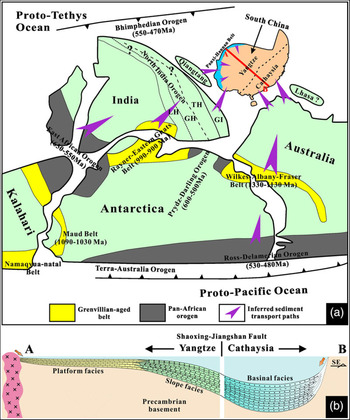
The integrated detrital zircon age spectra of the Cambrian–Ordovician samples from the Cathaysia and eastern Yangtze blocks display two prominent age peaks at ~1100 Ma and ~950 Ma (Fig. 6), which suggests the sources lay within Gondwana. Gondwanan sources involve the combined input from the Wilkes–Albany–Fraser Belt in SW Australia/Antarctica for the end Mesoproterozoic detritus and the Rayner–Eastern Ghats Belt in India for the early Neoproterozoic detritus, along with detritus from their adjoining cratons, including Western Australia, North India and Qiangtang (Fig. 7) (Xu et al. Reference Xu, Cawood, Du, Hu, Yu, Zhu and Li2013, Reference Xu, Cawood, Du, Huang and Wang2014a; Chen, Q. et al. 2018). These age relationships are consistent with the interpretation that the SCB was placed at the nexus of India, Antarctic and Australia (Fig. 8a) (Duan et al. Reference Duan, Meng, Zhang and Liu2011; Cawood et al. Reference Cawood, Wang, Xu and Zhao2013; Xu et al. Reference Xu, Cawood, Du, Hu, Yu, Zhu and Li2013, Reference Xu, Cawood, Du, Huang and Wang2014a; Yao, W. H. et al. 2014; Yao & Li, Reference Yao and Li2016; Chen, Q. et al. 2018). The proposed East Gondwana source regions can also provide a likely source for the Neoarchaean, late Palaeoproterozoic and Neoproterozoic detritus in the Cambrian–Ordovician strata of the SCB (Fig. 7). The Cambrian and Ordovician shallow marine faunas in the SCB (Li, Reference Li and Hongfu1994; Yang, Reference Yang and Yin1994) have close affinities with those in East Gondwana, especially Australian Gondwana (Burrett, Reference Burrett1973; Burrett & Stait, Reference Burrett and Stait1985; Metcalfe, Reference Metcalfe, Audley-Charles and Hallam1988; Burrett et al. Reference Burrett, Long, Stait, McKerrow and Scotese1990). Additionally, the model that the SCB was located on the northern margin of East Gondwana during early Palaeozoic time is also supported by most palaeomagnetic investigations (Yang et al. Reference Yang, Sun, Yang and Pei2004; Huang et al. Reference Huang, Zhou and Zhu2008; Torsvik & Cocks, Reference Torsvik, Cocks and Bassett2009; Han et al. Reference Han, Yang, Tong and Jing2015).
Detrital zircon age distributions for the main blocks in East Gondwana. (a) Western Australia (Cawood & Nemchin, Reference Cawood and Nemchin2000; Veevers et al. Reference Veevers, Belousova, Saeed, Sircombe, Cooper and Read2006; Kettanah, Reference Kettanah2015); (b) Himalaya and North India (Myrow et al. Reference Myrow, Hughes, Paulsen, Williams, Parcha, Thompson, Bowring, Peng and Ahluwalia2003, Reference Myrow, Hughes, Goodge, Fanning, Williams, Peng, Bhargava, Parcha and Pogue2010; McQuarrie et al. Reference McQuarrie, Robinson, Long, Tobgay, Grujic, Gehrels and Ducea2008; Gehrels et al. Reference Gehrels, Kapp, DeCelles, Pullen, Blakey, Weislogel, Ding, Guynn, Martin, McQuarrie and Yin2011); (c) Qiangtang (Dong et al. Reference Dong, Li, Wan, Wang, Wu, Xie and Liu2011; Zhu et al. Reference Zhu, Zhao, Niu, Dilek and Mo2011).

(a) Reconstruction of early Palaeozoic East Gondwana showing position of the SCB (modified after Fitzsimons, Reference Fitzsimons2000; Boger et al. Reference Boger, Wilson and Fanning2001; Metcalfe, Reference Metcalfe2006; Zhu et al. Reference Zhu, Zhao, Niu, Dilek and Mo2011; Burrett et al. Reference Burrett, Zaw, Meffre, Lai, Khositanont, Chaodumrong, Udchachon, Ekins and Halpin2014; Chen, Q. et al. 2018). LH – Lesser Himalaya; GH – Greater Himalaya; TH – Tethyan Himalaya; GI – Greater India. (b) The palaeogeographic pattern for the Cathaysia and Yangtze blocks during the Cambrian and Ordovician periods (modified after Wang et al. Reference Wang, Zhang, Fan, Zhang, Chen, Cawood and Zhang2010; Wu et al. Reference Wu, Jia, Li, Deng and Li2010).

The relative positions of the Cathaysia and Yangtze blocks in East Gondwana vary in several early Palaeozoic reconstruction models. The Cathaysia Block was placed adjacent to the northern margin of East Gondwana, while the Yangtze Block was in the distal position (Wang et al. Reference Wang, Zhang, Fan, Zhang, Chen, Cawood and Zhang2010; Xu et al. Reference Xu, Cawood, Du, Hu, Yu, Zhu and Li2013, Reference Xu, Cawood, Du, Huang and Wang2014a; Yao, W. H. et al. 2014; Yao & Li, Reference Yao and Li2016). However, because of the dominant carbonate platform of the central Yangtze Block (Fig. 8b) (BGMRSP, 1982; BGMRJX, 1984; Wang et al. Reference Wang, Zhang, Fan, Zhang, Chen, Cawood and Zhang2010; Xu et al. Reference Xu, Cawood, Du, Hu, Yu, Zhu and Li2013), it is impossible for the sediments derived from East Gondwana to traverse the platform and be deposited in the western Yangtze Block during the Cambrian and Ordovician periods. Duan et al. (Reference Duan, Meng, Zhang and Liu2011) placed the Yangtze Block adjacent to Western Australia, and the Cathaysia Block near North India. The Wilkes–Albany–Fraser Belt and Western Australia would provide abundant late Mesoproterozoic detritus for the western Yangtze Block in this situation, obviously, which is not consistent with the Cambrian–Ordovician detrital zircon age pattern of the western Yangtze Block (Fig. 6). The age spectra support the position proposed by Cawood et al. (Reference Cawood, Zhao, Yao, Wang, Xu and Wang2018) and Chen, Q. et al. (2018), in which the Cathaysia Block was located adjacent to Western Australia, while the Yangtze Block was connected with North India (Fig. 8a). This position is also supported by the palaeocurrent data, which suggest that the source for the lower Palaeozoic sedimentary rocks in the western Cathaysia Block and eastern Yangtze Block lay to the east and southeast (Wang et al. Reference Wang, Zhang, Fan, Zhang, Chen, Cawood and Zhang2010; Xu et al. Reference Xu, Cawood, Du, Hu, Yu, Zhu and Li2013; Shu et al. Reference Shu, Jahn, Charvet, Santosh, Wang, Xu and Jiang2014). Therefore, sediments in the Cathaysia Block and eastern Yangtze Block should have been mainly derived from the Ross–Delamerian Orogen, Wilkes–Albany–Fraser Belt and Western Australia (Fig. 8a). However, most detritus in the western Yangtze Block, with one dominant age peak at ~800 Ma (Fig. 6), was mainly derived locally from the nearby Panxi–Hannan Belt. Only a small amount of detritus was transported from the Rayner–Eastern Ghats Belt, East African Orogen, North India and Qiangtang (Fig. 8a).
6. Conclusions
(1) Cambrian–Ordovician sedimentary rocks in the western Yangtze Block contain detrital zircons with a wide age range, with a dominant peak at ~800 Ma, which suggests a mainly local supply.
(2) The integrated detrital zircon age spectra of the Cambrian–Ordovician samples from the SCB indicate that the block was placed at the nexus of India, Antarctic and Australia. Specifically, the Cathaysia Block was located adjacent to Western Australia, while the Yangtze Block was connected with North India.
Acknowledgements
We thank the editor and reviewers for their constructive comments that have greatly improved the manuscript. This work is financially supported by Petrochemical Fund Project of National Natural Science Foundation of China (No. U1663203) and Science Foundation of China University of Petroleum, Beijing (No. ZX20150066). The study is also financially sponsored by the foundation of State Key Laboratory of Petroleum Resources and Prospecting, China University of Petroleum (Beijing) (No. PRP/indep–2–1501).