Introduction
A new generation which has grown up with a fresh sense of involvement will make radical alterations in the overall character of the music scene. The symphony hall and the opera house will be treated for what they are: museums for keeping the treasures of the past. The real musical life will be governed again by music of its own time.Footnote 1
On 3 October 1965, a troupe of performers making their debut as the Isaacs Gallery Mixed Media Ensemble performed Udo Kasemets's Trigon at the University of Toronto's Faculty of Music. For nine minutes, the ensemble proceeded to engage in a series of seemingly unrelated activities: three pianists, including Kasemets, clustered around one instrument at stage centre, and played its ‘keyboard, case, and innards’;Footnote 2 Soprano Catherine Hindson ‘sang and controlled a tape recording of the Merry Widow Waltz’ and William Kilbourn, an historian and future Toronto city alderman, orated text from Marshall McLuhan's Understanding Media with ‘ferocious virtuosity and accompanied himself on some form of drum’; painter Gordon Rayner outlined an unnamed dancer in chalk on an easel, and Dennis Burton worked with plastic and paint in a darkened corner of the stage. ‘Towards the end of Trigon, the frame collapsed’, as reviewer Ralph Hicklin wrote, ‘and Burton sat down on a stool and smoked until the finale’.Footnote 3
In The Telegram the next day, critic Paul Ennis called Trigon ‘a juxtaposition of three art forms whose common source is physical actions’, and wrote that the audience was ‘bombarded on a multi-sensory level’. In a McLuhan-esque turn of phrase, he wrote that the work was ‘an expression of our electronic age where the medium is instant and society's senses [are] almost saturated’.Footnote 4 Other critics were less enamoured: The Globe and Mail’s John Kraglund warned that ‘if presented frequently, [Trigon] might be the end of all concerts or the beginning of something new’.Footnote 5
Trigon was published as part of Canavangard, a series of graphic scores curated by Kasemets that aimed to connect composers ‘prob[ing] new territories’.Footnote 6 At its essence, it was an initiative with a much broader purpose: in Canavangard, Kasemets transposed Marshall McLuhan's theory of the ascendance of electronic communication and the recession of the typographic-print era in the mid-twentieth century onto an analogous musical framework. By the middle of the 1960s, McLuhan had become something of a celebrity, frequently appearing on American and Canadian television as a critic, pundit, and popular public intellectual. His writings on media appeared in trade publications and popular magazines as often as they did in academic outlets, and his neologisms of ‘the global village’ and ‘the media is the message’ quickly became part of a common countercultural vernacular. As McLuhan predicted that such large-scale transitions would reconfigure the ‘sense ratio’ of human perception, Kasemets likewise believed that the collapse of standard Western musical notation in favour of newer graphic systems would recalibrate the triangulation of composer, performer, and listener.
Canavangard's lifespan was short, but its significance reaches far beyond the three years – 1967 to 1970 – Kasemets spent trying to realize his vision with the project. I want to argue that Canavangard was Kasemets's attempt at exploiting the purchase of this intellectual zeitgeist to mobilize and internationalize experimental musical practice in Canada by facilitating ‘immediate multidirectional flow of musical information across existing national borders’.Footnote 7 I will examine closely the discursive underpinnings of Canavangard, as articulated by Udo Kasemets in unpublished writings, as well as the manifesto included in the series’ catalogue, Canavangard: Music of the 1960s and After (BMI Canada, 1967). This examination will reveal the deep influence Marshall McLuhan exerted on Kasemets during the 1960s, and the extent to which Kasemets utilized McLuhanist theories of literocentrism, and the return to a ‘secondary orality’Footnote 8 with the rise of electronic media for his own purposes in galvanizing a coherent conceptual rationale for Canavangard. In focusing on Kasemets's major work Trigon, I will show how Kasemets put into practice, musically, McLuhan's axiomatic percepts of media in the electric age and their various properties. Finally, in the socio-political climate of the 1960s, where nationalism and cultural protectionism were competing forces in shaping the narrative of Canadian identity, I conclude by interrogating the ways in which Canavangard offered an alternative discourse to post-war nation-building strategies, as an initiative which brought in figures of the international experimental musical vanguard as part of the rubric of twentieth-century Canadian culture.
‘Onward with Canavangard!’: music publishing in Canada during the 1960s
Canavangard is as much a collection of scores brought together by Kasemets's curatorial vision as it is an account of his networking with figures of Canadian and American avant-garde music throughout the 1960s. An Estonian émigré who arrived in Canada in 1951,Footnote 9 Kasemets quickly established himself in first Hamilton and then Toronto, Ontario, as a critic and concert organizer. By the mid-1960s, he had already attracted considerable local attention for his Men, Minds, and Music concerts of 1963 (the first series in Toronto dedicated entirely to contemporary and avant-garde music), and the Isaacs Gallery Mixed Media Concerts, ambitious weekend-long presentations of experimental sound, film, and dance. Both series received extensive coverage in local press, and helped solidify Kasemets's presence as Toronto's own enfant terrible Footnote 10 of the avant-garde. Kasemets recalled to me that by the middle of the decade he felt a need to take control of publishing not only his own work, but also the work of experimental composers who could not get scores disseminated to a wider public – it was, as he described it, a DIY, or ‘do it yourself’ effort inspired in part by the introduction of the photocopier to consumer markets at the beginning of the 1960s.Footnote 11
Canavangard was published by BMI Canada (BMIC) thanks to Kasemets's relationship with Ronald R. Napier, who ran the publishing division at BMIC's Toronto office in the 1960s, and, as Kasemets recalled, was a supporter of his work as a concert promoter.Footnote 12 Napier remembers that Kasemets approached him about publishing a series of ‘avant-garde pieces by Canadian composers’ which Napier thought would be a worthwhile project.Footnote 13 Beyond popular music, BMIC had from its earliest years a mandate to promote the viability of serious Canadian music. Throughout the 1950s, with the Royal Commission on National Development in Arts, Letters and Sciences (known commonly as the Massey Commission) fresh in policymakers’ minds, debates about the importance of fostering and promoting home-grown culture circulated fluidly amongst the small community of avant-garde composers in post-war Canada. As Napier explains, BMIC had been engaged in numerous activities throughout the post-war decades in the service of promoting the awareness and availability of music by Canadian composers. Publishing was only one of many such enterprises into which BMIC invested its resources, and initially only works that had ‘the potential to earn performance royalties were considered’.Footnote 14 However, after 1955 BMIC began to open its purview to works with educational value for younger musicians with the view that such a strategy would yield longer-term benefits for Canadian composers: if Canada's ‘young people were introduced to contemporary Canadian sound at an early grade . . . they would be more receptive to it later as teachers and performers’.Footnote 15
In early 1967, Kasemets began soliciting composers to submit works for the series. From Canada, Kasemets approached R. Murray Schafer, Istvan Anhalt, Harry Somers, Gilles Tremblay, Serge Garant, Sydney Hodkinson, and Otto Joachim, all of whom by the mid-1960s were established as influential figures in post-war Canadian music. Along with these more senior composers Kasemets included John Mills-Cockell and Lowell Cross, then a graduate student at the University of Toronto. Mills-Cockell was at times involved with the Isaacs Gallery Mixed Media Ensemble, and was a founding member of the Canadian proto-experimental group Intersystems. Lowell Cross would achieve considerable notoriety for his role in the Reunion concert of 1968, where John Cage and Marcel Duchamp played a sonically amplified chess match at Ryerson Theatre in Toronto as part of Kasemets's SightSoundSystems festival: Cross was enlisted to build the electronic chessboard in question which provided the raw sonic material for the concert.Footnote 16
The remainder who participated in Canavangard were Americans. Barney Childs, Gordon Mumma, George Cacioppo, and Alvin Lucier were all composers that Kasemets knew through his association with the ONCE group, and the Isaacs Gallery Mixed Media Concerts. Kasemets had become increasingly attracted to ONCE's methods of interposing artistic and politically liberal agendas into creative practice,Footnote 17 and presented works of his own at the 1965 ONCE festival in Ann Arbor (including Trigon). Both Mumma and ONCE-associated composer Robert Ashley toured and performed several of Kasemets's works across the United States throughout the 1960s.Footnote 18
Correspondence from composers about their involvement with Canavangard reveals not only a range of attitudes towards the project, but also practical concerns about distributing and securing copyright for scores which did not easily conform to traditional publication formats. Anhalt was immediately on board, calling Kasemets's ideas ‘courageous’.Footnote 19 Mumma, with whom Kasemets had been collaborating since the early 1960s, enthusiastically wrote ‘Onward with Canavangard!’Footnote 20 but later had concerns about the legality of distributing the tape part to one of his Mograph pieces, slated for inclusion in the series.Footnote 21 From 1967 to 1969, Kasemets had been in correspondence with Pauline Oliveros, whose part in Canavangard never materialized. In her letters to Kasemets she queries how she would properly make her multimedia works Light Piece (1965) and Theatre Piece (1966) available in such a series: in their communication, she writes that Light Piece ‘really requires David Tudor and Theatre Piece requires [trombonist Stuart] Dempster . . . Their instructions are personal and I wouldn't expect any other performer to do these pieces.’Footnote 22 These fragments of communication not only speak to the problems of accurately representing musical works which encompass a wide spectrum of non-standard notational media – audio tapes, personal instructions to performers, aleatoric and graphic scores – but also reinforce Kasemets's argument that 400 years of standardized and commercialized music publication had dramatically compromised the tactility of music, had compromised the unique relationships between composers of music, performers, and audiences, and had effectively respatialized the positionality of these subjectivities into individuated and detached locations in the musical communication process.
McLuhan and the geometries of musical literocentrism
By the late 1960s, Marshall McLuhan's spatial theory of media, communications, and technology had begun to take hold in experimental art and music practice. In particular, McLuhan's focus on the relationship between environment and art resonated deeply with conceptualist practitioners whose works sought to destabilize the boundaries separating art from non-art. His relationship to avant-garde music has most frequently been identified through the influence he exerted on John Cage, Glenn Gould, and R. Murray Schafer. Cage wrote that McLuhan's views ‘corroborate and extend the far-reaching perceptions of the most advanced artists of this century’,Footnote 23 and notes that McLuhan had been an influence since at least the beginning of the decade: ‘everything I write is in some way influenced by him’.Footnote 24 He continues:
Art and now music in this century serve to open people's eyes and ears to the enjoyment of their daily environment. We are now, McLuhan tells us, no longer separate from this environment. New art and music do not communicate an individual's conceptions in ordered structures, but they implement processes which are, in our daily lives, opportunities for perception.Footnote 25
In the same way that Kasemets would polemicize about experimental modes of performance having the capacity to unmoor Canadian musical culture from the conventions and attitudes of the nineteenth century, McLuhan himself positioned the onset of electronic culture in the 1960s as a sloughing off of the binds of literocentrism keeping Western culture entrenched in the vestigial heritage of its typographic past. ‘New media have created a new society with new tastes, new sensitivities, new modes of communication’, Kasemets writes in Source magazine in 1968, echoing McLuhan. ‘New artists illuminate our media-controlled environment, stimulate our perceptive faculties, evoke new responses to life around and within us. New media call for immediate involvement. New arts demand practical participation.’Footnote 26 By casting the experiential dimensions of music, sound, and performance as medial phenomena – that they engender a new relationality between participants in these processes – Kasemets embarked on a cultural project throughout the 1960s to deploy experimental music as a transformational communications medium.
Kasemets articulated the discursive underpinnings of Canavangard in the series’ catalogue, published in 1967. Canavangard: Music of the 1960s and After (BMIC, 1967) contains a complete and indexed list of works, along with brief composer profiles accompanied in some cases by a ‘very personal statement’ from the composer. In an introductory essay, titled ‘FOREWORD: Variations on a theme by Marshall McLuhan’, Kasemets situates Canavangard within a climate of cultural transition. Structured in the form of a concrete poem, the foreword is laid out textually in a manner that echoes the stylized typographic design of McLuhan's chapbooks published in the 1960s as well as work by experimental poets like Jackson Mac Low and Louis Zukofsky. The foreword is ‘to be read / wholly or in part or not at all, / silently or aloud, / not necessarily in the order the pages and statements appear’, and contains two epigraphic quotes – one by Charles Ives, from Essays Before a Sonata (‘My God! What has sound got to do with music! . . . That music can be heard is not essential – what it sounds like may not be what it is’), as well as Cage's famous statement from the essay ‘Experimental Music: Doctrine’: ‘Composing's one thing, performing's another, listening's a third. What can they have to do with one another?’ The latter passage seems to simultaneously ask the same question from two opposing angles – as both a rhetorical formulation and a challenge.
The question posed by Cage distils what Kasemets had in mind in publishing Canavangard, and anchors the rather presumptuous set of statements that follow. Kasemets describes the 1960s as being the ‘end of the era of the predominance of the WRITTEN score . . . of the prominence of the music WRITER . . . [and] of the era of systematized music WRITING’.Footnote 27 Three large-scale ‘phases of culture’ are parsed out into categories of pre-print, print, and post-print. The pre-print era, Kasemets writes, is characterized by the transmission of aural information and person-to-person communication. The predominant musical activity associated with this era, in Kasemets's words, is one of ‘making’.Footnote 28 Conversely, Kasemets describes the print era as being defined, musically, by ‘writing’, where information is communicated visually, from person to persons. Kasemets's archival papers reveal a much longer exposition in draft form regarding the transition from pre-print to the print-era in music, where he cites the publication of Ottaviano dei Petrucci's Harmonice Musices Odhecaton A at the beginning of the sixteenth century:
Ever since Petrucci manufactured & marketed in Venice in 1501 the first printed pages of music, the role of the publisher has been that of a middleman between the composer and the performer . . . Not only that, by assuming this role, the music publisher has been as instrumental in shaping the form and content of music during the last four and a half centuries as any other participant in the musical communication process.Footnote 29
According to Kasemets, in the print-era of musical transmission – 1501 to the present (the 1960s) – composers became writers, ‘distinctly apart from a musician . . . and totally remote from the listener’.Footnote 30 Further, the print-era of musical transmission witnessed the systematization and concretization of musical notation, and a fixed regime of typographic practice which in turn influenced the entire process of musical creation:
The more music developed on a line of set rules, the more the conventions of musical notation became fixed, the more composers ceased to be practicing musicians and developed into abstract speculators, the more the language of music grew complex and the larger the performing forces the greater became the publisher's part establishing and maintaining workable communication lines between the composer & the performer.Footnote 31
During the print-era of music publishing, as Kasemets argues, the relationship between composer and listener had become increasingly abstracted to the point where modalities of musical communication had been fatally compromised. Composers had become ‘writer-specialist[s] communicating by visual rather than aural means’, ‘prisoner[s] of [their] visual communication methods’.Footnote 32 The intermediaries responsible for facilitating communication – musical performers – had likewise become adept visual interpreters, highly skilled labourers ‘of literacy and scholarship, versatility and individuality’ produced by centuries of mercantile industrialism.Footnote 33
The 1960s, then, was a decade of a very particular kind of cultural transformation for Kasemets. The print era was slowly giving way to a post-print phase of culture, wherein the predominant state of musical activity would be ‘listening’, and the principal class of music practitioner would not be the composer, or performer, but the listener.Footnote 34 The scores in Canavangard, all of which rely on unconventional notational practice, are intended to serve as a codex of post-print musical technologies, requiring new strategies and new competencies on the part of the composers, performers, and listeners. The emergence of graphic notation for Kasemets represented the very collapse of the print-typographic logos responsible for the conditioned patterns of musical creation, and regimes of performance and audition. Utopically, and perhaps even naively, Kasemets writes that
the post-print era composer has turned into an explorer, discoverer, thinker, teacher . . . He has deducted that if he has to communicate with performers he needs more realistic [and] more direct communication means than the straightjacketed notation methods of yesteryear.Footnote 35
However, the conceptual basis of Canavangard – the periodization of history into three broad phases, with communication of musical information entering into a transitional stage between the second and third – was not at all of Kasemets's designing. Kasemets was in essence translating McLuhan's main arguments, put forth most fulsomely in The Gutenberg Galaxy, into a specifically musical context. Where McLuhan drew freely and often irresponsibly from musical terms to generate a spatial configuration of perception based on the oral-literate divide, Kasemets takes McLuhan's obsession with Gutenberg's typographical legacy as a ground zero for constructing his polemic. As the essay draws near its conclusion, Kasemets's prose reads like an incantatory text, with a series of predictions laid out in mostly capitalized lettering. In many cases, he is not far off the mark, despite the zealous tone in which such predictions are presented: he writes of ‘houses of sensory pleasures’ replacing concert halls; electronic equipment becoming as common as the pianoforte; scores becoming disseminated electronically; and an overall rise in amateur (or non-professional) music-makers. All these transformations in musical communication draw from McLuhan. But also, in a way, the entire essay takes up Cage's challenge of addressing what can composing, listening, and performing have to do with each other?
Two concepts emerged from McLuhan's media cosmography which resonated beyond academic circles in the 1960s, and formed the basis of the media theory outlined in the Gutenberg Galaxy – that of the global village and acoustic space. The global village was McLuhan's way of describing relationality in a post-typographic world, wherein immediacy, a return to a new orality – what McLuhan idyllically calls a ‘garden . . . of haptic harmony’Footnote 36 – and total connectivity would result from the recession of print and the rise of electronic media. McLuhan had been developing his ideas of such a ‘historical return’ since the 1950s in his Communications and Culture seminars at the University of Toronto, as well as in the journal Explorations. McLuhan's global village was a world of instantaneous interconnectivity, a ‘new time-space paradigm’ as Richard Cavell describes, ‘constantly in flux, and inherently dialogical’.Footnote 37
In McLuhan's global village, the spatiotemporal arrangement of linearity and distance became replaced by acoustic space. In contrast to visual space, which is prescribed, predictable, and grounded in the geometries of Euclidian perspective, the fundamental non-linearity of acoustic space is characterized as a centre-without-margins. Immersive, holistic, multidirectional – a ‘sphere without fixed boundaries, space made by the thing itself, not space containing the thing’Footnote 38 – McLuhan's acoustic space seems aimed at obviating everything associated with the Gutenberg era's visual bias. Thanks largely to his close association with the anthropologist Edmund Carpenter,Footnote 39 who studied the Aivilik Inuit in Canada's Arctic, McLuhan formalized a notion that all oral cultures adhered to non-narrative orientations of reality, due to the absence of standardized systems of writing. The gradual ascendance of electronic media, slowly phasing out the typographic era of human history, would in turn reorder the human sensorium to accommodate a new, audile–tactile dimension of communication. Acoustic space is therefore not necessarily a mode of perception defined by sound, but by the immersive qualities of auditory experience, and McLuhan relied heavily and consistently on this metaphorical construction as a way of describing how subjectivity in the new time–space of post-print communication was being repositioned. According to McLuhan and Carpenter, ‘Auditory space has no point of favoured focus . . . It is not pictorial space, boxed in, but dynamic, always in flux, creating its own dimensions moment by moment. It has no fixed boundaries; it is indifferent to background.’Footnote 40 In contrast to visual space – or as they write, ‘pictorial’ space, which is misleading since McLuhan would later explore how spatial ‘acousticity’ is manifest in photographs and paintingsFootnote 41 – auditory space is marked by its insistence of perceptual organicism, an interplay of senses that resists the focused, acute, and localized apprehension of objects in the visual field.
In his famous and lengthy Playboy interview from March 1969, McLuhan says that
Acoustic space is organic and integral, perceived through the simultaneous interplay of all the senses; whereas ‘rational’ or pictorial space is uniform, sequential and continuous and creates a closed world with none of the rich resonance of the tribal echoland.Footnote 42
As a relational medium, McLuhan and Carpenter argue that ‘the essential feature of sound . . . is not its location, but that it be, that it fills space’.Footnote 43 Thus the material properties of sound that account for its indiscrete nature as an aural phenomena become, for McLuhan, part of an attractive representational matrix: ‘We hear equally well from left to right, front to back, above or below . . .We can shut out the visual field by simply closing our eyes, but we are always triggered to respond to sound.’Footnote 44 Referring to the all-seeing figure of Greek myth, they suggest that ‘We are not Argus-eyed, but we are Argus-eared.’Footnote 45
And in McLuhan's spatial cosmography, sound is indeed part of the newly emergent mythic environment articulated by electric media's supersession over the mechanical technoscape. It is tied to ritual, a ‘tribal echoland’. As a way of mitigating the intensification of reason associated with detached visuality, McLuhan frequently describes aural modes of communication as magical. With Carpenter, he writes, ‘Auditory communication makes present the absent thing; writing annulled this magic because it was a rival magical means of making present the absent sound.’Footnote 46
McLuhan is associated, along with Walter Ong (and others, like Harold A. Innis, Milman Perry, Albert Lord, Jack Goody, and Erick Havelock), with the Toronto School of Communication, a group who positioned literacy and orality against each other as a metric for indexing, respectively, cultural modernity versus cultural ancientness. Although this ‘Great Divide Theory’ (as it is often referred to) has been roundly criticized as monolithic, technologically determinist, and unable to stand up to the scrutiny of ethnographic data,Footnote 47 Veit Erlmann has recently suggested that it is indeed ‘alive and well’,Footnote 48 that the battles between the visual and aural continue to play out in critical theory, philosophy, and the recent surge in the study of audio and aural cultures. But the role of sound in McLuhan's spatial theory articulates precisely the agentive role of environment in generating ratios, in creating what McLuhan would ultimately refer to as the sensus communis – ‘common sense’, the coming together of perceptual systems. Yet in his unrelenting castigation of modernity's overwhelmingly visual bias, McLuhan's intersensory approach to sound becomes subordinated by the dualistic artifice of orality versus literacy, a binarism that recent works in sound studies have convincingly challenged.
For example, Jonathan Sterne engages directly with McLuhan, Ong, and the Toronto School's deeply troubled mishandling of the sonic as a methodological means of setting up modern Western histories along a trajectory to literacy from orality. The history of communication, Sterne writes, has been written in ‘the shadow of an aging fable’ – oral, literate, and post-literate eras of communication – and that denying the ‘coevalness’ of written and oral cultures effectively perpetuates larger hegemonic and discriminatory narratives that have skewed Western epistemologies.Footnote 49 Scholars such as McLuhan, and even more so Harold A. Innis and Edmund Carpenter, ‘asked the right questions for their moment, but our moment is not theirs’.Footnote 50 Sterne's critique of the Toronto School's understanding of the ancient world emphasizes the shortcomings that other and later generations of scholars have observed; but, importantly, it puts a challenge for us to reconsider the way that communication theory has been narrated along such precarious axes of orality and literacy, and to recognize them as conclusions which must be re-examined.
But as I want to emphasize here, to McLuhan orality is merely the auditory bias of a complex intersensorial web – the interplay he often describes – rather than a rigidly dichotomous opposition to visuality, or a wholly non- or illiterate communication system. His overreliance on ‘tribal’ culture badly mitigates the strength of the argument advanced precisely against print culture; namely, that it distorts the sense ratio to an anaesthetic or ‘hypnotic’ extreme. This is McLuhan's whole point in The Gutenberg Galaxy – to show how the schizophrenia of literacy results from an overemphasis on the cultivation of visual culture. It is not that orality and auditory space exclude other senses; in fact, it is quite the opposite – they metonymically signal a ‘balanced interplay of senses’.
The scores of Canavangard
All told, more than fifty works comprise the Canavangard catalogue, although some titles included were published by BMIC independently of the series – for instance, R. Murray Schafer's contributions, which included his works Five Studies on Texts by Prudentius and Requiems for the Party Girl. Schafer at the time was developing the World Soundscape Project at Simon Fraser University, a research group dedicated to exploring the relationships between sound and environment. The WSP was instrumental in forming the early theoretical framework for soundscape studies, and McLuhan's impact on Schafer's thinking became evident in The Soundscape: Our Sonic Environment and the Tuning of the World first published in the late 1970s.Footnote 51
Yet some of the most notable pieces of the 1960s avant-garde repertoire by Canadian composers were part of Canavangard, including three important electroacoustic works by Istvan Anhalt. Cento, which explores the continuum of lexical comprehensibility in speech, might be seen as the series’ centrepiece. It was performed ten times alone in Canada's centennial year of 1967 (for which it was commissioned), and was Anhalt's first composition that materialized in the newly built electroacoustic studio at McGill University. Cento is based upon text taken from Eldon Grier's poem An Ecstasy, and integrates pre-recorded sounds with a live twelve-voice choir, resulting in what Carl Morey calls a ‘telegraphic version’ of the original poem.Footnote 52 The other two pieces by Anhalt were Electronic Composition No. 3 and Electronic Composition No. 4, both works that Anhalt conceived after research trips to electronic music studios in Europe and the United States. As David Keane notes, the latter was created upon Anhalt's return from the Bell Telephone Laboratories in New Jersey, a major centre of innovation and experimentation in electronic music. Keane describes how the work's harshness, angularity, and fragmentation are enfolded within a ‘distinct matrix of an implied vast, resonant space’.Footnote 53
Canavangard also included music from three composers working in Quebec – Otto Joachim,Footnote 54 and two leading members of the French-Canadian avant-garde, Serge Garant and Gilles Tremblay. Joachim was an early experimenter in graphic scoring, electroacoustic, and mixed media compositions, and two of his works from the 1960s were published in the series: Expansion and a major work for mixed media, Illumination 1 for speaker, five instruments, and light bank (also a centennial commission). Illumination 1 explores the interactional possibilities between sound and light, with performers ‘reading’ the dynamic intensities and colours of lights, determined aleatorically and controlled by a conductor placed off stage. Garant's Anerca and Cage D'Oiseau are perhaps the two works that make the most limited use of graphic scoring – they are more or less standardly notated with a few modifications – but Tremblay's massive Kekoba for voice, percussion, and three ondes Martentot (yet another centennial commission) makes extensive and systematic use of non-traditional methods.
Notably, Kasemets achieved a minor coup with the inclusion of American composers who had music included in the series – BMI Canada was, as both Ron Napier and Gordon Mumma noted in interviews,Footnote 55 exclusively in the business of publishing Canadian works. ‘There was no reason to publish the works of non-Canadian composers’, Napier recalls.Footnote 56 Mumma's Mograph series for piano was part of Canavangard, as well as several pieces by George Cacioppo, Alvin Lucier, and Barney Childs. Childs's folio Music For. . . includes a handful of compositions for various ensembles, several of which are word scores that present practical dilemmas for performers: Oboe Piece For Jackson Mac Low, for instance, outlines an absurd performance scenario in which many parameters defining the action are invariably annulled within the same sentence containing the instruction: ‘The piece may begin when it is announced or it may begin either 8, 12, 17, 23, 28, 34, or 45 minutes after it has been announced’; ‘Any number of oboe players from one to seven may play; they should preferably be seated somewhat close together, but they need not be close together, nor need they sit.’
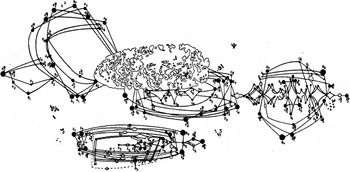
George Cacioppo's collection Piano Pieces contains the score for Cassiopeia (Figure 1), which became, in Mumma's estimation, an ‘immediate classic’ after its performance at the 1963 ONCE festival.Footnote 57 Cassiopeia’s score is a one-page chart of pitches, spatially configured in the form of a map connected by what Cacioppo describes in the performance notes as fields of intersecting sound paths. Each of the fields has a particular visual character to them, designed by the composer to elicit particular psychological reactions in the performer, who is given a series of suggestions as to how to best navigate the networks of pitches. Cacioppo described, in interview, the experience of performing this piece as seeing ‘a cloud go by, or a sunset’, that it gives one's eyes an opportunity to ‘roam about the score’.Footnote 58
George Cacioppo, Cassiopeia (BMI Canada, 1968). Used with permission from the Canadian Music Centre.

As a notational strategy, Cassiopeia emphasizes the interconnectedness of each pitch as well as their individuality as isolated sonic artefacts – in the same way that astrological constellations are aggregates of stars whose intensities are perceived in space by size and brightness, the intensities of sounds in the score are likewise fixed to specific pitches. Yet also as constellations are the arrangement of celestial bodies into an anthropomorphized imaginary, Cacioppo's Cassiopeia imbricates the performer's own visual fantasies as part of its indeterminate constitution – the score itself is no more a prescription for performance than an invitation to trace out a vision, along the manifold pathways that form its network of possibilities.
While there is limited space (and perhaps less need) to adumbrate every composition published in Canavangard, Sydney Hodkinson's Armistice: A Truce for Dancers and Musicians warrants mention. Armistice was written for a performance on 11 November 1966 by the Ann Arbor Dance Theatre, but its combination of conceptual, graphic, and mixed-media elements evidence a close affinity to Kasemets's goals with the series.
Figure 2 shows the first page of the score for Armistice, outlining the first 180 seconds in the work over three systems of notation. In each, the range is indicated by H, M, L – high, medium, low – with specific pitches left up to the performers. In the work's notes, Hodkinson explains that a ‘somewhat ambiguous graphic situation will engage an educated performer's response, thereby leading to many “correct” interpretations of the work as both a visual and audible event’.Footnote 59 The point of Armistice, as Hodkinson writes, is to create a dynamic in which musicians and dancers are mutually supportive of each other in realizing the work in a unified way, through cooperative interaction: ‘The attempt is to further enhance and intensify the feasible composer-graphic implications – performers – SOUND-MOVEMENT – audience relationships.’ Premiered during the height of the Vietnam War, the work's topicality is evident in its title, yet Armistice invites a kind of medial integration that relies on performers’ dexterity in improvising and responding to kinetic and aural events as a symbolic gesture of reconciliation.
Excerpt from Armistice: A Truce for Musicians and Dancers (BMI Canada, 1967). Used with permission from the Canadian Music Centre.

Trigon, and the performer as co-composer
Trigon is Kasemets's major work from this period, and was performed at least sixteen times in various versions between 1964 and 1967 in Canada and the United States.Footnote 60 Described by the composer as a ‘many-dimensional work for a soloist, trio, nonet or twenty-seven-piece ensemble of instrumentalists and/or singers and or/dancers’, Trigon encapsulates the conceptual ethos of Canavangard in microcosm. Broadly stated, Trigon is organized by multiple layerings of aural, visual, or kinetic expressions of events which fall into tripartite divisions of high–medium–low, short–medium–long, quiet–medium–loud, and so on. Performers are given the option to generate their own parts using whatever kind of notation they choose based on the information given in the master score, after working with it for an extended period of time. What follows is an attempt to demonstrate how Trigon ‘works’, or does not always work, as a blueprint for performers to engage in the processes – haptic, tactile, experiential – of repairing the relationships between composer/performer/audience, for which Kasemets advocated in Canavangard.
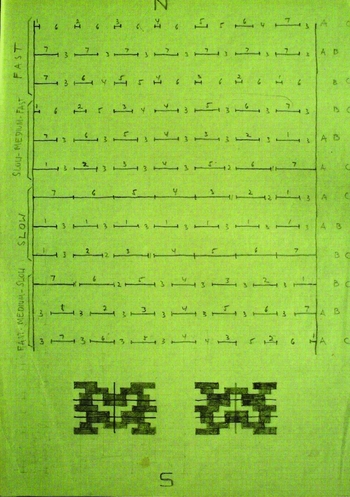
Kasemets began working on the score for Trigon in early 1963. Figure 3 shows initial pencil sketches of what would eventually become components of sequence, time, and event charts, discussed below.
Early sketch of Trigon event chart, found in Kasemets's 1963 day planner. Udo Kasemets, Archives Collection 11: B.2.8a. Courtesy of the University of Toronto Music Library. Used with permission from Susan Layard.

In the Foreword to Trigon, Kasemets writes that the order of appearance of each layer is simple, ‘almost classical in concept’: the events essentially progress from slow to fast, back to slow again; or quiet to loud, and back again; or low to high and low. He explains, that
However elementary and static the layout of the individual ‘layers’ may look, they all hold in themselves an immeasurable amount of latent intricacy and dynamism when one considers that their simultaneous appearance has been designed to occur in an infinite number of constellations, to be decided by the performer(s).Footnote 61
Further on in the Foreword, he continues:
Since the score consists of a number of separate charts which have to be co-ordinated by the performer(s), it is quite evident that only a very skilled player who has ‘lived’ with the score for a considerable amount of time and has virtually memorized the ingredients of it, may be in a position to perform directly from the score. Otherwise the performers have to prepare their own parts.Footnote 62
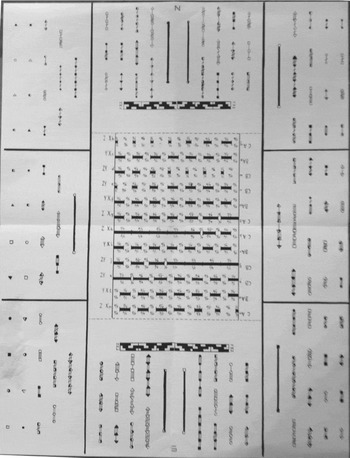
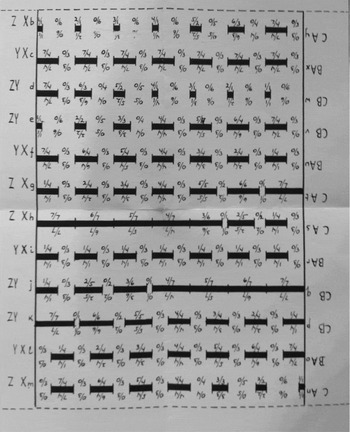
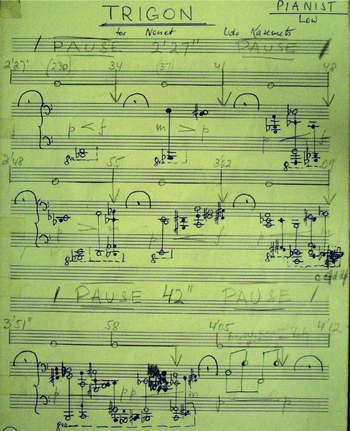
Figure 4 shows the score of Trigon.Footnote 63 Each of the separate layers (or charts) are arranged spatially on one large master sheet. There are four charts constituting the totality of the score, which performers are to effectively destroy in the process of working with the piece. The ‘time chart’ in the centre (also shown in Figure 5), dictates the duration and quantity of events to be played in prescribed durational intervals. For example, 3/7 indicates three events are to be executed within a frame of seven seconds; 0/3 indicates no events during three seconds, etc. Each horizontal row on the time scale has a sum durational total of 49 seconds, divided into seven units of executable actions. Black bars indicate the durational cells of such events, where white spaces equal rests, or non-action.
Score of Trigon (Toronto: BMI Canada, 1968). Used with permission from the Canadian Music Centre.

Time chart from Trigon (Toronto: BMI Canada, 1968). Used with permission from the Canadian Music Centre.

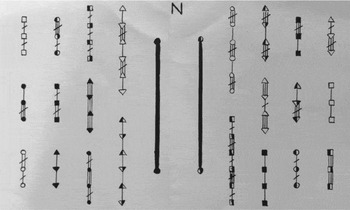
The ‘event chart’, shown in Figure 6, ‘provides intervallic, rhythmic, coloristic and instrumental-technical material of varying thickness and density for the realization’ of Trigon. The ‘note-heads’ in the event chart – round, square, and triangular – correspond to any three basic instrumental techniques, to be chosen by the performer, and are to be adhered to with as much consistency as possible. The event chart is divided into eight blocks which Kasemets has correlated to cardinal directions (north, east, south, west).Footnote 64
Event chart from Trigon (Toronto: BMI Canada, 1968). Used with permission from the Canadian Music Centre.

Figure 7 shows one of the ‘sequence charts’, which are meant to interact with the cardinal regions of the event chart. Each combination of ‘high–medium–low’ as it occurs along the sequence chart axis corresponds to specific event charts – either east or west, or north or south – with the performer given the freedom to choose material from each column or event box.
Sequence chart from Trigon (Toronto: BMI Canada, 1968). Used with permission from the Canadian Music Centre.

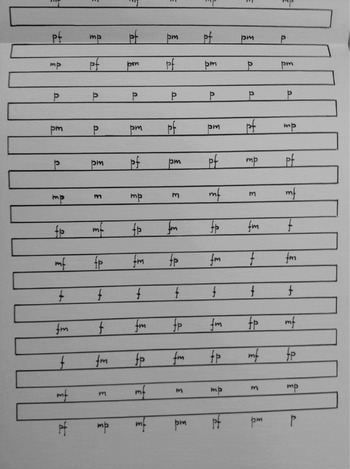
Figure 8 shows the volume chart – the fourth layer completing Trigon, which consists of twenty-four rectangles containing amplitude indications. Performers are instructed to cut out all rectangles, and insert them in the perforated lines above and below the time chart (also to be cut) so that corresponding volume indications line up with the Roman numeral and letter indications outside the time chart. In effect, to create a working template upon which musical (or visual, or kinetic) content may be generated, performers are required to destroy parts of the score itself.
Volume chart from Trigon (Toronto: BMI Canada, 1968). Used with permission from the Canadian Music Centre.

The rules, or more appropriately, the gamuts (to use Cagean phraseology) Kasemets set for a ‘faithful’ realization of Trigon posed substantial difficulties. Trigon was originally written for (and dedicated to) contrabassist Bertram Turetzky, who in the late 1950s was employed by the Hartford Symphony Orchestra. In 1959, his frustration with the restrictions of being an orchestral musician, and the limited opportunities for exploring new repertoire for the contrabass led him to start soliciting pieces from avant-garde composers in North America.Footnote 65 Turetzky told me that he was just beginning to marshal his interest in the avant-garde as a performer of the contrabass. Yet Trigon was more than Turetzky bargained for as a potential interpreter:
I was slowly moving toward getting interested in new music, improvisation. Before that, I played what was written. I didn't add anything. When I played baroque music, I studied performance practice and I would add the necessary ornaments that I felt would be appropriate. So, I must admit that I was a little perplexed at the first look at the score. So I think I wrote Udo or spoke to him. I said, ‘Gee . . . [I'm] not a composer’. He thought I was a composer who would, you know, make a realization with ease. So he made a realization for me, which I basically adhered to, with maybe a little change here, a little change there. But nothing radical. So we didn't enter into a partnership – let's see, how to say it . . . we ‘held hands’ and we did the piece together. But he did more in this case than I did.Footnote 66
Turetzky performed Trigon first in Toronto, at one of the Isaacs Gallery Mixed Media concerts in their inaugural season of 1965–66 at Avrom Isaacs's Yonge Street Gallery. Whether or not Turetzky performed it earlier, he could not recall with certainty, but mentioned that Kasemets and Catherine Hindson travelled to New York for a concert in the Donnell Library on West 53rd St in Manhattan to witness Turetzky perform it there.Footnote 67 Turetzky remarked that Kasemets ‘opened the door most of the way’ for him to actualize Trigon, and the piece was an early introduction for Turetzky to the challenges of interacting with graphically notated scores. Turetzky's role as a pioneer of developing a lexicon of extended techniques for the contrabass ostensibly arose from these early experimental years working and commissioning new repertoire by avant-garde composers.Footnote 68
Barney Childs had been working on preparing Trigon for performance as early as 1963 for a concert in the next year in New York City. Childs was having difficulty understanding certain aspects of the performance instructions, and eventually abandoned the piece. In a letter to Kasemets from December, Childs wrote, ‘Trigon is a helluva job to “realize” . . . I've been hacking away at it off and on for some time now and it just isn't going to be ready for 5 January's concert.’Footnote 69 Childs evidently went on to prepare it as a realization for solo oboe,Footnote 70 which likely was performed later that year in Tucson, where Childs was teaching.Footnote 71
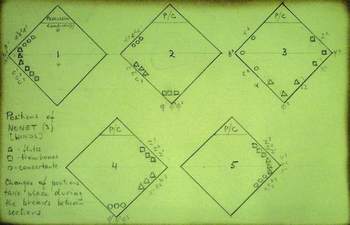
Even from the outset then, the practical problems that Trigon posed were substantial. By 1967 eleven separate realizations had been prepared for performance of the work, which ranged from solo voice to a full twenty-seven-piece ensemble. Kasemets had prepared nine of these himself; the other two by Childs and Turetzky. Trigon had become something of a staple in the Isaacs Gallery Mixed Media Ensemble's repertoire, and Kasemets toured various versions of the work, as well as supervising and realizing parts for different groups of interpreters. Figure 9 is taken from Kasemets's ambitious realization of Trigon for three nonets, which was performed at the ONCE Festival in Ann Arbor Michigan on 21 February 1965. By that year, the ONCE group had moved into staging larger, more theatrical performances, as the festival and seasonal programming became more popular and well attended.Footnote 72 In larger iterations of Trigon (such as this one), the positioning of performers conforms to the spatial qualities of the performance space, as Figure 9 demonstrates, with movement in and around the space and audience members.
Diagram indicating spatial arrangement of nonet 3 over the course of five cues. Udo Kasemets, Archives Collection 11: B.2.8f. Courtesy of the University of Toronto Music Library. Used with permission from Susan Layard.

Gordon Mumma recalled that Kasemets directed the ONCE Festival Orchestra for this performance, held in the local VFW (Veterans of Foreign Wars) Ballroom. In the Canavangard index of performances of Trigon, Kasemets notes that Mumma also performed as an instrumentalist, and the full ensemble required two other conductors (Robert Ashley and William Albright), presumably assigned to each of the nonets.Footnote 73 Due to the increasing scope of the performances, and also the growing audiences – 1965 was ONCE's ‘busiest season ever’Footnote 74 – larger performance venues were required. Mumma recounted that by 1964 appropriate spaces in Ann Arbor had become problematic, especially with the lack of any suitable civic auditorium or performance hall, a curious predicament given Ann Arbor's reputation as a ‘cultural oasis’ during the 1960s.Footnote 75 For the performance, Mumma remembered that individual performers often moved around by the walls at the perimeter.Footnote 76
‘An expression of our electronic age’: graphic notation as cool media
The most frequently realized version of Trigon was for nine players, performed by the Isaacs Gallery Mixed Media Ensemble in its various iterations and directed by Kasemets between 1965 and 1967. I would suggest that the Ensemble's nonet version, which combined spoken word, visual art, dance, and music, exemplified an idealized materialization of the work's potential as triangulated in the performance notes, the score itself, and the broader discourse informing Trigon and Canavangard. I want to focus on the first performance of Trigon as a way of illustrating how the piece might work as an experiment in deploying the theoretical abstractions of McLuhan and to focus my discussion of Canavangard as more than merely a project of polemics. In so doing I also consider Trigon, and graphic notational methods as they are used discursively in Canavangard as ‘cool media’: what McLuhan described as media requiring high levels of intersensory participation.
Composer John Beckwith recalled that he invited the Isaacs Gallery Mixed Media Ensemble to be included on the programme of the Ten Centuries Concerts 1965 season-opening performance, on 3 October at the Edward Johnson Building's Concert Hall. The programme was unusually diverse: the first half featured two ragas performed by P. Randeva (sarod) and Hem Ray (tabla), and two duo improvisations by guitarist Ed Bickert (who would later go on to a successful career in the Canadian jazz scene as a performer and teacher) and pianist Maury Kaye (misspelled Kay in the programme). Three works filled out the evening following the intermission: Kazuo Fukushima's Three Pieces from Chu-U for flute and piano; Barney Childs’s Music for Singer (commissioned by Kasemets in 1964, and eventually published as a Canavangard score in 1968); and, completing the program, Trigon.
The main text used for this performance was excerpted from McLuhan's Understanding Media, spoken by William Kilbourn, while other players were positioned variously throughout the hall. The Telegram’s Paul Ennis noted Catherine Hindson and Kilbourn were stationed at either end of a long gallery above the stage (presumably the organ loft in what is now Walter Hall), while Kasemets, Bruce Mather, and Paul Kilburn were clustered together at stage centre around a single piano. Dennis Burton and Graham Coughtry stood at easels at either end of the stage, and Gordon Rayner, also at an easel, just to the side of the piano. Jean-Guy Brault, on reeds, was dead centre, in front of the piano. Interestingly, and possibly as a last-minute addition, a tenth performer – an unnamed female model – also took part in the performance. Coughtry, Ralph Hicklin observed, ‘was permitted to destroy the magic number 9 [the number of performers allowed by Kasemets] by bringing in a model in white face and black union suit to posture against a blackboard, while he outlined her in chalk’.Footnote 77 He further writes, and here I quote him at length, that the event was ‘not for concert-goers who close their eyes and let the music penetrate their pores’:
No matter where you looked, you were conscious that you were missing some other musical event, spoken or blown or pounded or drawn. I found myself concertrating [sic] more and more on the painters, and expecially [sic] on Gordon Rayner, who had a position stage centre, and who was making music in a medium far more spectacular than any of his fellow musicians. On one side of a wooden stepladder he was building a composition with paint. As a hammerer, Rayner is a rythmic [sic] virtuoso, though the holding power of his hammering led to the composition's being something of a mobile; but that's how music is. Over in a dark corner, where I could not see well what he was creating, Dennis Burton was doing things to a sheet of plastic mounted on a frame. Towards the end of Trigon, the frame collapsed, and Burton sat down on a stool and smoked until the finale. I'm not sure whether the smoking would have been in Kasemets's time chart, or volume chart, or sequence chart, or event chart. It may have been a spur-of-the-moment improvisation by Burton.Footnote 78
Like each realization of Trigon, the October 1965 incarnation contains performance instructions unique to the players and their configuration. Kasemets used a system of colour coded and modified note heads which pointed each player towards a particular kind of action. For example, green note heads tell pianists to play a ‘normal’ attack, and to produce ‘conventional’ piano colour; red note heads to produce sounds on the strings, piano frame, additional percussion instruments, and so on; green note heads instruct painters (divided into high, medium, and low) to ‘paint only “what is in your head”’; blue notes, to listen to the sounds around you and ‘be influenced by them’, and red notes, to speak the given text (in their case, from ‘26 Statements re Duchamp’ by John Cage). Similar such instructions are given to speakers and to Brault (telling him which instrument to play – either flute, clarinet, or saxophone – and specific timbral and articulative attacks). Figures 10 and 11 detail excerpts from parts prepared for the concert, and Figure 12 shows the entire ensemble's trajectory through the first 49 seconds of the work.
Excerpt from Catherine Hindson's realized part of the 3 October 1965 performance of Trigon. Udo Kasemets, Archives Collection 11 : B.2.8e. Courtesy of the University of Toronto Music Library. Used with permission from Susan Layard.

Beginning of ‘low’ piano's realized part of the 3 October 1965 performance of Trigon. Udo Kasemets, Archives Collection 11 : B.2.8e. Courtesy of the University of Toronto Music Library. Used with permission from Susan Layard.

Ensemble chart (first page) of the 3 October 1965 performance of Trigon. Udo Kasemets, Archives Collection 11 : B.2.8e. Courtesy of the University of Toronto Music Library. Used with permission from Susan Layard.

Ennis, writing in The Telegram, called the piece
absorbing, involving. It is undeniably ‘cool’ in the Marshall McLuhan sense . . . McLuhan's ‘the medium is the message’ (that is, the spirit, the feeling, the ‘what is’ of a culture is better understood by the means of communication rather than by the substance of it) is central . . . That it does involve us in some measure of its quality; that it is unconventional is more the food for the controversy.Footnote 79
Cool, ‘in the Marshall McLuhan sense’ refers specifically to media which force their users to more actively engage with the technology in order to comprehend meaning through immersive participation. Cool media is low-grade, low-definition: a comic book, a seminar, television, speech. The amount of information given is minimal and fragmented, and the user (or, listener) has to fill in the missing data through sensory and cognitive processes. The opposite – ‘hot’ media – are high-definition, enhancing a single sense, requiring less effort, less participation: a lecture, a movie, a book, print typography and radio, according to McLuhan. This terminological dyad was originally generated from McLuhan's perception of jazz and popular music, and their transformations through the hot medium of radio.Footnote 80 Janine Marchessault notes that this theoretical move of quantifying various types of media into either hot or cool categories was one which McLuhan himself explored the least, and refrained from giving much nuance or definition. She usefully labels them as ‘discursive probes rather than empirical categories’,Footnote 81 and notes that McLuhan's use of hot and cool was consistently confusing, frustrating, and even crude.Footnote 82 But as a general tool for characterizing the ‘acoustic’ qualities of new media in the electronic age, the rhetorical quality of ‘cool’ is useful here for pointing to a movement towards immersiveness and involvement.Footnote 83
I would argue that Trigon exemplifies how Kasemets envisioned graphic and non-standard notation systems as a kind of cool media from a number of possible angles. It requires – and as a ‘composition’ may be defined by – a level of engagement from performers that shifts their roles into that of co-composers. Graphic notation as a technology describes an object whose material content is ostensibly missing, and needs to be realized or ‘filled in’ by its user. But recall, that thwarted by the score's complexities, Bertram Turetzky and Barney Childs found themselves ill-equipped to complete the compositional process asked of them. We may consider this conflict as a symptom of the inherent dialectical tensions endemic to the secondary orality expressed by Ong, wherein the embodied and systemic tactics of comprehension associated with typographic visuality reside at a deep level. Further, the parts themselves which performers used to execute the actions in Trigon may be considered indications that the process of moving beyond the typographic universe requires tools suited to the laws of its cosmology: performers still need notes to read; speakers still need words laid out in visual, alphabetic translations to communicate language.
Yet when we consider the processes involved in its realization, how its master score requires a prolonged and advanced tactile interaction by performers – often in collaboration with the composer, and ideally, total internalization – the decoding and deciphering of its material amounts to what McLuhan was describing as the electric age. As a visual medium, the score resists the systematized and prescriptive strategies of interpretation developed by so-called typographic musicians. This particular performance of Trigon from October 1965, as evidenced in part by the reviews quoted above, accentuates a disavowal of lineality and perceptual distance in the simultaneous, overlapping, and competing actions of performers. The resulting confusion approximates McLuhan's acoustic space, where single focal points are purposely obscured in favour of projecting multiple sensory stimuli in the guise of speech, dance, painting, and music. The October 1965 concert of Trigon might be seen as one instantiation of Canavangard's discursive propositions, which may be to varying degrees of success applied to the works by composers Kasemets chose in curating the series. This concert is also unique for one other reason: McLuhan was there to witness his ideas being tested in the kiln of performance. The following day, he telegrammed Kasemets to thank him for the performance.
In the same way that McLuhan viewed media as content, exemplified by the expression ‘the medium is the message’, Kasemets saw graphic and non-normative systems of musical visual communication as technologies having radical potential to reconfigure music's ontological framework of composer–performer–listener by forcefully engendering a dialogical process involving all three ‘classes’ of musical participants. Composition, then, occurs as much in the mind of the listener as it does during any other moment in the creative process. As Brian Eno eloquently observes, this is one of experimental music's legacies: music becomes ‘a process of apprehending that we, as listeners, could choose to conduct. It moved the site of music from “out there” to “in here.” . . . Experimental music is something your mind does.’Footnote 84 Trigon is not unique in this regard, of course: Cage's 4′33″ had already addressed this tripartite ontology of music in its foregrounding of the creative agency of listening. Fred Turner, in a reading of Cage, happenings, and the emergence of multimedia environments, refers to the ‘democratic surround’ afforded by post-war developments in communication. Where McLuhan augured of the global retribalization of human culture thanks to electronic media, Turner observes that these environments could be seen as spaces not only of unity, but also of tolerance, egalitarianism, and individuality. For Turner, Cage's path to indeterminacy was one towards democracy. Cage's music offered spaces where a ‘diversity of sounds might live in a unified form’, and in a summation of 4′33″ that some musicians might challenge, Turner suggests that the tensions between composer, performer, and listener (as well as between sound and music) ‘had dissolved’.Footnote 85
But Trigon became an effective way for Kasemets to communicate these broader claims of experimentalism to a particular listenership in a particular – and uniquely Canadian, as he believed – cultural moment.
Canavangard and Canada – a centre without margins
Kasemets had even more ambitious goals with the Canavangard project beyond remediating the relationships between composers, performers, and listeners. Commenting in the catalogue's Afterword on Canada's lack of ‘cultural unity’,Footnote 86 Kasemets locates the work done under the Canavangard umbrella in a wider landscape of post-war cultural politics. As a country of ‘isolated cultural hamlets’, he writes that Canada was ‘never able to develop anything even remotely resembling a national musical tradition’.Footnote 87 Where narratives about cultural nationalism in the 1960s lament such coherence, Kasemets sees this as a ‘blessing’ when ‘older nations are fighting hard to shed parochial prejudices in order to become world citizens’.Footnote 88 Expo ’67 (held during Canada's centennial year) was a chance for Canada to reflect on its emergence as a new force in cultural cosmopolitanism, and music – especially newly composed works by Canadian modernists – played a significant role at Expo: including the several commissions included in Canavangard, more than 130 new compositions (including operas, ballets, and orchestral pieces) were created for centennial celebrations.Footnote 89 Yet paradoxically, nationalist rhetoric surrounding Canadian composition during the 1960s emanated most strongly from cultural arbiters like Keith MacMillan of the Canadian Music Centre, who later suggested composers ‘ought to be made to write Canadian’.Footnote 90 Others, such as broadcaster Hugh Davidson of the Canadian Broadcasting Corporation, advocated legislating cultural nationalism in music, lest ‘we return to our old habits of having it dominated by foreigners’.Footnote 91
As Jody Berland writes, Canadian cultural policy as exemplified in the Massey Commission and its predecessors – 1929’s Aird Commission on public broadcasting and the 1936 Canadian Broadcasting Act – has been defined largely within a vision of nationalism that favours state intervention in protecting and maintaining unity through culture. Moreover, this sphere of culture itself constitutes a fragile space ‘in which an entity already self-defined as Other – defined negatively, without known quantities – could speak’.Footnote 92 The Massey Commission succeeded in defining post-war Canada as a dynamic configuration of thriving regional and local cultures in spite of the double threat offered by both commercial media (which the commissioners envisioned as the embodiment of American influence) and the unbridgeable geographies isolating the pockets of culture across the nation. Berland suggests that cultural policy in Canada has been ‘founded on the assumption that building national, publicly owned cultural and media infrastructures dedicated to presenting alternatives to American mass media would guarantee an expansion of a creative, commercially unimpeded cultural space and public sphere’.Footnote 93
What remains important to consider is that post-war Canadian culture was formulated principally within a paradigm of space, where the vectors of centre and margin become materialized as both rhetorical and physical quantities. Berland has commented extensively and authoritatively on the spaces of Canadian culture that communications technologies have created, taking up the ideas presented by the political economist Harold A. Innis. In Empire and Communication (1950) and The Bias of Communication (1951) Innis argued, through a broad historical survey of ancient civilizations, that the rise and fall of empires could be assessed according to the conditions set by their communications networks. Innis was among the earliest thinkers to draw correlations between culture and communication, and to illustrate how media presume biases towards either time, or space, or a combination of both.
Canada's fortification and expansion of its communications and infrastructural networks in the post-war period accelerated flows of cultural capital from urban metropolitan centres outward to more remote places within the nation: radio and television towers accompanied the mining and development projects northward and westward. In an early essay, Innis outlines his ‘staples thesis’ of economic nationalism, suggesting that the dominance of territorial space which newspapers and radio exercise is the natural extension of primary industries such as pulp and paper. He notes that ‘Improved communication such as the press and the radio, improved transportation, and the development of modern architecture, for example, the skyscraper, tend to stress similarities of language and ideas.’Footnote 94
Berland's work on space in communications and cultural theory is indebted to Innis, but also remains valuable for contemporizing the outlook and methodological shortcomings of Innis, who, as Sterne reminds us, belonged to a past generation of thinkers. Berland suggests that the notion of ‘margin’ in postmodern scholarship had become a ‘metaphorical rather than spatial term’.Footnote 95 Innis's contributions to cultural theory in this regard are the ways in which he anticipated cultural and postmodern theory through a materialist reading of postcolonial spaces. She writes:
[Innis] describes a materially and ontologically based relationship between space and time which requires a fundamental reconceptualization of space itself. He conceives topographical space as produced space, and shows that the production of space and the production of social life form one process. Space is neither an inhabited frontier nor a backdrop for history, but the very subject and matter of historical change. Communications technologies mediate the social relations of a particular society by setting the limits and boundaries within which power and knowledge operate.Footnote 96
For Innis, the notion of marginal space was at the heart of Canadian identity in both its topographical and its rhetorical connotations. Where the Massey Report overwhelmingly emphasized Canada's marginality in relationship to the centres of power, commerce, and influence emanating northward from the United States, Innis also imagined Canada in its early history as a peripheral dominion space within Britain's imperial purview. Yet within the nation itself, we can map onto Canada's territoriality the consolidation of centres and their margins in the post-war as both physical and metaphorical, and the acceleration of cultural activity within those centres reflected the imbalance of power embedded within those relations.
Canavangard attests to the international networks of exchange occurring at local levels between Canadian cultural producers and their international collaborators, and offers an exit from the inward and circular discourse of cultural identity by instead emphasizing the unusual cosmopolitanism of post-war Canadian music activity. By including his Ann Arbor associates from ONCE – Mumma, Lucier, Cacioppo, Childs – as part of what he calls a ‘truly 20th century culture’, Kasemets makes an oblique manoeuvre that rejects the hollow sloganeering about ‘writing Canadian’, at the same time acknowledging the rhizomatic border-crossing movements of Canadian and American avant-garde composers, exemplified in no small part by Kasemets himself.
Kasemets's vision for Canadian culture in the late 1960s, if we permit Canavangard to be considered as a vehicle or expressing such a vision, conformed to McLuhan's technological utopia of the global village. As we have seen, the global village's spatial profile is ‘acoustic’, and immersive – a centre without margins, in McLuhan's way of putting it. But Canavangard disappeared with the 1960s, for reasons as banal as they were reflective of any change in the prevailing currents of avant-garde practice at decade's end. BMIC relinquished its publishing interests in the early 1970s to Berandol Music, which effectively became a ‘holding company’ for all the Canadian scores it acquired,Footnote 97 and with Ronald R. Napier's support and political influence removed from the picture, Canavangard as a publication enterprise ground to a halt. For all of Kasemets's ‘DIY’ aspirations to remove the publisher as middleman from the chain of communication, Canavangard's fate was, in the end, ultimately determined by the vagaries of the music publishing industry. Beckwith recalls that
In the sixties, BMI certainly was a lively place. You could imagine that you were doing something that if it wasn't too big and too complicated, BMI would've produced it . . . Udo could show that there were composers in Canada and the States who were doing interesting things in musical notation, and he got the enterprise started. Even in the 70s you couldn't have done that . . . Berandol didn't have nearly the same interest or impact.Footnote 98
Kasemets's preliminary sketches for the project also included a periodical series called FOCUS (the first issue of which, ‘FOCUS on Musicecology’, was published in 1970 just before the switch to Berandol) which would elaborate on the scope and contents of the Canavangard catalogue, and include LP recordings of works featured in each issue, but these never materialized. Perhaps by the 1970s, however, Kasemets's experimentalist practice no longer resonated with the same urgency and immediacy as it did during the electric arc of the mid-1960s. McLuhan's intellectual influence had likewise waned, and would continue to diminish steadily, and in many respects the ideological undergirding of Canavangard today seems decidedly less than sturdy. Even at the time, not everyone was convinced of Kasemets's entrepreneurial ability to re-shape the constitution of sensory and subjective experience through experiments with notation, music, and the mixing of media. Jackson House was in the theatre at the Edward Johnson Building on 3 October 1965, and did not buy it: the next day, in the Toronto Daily Star, he reported that Trigon was
vaguely amusing for about the first five minutes . . . but the fun grew thin very rapidly. If this is the direction the modern concert hall is travelling, I for one want no part of it. I agree that music must change, but if the changes mean that we are to be treated to ideas that fail to stimulate either negatively or positively, then the future of music is bleak indeed. Mr. Kasemets, you're on the wrong road.Footnote 99
Such dismissive reception to Kasemets's projects was commonplace, and many critics regularly took the opportunity to excoriate him in print, and to delegitimize experimentalism at large as a fraudulent cultural pursuit.
Significant incongruences emerge in reconciling Kasemets's interpretation of McLuhan, such as the analogous role that graphic-alternative notation seems to occupy in place of electronic media. But as a new musical technology, Kasemets believed that abandoning standard notation would have extraordinary ramifications for musical practice going forward in the twentieth century, similar to how McLuhan saw the messianic power of electronic media to destabilize the typographic universe. Canavangard, as much more than a short-lived publication series of graphic scores, maps the convergences of music, culture, and technology which intersected in such particular ways, and offers an account of the physical, disciplinary, and aesthetic border-crossing that shaped Canadian experimental music during the 1960s.