Introduction
Animal silks, such as spider dragline silks, feature superior toughness, with toughness values that are several times that of steel and Kevlar fibers.Reference Ling, Kaplan and Buehler1–Reference Yarger, Cherry and van der Vaart3 Carbon nanomaterials (CNMs) such as graphene oxide (GO), graphene, and carbon nanotubes (CNTs), by contrast, are the strongest materials ever tested. For example, graphene has a tensile strength of 130.5 GPa and a Young’s modulus of 1 TPa,Reference Lee, Wei, Kysar and Hone4 which is 200 times stronger than steel. Silk materials, especially silk fibroin (SF), derived from mulberry Bombyx mori silkworm cocoons, are often integrated with CNMs to construct mechanically enhanced materials. Applications for these SF/CNM nanocomposites have also expanded, from structural materials to high-tech fields, such as biomedicine, ultrafiltration membranes, environmentally adaptive materials, as well as electronic and optical devices.Reference Kenry, Yeo and Lim5
As with biological nanocomposites such as diatoms, seashells, and bone, the macroscopic mechanical properties of SF/CNM nanocomposites are governed by the size, shape, structure, and arrangement of the “building blocks” (the repetitive units that constitute the superior structure, such as basic crystal units and nanofibrils). However, there is growing evidence that the mechanical behavior of these composite materials is largely modulated by the interfacial interactions, even though they comprise a very small volume fraction in the materials.Reference Barthelat, Yin and Buehler6 For example, weak interfaces typically induce nonlinear deformations and deflect cracks in materials into configurations in which propagation is more difficult.Reference Zhang, Ye, Zheng, Zhong, Tang, Fan, Buehler, Ling and Kaplan7 Gradient interfaces usually channel programmed deformation of materials to adapt to environmental (e.g., humidity and temperature) changes.Reference Ling, Jin, Qin, Li, Zheng, Zhao, Wang, Kaplan and Buehler8
The regulation of interactions between SF and CNMs provides a rational route to tailor the mechanics of the materials to fulfill task-specific needs without involving additional components for mechanical enhancement. Different applications of the materials often require distinct mechanical properties. For instance, soft regenerated engineered tissues (e.g., artificial skin and ligamentsReference Ling, Zhang, Kaplan, Omenetto, Buehler and Qin9,Reference Sherman, Yang and Meyers10 ) and wearable electronics (e.g., electronic skins and sensorsReference Seo, Kim, Kim, Choi and Lee11) usually require SF/CNM nanocomposites that are mechanically compatible with biological tissues, with low modulus, good flexibility, and stretchability. In contrast, in some hard regenerated engineered tissues (e.g., bones and teethReference Barthelat, Yin and Buehler6,Reference Espinosa, Rim, Barthelat and Buehler12 ) and biosensor systems (e.g., diagnostic and biochemical sensorsReference Liu, Dong and Chen13), the SF/CNM nanocomposites are required to exhibit high strength and high structural stability.
This article provides a summary of structure–mechanics relationships in SF/CNM nanocomposites, including SF/GO, SF/graphene, and SF/CNT systems. We mainly focus on the effects of interactions between SF and CNMs on mechanical properties of the composite materials. We demonstrate the challenges involved in developing these materials and provide directions for future designs of mechanically enhanced SF/CNM nanocomposites.
SF/GO nanocomposites
GO is most commonly used to integrate with SF due to its good water dispersibility characteristics.Reference Huang, Li, Yuan and Shi14–Reference Wang, Ma, Hu, Kim, Fang, Shao and Tsukruk16 In such systems, GO has epoxy and hydroxyl groups on the graphene basal plane and carboxylic groups along the edges. SF can be simplified to a high molecular weight amphiphilic copolymer that contains alternate hydrophobic and hydrophilic blocks or domains.Reference Ling, Qi, Knight, Shao and Chen17–Reference Zheng and Ling19 The hydrophobic blocks consist of highly repetitive “glycine-alanine-glycine-alanine-serine” motifs that form anisotropic β-sheet nanocrystals, while the hydrophilic blocks do not contain repetitive sequences.Reference Jin and Kaplan18
Several strong interactions, including hydrogen bonding, polar–polar, and hydrophobic–hydrophobic interactions, appear at the interfaces of the nanocomposites.Reference Huang, Li, Yuan and Shi14,Reference Zhang, Zhang, Shao and Hu15,Reference Hu, Gupta, Kulkarni and Tsukruk20–Reference Ling, Li, Adamcik, Wang, Shao, Chen and Mezzenga22 These interactions at the chemical bond and molecular scale provide the driving force to trigger the conformation transitions of SF from random coil or helix into β-sheet structures, which plays a critical role as a physical cross-linker for interlocking of SF chains and further enhancing the strength and toughness of the materials.Reference Ling, Zhang, Kaplan, Omenetto, Buehler and Qin9 These multiscale synergistic effects facilitate the combination between SF and GO at the macroscale.Reference Hu, Gupta, Kulkarni and Tsukruk20
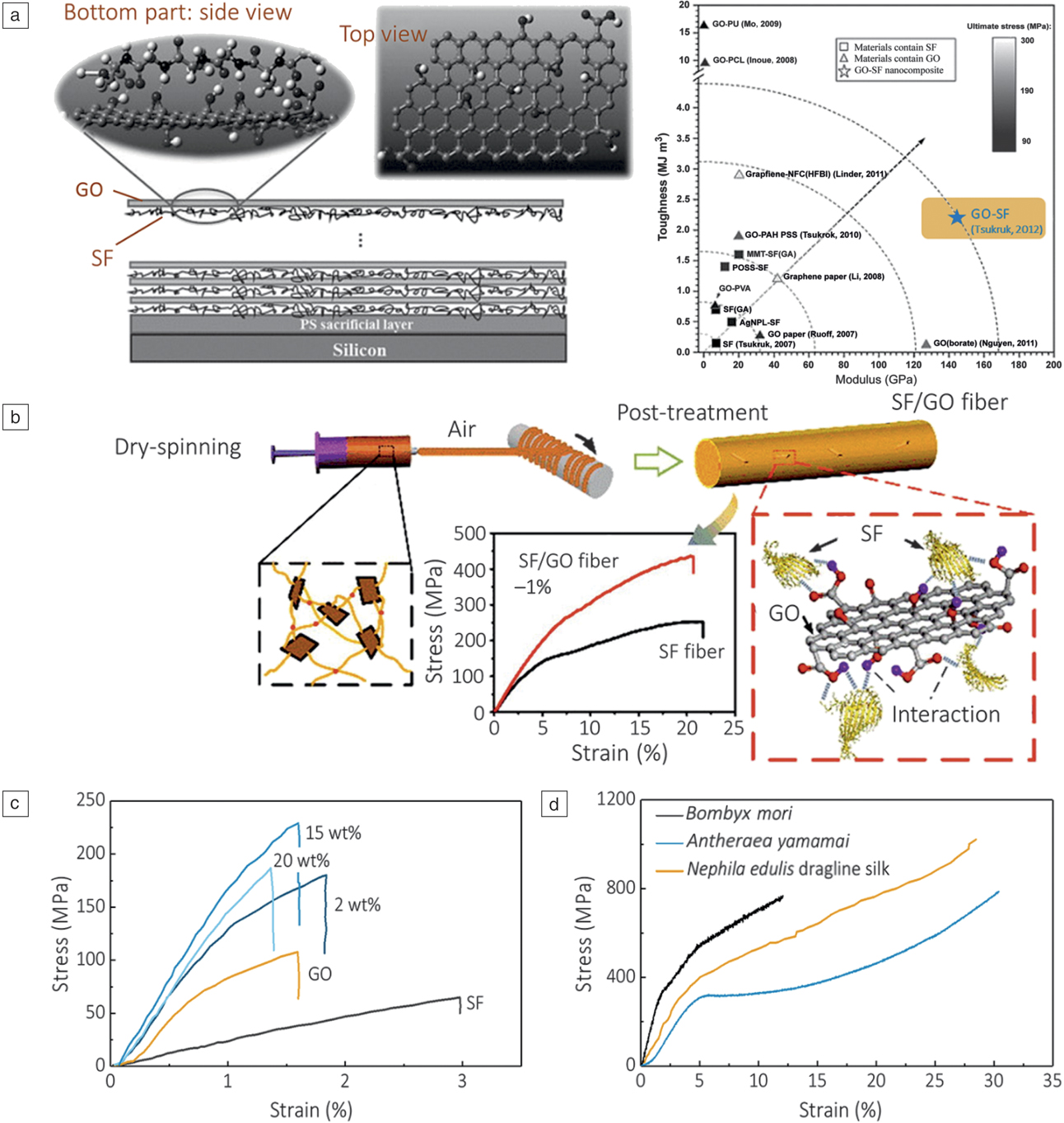
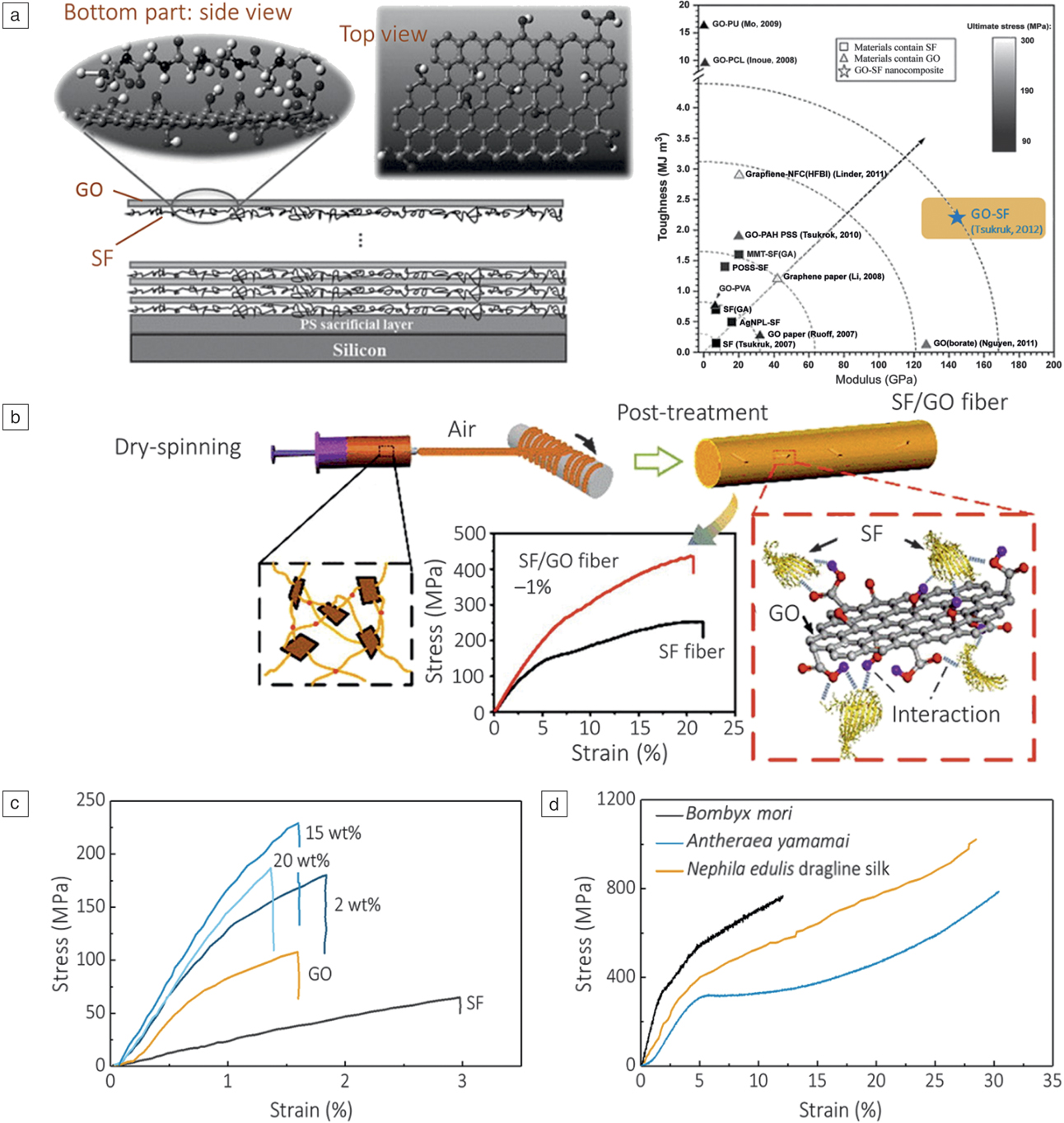
Most SF/GO materials, such as membranes (Figure 1a) and dry-spun fibers (Figure 1b), have demonstrated enhanced mechanical performance compared with their individual counterparts. Thus, SF/GO composites were typically stiffer than pure SF materials and tougher than GO materials (Figure1c–d and Table SI). For example, SF/GO membranes assembled by spin-assisted layer-by-layer techniques had a tensile modulus of 145–170 GPa and ultimate strength of more than 300 MPa (Figure 1a and Table SI).Reference Hu, Gupta, Kulkarni and Tsukruk20 In particular, the modulus of such a system was by far the highest value that has been reached in SF nanocomposites. The success of this SF/GO system in terms of mechanical performance was attributed to the dense network-like noncovalent interactions between SF and GO, facilitating the formation of molecular interphase zones to increase the reinforcing effect.
(a) Schematic (left) and mechanical performance (right) of silk fibroin/graphene oxide (SF/GO) membranes fabricated from a spin-assisted layer-by-layer technique. Reprinted with permission from Reference Reference Hu, Gupta, Kulkarni and Tsukruk20. © 2013 Wiley. (b) Schematic and mechanical performance of SF/GO fiber spun by a dry-spinning technique. Reprinted with permission from Reference Reference Zhang, Zhang, Shao and Hu15. © 2016 American Chemical Society. (c) Typical stress–strain curves of GO, SF, and SF/GO composite films with different SF content. Adapted with permission from Reference Reference Huang, Li, Yuan and Shi14. © 2013 Royal Society of Chemistry. (d) Typical stress–strain curves of Antheraea yamamai silk, Bombyx mori silk, and Nephila edulis dragline silk. Adapted with permission from Reference Reference Zhang, Ye, Zheng, Zhong, Tang, Fan, Buehler, Ling and Kaplan7. © 2018 American Chemical Society. Note: PS, polystyrene.
SF/CNT nanocomposites
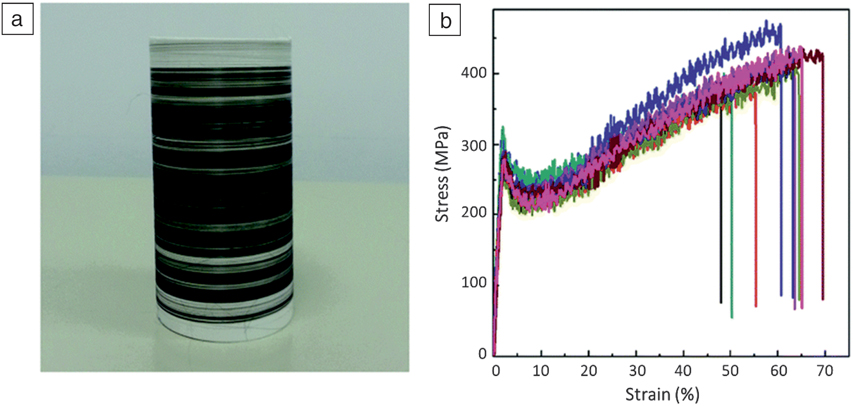
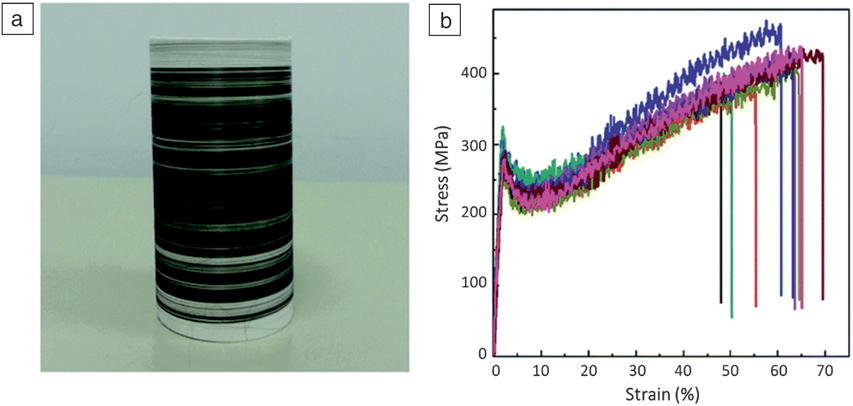
The combination of SF and CNTs is more challenging. CNTs tend to self-aggregate in water or other commonly used solvents, due to their strong π–π interactions, hydrophobicity, and chemical inertness.Reference Lee, Wei, Kysar and Hone4 Chemical modification (such as surface carboxylation) and introducing surfactants (such as sodium dodecyl sulfate) promote the stabilization of CNTs in SF aqueous solution.Reference Fang, Zheng, Yao, Chen, Tang, Zhong, Qi, Li, Shao and Chen23,Reference Zhou, Shao and Chen24 The addition of CNTs in SF aqueous spinning dope (concentrated regenerated silk fibroin solution) is favorable for the formation of β-sheet structures and a decrease in crystallite dimensions during wet-spinning, toughening the resultant composite fibers.Reference Fang, Zheng, Yao, Chen, Tang, Zhong, Qi, Li, Shao and Chen23 These SF/CNT fibers (Figure 2) exhibited a breaking energy beyond 130 MJ m–3, which is comparable to that of native spider dragline silk (160 MJ m–3).Reference Fang, Zheng, Yao, Chen, Tang, Zhong, Qi, Li, Shao and Chen23,Reference Zhou, Shao and Chen24 However, it has proven exceedingly difficult to uniformly blend CNTs with SF at a high volume fraction (e.g., a mass ratio of CNTs larger than 1%), because of the poor filler-matrix adhesion and strong nanosurface effects.Reference Fang, Zheng, Yao, Chen, Tang, Zhong, Qi, Li, Shao and Chen23 At higher filling fractions, the modified CNTs are still susceptible to agglomerate into clusters, which often serve as defect centers and result in material failure.
(a) Photograph and (b) stress–strain curves of silk fibroin/carbon nanotube fibers obtained by wet-spinning. Colors represent different samples. Reprinted with permission from Reference Reference Fang, Zheng, Yao, Chen, Tang, Zhong, Qi, Li, Shao and Chen23. © 2015 Royal Society of Chemistry.
Polymer-assisted stabilization is another route to increase the interfacial interaction between SF and CNTs.Reference Ling, Qin, Li, Huang, Kaplan and Buehler25 For example, isopropanol/polyvinyl alcohol-stabilized CNT suspensions have been employed to generate conductive silk/CNT nanocomposites.Reference Zhang, Ye, Zheng, Zhong, Tang, Fan, Buehler, Ling and Kaplan7 Although this polymer-stabilized SF/CNT suspension is unable to disperse in water, it is dispersible in hexafluoroisopropanol (HFIP), a solvent that can also dissolve SF. Using HFIP as a solvent, well-dispersed and highly stable SF/CNT suspensions with different desired mass ratios were produced and allowed to integrate with natural silk fibers through a dip-coating method. HFIP can selectively etch the surface of the silk fibers without destroying their internal structure.Reference Zhang, Ye, Zheng, Zhong, Tang, Fan, Buehler, Ling and Kaplan7 This approach, therefore, is suitable for the construction of conductive silk fibers where the native fiber mechanical features are maintained.
SF/graphene nanocomposites
The strategies used to produce the SF/CNT nanocomposites are applicable for SF/graphene systems as well, since graphene and CNTs have the same chemical structures. While graphene is a two-dimensional material, unlike the cylindrical nanostructure of CNTs, it is more inclined to self-aggregation,Reference Ling, Li, Adamcik, Wang, Shao, Chen and Mezzenga22 due to the much higher specific surface area of about 2600 m2 g–1. Pristine graphene is also a relatively brittle material and lacks toughness, which can be optimized by cooperative interactions with SF. Polymer-assisted stabilization methods, such as polylactide-co-glycolide stabilized graphene ink, have been employed to directly blend with SF in HFIP and formic acid/calcium chloride.Reference Ling, Wang, Zhang, Zhang, Mu, Kaplan and Buehler26 Using these methods, well-dispersed and highly stable SF/graphene suspensions were achieved, which were fabricated into fibers, membranes, and films through spinning, painting, or other methods. More significantly, the mechanical performance of these nanocomposites was tunable by modulating the interface between SF and graphene.
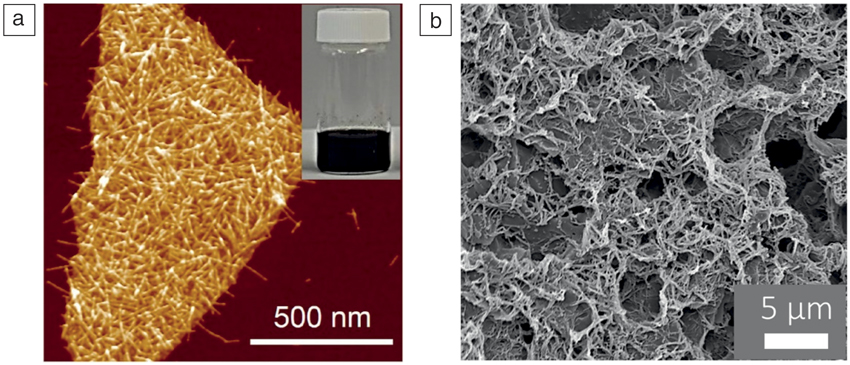
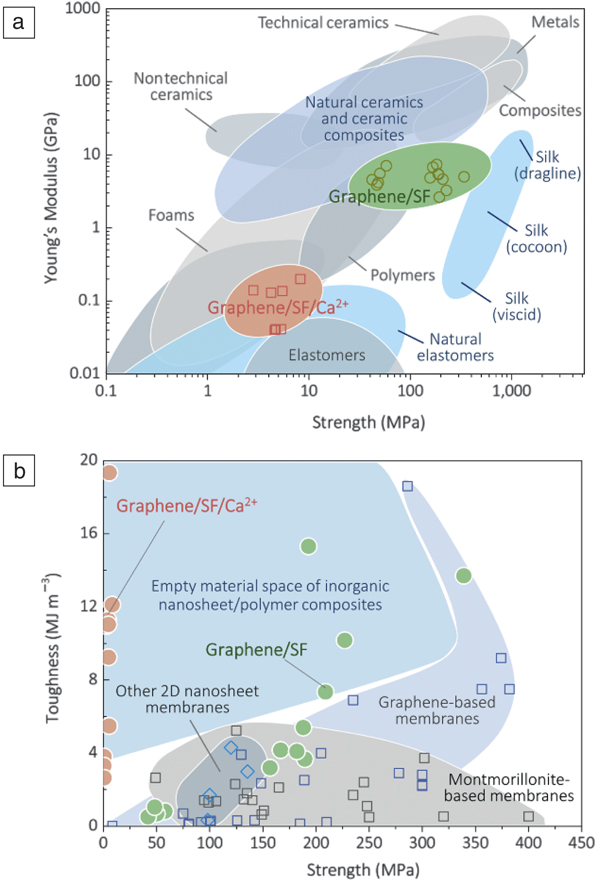
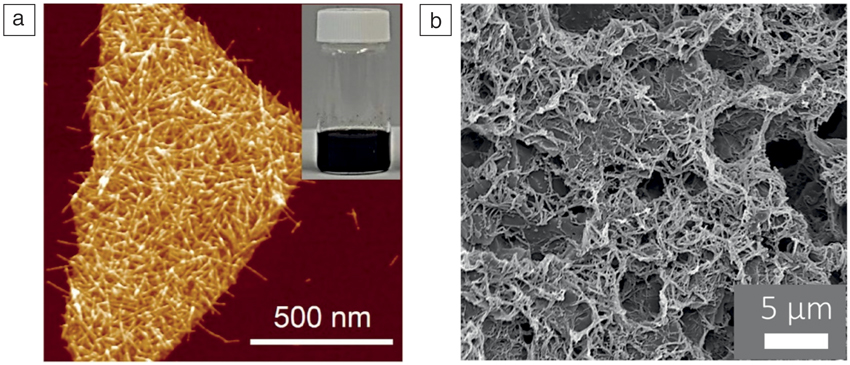
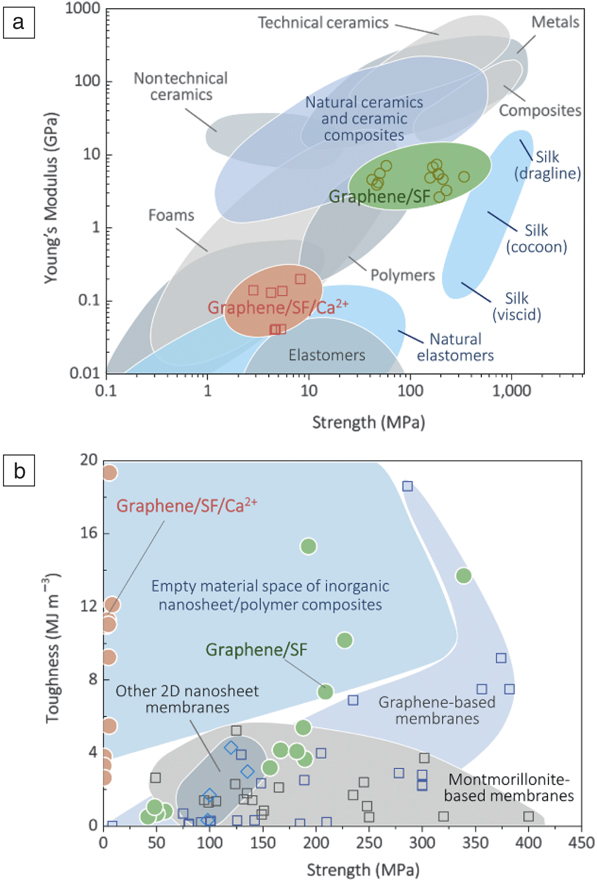
Because of the presence of hydrophobic interactions with nonpolar moieties of SF, graphene surfaces can adsorb SF monomers and oligomers, thus, promoting the formation of β-sheets and templating fibrillation.Reference Ling, Li, Adamcik, Wang, Shao, Chen and Mezzenga22,Reference Ling, Wang, Zhang, Zhang, Mu, Kaplan and Buehler26 For instance, β-sheet-rich nanofibrillar structures of SF have been detected in both SF/reduced GO/H2OReference Ling, Li, Adamcik, Wang, Shao, Chen and Mezzenga22 (Figure 3a) and SF/graphene/HFIP systemReference Ling, Wang, Zhang, Zhang, Mu, Kaplan and Buehler26 (Figure 3b). As a result, the materials prepared from these systems display a unique and attractive combination of stiffness, strength, and toughness, showing similar synergistic effects as those observed in SF/GO nanocomposites and in many biological materials (Figure 4a). The highest strength, modulus, and toughness achieved in these SF/graphene nanocomposites was 339 MPa, 7.4 GPa, and 15.3 MJ m–3 (Table SI), respectively, comparable with the highest values recently reported in other polymer nanocompositesReference Ling, Wang, Zhang, Zhang, Mu, Kaplan and Buehler26 (Figure 4b).
(a) Atomic force microscope image and photograph (inset) of silk fibroin (SF)/reduced graphide oxide (GO) hybrid prepared from SF/reduced GO/water suspension. Reprinted with permission from Reference Reference Ling, Li, Adamcik, Wang, Shao, Chen and Mezzenga22. © 2014 American Chemical Society. (b) Scanning electron microscope image of SF/graphene hybrid prepared from SF/graphene/ hexafluoroisopropanol suspension. Reprinted with permission from Reference Reference Ling, Wang, Zhang, Zhang, Mu, Kaplan and Buehler26. © 2018 Wiley.
(a) Comparison of the strength and stiffness (Young’s modulus) of graphene/silk fibroin (SF) and graphene/SF/Ca2+ materials with other natural and synthetic materials. Reprinted with permission from Reference Reference Ling, Wang, Zhang, Zhang, Mu, Kaplan and Buehler26. © 2018 Wiley. (b) Comparison of the strength and toughness of graphene/SF and graphene/SF/Ca2+ materials with other mechanically advantageous polymer nanocomposites. Reprinted with permission from Reference Reference Ling, Wang, Zhang, Zhang, Mu, Kaplan and Buehler26. © 2018 Wiley.
However, the inferior stretchability of these SF/graphene materials significantly hampers the potential applications in conformal materials, such as strain sensors and artificial electronic skins.Reference Seo, Kim, Kim, Choi and Lee11 Incorporating calcium ions into the SF layer has been shown to be an effective strategy to increase stretchability of SF/graphene nanocomposites.Reference Ling, Wang, Zhang, Zhang, Mu, Kaplan and Buehler26 Calcium ions can bond with SF via chelation and charge interactions,Reference Katz, Glusker, Beebe and Bock27,Reference Strynadka and James28 and can capture water molecules from the atmosphere through coordination; a calcium ion can coordinate six to eight water molecules via the oxygen atoms.Reference Ling, Zhang, Kaplan, Omenetto, Buehler and Qin9 Hence, the more calcium ions in the SF layer, the more water molecules, as plasticizers, can be captured, resulting in much softer and stretchable SF/graphene materials.Reference Ling, Wang, Zhang, Zhang, Mu, Kaplan and Buehler26
Challenges and opportunities
The direct regulation of the interfacial interactions in SF/CNM nanocomposites to generate materials with enhanced mechanical properties has been a focus in recent years. SF/CNM nanocomposites (e.g., membranes and fibers) can be fabricated in the micron to meter scales. However, maintaining the mechanical advantages of CNMs present at the nanoscale to the macroscale of SF/CNM nanocomposites remains a significant challenge.Reference Ji and Gao29,Reference Martin-Martinez, Jin, López Barreiro and Buehler30 SF/graphene membranes produced from SF/graphene/HFIP suspensions, for example, were around ∼400 times weaker in terms of strength than single graphene.Reference Ling, Wang, Zhang, Zhang, Mu, Kaplan and Buehler26 The same challenges and opportunities also exist in other SF-based nanocomposites. For instance, SF/silicaReference Guo, Li, Ling, Huang, Chen and Kaplan31 and SF/hydroxyapatiteReference Ling, Qin, Huang, Cao, Kaplan and Buehler32 materials are also weaker than nanoscale silica and hydroxyapatite alone.
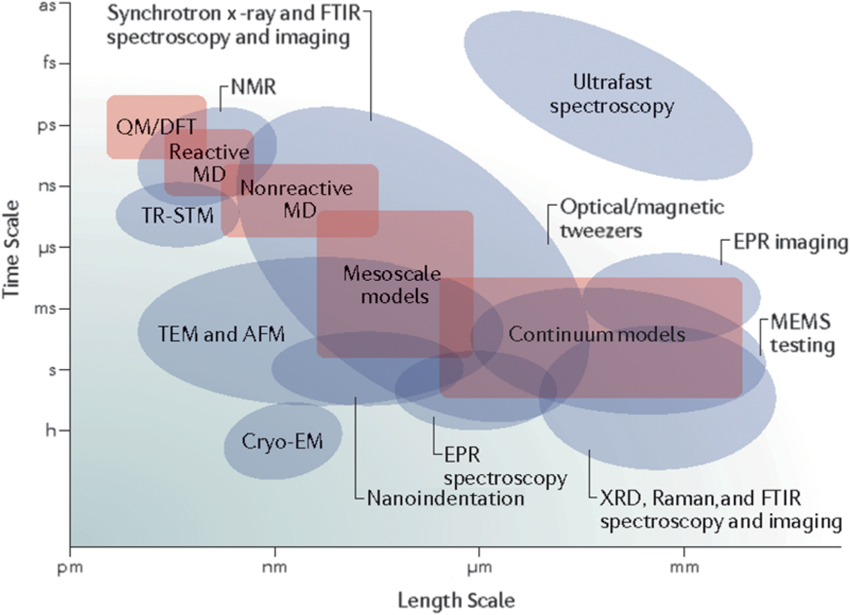
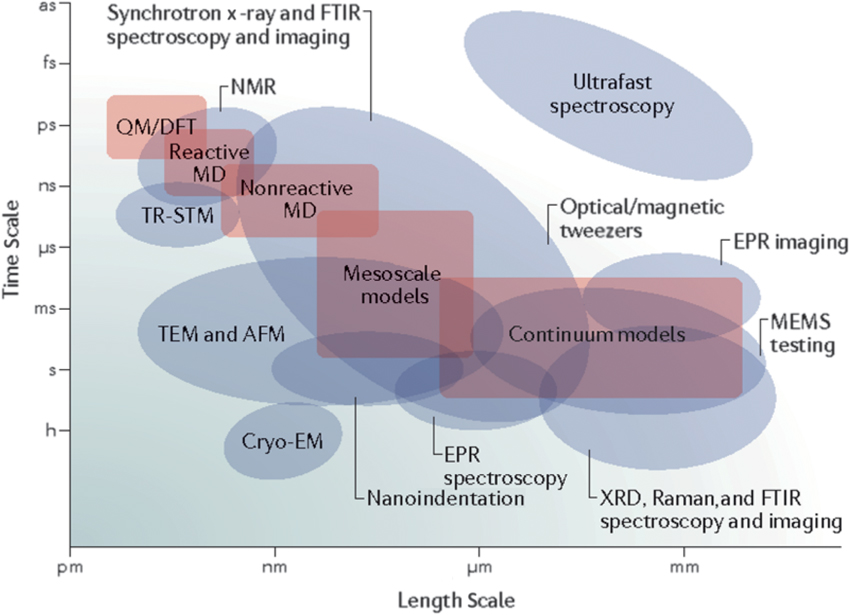
In this respect, materiomics is a useful guide toward SF-based nanocomposite designs. Materiomics is a methodology for analyzing and designing a material by examining the fundamental links of structure–process–property relationships through the combination of computational modeling with experimental characterization. This combination provides synergistic support to understand structure–mechanics interplay from the atomic scale to the macroscale (Figure 5); all SF-based nanocomposites are included in such regions. Therefore, the spatiotemporal hierarchies of the materials can be analyzed, leading to comprehensive knowledge of the complex interactions between these hierarchies.Reference Ling, Kaplan and Buehler1
Theoretical and experimental approaches for the rational design of silk fibroin/carbon nanomaterial nanocomposites. Reprinted with permission from Reference Reference Ling, Kaplan and Buehler1. © 2018 Springer. Note: FTIR, Fourier transform infrared; NMR, nuclear magnetic resonance; QM, quantum mechanics; DFT, density functional theory; MD, molecular dynamics; TR–STM, thermal radiation scanning tunneling microscopy; TEM, transmission electron microscopy; AFM, atomic force microscopy; MEMS, microelectromechanical systems; EPR, electron paramagnetic resonance; XRD, x-ray diffraction.
Recently, materiomics designs have emerged for the de novo design of SF-based nanocomposites (e.g., SF/hydroxyapatite water filtration membranes).Reference Ling, Qin, Huang, Cao, Kaplan and Buehler32 A lamellar nanoporous structure is useful for filtration membranes because this architecture enables increased water throughput, filter efficiency, and molecular loading capacity.Reference Ling, Qin, Huang, Cao, Kaplan and Buehler32,Reference Ling, Jin, Kaplan and Buehler33 However, significant challenges were encountered during the experimental preparation of these membranes. Comparative computational simulations revealed that silk nanofibrils and hydroxyapatite could form multilayer structures when the interactions between silk nanofibrils and mineral plates were weak. These “virtual” materials were indeed experimentally confirmed by using a mixture of silk nanofibrils and hydroxyapatite in the solution dope. These attempts suggest that materiomics methodologies allow for improved efficiency in the design of new materials with precisely defined structures and properties, particularly where interfacial interactions at hierarchical scales control material mechanics.
In addition, different types of silk fibers reveal different performance. For example, the mechanical properties of spider dragline silks are generally stronger and tougher than those of B. mori silk, due to their different microstructures and composition and distribution of amino acids (Figure 1d), which significantly impact the properties of composite materials. However, it remains a challenge to produce spider silk in large scale. More efforts are required to optimize the coordination among different candidate components to identify the balance between properties and production costs. Moreover, as with other biopolymer materials, the mechanical properties of the SF-based materials in the wet state are usually several to hundreds of times lower than that of the materials in the dry state.Reference Ling, Kaplan and Buehler1 Thus, the challenge is how to endow SF/CNM nanocomposites (e.g., SF/GO fibers) with the ability to resist water or moisture. The stabilization of SF against moisture uptake can be enhanced by coating with CNMs,Reference Zhang, Ye, Zheng, Zhong, Tang, Fan, Buehler, Ling and Kaplan7,Reference Ling, Qin, Li, Huang, Kaplan and Buehler25 while more accessible and durable approaches are still required.
Summary
In this article, we discussed the interplay of structure and mechanics in SF/CNM nanocomposites. The interactions between SF and CNMs on mechanics of the nanocomposites were highlighted. Several noncovalent interactions, such as hydrogen bonding, polar–polar, and hydrophobic–hydrophobic interactions, appear in SF/GO system, thus these nanocomposites typically present enhanced strength and toughness when compared to their individual counterparts. In contrast, owing to strong π–π interaction, hydrophobicity, and chemical inertness of graphene and CNTs, the fabrication of SF/graphene and SF/CNT nanocomposites is a greater challenge. Chemical modification, surfactant-assisted, and polymer-assisted dispersion are rational approaches to regulate the interfacial interactions between these components. The SF/CNM nanocomposites fabricated from these methods have displayed tunable mechanical performance from strong-and-tough to ultrahigh extensibility, promising for a wide range of high-tech applications such as in biosensors, strain sensors, e-skins, and e-textiles. In the future, a better understanding of the interplay of SF and CNMs will guide the design and fabrication of high-performance macroscopic nanocomposites with an optimized structure–property–function paradigm.
Acknowledgments
We acknowledge NIH (U01 EB014976) for support of this work. S.L. acknowledges the Shanghai Pujiang Program (18PJ1408600) and a starting grant from ShanghaiTech University for support of this work.

Jing Ren is a research assistant professor in the School of Physical Science and Technology at ShanghaiTech University, China. She received her BS degree in chemistry at Lanzhou University, China, in 2007, and her PhD degree in macromolecular chemistry and physics at Fudan University, China, in 2016. She was a postdoctoral associate at Xinhua Hospital, which is affiliated with Shanghai Jiaotong University School of Medicine, China. Her research focuses on the development of multifunctional fibers and fiber-shaped energy devices. Ren can be reached by email at renjing516@163.com.

Yawen Liu is a graduate student in the School of Physical Science and Technology at ShanghaiTech University, China. She received her BS degree in biological engineering from Shandong Agricultural University, China, in 2018. Her research focuses on the characterization of biomacromolecules and synthetic biomimetic materials for energy and environmental applications. Liu can be reached by email at liuyawen_0606@163.com.

David Kaplan is an Endowed Chair, and the Stern Family Professor of Engineering at Tufts University. He is a professor and chair of the Department of Biomedical Engineering and also holds faculty appointments in the School of Medicine, the School of Dental Medicine, Department of Chemistry, and the Department of Chemical and Biological Engineering. He directs the NIH P41 Tissue Engineering Resource Center that involves Tufts University and Columbia University, and is editor-in-chief for ACS Biomaterials Science and Engineering. Kaplan can be reached by email at David.Kaplan@tufts.edu.

Shengjie Ling is an assistant professor in the School of Physical Science and Technology at ShanghaiTech University, China. His research focuses on developing biopolymer functional materials through the integration of synchrotron-based characterization, computational modeling, and bioinspired and biomimetic fabrication. He obtained his BS degree from Zhejiang University of Technology, China, in 2009, and his PhD degree from Fudan University, China, in 2014. From 2012 to 2013, Ling was awarded the State Scholarship Fund of China to pursue his study at ETH Zürich, Switzerland, as a joint doctoral candidate. He was a postdoctoral associate at the Massachusetts Institute of Technology and Tufts University from 2014 to 2017. Ling can be reached by email at lingshj@shanghaitech.edu.cn.