Apolo Kivebulaya was a Ganda Christian, an evangelist to Toro and to Boga and an Anglican priest. He remains a beloved saint in the Anglican churches of Congo and Uganda. Without exception, he is described as a humble, unassuming man who owned few material possessions and who was willing to evangelize isolated places that other missionaries were reluctant to visit. Recent studies have emphasized the African connections made by African evangelists because they were able to create local, traditional, linguistic, and cultural links between the Gospel and their hearers. ApoloFootnote 2 might seem to be a prime candidate for such a study. Yet many aspects of his life and mission were closely associated with Europe. His very name shouts out this connection. Born Waswa, he chose the name “Apolo” at his baptism in 1894. “Kivebulaya” was given at about the same time. It means “the one from” (Kive) “Europe” (bulaaya). Footnote 3 An African clergyman so greatly respected during his life and revered in death for his missionary work who carries the moniker “one from Europe” might be said to indicate the pervasive power of the imperial endeavor and its colonization of the mind.
Apolo demonstrates the conundrum of interpreting the interface between African contexts and western Christianities at the point when Christianity was first introduced to much of sub-Saharan Africa. Briefly, some scholars have suggested that early African Christians were prey to European hegemonic influences presented by missionaries and colonialists who commandeered local languages and imposed a “pre-packaged” systematic Christianity complete with particular beliefs, practices, and structures, thus colonizing traditional religious identity.Footnote 4 Others have criticized this interpretative approach toward missionary action and African reaction because it appears to ignore or belittle the agency of Africans. They argue that in accepting missionary Christianity, Africans adapted it to their own situations, emphasizing aspects that appeared appropriate. Furthermore, they argue that Africans contested its meaning with missionaries, gained power from developing their own Christian discourse, and developed new social formations.Footnote 5 This essay, by examining to what exactly “Kivebulaya” refers, attempts to understand what influenced Apolo. It also examines how he may have been understood by those he converted. Thus the essay explores the cultural and religious choices made by one African missionary and the meanings with which they were imbued. I begin with a brief explanation of the historical context and an introduction to the sources on Apolo.
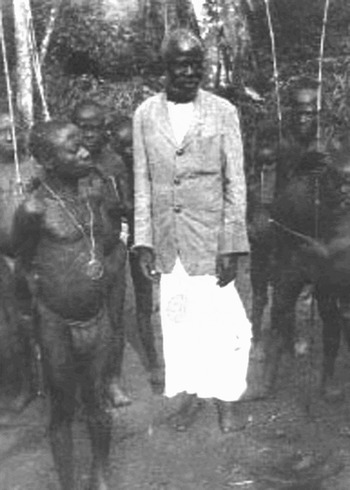
Apolo Kivebulaya with Mbuti Pygmies, c.1930, taken by A.T. Schofield.

I. Context and Sources
Ganda society underwent a period of acute social change during the latter half of the nineteenth century. Kabaka (King) Muteesa was open to new ideas and explored Islam until he became aware of Egypt's potential political threat. When H. M. Stanley visited Buganda in 1875, Muteesa welcomed contact with Europe and with Christianity. Stanley appealed for missionaries, and the Church Mission Society responded by sending a group who arrived at the kabaka's court in 1877. With relative speed they won a significant number of converts, as did the Muslims and the White Fathers of the Roman Catholic Church, who arrived in 1879. For these converts, “A new world was opening up, symbolized by the power of literacy.”Footnote 6 Muteesa attempted to return his kingdom to traditional Ganda forms of worship, but modern ideas had taken hold and the stage was set for the political differences among the Ganda to assume different religious identities.Footnote 7 During the reign of Muteesa's son, Mwanga, a series of civil wars began. Many Ganda took refuge in neighboring kingdoms and so further spread their new-found faiths. When the wars ended, the Anglican Church introduced by the CMS had gained a quasi-established position throughout Baganda, Toro, Ankole, and Buyoro. Its influence eventually spread to all regions in the area that became known as Uganda. The British Protectorate of Uganda was established in 1893.
For the CMS, the rapid conversion of the Ganda and their willingness to share Christianity with the Bunyoro, Toro, Ankole, and others was considered one of the greatest successes of the era. The CMS had been founded in London in 1799 as a voluntary lay society inspired by the evangelical revival to preach the Gospel to all nations. In the mid-nineteenth century, the CMS general secretary, Henry Venn, famously articulated the society's aim as the establishment of a self-governing, self-propagating, and self-financing “Native African Church” and the eventual “euthanasia” of missions.Footnote 8 This ideal was often honored in the breach, but it inspired members of the early Ugandan mission. Bishop Alfred Tucker, for example, recognized the extent to which Ugandans had adapted and owned the Christian faith in its Anglican form by ordaining the first clergy in 1891. Tucker prioritized the rapid establishment of a local clergy over an emphasis on lengthy theological training.Footnote 9 He maintained an emphasis on Ugandan leadership, despite some resistance from fellow missionaries, and expected significant local autonomy in the growing church.
Apolo Kivebulaya was a product of this expanding, confident, indigenous expression of Christian faith and its CMS influence. He was in the employ of the CMS from 1895 as a catechist and was ordained by Tucker in 1903. His work was directed, albeit at some distance, by CMS archdeacons and bishops, yet his own leadership qualities were recognized when he was installed as a canon of Namirembi Cathedral in 1910 and was made rural dean of Toro in 1927. British CMS personnel had neither Apolo's familiarity with African cultures nor his ability to travel. He is best known for his work in the Congo across the Semeliki plain from Toro. This area came under Belgian control in 1910, and it became difficult for British missionaries to visit the area. The CMS maintained an influence in the area through Apolo. He first visited Boga in 1896, although he did not live there for any sustained period of time until 1916 when he gave up a year's leave to attend to the Boga church. From 1921 he made a concerted effort to preach beyond the Hema of Boga to those with whom they had client relations. He formed relationships with some Mbuti pygmies, preaching to them and spending time in the Ituri forest with them. He continued evangelism, teaching, and translation when many of his peers had returned home to assume hereditary chieftancies. His commitment was understood by CMS missionaries as a fulfillment of the ideals of the missionary society of forming local churches.
There is a substantial body of primary sources on Apolo. Significantly for the researcher, he kept a diary. It starts in 1899, although the first years are written retrospectively, and charts his itinerant ministry until the year of his death. It records the long distances that Apolo traveled and the different peoples to whom he preached. Most of the entries are lists of places and people visited with the briefest descriptions of his preaching or other events. An example from events that took place on a safari from Kabarole at some time in 1901 illustrates the style:
In the a.m. we got up and went on to Kasuiga, we met together there with about 40 people and preached Jesus Christ is our Lord and that he wants them to believe on Him. In the a.m. we got up and went on to Ruhweza and met with 35 people. In the a.m. we left there and arrived at the house of Mutagwanda Kanyamino, we prayed by ourselves, we besought them to meet with us but they refused. We left there in the a.m. and went to Mubuku, we slept at [?] and met about 25 people. We preached to them Jesus, that he wants them to believe on him and as how he has prepared to give them all they need.Footnote 10
Having Apolo's own words on his work is invaluable, and the diary will be analyzed below. Little of the detail of Apolo's early life is known, although there are a few oblique references to it.Footnote 11 His name begins to appear in written sources from 1895 when he went to Toro. Many of the primary sources are from CMS administration and missionaries' private correspondence, although some letters from Ugandan friends and colleagues have also been preserved. There are also newspaper articles, an unpublished memoir by Bishop Balya, photographs, and a short film.
Early missionary comments on Apolo express a certain patronizing fondness for Apolo. They did not expect him to be an outstanding evangelist. His unassuming, slow manner was different from the confidence of many of his Ganda peers. It is stated several times that he lacked education and even “natural ability,”Footnote 12 that he was “simple.”Footnote 13 His work in the Boga area attracted great attention because of its apparent isolation and its proximity to pygmies and supposed cannibals. CMS missionaries began to praise his faithfulness and his commitment to the peoples of the Semeliki escarpment. A number of them were particularly struck by the affection with which he held the pygmies and his willingness to endure the hardship of forest living to bring them the Christian message. The manner of his death also provoked admiration. In 1933 Apolo was told in Kampala that he was terminally ill, and he decided to make the long journey back to Boga to die there. He requested that he be buried with his head facing west toward the forest he worked in rather than be buried in the customary position with his head pointing toward his Ganda homeland in the East. Such acts of symbolic dedication impressed British missionaries and Ugandan Christians alike, as the effusive eulogy in the otherwise dry minutes of the Native Anglican Church Council Standing Committee demonstrates. It stated that the church
has met with a crushing [loss]. To know him was to love him and those who knew him longest loved him most. He was the genuine apostle of the type of St Paul … he was emphatically one who has hazarded his life in the service of the Lord Jesus … His gentleness, his sympathy, the transparent sincerity of his life, and the domination of his will over his ageing body presented an outstanding example of the grace of God in a chosen vessel.Footnote 14
Apolo far exceeded early missionary expectations of him. He developed a role for himself in places isolated from the center of ecclesiastical or political authority. He appears to have engaged with peoples of other cultures, being particularly remembered for his evangelism of the pygmies, and to have been willing to face difficult circumstances.
From the 1920s, Apolo Kivebulaya was recognized by western missionaries as a significant figure in East African Christianity, as demonstrated by a relatively substantial corpus of secondary material about him in English, mainly in the form of missionary biographies written before and after his death in 1933. Most of these books are concerned with the latter half of Apolo's life and his work as a Christian evangelist and model of Christian missionary service. They are all written in a similar hagiographical tone with titles such as The Apostle to the Pygmies and Apolo the Pathfinder—Who Follows?Footnote 15 Apolo was a CMS success story: an African Christian who gave himself tirelessly for the furtherance of the Gospel, an example of courage and faithfulness to Christians in Britain. He was praised for his dedication to itinerant ministry in remote places among peoples feared by the Ganda. His successes in establishing churches and inspiring young men and women to become catechists are described with awe and pride. A number of biographies also appeared in Luganda, Runyoro, Swahili, and other languages of the region. The evangelicalism of CMS missionaries at this time had shifted to a more quietist approach. In the late nineteenth century, CMS missionaries had been actively engaged in the power struggles of the Ganda; they had admired the dedication and faith of the Ganda in public life. By the 1920s they were critical of the personal morality of Protestant Christians in public life and insisted on high standards for Ugandans assuming authority within the church. Apolo's asceticism, modesty, and faithfulness were exactly the qualities they admired. His life on the margins rather than at the center of influence made his biography less contentious to write. Here, it seemed, was a humble man uninterested in the machinations of power.
The last of the biographies was published 30 years after Apolo's death. Anne Luck's African Saint provides more historical background and attempts to read the other biographies critically. But, as with the others, there is an attempt to distance Apolo from his Ganda background by providing a clear-cut “before” and “after”—often, metaphorically, “darkness” and “light”—to the results of his Christian conversion. Archbishop of Uganda Leslie Brown wrote with great approbation in the forward to African Saint: “There is no trace in the records that after his conversion he was consciously influenced by an African world view or by the attitudes which his parents must have passed on to him.”Footnote 16 For Brown this confirmed Apolo's character as “apostolic” and “directed by the Holy Spirit.” Brown's suggestion is that one could not have an African worldview and exhibit characteristics of outstanding Christian leadership. Was this indeed the case with Apolo? The picture painted of Apolo “the-one-from-Europe” by his biographers seems to debunk the idea of African evangelists—or this particular one—making Christianity local and situational for his hearers. Missionaries like Leslie Brown saw a much more desirable aim, that of Apolo presenting a universal message that should not be localized. For those concerned that missionaries projected an imperialist agenda, it suggests that the consciousness of Apolo Kivebulaya was colonized and that he became an agent of colonization.
This latter interpretation might be borne out by comparisons of other studies on African Christians. Since the 1960s, Apolo Kivebulaya has fallen from public attention. There has been a greater appreciation of independent churches and their founders, like Apolo's contemporaries William Wade Harris in West Africa and Simon Kimbangu in western Congo. Apolo's approach was very different from theirs. He did not draw large crowds or influence an obviously different form of Christianity. He did not upset colonial authorities. On the contrary, although Apolo, as one of the few African church leaders in Congo, was watched carefully by the Belgian colonial authorities after Simon Kimbangu's brief ministry in 1921, nothing untoward was ever reported about him.Footnote 17 He remained a clergyman in the Anglican Church until he died. Dedicated to introducing an Anglican form of Christianity wherever he went, he appeared to comply with European ideals of African Christians and clergymen. Those interested in an African Christianity that appeared independent of western influence and confident in its African identity did not look to Apolo. More recently, African mainline churches have been studied and their “African-ness” acknowledged, but Apolo by name and by reputation appears too European for interest. Like the others, however, he made a particular response to new influences coming from Europe at a time when his own culture was in flux.
II. The Red Military Jacket
There are two references to the meaning of kivebulaya from CMS missionaries.Footnote 18 They say the name referred to the red military jacket Apolo wore. It could have come from serving in Captain Frederick Lugard's Imperial British East Africa CompanyFootnote 19 police patrol in 1891 or could be a guardsman's red dress tunic given by an English officer. They note that Apolo was particularly fond of this jacket and wore it most of the time.Footnote 20 CMS missionaries thought it endearing that in a life of self-sacrifice Apolo allowed himself the vanity of this jacket. For the missionaries, kivebulaya simply referred to a piece of clothing he habitually wore. The tag of “European” was not considered worthy of further comment.
So should we make any more of the nickname kivebulaya? Was it simply an amusing reference thought up in a moment of idleness? Luganda names were usually given with some thought to their meaning such as an event surrounding the birth, a family relationship, or a characteristic of the child as he or she grew up. Waswa, Apolo's first name, was given because he was one of twins. Before he became Apolo Kivebulaya, he seems to have had another name given to him for a short period: Omunubi, the Nubian. Once again, the name referred to clothes he wore. This time the clothes came from Sudanese soldiers with whom he may have been associated.Footnote 21 The verbal connection between an item of clothing and alliance with a particular group indicates the importance of clothes in the man's identity. In the words of Adrian Hastings, clothes are “a crucial part of consciousness, culture, and group identity.”Footnote 22 Following this argument, Apolo was declaring his identification with a particular group of people and a particular culture.
The clothes Apolo wore suggest a great deal about the alliances he made. These alliances were military and they were foreign, and ultimately and definingly they were European. We may suppose he was not called kivebulaya simply because he wore European things. Wearing European clothes was the outward and visible sign of an inward acceptance of European ways. He made European (and more particularly British) connections, had European friends and colleagues, learned European communication methods, followed a religion brought directly from Europe, and introduced these things to others. It is here that we may understand something of what might be signified by the red military jacket. In her introduction to the edited volume Religion, Dress and the Body, Linda Arthur notes that although clothes in a mission context can have a “constraining” role, clothes can also permit the assertion of a changed identity. They can be “used as a means of negotiating a new social environment.”Footnote 23 Apolo had to negotiate the changing Ganda culture. For over a decade there had been power struggles in the influential Buganda kingdom. Muslim, Christian, and traditionalist factions had fought for power. If we can speak of “old certainties,” they were, for many, eroded by the turmoil. Apolo was part of this militaristic culture and had, in his youth, fought on all these sides. In 1892, two years before he was baptized, the Christian faction split between Protestant and Catholics. The Protestants, with their British allies headed by Captain Frederick Lugard, gained the upper hand. Apolo found himself on this side. Apolo was involved in the political turmoil of the times and sought to make sense of the upheaval. Apolo Kivebulaya's Christian conversion came as a result of the turmoil and is to be understood in its context.
III. Representing Power
In the historical context, the military jacket did not simply have European cultural connotations. It had Ganda ones as well. Apolo's baptismal name provides a verbal reference to his association with modern Ganda society. It was common practice to assume a biblical name at baptism, thus clearly identifying oneself with the Christian faith. “Apolo” was a reference to the upright, hardworking Apollos in Acts 19,Footnote 24 but it was a nearer reference in time and space to the influential Anglican Katikiro (Chief Minister) Apolo Kagwa, who led the Protestant Christians and liaised with their British allies. Indeed, it could be supposed that even in wearing the jacket Apolo was attempting to associate himself with Apolo Kagwa. Photographs of the chief minister from the 1900s show him wearing a dark silk robe or joho over a white kanzu or full-length robe. In one,Footnote 25 two of the four men accompanying him are wearing short, dark, tailored jackets. Apolo Kivebulaya wore his jacket over a kanzu and in later life was photographed wearing a dark civilian jacket. He may have been attempting to follow the sartorial fashion for respected men among the political elite. By attiring himself thus, however, he was visually positioning himself with contemporary Protestant leaders.
It is difficult to escape the impression that Apolo's dress associated him with military victors, Ganda and British, both Protestant. Missionary Ruth Fisher said Apolo called himself “a soldier of Jesus” and was reluctant to remove his jacket for his ordination service.Footnote 26 Although he seems to have left his military past behind when he became an evangelist in 1895, turning to pacific, itinerant ministry, the military connections remained visible as a way of interpreting his Christian convictions in his historical context. Indeed, such connections are to be expected. J. D. Y. Peel in his work on the Yoruba explains that the decision to convert to Christianity arises from judgments made in the pre-Christian situation. Since these judgments “undergird the decision to convert, they are likely to continue as a substrate of the new beliefs and practices.”Footnote 27 Apolo could not leave his past behind him because his conversion had arisen from it. His past continued to inform his present.
In attempting to understand Apolo, the fact that he wore the kanzu should not be forgotten. To illustrate his point about the relationship between clothing and identity, Hastings says:
In Buganda the good Christian did not wear trousers, but a kanzu, just like a Muslim or a traditionalist. In nothing perhaps is the self-confidence of Ganda Christianity better expressed.… In most places from the early nineteenth century on an African Christian, a missionary, and a settler all dressed alike, in European style. … In Buganda this was not so.Footnote 28
The kanzu was probably introduced through trade with Arabs on the East Coast. By the late nineteenth century, it was common Ganda dress, and the wearing of bark cloth was on the wane. Interest in Apolo's jacket should not distract from the fact that Apolo dressed as all Ganda men dressed. There were, nevertheless, many other Christian Ganda who had also been caught up in these historical events but were not called “kivebulaya” because of the clothes they wore. Was Apolo more “from Europe” than others? Was he more wholeheartedly convinced of the usefulness of European things than others? Perhaps Apolo lacked the self-confident air of importance that was said to characterize many of his Ganda colleagues. Louise Pirouet has described the mixture of “genuine religious motivation, paternalistic beneficence and expansionism”Footnote 29 among Ganda catechists working beyond Buganda. They understood themselves to be natural rulers, and many became chiefs in later life. Apolo, however, was markedly different. He was unassuming and quiet, less educated than many and less well-connected. Ironically, he felt, perhaps, that the European military jacket made a statement, not clear by his poverty, that he was associated with the powerful in a rapidly changing society and that he brought new and better things.
Visual symbols and verbal associations rooted Apolo's evangelism in troubled times. They also associated it with the material trappings of the victors. He must have cut a striking figure in his white kanzu and red jacket over top when the majority of those he worked among wore bark cloth or similar materials. He represented two forms of power, both potentially predatory: Ganda and British. All the evidence suggests that Apolo did not particularly distinguish between spiritual and political influence and was proud to associate himself with military power. In order that he could carry out his unassuming, gentle ministry, his clothing—and thus his name—made a statement about temporal power and influence. The outward appearance of Apolo “from Europe” heralded the arrival of new influences in distant places. Wearing a military jacket, he preached the Christian Gospel and offered people new skills and new objects that he associated with political victory, social security, and eternal life; this package was understood to have come most directly from Europe. Other objects that Apolo used in his missionary work demonstrate this, and it is to these we turn now.
IV. Literacy, Narrative, and Social Order
Apolo was part of the literacy-conversion movement of the modern missionary era. He appeared to propagate Christianity as presented by western missionaries. As the Christian movement spread throughout Uganda, CMS missionaries encouraged the founding of bush schools alongside chapels. Medical missionaries were engaged to introduce biomedical practices, establish clinics, and introduce European ideas of sanitation.
Apolo carried with him the Bible and the Book of Common Prayer with hymn book. Like other CMS evangelists, he was a keen founder of schools and taught in them for a while. Wherever he went, he encouraged praying and reading. Apolo believed they provided security for life. He records in his diary that he told one group “that they should love books as they are the spears which protect us. Therefore the one without a book was really without a spear.”Footnote 30 In the political and social upheaval of the region at the time, this was an apposite analogy with which to encourage his audience to appreciate the value of trying a new skill to face the challenges of living in a disordered colonial state. It also suggests that in his communication he connected antithetically his warring past with his literate present.
Significantly for his European credentials, Apolo went further than public literacy and kept a private account of his life in his personal diary. As has already been illustrated, many of the diary entries are brief statements of location and action. The primary tasks he records are traveling, preaching, and teaching: the latter two were helped by his ability to read. It seems that he had been encouraged by CMS missionaries to keep a diary. Although there is no suggestion that it was anything but a private journal while he was alive, it certainly contains all that a CMS missionary would want to read: an unstinting schedule of itinerant preaching and teaching, a conviction in the power of personal prayer, and a “religion of the heart” that included at least one vision of Jesus at a particularly difficult time in his life. Like the jacket, the literary introspection of journal keeping came directly from Europe.
In his diary, however, and to his listeners, Apolo was communicating a past that he had adopted as his own, that of the Christian story contained in the Bible. J. D. Y. Peel calls it the “trans-historical memory,” which is “ceaselessly re-activated in the consciousness of … adherents.” The Yoruba mission agents of West Africa, whom Peel studies, kept journals. In them they interpreted their life and work through biblical lenses and paralleled their contemporaries to biblical characters.Footnote 31 Apolo had a similar profound commitment to the narratives and beliefs of Scripture, with which he identified entirely. Ultimately, he was a Christian because he believed that he had encountered Jesus Christ, whom he knew from the Bible and who fortified him in daily life. Here is a passage from his diary that looks back on unpleasant events in the year 1898, when he was accused of killing someone and spent four months in prison before being found not guilty. In it, one can hear biblical references and cadences:
When this one fell upon the spear sorrows heaped upon me … They brought spears to stab me [saying] “You have stabbed him” … I then remembered that God is my helper. I will fear no evil … God strengthened me and I did not get weak in our Lord's work. But God helps those who believe in him for I believed and he rescued me. And he hears the prayers of his people as the Baganda say, “Seek advice from the one who has gone through the same thing,” I too was caught and put in chains but because of prayer they let me go. My God helped me greatly and my enemies could not overcome me.Footnote 32
There are resonances with the psalms and a clear reference to the 23rd Psalm, followed by a quotation of a Ganda proverb. Apolo's mention of “chains” refers almost certainly to the chains of St. Paul mentioned three times in his epistles. Apolo draws on his own culture and biblical texts to set his suffering in wider narratives of courage and salvation.
Apolo does not directly mention St. Paul in his diary, but Bishop Aberi Balya, a pupil of Apolo's, frequently connects Apolo with the apostle. He notes that Apolo enjoyed teaching Paul's missionary journeys and knew them by heart. Several times he compares Apolo with Paul. “They were very much alike,” he says; “… Apolo … had his special education from God like Paul,” and their travels for the sake of the Gospel were similar. Finally, he exhorts, “those people determined to serve Jesus must first look at Paul's and Apolo's lives.”Footnote 33 Such close equivalence closes the temporal gap between biblical times and Apolo's.
Leslie Brown's incorporation of Apolo into the wider Christian narrative by referring to his apostolic nature may have resonated with Apolo. It certainly resonated with Balya and others who made biblical narratives alive and contemporary in the life of their own saint. Brown's assumption, however, that using the description “apostolic” for Apolo indicated a rejection of African culture was not only wrong but impossible. The discussion of cultural influences cannot assume that the biblical narrative was read by Apolo, Balya, or the Yoruba with a European mind. CMS missionaries provided some interpretation, but the usage and meaning of the biblical text was flexible. Once the text was translated and Africans were reading it for themselves, they developed their own ways of engaging closely with the text. The act of translation instigated a negotiation of meaning in which some definitions and cultural expressions were chosen over others. Furthermore, Africans interpreted their actions in terms of the text. By doing so, they acknowledged the “trans-historical” power of the biblical narrative.
The missionary package Apolo offered went beyond literacy, conversion, and engagement with the biblical narrative into areas of social order and health. Apolo adopted many of the ideas propounded by CMS missionaries and supported by colonial authorities. In doing so, he changed the physical appearance of the places in which he worked by introducing European ascetic and sanitary sensibilities to his converts. He planted gardens with flowers as well as food, encouraging others to do the same. He planted fast-growing eucalyptus trees everywhere he went and stipulated that they be used for the building of rectangular-shaped houses, schools, and churches. His desire to change domestic architecture was also a health issue; smoke-filled, round grass houses often induced respiratory problems. Aberi Balya considers Apolo to have excelled in improving health and sanitation: “Rev Apolo was not only clean and tidy but he was the first man to bring cleanliness and tidyness (sic) in the churches.”Footnote 34 He taught people the advantage of keeping their water sources clean.Footnote 35 He distributed basic medicine and accompanied medical missionaries like A. T. Schofield on their trips. By encouraging these local innovations, Apolo was introducing new methods for enhancing one's well-being. Apolo “of Europe” associated himself with material changes introduced by the Europeans with whom he worked. He also disseminated these changes more widely than Europeans could do.
V. Anglican Structures
Apolo introduced to Toro and Boga a European church with liturgy and hymns translated into Runyoro/Rutoro from their English setting, a church structure borrowed from the Church of England, and even clerical vestments more suitable for a colder climate. He expected people to adopt the governance and liturgy of the Anglican Church on their conversion to Christianity. There was no suggestion that a different model might be more appropriate. Apolo himself had become a Christian through the Anglican Church and was ordained into it.
Why was such a thoroughly European—not to say English—religion attractive to Apolo Kivebulaya, and to many of his fellow Ganda? Apolo's diary suggests that the Protestant political movement and the Anglican Church offered to Apolo a sense of order, an offer of well-being, and a contact with ultimate power. Apolo may have found in the Anglican Church in Uganda a sense of order and a connection with power. In engaging with the bewilderment of the rapidly changing society around him, Apolo opted for modernity in its spiritual manifestation as well as its political one. This suggestion assumes that Apolo acted as a Ganda of his era, assessing the Anglican Church in terms of his pre-Christian values. The Ganda people and other peoples around them were concerned about the issue of power. They had a holistic approach to life that did not divide ideas of power into temporal and divine but assumed that temporal power was a manifestation of divine power. When Apolo spent time in prison as a result of false accusations, he mentions his faith in God's power several times—“Jesus gave me great strength,” and “God is merciful to those who trust him … he saved me”—and pertinently, in the light of Apolo's former occupations, “It is God who saved us and, therefore, we know that God saves without spears or guns.”Footnote 36 God's power transcends war making and political machinations. Once again we see that Apolo rejected militarism but with constant reference to the need for an alternative, more powerful resource. Far from being uninterested in power, as the missionaries thought, the source of ultimate power motivated Apolo's ministry. This does not yet explain why the Anglican Church worked as a vehicle for that power. Titre Ande makes some general comments about power in the African worldview, which help:
[The] African view of power is built on the concept of life. Life is ordered hierarchically. This hierarchy belongs to both the invisible and to the visible world. The visible world in which human beings live is inconceivable without the infiltrating power of the invisible (spiritual) world. Therefore the visible world is continuous with the invisible world.Footnote 37
The hierarchy of authority provided by the structure of the Anglican Church was a framework comprehensible to the Ganda. Its temporal influence suggested that it was capable of linking the visible and invisible world, thus providing a continuous recourse to the ultimate divine power from which life comes.
Power in the Ganda context also seems to have become connected to modernity. Before the political upheaval of the 1880s, Ganda society had already been interested in modernity. Kabaka Muteesa invited foreigners to court so they could exchange ideas and demonstrate technology and so that he could learn new skills. “Modernity” is used here to indicate a collective of ideas, objects, and cultural manifestations that are relatively new to a particular society. They may connect with a western enlightenment understanding of modernity but do not necessarily entail the same philosophical understanding of the world. Therefore, the kabaka's interest in Islam, clocks, and the written word can all be understood as an interest in modernity. Also, the Book of Common Prayer, while not signaling modernity in nineteenth-century Britain, would be a sign of it in nineteenth-century Buganda. Modernity, therefore, denotes the relative position of an object or idea in a society. Ultimately, Apolo chose a modern and influential way to be Ganda, a way that linked him to places far beyond Ganda society, as far away as Europe—and then to the Ituri forest. His interest in modernity caused him to explore new connections to divine power and to share those connections with others.
VI. Interpreting Apolo
In commenting on Apolo's work so far, I have presented only half the story. It is a story of the intersection of African identity with European influence. I have suggested that Apolo originally evaluated these influences from his pre-Christian position. He chose them rather than the other options available to him because he understood them as modern and “power-full” and interacted with them as such. The second half of the story is about how these influences were understood by those around Apolo. Scholars who emphasize African agency in the adaptation of Christianity have emphasized the issues of interpretation and of meaning. They appreciate that the content messengers intended to transmit differed from the message the recipients understood and acted upon. Terence Ranger articulates it thus:
What did Africans think of what they could see and hear of Christian rituals, institutions and teaching? What use could they make of particular Christian ideas and ceremonies? They certainly did not just accept everything exactly as it was offered them and cease all participation in African religion.Footnote 38
Like Apolo, his listeners engaged with the beliefs and practices they brought from their own cultural background. There is little direct evidence of the reactions to European influence by people among whom Apolo worked, but certain observations can be made from their actions.
By the end of his life, Apolo had made a considerable impact on both sides of the Semeliki plain. On the Congolese side of the Semeliki, for example, his early work was frequently mistrusted and disrupted. Yet some individuals were quickly attracted to what Apolo had to offer, and the first baptisms took place in 1897, within a year of his arrival.Footnote 39 In 1931, J. J. Willis, bishop of Uganda, visited the Congo and reported that there were forty-two churches within a three-day walk from Boga with fifty-eight teachers and 1,426 baptized Christians from six ethnic groups.Footnote 40 Two years later, Willis reported that there were eighty teachers. A local church emerged as a direct result of Apolo's ministry. He was the senior clergyman in the area and, while there were CMS missionaries in Toro on the Ugandan side of the Semeliki, there were none in the Boga area. People were responding to Apolo's preaching of “Jesus, as He came to save all people” and of “God, as He creates us.”Footnote 41
In Toro, where Apolo first worked, Omukama (King) Kasagama had grown up in the Ganda court and was allied to it. Apolo went to Boga as a direct result of Boga's omukama, Tabaro, seeking to form alliances with Kasagama in the face of increasing unrest on the other side of the Semeliki plain. The Toro people, ruled by Kasagama, and the Hema people, ruled by Tabaro, were related. They shared a common language and had similar centralized structures of societal authority with hierarchies of leadership. The political upheaval the Hema faced was different from that in which Apolo had fought, but the perceived need for a client relationship with powerful allies was similar. It is possible to imagine the complexity of Tabaro's position. It was a particularly uncertain and confusing time for those in leadership who were desirous of guiding their people to peace and prosperity when the forces of power were new and changing rapidly. Slave-raiders still presented a problem, and the malignant influence of colonial government was being unleashed. Apolo's military jacket was a visible sign of an association that was at best desirable and at worst better than other available options. Apolo was the vanguard of a system that Tabaro hoped would save his people from crisis. The associations that were perceived to be European—and in this case particularly British as opposed to Belgian—were also perceived to be useful and even to offer some sense of security.Footnote 42 In the world of realpolitik, Apolo's red jacket could be interpreted as reassuring as well as menacing. But it worked on the cultural assumption that divine power was, inextricably, both spiritual and political. Thus it challenged those who presently channeled that power for their communities.
If Apolo was perceived by Tabaro to offer possible stability and well-being to the Boga area, he was also perceived as a threat to Tabaro's own position. As omukama, Tabaro was expected to be the conduit of political, social, and spiritual well-being. Isingoma Kahwa explains the omukama's role as the symbol of unity for his people:
He is seen as the successor of the ancestor common to all the people he represents. He incarnates the divine law and ensures the respect of ancestral traditions and customs. He takes care of the sacred objects that symbolize the unity of the people with the royalty. He represents a religious power that is visible in the sacred drum and in the throne.Footnote 43
When some Hema began to accept Christianity, they indirectly challenged the authority of the omukama as the conduit of sociopolitical and religious well-being. Tabaro's antagonism of Apolo in the first few years of his ministry in Boga can be understood as one whose position in the hierarchy of sacred power was being threatened. However, despite initial misgivings about its efficacy and its demands, Tabaro eventually converted to Christianity and took the baptismal name Paul. Hema society was dynamic and flexible, and Tabaro took this innovative route as a way of dealing with the social crisis he was expected to resolve on behalf of his people. Indeed, he permitted Apolo's audacious appropriation of the sacred drum to call people to Christian worship. The engoma yobukama, the object of the unity of Tabaro's kingdom, which had been venerated in the same way as the omukama,Footnote 44 now united Tabaro's people in a modern way of worshiping ultimate divine power. In turn, Tabaro took a significant role in the church while maintaining his community role and certain rites of traditional kingship. The new system accommodated the old and maintained a conservative hierarchy of church and community governance. Although spiritual and temporal powers were more diffuse than they had been, they were not entirely separate, and the omukama still played a role in both.
The nature and effects of the power Apolo introduced may also have been signaled by the color of Apolo's clothes, if anthropological evidence is taken into account. Apolo carried out much of his ministry wearing red and white. There is no historical evidence that these colors had any significance for Apolo or those he worked among. There is, however, a wealth of anthropological literature on the universal importance of these colors, and it would be unwise to ignore it.Footnote 45 The connection between the color red and blood signals both life and the danger of death for many African peoples. Red is powerful and ambiguous. White is often associated with goodness, justice, strength, purity, health, and authority. If the practice of the BaKongo on the western side of the Congo basin is analogous to that of the peoples Apolo worked among, then the combination of red and white might be particularly potent. The two colors are used together in ritual ceremonies of healing and protection. Those who wear them would be associated with magical power. It may be that, in the eyes of the Toro, Hema, and others, Apolo made a fundamental connection with the elemental power of a healer or a rain-maker through the color of his clothes before they associated the style of the clothes with the particular, contemporary forms of British and Ganda power. If this were true, then it would further support some of the views of him examined below.Footnote 46
VII. Modernity and the Missionary Package
Another example of reaction to Apolo's work comes from Basimasi Kyakuhaire.Footnote 47 Daughter of one of the first Christians, she was baptized soon after her birth in 1906. She attended Apolo's elementary school in Boga. The education she received from Apolo allowed her to study in Uganda and then work as a catechist for a time. Her husband followed a similar trajectory, eventually leaving employment in the church for a job as a clerk in a mining company. The European things they had learned from Apolo allowed them to make the most of the opportunities available to them in colonial Congo; they traveled, joined a monetary economy, and further educated their children.Footnote 48 Basimasi's family embraced the new things Apolo introduced with an enthusiasm that left little room for old things. If her words are to be taken at face value, the family rejected traditional religious beliefs and practices to such an extent that Basimasi knew almost nothing about them. She said, most emphatically, during an interview,
There were these gods, but I did not know them. I was born into the hands of a Christian. My mother is a Christian. My father is a Christian. We do not know these things. These things never entered our house.Footnote 49
Instead, schools, western medicine, secretarial work, and the leading of and participation in Christian worship filled her family's time. Things associated with Europe were attractive to the first converts, many of whom wished to develop new socioreligious skills in order to respond to a rapidly changing situation. Yet even those most influenced by European things could interpret them in a way that maintained conceptual and cultural contact with life before they were introduced. Basimasi's understanding of Apolo was not simply of one who brought modern medicine and books. She also regarded him as a healer, testifying to his power to heal school children simply by praying and laying them on his bed while continuing to teach. Western medicine was no substitute for the power of personality and prayer.
One story told by early Christians in Boga recounts that a diviner gave Apolo hospitality on the Semeliki plain. During their time together, Apolo also claimed to be a diviner and opened up his Bible as his divining tool and read John 3:16.Footnote 50 This story may well be more myth than history. It gives insight, however, as to how the Bible could be understood. It may have been considered a new and foreign tool, but its function was regarded as analogous to ancient ways of discerning the future and knowing how to act in the present. The Europeans who brought the Bible might have felt uncomfortable with the way Apolo used it in this instance. Likewise, events recorded in Apolo's diary, such as his public and successful prayer for rainFootnote 51 and for the demise of a difficult chief,Footnote 52 present Apolo as rain maker and king slayer, thus asserting spiritual power and taking the genre of missionary journal into new realms. Apolo and his converts understood his jacket, books, medicine, and eucalyptus trees differently from CMS missionaries. European things were given new significance and power because they were made to serve an African context. The missionary package was often unpacked in ways unexpected by the employees of the CMS.
VIII. Structures and Hierarchies
What did Apolo's converts make of Anglican structures? The adoption of western church structures has been criticized as a sign of imperialism: the Church of England arose as a result of particular historical and ecclesiastical circumstances, and it is considered to be a grave imposition to replicate these structures in an entirely different historical setting. If the structures were not forced on Africans, it is assumed that their attitudes had been so colonized as to leave them little choice but to accept them. The understanding of power and modernity already laid out in this paper suggests another interpretation that allows a measure of autonomy, interpretation, and choice on the part of Africans.
It is likely that Apolo's converts found in Anglicanism a similar sense of power and order to that, I suggest, which Apolo found. Apolo was not introducing them to nineteenth-century English Anglicanism but to an Anglicanism that had already been changed by its encounter with the Ganda. Apolo followed the pattern of evangelism he knew from Buganda, a pattern that fit the culture of the ruling class. He targeted the omukama and his entourage through living with and teaching children of family heads in a manner analogous to the Ganda custom of educating young men by sending them to the household of a chief.Footnote 53 In Buganda, the result had been that the first ordained Ganda were also significant chiefs.Footnote 54 Using this model meant that Apolo attracted a following of well-connected young people whom he catechized and taught to read. They worked alongside him, accompanying him in his journeys into the forest and becoming walimu, teachers, in the small chapels.Footnote 55 In many respects, growth in the areas influenced by Apolo was driven by young people with a strong personal loyalty to Apolo, many of whom inherited influential positions in society. There was a parallelism between Anglican polity and the traditional socioreligious order that the ruling elite developed to their advantage in the 1930s and beyond. The heads of clans and families were responsible for maintaining harmony through retaining their stratified social order, handing down religious rites from generation to generation, and carrying them out with solemnity and dignity. When these heads became Christians, they made the Anglican Church their own through their identification of local, traditional structure and order. A Hema clergyman looking back at the conversion of his people understood the appreciation of Anglican structures in this way:
The Anglican Church, in the place where it started, was led by the traditional ruler or King. Here in Boga we are led by the traditional ruler or Omukama … And in the Anglican church [there are] important leaders from the lowest to the highest [level] and even so with our tradition there are leaders for house [level] to section [level] and even to the leader, Omukama, who leads all the sections together. Such is the traditional way, so there is no difference for us Hema, we see the Anglican [church] has a good tradition like our indigenous one.Footnote 56
The hierarchical and ritual order already known in societyFootnote 57 was seen to bind together local society with the Anglican Church. Orderliness in religious rites and respect for those who retained social order were the cement that bonded the new religion with the old culture. People already prominent in society became leaders of the new religion. The Anglican hierarchy of church leaders and the rites they performed were now clothed in local concepts instead of English ones. The meaning and significance of outward forms had been adapted to enable them to be easily adopted by the majority in a new location. An alien religious structure now fitted local structures to the benefit of ruling elites. While Apolo may have been in the vanguard of modernity by introducing literacy and biomedicine, he retained a conservative social structure by adapting Anglican governance into the existing local socioreligious order. Ultimately, Tabaro considered the structure Apolo introduced acceptable because it sufficiently conserved the influence of the chiefly office. Certain beliefs, codes of practice, and religious rites had clearly changed—and people hoped they had changed in order to improve the engagement with divine power—but social structures were maintained and even strengthened within hierarchical society.
IX. Conclusion
The study of Apolo Kivebulaya has permitted a focused reflection on the question of what happens to culture during Christian conversion in Africa. How much change is the result of European influence or European domination? How much is change welcomed through African innovation, participation, action, and so forth? This paper has assumed that cultures are always adapting to new circumstances and that there is always continuity as well as change in cultural exchange. It is precisely in the fusion of different influences through their reworking and their appropriation that a culture remains vibrant. Apolo and his converts interpreted new influences in the light of their own priorities of engaging with power and modernity and ensuring their well-being. In doing so they were engaged in a process of remaking cultures. Apolo's “European-ness” was a very visible influence in this process. It held some or much appeal for those with whom he worked. His “African-ness” was much less visible; it was assumed by Apolo himself and largely ignored by his missionary biographers. Apolo and the biographers both wanted to emphasize his connection with the “trans-historical” biblical narrative. Apolo's modernity was read by European missionaries from a European perspective largely as a rejection of his African identity. For his converts, Apolo's modernity was read within an African worldview of social and spiritual power.
Apolo, “the one from Europe,” dressed in a British military jacket, was a transmitter of modernity—in all its material, spiritual, political, and cultural aspects—to isolated places. He and his converts believed in the Gospel in its European package of temporal power and literary and medical innovation. In converting, their identity was altered. Apolo used and reinterpreted foreign materials to assert visibly the connections between temporal and divine power and his personal connection with both, and thus he convinced many of his listeners of the power of Christianity. In the process, the European package was unpacked and reassembled, and Christianity itself was “remade.”Footnote 58