Management Implications
Eichhornia crassipes (waterhyacinth) management using either glyphosate or hand removal should be considered in any management plan at San Juan Bay Estuary (SJBE). Yet follow-up applications of glyphosate are recommended to provide adequate control while maintaining the biomass of E. crassipes below manageable levels, potentially in combination with hand removal. Such a recommendation is supported, as herbicide application and E. crassipes decay did not change water quality or alter the macroinvertebrate aquatic community. As SJBE is a tropical estuary, fluctuations of water salinity in the system may reduce E. crassipes biomass and impede its further establishment beyond the infested area. Following treatment, biomass should be monitored constantly to detect temporal changes and elucidate timing to implement management methods. Moreover, the presence of natural enemies of E. crassipes should be considered in a management plan. The implementation of other methods like hand removal should consider the survival of aquatic fauna. Plant tissue analysis to detect the presence of heavy metals should be considered if E. crassipes is used for other purposes (e.g., compost) by the surrounding communities of the SJBE.
Introduction
Waterhyacinth [Eichhornia crassipes (Mart.) Solm] is considered the world’s worst aquatic weed (Holm et al. Reference Holm, Plucknett, Pancho and Herberger1991), because its presence leads to a reduction of phytoplankton production, oxygen depletion, and displacement of native aquatic plant species (McVea and Boyd Reference McVea and Boyd1975; Toft et al. Reference Toft, Simenstad, Cordell and Grimaldo2003). Vector-borne diseases such as dengue fever, malaria, encephalitis, and schistosomiasis have been related to the presence of E. crassipes, as it harbors vector organisms (Barrett Reference Barrett1989). In addition, E. crassipes may affect recreational use of waterbodies and accelerate water loss due to evapotranspiration (Timmer and Weldon Reference Timmer and Weldon1967).
The presence of E. crassipes has been documented in Puerto Rico since the early 1900s according to herbarium specimens and is currently recognized as the most important nonnative aquatic weed (Abreu and Bernier Reference Abreu and Bernier2002; Gangstad Reference Gangstad1977; Robles Reference Robles2011; Robles et al. Reference Robles, Gonzalez and Gonzalez2010a; Rushing Reference Rushing1974). In Puerto Rico, the presence of E. crassipes causes problems in the operation of water reservoirs by clogging of dams as well as limiting the functionality of pumping facilities for aqueducts and sewer operations (Gangstad Reference Gangstad1977; Rushing Reference Rushing1974). Moreover, the presence of E. crassipes impairs the functionality of estuaries and freshwater wetlands used as wildlife refuges. Among the many waterbodies affected by E. crassipes in Puerto Rico, Lakes Carraízo, La Plata, and Guayabal are currently the most heavily infested. Wildlife habitat like Laguna Cartagena and the San Juan Bay Estuary (SJBE) have been also impacted by the presence of E. crassipes.
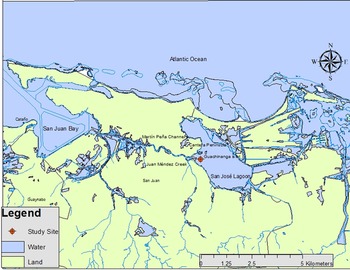
The SJBE has gained increasing attention due to rising sea levels, which alter water salinity and the mangrove ecosystem. Moreover, water pollution as a result of high urban development and wastewater discharges into the system have degraded its use as a wildlife refuge for aquatic species, including mammals, fish, birds, reptiles, and amphibians (ENLACE 2016; PRCCC 2013; SJBEP 2000). Consequently, a multidisciplinary habitat restoration project was initiated in 2012, as the SJBE is the only tropical estuary system included in the U.S. Environmental Protection Agency’s (EPA) National Estuary Program. The SJBE comprises five coastal lagoons with either marine or brackish waters: San José, Los Corozos, Condado, Piñones, and Torrecilla. The Suarez, San Antonio, and Martin Peña channels connect them, and freshwater enters into the SJBE from Rio Puerto Nuevo as well as from the Juan Méndez, San Anton, and Blasina creeks (SJBEP 2000) (Figure 1).
San Juan Bay Estuary and its water tributaries with the location of the study site shown.

The SJBE has two islets, Guachinanga and Guachinanguita, which are located in the San Jose Lagoon. Geographically, Guachinanga should be separated from land at the Cantera Peninsula; however, nuisance vegetation such as E. crassipes has been able to become established (Malpica-Sierra et al. Reference Malpica-Sierra, Abreu-Rodriguez and Almodóvar2002) and is currently considered an invasive plant (ENLACE 2016) at this site. Eichhornia crassipes acts as a land bridge for invasive and nuisance species (e.g., rodents) to cross onto Guachinanga from the shoreline, which consequently disrupts the habitat for aquatic fauna. In addition, E. crassipes limits boat traffic for sport fishing in the San Jose Lagoon and allows for vegetative and anthropogenic debris accumulation that affects water circulation.
Management of E. crassipes in the SJBE has relied on mechanical control or the biological control agent Neochetina eichhorniae Warner (Malpica-Sierra et al. Reference Malpica-Sierra, Abreu-Rodriguez and Almodóvar2002). It is recognized that biological control efficacy is low (Tipping et al. Reference Tipping, Martin, Pokorny, Nimmo, Fitzgerald, Allen Dray and Center2014), and mechanical control using machinery is often limited due high costs (Greenfield et al. Reference Greenfield, Blankinship and McNabb2006). In addition, removal of non-target aquatic fauna is always an environmental concern (Booms Reference Booms1999). That said, other control methods like the use of herbicides are not considered in Puerto Rico due negative public perception and an unfounded fear that herbicides labeled for aquatic use are unsafe for humans and animals. There is a lack of understanding that several herbicides are registered and can be used for E. crassipes management (Gettys Reference Gettys, Gettys, Haller and Bellaud2009; Gutierrez-Lopez Reference Gutierrez-Lopez1993; Robles et al. Reference Robles, Madsen and Wersal2010b; Van et al. Reference Van, Vandiver and Conant1986) and that they can be combined with other methods like biological control (Center et al. Reference Center, Allen Dray, Jubinsky and Grodowitz1999). Although citizen awareness programs about aquatic weeds and herbicides have been conducted previously (Robles Reference Robles2011), the ongoing worldwide debate on glyphosate exacerbates the negative public perception of glyphosate and herbicides in general (Robles Reference Robles2019), even though environmental harm from glyphosate has proven to be low (Duke Reference Duke2020; Duke and Powles Reference Duke and Powles2008; EPA 2020). A recent decision (EPA 2020) has created an opportunity to continue conducting comprehensive scientific studies related to glyphosate use, research of decided value in Puerto Rico, where there have been no previous studies evaluating the use of glyphosate to control aquatic weeds or documenting its effects on the aquatic habitats.
The objectives of this study were to determine: (1) the effectiveness of glyphosate and hand removal of E. crassipes, (2) their effect on the aquatic macroinvertebrate community and water-quality parameters, and (3) the presence of heavy metal pollutants in E. crassipes tissue.
Materials and Methods
Study Site
In a cove located at the Guachinanga Channel just southwest of Guachinanga Islet and the Cantera Peninsula (18.426335°N, 66.035621°W), E. crassipes growth extends across 7 ha along the shoreline (Figure 1). Within this site, only the outer fragment of the entire infested cove was selected due limited navigation caused by shallow water depth. Three plots located 250 m apart were laid out across the outer fragment of the cove. Specifically, the nontreated plot was located in the northern end of the infested cove adjacent to the eastern section of Martin Peña Channel, whereas the chemical control plot used for glyphosate treatment was located south and near the Juan Mendez Creek downstream end reach. Just north of the nontreated plot, a third plot located to the west of Guachinanga Islet was use for the mechanical control treatment (hand removal). All three plots were approximately 0.25 ha in size, with an average depth of 3 m. The entire study area was protected with a line of buoys to prevent E. crassipes floating away from the study area.
Chemical and Mechanical Control Treatments
On February 25, 2013, a foliar application of the herbicide glyphosate (Rodeo®, DowAgrosciences, 9330 Zionsville Road, Indianapolis, IN 46268) was applied to E. crassipes at the recommended label rate of 3.4 kg ae ha−1. A non-ionic surfactant (D-W Surfactant®, Triangle Chemical, Macon, GA 31208) at 0.25% v/v was added to the spray mixture to enhance foliar retention and absorption of glyphosate. Herbicide treatment was applied by boat using a gas-motored sprayer with a single-nozzle handgun with a full cone spray-tip nozzle (Spraying Systems, P.O. Box 13327, Memphis, TN 38113) delivering the herbicide solution at a rate of 935 L ha−1 and a constant pressure of 276 kPa.
Mechanical control consisted of manually removing four 2-m2 areas from the E. crassipes mat and transporting biomass to a drying area next to the boat ramp. The aquatic fauna found tangled in the removed plant material were documented and then returned to the water. Plant material was spread out around the selected area and let dry for 4 wk to ensure complete water loss from plant tissue. Hand removal was performed the same day as the glyphosate application.
Field Assessment of Eichhornia crassipes Population and Water Quality
To describe the conditions of the E. crassipes mat before glyphosate application, four 0.25-m2 quadrats were randomly tossed at each plot. Eichhornia crassipes within each quadrat were removed from the water to measure plant height and percent humidity on plant tissue. Plant height consisted of measuring the length from the rosette base to the leaf blade tip, whereas fresh weight and dry weight (DW) were used to estimate percent moisture. Flowering abundance, leaf blade color, and leaf blade orientation were estimated visually around the study area. The visual estimation considered leaf blade orientation, either horizontal or vertical, against the water surface. Both foliage and root tissue samples collected from each quadrat were also used to determine the presence and concentration of heavy metal pollutants and nutrient elements such as nitrogen, phosphorus, and potassium. Plant tissue analysis was conducted at the Central Analytical Laboratory of the Agricultural Experiment Station, University of Puerto Rico, Mayagüez.
Biomass (total DW m−2) and density (no. of plants m−2) of E. crassipes in treated and nontreated plots were monitored before herbicide application and at 48 h and 1, 2, 4, and 8 wk after glyphosate application. At each sampling date, a 0.25-m2 quadrat was tossed randomly over the E. crassipes mat to collect 10 samples from each plot. All plant material contained within the quadrat was harvested and placed in plastic bags already labeled with a sample identification number. Collected samples were transported to the laboratory and sorted into above (shoots) and below (roots) water surface biomass. During the sorting process, the number of E. crassipes plants per sample was counted to determine density. Sorted samples were then placed into an oven and dried for 72 h at a constant temperature of 70 C. After being dried, samples for both shoots and roots were combined and weighed to determine total biomass.
Both percent control and herbicide phytotoxicity of E. crassipes were estimated visually at each sampling date. Percent control of E. crassipes was estimated at each plot in 10% increments from 0% to 100%, where low and high values represented poor and best control, respectively. Herbicide phytotoxicity was estimated using a rating scale from 1 to 9, where 1 indicates no herbicide injury was noted and 9 indicates necrosis was observed in 100% of plant tissue followed by plant stand collapse due herbicide treatments (Robles et al. Reference Robles, Madsen and Wersal2010b).
The hand removal treatment was monitored at 7 and 14 d after plant material was removed from the water. The assessment consisted of weighing the remaining plant tissue in five 0.25-m2 quadrats randomly placed over the hand-removed plant material to determine fresh weight. The resulting fresh weight (kg m−2) was then compared against those obtained at the glyphosate and nontreated plots.
Water quality from each plot and open water at the time of E. crassipes field assessment was determined using a YSI® multiparameter sonde (1700/1725 Brannum Lane, Yellow Springs, OH 45387). A total of 10 readings per plot were collected by randomly placing the multiparameter sonde at a 15-cm depth from the E. crassipes mat surface to measure the following parameters: temperature (C), dissolved oxygen (mg L−1), pH, and salinity (ppt). A Secchi disk was lowered within the water column to obtain water transparency data at each plot.
Field Assessment of the Aquatic Macroinvertebrate Community
Three field surveys were performed to determine aquatic macroinvertebrate presence in the treated and nontreated plots. The first survey was performed before glyphosate application, the second and third surveys were performed 1 and 2 mo after treatment, respectively. At each sampling date, five samples of aquatic insects were obtained from each plot using a D-shape aquatic net (30.5-cm diameter and 0.5-mm mesh size). The net was dragged over the E. crassipes mat five times to collect each sample. Collected specimens were removed from the net and transferred to a glass vial that contained ethanol at 95%. Each preserved specimen was identified to the finest taxon possible (Merritt et al. Reference Merritt, Cummins and Berg2008) and deposited at the Museo de Entomología y Biodiversidad Tropical of the Agricultural Experiment Station, University of Puerto Rico (Franqui et al. Reference Franqui, Santiago-Blay, Medina Gaud and Abreu1997).
Statistical Analysis
Eichhornia crassipes biomass and density as well as water quality were subjected to a one-way ANOVA using a Fisher’s protected LSD test at a significance level of P = 0.05 for all sampling dates to determine statistical differences between sites. Aquatic macroinvertebrate community data were subjected to a nonparametric Friedman test to determine differences between each taxon found at both the nontreated and treated glyphosate plots for each sampling date. All statistical analyses were performed using the statistical software InfoStat v. 2020 (Di Rienzo et al. Reference Di Rienzo, Casanoves, Balzarini, Gonzalez, Tablada and Robledo2020).
Results and Discussion
A Priori Assessment of Eichhornia crassipes at the Study Area
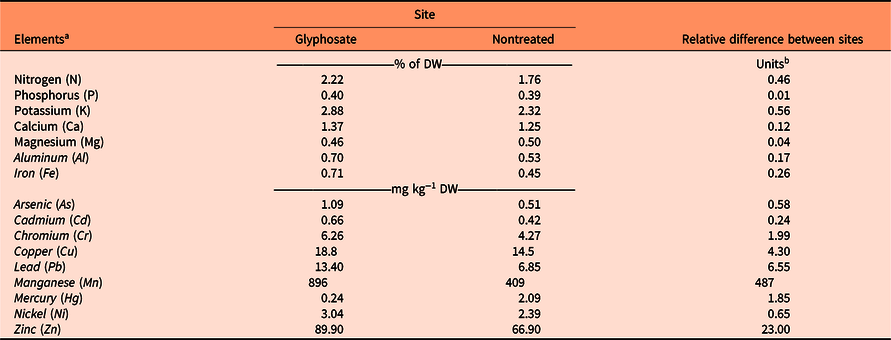
Eichhornia crassipes height in both treated and nontreated sites ranged between 40 and 51 cm before treatments were implemented. Plant tissue had, on average, 94% moisture content, and it was visually estimated that up to 90% showed a dark-green leaf color. Less than 10% of the E. crassipes mat was observed to have mild brownish color along leaf veins with leaf margins appearing curled and necrotic. Leaves were oriented vertically from the water surface and flowering was scattered (less than 10%) around the mat. A total of 16 elements were detected in E. crassipes tissue collected from both sites (Table 1). In both sites, elements such as nitrogen, phosphorus, potassium, calcium, and magnesium were found at less than 2.9% of DW. The relative difference in both plots was less than 1%, which means that samples obtained from both sites were consistent with each other. The presence of heavy metals has been reported previously in both sediment and water at the SJBE (ENLACE 2016; SJBEP 2000). With the exceptions of chromium, copper, lead, manganese, mercury, and zinc, the relative difference between sites was less than 1 unit. The most abundant heavy metal found in E. crassipes tissue was manganese, with values ranging between 400 and 900 mg kg−1 DW. Values obtained for copper and zinc differed from 4 to 23 relative difference units, indicating inconsistency between sites. Similarly, values obtained for lead and mercury were 6.8 to 13.4 and 0.2 to 2.1 mg kg−1, respectively. On the other hand, the concentration of harmful pollutants such as arsenic, nickel, and cadmium was less than 3.0 mg kg−1 DW in E. crassipes tissue.
Chemical elements composition in Eichhornia crassipes tissue collected from both sites.

a Heavy metals are in italic type.
b Units are based on dry weight (DW) of E. crassipes.
Efficacy of Chemical Control
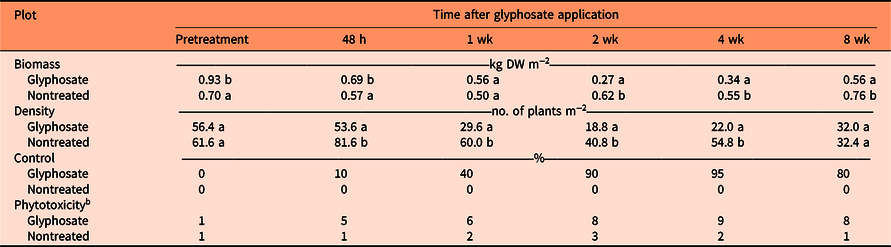
At 2 wk after treatment, E. crassipes biomass was significantly reduced (P < 0.05) to 0.27 kg DW m−2 at the treated plot when compared with the nontreated plot (Table 2). This represents a 71% biomass reduction when compared with the initial biomass of the treated plot. This effect was observed for up to 2 mo after treatment application, resulting in significantly less biomass on treated plots in relation to nontreated plots. Initially, E. crassipes density was estimated between 56.4 and 61.6 plants m−2. Once glyphosate was applied, plant density was significantly reduced (P < 0.05) in the treated plot (Table 2). The lowest density of 18.8 plants m−2 was observed at 2 wk after glyphosate application and represented a 67% reduction from initial plant density. Glyphosate application was efficacious for 2 mo, after which differences in density of E. crassipes between the treated plot and nontreated plot were not detectable. During the study period, several stem bases of E. crassipes were observed to be injured by glyphosate, although sprouting and new leaf growth were noted.
Biomass, density, percent control, and phytotoxicity of Eichhornia crassipes at treatment plots during trial assessment. a

a Means with the same letter are not significantly different according to Fisher’s LSD at a significance level of 0.05.
b Values for phytotoxicity are expressed as ratings according to Robles et al. (Reference Robles, Madsen and Wersal2010b).
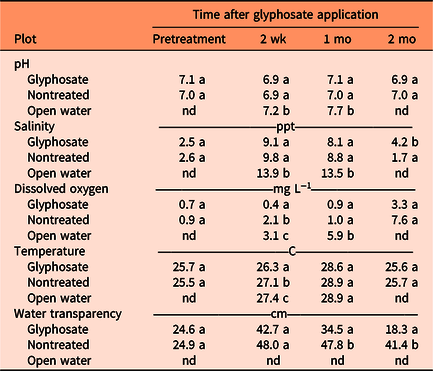
Both plots exhibited scattered curly-necrotic leaf margins, perhaps due water salinity fluctuations during the study (Table 3). However, a gradual and uniform herbicide activity throughout the treated plot was noticeable at 1 wk after treatment, when distinct chlorosis of 50% or less (rating 6; Robles et al. Reference Robles, Madsen and Wersal2010b) was observed in plant tissues. Between 2 and 4 wk after treatment, severe chlorosis followed by necrosis and destruction of plant stand (ratings 8 to 9) was noticeable, yielding up to 95% control (Table 2). Glyphosate effect on E. crassipes was reduced at 8 wk after treatment, when several stem bases started to sprout, even when old leaves were still severely injured. No herbicide injury due to glyphosate treatments was observed in the nontreated plot.

In both plots, minimal fluctuations of water pH, dissolved oxygen, and temperature were detected within the first month after glyphosate application (Table 3). However, during the same period, values for water pH and dissolved oxygen were significantly higher compared with open water where E. crassipes was not present. Moreover, water salinity increased to 8 to 9 ppt at both plots between the second and fourth weeks of the study compared with pretreatment and at 8 wk after glyphosate application, when salinity was less than 4 ppt. Within the same period, salinity increased significantly at 13 ppt in open water where E. crassipes was not present (Table 3). At 2 mo after glyphosate application, water transparency was significantly higher at the nontreated plot, reaching up to 41.4 cm within the water column, whereas the glyphosate plot was affected by E. crassipes decay and resuspension of sediment particles and debris was noticeable.
Efficacy of Hand Removal
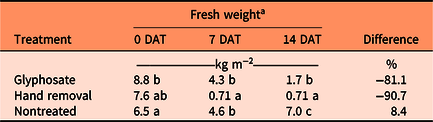
Initial fresh weight of E. crassipes removed from the water was 7.6 kg m−2 and was comparable to the fresh weights for the nontreated and glyphosate-treated plots (Table 4). Although they were not counted or sampled, juvenile fish of the species Dormitator maculatus (Bloch) as well as numerous crabs were observed tangled within the plant tissue of E. crassipes. Fresh weight of E. crassipes decreased significantly 7 and 14 d after hand removal due to water loss. Consequently, hand removal caused a 90.7% decrease compared with initial fresh weight of E. crassipes, whereas glyphosate treatment caused an 81% decrease. As expected, fresh weight of E. crassipes continued to increase at the nontreated plot.
Fresh weight of Eichhornia crassipes for the various treatments.

a Means with the same letter are not significantly different according to Fisher’s LSD at a significance level of 0.05. DAT, days after treatment.
Assessment of Aquatic Macroinvertebrate Community
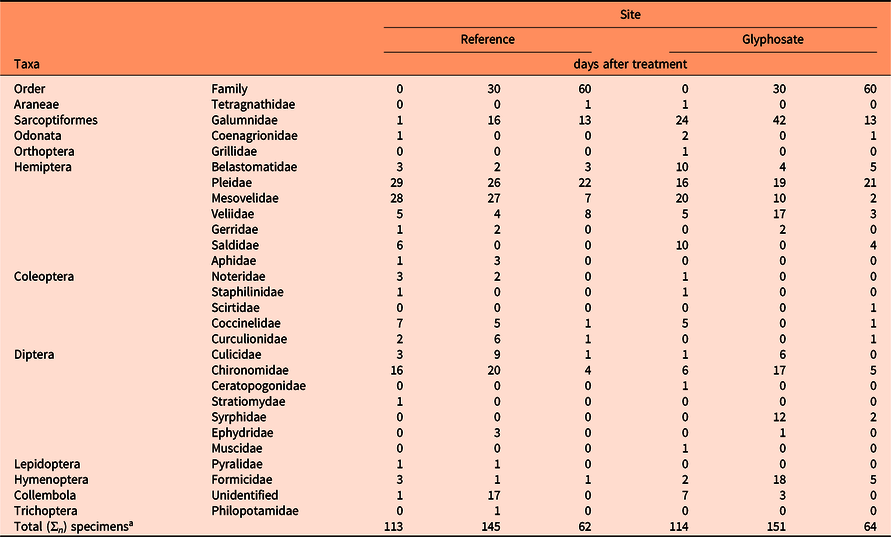
A total of 649 specimens were documented from the survey area. Twenty-five families in 11 orders and two classes of Arthropoda were identified to the finest taxon possible (Table 5). There were no significant differences between the number of specimens collected for each taxon found in both plots for all sampling dates. Over the study period, the macroinvertebrate community associated with E. crassipes consisted mainly of species representing taxonomic families such as Galumnidae, Belastomatidae, Pleidae, Mesovelidae, Velidae, Culicidae, and Chironomidae. Species reported as natural enemies of E. crassipes—Orthogalumna terebrantis Wallwork (Acari: Galumnidae), Niphograpta albigutalis (Warren) (Lepidoptera:Pyralidae), and Neochetina eichhorniae Warner (Coleoptera:Curculionidae)—were found. Among them, O. terebrantis was the most common.
Number of macroinvertebrate specimens collected per site within the Eichhornia crassipes mat over the study period.

a These values reflect the total number of specimens collected per site.
Eichhornia crassipes
In general, the biomass of E. crassipes was less than 1 kg DW m−2, with plant density ranging between 30 and 80 plants m−2 during the study time period. According to previous studies, in freshwater systems, E. crassipes biomass fluctuates between 1 and 3 kg DW m−2 over similar plant densities (Center and Spencer Reference Center and Spencer1981; Knipling et al. Reference Knipling, West and Haller1970; Madsen Reference Madsen1993; Robles et al. Reference Robles, Madsen and Wersal2015). Moreover, a plant density of 84 plants m−2 has been reported for E. crassipes in several freshwater systems in Puerto Rico (Malpica-Sierra et al. Reference Malpica-Sierra, Abreu-Rodriguez and Almodóvar2002). Our results suggest that E. crassipes biomass will not exceed 1 kg DW m−2 due to abrupt fluctuations of water salinity caused by tidal exchange capacity of SJBE and freshwater effluents from Juan Mendez Creek regardless of glyphosate use (Tables 2 and 3). According to Penfound and Earle (Reference Penfound and Earle1948) and Haller et al. (Reference Haller, Sutton and Barlowe1974), salinity levels above 2.5 ppt limit E. crassipes growth and survival. In addition to water dynamics, piercing−sucking natural enemies reported by us may affect its growth on the study area.
Nutrient content in plant tissue was similar between both sites (Table 1) and comparable to that reported for E. crassipes in previous studies in freshwater systems (Boyd and Vickers Reference Boyd and Vickers1971; Center et al. Reference Center, Allen Dray, Jubinsky and Grodowitz1999; Knipling et al. Reference Knipling, West and Haller1970; Parra and Hortenstine Reference Parra and Hortenstine1974). In fact, E. crassipes is considered to have good potential as a fertilizer (Parra and Hortenstine Reference Parra and Hortenstine1974), animal feed, and compost material (Baldwin et al. Reference Baldwin, Hetges and Bagnall1974; Knipling et al. Reference Knipling, West and Haller1970; Montoya et al. Reference Montoya, Waliczek and Abbott2013). Other elements that were found in E. crassipes plant tissue (Table 1) are categorized as heavy metals and considered to be “toxic hazard” pollutants in water (EPA 2007). Eichhornia crassipes is well known to be a good indicator of heavy metal presence in a waterbody, as it is capable of absorbing and bioaccumulating these elements, mainly in root tissue (González et al. Reference Gonzalez, Lodenius and Otero1989; Lenka et al. Reference Lenka, Panda and Panda1990; Liao and Chang Reference Liao and Chang2004). Specifically, it has been reported that lead and mercury have increased over the past 50 yr in the sediment of SJBE (ENLACE 2016). In this study, both elements were detected in E. crassipes tissue at concentrations comparable to those reported in other polluted waterbodies (Gonzalez et al. Reference Gonzalez, Lodenius and Otero1989; Lenka et al. Reference Lenka, Panda and Panda1990; Liao and Chang Reference Liao and Chang2004)
Glyphosate was an effective tool to reduce the biomass and density of E. crassipes up to 2 mo after application. The reduction of biomass and destruction of plant stand was gradual, as phytotoxicity progressed from wilting and yellowing to browning and necrosis. This pattern is commonly observed when using slow-acting herbicides like glyphosate (Robles et al. Reference Robles, Madsen and Wersal2010b; Van et al. Reference Van, Vandiver and Conant1986) at the use rate of 3.4 kg ae ha−1. Yet it allows aquatic organisms such as beneficial arthropods, fish, reptiles, and amphibians that harbor in E. crassipes to migrate to other areas, thereby avoiding an adverse impact seen with mechanical removal (Booms Reference Booms1999). The use of glyphosate did not affect dissolved oxygen (Table 3), as the slow decay of E. crassipes prevented oxygen depletion in the water column. While E. crassipes was decaying in the glyphosate plot, sediment particles and anthropogenic debris (e.g., rubber, foam, and plastic) were resuspended and exposed within the water column, causing poor water transparency. It is known that gap openings created by the loss of E. crassipes may lead to turbulence caused by wind exposure at the water surface. Moreover, algal growth enhanced by an increase in water surface openings could result in light extinction or attenuation within the water column, which lowers water transparency. Further colonization by other aquatic plant species such as Lemna minor L. and Pistia stratiotes L. is also possible, as they were observed at gap openings.
Although the fresh weight of E. crassipes was reduced up to 91% when using hand removal, it was observed that aquatic organisms like juvenile fishes and crabs were also removed from the water. This effect should be considered in an E. crassipes management plan where mechanical weed-harvesting is used (Booms Reference Booms1999).
Aquatic Macroinvertebrate Community
Most of the specimens collected in this study fall within taxonomic families that have an aquatic habitat preference specifically related to aquatic plants (Merritt et al. Reference Merritt, Cummins and Berg2008). In general, they are considered either shredders, collectors, scrapers, or predators commonly found in aquatic vegetation at the littoral zone or limnetic surfaces (Cummins Reference Cummins1973; Merritt et al. Reference Merritt, Cummins and Berg2008). In this study, all three species identified as natural enemies of E. crassipes have been reported with promising results for control (Tipping et al. Reference Tipping, Martin, Pokorny, Nimmo, Fitzgerald, Allen Dray and Center2014). However, the most noticeable E. crassipes leaf damage in this study was caused by larvae and nymphs of O. terebrantis. This species was able to produce galleries or tunnels on the leaves of E. crassipes, which consequently may reduce the plant’s photosynthetic capability.
On the other hand, only one adult of the order Trichoptera was collected during the survey period, and its scarcity suggests that the water is highly polluted. Members of this taxonomic order are pollution intolerant, so its dominance typically signifies excellent to good water quality. Other taxa collected related to water quality are those within the families Coenagrionidae and Chironomidae. A higher number of specimens collected from these two families indicates that water at the SJBE may have some degree of pollution. Specifically, members of the Coenagrionidae exist in a wide range of water-quality conditions and can tolerate some degree of pollution, whereas members of the Chironomidae are generally tolerant to pollution and dominance usually signifies fair to poor water quality. Additionally, members of the family Chironomidae are commonly found in E. crassipes stands (Masifwa et al. Reference Masifwa, Twongo and Denny2001; Toft et al. Reference Toft, Simenstad, Cordell and Grimaldo2003)
Further Research
The current study was conducted in a dynamic estuarine ecosystem, as the SJBE is affected by freshwater effluents and tidal exchange that could increase water salinity and consequently limit the growth of E. crassipes. Results from this study represent just one possible effect of the evaluated treatments, and long-term studies should be conducted to continue assessing current control methods at different freshwater bodies in Puerto Rico. It is well known that glyphosate poses low environmental risk and that microbial degradation maintains a short half-life for this herbicide in terrestrial and aquatic habitats (Duke Reference Duke2020; Duke and Powles Reference Duke and Powles2008). Glyphosate was shown to be an effective method for managing E. crassipes, and both aquatic macroinvertebrates exposed to the herbicide and water quality remained unchanged. However, results indicate that E. crassipes bioaccumulates heavy metals into stem bases, but the release of these elements back into the water when plants decay due to glyphosate exposure is unknown for the SJBE. Additional research of heavy metal accumulation in E. crassipes is needed, along with estimates of operational costs for implementing hand removal and chemical control to determine their feasibility for the SJBE. Also, a more extensive monitoring program for aquatic macroinvertebrates is recommended to provide information about their community structure in relation to water quality and the presence of E. crassipes. Further studies are also needed to assess the population of the three macroinvertebrate species reported as natural enemies along with their use as a complementary E. crassipes control method.
It is recognized that community involvement is strong on the SJBE, so the implementation of mechanical control by either hand removal or using machinery should consider the use of E. crassipes by-products as compost material to develop urban gardens. Because E. crassipes bioaccumulates heavy metals, compost material should be examined before using it when growing fruit or vegetable crops. In Puerto Rico, the use of E. crassipes for this purpose has not been explored within the context of integrating the community in a management plan. It is suggested that a pilot study with the community of Peninsula Cantera be implemented to explore this alternative benefit that the SJBE may provide while improving habitat restoration.
Acknowledgments
This work was supported by the U.S. Environmental Protection Agency and the San Juan Bay Estuary Program under USEPA award no. CE992069.17. The authors would like to thank the Puerto Rico Department of Natural Resources and Environment, the Proyecto Enlace Caño Martín Peña, and community volunteers for providing field support to conduct the study. Additional funding was provided by the USDA Forest Service under award no. 08-CA-11120107-046 and the Agricultural Experiment Station, University of Puerto Rico, Mayagüez. The mention of trade names in this publication does not constitute endorsement by the authors. No conflicts of interest have been declared.