

Introduction
In the context of increased interest in musical creativityFootnote 1 and its social and distributed character, contemporary music offers particularly fruitful opportunities to investigate the detailed fabric of creative work. The chance to observe the live interactions between composers, performers, producers and technologists offers a direct insight into creative processes at a time when the roles of these principal creative agents have become more fluid in much contemporary musical production.Footnote 2 This article focuses on a collaboration between the composer Jeremy Thurlow (henceforth Jeremy) and the violinist Peter Sheppard Skærved (Peter) in the making of Ouija, a work that consists of five movements for solo violin and precomposed sound files. The approach that we take brings together an analysis of the discursive interaction between the participants as they worked together on the piece; an analysis of the development of musical materials over the course of the collaboration; and a consideration of the embodied character of the performer's developing relationship with the music. Together, these perspectives provide a way to investigate and understand the intertwining of collaborative interaction with musical development.
The intimate, relatively compressed collaboration witnessed here, centred on a piece that contains a significant amount of guided improvisation and semi-indeterminate notation, brings into focus questions about creative development and the way in which collaborating musicians set up the conditions for its genesis. In discussing joint work and creative development, we situate this study in relation to two distinct areas of research: a number of recent studies of composer–performer collaborations; and a broader category of research that investigates the psycho-social conditions of creativity within groups. While our focus here is on the collaborative elements of the work and their significance, the genesis of the piece also involved a considerable amount of individual labour. Our intention in this study is not to downplay or deny the contribution of solitary work, but to draw attention to and analyse the subtle, transformational effects of what might be termed ‘sociable creativity’.
The dominant model across creativity research of the last 60 years has tended to adopt a singular, individualized and cognitive approach, with an emphasis on problem-solving.Footnote 3 An important recent extension to this cognitive framing of creativity has come from research with a focus on group work and the group itself as a creative force.Footnote 4 In tandem with sociological studies of creativity that emphasize the distribution of labour within different art worlds, this has substantially reframed the questions that are posed in relation to creativity – away from what happens within creative agents and towards what goes on between them. There is no single model of ‘between’, and as Howard Becker has written, the division of labour between the members of a group can take many forms: it need not be simultaneous or under the same roof, and many instances of collaborative work depend on a distributed succession of individualized contributions.Footnote 5 Much Western art music appears to follow a model of collaboration that is successive and linear, a composition developing as the autonomous work of a composer that is then passed on to the performer(s), with whom there may be only very limited exchange. Performers themselves may, and usually do, work in a highly collaborative fashion, but such collaboration is often characterized as realization or re-creation, rather than a contribution to, or involvement in, what is regarded as the ‘primary’ creative process.
In this study, however, we look at co-present collaboration as part of the shaping of the work (as well as acknowledging the significant involvement of sequential development), and it is in the examination of such face-to-face creative practices that Keith Sawyer's work has been particularly influential, adopting a more social and interactional approach to creativity.Footnote 6 Across a number of writings, Sawyer has explored the improvisational, collaborative and emergent qualities that are inherent in group creativity. In doing so, he argues that most forms of group creativity happen ‘in the moment of the encounter’ and therefore are necessarily improvisatory; that ‘creativity cannot be associated with any one person’ and is therefore necessarily collaborative; and that collective phenomena – being irreducible to the sum of their parts and inherently unpredictable in outcome – must be regarded as emergent.Footnote 7
Within this wider exploration of creativity, our work relates to a more targeted agenda – a developing body of research that since 2005 has examined musical collaborations between composers and performers from psychological, sociological/anthropological and practice-led perspectives. In an article that constitutes a precursor to the current study, Eric Clarke, Nicholas Cook, Bryn Harrison and Philip Thomas present an analysis of the rehearsal and first performance of a new work for solo piano (être-temps, composed by Harrison and performed by Thomas), focusing on a number of collaborative and distributed attributes of the project.Footnote 8 These include particular features of the way in which Thomas engages with the piece and prepares it for performance; the development of various interpretative strategies through the rehearsal period (particularly those concerned with rhythm and timing); questions of flexibility and fixity in the performance; and the relationship between notation, action and sound. Harrison describes Thomas as a ‘performer who […] sees questions as a productive rather than restrictive part of the learning process’,Footnote 9 and as a creative collaborator. A theme to which Thomas returns on a number of occasions is how he can maintain an open and inventive relationship with the piece and its notation, when he also has to spend long hours working painstakingly on detailed aspects of the material – as is vividly illustrated in an exchange between Thomas and Harrison during the rehearsal period:
Thomas: You kind of do it so much, I've practised it, and then you get used to it, and it gets compromised again, so I've got to keep kicking myself in the arse to kind of take it apart again, I think that's the problem, I've got to keep unravelling it.
Harrison: Otherwise you get used to the sound and keep imitating yourself in a slightly inaccurate way really.Footnote 10
Thomas's commitment to a deliberate provisionality, and to the sense of ‘liveness’ that he aims to create from that, is mirrored in Harrison's similarly unfixed and enquiring attitude towards notation. He acknowledges the formalized character of the notation, which is based on an unusual use of metrical grids, but regards this neither as the image of an authoritative sound in his head, nor as deterministic in its aims or consequences, but as a starting point for the performer's exploration and imagination: ‘I'm writing it to hear it as much as I'm hearing it to write it.’Footnote 11
A similar study of composer–performer collaboration, involving the composer Fabrice Fitch and the cellist Neil Heyde, investigates analogous issues, but with a greater focus on instrumentality, sound and the affordances of particular technical features of the cello.Footnote 12 Whereas être-temps was a finished score when Thomas received it, the score for Fitch's piece for speaking cellist entitled Per Serafino Calbarsi II: Le songe de Panurge (henceforth PSCII) evolved over a period from 2002 to its first full performance in 2006 through an intermittent dialogue between Fitch and Heyde. For reasons that are connected with PSCII's particular scordatura tuning, the piece plays particularly with the pitch relationships between different harmonics, and in exploring those possibilities Fitch and Heyde chanced upon a particular combination of harmonics with a specific pizzicato technique that subsequently became a central element in the further compositional development of the piece. Fitch and Heyde make reference to Helmut Lachenmann's description of composition as ‘building an instrument’, entailing ‘the building of “an imaginary instrument”, the exploration of whose properties (by the composer) brings about the piece itself’.Footnote 13 It is clear that PSCII indeed involves a kind of mutual tuning of the instrument and performer – both literally through the exploration of a particular scordatura and more metaphorically in the discovery and development of playing techniques. But more than that, the ‘instrument’ that is built crosses over between Fitch's and Heyde's apparent roles as composer and performer:
Taking Lachenmann's ideas into the collaborative context, one can observe the blurring of traditionally clear lines of demarcation between performer and composer. Most obviously, the composer becomes, according to Lachenmann, not only an organologist, but also an instrumentalist (albeit on an imaginary instrument). But the converse is also true: in the process of reshaping the instrument, the performer takes on some of the attributes of the composer in Lachenmann's model. This would seem particularly true in the case of the present collaboration, in which the performer has taken an equal role in defining the ‘problems’ we have made it our task to solve.Footnote 14
In a statement that both pays tribute to the crucial creative role of Heyde as the performer and at the same time reinscribes his own position as the original ‘source’ of the composition, Fitch writes:
Perhaps this inflected view of the role of each participant helps to explain a curious personal sentiment concerning the piece at the end of the process. For the composer, paradoxically, there is no doubt that the piece in its final form would be unthinkable without the input of this particular performer. At the same time, I am equally certain that the piece concretizes very precisely those sensations or impressions (admittedly as inchoate as they were vivid) experienced when the idea for this piece first arose many years ago.Footnote 15
As pieces for solo performer, neither être-temps nor PSCII engages with that very direct form of creative collaboration that is necessarily true of an ensemble. In two rather different projects, both of which involve new music for string quartet, Amanda Bayley and Paul Archbold have studied the interactions between composers and ensembles. Bayley's project has been concerned with the rehearsal of Michael Finnissy's Second String Quartet, and the commissioning and rehearsal of his Third String Quartet, both for the Kreutzer Quartet.Footnote 16 Using audio and video documentation, and a number of interviews with the composer, Bayley provides an account of rehearsals, three public performances, and reflections by the composer and members of the quartet on the performances. Bayley's examination of this collaboration provides one of the most detailed descriptions and analyses of discourse and interaction in rehearsal.Footnote 17 The rehearsal process is explored through a mixture of content analysis (outlining the proportion of time engaged in various forms of rehearsal activity such as playing and talking, with a breakdown of the topics for discussion between the composer and quartet members such as sound quality, coordination and social conversation) and more qualitative attention to what is said. The approach is developed from social psychological studies of rehearsals,Footnote 18 and from ethnomusicological writings that cover not only the process of making music but also the relationship of sound to discourse.Footnote 19 While the roles of composer and performers are distinctly separate here, and ‘the composition is in no sense collaborative’,Footnote 20 it is clear that there is a significantly collaborative creative effort involved in bringing the piece to performance. A subsequent article arising out of the same project demonstrates that Finnissy (MF) and the leader of the Kreutzer Quartet (Peter Sheppard Skærved; PSS) engage in very much the same kind of creative interaction as that between Harrison and Thomas mentioned above:
MF: It should have that feeling of initially not really being within reach, as if an unattainable plateau that they're on and you're desperate to reach it but …. And then you see it gradually become more possible.
PSS: We actually have to go through the curve of learning what the other person is doing and then de-learning it. Because what happened, that time, now we have too much knowledge. So we now actually have to de-skill a little bit in order for that to happen. Then we can not observe because what happens is we've started co-ordinating, not deliberately but because we have a kind of idea of what's happening, so we have to de-learn it.
MF: You have to adjust it so that it's not in the right place.Footnote 21
If a deliberately ‘unattained’ quality, projected through a degree of asynchrony, is one of the aims in the Finnissy quartet, a serious and detailed attention to achieving finely tuned coordination in the context of great complexity is a central feature of the collaboration between Brian Ferneyhough and the Arditti Quartet in Archbold's documentary film of the rehearsal and performance of Ferneyhough's Sixth String Quartet.Footnote 22 The film documents the quartet's detailed preparatory work on the score and parts before the first rehearsal and the interplay between the composer and the four performers during the rehearsal period that immediately precedes the première at the Donaueschingen Festival. The quartet clearly enjoys and values working with Ferneyhough, as it has done over many years, but the relationship comes with its own internal dynamics, arising from underlying attitudes about the roles and responsibilities of composers and performers. One of the rehearsals with the composer exemplifies this when, in the middle of a passage of complex rhythmic interaction, Ferneyhough (BF) – who is directing the quartet in quasi-conducting fashion – goes ‘shhh’ to Irvine Arditti (IA), sitting just to his left. The quartet comes to a stop, and the following exchange takes place:
IA: Shhh? Why are we shhh? You said shhh right on the word of the diminuendo: I'm still fff ! Shhh?
BF: I have this predictive mentality, Irvine. Which like the arrow of Eros plants itself straight in the foreheads of all those who dare to contravene my instructions.
IA: Alright then, I'll go for a cup of tea (laughs). Time for a cup of tea: I don't want no bleeding arrows in my head.
BF: […] Like Irvine's da da da da da da da da da – we've just got to estimate it …
IA: Am I not doing that?
BF: It's OK. I'm making this just as a general comment …
IA: What do you mean it was OK: it was good!
BF: It was fine. I was just saying it as a general comment …
IA: What do you mean it was fine?
BF: It was absolutely perfect and brilliant Irvine!!
IA: Ahhhhh!!! Then I'm definitely going to have a cup of tea (laughter).Footnote 23
Behind the laughter and teasing lie the dynamics of authority and compliance, competence and intelligibility, and independence and cooperation between composer and performers, and the delicate negotiations that are involved. In the prevailing assumption that composers sit at the top of the pyramid of creativity, with performers below them, lies the source of the tensions that briefly poke through the surface of this interaction: the composer's reliance on the performers to bring his music to life; the performer's pride in fidelity to the score (‘I'm still fff !’) against the composer's authority (‘those who dare to contravene my instructions’); and the underlying anxiety that the composer might not really be able to hear his own music, or that the performer might be too literal in his reading of the notation. Collaborations between composers and performers are inevitably as much about the socially constructed roles that individuals inhabit more or less willingly and comfortably as they are about creative imagination and ‘free play’.
In an article that considers the collaborative work of a considerably larger ensemble and its conductor with the composer of a newly commissioned work, Clarke, Mark Doffman and Liza Lim analysed a number of critical rehearsal episodes that exposed similar interweavings of institutional, social, notational, instrumental and circumstantial factors in the creative process.Footnote 24 Building on an increasing volume of recent publications,Footnote 25 they offer a view of the distributed and ecological character of aesthetic production, pointing both to the ways in which people are deeply intertwined with opportunities and technologies and to the different scales of history and social order within which musical production takes place. Using video recordings of rehearsals and two performances, and interviews and discussions with the composer, conductor and members of the ensemble, the research focuses on three episodes in rehearsal and performance that reveal the network of creative forces that much of the time operates in rather hidden ways in the comparatively ‘seamless’ working practices of a professional ensemble. All three episodes involve opportunities and tensions that arise out of the interplay between fixed and improvised elements, and all three also expose the influence of microsocial forces (immediate interactions between co-present individuals) and macrosocial forces (larger and more long-term social factors that relate to roles, institutions and traditions) on the direct materiality of music-making and creative decisions. In one case, distinctly different views of the musical virtues of deliberate planning and spontaneous emergence shape the realization of a passage of semi-indeterminate notation. In a second case, an informal process of ‘rule-making’ and ‘rule-breaking’ that relates to a sustained passage of improvised ensemble accompaniment is called into question and becomes entangled with prevailing assumptions about instrumental roles and creative prerogatives. And in a third case, a combination of serendipitous personal history (the birthday of a key player), the relationship between permanent ensemble members as ‘hosts’ and a soloist as ‘guest’ and the specific affordances of the musical material give rise to a striking moment of complex social communication expressed through music. The creative ecosystem that the article explores is therefore revealed as a heterogeneous mesh of material, historical, ideological and ‘memorial’ forces operating at a variety of scales.
The current article also considers the ecology of collaborative creation in the specific context of a piece of contemporary concert music, but is complementary to the previous study in two respects: it focuses on the concentrated interaction of a composer with a single commissioned performer; and it combines qualitative and quantitative methods in analysing the creative development of the piece over the rehearsal period and across repeated performances. Our approach ranges across the physicality of an individual musician's creative engagements with his instrument; practical and conceptual aspects of notation; the discursive and social engagement of the composer and performer working together; and the historical and biographical threads that they weave. As in the earlier article, we argue that an ecological perspective provides a productive framework for such an account by drawing together what might otherwise remain separate domains of material culture, psychological process and linguistic and social interaction. Within the broad context of that ecological mesh, we make use of a deliberately simplified distinction between processes that are ‘inside the room’ – the immediate matters of notation, instrument, sound – and processes that extend ‘outside the room’, encompassing the influences, histories and aesthetic attitudes that the musicians bring with them to their creative encounter. And within this framework we also acknowledge that this is an ecology with a tangible outcome: a piece of music emerged from this collaboration, and our primary research questions reflect our concern to understand not just the details of this very particular ecology but its relationship to and effects on the musical outcome: (1) How do a composer and performer work together in the production of a new piece of music? (2) How is creativity enacted in face-to-face collaboration? (3) How is the collaborative effort reflected in material changes in the music?
The material
Musical material
Following a chance meeting with Peter in 2009, Jeremy was keen to write a piece for him when the opportunity and commissioning funds became available in early 2010.Footnote 26 Drawing on the experience of a previous piece from 2007 entitled Endlessly Enmeshed, which combined Western classical musicians using conventional notation with two improvising Indian classical musicians, Jeremy's explicit aim was again to make use of fully notated and more improvised materials, but to push his own compositional practice in a new direction by incorporating computer-generated or computer-controlled sounds.
Despite the integration of improvised elements into the piece, Jeremy ‘very much wanted to write a piece which would feel like it had a character, a shape, a design, every time it was played, even though there's improvisation in it and therefore it's different every time’. He ‘wanted the piece to be a space that you could inhabit in lots of different ways, but it was still a [particular] space’.Footnote 27 This posed a problem: how could the piece incorporate the flexibility of improvisation and at the same time retain a sense of its own shape?
There had to be some looseness, and some sense that all sorts of different possibilities could work, and for a while I just found that an impossible conundrum. I felt like a poet being asked to write a poem, but also being told ‘You can't actually specify what the words are in the poem.’ And I just thought: How can I do that? How can I make a poem if I can't specify which words they are and which order they go in? I really got stuck.Footnote 28
The solution to this creative impasse came when Jeremy came across an account of the early twentieth-century Hungarian violinist Jelly d'Arányi on Peter's own website. From this he learnt that d'Arányi had been a medium,
and spoke to spirits, and especially musical spirits, and that gave me the idea that it might be interesting for the violinist to be a medium, and it would solve or help with two problems. One is: ‘Why are there these disembodied sounds coming out of loudspeakers?’, which I often find very problematic in electroacoustic music […]. But in this case I thought you have got a live violinist acting and moving, and there is a reason why there are voices, as it were – sounds that are disembodied. And we can relate to why they're disembodied because it's like what would happen in a séance or in a meeting with other-worldly spirits. So it helped with that, and it also gave a rationale for the improvisatory aspect, because a medium of course doesn't go in with a book, a play-script and say what he has to say: he has a conversation which evolves depending on what happens. […] And almost as soon as I read the bit about Jelly d'Arányi I had the idea. It just fell into place, so I was able to email Peter back quite quickly and say: ‘I think I've got an idea. Why don't we call it Ouija?’ […] And in his performances Peter's talked about Jelly d'Arányi and […] how she is connected to a sort of living tradition of past musicians, and memories of them, and feeling that they were still with her when she played, most of which I didn't know. So it worked out wonderfully. I just knew this little thing about Jelly d'Arányi but it was enough.Footnote 29
Having hit upon this creative solution to the problem of how the laptop music might be ‘motivated’, and how to conceive of the relationship between composer-defined and flexible or improvised elements, Jeremy decided to organize the materials of Ouija in the manner of a séance – as reflected in the titles of the movements: ‘Invocation’, ‘Among Voices’, ‘Sprite’, ‘Under the Shadow of Wings’ and ‘Among Voices II’. By the time of the first workshop in February 2012, Jeremy had prepared initial scored versions of ‘Invocation’, ‘Among Voices’ and ‘Under the Shadow of Wings’ on the basis of work that he had been doing since November 2011, and was in the process of writing further material that became ‘Among Voices II’ and ‘Sprite’. In an email to Peter and Doffman shortly after the first workshop, Jeremy commented that the piece would consist of seven movements:
As well as the movements we tried yesterday, there could also be a) a new mvt drawn from Paganini in the same way that Under the shadow is drawn from Bach [this became ‘Sprite’] b) a new mvt based on the idea of Peter ‘catching’ the tempo of the tape part, which suddenly changes every now and then like a will o’ the wisp c) a new final movement exploring the higher registers of the instrument, so far neglected [this became ‘Among Voices II’]. Not all of these will necessarily come to fruition, but if we consider all of them for now, the order might be: Invocation – Will o’ the wisp – Paganini – Among voices – Bach – new repartee – final mvt.Footnote 30
By the middle of March, at the second workshop, the materials and overall shape of the piece were close to their final form and had been narrowed down to five movements. In the interim, Peter had worked on technical aspects of the music, was no longer sight-reading the notated material and was comfortable with the kinds of improvisation that the piece entailed.
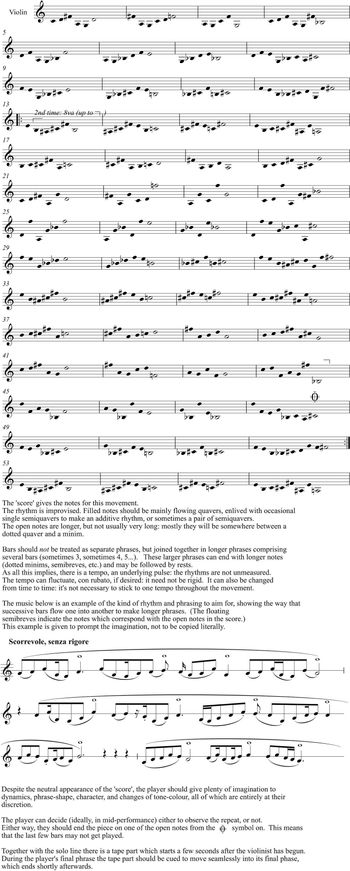
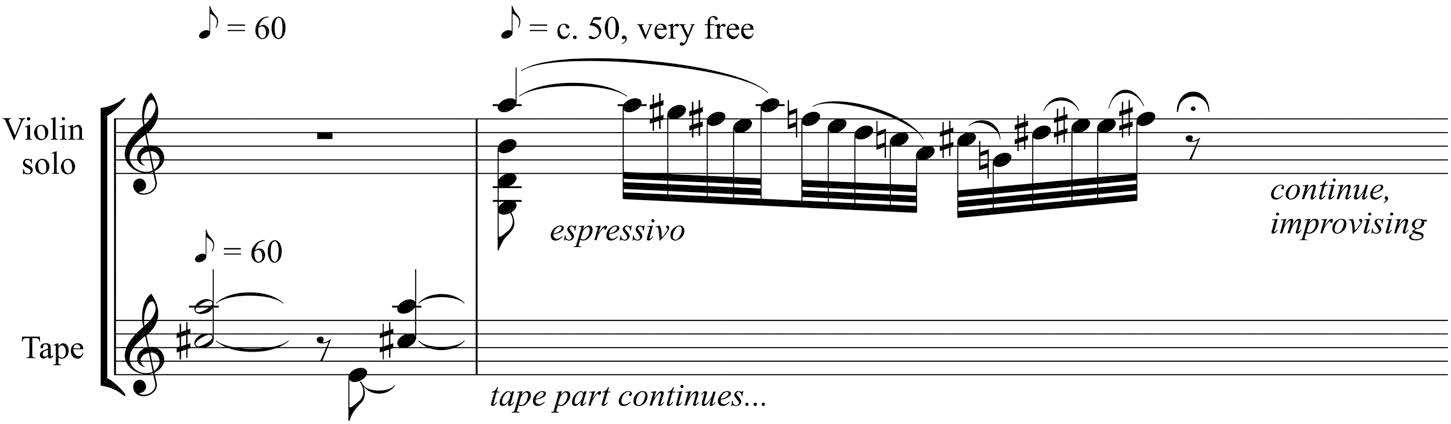
In broad terms, Ouija employs three approaches to musical material and to the relationship between notation and improvisation. ‘Invocation’ (see Example 1) is the most conventionally and fully notated of the movements, with only the duration of the pause at the end of each phrase left unspecified – these pauses at first being filled with silence, and later with the initially ghostly sounds of other music emanating from the laptop. ‘Among Voices’ (see Example 2) uses a semi-indeterminate notation in which the pitches are specified, but little or nothing of the rhythm – although the score provides a passage of suggestive comments about how the rhythm of the movement might be approached. The movement involves a constant interplay between the violin and the laptop, with the violin line swimming in what Jeremy describes as ‘a shoal’ of other musical lines.Footnote 31 As its title implies, the fifth movement – ‘Among Voices II’ – adopts the same general approach. Finally, movements 3 and 4, entitled ‘Sprite’ and ‘Under the Shadow of Wings’ respectively, make use of material that has a specific compositional reference: Paganini in the case of ‘Sprite’, and J. S. Bach in the case of ‘Under the Shadow of Wings’ (see Example 3). In ‘Under the Shadow of Wings’, on which we focus in this article, the laptop music took as its source the Siciliano movement of the Bach Solo Violin Sonata in G minor (BWV 1001), while the violinist's music consists of a short phrase, loosely modelled on the opening of the first movement of that same sonata, followed by the instruction to ‘continue, improvising’. The score gives brief advice about the relationship between the violin and ‘tape’ (= laptop)Footnote 32 parts – mostly in terms of the flexible coordination of the two, including the statement that ‘the improvisation should feel, in some broad sense, in sympathy with the music of the tape (though this can be defined as freely as the player wishes: it certainly doesn't rule out playing notes which are dissonant with the tape part)’.
Score of ‘Invocation’.

Score of ‘Among Voices’, pp. 1–2.

Score of ‘Under the Shadow of Wings’.

The laptop music for the three movements was developed in rather different ways. In the first movement (‘Invocation’), Jeremy's idea was to use the laptop to produce faint wisps of sound/music during the pauses following the third and fourth violin phrases and a ‘reaction’ at the end of the movement (see Example 1) – as if ‘called forth’ by the violinist's musical appeals. At the first and second workshops, Jeremy had not yet made these sound files, and Peter worked on the music in the absence of any answering ‘voice’. Shortly before the première, Jeremy put together a succession of sound files (from barely to distinctly audible) made out of snatches of recorded orchestral textures, transformed with granular synthesis and mixed with brief recorded extracts of Peter's own violin music from that movement. This was intended as no more than a first attempt at this music, to provide something for the première and likely to be superseded – but at the pre-performance rehearsal, and then in the première itself, both Jeremy and Peter agreed that it had worked so well that there was no need to consider any replacement.
By contrast, the laptop music for ‘Among Voices’ forms a much more substantial and closely integrated component of the movement, giving a sense of the violinist being immersed within lines of music (‘among voices’) that are a partial echo of the soloist's own material, and are therefore derived deliberately and quite directly from the violin part. The laptop music was generated by layering together a number of separate strands, each of which consisted of a rhythmic realization of the violinist's notated material (incorporating frequent tempo shifts) and a partial fragmentation of the scored material, so as to avoid and disguise any direct mirroring of the performer's line. Jeremy scored these layers using Sibelius notation software, and Peter then made digital recordings of these separate lines,Footnote 33 which in the final version of the laptop music were combined with sampled string sounds controlled directly by the Sibelius-based MIDI files.Footnote 34
Finally, ‘Under the Shadow of Wings’ used yet another approach. Starting with a fortuitously available commercial recording of the Siciliano movement of the Bach Solo Violin Sonata BWV 1001, Jeremy identified some relatively brief extracts that featured double-stopping and, using pitch transposition and tempo shifts coupled with granular synthesis, layered these elements to form a slow-moving homophonic texture, starting rather diatonically and becoming somewhat more chromatic as the movement progressed. Although the recorded source is a violin, the effect of the granular synthesis is to produce a texture that has the character of an instrumentally indeterminate harmonic wash. The remainder of this article focuses on ‘Invocation’, ‘Among Voices’ and ‘Under the Shadow of Wings’, representing as they do the three broad musical strategies of the work as a whole, and constituting the movements on which the most rehearsal and discussion took place.
Empirical material
The primary material on which this article is based consists of around seven hours of video recordings documenting all of the workshops and rehearsals involved in making the piece, from Jeremy's first meeting with Peter in February 2012 to the first performance in May;Footnote 35 video and audio recordings of four public performances between May and November 2012; and around six hours of recorded interviews and retrospective verbal protocol sessionsFootnote 36 with Jeremy and Peter (see Table 1). The video material was captured using a single digital video camera positioned wherever was convenient in the various workshop, rehearsal and performance circumstances.Footnote 37 Audio recordings were made using Zoom and Roland portable digital audio recorders.
| Date | Event | Location | Data | Personnel | Event code |
|---|---|---|---|---|---|
| 14/02/12 | workshop 1 | Jeremy's room, Robinson College, Cambridge | audiovisual | Jeremy, Peter, MD | W1 |
| 15/03/12 | workshop 2 | Jeremy's room, Robinson College, Cambridge | audiovisual | Jeremy, Peter, MD | W2.1 |
| 15/03/12 | workshop 2 cont. | Chapel, Robinson College, Cambridge | audiovisual | Jeremy, Peter, MD | W2.2 |
| 23/05/12 | pre-concert rehearsal | Chapel, Sidney Sussex College, Cambridge | audiovisual | Jeremy, Peter, MD, EC | P1R |
| 23/05/12 | première performance | Chapel, Sidney Sussex College, Cambridge | audiovisual | Jeremy, Peter, MD, EC, audience | P1 |
| 06/07/12 | performance | Chapel, Robinson College, Cambridge | audio only | Jeremy, Peter, MD, audience | P2 |
| 19/07/12 | interview 1 | Faculty of Music, Oxford | audio only | Peter, EC | I1 |
| 23/07/12 | performance | Wilton's Music Hall, London | audio only | Jeremy, Peter, EP, audience | P3 |
| 06/08/12 | interview 2 | Robinson College, Cambridge | audio only | Jeremy, EC | I2 |
| 02/11/12 | performance | Holywell Music Room, Oxford | audiovisual | Jeremy, Peter, MD, EC, audience | P4 |
| 03/11/12 | interview 3 (RVP) | Faculty of Music, Oxford | audio only | Jeremy, MD | I3 |
| 01/02/13 | interview 4 (RVP) | Faculty of Music, Oxford | audio only | Peter, EC | I4 |
RVP = retrospective verbal protocol
Personnel are Eric Clarke (EC), Mark Doffman (MD), Emily Payne (EP), Peter Sheppard Skærved (Peter) and Jeremy Thurlow (Jeremy)
The recordings of the workshops, rehearsal and performances are self-explanatory, but the interviews require a brief comment. The first two interviews (19 July and 6 August 2012) were standard semi-structured interviews, each lasting for around 90 minutes. Interviews 3 and 4 (3 November 2012 and 1 February 2013) were designed to elicit the two musicians’ reflections on the development of Ouija from its origins through to the fourth (Oxford) performance on 2 November 2012. Following some initial more general questions, the interviews made use of a retrospective verbal protocol, presenting each musician with audiovisual extracts documenting various stages of Ouija's development, and inviting their comments on the music's evolution. The extracts took four significant moments for each of the three target movements:
(1) the first read-through on 14 February 2012;
(2) the first play-through in the more appropriate space/acoustic of Robinson College Chapel, as part of the second workshop on 15 March 2012;
(3) the pre-performance rehearsal in Sidney Sussex Chapel on 23 May 2012;
(4) the première performance in Sidney Sussex Chapel on 23 May 2012.
From the original commissioning discussions onwards, it was explicitly agreed with Jeremy and Peter that their collaboration would be the object of systematic recording and detailed analysis, but that this would be done in such a way that it had as little impact as possible on either the creative process or the creative outcome. The number, duration, date and location of the collaborative workshops were decided entirely by Jeremy and Peter, and the success of the three performances in Cambridge, London and Oxford that had been planned from the outset was understood as the primary consideration: all participants agreed that if any aspect of the research process interfered with that aim, that activity would be discontinued. Nonetheless, the consequences of one or both of the first two authors of this article being present at workshops, rehearsals and performances must be recognized. In formal terms, the standard ethical requirements for projects involving human participants were met in full, both Jeremy and Peter signing informed consent forms. More significantly, both Jeremy and Peter were directly and actively involved in the research process itself through the interviews and RVP processes described above, and were invited to comment on a full draft of the article.Footnote 38
Analysis of video material
All verbal interaction during the workshops was transcribed, and performances of the music were logged within the transcription. Similarly, the interviews and RVP recordings were transcribed in full. In the analyses presented below, we focus on characterizing the interaction during the workshops, since this constituted the primary locus of collaborative creative development. Data from the interviews and RVP recordings are used to provide insight into the musicians’ understandings of the music, the collaboration and the creative process, and citations are identified using the event coding listed in Table 1 (final column).
Analysis of performance data from audio
To analyse the development of the musical material over time, a quantitative analysis of the timing of musical events was undertaken using a sample of material (see Table 2). The sample focused on early development, including the first encounter with the music during the first workshop (W1), a run-through of the music during the second workshop (W2), the première (P1) and the fourth (Oxford) performance (P4). Onset timing was measured manually using PRAAT for the detailed timing analysis of ‘Invocation’ and ‘Among Voices’.Footnote 39 <http://www.fon.hum.uva.nl/praat>. The timing of note onsets in ‘Under the Shadow of Wings’ was extracted by tapping along with the rhythm of the improvisation using Sonic Visualiser.Footnote 40 <http://www.sonicvisualiser.org>. This method involved taking short excerpts and, after repeated listening to these excerpts, first tapping along to the succession of note onsets, and subsequently correcting and adjusting the position of the recorded taps until they coincided exactly with the rhythm of the improvised violin part. In the following sections, we analyse the collaborative process from three standpoints: the discursive interaction of the musicians in the collaboration; the development of the musical materials over the course of the collaboration; and the embodied engagement of the performer.
| Type | Event coding |
|---|---|
| workshop 1: first run-through of ‘Invocation’, ‘Among Voices’ and ‘Under the Shadow of Wings’ | W1 |
| workshop 2: fifth run-through of ‘Invocation’; sixth run-through of ‘Among Voices’; third run-through of ‘Under the Shadow of Wings’ | W2 |
| first concert performance | P1 |
| fourth concert performance | P4 |
Talk and collaboration
Jeremy and Peter established the collaborative momentum of Ouija over the course of two workshop days, separated by a month's interval. As already noted, prior to the first workshop Jeremy had prepared four movements to work on – ‘Invocation’, ‘Among Voices’, ‘Under the Shadow of Wings’ and ‘Repartee’ (which was subsequently dropped). Peter came to the first workshop having seen small snippets of some of the pieces but was effectively sight-reading the material, and although many of the final constituent elements were recognizable at the first workshop, there was still considerable uncertainty about the component movements and overall shape that the piece would take. Jeremy's and Peter's creative work on Ouija therefore occupies a collaborative middle-ground, in that while the overall framework and a significant proportion of the musical material is attributable to Jeremy's compositional perspective, the improvised nature of some of the movements and the relatively sparse violin part in others left much more to shared decision-making than would be the case in a fully through-composed piece. But the piece was also at a considerable remove from a completely improvised approach, in which all participants share similar creative authority. The materials and processes evident in the creation of Ouija specify a much more porous relationship between pre-given material and the in-the-moment qualities of improvised performance. In looking at the two days of workshops, our point of departure is to examine the dialogue between the participants and the ways in which their discourse participated in the collaborative process.
Although researchers have looked at language use as a collaborative outcome, for instance in improvised theatre performance,Footnote 41 there has been relatively little detailed work on the dialogic component of creativity leading up to the moment of performance.Footnote 42 In posing the question ‘How is creativity enacted in face-to-face collaboration?’, we look at the ways in which dialogue was used by the two musicians over the course of the collaboration. The starting point for our analysis is a set of figures that display the amount of time spent within the workshops on playing and discussing the piece and its performance. Figure 1 gives an overview of the proportion of playing and discussion in the three workshop sessions (over two days – W1, W2.1 and W2.2), providing a panoptic view of what took place rather than a detailed content analysis. In addition to playing longer or shorter stretches of the music (‘playing’), the major part of each workshop was devoted to discussion about the piece and its realization, and we have thematized this as follows: ‘composition-talk’ was conversation about the composition; ‘playing-talk’ centred on performance; and ‘making-talk’ was often about pragmatic aspects of the realization of the piece, including the rehearsal process itself. This characterization is summative rather than analytically detailed, and was coded at the level of pair-wise exchanges rather than at the sentence or phrase level, so as to convey a general sense of what was going on through a stretch of dialogue rather than to produce a detailed content analysis. In addition to these three categories, there were periods during the sessions when the conversation turned to topics that were of no relevance to the workshopping of the piece, and we have coded these periods as ‘social-talk’.
Pie charts showing the percentage of each workshop taken up with playing and talk about the composition, performance (playing-talk), practicalities of the rehearsal (making-talk) and general conversation (social-talk).

The interest in these summary charts lies in the changing proportions of playing and talking over the course of the workshops. By the afternoon session of the second workshop (W2.2), which took place in the resonant and atmospheric space of Robinson College Chapel, playing had become the dominant mode of work, following the earlier preponderance of discussion (W1 and W2.1). By contrast with the proximity and intimacy of Jeremy's relatively small and acoustically dry college room (where both W1 and W2.1 took place), the size, resonant acoustic and architectural character of the chapel powerfully afforded playing rather than talking. Not surprisingly, as Figure 1 illustrates, composition-focused talk became less a feature of the workshops as they progressed, since it was at the beginning of the workshop process that Jeremy explained the organization and ideas behind the work. For example, at the beginning of the first rehearsal, before the first play-through of ‘Invocation’, the conversation was largely given over to an explanation of the origins of the piece and the rationale for the phrase structure of the movement.
Jeremy: So there will in fact be silences mostly, but […] gradually those silences will have the very quietest sounds in them, which will in fact be sort of trace echoes of some of the pitches that you have played.Footnote 43
And, as might be expected, stretches of playing through the movements were often followed by talk that centred on interpretative aspects of the work. Following on from the first play-through of ‘Under the Shadow of Wings’, the conversation turned to Peter's getting to know the (unnotated) sound file:
Peter: The trouble is, I was basically five seconds behind the whole time, but now I understand what the structure is.
Jeremy: I mean, we could try it again.
Peter: Yes.
Jeremy: […] There will still be lots of things you haven't managed to catch because you are very busy [with your own playing] but you will have some sense of …
Peter: I can promise you that basically nothing is going to happen the same again.Footnote 44
This category of ‘playing-talk’ was demonstrably greater in the second workshop (both morning and afternoon) than in the first session, when composition-talk predominated.
The third type of content, which we have designated ‘making-talk’, consisted of conversation directed to the many practical issues of the piece without being directly focused on either the composition or its performance, and this became more noticeable in the third session:
Peter: You realize this would work very well as a violin duo, this one.
Jeremy: Yes, it would, wouldn't it?
Peter: I'll sit down with MihailoFootnote 45 and we'll record a version of it for violin duo for you because you should have that.
Jeremy: Yes, fine.
Peter: Because that might add something quite interesting.
[…]
Peter: My only problem is when I can't hear [the sound file].
Jeremy: Yes, I see.
Peter: So when we've got that good and loud, that'll be no problem at all.
Jeremy: Good, I think it's going to work.Footnote 46
Figure 2 is based on the same data as Figure 1, but indicates the moment-to-moment distribution of talk and performance across the workshops. It shows relatively long passages of composition-talk in the first workshop alternating with passages of playing through movements. Stretches of playing are often directly followed by conversations about the playing, and talk about the composition often returns once the interpretation or improvisatory playing has been discussed. Within the second workshop, there is a change towards less talk about the composition, and more about the playing and the making of the music.Footnote 47 These different categories of exchange (excluding ‘social-talk’) together form a discursive register that we summarize as creative-talk, representing dialogue whose central focus was on the making of the piece.
Timeline of the workshops, showing periods of talking and playing, and an indication of the focus of the talk. Categories are: playing (P), composition-talk (CT), playing-talk (PT), making-talk (MT) and social-talk (ST).

Creative-talk and its functions
Our initial exploration of discourse in the workshops centres on conversational topics using the three broad categories already identified. However, although this examination of the content of rehearsal discourse provides a useful breakdown of the topics of conversation, it contributes less to our understanding of how creativity is enacted through discourse – the functional effects of language in shaping the performance. It is clear that dialogue between the musicians gave rise to changes in the musical material and decisions concerning its realization in performance: the language in the rehearsal is not just ‘about’ composition or playing, but is functional – it is part of the creative process.
The following interchange from the first workshop provides one such example, the short dialogue taking place as the musicians look at the guidance notes for the performer that accompany the score of ‘Among Voices’ (see Example 2 above, pp. 125–6). The extract of conversation begins with Peter noticing the marking Scorrevole, senza rigore in connection with the rhythmic example given by the composer in the notes to the score. The musicians get into a discussion that begins with the meaning of the marking:
Peter: But interesting, scorrevole, senza rigore, I am not quite entirely clear what kind of speed this is.
Jeremy: No, I am not entirely clear, I think I am actually stepping back from that one [laughter], but there is a tape part and you don't have to … well there is no one tempo, but it may suggest some …
Peter: Does it start? Interesting thing, I am not clear from here, does … ? Aah, the tape is started immediately before the player begins, that's a sort of visual cue, that's an interesting thing, that means in terms of operator we have to have visual …
Jeremy: Or in fact you could … I could redo it: you could simply start. The person in the wings will see you start and press the button, you don't need to worry about that.Footnote 48
In the turn-taking between the musicians, a loosely directive dialogue establishes a shared understanding of the piece.Footnote 49 In the four turns, the conversation moves between a series of clarifications, questions and answers that lead to a ‘solution’. What seemed, prior to this conversation, to have been a settled decision for the composer about how to start the movement becomes a decision that arises from in-the-moment questioning and answering. The ambivalence and indirectness in this interaction is important in allowing a relatively improvised flow of dialogue to set up an outcome previously unanticipated by either of the participants, the creative responsibility for which cannot easily be ascribed to either individual: although Jeremy suggests the change (the violin rather than the computer starting the piece) by saying ‘I could redo it’, this only emerges from Peter's prompting and questioning. The creative idea emerges from a series of not quite formed opportunities for decision-making or action.
The ambivalence or half-formedness that pervades this interaction allows for a productive indeterminacy in the flow of the conversation, and points to the value of indirect speech in such a working relationship. Jeremy specifically commented on how in certain circumstances it is valuable to be somewhat circumspect when making comments:
If you say: ‘Don't do it like that, do it like this’, there is always a risk that the result will be a slightly artificial or an over-compensated thing. For example, with a choir, if something is a bit too loud, let's say, and you say: ‘Can you do that a bit quieter?’, if you don't find the right way of saying it, very often you find that it's then pianissimo, which is not what you wanted at all; you just wanted it ‘a tiny bit quieter’.Footnote 50
The collaborative character of the conversation is assisted by the way in which Jeremy refrains from making any strong statements about how the piece should go, though enough is done to maintain a sense of direction and control; and the interchange illustrates Peter's and Jeremy's willingness to be flexible in their roles in order to make the most of the joint musical project.
This desire to be flexible and yet to make sense of their roles as performer and composer in this creative interaction is further exemplified by the following stretch of dialogue towards the end of the first workshop, which also resulted in a significant change to the piece.
Jeremy: Good, well I have a question which is: How does this whole piece, the whole set of movements, end? More generally, do you have an idea about the order? I think I am getting an idea about the order of things, but how is it going to end?
Peter: I don't think we know yet, do we, because the interesting thing [is], what we have got here is this idea of the ‘breath before the plunge’ thing, of the invocation […]. I am not sure which of the voices are going to end up speaking or whether we need to find a way of bringing it all together into a sort of thing which drifts off into the ether; it depends whether it's earth-bound or which direction it is going.
Jeremy: True, true.
Peter: It's always whether you want to do a kind of ‘close the door with a thud’ or whether you want to leave it drifting because one thing it doesn't do yet, it's worth thinking about, is in terms of tessitura – it's a bit narrow at the moment.
Jeremy: True, it's all low.Footnote 51
By posing the question ‘How does this whole piece […] end?’, Jeremy opened out the compositional decision-making and solicited ideas from Peter. As a result, Jeremy made subsequent refinements to the final movement of the piece (‘Among Voices II’), moving the violin to a higher register as Peter suggested. The direction of the questioning in this example is the converse of the previous exchange, where Peter had asked more targeted questions about tempo and the practicalities of performance. In this second example, change occurs through a more speculative process that is led by Peter, and while both Jeremy and Peter are clearly aware of their roles as composer and performer, the collaboration at this point seems to enact a high level of participation: indeed, a few moments later Peter comments on this and the conventionalized division of labour in music:
Peter: As long as I have got this material and if you don't mind me making suggestions.
Jeremy: No, of course I don't.
Peter: Because that is the threshold thing, of course, there are lots of composers who go no no no no no.Footnote 52
These instances are examples of the type of dialogue through which changes in the piece are actualized through collaboration between the partners, and in an interview following the première Jeremy described Peter's role in helping to establish the overall shape of the piece in the following terms:
Peter is making different kinds of connections every time; making phrases sound like each other or refer to each other between different movements and getting a sense of the architecture of the whole thing, which came together in a fairly ad hoc way but I think has definitely found its right shape. […] It's a shape which now feels very composed to me, even though it wasn't planned; it was more just evolved and worked out according to what seemed like a sensible idea.Footnote 53
This does not imply that creative-talk necessarily results in change, nor that it is overwhelmingly directed towards ‘problem-solving’. Its significance lies in setting up a field of possibilities, which might or might not result in tangible differences within the piece. From this perspective, and in the light of what Tim Ingold and Elizabeth Hallam refer to as a ‘forwards-looking’ approach to creativity, the significance of the interactions lies much more in incremental moves towards a shared understanding than in innovation.Footnote 54
Face-talk
Our understanding of creative-talk is not that it is just about the work, but that it is intended to enact change and movement in the collaboration. However, collaboration also involves the development of a relationship. Collaborators have to gain one another's trust and respect, as Jeremy recognized in an interview nine months after the initial workshop.
Sometimes there is this slightly defensive and tense start to a relationship where you're thinking people are assessing you, thinking: ‘Can they actually do their job?’, and therefore you want to present something that shows that you can do your job. And therefore it's reasonable to expect that they, the players, will do their job in return. So you have to show that professional front only when there is that; I mean, very often it is friendly and in that case I would not want to make a big fuss about this at all. But sometimes there is a little bit of a feeling at the beginning, and so there's that. But also taking that slightly awkward thing out of the equation, I feel as a composer there is a kind of obligation both to the players and ultimately to the listeners, the public, that you should give them something that is worth hearing. That's a crucial thing really.Footnote 55
Language is used not only to move the work towards an outcome, as discussed earlier, but also for the construction and maintenance of the collaborative relationship itself. Here we borrow from Erving Goffman's work on ‘face’ to look at how the protagonists achieve a necessary social understanding in their interacting, which we describe as face-talk.Footnote 56 In contrast to the ‘social-talk’ that occupied some of the workshop time and whose locutionary content is explicitly not about the work, face-talk is temporally co-existent with creative-talk – it is woven into the conversational exchanges as an additional lamination or plane.
The notions of face and face-work within social interaction describe the seemingly universal need (although it may be accomplished in culturally diverse ways) to create conditions of mutual esteem, manage impressions of self to others, and preserve interactional cohesion through forms of politeness and the use of disclaimers and justifications that preserve self-image in public.Footnote 57 Face-work has been defined variously as ‘a set of coordinated practices in which communicators build, maintain, protect, or threaten personal dignity, honor, and respect’,Footnote 58 and the ‘communicative strategies one uses to enact self-face and to uphold, support, or challenge another person's face’.Footnote 59 Face can therefore be broadly defined as the co-constructed public self-image that is intended to afford smoothly running social interaction.
In an intimate encounter such as this, there is a considerable need for the participants to attend to face and the effects of face on the course of the interaction. The inhabiting of role is particularly salient here: composers and performers operate within well-defined, historically weighted working relationships, and yet within a collaboration these boundaries may be tested in different ways, and the momentary conduct between the musicians may reinforce or challenge these conventionalized roles. There are a number of ways in which the face-to-face interaction between Jeremy and Peter shows them fulfilling the need to maintain a productive environment for the work to take place. Throughout their conversations, there are numerous interjections by one or the other that serve not to isolate or analyse specific creative concerns, but the more global purpose of allowing the creative engagement to be accomplished without too much emotional cost or anxiety. Expressions of thanks, praise and interest all appear throughout the dialogue and set up conditions in which both parties can establish mutual confidence and trust.
Peter: It's going to be very interesting to work with this, I am really enjoying it.Footnote 60
Jeremy: How about that? Fantastic, thank you […]. Yeah, superb, absolutely superb, yeah, and the phrases with the pauses with them, mean that the timing works.Footnote 61
But face-talk in the regulated creative milieu of contemporary concert music not only involves reciprocal gestures (compliments, encouragements and expressions of thanks), important though these are in any working relationship; it also demands the active presentation of competence in one's craft, which is vital to the development of a working relationship, as Jeremy makes clear. ‘You want to get to the point that [the performers] start to feel “This is good music. This is worth my while. I'm actually enjoying it a bit.” You want to get to that point as quickly as possible, because then of course their generosity kicks in.’ Jeremy points out that it is important for him to establish his competence and a sense of mutual trust at an early stage in a collaborative project, manifest not only in talk but in the presentation of musical materials. He was concerned to ensure that Peter had a sense of his compositional credentials before he tackled ‘Among Voices’, a movement about which Jeremy initially had a significant degree of anxiety.
In a sense, writing ‘Invocation’ was a sort of comfort and safety net for me, because it's a traditional piece of unaccompanied violin music really. It's a normal score; I write the rhythms, the dynamics, the phrases, and I leave pauses. And at that first workshop I hadn't filled in any of the pauses … so we just had silences when we ran it through in the workshop. But I did that first, because I needed the confidence. I hadn't yet got the confidence to know that the other bits were going to work, and I thought: ‘To start with I can give Peter a proper bit of music, and he can see that I know how to put notes one after the other.’ I was fairly sure it would work in a straightforward way and therefore that he would start to trust me, and I thought ‘Actually that's quite important.’ I wasn't expecting it [‘Among Voices’] to work and I held it back on the first workshop until after a couple of others which I thought were safer, just so that he [Peter] wouldn't think I was a complete idiot […]. I was really embarrassed about handing him the page because it looked like the musical equivalent of a telephone directory. It was just a series of black pitches with a treble clef. I thought he would be switched off by it.Footnote 63
‘Invocation’, on the other hand, was fully written, and in contrast to the much more improvised quality of most of the rest of the piece, lay most within Jeremy's compositional control. For Jeremy, the original decision to write a work that incorporated a significant element of improvisation represented a challenge to his craft, not only in terms of the difficulty of making that work, but also in terms of relinquishing control to the performer. ‘Invocation’ therefore served not only as a demonstration of competence to Peter, but also as a reminder to Jeremy himself of his competence and craft. Face-work here is a matter not only of talk but also of the presentation of self through crafted materials and practices.
Richard Sennett points out that ‘craft’ emphasizes the personal judgment, skill and material consciousness that goes into producing goods;Footnote 64 but in collaborative work, craft assumes a more rhetorical, persuasive character as collaborators try to understand one another through the shared crafting of a piece of work. Competence constitutes the public assertion of one's right ‘to be there’ as well as the incremental development and maintenance of craft, and competent work is a matter not only of self-satisfaction but also of acquiring social capital within a working relationship. Face-talk in this kind of encounter therefore functions not only to preserve a certain mutual respect, but also to promote the sense of competence that is vital to the success both of the personal interaction and of the creative outcome.
As a striking example of this complex intertwining of ‘competence’, a sense of personal and disciplinary history and the materiality of his profession, consider this comment on the nature of craft from Peter's interview after the first performance of Ouija:
[Craft is] the passing on of both an oral and a tactile tradition […], literally the laying on of hands. You pass something on […]. My teacher was Louis Krasner, who commissioned the Berg concerto and premièred the Schoenberg concerto; and his teacher was Lucien Capet, who worked with Ravel and Debussy; and his teacher was Jean-Pierre Maurin, who invited Wagner to coach his quartet playing Beethoven. His teacher was Pierre Baillot, one of the troika of violinists who founded the Paris Conservatoire; whose teacher was Viotti, who was Marie-Antoinette's violinist; whose teacher was Pugnani; whose teacher was Corelli. And then you say: ‘Where's the evidence of the craft?’ And I would say: ‘One of the evidences of the craft? What's the thing we spend all of our time (if you teach children – which I don't) trying to stop them doing? It is making the down-bow louder than the up-bow.’ And then when people start playing seventeenth- and eighteenth-century music we have to retrain them to do it, because that's absolutely fundamental, that is the nature of the beast. That's the craft.Footnote 65
Contained within this rich statement is both a declaration of a ‘lineage’ and an expression of the embodied (‘oral’, ‘tactile’), practical (bowings) and even spiritual (‘the laying on of hands’) components of Peter's violinistic identity. Just as it is common practice for performers’ biographies to list their teachers, so here Peter provides a glimpse of the hugely ramified network of players/teachers and associated composers and institutions that informs and animates his own playing. This sense of his own position in a web of history and praxis constitutes a central feature of his verbal and musical interaction with Jeremy – with references ranging from the film-maker Eisenstein to Renaissance painting and a whole catalogue of composers and pieces that, for him, make some connection to Ouija. These references at times inform strategies for very immediate aspects of Peter's engagement with the piece (sound, phrasing, his improvised material), and at other times they constitute a framework within which to organize his own – and perhaps Jeremy's – emerging understanding of what the piece is and his own role within it. As Peter observed in the first workshop, when Jeremy elaborated on the séance idea behind Ouija: ‘What you have done for me immediately is you have actually answered the question I was trying to ask at lunch – which is “What am I doing there?”’Footnote 66
‘Inside/outside the room’
Both creative-talk and face-talk derive much of their power from the immediacy of direct interactions in the here and now. But the talk that goes on also locates the work within cultural place and time. The ways in which the participants contextualize their work by invoking texts, practices and people points to a continuous dialectic between any present improvised moment and the invoked past in shaping ongoing cultural creativity. We have characterized this cultural indexation, establishing various forms of context for the creative encounter, as ‘inside/outside the room’. For example, consider Peter's first play-through of ‘Invocation’, in which he immediately makes a comment about both narrative and performative connections that he is aware of making, and a specific reference that he picks up in the written material.
Peter: With this, as I am playing I had a whole mess of ideas – so first of all we started with … [plays]. I almost had a Scheherazade kind of thing going on, the story telling which is [sings] but then this, which is interesting – whether it is deliberate or not, [plays] that's Berg Violin Concerto, of course.Footnote 67
And similarly, later in the same workshop, after the first try-out of ‘Under the Shadow of Wings’:
Jeremy: Well, there is a kind of Bachian thing there.
Peter: It's a Bachian thing; it is an Adagio with a [sings] … [plays].
Jeremy: It's that sort of thing … yeah, and it's adagio, so although they are actually fairly fast notes, it's within a very broad slow kind of tempo.
Peter: So you are telling us a lot about your Bach.
Jeremy: So it's an old Romantic, nineteenth-century kind of Bach, yes.Footnote 68
These two examples illustrate different forms of cultural connection that focus on musical (and sometimes extramusical) references as part of the dialogue. In a piece that is novel in conception and incorporates a significant element of improvisation, the use of intertextual references seemed to play a particularly crucial role: the points at which the dialogue moved to musical quotations and references often seemed to create cultural models that provided a shared interpretative platform for Jeremy and Peter, and helped either to anchor improvised passages (for example, the reference to Bach) or to move the compositional framework forwards – sometimes in an unanticipated fashion. The reference to Berg, rather than identifying a positive connection, prompted Jeremy to rewrite the passage that contained this reference, so as to eliminate it.
After we did this run-though, Peter said of this bit that he's playing now, that it was rather like the Berg Violin Concerto, because it's got this wide-spread figure across four strings like the way the Berg opens. And he's right, though I hadn't particularly meant it; it was an unconscious finding. Not quite a cliché but a kind of ready-made thing, because I did write this piece very quickly. I seem to remember I wrote it the day before the workshop. And I thought: I don't mind putting a big Berg quotation in there for a good reason and really making use of it in the piece. It's not that I've anything against that, but if I'm going to do it I want to do it for a reason and really use it in the piece. Whereas as it is, it's not there for any particular reason, and I don't make any further use of it. So it's a bit random and loose. So I actually more or less got rid of it. There is a trace of this bit left in the final version, but it sounds much less like the Berg Violin Concerto, and it's much shorter.Footnote 69
In an essay on musical sociability between jazz musicians in rehearsal, Byron Dueck has looked at the relations between the intimacies of rehearsal and the imagined musical publics that lie outside the confines of the room but are in dialogue with the face-to-face work of the musicians.Footnote 70 Dueck describes the way in which a group of young musicians make use of formulaic musical scripts in ending a jazz standard, providing a picture of the relationship between aesthetic discourse, identity and musical praxis in the interplay between face-to-face intimacy and their imaginings of the public aspect of the musical scripts that they use. In a similar way, dialogue that references materials, persons and practices outside the room, as well as the immediate references to these things in the room, brings out the mesh-like qualities of creativity as distributed over time, materials (notations, images, instruments) and people. As demonstrated in Dueck's study, the intimate space of rehearsal opens out into a more public imagined sphere, and at the same time also provides an opportunity for the converse process to take place: as we see here with Peter and Jeremy, various distal associations intensify and enrich the immediate manner in which the two musicians understand the piece.
Talk is only one element of the musicians’ dialogue, and Peter frequently uses his violin (as well as singing and gesturing) as another significant ‘voice’ in the conversation. Steven Feld writes of ‘music's poetic de-referentializing of language’,Footnote 71 but in these interchanges, the use of musical sound can at times become denotationally very explicit: at one point early in the first workshop, Peter demonstrates a succession of playing styles, each of which offers possibilities for the performance.
Peter: You started talking about Jelly d'Arányi, so immediately I started thinking about how much you wanted it to be [plays in one way] or [plays another way] or [plays another way] – which is her, of course, as well …. Because part of what I am thinking is … how much freedom I have got to move between notes, … or … or … or … [plays four options on violin].Footnote 72
To play a single sound or set of sounds for comparison, and to know that your collaborator understands what each one of them means, depends on the sort of confidence-building that we have discussed as part of face-talk. Playing, as a kind of referential shorthand, works very well only if your collaborator can interpret it; so although this sort of intertextual reference can be understood as a move towards publicness, the use of a musical sign (a specific sound on the violin) as opposed to a linguistic sign (an explicit description of a playing style) makes this a moment of insider understanding. The musical referent may be explicit, but the code is restricted to that in-group of musicians who can pick it up.
In summary, the use of ‘outside-the-room’ musical references has a host of implications for the creative process. First, it sets up the conditions for making progress in the workshops themselves: not only were immediate problems clarified by means of shorthand references to other violinists, composers and fragments of music that appeared in (or resembled) materials in the piece, but also the larger direction of the work was also negotiated through these ‘external’ signifiers. The recognition of a web of other works and composers that radiated out from the piece seemed particularly important in making sense of the music for Peter, and – although Jeremy could not have known in advance that this would be the case – is particularly apt for a piece that takes as its poetic idea the invocation and exploration of a web of ‘other-worldly’ musical references. But references outside the room also contributed to the creation of an intimate working relationship: talking and playing that indexed people or music outside the room both fed the immediate project with material that steered the direction of the work and provided opportunities for face-work. In sharing an imagined past and identifying their common musical histories, the participants help to shape a relationship in the present and display competent knowledge of the wider field in which they work. We have explored ways in which talk creates the conditions for collaboration as well as actualizing material changes in the work. The next section adopts a complementary perspective, and examines quantitatively the material changes that occurred in the music over the course of the collaboration.
Material changes in Ouija
In the quantitative analysis that follows, we focus on changes in timing in the opening passages of ‘Invocation’ (INV), ‘Among Voices’ (AV) and ‘Under the Shadow of Wings’ (USW). As already noted, these three movements provide an opportunity to compare music that is fully notated, rhythmically improvised and fully improvised. The three movements differ considerably in length (INV is between 2 and 3 minutes in duration, while AV and USW are both between 5 and 6 minutes), and the analyses that follow are based on the first 14 bars of INV, the first 24 bars of AV and the first 180 seconds of USW. The focus on timing excludes consideration of dynamic shaping, the relationship with the laptop part and the pitch content of Peter's improvisation in USW, but provides one particular perspective on change and development in the piece over time.
‘Invocation’
It is common in empirical investigations of performance to express timing variations as deviations from the notated rhythmic values, and to express these deviations proportionally in relation to the notated values.Footnote 73 However, because the notated rhythmic values of INV were interpreted very freely by Peter, it is questionable whether this approach, which implicitly takes the score as a norm, is appropriate.Footnote 74 One consequence of the proportional approach is that changes in the duration of short notes often appear large and changes in the duration of long notes disproportionally small (a lengthening of, for example, 30 milliseconds is a considerable proportion of a short note, but only a small fraction of a long note).Footnote 75 An analysis of variations in local tempo at beat level avoids this problem of scale, but requires interpolation in the absence of note onsets on beats. The score of INV (see Example 1 above, p. 124) demonstrates that the music consists predominantly of groups of relatively short notes followed by one or sometimes two longer notes within a loose metrical framework, somewhat like a recitative. Our analysis therefore focuses on the absolute duration of successive units, alternating between units comprising one or more long notes and units comprising one or more short notes. This grouping of notes is shown in the numbering of the units in Example 4. Figure 3 shows the absolute durations of the inter-unit intervals in the first 14 bars of INV. The onset of units was manually identified in the audio recording of each playingFootnote 76 using the audio analysis software PRAAT.
Absolute values of inter-group intervals in four playings of ‘Invocation’: W1 (A); W2 (B); P1 (C); and P4 (D). The data point out of range in panel D (unit 35) has a value of 14.46s.

Start of ‘Invocation’, indicating the units identified for timing analysis.

The timing profiles feature obvious large peaks in duration (the last of which concludes the extract) that relate to the four notated pauses in the musical excerpt, and these are particularly pronounced in the two public performances (panels C and D). For Jeremy, these pauses are particularly significant for the meaning of this opening movement, as he explains on a number of occasions. Having ‘called out into the unknown’, the violinist should wait for the spirits to start to respond: ‘So [in] the pauses […] you are hoping something is going to happen; and eventually something will come back […]. You are the one who starts the conversation.’Footnote 77 Over the course of these four playings, the duration of each pause in relation to the preceding phrase increases considerably, reflecting the increasing rhetorical importance of the ‘listening’ that follows each of Peter's ‘invocations’. Table 3 further illustrates this by showing the proportional value of the duration of the pause in relation to the duration of the phrase that precedes it, demonstrating the considerable increase in this value for P1 and P4 compared with that for the workshops.
| Pause/phrase | W1 | W2 | P1 | P4 |
|---|---|---|---|---|
| 1 | 0.162 | 0.233 | 0.326 | 0.345 |
| 2 | 0.099 | 0.146 | 0.428 | 0.510 |
| 3 | 0.174 | 0.199 | 0.372 | 0.909 |
| 4 | 0.143 | 0.163 | 0.312 | 0.243 |
Apart from the change in the duration of the pauses, the inter-unit interval (IUI) values change very little: cross-correlations between the timing profiles – excluding the peaks related to the pauses – indicate that in general the pattern of IUI values is very consistent across performances, with Pearson correlation coefficients all above .858 (p < .0001, N = 46).Footnote 78 This consistency is based on the absolute duration of the musical units as already noted, and can therefore be attributed in part to variations in the notated duration of the units (which is constant for all playings). If the unit durations are normalized with respect to the notated durations (by dividing the measured durations by the score values of the units), the variation attributable simply to score durations is removed. The cross-correlations between normalized timing profiles are lower, but are all still strong (greater than .7). Within this overall figure, the normalized timing patterns for the two rehearsal playings are relatively strongly correlated with one another (r = .794, N = 46), as are those for the two concert performances (r = .813, N = 46), suggesting that Peter adopted distinct timing strategies (less and more rhetorical, respectively) under the two playing circumstances.
One noticeable change across the playings is the relative duration of shorter and longer notes. In the absolute timing of the units, there is a clear distinction between shorter and longer units, in response to the rhythmic gestures notated in the score. This is reflected in a positive correlation between the notated values and performed durations (see Table 4). In a mechanical performance this value would be 1 (indicating perfect agreement between notated and played values), which is clearly not the case for P1 and P4. Instead, shorter notated units are played relatively long, while longer notated units are played relatively short. This is apparent from a negative correlation between the notated duration and the normalized played duration, indicating that with increased notated duration the proportional (normalized) duration of the played values becomes relatively short (see again Table 4). This negative correlation is particularly strong in P1 and P4. This analysis indicates that the overall temporal pattern of INV is fairly consistent over the four playings, as indicated by the high cross-correlations between timing profiles, except that the silences become longer in P1 and P4, and the contrast between short and long durations becomes progressively smaller. These changes result in a less metrical and more rhythmically homogeneous playing of the music (smaller contrasts between long and short notes), in which the silences play a significantly more prominent role.
| Correlation with absolute IUI | Correlation with normalized IUI | |
|---|---|---|
| W1 | .922Footnote *** | –.501Footnote ** |
| W2 | .929Footnote *** | –.470Footnote * |
| P1 | .822Footnote *** | –.705Footnote *** |
| P4 | .823Footnote *** | –.709Footnote *** |
* p < .01;
** p < .001;
*** p < .0001; N = 46
In Jeremy's and Peter's discussions of this movement, the interpretation of the pauses and other expressive gestures was addressed on a number of occasions. As already noted, in the first rehearsal Peter emphasized the variety of ways in which he could perform the opening gestures of the movement and the tone colour that he might adopt, while Jeremy returned to the idea of ‘invocation’, and encouraged Peter to think in terms of being a medium and of the attempt to start a conversation with the spirits. And it is this conceptual underpinning that seems to drive the development of the movement, as the following comments from the first workshop indicate.
Jeremy: Each of these phrases is actually sort of tentative […]
Peter: OK, so this is like there is a formal gesture that starts it and now we begin; then stuff happens after that.
And later:
Peter: I am very excited about this whole medium thing […]. There are two big André Jolivet pieces for solo violin […] [which have] that thing that Jolivet loved – kind of invocation actually. He believed it was the job of a player to summon up evil spirits, and Pan, and slavering gods and everything.Footnote 79
‘Among Voices’
The semi-determinate score of ‘Among Voices’, shown in Example 2 (pp. 125–6), consists of a series of motivic units each made up of a group of short notes and a long note. As the performance notes in the score indicate,Footnote 80 and as was reiterated by Jeremy in the first workshop, the performer is expected to phrase these units in various ways: ‘I would like the phrases to run across several bars […]. You know, sometimes it's four, sometimes it's five, three, and it doesn't have to start at the beginning of the line, it can overlap the line.’Footnote 81 These different phrase lengths can be achieved through tempo modulation and variation of the duration of the long notes (keeping some of them relatively short to preserve forward momentum), the results of which are shown in Figure 4. Owing to the strict alternation between a group of short notes and a long note, the odd-numbered units in Figure 4 always relate to the summed duration of a group of short notes (short-note units – SNU), while the even-numbered units indicate the duration of individual notes notated as long in the score (long-note units – LNU). The number of notes within each SNU varies from four to eight in a regular pattern across four-bar units: each four-bar unit starts with two bars, each containing five short notes and a long note; the third bar contains four short notes and a long note; and the final bar has between six and eight short notes and a long note.
Time intervals between successive units (groups of short notes, and individual long notes) in the first 24 bars for playings of ‘Among Voices’: W1 (A); W2 (B); P1 (C); and P4 (D). The start of the laptop music is indicated with an arrow. In A (first run-through) the laptop starts before the violin; in panel C (first performance) the laptop plays the wrong sound file, and has to be quickly restarted with the correct file – hence the two entries.

Figure 4 shows considerable changes in the timing profile of the music across the four playings. In panel A, which shows the very first play-through, the alternation of SNUs and LNUs is mirrored in a regular pattern of short and long unit durations – at least for the first 20 units (10 bars), after which it becomes somewhat more varied. The ratio of the summed duration of the short notes to the long note in each bar fluctuates around 0.487, indicating that the summed duration of the short notes is a little less than half the duration of the single long note.Footnote 82 This is in sharp contrast to the later playing, in which the duration ratio between the short and long notes is much more variable, the ‘zigzag’ pattern appearing only briefly and usually towards the start, and with numerous instances of the LNU being shorter than the SNU. The average proportion between successive SNUs and LNUs progressively increases, from just below 1 in the second workshop (0.978 – panel B) to slightly above 1 in the fourth performance (1.084 – panel D). The standard deviation of this proportion, which indicates its variability across a playing, is very small for the first run-through (0.152 – panel A), larger for the second workshop (0.459 – panel B), and largest for the two public performances (0.585 and 0.583 respectively – panels C and D), indicating that there is a marked increase in the variability or ‘playfulness’ of the phrasing in the concert performances. In addition to these local relationships, there is some evidence of larger-scale modulation of the durations of the units, indicating phrasing across numbers of units – including some evidence for phrasing across eight units relating to the four-bar structure of the music,Footnote 83 despite Jeremy's comment that the phrasing need not respect the four-bar organization of the notation. For example, in the second workshop playing (panel B of Figure 4), unit 16 (LNU of bar 8) is distinctively long, and is followed by rather clear phrase arches across two spans of eight units (four bars) each. The fourth concert performance (panel D) shows similar patterns of tempo variation, but now much more variable in length – with phrase boundaries (signalled by long durations) at units 18, 24, 32 and 44 (LNU of bars 9, 12, 16 and 22).
The duration of the SNUs is only partially determined by the number of notes in each unit. The relationship between the number of notes and the unit duration as indicated by their correlation is stronger for W2 and P4 (r = .567 and r = .553 respectively; p < .01 for both) than for W1 and P1 (r = .302, n.s. and r = .456, p < .05 respectively; N = 24 throughout). This may be a by-product of the tendency to indicate four-bar phrases by a lengthening in W2, P1 and P4 of the fourth bar, which always contains a relatively large number of short notes. Nevertheless, even excluding every fourth bar, the correlation between the number of notes and unit duration is strongest for W2 and P4 (r = .530, p < .05; r = .466, p = .052 respectively; N = 18), and is non-significant for W1 and P1 (r = .219, r = .364; n.s. for both). It appears that Peter employs two timing strategies: one in which the duration of the units has a more direct relationship with the notation; and one in which this relationship is looser and more flexible. It is interesting in this respect that Peter observes after the first play-through that the groups with varying numbers of notes suggest an additive rhythm.Footnote 84 However, variations in the duration of SNUs are more strongly correlated across playings than are variations in the average duration of individual short notes (see Table 5), which suggests that timing control was exercised at the level of the unit, rather than at the level of the individual note, despite the sense of an additive rhythm to which Peter refers.
| Duration of SNUs | Average duration of short notes | |||||
|---|---|---|---|---|---|---|
| W2 | P1 | P4 | W2 | P1 | P4 | |
| W1 | .366 | –.106 | .382 | .226 | –.214 | .216 |
| W2 | .395 | .549Footnote * | .207 | .274 | ||
| P1 | .497Footnote * | .325 | ||||
* p < .05
This analysis has demonstrated that the timing of rhythmic units in the movement changed considerably across the workshops and performances, reflecting discussions between Jeremy and Peter about the deliberate modulation of phrasing so as to emphasize the music's improvisatory character. There appears to be a distinction between more ‘notation-driven’ and more ‘in-the-moment’ strategies of playing, where the ‘in-the-moment’ strategy was driven by detailed local features of the musical material. This approach was manifest in playings that showed more diverse and varied phrasing, and a more improvised and unpredictable quality. Across the workshops and performances, the average tempo of Peter's playing varies somewhat, and the laptop joins Peter at a slightly different moment, with the consequence that the relationship between his part and the accompanying laptop is different on each occasion – an indeterminacy that is further emphasized by the option of using either one of two slightly different versions of the laptop music for each performance.
The interaction between the composed and improvised elements is well explained by Jeremy in an interview after the première, in which he comments on both the freedom of interpretation and the fixity of the composition:
I encouraged the player to think about phrasing and continuity and span, and I wrote all the notes out, so in terms of pitch it is not an improvisatory piece. […] Peter does actually do slides and bends and things on the notes and it sounds great, I'm happy about that. But I think he realized that the idea was that I had written the melody, and that the rhythm was one aspect of the freedom; but even more important than that was the phrase building. And you can do an awful lot with that that can be radically different every time. So in a sense you decide where semicolons or half-cadences are, and bigger cadences, and you decide where climaxes are; and you decide where crescendos and diminuendos are, and other aspects of the music go with that. But I've left that to the violinist […]. So that was one answer to the question of how you could improvise in some respects, but I could still feel that I composed the thing. [And Peter] said actually the shapes of the little phrases were suggestive to him, and the things I had not specified were also suggestive: he thought that he could make all kinds of things with this. And he suddenly was very imaginative and free; and he also said that he found that playing that movement felt particularly like improvising, which is interesting because as I say, every pitch is specified and in the right order.Footnote 85
‘Under the Shadow of Wings’
‘Under the Shadow of Wings’ has only the most minimal of scores (see Example 3 above, p. 127), and in the absence of more extensive notation the analysis of performance timing that follows necessarily focuses on raw onset data. The timings of note onsets for the first 180 seconds were identified using Sonic Visualiser (as described above), and Figure 5 shows the detected onset times of notes on the x-axis, the distance between onsets indicating their inter-onset durations. Each playing starts with the opening gesture notated in the score: a broken chord (represented as two onsets) followed by a succession of fast notes.
Note onsets across four playings of ‘Under the Shadow of Wings’: W1 (A); W2 (B); P1 (C); P4 (D). Each vertical bar represents the temporal position of a violin note.

Figure 5 demonstrates a clear pattern of change across the playings. The first play-through (panel A) shows an alternation between a melodic gesture (consisting of one or two long notes, followed by a sequence of fast notes) and a longer pause. Peter explained in an interview: ‘I decided to [use] the material he gave me to play, which is about 17 notes, as a kind of mode of limited transposition. So I would worm my way backwards and forwards through that in different transpositions, inversions and things,’ and he would confine himself to ‘intervals or gestures, which were implicit in that inverted arch; in augmentation or diminution’.Footnote 86 In the two concert performances (panels C and D), and to a lesser extent the second workshop, this strategy alternates with a more continuous manner of improvisation, in which event onsets are more evenly spread across time, there are fewer and shorter breaks between gestures, and also fewer fast notes – in other words a more even distribution of onsets. It seems that after the first playing, the improvisation becomes more attuned to the pace of change in the laptop music, in line with a key concept of the music. As Jeremy explained in the first workshop: ‘I am thinking of spirit voices out there [i.e. the laptop part] that you can tune into, you can have conversations with, you can kind of go with; and in this case there are sort of violin spirits out there and you should feel a warm envelope of violinhood as it were.’Footnote 87
The data presented in Table 6 confirm this interpretation of the changes in rhythmic pacing across the performances. The table shows the median, lower and upper quartiles, and minimum and maximum values of the time intervals between successive note onsets, and demonstrates how the tempo of Peter's performance decreases over the four playings: by a factor of more than seven for the median (from 0.128 to 0.981 seconds); more than five and nearly nine for the lower and upper quartiles respectively (0.080 to 0.445; and 0.296 to 2.405); and a factor of nearly ten for the minimum (0.027 to 0.262). Only the maximum shows a different picture (effectively no change), indicating that the duration of the longest pauses between ‘utterances’ by the violinist remains essentially constant. The score itself (see Example 3, p. 127) provides two tempo indications: a general tempo for the movement (♪ = 60), which is also given as indicative of the laptop part; and a slower tempo (♪ = c.50) for the opening gesture of the violin part. If the median duration is taken as an approximation to the overall tempo of any playing, then P4 (corresponding to ♪ = 61) is closest to the indicated tempo, while all the earlier playings are significantly faster.
| Playing | Median | 25% | 75% | Minimum | Maximum |
|---|---|---|---|---|---|
| W1 | 0.128 | 0.080 | 0.296 | 0.027 | 17.387 |
| W2 | 0.443 | 0.229 | 0.949 | 0.078 | 8.389 |
| P1 | 0.650 | 0.395 | 1.612 | 0.148 | 15.044 |
| P4 | 0.981 | 0.445 | 2.405 | 0.262 | 15.604 |
This analysis of onset timing indicates that Peter's approach to the movement changes appreciably over the course of these four playings, which is consistent with his own comment that while his approach to the movement met with Jeremy's approval right from the beginning, he nevertheless kept on developing and adapting his playing. ‘I think I probably hit something he liked fairly early on in the process; I just kind of wanted to make sure that he liked it slightly more each time.’Footnote 88 He does not go on to explain exactly how he changed his playing, and there was little explicit intervention from Jeremy – almost his only comment being that Peter might leave a few longer gaps; but as this analysis has shown, the improvisation seems to become more homogeneous in its rhythmic characteristics in later playings, resulting in a more continuous interweaving of the two voices.
To summarize, perhaps the only general or unifying strategy across developments in the playing of these movements was a tendency to increase the homogeneity and integration of certain features of the performance, while increasing the variability and contrast of others. In ‘Invocation’, for example, the silences became more pronounced and contrastive, while the differentiation between short and long notes was reduced, with the result that the rhythms became more homogeneous. In ‘Among Voices’, on the other hand, the timing of composite units containing long and short notes became more varied and less stereotypical, while the duration of the short notes within each figure became relatively more uniform. Finally, in ‘Under the Shadow of Wings’, the improvisation became both more unpredictable, in the sense that it was less closely related to the notated opening gesture of the movement, and more integrated with the accompaniment, as the rhythms became less durationally contrastive, with a slower median tempo that was closer to the tempo of the laptop accompaniment.
Understanding, materiality and embodiment
We have so far discussed Jeremy's and Peter's collaboration in terms of their social and discursive interactions, and the material changes that took place across workshops and performances. But this is to neglect one of the most striking features of Ouija's development: the way in which it came to life through the instrument in Peter's hands – the way in which it became instrumental/embodied. While an increasing theoretical interest in the explanatory power of theories of embodiment has now built up a significant literature,Footnote 89 there remain significant practical difficulties in analysing the ways in which embodied action may either constitute or reflect changed understanding – and what kind of ‘understanding’ that is. Variously referred to as tacit knowledge, procedural knowledge or ‘knowledge how’,Footnote 90 the knowledge or understanding that is achieved and manifest through the exercise of a skillFootnote 91 has often been contrasted with the explicit, declarative or propositional knowledge that is exemplified in knowing, for instance, that Jelly d'Arányi died in 1966. It is clear that Peter's declarative knowledge and understanding of Ouija (including aspects of notation, narrative/poetic reference, phrase length, the content and sequence of the laptop part) develop through the workshops in many of the ways that we have already discussed – along with his procedural knowledge. As discussed earlier, Peter himself articulates a complex interweaving of declarative and procedural knowledge in describing the craft of violin playing both as a genealogical tree (an explicit history of teachers) and as a practice that involves a literal (as well as metaphorical) ‘laying on of hands’. The more embodied and material nature of that knowledge and understanding is expressed even more strongly later in the same interview, when he continues:
This is […] where the relationship between the craft of playing and the craft of making comes in, which is something that I'm absolutely obsessed with as well. The relationship that I have, say, with my bow makers. Or the relationship that I will have then with the instruments that I choose to play, which will excite me both because of their history as objects, and because of what they represent in terms of their making and their alterations. So this violin here is a large Strad; very likely to have been made large because it was made for the court at Bologna which had a low pitched A. […] And then it finds its way into the hands of Joseph Joachim, and then a whole extra thing adheres to that, which is what happens with the people who've played the instruments; what's our relationship to this slightly abstract … – well, for players it's not abstract, it's just as tactile as holding the instrument and playing the music. So the craft brings us very, very close to the voices that aren't heard any more, which curiously is something that has not been changed fundamentally since the arrival of recording. There are different ways that things are communicated.Footnote 92
It is having the violin in his hands, the size of the instrument and the history of the other players who have also held the instrument – even the physical posture that those other players may have adoptedFootnote 93 – that informs the way in which Peter approaches and makes the music. For him, this physicality plays a central role in the sound that he produces, his relationships with co-performers (most obviously the other members of his quartet) and even his relationship to the audience:
Someone sent us [the Kreutzer Quartet] a photograph the other day of us playing, it was actually the Mendelssohn Octet, and the photograph had this thing underneath it: ‘Look at the legs!’ And we [Peter and second violinist Mihailo Trandafilovski] were leaning towards each other in the concert, and our legs were exactly symmetrical. And it was really interesting: we never do that in a rehearsal but something about the way we want to be in public makes things happen physically. It was an amazing picture of what the music was doing at that point. […] The number of times composers have said to me: ‘A certain colour only emerges when you are a certain way physically.’ I remember many years ago a German composer called Stefan Hakenberg said – we were trying to find a colour [timbre] and nothing happened, and I kind of bent over and he said: ‘That's it. Let's put it in the score. If you bend over like that it makes the colour.’Footnote 94
The instruments and physicality of playing together act as a bridge to the traditions of the instrument as well as serving the more immediate function of communicating with fellow musicians and the audience. While the instrument and body here act as a repository of history, there are also shorter scales of temporal engagement at work in Ouija, and in what follows we offer a description of the performer's emerging bodily engagement with the music over the course of the rehearsal period, as shown in a series of short video clips.
Video clips 1 and 2 show the first two minutes of ‘Among Voices’ – on the first occasion that Peter played it at the first workshop (clip 1), and at the première in Sidney Sussex Chapel (clip 2).Footnote 95 A number of striking differences in the physicality of these playings of the music are evident – some of which are the consequence of Peter's first play-through of the music being in the relatively physically confined space of Jeremy's college room. While Peter moves a fair amount in clip 1, the movements are all of a similar kind – as if drawn from a limited repertoire. In general, these movements mirror the motivic profile of each unit of the piece, reflecting melodic and rhythmic properties of the music, and in some cases are partially determined by simple ergonomics (particularly the movements of the bowing arm). By comparison, clip 2 shows a much wider repertoire of considerably more dramatic movements (no doubt facilitated by standing rather than sitting), some of which trace much larger trajectories in space and extend over longer periods of time, reflecting or inducing an organization of the music into longer and more integrated strings of units. These movements convey a much more intense involvement with the music – a sense that these movements are making the music, rather than reflecting it; and at the same time they seem more free of the music, an example being the way in which Peter uses the opportunity of an open E string to take his left hand right away from the neck of the violin at about 1:40.
One obvious and significant difference between the two clips is in the social occasion and context in which the playing takes place: a private run-through in a relatively small room with only the composer and a researcher present in one case; and in the other, a public première in a large performance venue in front of an audience. Peter himself commented on what he described as his own inability to perform the music convincingly without an audience.
A lot of the piece […] only really [works] when there is audience in the room, for the suspension of disbelief to happen. I can't do it unless there are people to do it with me. And that has an impact on what happens as you go through the eight or nine lines of it [‘Invocation’], as the listening-to response grows. Because the response is so quiet you'll also involve the response of people in the room as well. That will have an impact on when you choose to play, how you choose to wait, and even note values.Footnote 96
It would be wrong, however, to suggest that Peter's movements in the performance are simply the result of tacit and emergent processes of embodiment: there is also an explicitly choreographic element, as was clear from a comment of Jeremy's to Peter at the second workshop, following a play-through of ‘Invocation’:
I've got a few thoughts about the drama at this stage. When you get to any of the silences, it would be fantastic if you could not look at the music, because, somehow, when you look at music, it's like: ‘This is a pause in the piece, and now I've got to play the next thing’; whereas really it should be: ‘I'm hoping there's going to be a response.’ […] And in fact if the first couple of phrases on the 23rd May [the première] could be from memory, that would help to give the impression that you are just looking for spirits.Footnote 97
Peter agreed, and though he had had no time in which to memorize the music, he tried out this more ‘dramatic’ and self-consciously choreographed approach with immediately different consequences for his posture and movement. Video clips 3 and 4 demonstrate the distinct character of these two playings, and the interpretative difference that is the consequence of this deliberate bodily strategy.Footnote 98 With the séance narrative running throughout Ouija, each movement of the piece presents a clear opportunity for Peter to ‘act out’ some aspect of the drama – floating and swimming in a shoal of voices in ‘Among Voices’; responding to the sound and spirit of Paganini in ‘Sprite’; inhabiting and exploring the sound-world of Bach in ‘Under the Shadow of Wings’.
Nonetheless, while acknowledging the role of deliberate choreography, there is also a clear sense of the music's increasingly embodied presence (the music both taking over Peter's body and being taken over by it) in the second of the two workshops – particularly in the more theatrical and acoustically responsive space of the Robinson College Chapel. Our final example (video clip 5) shows Peter in Robinson Chapel playing ‘Among Voices’ for the first time in this space.Footnote 99 After a straightforward start, the playing takes on a dramatically more physical and bodily character after about 30 seconds, first with a suddenly powerful rendering of two of the motivic units, followed immediately by an equally striking shift to a much more lyrical style accompanied by a distinctive rocking movement of his body. Although Peter was not yet deeply familiar with the movement, there is a palpable quality of involvement and bodily characterization that conveys his engagement with the music. Closing with an extended and intense decrescendo, and after a moment of dramatic silence, Peter walks slowly over to where Jeremy is standing with the laptop, and half-ironically remarks: ‘I was probably having way too much fun there, I don't know.’Footnote 100 The comment encapsulates both Peter's acknowledgement of his own more passionate engagement with the music, and perhaps a genuine uncertainty about whether this approach was still consistent with Jeremy's conception of the movement. In this respect, and particularly when Jeremy responds: ‘No, I liked it, I liked it a lot actually,’ it also acts as an appeal by Peter to Jeremy's judgment and opinion, which in turn gets a reciprocal reassurance by Jeremy that he approves. This is an example of face-talk that signals increasing trust between the two musicians, in turn allowing them to appeal more directly to one another for judgment and opinion. In this episode of playing and talking, body, interpretation and working relationship come together in a way that seems to act as a turning point in the project.
In summary, we have suggested that embodiment performs a number of functions within the working relationship between the two musicians. First, the body acts as a conduit for knowledge in relation to instrumental techniques, and the tacit knowledge that connects musicians to a musical past – something that is also realized in less procedural and more explicit ways through the musicians’ dialogue (‘inside/outside the room’). In this respect, the body connects musicians, instruments and events over relatively long timescales. Over the course of the workshops and performances, however, and on a relatively short timescale, the body is a means to Peter's increasing absorption in the music,Footnote 101 and a manifestation of that changing relationship. It is in this enactive relationship that Peter both makes and finds a developing understanding of the material, an embodied complement to the shared discursive engagement that constitutes and intensifies the creative collaboration.
Conclusions
This article has examined the production of a piece of new music, using a combination of methods to explore collaboration and change in a creative partnership. We have sought to identify how a piece-in-performance emerges from collaboration by examining the development of musical materials through the embodied interactions and discourse of the musicians during their face-to-face work. The collaborative momentum of this project revolved primarily around two days of intense workshops between the composer and the performer; and while the completed score could be characterized as having a controlled indeterminacy written into it, it also made use of a sufficiently explicit notation and verbal instruction that the work could be performed without extensive exchange between the composer and the performer. What, then, was the role of collaboration and dialogue as a creative force in bringing this musicking to fruition, and how different was the process from the traditional sequence of composition and interpretation?
As we have shown, there were examples over the course of the workshops when stretches of dialogue led to direct changes in the musical material. Such conversational moments were marked by a degree of indirectness and a relatively open or fluid approach, allowing Peter and Jeremy opportunities to proffer suggestions and share uncertainties about the creative direction. Decision-making seemed often to occur at a very pragmatic level, and we have pointed to a number of specific moments when manifest creative change occurred through clear collaborative input. But conceptions of creativity place different emphases on different processes: Margaret Boden, for example, tends to see creativity as a relatively focused and deliberate transformational process, whereas other research points to the messier and more indeterminate nature of much creative work.Footnote 102 In this study, while there were moments of unambiguous change that occurred through interaction, perhaps of greater significance was the progressive accumulation of shared understanding, which took place in two ways. First, there is that category of talk that we have described as face-talk through which Jeremy and Peter demonstrated trust in each other and a sense of each other's competence, the latter also achieved through displays of compositional and performance prowess. This mutually sustaining interaction, constructed through competence and interpersonal trust, appears central to a collaboratively creative project. Secondly, however, the accumulation of understanding also occurred through the frequent sharing of musical and other references that we have characterized as ‘outside the room’. This form of discourse functioned some of the time to establish an understanding of musical materials by reference to other music acting, particularly for Peter, as a way of contextualizing and consolidating his improvisational strategies. But just as significantly, these links to a network of public materials (other music, literature, film, paintings) outside the room helped to foster the intimacy inside the room that an enterprise of this kind requires, building a shared world for the project to inhabit.Footnote 103 Although there was clearly an increasingly public transformation over the course of the project (from the privacy/intimacy of Jeremy's room, to the public space of the Robinson College Chapel workshop, to the manifestly public première), in the workshops, public culture was used to intensify and stimulate the private workings of this collaboration, both in terms of praxis and at an affective level. In contrast to those psychological models that characterize creativity in terms of a surprising or innovative shift, the development that occurred between these two musicians is therefore incremental and cumulative, characterized by emergence – particularly the understanding (embodied and procedural, as much as propositional and conceptual) that was shaped by the participants’ interactions.
Sawyer's research on group creativity has highlighted how emergence is one of the defining features of collaboration – the recognition that ‘the whole is greater than the sum of its parts’.Footnote 104 However, a number of refinements to this familiar formula are suggested by our study. As Sawyer acknowledges, the momentary interactions within an improvised, collaborative framework are never simply of the present: there is a wealth of tacit understandings and reference points that scaffold the process through pre-existing knowledge and via structuring processes that emerge internally within the flow of the creative work. But Sawyer sees these as secondary to the improvisational present, a hinterland that lies behind the real work in the moment, thus underplaying a central aspect of joint work – namely the reflective understanding on the part of the collaborators about the creative context in which they are working.Footnote 105 Collaborators are not simply known to each other as individuals; they also inhabit generic roles (in this case those of composer and performer) with particular cultural histories that are brought to bear in the work. They interact with one another as composer and performer – in both an episodic sense (being familiar, or not, with this composer) and a more generic or semantic sense (a more or less shared sense of composers’ roles more generally). In this study, much of the engagement between the participants hinges on their desire for creative interaction within, and perhaps at times against, the knowledge and experience they have accrued as composers and performers.
So even in highly improvised situations, such as a workshop conversation or an improvised performance, history matters, both in the sense that an aesthetic object or performance participates in a genre (that is, it is part of a significant ‘large-scale’ or broad social history) and in the way that an activity of this kind makes and feeds upon its own micro-historical context. What is particularly salient about context in the course of a possibly unpredictable creative process is not simply what context may explain about the unfolding creative work, but also how context (micro or macro) is used in this unfolding to generate new insights, solidify agreements, nudge the collaboration in new directions or suggest an alternative to an unproductive trajectory. We make no claim that all creative collaborations would enjoy the same degree of reference to other works, performers, composers and so on that we have observed here, since much of that referencing is a product of Peter's particular immersion in, and passion for, the history of his instrument and its repertoire. Nonetheless, the principle remains that a form of signifying – pointing to the context of the work and to the collaboration itself – is central to the twin goals of making music and developing a productive and enduring collaborative relationship.
While there is no escaping the profound influence of the history of musical materials and musical roles (the sedimented roles of ‘composer’ and ‘performer’) suffusing the whole project, there is also the risk of over-stressing the macrosocial and institutional forces – of appearing to espouse a type of determinism in which the entirety of the interaction and collaboration is understood in terms of institutional and historical power. In the immediacy of face-to-face and moment-to-moment working, those macrosocial forces recede into the background, only to reappear in sometimes sudden and unexpected ways – as when Peter alludes to the long lineage of violin players to which he feels connected, or reinforces Jeremy in his role as composer just four minutes into the first workshop: ‘You tell me, you're in charge, you're the boss.’Footnote 106
A second refinement to Sawyer's perspective is the recognition that collaborative work seldom takes the form of an equal and constant input from all collaborators throughout the lifetime of the project. A collaborative ‘deficit’ may be the consequence of inequalities of status that result in a more hierarchical set of working relationships, such that collaborative good faith may be quite attenuated at certain points. Equally, as is illustrated in this project, there may be considerable changes over time in the depth of collaboration, as a consequence of intrinsically different phases of a creative project. The great majority of Jeremy's compositional work had been accomplished before the first workshop, apparently placing primary creative responsibility almost entirely in his domain;Footnote 107 but by the time of the first performance, there was a palpable sense that the work had passed very much more into the performer's territory.
A final point in relation to language and interaction – and one that seems central to understanding creative collaboration – is the way in which participants are involved in a social process that extends considerably beyond what is narrowly required to achieve the musical goal. In collaboratively creating a piece of music, significant work also goes into establishing, maintaining and developing a working relationship. We have mentioned the way in which face-talk is implicated in the creative process, but there is a degree of creativity involved in the construction and maintenance of the collaboration itself, over and above its ‘products’. For every component of a collaboration geared towards making materials and identifying or solving creative problems, there is an accompanying interactional dimension that is dedicated to the shared task of establishing and maintaining appropriate social engagement.
Beyond the recognition that collaboration has become a more central feature of contemporary music, there is also an implicitly positive gloss that is often attributed to collaborative work, which should not go unquestioned. While the animated engagement between Peter and Jeremy and the positive creative outcome constitute a fruitful collaborative project, in what ways did the piece actually develop through these interactions? From our detailed timing analysis, it is clear that there were shifts, sometimes quite marked, in how the piece was realized in performance; and some of the material (for instance in ‘Under the Shadow of Wings’) developed a much more integrated relationship with the compositionally fixed laptop part, with Peter's improvisation becoming more nuanced and selective as he got more attuned to Jeremy's ideas and more familiar with the sound files. Similarly, in comparison with the initial read-through, ‘Among Voices’ manifested a very different quality by the time of the performances, with the improvisatory framework realized through longer phrases that became more differentiated and less predictable, in somewhat the same way that Peter's approach to ‘Invocation’ became more dramatic and rhetorical.
However, not only were the musical materials changed by the collaborative process in particular ways, but these same materials also afforded different opportunities for the collaborative process itself. One of the intriguing features of the collaboration was the way in which the movement that lies midway between explicit notation and free improvisation seemed to elicit the most intensive exchanges in the collaboration. The most improvised movements (‘Under the Shadow of Wings’ and ‘Sprite’) seemed to afford interchange only at a relatively broad and general level; and the most fully notated movement, ‘Invocation’, not surprisingly drew the collaborators into more standard topics of clarifying and realizing the notation – though not exclusively. But it was ‘Among Voices’, where the presence of a loose notational framework acted as a kind of anchor or partially fixed point, that gave both participants something to work around. Peter remarked that Jeremy was at his ‘fussiest’ with respect to ‘Among Voices’; far from being a negative comment, this indicates the degree to which the structure of the piece affords a more sustained and dialogic interaction. Indeed, in an interview after the second performance, Peter reflected on the sometimes counter-intuitive relationship between notational specificity and freedom:
You never know […] when you're suddenly going to find yourself either puppet-master or puppet, effectively. You never know. That's one of the charms of being a performer – the relationship between being active and passive: when you think you're being active, then you realize sometimes you're not. That comes back to the question of notation. Some of the freest music to play is some of the most densely notated. If you take twentieth-century English music, to me the two extreme notators are Elgar and Ferneyhough, who have a lot in common in that respect. Opening of the Elgar Violin Concerto, the first phrase has 14 expressive marks on it, and that is one of the freest things to play imaginable, as is the Ferneyhough Intermedio alla ciaccona, which actually has the same feeling. Whereas something which has nothing on the page, such as Philip Glass's Company or Strung Out, where there's nothing but single notes to play, is one of the most limiting things imaginable.Footnote 108
And, contrary to a negative view of the specialization and consequent separation of the two spheres of composition and performance that took place in the latter part of the nineteenth and into the twentieth century, Peter expressed a fascination for the interpretative space that this opened up for the performer:
I think one of the most exciting things that happened to classical music in the nineteenth century was the separation of the world of the performer and the composer. I know this is an unfashionable thing to say, but I think enormous opportunities emerged from that. Obviously one of the first things that emerged was a new opportunity for subtlety of what we've come to call interpretation, which we might have called embellishment. […] But [also] something to do with working with a text which is not fully ours. Now I am passionate about that.Footnote 109
We end by returning to Ingold's proposal to read creativity ‘forwards’, understood in the light of Jeremy's reflection on the whole experience of working with Peter. To read Jeremy and Peter's collaboration ‘backwards’ – that is, to assign it value on the basis only of the outcome – would be to miss the point. It is in a ‘forwards’ reading that the value of this joint work can be seen. The creativity of the collaboration is not so much a matter of innovation as of developing a shared, complex realization of a piece. Many of the creative changes that we have documented in this article could also have taken place under the more standard and sequential circumstances of a finished piece (however ‘open’ or ‘closed’) that is passed on to a performer; and despite Peter's own strongly expressed preference for working with composers wherever possible,Footnote 110 we make no claim for the special virtues of collaboration in terms of its outcomes. But the particular circumstances of this project allowed us to witness creative processes that are also features of less obviously collaborative circumstances. Some of Peter and Jeremy's collaborative decisions undoubtedly resulted in concrete changes, but many of the ‘changes’ are better understood as shifts of emphasis and understanding – a developing sense of comfort, confidence and identification on the part of both musicians that configures creativity not only in terms of production but also as collaborative empathy, mutual understanding and the realizing of opportunities:
Struggling with the difficulty of this [‘letting go’ of compositional control] was a really good thing to do because it made me step back a lot from my composing, and realize that the whole process – from the point of meeting the performer onwards through to the first performance and further performances – can be something more open; and if it is, it's actually more relaxing and pleasant to take part in. […] Once we'd had the two initial workshops I became very relaxed and very confident about it, and I strolled into the first performance thinking: ‘I don't really know what the piece is going to do, and [Peter] might do all kinds of things, but it's going to work.’ […] Peter struck a great balance between being full of ideas and invention and therefore happy to do improvising, but also very keen to understand my imagination and the piece such as it is; to get my idea and therefore be able to inhabit it.Footnote 111