Hepatitis B (HBV) and hepatitis C (HCV) infections are most commonly associated with injection drug useReference Zibbell, Iqbal and Patel1–6 and high-risk sexual activity.6,Reference Ghisla, Scherrer, Nicca, Braun and Fehr7 However, persons age 55 years and older with acute HBV or acute HCV are more likely than uninfected controls to report dialysis or injections in healthcare settings during the incubation period.Reference Perz, Grytdal and Beck8 Patient-to-patient transmission of HBV and HCV has been reported in association with inadequate infection control during surgical,Reference Apostolou, Bartholomew and Greeley9 dentalReference Radcliffe, Bixler and Moorman10 and podiatricReference Calles, Collier and Khudyakov11 procedures, blood-glucose monitoring,Reference Zheteyeva, Tosh and Patel12 injections,Reference Foster, Grigg and Hagon13,Reference Branch-Elliman, Weiss, Balter, Bornschlegel and Phillips14 and hemodialysis.Reference Collier, Nguyen, Patel and Moorman15 Large outbreaksReference Njuguna, Stinson and Montgomery16,Reference Alroy-Preis, Daly and Adamski17 have been reported among patients who received injections contaminated by a HCV-infected healthcare worker diverting narcotic medications for personal use.
Healthcare-associated outbreaks may require notification of hundreds of patients about potential exposure to bloodborne pathogens18 and are a high priority for health departments. We report a prolonged healthcare-associated outbreak of HBV and HCV that was recognized and reported by a primary care physician.
Methods
On November 20, 2014, a physician reported a case of HCV in an elderly woman with multiple underlying medical problems (“patient 1”) who presented with acute transaminase elevation on October 10, 2014. The patient had no behavioral risk factors, so healthcare exposure was suspected as the cause of her infection. Beginning in January 2015, we performed site visits for all settings where care had been provided during the incubation period, including “clinic A,” where the patient had undergone myocardial perfusion imaging (MPI).
Epidemiological investigation
In February 2015, a retrospective search of the West Virginia HCV registry for acute HCV cases seen at clinic A led to detection of patient 2, who tested positive for HCV on April 30, 2014.
We cross-matched lists of clinic A patients seen 1 week before and 1 week after patients 1 and 2 against the HBV, HCV, and human immunodeficiency virus (HIV) registries. Of 9 total patients with HCV identified in the registry cross-match, 6 underwent MPI on June 25, 2014 (same day as patient 1), and March 12 and 13, 2014 (same day as patient 2 and the day before). The remaining 3 patients first tested positive for HCV prior to MPI and were eliminated from further investigation. We subsequently offered serological testing for HBV, HCV, and HIV to all clinic A patients who had MPI on June 25, and March 12–13, 2014. We forwarded anti-HCV–positive patient specimens to the Centers for Disease Control and Prevention (CDC) for additional testing.
During June 2015, “patient 3” was identified through routine surveillance, with transaminase elevation and HBV infection in May 2015 and history of MPI at clinic A in December 2014. A retrospective search of the registry for acute cases of HBV seen at clinic A identified “patient 4.” We cross-matched lists of clinic patients seen the same day and the day before patients 3 (December 3, 2014, to December 4, 2014) and 4 (March 6, 2012, to March 7, 2012) against the HBV and HCV registries. Cross-matching identified 2 additional patients with HBV; one underwent stress testing on the same day as patient 3 (December 4, 2014) and the other underwent stress testing on the same day as patient 4 (March 7, 2012). We subsequently offered serological testing for HBV, HCV, and HIV to patients seen on December 3 and 4, 2014, and March 6 and 7, 2012. Similarly, we offered HBV, HCV, and HIV testing to the clinic A physician and technician.
We interviewed case patients19 to identify behavioral risk factors and healthcare exposures. We reviewed medical records to verify dates of procedures and test results. We obtained time for each MPI procedure from clinic A, based on the perfusion image date-and-time stamp.
Laboratory methods
HCV molecular testing of patient specimens was performed at the CDC. Genetic relatedness among patient HCV isolates was determined by a quasispecies and phylogenetic analysis of the HCV genome encompassing the hypervariable region 1, as previously described.Reference Ramachandran, Thai and Forbi20,Reference Forbi, Layden and Phillips21 Hypervariable region 1 quasispecies sequences variants from patient specimens were compared to each other and to corresponding sequences of the same HCV genotype from randomly selected HCV-infected patients identified through the National Health and Nutrition Examination Survey, a representative sample of the noninstitutionalized civilian population of the United States.
Case definitions
A case of acute HCV was defined as an individual who underwent MPI at clinic A and subsequently developed illness consistent with the 2012 acute HCV case definition.22 A case of acute HBV was defined as a clinic A patient who underwent MPI and subsequently developed illness consistent with the 2012 acute HBV case definition.22
Patients were further categorized as (1) a known case if the case had positive HBV (total HBV core antibody, HBV surface antigen, HBV DNA) or HCV (HCV antibody, HCV RNA, or genotype) results in the West Virginia HBV or HCV registries prior to MPI at clinic A; (2) HCV past or present infection if the case was asymptomatic but was diagnosed with HCV after MPI; (3) HBV nonacute infection if the case was asymptomatic but was diagnosed with HBV after MPI; (4) not a case if HBV or HCV test results were negative; or (5) unknown if test results for HBV or HCV infection were unavailable.
Infection control interviews and observations
During site visits in January and March 2015, we interviewed clinic staff about infection control procedures, injection safety, and staff vaccination. We observed initiation of intravenous access, preparation, and administration of 99mTc sestamibi as well as administration of intravenous flushes.
Investigation of compounding pharmacy
In May 2015, we interviewed staff pharmacists and observed procedures at the compounding pharmacy where 99mTc sestamibi was prepared for use during MPI. We obtained names of patients who had tagged white blood cells (tWBC) prepared on the same day and the day before 99mTc sestamibi was prepared for HCV case patients. We cross-matched these names against the HBV, HCV, and HIV registries.
Results
Epidemiology
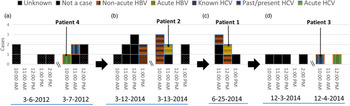
Based on serological testing and HBV and HCV registry matching, 2 clusters of HCV and 2 clusters of HBV were identified among patients who underwent MPI stress testing at clinic A between 2012 and 2014 (Fig. 1a–d). None of the newly identified patients reported behavioral risk factors on interview.
Hepatitis status of patients by date and time of MPI stress test, clinic A, West Virginia, 2012–2014. The 4 clusters of viral hepatitis are organized chronologically according to date and time of MPI. Patients 1–4 are numbered sequentially based on the order in which they were identified during the investigation. (a) March 6 and 7, 2012 (N = 9). Patient 4 (“acute hepatitis B”) and a deceased HBV positive patient (“nonacute hepatitis B”) were identified through the HBV registry cross-match. Overall, 5 patients could not be tested (“unknown”): 4 were deceased, and 1 refused. Also, 2 patients were tested and were negative (“not a case”). No patients had evidence of HCV or HIV infection. (b) March 12–13, 2014 (N = 15). Patient 2 was identified through registry cross-match with acute HCV and a positive HCV test from April 30, 2014. Also, 4 patients with past or present HCV were identified, including a cluster of 3 patients with past or present HCV 1a with consecutive procedure times between 10:19 and 10:59 a.m. on March 13, and 96.96%–99.24% molecular identity. Patient 2 was also known to have HCV genotype 1a but had a resolved infection at the time of investigation. Also, 2 patients with HCV seen at 1:05 p.m. (“past or present HCV”) and 1:46 p.m. (“known case”) on March 12 had resolved infection, 2 patients refused hepatitis testing (“unknown”) and 7 tested negative for HCV (“not a case”). None of these patients had positive results for HIV and 2 had evidence of past infection with HBV. (c) June 25, 2014 (N = 6). Patient 1 presented with acute elevation of ALT to 888 IU/mL on October 10, 2014 and was diagnosed with HCV. Also, 3 patients with consecutive MPI procedure times between 11:47 a.m. and 12:33 p.m. were HCV genotype 1a positive, including 2 with past or present HCV and 1 patient with acute HCV (patient 1). HCV isolates from 2 patients, including patient 1, showed 98.48% molecular identity. The patient with past or present HCV seen at 12:33 p.m. had a resolved infection. Also, 3 patients were negative for HCV (“not a case”). All patients had negative tests for HBV and HIV. (d) December 3–4, 2012 (N = 8). Patient 3 was identified through surveillance with positive anti-HBc IgM, HBsAg and ALT of 345 IU/mL on May 30, 2015, but was classified as “nonacute” because of lack of symptoms clearly related to HBV infection. A deceased patient with acute HBV was identified through registry cross-match. Also, 1 patient refused testing (“unknown”) and 3 were negative for HBV (“not a case”). HCV tests results were negative and HIV testing was not done. Note. ALT, alanine aminotransferase; anti-HBc IgM, immunoglobulin M antibody to hepatitis B core antigen; HBsAg, hepatitis B surface antigen; HBV, hepatitis B virus; HCV, hepatitis C virus; HIV, human immunodeficiency virus; MPI, myocardial perfusion imaging.

The clinic A technician tested negative for HIV, HBV, and HCV. The physician had detectable HBV surface antibody but was otherwise negative for HIV, HBV, or HCV.
Laboratory data
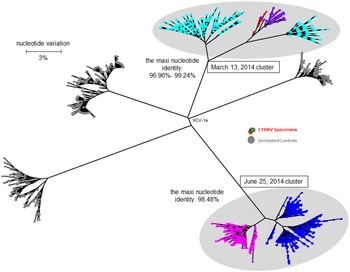
HCV RNA from 2 patients who underwent MPI stress testing on June 25, 2014 showed 98.48% nucleotide sequence identity (Fig. 2). HCV RNA from 3 patients who underwent stress testing on March 13, 2014 showed 96.96% to 99.24% sequence identity.
HCV E1-HVR1 quasispecies sequences, West Virginia, 2014. Quasispecies analysis demonstrating 98.48% molecular identity between 2 patients who underwent MPI on June 25, 2014, including patient 1; and 96.96%–99.24% molecular identity between 3 patients who underwent MPI on March 13, 2014. (E1-HVR1 region, 264 bp in length, only unique NGS454 sequences are shown.) Note. bp, base pairs; E1, envelope protein 1; HCV, hepatitis C virus; HVR1, hypervariable region 1; NGS454, the next-generation sequencing platform by Roche 454.

Infection control and clinic practices
Prior to March 27, 2015, clinic A received 4 doses of 99mTc sestamibi daily, calibrated to 40 millicuries as of 10:00 a.m., 12:00 p.m., 2:00 p.m., and 4:00 p.m. Usually, 4 patients were scheduled for MPI daily; however, the physician accepted walk-in patients and diluted the doses on a bench top in the hot lab to accommodate the extra patients, using a fresh vial of single-dose saline and a 3-cmReference Zibbell, Asher and Patel3 syringe.
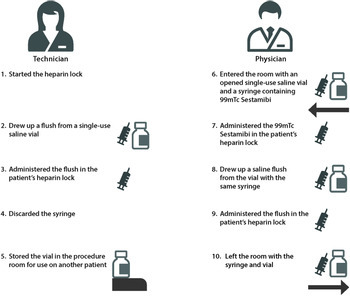
Figure 3 shows routine injection practices in the procedure room of the cardiology clinic. Briefly, the technician started the patient’s heparin lock. The physician entered the procedure room carrying a 3-cmReference Zibbell, Asher and Patel3 syringe of 99mTc sestamibi enclosed in a metal casing (to minimize radiation exposure) and the saline vial that had been used to dilute isotope in the hot lab. After injecting 99mTc sestamibi into the patient’s heparin lock, the physician reused his syringe to draw up a saline flush from the vial he was carrying and injected the flush in the heparin lock. The physician then returned to the hot lab, and discarded the needle, syringe, and vial.
Technician and physician injection practices in the cardiology clinic procedure room. With every patient seen in the cardiology clinic, the technician carried out steps 1–5 and the physician carried out steps 6–10. In step 6, the physician entered the procedure room with the single-dose vial that had been used for dilution of 99mTc sestamibi in the hot lab, and a 3 cmReference Zibbell, Asher and Patel3 syringe containing 99mTc sestamibi enclosed in a metal casing to minimize radiation exposure. The physician carried out steps 7–9 and left the procedure room (step 10) carrying the syringe and vial back to the hot lab to be discarded.

Infection control recommendations
On March 25, 2015, we recommended that clinic A (1) replace all saline vials with prepackaged single-use saline flushes, (2) order only patient-specific precalibrated doses of 99mTc sestamibi, (3) cease dilution of pharmacy-prepared doses on the bench, (4) switch to needleless or retractable systems for injection, and (5) ensure all staff that perform invasive procedures complete bloodborne pathogen and infection control trainings and obtain HBV vaccine.
Compounding pharmacy
On average, the compounding pharmacy prepared 99mTc sestamibi for 45–50 patients at 15 facilities daily and tWBC for 3–4 patients per week. Orders of 99mTc sestamibi were prepared and packaged for delivery by 7:30 a.m. Patient blood for tWBC arrived in a lead-lined container to a completely separate preparation room later in the day; all waste was discarded in that room and the only item to leave the room was the tWBC in the same lead-lined container used for delivery of the patient blood. On 2 days, tWBCs were prepared and HCV clusters were detected. On March 13, 2014, 99mTc sestamibi was prepared 4 hours before tWBC preparation, and on June 25, 2014, 99mTc sestamibi was prepared 3 hours before tWBC preparation. None of 4 patients who had tWBC prepared on March 11–13, 2014, and June 23–25, 2014 were identified in the HBV or HCV registries. No breaches of infection control, environmental cleaning, or aseptic technique were identified.
Patient notification
Beginning March 11, 2016, patients who had undergone MPI at the cardiology clinic between March 1, 2012, and March 27, 2015, were notified by mail of potential exposure to bloodborne pathogens, advising consideration of testing for HBV, HCV, and HIV infections. Because of resulting media coverage, an elderly woman (patient 5) self-reported a diagnosis of HCV after undergoing MPI in July 2010 at clinic A. Patient 5 had been monitored monthly by her physician, who noted elevated transaminases in October 2010, prompting him to order diagnostic testing which returned positive for HCV. The patient denied any HCV risk factors and her physician did not know why she became infected. In the ensuing weeks, 3 additional patients self-reported HCV after undergoing MPI at Clinic A between July 2010 and June 2011. Therefore, on May 9, 2016, a media announcement was released expanding notification to all patients seen at clinic A through March 27, 2015.
Discussion
This outbreak of HBV and HCV occurred as 4 distinct transmission clusters between March 2012 and December 2014 at an outpatient cardiology clinic (Fig. 1a–d). After patient notification, 4 additional patients self-reported HCV in temporal association with MPI suggesting possible viral hepatitis transmission in association with the clinic as far back as 2010. Even though we were unable to characterize the exact mode of viral hepatitis transmission, we recommended safe injection practices, including single-use flushes and needleless injection equipment. After the clinic implemented these recommendations, no further cases were identified.
This outbreak illustrates both the importance and the challenge of recognizing an index case of acute HBV or HCV that might be associated with a healthcare-associated outbreak. Clinicians in the United States are often the first to recognize viral hepatitis outbreaks related to healthcare exposure,Reference Radcliffe, Bixler and Moorman10,Reference Branch-Elliman, Weiss, Balter, Bornschlegel and Phillips14,Reference Alroy-Preis, Daly and Adamski17,Reference Greeley, Semple and Thompson23 as occurred with patient 1. Patient 1 had several medical encounters but no history of high-risk behaviors. Because patient 1 had no reported symptoms of acute HCV, a public health investigation would not have been conducted without physician notification. Outbreak recognition can also occur from review of surveillance case reports24 as occurred with patient 3. Recognition is challenging because fewer than one-third of adults with acute HBV infectionReference McMahon, Alward and Hall25 and approximately one-third of persons with acute HCV infectionReference Hoofnagle26 have symptoms. In addition, surveillance data underestimate the occurrence of acute HBV and HCVReference Klevens, Liu, Roberts, Jiles and Holmberg27 and surveillance case definitions are insensitive compared to physician diagnosis.Reference Onofrey, Aneja and Haney28 Finally, the prevalence of chronic HCV in the United States is estimated at 1%Reference Hofmeister, Rosenthal and Barker29; therefore, the overwhelming majority of patients newly diagnosed with HCV have chronic, nonacute infection, and the source of infection cannot be determined.
Although outbreaks of HBVReference Greeley, Semple and Thompson23 and HCVReference Foster, Grigg and Hagon13,Reference Branch-Elliman, Weiss, Balter, Bornschlegel and Phillips14,24,Reference Fischer, Schaefer and Labus30–Reference Coyle, Goerge and Kathryn Kacynski32 related to unsafe injection practices are infrequently recognized, unsafe injection practices have been described in a sizeable minority of health settings. In one survey, 43% of 370 physicians from 8 states reported that healthcare personnel in their workplace reentered multidose vials with the same syringe for an additional dose for the same patient; yet only 26% of physicians reporting this practice indicated that multidose vials are never used for >1 patient in their workplace.Reference Kossover-Smith, Coutts and Hatfield33 In an observational study of 31 clinics, almost 20% stored single use vials for use on another patient.Reference Anderson, Weissburg and Rogers34 Unsafe injection practices resulted in notification of more than 66,768 patients related to 38 events in 24 states between 2012 and 2018.Reference Schaefer, Perkins and Perz35 More than half of the events involved exposures occurring in a nonhospital setting (n = 21, 55%) and were identified on the basis of unsafe practices without documentation of disease transmission (n = 25, 66%).Reference Schaefer, Perkins and Perz35
We were unable to characterize the precise mechanism of transmission of HBV and HCV in clinic A. Although infection control breaches at a compounding pharmacy have previously resulted in HCV transmission,Reference Patel, Larson and Castel36 we found no evidence of infection control breaches and no opportunities for contamination from processing of blood at the compounding pharmacy. Both the technician and physician at clinic A tested negative for HBV, HCV, and HIV infections. The technician and physician at clinic A denied that a vial entered with a used syringe from 1 patient could have been subsequently used for another patient; however, the most likely explanation for multiple transmission events (Fig. 1a–d) is inadvertent reuse of a saline vial contaminated by syringe reuse (eg, step 8, Fig. 3). Both the technician and the physician routinely reused single-dose vials in the procedure room; inadvertent reuse of a contaminated vial for another patient might have occurred in either the procedure room or the hot lab, resulting in transmission of viral hepatitis. Injection safety breaches similar to those described in this report have been associated with clusters of HBVReference Greeley, Semple and Thompson23 and HCV.Reference Foster, Grigg and Hagon13,Reference Branch-Elliman, Weiss, Balter, Bornschlegel and Phillips14,24,Reference Fischer, Schaefer and Labus30–Reference Coyle, Goerge and Kathryn Kacynski32 The CDC has developed resources and recommendations for clinicians to ensure that safe injection practices are used in all healthcare settings.37 Relevant recommendations include not entering medication vials with a used syringe and dedicating single-dose vials for 1 patient only.
We identified several limitations in our investigation. First, patient interviews were conducted 6 months or more after the procedure, potentially resulting in recall bias; response to viral hepatitis risk factor questions were self-reported, potentially resulting in information bias. Second, molecular testing was unavailable for some cases of HCV and all cases of HBV because the infection resolved or was successfully treated, the patient refused testing, or the patient was deceased. For example, we were unable to determine whether the HCV cases from March 12, 2014 were related to those from March 13, 2014. Third, HCV is frequently asymptomatic, so the date of infection cannot be determined for some cases who tested positive after the procedure. Fourth, the West Virginia HBV and HCV registries do not contain all HBV and HCV cases because some viral HCV cases may not have been reported and registries are incomplete. This factor, taken with the fact that only 33% of adults with acute HCV or acute HBV infections have symptoms, suggests that bloodborne pathogen infections associated with this clinic may be underrecognized using registry cross-match. Fifth, the times for stress tests were the only procedure times documented by clinic A. There was no information on when intravenous access was started or when 99mTc sestamibi or other medications were administered. Each patient spent ˜2 hours in the clinic, so there was substantial overlap of patient care when multiple patients were scheduled the same day. Sixth, environmental cleaning and hand hygiene procedures were not reviewed at the clinic in detail; however, it is unlikely that either of these could explain clusters of 3–6 patients with HCV. Our report illustrates the strengths of multiple methods of case finding, including registry cross-match, patient call back for serological testing, and media notification, detailed patient interviews,19 and molecular analysis.Reference Campo, Xia and Dimitrova38 Ultimately, the outbreak was brought to a close after the clinic implemented good injection safety practices.
Adherence to good infection control practices in all healthcare environments is a fundamental responsibility of all health professionals. Providers practicing in outpatient settings can access CDC guidelines for infection prevention and infection prevention checklists online.39 When systems promoting safe injection practices fail, patient safety depends on recognition and reporting of unsafe injection practices,Reference Arnold, Melville, Morehead, Vaughan, Moorman and Crist31,Reference Patel, Larson and Castel36 physician reporting of index cases or clusters of acute viral hepatitis plausibly related to transmission in healthcare,Reference Radcliffe, Bixler and Moorman10,Reference Branch-Elliman, Weiss, Balter, Bornschlegel and Phillips14,Reference Alroy-Preis, Daly and Adamski17,Reference Greeley, Semple and Thompson23 and public health surveillance systems designed to detect the outlier case of acute HBV or acute HCV in a patient with no behavioral risk factors who has exposures in healthcare settings.24
Acknowledgments
The authors thank the following contributors: Joseph I Golden, MD, MPH, Sophia, West Virginia; Carrie Thomas, PhD, Lena Anil, PhD, Dondeena McGraw, BS, Loretta Haddy, PhD, MS, West Virginia Bureau for Public Health, Charleston, West Virginia; Anne Moorman, BSN, MPH, Eyasu H Teshale, MD, MPH, Scott D Holmberg MD MPH, John Ward MD, Division of Viral Hepatitis, Centers for Disease Control and Prevention, Atlanta, Georgia; Duc Nguyen MD, Joseph Perz PhD, Division of Healthcare Quality Promotion, Centers for Disease Control and Prevention, Atlanta, Georgia; Brenda Holmes, Graphic Services Branch, Centers for Disease Control and Prevention, Atlanta, Georgia. The findings and conclusions in this report are those of the authors and do not necessarily represent the official position of the Centers for Disease Control and Prevention.
Financial support
West Virginia Bureau for Public Health and Centers for Disease Control and Prevention.
Conflicts of interest
The authors report no conflicts of interest.