Introduction
Poor impulse control is common in patients with Parkinson's disease (PD). Indeed, about 14% suffer from a variety of problematic behaviours characterised by a failure to resist an impulse, drive, or temptation to perform an action that is ultimately harmful to the person or to others because of its excessive nature, known as ‘impulse control disorders’ (ICDs) (Voon et al. Reference Voon, Mehta and Hallett2011a ). In PD, ICDs include compulsive gambling, shopping, sexual behaviour, eating and related disorders (including hobbyism, punding, and dopamine dysregulation syndrome) (Voon & Fox, Reference Voon and Fox2007). However, the term ‘impulsivity’ is applied somewhat indiscriminately to individuals, behaviours, and cognitive processes. In fact, impulsivity can have multiple expressions and can be used to refer to specific acts, trait-like personality characteristics or cognitive performance on laboratory tasks (Enticott & Ogloff, Reference Enticott and Ogloff2006; Cyders & Coskunpinar, Reference Cyders and Coskunpinar2011). In the current study, we focus on impulsivity as a multidimensional trait-like construct.
Whiteside & Lynam (Reference Whiteside and Lynam2001) developed the Urgency–Premeditation–Perseverance–Sensation seeking (UPPS) Impulsive Behaviour model, which includes four dimensions of impulsivity: urgency (the tendency to experience strong reactions, frequently under conditions of negative affect); (lack of) premeditation (the tendency to think and reflect on the consequences of an act before engaging in that act); (lack of) perseverance (the ability to remain focused on a task that may be boring or difficult); and sensation seeking (the tendency to enjoy and pursue activities that are exciting and openness to trying new experiences). Many studies using this multidimensional conception of impulsivity have revealed relationships between the four dimensions of impulsivity and various psychopathological states and problematic behaviours, such as addiction, compulsive buying, problem gambling, aggressivity, antisocial conduct, attention deficit and hyperactivity disorders, bulimia, and risky sexual behaviours in non-brain-damaged persons (Miller et al. Reference Miller, Flory, Lynam and Leukefeld2003; Miller & Lynam, Reference Miller and Lynam2003; Smith et al. Reference Smith, Fischer, Cyders, Anus, Spillane and McCarthy2007; Billieux et al. Reference Billieux, Gay, Rochat and Van der Linden2010; Lopez et al. Reference Lopez, Dauvilliers, Jaussent, Billieux and Bayard2015). We therefore contend that this multidimensional approach to impulsivity should allow for a better comprehension of impulse-related behaviours in PD.
Although impulsive trait-like personality characteristics are considered a risk factor for developing ICDs (Weintraub et al. Reference Weintraub, Koester, Potenza, Siderowf, Stacy, Voon, Whetteckey, Wunderlich and Lang2010; Voon et al. Reference Voon, Sohr, Lang, Potenza, Siderowf, Whetteckey, Weintraub, Wunderlich and Stacy2011b ), the literature does not robustly support the notion that patients with PD have a characteristic premorbid personality profile (Poletti & Bonuccelli, Reference Poletti and Bonuccelli2012b ). However, case-control studies have indicated that patients with PD reported higher levels of impulsivity than controls on self-report scales such as the Barratt Impulsive Behaviour scale (Fonoff et al. Reference Fonoff, Fonoff, Barbosa, Quaranta, Machado, Andrade, Teixeira and Fuentes2014; Nombela et al. Reference Nombela, Rittman, Robbins and Rowe2014). Furthermore, ICD-positive patients with PD scored higher than ICD-negative patients on the Barratt scale (Isaias et al. Reference Isaias, Siri, Cilia, De Gaspari, Pezzoli and Antonini2008; Voon et al. Reference Voon, Sohr, Lang, Potenza, Siderowf, Whetteckey, Weintraub, Wunderlich and Stacy2011b ; Bentivoglio et al. Reference Bentivoglio, Baldonero, Ricciardi, De Nigris and Daniele2013). ICDs in PD have also been associated with high novelty seeking (Voon et al. Reference Voon, Sohr, Lang, Potenza, Siderowf, Whetteckey, Weintraub, Wunderlich and Stacy2011b ), a heritable bias in the activation or initiation of behaviours such as frequent exploratory activity in response to novelty, impulsive decision-making, extravagance in approach to reward cues, quick loss of temper and active avoidance of frustration (Cloninger et al. Reference Cloninger, Svrakic and Przybeck1993). In addition, the literature shows that PD alters cognitive performance on behavioural tasks that tap into the different types of cognitive processes at play in various aspects of impulsivity (Robert et al. Reference Robert, Drapier, Verin, Millet, Azulay and Blin2009; Kudlicka et al. Reference Kudlicka, Clare and Hindle2011; Poletti & Bonuccelli, Reference Poletti and Bonuccelli2012a ; Nombela et al. Reference Nombela, Rittman, Robbins and Rowe2014), such as prepotent response inhibition, resistance to distractor interference, delayed response, and distortions in elapsed time. Furthermore, abnormalities in reward processing have also been documented in PD. Reward processing is generally assessed through the use of decision-making or risk-taking tasks such as the Game of Dice Task (GDT; Brand et al. Reference Brand, Labudda, Kalbe, Hilker, Emmans, Fuchs, Kessler and Markowitsch2004; Poletti & Bonuccelli, Reference Poletti and Bonuccelli2012a ; Nombela et al. Reference Nombela, Rittman, Robbins and Rowe2014), in which patients with PD tend to take more risks.
Although these studies have shed light on impulsivity in patients with PD, there is still no validated scale based on a comprehensive theoretical framework and specifically designed to assess the various impulsivity-related traits in PD. In addition, impulsivity cannot be validly compared in patients and controls without first establishing the measurement invariance across these groups of participants. Measurement invariance refers to whether or not a measure assesses the same trait in the same way in different groups (Widaman et al. Reference Widaman, Stacy and Borthwick-Duffy1993) and can be tested with confirmatory factor analyses. The test consists in assessing whether the items relate to the underlying latent trait with the same magnitude across different groups. If they do, the trait can be considered to hold the same meaning in different groups and its characteristics can therefore be compared. Thus, comparisons across multiple groups (e.g. on mean differences on the trait) are not meaningful if the scale is not measurement invariant, because in that case, group differences could be related to the different item-trait relations in the two groups, rather than to differences in the trait (Reise et al. Reference Reise, Widaman and Pugh1993). Despite studies emphasising group differences in impulsivity traits in patients with PD (with and without ICDs) and controls, there has been little appreciation of the importance of measurement invariance in attempts to evaluate these group differences. Once measurement invariance has been empirically established, one may then inquire about structural invariance, which addresses whether the characteristics (means, variances, covariances) of the latent variables representing the investigated traits are equal across multiple groups.
Our study seeks to examine both the measurement invariance and the structural invariance of a well-validated measure of four predispositions toward rash action that has been shown to have strong, clinically relevant relationships with risky outcomes: the short form of the UPPS Impulsive Behaviour Scale. This study used confirmatory factor analyses (CFA) to examine measurement invariance and structural invariance on this scale between patients with PD and healthy controls. We hypothesised that the patients would demonstrate greater urgency, lack of premeditation, lack of perseverance and sensation seeking than controls, which is in line with the executive/attentional impairments and abnormal reward processing frequently described in these patients. In addition, patients with ICDs should present even greater levels of impulsivity on these dimensions. Finally, we examined whether the four impulsivity traits were differentially related to risky decisions in patients with PD after gender, duration of the disease, years of education, agonist dopaminergic use and depressive symptoms were controlled for.
Method
Participants
Seventy-eight non-consecutive non-demented patients with idiopathic PD were enrolled in this study. The clinical diagnosis of PD was based on the UK Parkinson's Disease Society Brain Bank (Fahn et al. Reference Fahn, Elton, Fahn, Marsden, Calne and Golstein1987). Dementia was excluded using specific diagnostic criteria (Emre et al. Reference Emre, Aarsland, Brown, Burn, Duyckaerts, Mizuno, Broe, Cummings, Dickson, Gauthier, Goldman, Goetz, Korczyn, Lees, Levy, Litvan, McKeith, Olanow, Poewe, Quinn, Sampaio, Tolosa and Dubois2007). The l-dopa equivalent daily dose (LEDD) was calculated both for dopamine agonists (DA-LEDD) and for dopamine agonists plus l-dopa (total LEDD) (Tomlinson et al. Reference Tomlinson, Stowe, Patel, Rick, Gray and Clarke2010). The mean duration of PD at the time of study was 7 years (range 1–23). The mean motor severity of the disease was 2 (range 1–3) according to the Hoehn and Yahr scale (Hoehn & Yahr, Reference Hoehn and Yahr1967) and 24 (range 5–80) on the Unified Parkinson's Disease Rating Scale (UPDRS, section III) scale (Goetz et al. Reference Goetz, Tilley, Shaftman, Stebbins, Fahn, Martinez-Martin, Poewe, Sampaio, Stern, Dodel, Dubois, Holloway, Jankovic, Kulisevsky, Lang, Lees, Leurgans, LeWitt, Nyenhuis, Olanow, Rascol, Schrag, Teresi, van Hilten and LaPelle2008).
All patients were tested while taking their regular dopaminergic medication. The percentage of patients on least one DA was 73% [median DA-LEDD = 300 (range 67–670)]. Of the sample, 84% were taking l-dopa [median LEDD = 537 (range 150–1650)]. The mean total LEDD was 650 mg (range 133–2000). Nineteen (24%) patients were taking antidepressants and 16 (20%) benzodiazepines. A least one active ICD was identified in 20% of patients (n = 16). Frequencies of active ICDs were as follows: compulsive sexual behaviour (7%), pathological gambling (1.2%), compulsive buying (2.5%), binge-eating disorder (1.2%), and punding (12.8%). Co-morbid ICDs were recorded in 3.8% of patients.
The control group consisted of 96 participants from the general population with no history of neurological or psychiatric disorders. In both groups, overall cognitive functioning was assessed with the Mini-Mental State Examination (MMSE; Kalafat et al. Reference Kalafat, Hugonot-Diener and Poitrenaud2003). Only participants for whom a close relative (e.g. a spouse or adult child) could complete the informant version of a questionnaire assessing impulsivity changes were included in the study. All participants and relatives spoke French fluently.
Impulsivity measure
The informant's short version of the UPPS Impulsive Behaviour Scale (Rochat et al. Reference Rochat, Delbeuck, Billieux, d'Acremont, Van der Linden and Van der Linden2008) was used to assess the multidimensional construct of impulsivity. This 16-item scale assesses changes that might occur in four components of impulsivity (urgency, lack of premeditation, lack of perseverance, and sensation seeking) in the course of a neurodegenerative disease. Each informant had to assess impulsivity changes on a 5-point Likert scale (from –2 ‘much less than 10 years ago’ to +2 ‘much more than 10 years ago’). The total score ranges from –8 to +8 for each component. Thus, a positive score indicates an increase in impulsivity, a negative score indicates a decrease in impulsivity, and a score of 0 indicates no changes compared with the baseline (10 years ago).
Psychopathological assessment
Diagnosis of ICD. Patients were given the recommended semi-structured interview for drug-induced behaviours associated with PD (Voon & Fox, Reference Voon and Fox2007). This semi-structured interview, which relies on specific diagnosis criteria, was developed by different authors in the field. It includes the assessment of current compulsive gambling (APA, 2000), buying (Lejoyeux et al. Reference Lejoyeux, Tassain, Solomon and Adès1997), sexual behaviour (Voon et al. Reference Voon, Hassan, Zurowski, de Souza, Thomsen, Fox, Lang and Miyasaki2006), eating (APA, 2000), compulsive use of dopaminergic treatment (Giovannoni et al. Reference Giovannoni, O'Sullivan, Turner, Manson and Lees2000), punding (Fernandez & Friedman, Reference Fernandez and Friedman1999), hobbyism (Voon et al. Reference Voon, Hassan, Zurowski, de Souza, Thomsen, Fox, Lang and Miyasaki2006), and walkabout (Evans et al. Reference Evans, Katzenschlager, Paviour, O'Sullivan, Appel, Lawrence and Lees2004). The DSM-IV-TR research criteria for binge-eating disorder were modified to include general overeating in addition to discrete binge-eating episodes. Diagnosis of ICD has been coded as a dichotomous variable (no ICD v. at least one ICD).
Beck Depression Inventory II (BDI-II; Beck et al. Reference Beck, Steer and Brown 1998 ). The BDI-II measures the severity of self-reported depressive symptoms. Each symptom is rated on a 4-point scale ranging from 0 to 3, and total scores can range from 0 to 63.
GDT
The computerized GDT is a laboratory measure of decision-making under risky conditions (Brand et al. Reference Brand, Kalbe, Labudda, Fujiwara, Kessler and Markowitsch2005). In this task, participants are asked to maximize their fictitious starting capital of €1000 within 18 throws of a single virtual die. On each trial, participants have to guess which number (1–6) will be thrown next. They make their choice with a mouse click on one number, or a combination of two, three, or four numbers and then the die is thrown once. If their guess was correct, participants win a certain amount of money. If not, they lose the same amount of money. Each choice is associated with explicit, stable gains and losses dependent on the probability of occurrence of choice (e.g. a single number with a winning probability of 1:6 = €1000 gain/loss; a combination of four numbers with a winning probability of 4:6 = €100 gain/loss). The gains and losses related to the different alternatives are permanently shown on the screen, as is the fluctuating fictitious capital. The choice of a single number or a combination of two numbers is judged to be ‘disadvantageous’, as it is associated with winning probabilities lower than 50%, leading to long-term losses. In contrast, the choice of combinations of three or four numbers is evaluated as ‘advantageous’, because winning probabilities are 50% and higher, resulting in a modest positive balance. A net score is computed by subtracting the number of advantageous choices from the number of disadvantageous choices. Accordingly, a positive net score indicates non-risky, advantageous decisions, whereas a negative net score indicates risky, disadvantageous decisions.
Study procedure
Patients with PD were recruited in two neurological units (Gui de Chauliac University Hospital and Beau Soleil Clinic) in Montpellier (France). At the time of study, all patients with PD were examined by a movement disorder specialist (C.G.). All controls were community-dwelling adults who were recruited by means of advertisements and personal contacts and through snowballing techniques. All participants were individually tested during a single session. Experienced psychologists (A.R., S.B. and Y.H.) collected socio-demographic, clinical and neuropsychological data. The informant version of the UPPS was completed by the participants’ relatives. The authors assert that all procedures contributing to this work comply with the ethical standards of the relevant national and institutional committees on human experimentation and with the Helsinki Declaration of 1975, as revised in 2008. All participants gave their informed consent to participate in the study, which was approved by the hospital's ethics committee.
Statistical analyses
First, t tests and χ2 tests of homogeneity were used to compare patients with PD and controls on demographic variables, general cognitive functioning, depression symptoms and risk-taking as assessed by the GDT. Then CFAs were computed with IBM SPSS Amos version 22 (Arbuckle, Reference Arbuckle2011) to test the expected four-correlated-factor structure against alternative factor models. After that, confirmatory multigroup analyses were conducted to assess measurement invariance, that is, whether factor structures and loadings were invariant across groups. Structural invariance was then assessed to determine whether the variances and means of the UPPS subscales differed between groups. For all models, the intercepts of the items were set at 0. In multigroup analysis, this procedure allows for the simultaneous estimation of both group means on the four factors of impulsivity and at the same time imposes scalar invariance (equality of factor loadings and items’ intercepts) across groups. This step is fundamental to ensure that the scales are interpreted equivalently by both control and patient groups and to allow for comparisons of means. The means of the four impulsivity factors were then compared between patients and control participants and also between control participants and patients with and without ICDs. Finally, based on this model, factor scores on the four UPPS subscales were estimated to further explore the relationships between impulsivity and risk taking as assessed by the GDT, while controlling for depressive symptoms (BDI-II), duration of the disease, dopaminergic agonist dose (DA-LEDD) and demographic variables (sex, years of education) using structural equation modelling in the clinical group.
We used maximum likelihood estimation for each model, and goodness-of-fit (GOF) was assessed using the χ2/df ratio, the root mean square error of approximation (RMSEA), the standardized root mean square residual (SRMR) and the comparative fit index (CFI). An RMSEA between 0 and 0.05 is commonly used to indicate an excellent fit, and a result between 0.05 and 0.08 indicates an acceptable fit (Yuan & Bentler, Reference Yuan and Bentler1998). Similarly, an SRMR between 0 and 0.05 indicates an excellent fit, and an SRMR between 0.05 and 0.10 an acceptable fit. Conversely, a CFI of >0.90 indicates an acceptable fit of the model. We computed likelihood ratio tests to assess the difference in the χ2 values between two compared nested models, in relation to their respective degrees of freedom. When such a difference was not significant, meaning that estimating additional parameters did not significantly increase the quality of the model, we retained the more parsimonious model. All analyses were conducted with a significance threshold of α = 0.05, two-tailed.
Results
Group comparisons
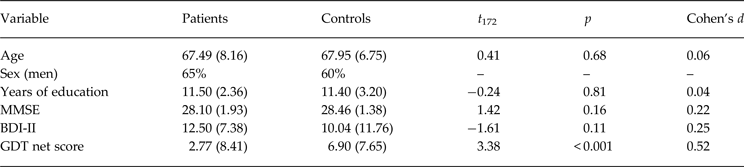
No significant differences were observed between patients and controls for age (p = 0.68), sex ratio [χ2(1, N = 174) = 0.45, p = 0.50], years of education (p = 0.81), MMSE score (p = 0.16) or level of depression (p = 0.11). However, a group effect was observed for the GDT net scores, indicating that patients made risky choices more frequently than controls (p = 0.001) (Table 1).
Means (standard deviation), t test statistics and effect size for demographic characteristics, self-report questionnaires and GDT results for patients with Parkinson's disease and control participants

GDT, Game of Dice Task; MMSE, Mini Mental State Examination; BDI-II, Beck Depression Inventory – II.
CFA
Based on previous validations of the UPPS Scale (e.g. Rochat et al. Reference Rochat, Delbeuck, Billieux, d'Acremont, Van der Linden and Van der Linden2008), we postulated a four-correlated-factor structure, which was compared to two alternative models: a one-factor structure and a four-uncorrelated-factor structure.
Nested model comparisons revealed that the expected four-correlated-factor structure fitted the data best (Table 2). GOF indices for the expected four-correlated-factor structure indicated that the model adjusted well to the data (χ2 = 202.04, df = 110, p < 0.001, χ2/df = 1.84, CFI = 0.91, RMSEA = 0.069, SRMR = 0.061), confirming the previously reported structure for the four interrelated facets of impulsivity. In addition, the reliability of latent factors was calculated for each group with the formula provided by Raines-Eudy (Reference Raines-Eudy2000). Urgency (0.63), lack of premeditation (0.73), lack of perseverance (0.75) and sensation seeking (0.78) presented acceptable reliability for controls. For patients, urgency (0.72) presented acceptable reliability, while lack of premeditation (0.81), lack of perseverance (0.87) and sensation seeking (0.83) presented good reliability.
Goodness-of-fit indices and comparison of nested models for alternative and postulated models of factor structure for the UPPS Scale in the whole sample

UPPS, Urgency–Premeditation–Perseverance–Sensation seeking Impulsive Behaviour Scale; CFI, Comparative fit index; RMSEA, root mean square error of approximation; SMR, standardized root mean square residual.
Δχ2 and Δdf refer to the difference in χ2 and degrees of freedom of the likelihood ratio test between the specified model and the alternative model on the preceding line. The expected model is the one with four correlated factors.
Multigroup factor analysis
To compare control participants and patients on the structure of the scale and mean levels, we performed a multigroup factor analysis based on the model with four correlated impulsivity factors. Measurement invariance was tested across groups by comparing a model that constrained factor loadings to be equal in controls and patients (model 2) with a model in which the loadings were estimated separately for the two groups (hence without equality constraints; model 1). Finally, two aspects of structural invariance were assessed. We compared the two groups’ heterogeneity by testing the equality of their factor variances (model 3). Then, because comparing levels of impulsivity on the four UPPS subscales between controls and patients was a major goal of this study, we compared models that forced the same factor means across groups (model 4) with a model that allowed for different means between controls and patients (and that constrained equality of intercepts).
The results showed that model 2 did not differ significantly from model 1 (Table 3). This indicates that the four facets of impulsivity are measured invariably in controls and patients with PD, and consequently, the factors can be compared in the two groups. However, models 3 and 4 did differ significantly from model 2, indicating that model fit worsened when variances and means were constrained to be equal in the two groups. Consequently, although the four facets have the same meaning in controls and patients with PD, variances and mean levels of impulsivity are different between groups, with patients presenting higher levels of impulsivity and greater variability than controls.
Comparison of nested models assessing measurement invariance between controls and patients

CFI, Comparative fit index; RMSEA, root mean square error of approximation; SMR, standardized root mean square residual.
Δχ2 and Δdf refer to the difference in χ2 and degrees of freedom of the likelihood ratio test between the specified model and the alternative model as follows:
a Model 1–Model 2 comparison.
b Model 2–Model 3 comparison.
c Model 2–Model 4 comparison.
Next, we estimated the factor scores of the four dimensions of impulsivity for each group based on the selected model (model 2). Because multigroup analyses revealed that mean impulsivity levels were different in patients and control participants, independent-sample t tests with separate variance estimates and Cohen's d were computed on the estimated factor scores for all participants. The results indicated that the patients’ means were significantly higher than controls’ on all four dimensions of impulsivity, with effect sizes ranging from medium to large (Table 4).
Mean factor scores (and standard deviations) on the four UPPS subscales by group

UPPS, Urgency–Premeditation–Perseverance–Sensation seeking Impulsive Behaviour Scale.
A positive score indicates more impulsivity and a negative score indicates less impulsivity than 10 years ago; 0 indicates no change.
a 0 not included in the 95% confidence intervals (thereby indicating a significant change in impulsivity compared to 10 years ago).
To further explore the discriminant validity of the scale, comparisons of means between the control group and patients with PD were also performed after the patient group was subdivided into two groups based on the presence or absence of ICDs (Table 5). The results revealed that patients without ICDs had greater levels of urgency, lack of premeditation and lack of perseverance than controls, but these two groups did not differ on sensation seeking. Patients with ICDs showed significantly greater impulsivity than controls for all dimensions. They also presented higher levels of sensation seeking and a marginally higher level of lack of premeditation than the patients without ICDs.
Mean factor scores (and standard deviations) on the four UPPS subscales for the control group and patients with and without ICDs (left panel), and t value (df) with separate variance estimates for group comparisons (right panel)

UPPS, Urgency–Premeditation–Perseverance–Sensation seeking Impulsive Behaviour Scale; ICD, impulse control disorder.
a 0 not included in the 95% confidence intervals (thereby indicating a significant change in impulsivity compared to 10 years ago).
b Marginally significant p = 0.059.
*p < 0.05. ** p < 0.01. ***p < 0.001.
Structural equation modelling based on factor scores for patients with PD
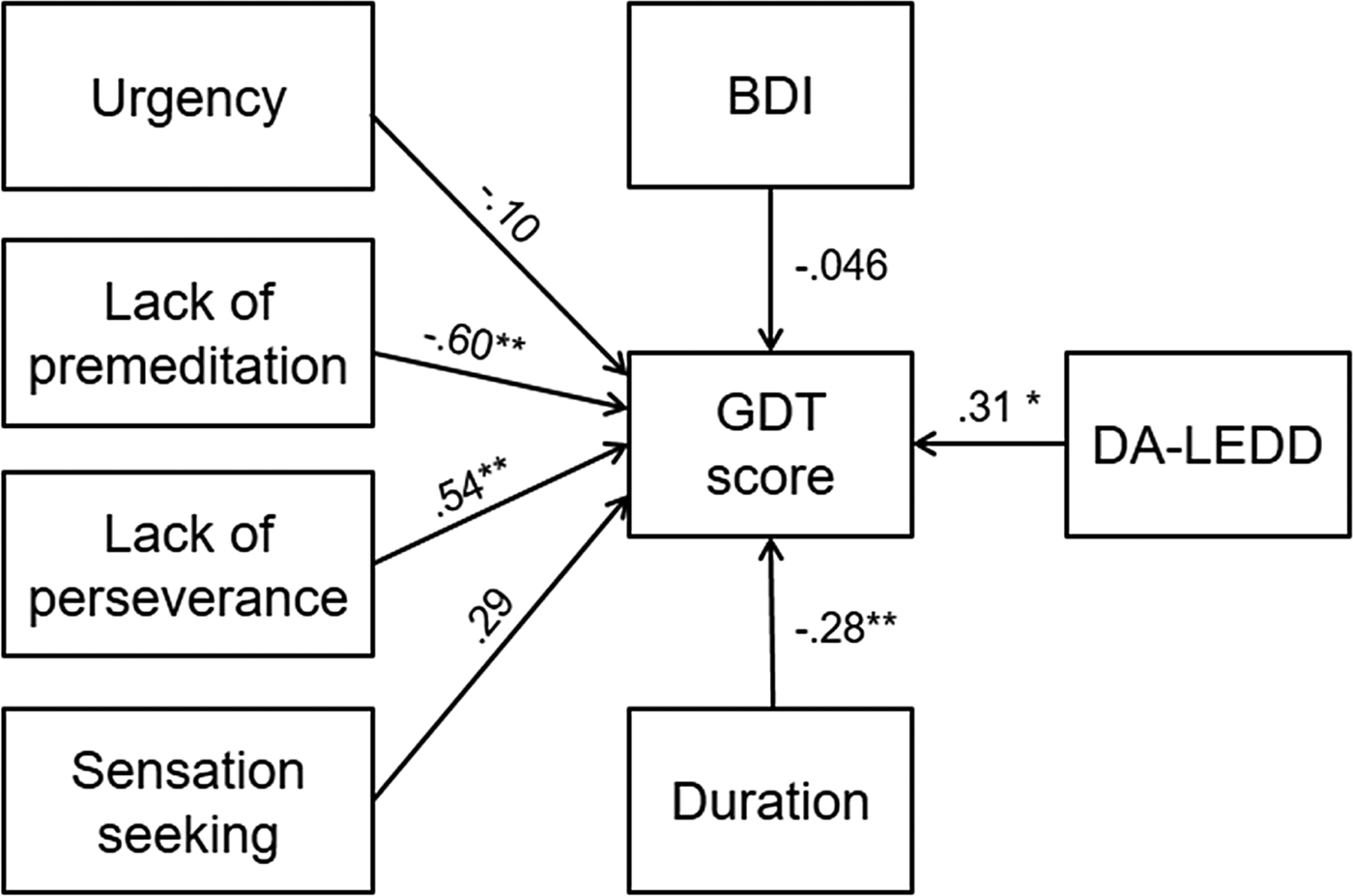
The second aim of this study was to assess the links between scores on the GDT and the four facets of impulsivity, DA-LEDD, duration of the disease, depressive symptoms (BDI) and demographic variables (sex, years of education). The variables were entered in an exploratory saturated structural equation model in which we expected GDT scores to be predicted by the other variables. Since gender and years of education did not add useful predictions to the model, we estimated a second model without these variables. Neither the covariance between duration of the disease and BDI, nor covariances between DA-LEDD and both impulsivity factors and BDI reached significance, hence these parameters were removed from the final model (Fig. 1).
Final structural equation model for Game of Dice Task (GDT) score prediction. Numbers above the arrows report standardised regression weights, *p < 0.05. ** p < 0.01. For the sake of clarity, covariances are not depicted. BDI, Beck Depression Inventory; DA-LEDD, l-dopa equivalent daily dose for dopamine agonists.

The final model presented an excellent fit (χ2 = 6.95, df = 6, p = 0.33, χ2/df = 1.16, CFI = 1.00, RMSEA = 0.045, SRMR = 0.042). The predictors explained 25.4% of the total variance in GDT score. Lack of premeditation (p = 0.005) and a longer duration of the disease (p = 0.009) were associated with greater risk taking on the GDT, whereas lack of perseverance (p = 0.003) and DA-LEDD (p = 0.002) were related to lower risk taking on the GDT. BDI score was not associated with GDT score (p = 0.90). Duration correlated with DA-LEDD (r = 0.21, p = 0.05). Thus, the longer the disease duration, the higher the dose of DA. In addition, duration also positively correlated with lack of premeditation (r = 0.31, p = 0.008) and lack of perseverance (r = 0.30, p = 0.007), and marginally with urgency (r = 0.21, p = 0.07), indicating that the longer the disease duration, the greater the impulsivity on these dimensions. BDI score, in turn, correlated with lack of perseverance (r = 0.25, p = 0.03) and sensation seeking (r = –0.24, p = 0.04): increased levels of depression were associated with greater lack of perseverance but lower sensation seeking. It should be noted that DA-LEDD was not significantly associated with any of the dimensions of impulsivity.
Discussion
The objectives of this study were to examine the measurement and structural invariance of the UPPS Scale for patients with PD and controls, and determine how the four impulsivity traits might differentially relate to risky decisions in a laboratory task.
The results indicated that the UPPS is a reliable scale for measuring impulsivity changes in both patients with PD and controls. Indeed, because measurement invariance was confirmed across groups, the comparisons between the groups on the UPPS Scale are valid. More specifically, the results indicated that the patients with PD presented greater changes and greater variances on each dimension of impulsivity compared to 10 years before than the controls did. In addition, patients with ICDs showed greater levels of sensation seeking than patients without ICDs and controls, whereas sensation seeking was the only dimension that did not differ between patients without ICDs and controls. The results therefore confirmed that impulsivity is common in PD, even in the absence of ICDs. We must now discuss the mechanisms underlying the increase in impulsivity in PD.
The various facets of impulsivity have been claimed to be related to specific cognitive processes, such as inhibition of a prepotent response (for urgency and premeditation), resistance to proactive interference in working memory and sustained attention (for perseverance), decision-making ability (for premeditation) and abnormal reward processing (for sensation seeking) (Bayard et al. Reference Bayard, Raffard and Gely-Nargeot2011; Rochat et al. Reference Rochat, Billieux, Juillerat Van der Linden, Annoni, Zekry, Gold and Van der Linden2013). On the one hand, the higher scores on the urgency, lack of premeditation and lack of perseverance dimensions of impulsivity in patients with PD are congruent with the inhibition of prepotent responses (Nombela et al. Reference Nombela, Rittman, Robbins and Rowe2014), sustained attention (Kudlicka et al. Reference Kudlicka, Clare and Hindle2011) and decision-making impairments observed even in the early phase of PD (Poletti & Bonuccelli, Reference Poletti and Bonuccelli2012a ). On the other hand, the significant increase in sensation seeking in patients with ICDs is in line with previous work emphasizing the role of this impulsivity facet in reward-seeking behaviours in PD (Evans et al. Reference Evans, Lawrence, Potts, Appel and Lees2005).
In this context, the positive relationships found between lack of premeditation and greater risk taking on the GDT are particularly interesting. Indeed, the GDT is considered to be a task that assesses decision-making under risk (Brand et al. Reference Brand, Labudda and Markowitsch2006) because decisions have to be made while explicit information about the probabilities for reinforcement and punishment is provided. Consequently, individuals can compute the risk associated with each alternative and make strategic choices; this outcome is congruent with previous results showing that decision-making under risk relates to controlled processes, such as inhibition of a prepotent response (e.g. Billieux et al. Reference Billieux, Gay, Rochat and Van der Linden2010). This observation had also been confirmed in PD (Brand et al. Reference Brand, Labudda, Kalbe, Hilker, Emmans, Fuchs, Kessler and Markowitsch2004; Euteneuer et al. Reference Euteneuer, Schaefer, Stuermer, Boucsein, Timmermann, Barbe, Ebersbach, Otto, Kessler and Kalbe2009). In this context, problems inhibiting a prepotent response are likely to preclude the activation of deliberative processing, which is necessary for considering the immediate benefits in relation to the future costs of an action when making a decision. Instead, decisions may be guided by the search for immediate gratification, resulting in unplanned actions that might have detrimental consequences for the individuals. These arguments are in line with the fact that lack of premeditation has been found to be significantly associated with impaired inhibition of prepotent responses in a sample of older adults with or without Alzheimer's disease (Rochat et al. Reference Rochat, Billieux, Juillerat Van der Linden, Annoni, Zekry, Gold and Van der Linden2013). In addition, impaired prepotent response inhibition has been described even in non-demented patients with PD (e.g. Obeso et al. Reference Obeso, Wilkinson, Casabona, Bringas, Álvarez, Álvarez, Pavón, Rodríguez-Oroz, Macías, Obeso and Jahanshahi2011). Consequently, we assume that this specific cognitive mechanism constitutes one possible explanation of the relationships between lack of premeditation and risk taking.
The results also indicated that greater perseverance was significantly associated with greater risk taking on the GDT. This result suggests that excessively low levels of impulsivity may also have detrimental consequences. Tentatively, this hyperperseverance might be due to cognitive inflexibility, which is frequently observed in patients with PD (Rustamov et al. Reference Rustamov, Rodriguez-Raecke, Timm, Agrawal, Dressler, Schrader, Tacik, Wegner, Dengler, Wittfoth and Kopp2013) and prevents them from distracting themselves in certain situations (e.g. thinking about anything but winning money).
Another relevant finding is the positive association found between DA-LEDD and GDT performance, namely that greater DA-LEDD was associated with less risky choices on the GDT. This result corroborates previous studies reporting a positive effect of dopaminergic medication on GDT performance in PD (Boller et al. Reference Boller, Barbe, Pauls, Reck, Brand, Maier, Fink, Timmermann and Kalbe2014), as well as a beneficial effect of dopamine agonists on dorsolateral prefrontal cortex-related executive functions in PD (Poletti & Bonuccelli, Reference Poletti and Bonuccelli2012a ). Thus, properly adjusted dopa therapy might increase the dorsolateral prefrontal cortex's regulatory influence over the ventral tegmental area and the nucleus accumbens and thus increase resistance to immediate gratification and pursuit of long-term goals while making a decision (Diekhof & Gruber, Reference Diekhof and Gruber2010). However, recent studies indicate that both serotonin and noradrenaline also play a crucial role in regulating various aspects of impulsivity in PD (Ye et al. Reference Ye, Altena, Nombela, Housden, Maxwell, Rittman, Huddleston, Rae, Regenthal, Sahakian, Barker, Robbins and Rowe2014, Reference Ye, Altena, Nombela, Housden, Maxwell, Rittman, Huddleston, Rae, Regenthal, Sahakian, Barker, Robbins and Rowe2015).
We acknowledge that this study has some limitations. First, we used a cross-sectional design. Longitudinal studies are needed to examine the changes in impulsivity in PD and its relevance as a predictor of ICDs. We also used the informant version of the UPPS, which was initially validated on a sample of patients with Alzheimer's disease (Rochat et al. Reference Rochat, Delbeuck, Billieux, d'Acremont, Van der Linden and Van der Linden2008). However, patients with PD may have relatively well-preserved insight into their impulsive symptoms (Papay et al. Reference Papay, Mamikonyan, Siderowf, Duda, Lyons, Pahwa, Driver-Dunckley, Adler and Weintraub2011). Consequently, future studies should also explore the psychometric characteristics of this short version of the UPPS in a self-administered format.
To conclude, this study indicates that a multifaceted approach to impulsivity could be relevant in understanding the behavioural symptoms that are frequently described in PD. Indeed, a better comprehension of the impulsivity changes in PD may help clinicians to quickly identify and manage patients at risk of developing impulsive features and ICDs. However, to further investigate the validity of the UPPS Scale, impulsivity should be assessed using complementary measures to questionnaires, such as observations in real-life situations or clinical impressions. In addition, the relationships between the dimensions of impulsivity and specific cognitive processes (e.g. inhibition of a prepotent response) remain to be investigated. Likewise, how the various dimensions of impulsivity and associated cognitive mechanisms relate to risk taking and ICDs in PD remains to be examined.
Declaration of Interest
None.