Introduction
The exact time to adopt new treatment and technology options has always remained a clinical challenge.Reference Potters, Raince and Chou1 In the past few years, the complexity of cancer treatment techniques has increased which has influenced overall patient safety, efficiency of treatment delivery and treatment effectiveness.Reference Potters, Raince and Chou1 There is a growing need to standardise the delivery of radiotherapy (RT) based on practices developed by published consensus guidelines.Reference Potters, Raince and Chou1
Inadvertent treatment interruptions often lead to prolongation of planned treatment time. In the case of RT with a curative intent, prolongation of planned treatment has been associated with inferior clinical outcomes.Reference Rudat, Nour, Hammoud and AbouGhaida2 This association has been consistent for several disease sites such as head and neck cancer, lung cancer, cervical cancer, breast cancer and other cancers.Reference Rudat, Nour, Hammoud and AbouGhaida2 Delay or prolongation of treatment is associated with a relative risk of local recurrence by up to 2% per day for specific malignancies.Reference Bese, Hendry and Jeremic3
The curative treatment for most cancers often involves RT accompanied with or without concurrent chemotherapy. However, the radical course of treatment spans for a long-drawn-out period of 5–7 consecutive weeks, depending on the nature of fractionation.
As per our experience, some of the most common acute side effects include nausea,Reference Habibi, Namimoghadam and Korouni4 vomiting,Reference Habibi, Namimoghadam and Korouni4 skin reactions,Reference Wei, Meng and Hou5 dysuria,Reference Janowski, Kole and Chen6 dysphagia,Reference Ursino, Seccia and Cocuzza7 diarrhoeaReference Stacey and Green8 and abdominal pain,Reference Shadad, Sullivan, Martin and Egan9 depending on the site of treatment. In patients with compromised nutritional status, loss of appetite, exquisite mucosal toxicity and vomiting are fairly common.Reference Koom, Ahn and Song10
A clinical audit provides key information associated with the RT process. Some of the key factors that are assessed include compliance to RT, waiting time for RT, intention of treatment, effect on overall treatment time and the integration with allied cancer modalities.Reference Kaur, Mohanti and Muzumder11 Thus, an audit has the potential to improve overall RT practice, specifically in developing countries such as India with an aim to improve treatment outcomes.Reference Kaur, Mohanti and Muzumder11
There are several reasons for unwanted interruptions in planned RT. Some of the most common include toxicities or patient-related factors such as myths about RT, financial issues, social taboos and alternative medicine treatment, among others. Non-adherence to planned RT eventually has an impact on local control and overall survival.Reference Gupta, Rastogi, Bhatnagar, Singh, Gupta and Choudhary12
Radiation oncologists prepare the patient in advance to ensure timely, effective and efficient care throughout the treatment process. Radiation oncologists are the only direct point-of-contact of patients undergoing RT. Key practices such as patient education sessions, relationship building, screening and needs assessment have been attributed with reduced anxiety among patients.Reference Elsner, Naehrig, Halkett and Dhillon13 Patient education through interactive platforms such as videos can enhance overall awareness about RT.Reference Matsuyama, Lyckholm, Molisani and Moghanaki14 In addition to educational and counselling sessions, understanding and responding to patients’ emotional cues can help reduce anxiety and increase preparedness for RT.Reference Halkett and O’Connor15 In a recent report, psycho-oncology support that involved referral to external services, in-house treatment and referral to family members helped patients cope with stress and discomfort.Reference Riedl, Gastl and Gamper16
However, despite these preventive measures, non-compliance toward the planned course of treatment remains one of the major causes of treatment failure. However, the major cause of apprehension and dissatisfaction is the fact that many patients assigned for RT do not comply with the complete treatment plan. Thus, this is one of the few studies of its kind to elucidate the factors that cause patient non-adherence to planned course of treatment. It also focuses on interventions to improve or enhance compliance to treatment. The objective of the study was to evaluate the frequency, factors, and reasons of patient non-adherence to RT in a tertiary cancer centre.
Materials and Methods
A retrospective observation audit was conducted comprising patients treated with radical, adjuvant or palliative RT at our centre from January 2018 to December 2018. The patient’s social, geographic and clinical information were obtained from the hospital’s electronic medical records and telephonic records. All patients treated from 01 January 2018 to December 2018 who had undergone RT were included in the study. An institutional ethics approval was obtained prior to the commencement of the study. All data was stored and managed using Statistical Package for the Social Sciences (SPSS) version 22. The corresponding author obtained the data while all authors were responsible for data integrity. Non-adherence was defined as the premature permanent termination of planned treatment by the patient without recommendation or consultation from the treating clinician. The proportion of patients who were non-adherent to the treatment plan were assessed in the context of
-
▪ Patient-related factors
-
○ Gender of patient
-
○ Age of patient
-
○ Distance of native place from RT centre
-
○ Socioeconomic status (SES)
-
-
▪ Disease-related factors
-
○ Primary site
-
Head and neck
-
Thoracic
-
Gynaecological malignancies
-
Breast
-
Others
-
-
○ Stage (The American Joint Committee on Cancer (AJCC), Eight Edition)
-
-
▪ Treatment-related factors
-
○ Intent of treatment
-
○ Technique of RT
-
○ Concurrent Chemotherapy
-
○ Toxicities of treatment
-
The study explicitly includes the extent of treatment involved in patients undergoing RT. In addition to treatment, interventions that could possibly prevent or control non-adherence to RT were descriptively mentioned.
All data were collected and analysed (retrospectively) with the help of SPSS version 22 software.
Results
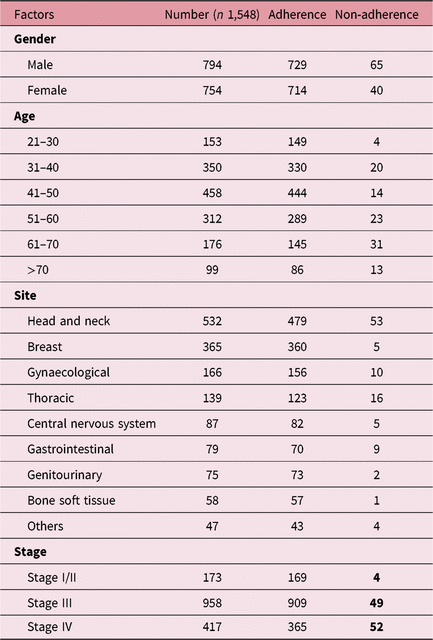
From January 2018 to December 2018, a total of 1,548 cancer patients underwent RT at our centre. The demographic and clinical characteristics of all patients have been mentioned in Table 1.
Demographic Characteristics of patients treated by radiotherapy in our centre from January 2018 to December 2018

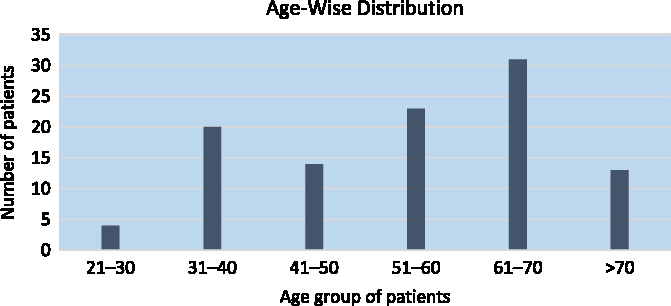
Head and neck cancer patients (n = 532) constituted majority of the patients followed by breast cancer patients (n = 365). The ratio of males and females was similar (Table 1). In context to age, 44 (42%) patients out of 105 were elderly (60 years and above) (Figure 1).
Age-wise distribution of cancer patients between January 2018 and December 2018.

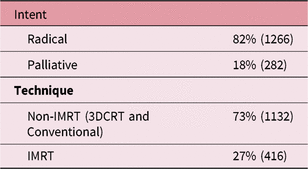
A total of 1,266 (82%) of patients were treated with radical radiation. A total of 282 (18%) of patients received palliative RT (Table 2). A total of 416 (27%) of patients were treated with intensity-modulated RT (IMRT) while 1,132 (73%) of patients received either three-dimensional (3D) conformal RT (3D-CRT) by conventional techniques (Table 2).
Intent and technique of radiotherapy in our centre from January 2018 to December 2018

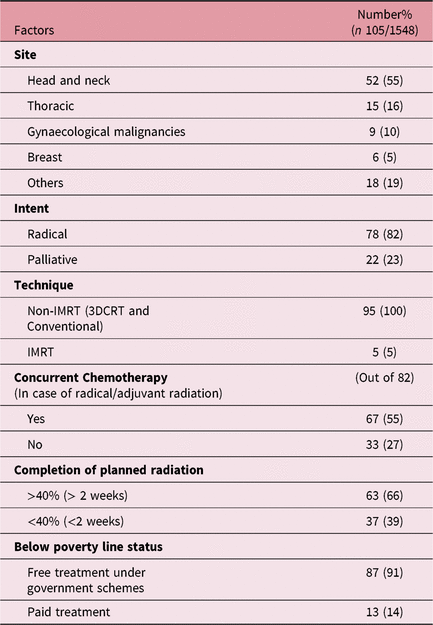
Out of the 1,548 patients, 105 patients (6·78%) were noted to have discontinued from planned RT without agreement by the treating clinician, where non-adherence in male patients (n = 65) was found to be high compared with the female patients (n = 40) (Figure 1). With respect to the site, head and neck patients (n = 53) have highly contributed to non-compliance compared with other forms of cancers (Figure 1). In the context of age, 44 patients out of 105 (42%) were elderly (>60 years) (Figure 1). Considering stages of cancer, more than 90% of non-adherent patients were found to have stage III and stage IV cancers. A total of 77 patients (74%) out of 105 were more than 50 km away from our centre.
Patients residing within 50 km radius of hospital were less likely to default on planned RT compared to those residing ≥75 km away from the hospital. Patients with radical curative intent, received radiation either radically or in adjuvant form of radiation. Fifty-five out of 82 patients received concurrent chemotherapy which contributes around 67% of total (Table 3). A total of 66 (63%) out of 105 patients had completed more than 2 weeks of radiation (40% of planned RT) and then defaulted for RT due to acute toxicities.
Factors influencing non-adherence of radiotherapy in 105 patients

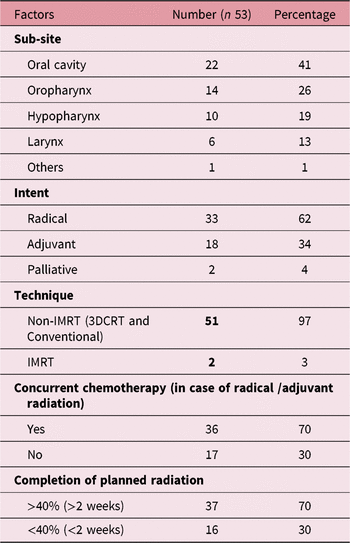
Approximately 50% of patients who defaulted from planned treatment were head and neck patients. Maximum radiation-induced toxicities were observed in head and neck cancer patients. As per a sub-set analysis of our head and neck cancer patients, 62% were planned for intent radical radiotherapy and a total of 37 (70%) out of 53 patients had completed 40% of planned RT (< 2 weeks) (Table 4).
Factors influencing non-adherence of radiotherapy in head and neck patients

A total of 20 patients had a history of non-adherence for previous treatments like neo-adjuvant chemotherapy (NACT) or surgery. A total of 23 patients were on alternate therapy such as homeopathic or Ayurveda prior to commencing definitive cancer-directed treatment.
Discussion
Radiotherapy: key to management of solid tumours
RT has remained a central part in the management of solid tumours. It could be definitive, radical or palliative. In the past few years, the understanding of radiobiology and advanced technologies has helped in keeping the overall RT treatment time short. Some key examples include stereotactic body RT for tumours of the lung and central nervous system or continuous hyper-fractionated accelerated RT for lung malignancies, etc.Reference Withers17– Reference Barendsen20 There are several ongoing trials that are assessing the effects of hypo-fractionated RT for head and neck, brain, breast and prostate malignancies. A short course of RT is expected to increase the rate of compliance among patients.Reference Withers17– Reference Barendsen20
Non-adherence to radiotherapy
Non-adherence to RT is a severe issue as it is attributed with incurability. In grave cases, it could alter the natural progression of the disease.Reference Withers, Taylor and Maciejewski21 Sub-curative doses of radiation may result in accelerated re-population which makes re-initiation of therapy challenging.Reference Withers, Taylor and Maciejewski21, Reference Yang, Yue, Liu and Yu22 However, non-adherence to treatment remains a neglected issue. The unfavourable effect of non-adherence on cure rates has not been given emphasis.
Adherence to cancer-directed treatment is a key factor in determining treatment outcomes. Non-adherence to planned treatment can influence disease control and survival among cancer patients.Reference Gupta, Rastogi, Bhatnagar, Singh, Gupta and Choudhary23 Successful outcomes in cancer patients are dependent on the completion of planned RT or total dose delivered.Reference Vigneswaran and Williams24 However, these are not the only factors that influence successful outcomes. Non-adherence to RT is a serious issue as it increases the chances of incurability and alters the natural progression of the disease.Reference Mishra and Meherotra25
In our study, a total of 1,548 patients were analysed, wherein 105 (6·7%) of patients had defaulted from planned radiation treatment. In a previously published study, out of a total of 1,227 patients, 266 (21·7%) patients were reported to be non-compliant.Reference Ohri, Rapkin, Guha, Kalnicki and Garg26 Our study assessed key aspects such as patient-related factors, such as age, gender and disease, and treatment related factors, such as stage of disease, primary site, technique of RT treatment and use of concurrent chemotherapy, and social aspects, such as distance from residence to hospital, for a possible link with non-compliance.
Factors influencing non-adherence to radiotherapy
Patient’s age, specifically the elderly, had an impact on non-adherence to planned treatment. Elderly patients were found to be non-adherent to planned RT. The primary reason for higher male predominance to non-adherence is the high number of head and neck cancers in this group. In developing countries, head and neck cancer is more common in males than in females.Reference Joshi, Dutta, Chaturvedi and Nair27, Reference Francis28
In the context of disease-related aspects, patients with advanced-stage diseases were non-adherent to planned treatment. As per our experience, we have observed advance stages being more non-adherent due to the likelihood of cumulative toxicities of multimodality treatment. Since patients with advanced stages require a larger irradiated tissue volume, the risk of toxicities increase and thus the rates of non-adherence to treatment. Advanced-stage disease is considered as one of the major factors for non-compliance among cancer patients undergoing RT.Reference Pandey, Revannasiddaiah and Pant29 In the context of treatment-related aspects, patients with concurrent chemotherapy were more likely to suffer from toxicities and thus default from planned treatment.
Non-adherence in head and neck cancer patients
Non-adherence or non-compliance among head and neck cancer patients has been acknowledged in previous studies. Mohanti et al. reported a 56% compliance rate in 2,167 head and neck cancer patients treated with radical/palliative RT.Reference Mohanti, Nachiappan, Pandey, Sharma, Bahadur and Thakar30 Sharma et al. reported a 62% compliance rate among elderly patients with head and neck cancer citing non-compliance as a major issue in intended treatment.Reference Sharma, Madan and Kumar31 In our case, non-adherence to planned RT was highest among head and neck cancer patients.
Intent of treatment
In the context of all patients who did not adhere to planned treatment, 78% received radical treatment. Thus, planned dose is responsible for toxicities, and treatment toxicities are one of the key factors that influence both compliance and treatment outcome in cancer patients.Reference Ferreira, Sá-Couto, Lopes and Khouri32 A total of 66 (63%) patients had completed more than 40% of planned RT and then defaulted. As per our experience, radiation-induced toxicities generally commence after two weeks of treatment. Thus, it is justified that patients would have acute side effects only after two weeks of RT. Thus, toxicity can be considered as a key factor that influences non-adherence to RT among cancer patients.
As per our observation, patients who received IMRT had low rates of non-adherence. Only 5% of defaulters had planned IMRT which causes less toxicities and thus increases chances of adherence.
In the context of logistical reasons, distance from residence to hospital/centre strongly influenced adherence to planned treatment among our patients. SES also played a vital role in patients taking a decision, opting for a treatment and completing it. It will also show a profound influence on delayed reporting and late-stage presentation of the patient leading to delay in treatment in many cases, where it will worsen the successful treatment options and the patient recovery from the disease. Many studies have reported that SES is an important factor for initiating cancer treatment. Li et al.Reference Li, Malone and Daling33 conducted a study on breast cancer patients and reported that patients with a higher SES underwent a more appropriate treatment modality compared with patients with a lower SES.Reference Koom, Ahn and Song10 Many other studies have also proved the close association between SES and completion of treatment in various cancers, such as colorectal cancer, breast cancer, hepatocellular cancer, and so on.Reference Peng, Chen, Jiang and Zheng34– Reference Dik, Aarts and Van Grevenstein38 Whereas in our study, 91 (87%) of patients belonged to the below poverty line (BPL) class and were treated under several government-funded schemes (Table 4). These patients were treated free of cost. Most of these patients were labourers, workers and farmers. As per our experience, many patients often do not comply with funded treatment or allied schemes due to lack of awareness or knowledge on disease, treatment options, toxicities and outcomes. Illiteracy also contributes to non-adherence to funded-treatment schemes. However, we have observed an enhanced adherence to planned RT due to our multidisciplinary approach. As per our experience, non-adherence to planned RT is common among patients who are referred for RT only from other centres. This highlights the necessity for having all treatment modalities at a single centre.
Lastly, patients who had a previous history of default were more likely to default for planned RT. Patients who had opted for alternative therapy were likely to non-adhere to planned cancer-directed treatment.
Recommended interventions/resolutions to increase adherence to treatment
Non-adherence to planned treatment is a common but serious issue among cancer patients. Although there is sufficient information on the factors that contribute to non-adherence or non-compliance to planned treatment, few studies have cited interventions or resolutions to improve adherence among such patients. We propose a few interventions which are as follows:
-
▪ Elderly patients, specifically those 60 years and above, should be given priority care since they are most likely to default from planned treatment.
-
▪ Counselling of patients is of utmost importance while preparing for intent radical RT.
-
▪ Patients should be counselled on several aspects such as nature of disease, nature of treatment, possibilities of side effects, need for close monitoring or frequent visits to outpatient department to assess toxicities and referral to nutritionists.
-
▪ Patients are also assessed for Ryles tubes insertion or percutaneous endoscopic gastrostomy (PEG)/feeding gastrostomy regularly.
-
▪ Frequent admission should be given supportive care and accommodation facility should be provided.
-
▪ Radiation oncologist along with psycho-oncologists or counsellors should perceive to remove misconceptions about RT among patients.
-
▪ Radiation oncologist should provide additional support and care to cancer patients due to their likelihood of defaulting from planned treatment.
-
▪ Waiting time in the RT department for treatment should be reduced to minimal by proper scheduling of patients.
-
▪ Hostel accommodation near or within the centre may increase chances of adherence to planned RT.
-
▪ Frequent outpatient visits after the third week of planned RT may help improve outcomes.
Limitations of the study
Although our study helped gain new insights on non-adherence to treatment plan among cancer patients, we have to admit a few limitations of this study. The study was designed to involve patients during a short span of one year only. The retrospective nature of the study can be considered a key limitation. We could not consider all factors that could influence non-adherence to treatment. Some of these factors include (a) lack of family or social support and (b) personal views/opinions of patients such as interest/faith in RT, fear of not recovering from RT and inclination toward traditional or non-conventional approaches.
Conclusion
The successful outcome of RT among cancer patients is largely dependent on treatment adherence. However, in the Indian context, non-adherence to treatment is the most common cause of treatment failure among cancer patients. This study reveals several factors that influence non-adherence to treatment, specifically among patients based in tier-2 and tier-3 cities. Social and economic factors play a key role in determining compliance or adherence rates among cancer patients. Effective protocols need to be developed to track and communicate with patients the highest likelihood of defaulting from planned treatment.
Acknowledgements
The authors would like to thank Mr. Lyndon Fernandes and Dr. Yasam Venkata Ramesh for their medical writing assistance.
Financial Support
The author(s) received no specific funding for this work.
Conflicts of Interest
None