Introduction
Mood disturbances are prevalent in reproductive-age women and appear to be linked to hormonal fluctuation and reproductive events, such as the premenstrual and postpartum periods and the menopausal transition (Rapkin et al. Reference Rapkin, Mikacich, Moatakef-Imani and Rasgon2002; Kessler & Gadermann, Reference Kessler, Gadermann, Goldman, Troisi and Rexrode2013). Up to 40% of women going through the menopausal transition experience depressive symptoms but the prevalence varies substantially across studies (Harlow et al. Reference Harlow, Cohen, Otto, Spiegelman and Cramer1999; Li et al. Reference Li, Yu, Ma, Sun and Yang2008; Timur & Sahin, Reference Timur and Sahin2010). Numerous factors influence the risk of depressive symptoms, from psychosocial factors to the cumulative effect of lifestyle and hormonal exposures (Harlow et al. Reference Harlow, Cohen, Otto, Spiegelman and Cramer1999; Li et al. Reference Li, Yu, Ma, Sun and Yang2008; Timur & Sahin, Reference Timur and Sahin2010). The Harvard Study of Moods and Cycles found that the risk for depressive symptoms was higher for women who entered perimenopause compared with those who remained premenopausal, and the increased risk was amplified by the presence of vasomotor menopausal symptoms (VMS) (hot flushes and night sweats) (Cohen et al. Reference Cohen, Soares, Vitonis, Otto and Harlow2006). A systematic review has recently shown a bi-directional relationship between VMS and depressive symptoms during perimenopause, but a number of limitations of the studies contributing to the review have been identified (Worsley et al. Reference Worsley, Bell, Kulkarni and Davis2014). These included small sample sizes, limited information on confounders, and differences in study design and measures used for variables (Worsley et al. Reference Worsley, Bell, Kulkarni and Davis2014). Moreover, the dearth of longitudinal research, particularly with regard to depressive symptoms and subsequent VMS (Gold et al. Reference Gold, Colvin, Avis, Bromberger, Greendale and Powell2006; Freeman et al. Reference Freeman, Sammel and Lin2009), has raised questions about the directionality of these two key menopausal symptoms.
The quality of sleep is likely important in the relationship between VMS and depressive symptoms, though its exact role is not yet clear. On the one hand, the ‘domino hypothesis’ suggests a causal role of sleep problems in this relationship, postulating that VMS (resulting from low/fluctuating estradiol levels) lead to significant sleep disruption, which in turn cause negative mood (Eichling & Sahni, Reference Eichling and Sahni2005). There is some recent strong evidence providing empirical data showing that sleep difficulties partly mediate the association of VMS with depressive symptoms, although studies are small (Burleson et al. Reference Burleson, Todd and Trevathan2010; Vincent et al. Reference Vincent, Ranasinha, Sayakhot, Mansfield and Teede2014; Joffe et al. Reference Joffe, Crawford, Freeman, White, Bianchi and Kim2016). On the other hand, these three symptoms occur frequently and often co-occur around the menopausal transition. In fact, bi-directional relationships have been observed between VMS and depressive symptoms (Worsley et al. Reference Worsley, Bell, Kulkarni and Davis2014) and between insomnia and depression (Alvaro et al. Reference Alvaro, Roberts and Harris2013). The domino hypothesis has been applied only to the VMS first pathway. However, the relationship may differ depending on whether depressive symptoms or VMS are present first, and it would be reasonable to evaluate sleep problems as a risk factor for VMS.
This study used data from over 20 000 midlife women to examine the cross-sectional and prospective bi-directional associations between VMS and depressed mood over 3 years and to investigate the role of sleep difficulties in both directions. Individual-level data were pooled from eight studies in the UK, USA, Australia, and Japan that all contribute to the International Collaboration for a Life Course Approach to Reproductive Health and Chronic Disease Events (InterLACE) (Mishra et al. Reference Mishra, Anderson, Schoenaker, Adami, Avis and Brown2013; Mishra et al. Reference Mishra, Chung, Pandeya, Dobson, Jones and Avis2016).
Methods
Ethics
Participants in each study were recruited under the Institutional Review Board protocols approved at each research centre. Informed written consent was obtained from all participants.
Study participants
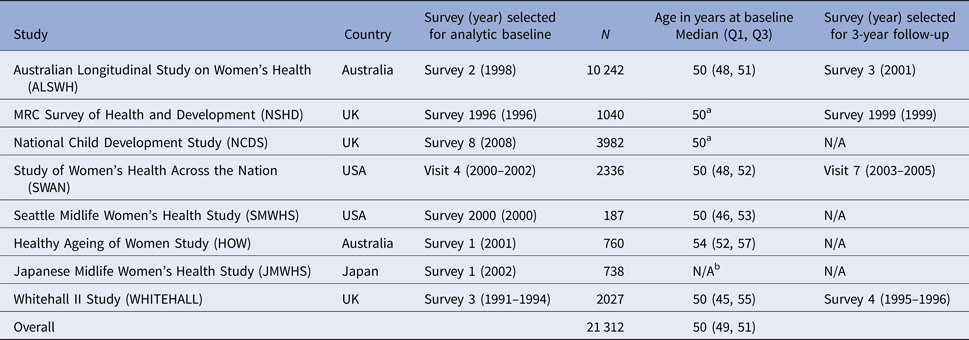
Eight studies in the InterLACE consortium had collected information on VMS and depressed mood: Australian Longitudinal Study on Women's Health (ALSWH) (Dobson et al. Reference Dobson, Hockey, Brown, Byles, Loxton and McLaughlin2015), MRC National Survey of Health and Development (NSHD) (Wadsworth et al. Reference Wadsworth, Kuh, Richards and Hardy2006), National Child Development Study (NCDS) (Power & Elliott, Reference Power and Elliott2006), Study of Women's Health Across the Nation (SWAN) (Sowers et al. Reference Sowers, Crawford, Sternfeld, Morganstein, Gold and Greendale2000), Seattle Midlife Women's Health Study (SMWHS) (Mitchell & Woods, Reference Mitchell and Woods2011), Healthy Ageing of Women Study (HOW) (Anderson et al. Reference Anderson, Yoshizawa, Gollschewski, Atogami and Courtney2004), Japanese Midlife Women's Health Study (JMWHS) (Anderson et al. Reference Anderson, Yoshizawa, Gollschewski, Atogami and Courtney2004), and Whitehall II Study (WHITEHALL) (Marmot & Brunner, Reference Marmot and Brunner2005) (Table 1). For the longitudinal studies, data collected at around 50 years of age (analytic baseline) were used to provide some consistency in the variability of menopausal status and symptoms. For HOW and JMWHS, data were included from the baseline surveys when the median age of participants was around 54 years (range 45‒60 years).
Baseline characteristics of individual studies in the InterLACE consortium whose data were used for this study

N/A, not applicable; Q1 ‒ 25th percentile; Q3 ‒ 75th percentile.
a Participants in the NSHD (1946 British birth cohort) and NCDS (1958 British birth cohort) were at age 50 years in the 1996 and 2008 survey, respectively.
b JMWHS provided age by category only (⩽55 and >55 years), and 48% of women were aged more than 55 (range 45‒60 years).
For the cross-sectional analysis, a total of 21 312 women who had reported VMS and depressed mood and had complete information on the covariates (listed below) at baseline were included in the analysis. Four cohort studies (ALSWH, NSHD, SWAN, and WHITEHALL) provided longitudinal data for further analyses (n = 15 645). Women who did not return or had incomplete data at 3-year follow-up were excluded (n = 4953), leaving 10 692 women for the prospective analysis (nearly 70% were retained). Women who were excluded were more likely to report VMS, depressed mood, or sleep difficulties at baseline and were more likely to be a current smoker, obese, less educated, currently taking menopausal hormone therapy, or having a history of hysterectomy/oophorectomy compared with those who were included (online Supplemental Table S1). To examine the prospective association between VMS and incident depressed mood, women with the presence of depressed mood (defined below, n = 2459) at baseline were excluded, while to examine the reverse prospective association, women with the presence of VMS (defined below, n = 3708) at baseline were excluded. There were no differences in characteristics between the two prospective samples.
Depressed mood and vasomotor symptoms
In this study, the term ‘depressed mood’ rather than ‘depressive symptoms’ is used because the data were from single questions about feeling depressed, blue, sad, or unhappy rather than from validated depression scales. In each study, hot flushes, night sweats, and depressed mood were collected using self-reported menopausal symptom checklists assessing symptoms over a specific period. VMS was defined by having either hot flushes or night sweats. In ALSWH, women were asked how frequently they have had the symptoms in the last 12 months (considered as a long-term recall period), and SWAN asked about symptoms in the past 2 weeks (a short-term recall period). The frequency categories were harmonised and categorised as never, rarely, sometimes and often. In the other six studies, women were asked how severely they had been bothered by the symptoms in the last 12 months (NSHD, NCDS), in the last 24 h (SMWHS) and at the moment (HOW, JMWHS, WHITEHALL). The severity of bothersome symptoms was harmonised and categorised as never, mild, moderate and severe. For our pooled analyses, the degree of symptoms was pooled into four categories: never, rarely, sometimes, and often (if reporting frequency) or never, mild, moderate, and severe (if reporting severity). When VMS and depressed mood were considered as an outcome variable, they were coded dichotomously as present (‘often/sometimes’ or ‘severe/moderate’, respectively) and absent (‘rarely/never’ or ‘mild/never’, respectively).
Sleep difficulties and covariates
Data on sleep difficulties were collected at baseline from menopausal symptom checklists or difficulty sleeping-related questions, i.e. ‘trouble falling asleep’ and ‘difficulty in sleeping’ in the questionnaires. The degree of sleep difficulties was harmonised as never, rarely, sometimes, and often (if reporting frequency) or never, mild, moderate, and severe (if reporting severity). Other baseline covariates included reproductive, socio-demographic, and lifestyle factors. Details of data harmonisation have been reported elsewhere (Mishra et al. Reference Mishra, Chung, Pandeya, Dobson, Jones and Avis2016). Menopausal status was collapsed into the simplest level of detail and categorised based on gynecological surgery and menstrual bleeding patterns: (1) hysterectomy/oophorectomy, (2) unknown due to hormone use (menopausal hormone therapy or oral contraceptive hormones before reaching menopause), (3) premenopause (regular menstrual cycles in the last 3 and 12 months), (4) perimenopause (menses in the past 3 months and changes/irregularity in menstrual patterns in the past 12 months; or no menses in the previous 3 months but menses in the preceding 11 months), and (5) natural postmenopause (amenorrhea for at least 12 months). Information on current use of menopausal hormone therapy (e.g. estrogen), regardless of menopausal status, was collected. Socio-demographic variables included race/ethnicity [Caucasian-Australian, Caucasian-European, Caucasian-American, Japanese, African American/Black, and Other (including Hispanic, Chinese, Middle Eastern, and mixed)] and education level (⩽10, 11–12, and >12 years). Lifestyle factors included smoking status (never, past, and current) and body mass index (BMI) (<25, 25–29.9, and ⩾30 kg/m2).
Statistical analyses
As a result of different types of assessment (frequency or severity) and different recall periods (past 12 months or past 2 weeks/less) for menopausal symptoms, studies were grouped as follows: (1) frequency of symptoms in the past 12 months (ALSWH); (2) severity of symptoms in the past 12 months (NSHD, NCDS); (3) frequency of symptoms in the past 2 weeks (SWAN); (4) severity of symptoms in the past 2 weeks (SMWHS, HOW, JMWHS, WHITEHALL). First, the associations between VMS and depressed mood were obtained separately for the four study designs, followed by the overall estimates.
Logistic regression models were used to examine the cross-sectional and prospective bi-directional associations between VMS and depressed mood and the odds ratios (ORs) and 95% confidence intervals (CIs) were obtained. Study variability was adjusted by including study indicator as a covariate in the model. Based on the previous literature, the effect estimates were adjusted for menopausal status, concurrent use of menopausal hormone therapy (Model 1), race/ethnicity, education, smoking status, and BMI (Model 2). To examine the heterogeneity between studies, study-specific logistic regression and random-effect meta-analyses were performed and fully adjusted for the covariates in Model 2. Data for SWAN were additionally adjusted for study site. In the prospective analyses (four studies included), ORs (95% CIs) were estimated for the incident depressed mood at 3-year follow-up by the degree of VMS in women without depressed mood at baseline. The odds for incident VMS associated with the degree of depressed mood in women without VMS at baseline were similarly analysed. The models were adjusted for baseline covariates mentioned above and were further adjusted for sleep difficulties at baseline to investigate the role of sleep difficulties in both directions.
To further examine the robustness of the results, multiple sensitivity analyses were performed. First, results for a single-item measure of depressed mood were compared with results using the Center for Epidemiologic Studies Depression Scale (CES-D) collected in ALSWH and SWAN. Second, the potential influence of previous history of depression and current use of antidepressants (e.g. Prozac, Aropax) on the association between VMS and likelihood of depressed mood was examined by adjusting for these two confounders and excluding women with a history of depression or current use of antidepressants from the prospective analysis using data from ALSWH. Third, we also tested prospective results with all the women included (n = 10 692) but conditioning on their baseline symptoms. Analyses were performed using SAS 9.4 (SAS Institute, Inc., Cary, North Carolina), and the METAN command in STATA 14 (StataCorp LP, College Station, Texas) was used to perform meta-analyses.
Results
Baseline characteristics
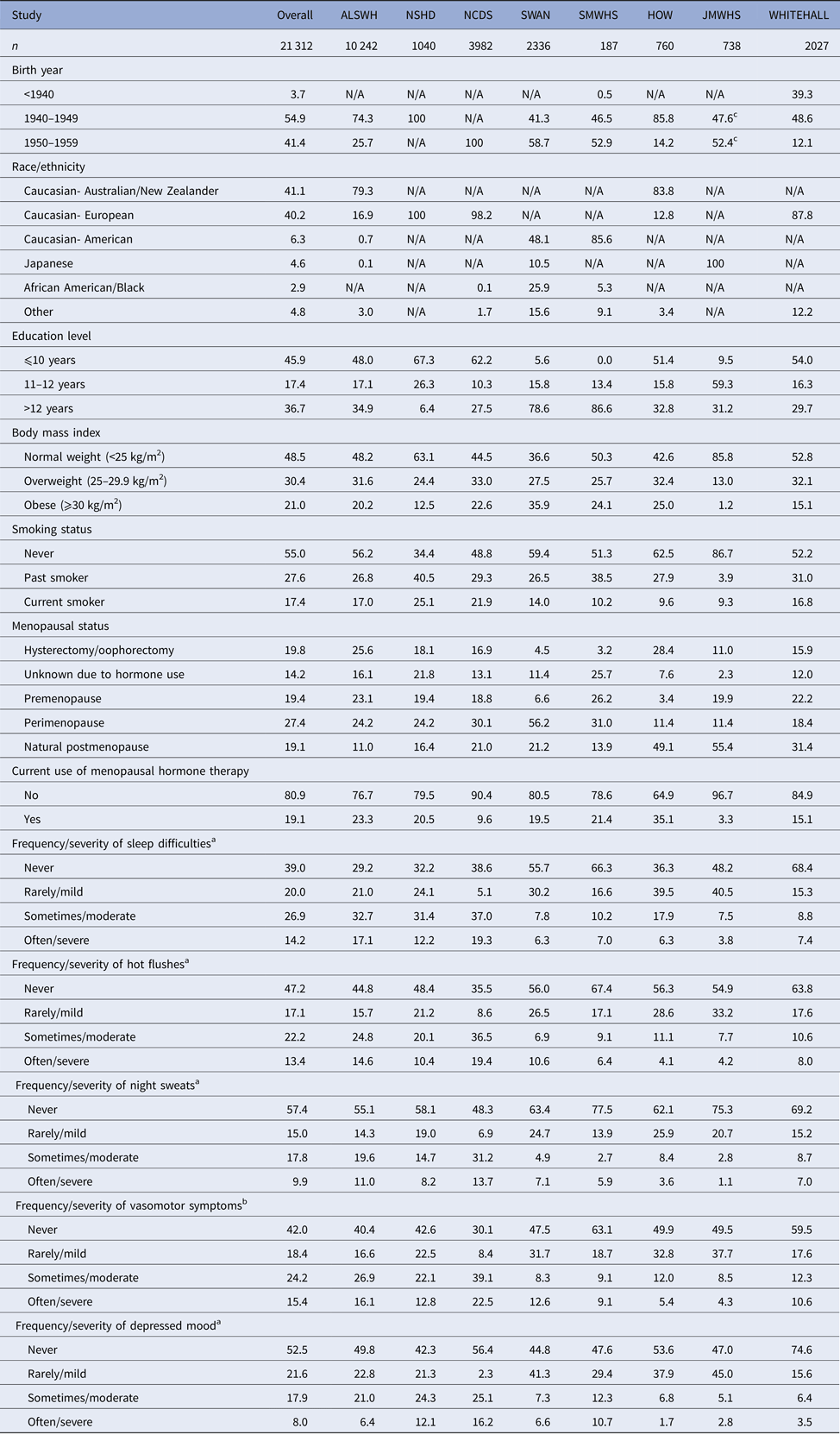
The present study pooled data from 21 312 midlife women (median age 50 years, interquartile range: 49–51) (Table 1). Among these women, 19% were premenopausal, 27% were perimenopausal, 19% were postmenopausal, and 20% had a hysterectomy or oophorectomy at study entry (Table 2). Nearly 20% of the women were taking menopausal hormone therapy (10% with an unknown menopausal status). At baseline, nearly 40% of the women (range 13–62% among studies) reported that they had experienced VMS, 41% (11–56%) reported sleep difficulties, and 26% (8–41%) had depressed mood (all dichotomised: ‘present’ indicating sometimes/moderate or often/severe). The prevalence of symptoms was substantially higher in ALSWH, NSHD and NCDS where symptoms were recalled over a longer period (12 months) compared with that over a shorter period (⩽2 weeks). We observed racial/ethnic differences in the menopausal symptom experience. Japanese women (from JMWHS) were less likely to use menopausal hormone therapy and less likely to report severe symptoms of hot flushes and night sweats compared with other Caucasian cohorts, even though it could be partly attributable to a lower proportion of women at the perimenopausal stage, a lower proportion being current smokers and being obese, and to the collection of data on symptoms over a short period.
Baseline characteristics of study sample

N/A, not applicable; ALSWH, Australian Longitudinal Study on Women's Health; NSHD, MRC National Survey of Health and Development (1946 British Birth Cohort); NCDS, National Child Development Study (1958 British Birth Cohort); SWAN, Study of Women's Health Across the Nation; SMWHS, Seattle Midlife Women's Health Study; HOW, Healthy Ageing of Women; JMWHS, Japanese Midlife Women's Health Study; WHITEHALL, Whitehall II study.
a Sleep difficulties, hot flushes, night sweats, and depressed mood were collected using self-reported menopausal symptom checklists assessing either frequency or severity of the symptoms: frequency of symptoms in the past 12 months (ALSWH), severity of symptoms in the past 12 months (NSHD and NCDS), frequency of symptoms in the past 2 weeks (SWAN), and severity of symptoms in the past 2 weeks or less (SMWHS, HOW, JMWHS, and WHITEHALL).
b Vasomotor symptoms were defined by having either hot flushes or night sweats.
cJMWHS provided age by category only (⩽55 and >55 years). Thus, birth year was categorised based on age categories.
At baseline, the prevalence of VMS (dichotomised) was 19.8, 42.9, and 45.8% in premenopausal, perimenopausal, and postmenopausal women, respectively. The increased prevalence of VMS in the peri- and postmenopausal periods suggested that VMS were potentially attributable to endocrine changes at menopause. However, the prevalence of sleep difficulties (32.6, 40.3, and 38.0%, respectively) and depressed mood (21.6, 26.4, and 21.8%, respectively) was reasonably comparable across menopausal stages, reflecting normal variation in women at midlife regardless of menopausal status.
Cross-sectional associations
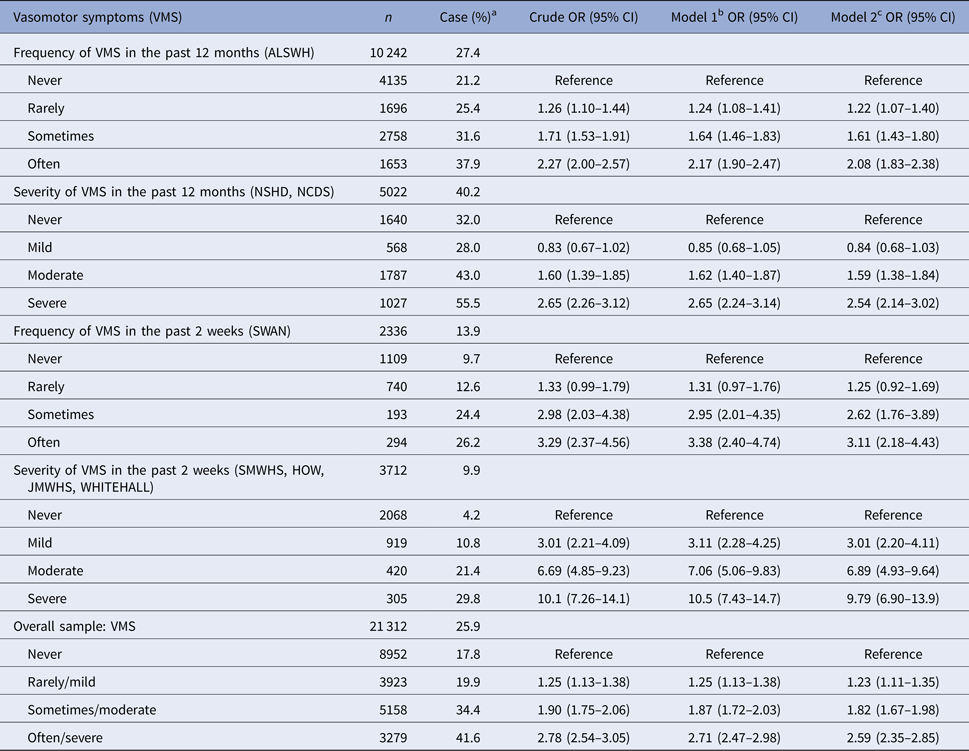
At baseline, a dose-dependent association between VMS and odds of depressed mood was found in all study designs, although the estimated effects were higher if the symptoms were recalled over a shorter period rather than a longer period (Table 3). In the pooled analysis, this association changed little after full adjustment (Model 2), with the adjusted ORs (95% CI) of 1.23 (1.11–1.35), 1.82 (1.67–1.98), and 2.59 (2.35–2.85) for increasing degree of VMS, compared with those without VMS. We observed that women who were currently taking menopausal hormone therapy were more likely to report an experience of VMS (OR 1.34, 1.21–1.47), depressed mood (OR 1.40, 1.26–1.55), and sleep difficulties (OR 1.32, 1.20–1.46) (data not shown), but hormone therapy use, as well as menopausal status, did not affect the observed associations.
Cross-sectional association between vasomotor symptoms and odds of depressed mood at baseline

Logistic regression models were used to estimate odds ratios (OR) and 95% confidence intervals (95% CI). Study level variability was adjusted by including study indicator as a covariate in the crude and multivariable model.
a Depressed mood was defined by ‘often or sometimes’ having depressed mood or having ‘severe or moderate’ depressed mood.
b Model 1 was adjusted for menopausal status and concurrent use of menopausal hormone therapy.
c Model 2 was adjusted for model 1 plus following socio-demographic and lifestyle factors: race/ethnicity, education, smoking status, and BMI. Data for SWAN were additionally adjusted for study site.
In the study-specific analysis, the dose–response relationship between VMS and odds of depressed mood was present in each study. Random-effects meta-analysis of the estimates from eight studies yielded a pooled OR of 1.50 (1.04–2.15), 2.85 (1.91–4.26), and 3.95 (2.52–6.18) for increasing degree of VMS compared with non-VMS (online Supplemental Fig. S1). The effect size was much larger for WHITEHALL than all other studies, while the estimates were not statistically significant in SMWHS. Although significant heterogeneity between studies was detected (all I 2>87%, p < 0.001), the pattern of results was similar across studies and random-effects models provided a partial solution to study heterogeneity.
Prospective bi-directional associations
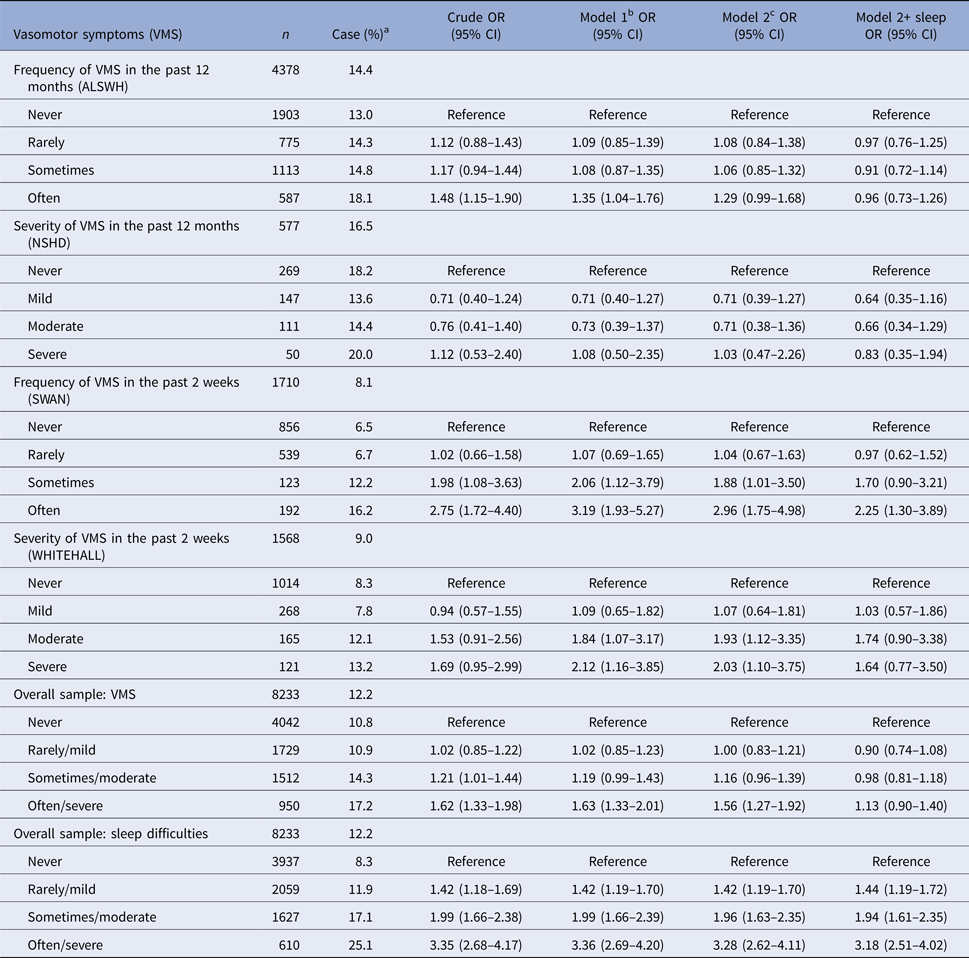
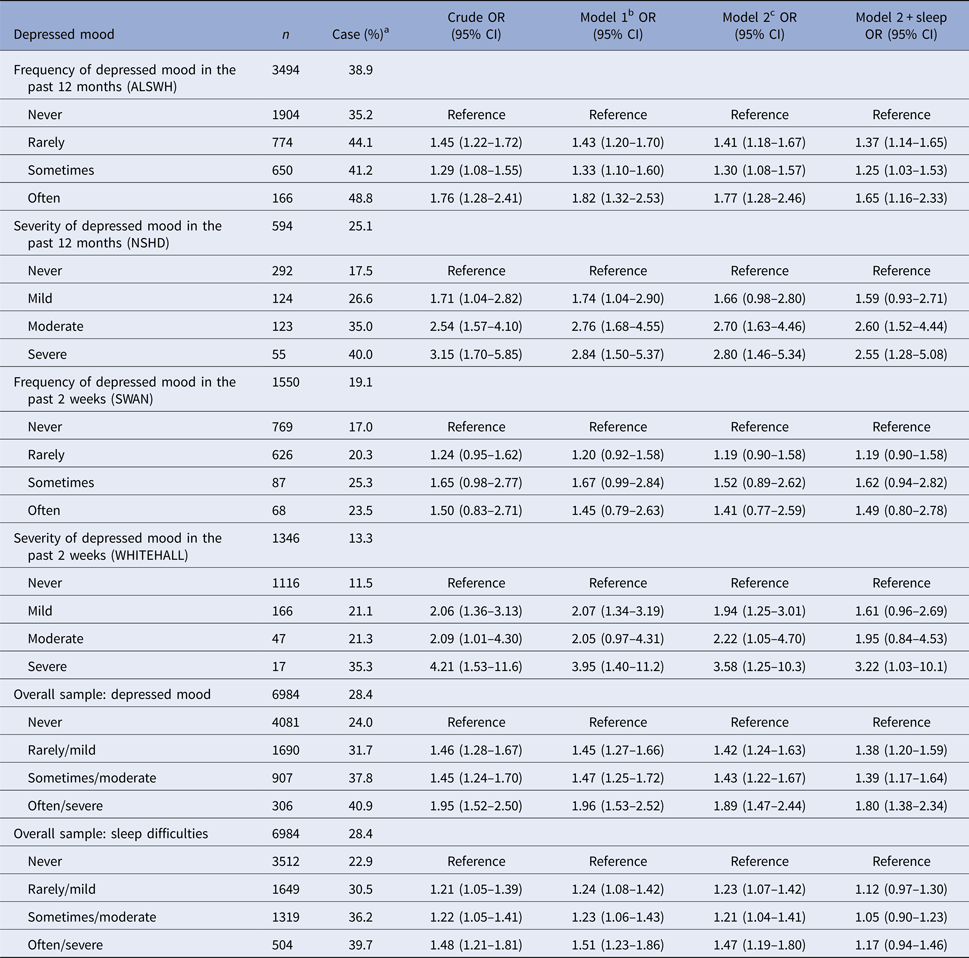
During the 3-y follow-up, 31.0% of the women experienced VMS only, 10.1% experienced depressed mood only, 14.3% had concurrent symptoms, 3.5% had VMS first then depressed mood, 4.4% had depressed mood first then VMS, and 36.6% had neither symptoms (n = 10 692, data not shown). In the pooled analysis, Tables 4 and 5 show dose-dependent associations between VMS and depressed mood in both directions (Model 2). Women with VMS at baseline were more likely to report subsequent depressed mood than those without VMS, with the adjusted ORs of 1.00 (0.83–1.21), 1.16 (0.96–1.39), and 1.56 (1.27–1.92) for increasing degree of VMS. The prospective relationship was much weaker than the cross-sectional relationship, with significant OR only for often/severe VMS after adjustment. On the other hand, the relationship between baseline depressed mood and subsequent VMS was stronger, with the adjusted ORs of 1.42 (1.24–1.63), 1.43 (1.22–1.67), and 1.89 (1.47–2.44) (all significant) for increasing degree of depressed mood.
Prospective association between vasomotor symptoms at baseline and incident depressed mood at the 3-year follow-up

Logistic regression models were used to estimate odds ratios (OR) and 95% confidence intervals (95% CI). Study level variability was adjusted by including study indicator as a covariate in the crude and multivariable model.
a Depressed mood was defined by ‘often or sometimes’ having depressed mood or having ‘severe or moderate’ depressed mood.
b Model 1 was adjusted for menopausal status and concurrent use of menopausal hormone therapy at baseline.
c Model 2 was adjusted for model 1 plus following socio-demographic and lifestyle factors: race/ethnicity, education, smoking status, and BMI at baseline. Data for SWAN were additionally adjusted for study site.
Prospective association between depressed mood at baseline and incident vasomotor symptoms at the 3-year follow-up

Logistic regression models were used to estimate odds ratios (OR) and 95% confidence intervals (95% CI). Study level variability was adjusted by including study indicator as a covariate in the crude and multivariable model.
a Vasomotor symptoms (VMS) were defined by ‘often or sometimes’ having VMS or having ‘severe or moderate’ VMS.
b Model 1 was adjusted for menopausal status and concurrent use of menopausal hormone therapy at baseline.
c Model 2 was adjusted for model 1 plus following socio-demographic and lifestyle factors: race/ethnicity, education, smoking status, and BMI at baseline. Data for SWAN were additionally adjusted for study site.
Role of sleep difficulties
At baseline, we observed a moderate correlation (polychoric correlation 0.43, 95% CI 0.41–0.46) between sleep difficulties and VMS for the depressed mood subgroup and a moderate correlation (0.54, 0.52–0.56) between sleep difficulties and depressed mood for the VMS subgroup (data not shown). In the prospective analyses, with adjustment for the degree of sleep difficulties at baseline, the OR of having subsequent depressed mood associated with often/severe VMS was attenuated from 1.56 (1.27–1.92) to 1.13 (0.90–1.40) and no longer significant, with nearly a 30% reduction in the OR, while sleep difficulties remained an independent predictor for incident depressed mood with little change in odds ratios (Table 4). Conversely, baseline sleep difficulties did not appear to affect the relationship between baseline depressed mood and subsequent VMS as the OR reduced little to 1.80 (1.38–2.34) for often/severe depressed mood, with a <5% reduction in the OR, and sleep difficulties were not a predictive factor for incident VMS (Table 5).
Sensitivity analyses
Associations between VMS and depressed mood were robust in multiple sensitivity analyses (data not shown). Of note, it was found that a single question about depressed mood was highly correlated with the dichotomised CES-D score (dichotomised at 10 in ALSWH for the 10-item short form; 16 in SWAN). The tetrachoric correlation for these two definitions for depressed mood was 0.74 (95% CI 0.72–0.76) in ALSWH and 0.79 (95% CI 0.75–0.83) in SWAN. Similar results were obtained in a sensitivity analysis in which dichotomised CES-D score was used as the outcome variable. In the ALSWH study, 8.1% of the women reported a history of depression (more than 2 years ago) at baseline, and 5.9% reported current use of antidepressants (during the past 4 weeks). A sensitivity analysis, in which models were further adjusted for prior history of depression and current use of antidepressants at baseline, yielded similar findings. We found women with a history of depression had a nearly 3-fold increased odds of reporting depressed mood at follow-up (OR 2.84, 2.09–3.84), and current users of antidepressants had an over 4.5-fold increased odds of experiencing depressed mood at follow-up (OR 4.65, 2.08–10.41). Further exclusion of women with a history of depression or current use of antidepressants at baseline did not alter the observed relationships. In the prospective analysis with all the women included (n = 10 692), baseline depressed mood, even adjusted by baseline VMS, was significantly associated with subsequent VMS.
Discussion
The findings from this pooled analysis provide robust evidence for a dose-dependent, bi-directional relationship between VMS and depressed mood. Prospective results showed that women with VMS were more likely to have a subsequent depressed mood, and women with depressed mood were also more likely to experience VMS subsequently. Sleep difficulties largely explained the relationship between VMS and subsequent depressed mood but did not appear to affect the relationship of depressed mood with subsequent VMS. The strength of the associations varied among studies according to differences in study designs and distributions of race/ethnicity and menopausal status.
Previous prospective studies have also shown that VMS predict subsequent onset of depressive symptoms and the association is independent of marked changes in reproductive hormones during the menopausal transition (Avis et al. Reference Avis, Crawford, Stellato and Longcope2001; Freeman et al. Reference Freeman, Sammel, Lin and Nelson2006; Bromberger et al. Reference Bromberger, Schott, Kravitz, Sowers, Avis and Gold2010). The Penn Ovarian Aging Study (POAS) (Freeman et al. Reference Freeman, Sammel, Lin and Nelson2006) and Massachusetts Women's Health Study (Avis et al. Reference Avis, Crawford, Stellato and Longcope2001) found that associations between VMS and depressive symptoms remained unchanged after adjustment for levels of estradiol. Again, the association was consistent with previous results from SWAN showing that elevated depressive symptoms (CES-D scores ⩾16) were more likely to occur in women with VMS even after adjustment for multiple psychosocial factors and concurrent levels of testosterone (Bromberger et al. Reference Bromberger, Schott, Kravitz, Sowers, Avis and Gold2010). Moreover, evidence from the SWAN Daily Hormone Study, which included daily diary reports of VMS and mood over a month, indicated that negative mood more often followed reports of VMS (Gibson et al. Reference Gibson, Thurston, Bromberger, Kamarck and Matthews2011). Other studies highlight the importance of night-time VMS (but not daytime) in the association of VMS with depressive symptoms (Joffe et al. Reference Joffe, Crawford, Freeman, White, Bianchi and Kim2016). However, the current literature does not suggest a relationship between VMS and a clinical diagnosis of major depression (Freeman et al. Reference Freeman, Sammel, Lin and Nelson2006; Joffe et al. Reference Joffe, Petrillo, Koukopoulos, Viguera, Hirschberg and Nonacs2011; Worsley et al. Reference Worsley, Bell, Kulkarni and Davis2014).
In line with the findings of the present study, results from two mediation analyses which evaluated the domino hypothesis (a temporal relationship between VMS, sleep, and mood) in midlife women showed that the relationship between VMS and subsequent depressed mood might partly result from sleep disturbance (Burleson et al. Reference Burleson, Todd and Trevathan2010; Vincent et al. Reference Vincent, Ranasinha, Sayakhot, Mansfield and Teede2014). One study of 114 breast cancer survivors reported that results were consistent with the hypothesis in which VMS have an indirect effect on negative mood which is mediated by sleep difficulties (Vincent et al. Reference Vincent, Ranasinha, Sayakhot, Mansfield and Teede2014). However, in another study with a sample of 55 healthy women, sleep problems accounted for only a small portion of the relationship between VMS and next day negative mood, suggesting that the domino hypothesis may be true in some cases, but that is not the complete explanation (Burleson et al. Reference Burleson, Todd and Trevathan2010). Additional mechanistic studies have identified that sleep interruption and night-time VMS are independently associated with the emergence of depressive symptoms during menopause (Joffe et al. Reference Joffe, Crawford, Freeman, White, Bianchi and Kim2016). It is vital for future research to examine the temporal relationship and formally quantify the mediating effect of sleep disturbance in these associations.
Recent intervention studies have shown the effectiveness of online insomnia programmes, such as Sleepio (Elison et al. Reference Elison, Ward, Williams, Espie, Davies and Dugdale2017) and SHUTi (Christensen et al. Reference Christensen, Batterham, Gosling, Ritterband, Griffiths and Thorndike2016), for improvement and prevention of mental health difficulties. Internet-based cognitive behaviour therapy for insomnia (CBT-I) could be a practical and effective intervention to reduce depression symptoms in midlife women with insomnia. However, CBT-I services are limited, particularly amongst general practitioners (Asnis et al. Reference Asnis, Thomas and Henderson2015). In clinical practice, the first-line pharmacotherapy treatment for insomnia is often hypnotic medication (e.g. zaleplon, zolpidem, and benzodiazepines) (Asnis et al. Reference Asnis, Thomas and Henderson2015). A double-blind randomised controlled trial found adding a hypnotic agent (zolpidem) to serotonin-norepinephrine reuptake inhibitors/selective-serotonin reuptake inhibitors improved sleep and optimised the quality of life in breast cancer women with hot flushes (Joffe et al. Reference Joffe, Partridge, Giobbie-Hurder, Li, Habin and Goss2010). Long-term effects of sleep loss and sleep disorders have been linked to a range of adverse health consequences including hypertension, obesity, diabetes, cardiovascular disease and depression (Institute of Medicine, 2006). Although clinicians are often reluctant to prescribe hypnotics, treatment approaches should include consideration of longer-term use of hypnotic therapy targeting sleep disturbance, which may have profound implications for the mental health of women during midlife.
One major finding is that VMS also follow the onset of depressed mood, which is consistent with results from two prospective cohorts. POAS examined the temporal relationship between hot flushes and depressive symptoms in women with no previous experience of either symptom and found that among women who developed both symptoms, depressive symptoms were twice as likely to precede hot flushes, with an average of 1.5 years before the onset of hot flushes (Freeman et al. Reference Freeman, Sammel and Lin2009). SWAN study also found that baseline depressive symptoms were associated with subsequent VMS (Gold et al. Reference Gold, Colvin, Avis, Bromberger, Greendale and Powell2006), and women who reported more depressive symptoms when first experiencing VMS had a longer duration of VMS (Avis et al. Reference Avis, Crawford, Greendale, Bromberger, Everson-Rose and Gold2015). Although the relationships between depressed mood and subsequent VMS are established in a few studies, the underlying mechanism remains unclear; sleep difficulties do not seem to explain the relationship. One interpretation is that women with negative emotions tend to over-report symptoms via a negative reporting style and be highly self-attentive and sensitive to bodily sensations (Aronson et al. Reference Aronson, Barrett and Quigley2006). It is possible that somatic symptoms in depression amplify experiences of physical sensations such as VMS. Hunter et al. found that women with depressed mood were more likely to report VMS as problematic (Hunter & Liao, Reference Hunter and Liao1995). A systematic review of 13 studies also suggests that women with more negative attitudes towards the menopause report more menopausal symptoms, but more prospective studies are needed to determine causality (Ayers et al. Reference Ayers, Forshaw and Hunter2010). In addition to negative mood, anxiety was also found to be a predictor of VMS even after the adjustment of depression (Freeman & Sammel, Reference Freeman and Sammel2016). The SWAN study even found that the association with anxiety appeared to be stronger than the association with depressive symptoms (Gold et al. Reference Gold, Colvin, Avis, Bromberger, Greendale and Powell2006). Given that anxiety data were not available in all studies, however, it is important to understand these as forming another triad of symptoms: anxiety, sleep, and VMS.
Strengths and limitations
To our knowledge, this is the first study pooling individual-level data from multiple observational studies across different geographic regions, races, and cultures to quantify the dose-response relationships between VMS and depressed mood. The scale of these analyses ensures sufficient statistical power to examine the prospective relationship in both directions. Furthermore, this study included three nationally representative studies, which increases the generalisability of findings. However, some limitations should be considered in interpreting the findings. First, data used to define depressed mood were not based on structured clinical interviews or diagnoses. ALSWH and SWAN had data from the validated CES-D depression scale, and the scores were highly correlated with the single questions about depressed mood. Second, a significant limitation of this study was the variation in measurement tools used to assess VMS across studies. This variation restricted the ability to pool data, resulted in four analysis groups being created (based on frequency/severity and length of recall period), and limited the usefulness of research to inform clinical practice. For future research, it is important to develop standardised measures to collect and report menopausal symptoms across different populations. The COMMA initiative (Core Outcome set in Menopause; part of the CROWN project: Core Outcomes in Women's and Newborn Health) is a new international collaboration established to achieve consensus on standardised measures for menopause which will enhance the availability of comparable data across diverse ethnic groups and advance understanding of factors influencing women's experience of menopause to facilitate evidence-based patient care (The CROWN initiative, 2016; Duffy et al. Reference Duffy, Rolph, Gale, Hirsch, Khan and Ziebland2017). Third, sleep is a complicated variable to study and how it is assessed and defined may influence its link to the menopausal transition and symptoms (Shaver & Woods, Reference Shaver and Woods2015). Given that data on insomnia disorder and awakenings were not available, however, the specific type of sleep problems, such as night-time and early morning awakening, may be differentially associated with the transition and symptoms and need to be investigated further. Fourth, of the eight studies, four cohort studies provided longitudinal data on menopausal symptoms. It should be noted that women who were excluded due to the missing data at follow-up had a higher prevalence of VMS, depressed mood, and sleep difficulties at baseline compared with those included, which may have led to an underestimation of these symptoms. However, as there was sufficient variation in the distributions of VMS, depressed mood and sleep difficulties, we do not expect the nature of relationships observed in this paper to change substantively. Fifth, in the study-specific analysis, few studies showed conflicting results where no significant association between VMS and depressed mood was found (i.e. SMWHS in the cross-sectional analysis; NSHD and SWAN in the prospective analysis). We observed that the effect estimates were consistently in the same direction, although the confidence intervals were wide and overlapping potentially due to small sample size. When we pooled the estimates under the random-effects model, these studies made relatively small contributions or weightings towards the combined effect. Sixth, it is possible that women who experienced VMS at baseline were still experiencing them at follow-up, so that prospective results might partly be attributed to cross-sectional associations. Last, although the models were adjusted for a range of confounding factors, some variables of interest, such as lifelong mental health history, anxiety, adverse life events and poor social support, were not available in all studies.
Conclusions and clinical implications
Our findings provide detailed insight into the bi-directionality of the relationship between VMS and depressed mood and different role of sleep difficulties plays in the two pathways, which build evidence to inform practical and public health recommendations for women with VMS and depressed mood. Midlife women who seek clinical help for VMS are likely to have concurrent and subsequent depressed mood, which may be largely explained by sleep difficulties. Effective interventions for sleep disturbance may have profound implications for prevention of depressive symptoms in midlife women. Women with depressed mood, however, are likely to have subsequent VMS regardless of whether sleep difficulties co-occur with depressed mood. Management and treatment of negative moods, such as social supports and more tailored treatment options (hormonal and non-hormonal) for negative emotions, may help reduce the burden of depression during the menopausal transition.
Supplementary material
The supplementary material for this article can be found at https://doi.org/10.1017/S0033291718000168
Acknowledgements
The data on which this research is based were drawn from eight observational studies. The research included data from the ALSWH, the University of Newcastle, Australia, and the University of Queensland, Australia. We are grateful to the Australian Government Department of Health for funding and to the women who provided the survey data. NSHD has core funding from the UK Medical Research Council (MC UU 12019/1). NCDS is funded by the UK Economic and Social Research Council. SMWHS was supported in part by grants from the National Institute of Nursing Research. HOW and JMWHS (also called Australian and Japanese Midlife Women's Health Study) were supported by the Queensland University of Technology Early Career Research Grant and the JSPS Grant-in-aid for Scientific Research. The Whitehall II study has been supported by grants from the Medical Research Council.
The Study of Women's Health Across the Nation (SWAN) has grant support from the National Institutes of Health (NIH), DHHS, through the National Institute on Aging (NIA), the National Institute of Nursing Research (NINR) and the NIH Office of Research on Women's Health (ORWH) (Grants U01NR004061; U01AG012505, U01AG012535, U01AG012531, U01AG012539, U01AG012546, U01AG012553, U01AG012554, U01AG012495). The content of this article is solely the responsibility of the authors and does not necessarily represent the official views of the NIA, NINR, ORWH or the NIH.
Clinical Centers: University of Michigan, Ann Arbor – Siobán Harlow, PI 2011 – present, MaryFran Sowers, PI 1994–2011; Massachusetts General Hospital, Boston, MA – Joel Finkelstein, PI 1999 – present; Robert Neer, PI 1994–1999; Rush University, Rush University Medical Center, Chicago, IL – Howard Kravitz, PI 2009 – present; Lynda Powell, PI 1994–2009; University of California, Davis/Kaiser – Ellen Gold, PI; University of California, Los Angeles – Gail Greendale, PI; Albert Einstein College of Medicine, Bronx, NY – Carol Derby, PI 2011 – present, Rachel Wildman, PI 2010–2011; Nanette Santoro, PI 2004–2010; University of Medicine and Dentistry – New Jersey Medical School, Newark – Gerson Weiss, PI 1994–2004; and the University of Pittsburgh, Pittsburgh, PA – Karen Matthews, PI.
NIH Program Office: National Institute on Aging, Bethesda, MD – Chhanda Dutta 2016 – present; Winifred Rossi 2012–2016; Sherry Sherman 1994–2012; Marcia Ory 1994–2001; National Institute of Nursing Research, Bethesda, MD – Program Officers.
Central Laboratory: University of Michigan, Ann Arbor – Daniel McConnell (Central Ligand Assay Satellite Services).
Coordinating Center: University of Pittsburgh, Pittsburgh, PA – Maria Mori Brooks, PI 2012 – present; Kim Sutton-Tyrrell, PI 2001–2012; New England Research Institutes, Watertown, MA – Sonja McKinlay, PI 1995–2001.
Steering Committee: Susan Johnson, Current Chair; Chris Gallagher, Former Chair.
All study teams would like to thank the participants for volunteering their time to be involved in the respective studies. The findings and views in this paper are not those from the original studies or their respective funding agencies.
The InterLACE study team also includes Daniel Brown, Lynette L. Sievert, Janet E. Cade, Victoria J. Burley, Darren C. Greenwood, Graham G. Giles, Fiona Bruinsma, Kunihiko Hayashi, Jung-Su Lee, Hideki Mizunuma, Rachel Cooper, Rebecca Hardy, Carla Makhlouf Obermeyer, Kathryn A. Lee, Mette Kildevæld Simonsen, Mark Hamer, Panayotes Demakakos, Sven Sandin, Hans-Olov Adami, and Elisabete Weiderpass.
InterLACE project is funded by the Australian National Health and Medical Research Council project grant (APP1027196). GDM is supported by the Australian National Health and Medical Research Council Principal Research Fellowship (APP1121844). The funding sources had no role in the design and conduct of the study; collection, management, analysis and interpretation of the data; preparation, review, or approval of the manuscript; and decision to submit the manuscript for publication.
Conflict of interest
Dr Joffe reports receiving grant funding from NIH, Merck, and SAGE, as well as serving as a consultant to NeRRe Therapeutics, Mitsubishi Tanabe, Merck, and SAGE. Other authors have no conflict of interest to declare.
Ethical standards
The authors assert that all procedures contributing to this work comply with the ethical standards of the relevant national and institutional committees on human experimentation and with the Helsinki Declaration of 1975, as revised in 2008.