Introduction
The role of spirituality and religion has interested researchers in gerontology over the last 30 years, particularly because spirituality and religion in the elderly are essential issues to consider insofar as they can have a positive role in individuals’ health and well-being (Koenig et al., Reference Koenig, King and Carson2012). Indeed, studies have focused on the role of spirituality and religion in physical as well as mental health (Parker et al., Reference Parker, Lee Roff, Klemmack, Koenig, Baker and Allman2003; Powell et al., Reference Powell, Shahabi and Thoresen2003; Koenig et al., Reference Koenig, George and Titus2004). Although findings are sometimes ambiguous, most studies indicate that various aspects of religion and spirituality could enhance well-being (Ellison and Fan, Reference Ellison and Fan2008), reduce levels of depression and psychological distress (Parker et al., Reference Parker, Lee Roff, Klemmack, Koenig, Baker and Allman2003), improve cognitive functioning (Kaufman et al., Reference Kaufman, Anaki, Binns and Freedman2007), preserve physical health (Powell et al., Reference Powell, Shahabi and Thoresen2003), and reduce morbidity and mortality (Hummer et al., Reference Hummer, Ellison, Rogers, Moulton and Romero2004). In addition, spirituality and religion emerge as an important resource for people coping with stress (Pargament, Reference Pargament2001), particularly in later life (Reyes-Ortiz et al., Reference Reyes-Ortiz, Ayele, Mulligan, Espino, Berges and Markides2006), and even in populations with dementia (Beuscher and Beck, Reference Beuscher and Beck2008). According to Rivier et al. (Reference Rivier, Hongler and Suter2008), spirituality is a human cognitive approach that seeks to give meaning to life, to set values, and sometimes to seek transcendence, resulting in a spiritual identity. This is part of human development, especially in adults and the elderly. For Dalby (Reference Dalby2006), spirituality corresponds to a search for meaning and purpose at a time of life when earlier sources of meaning and purpose may be diminishing. In this sense, it seems important to include aspects of spirituality/religion in psychological care (Ortiz and Langer, Reference Ortiz and Langer2002).
These findings led us to question whether the same relationship between spirituality and positive health outcomes could be found in the current literature for people with dementia. Dementia is a degenerative neural disease, also known as neurodegeneration. It is characterized by the emergence of neuropsychological deficits, which impact the subject's autonomy. Its development is characterized by a gradual insidious onset, and ongoing cognitive decline; the evolution depends on the etiology involved. Dementia syndrome describes a particular set of symptoms related to brain pathologies associated with aging. It combines a memory disorder and impairment in other cognitive functions (diagnostic criteria of DSM-V, 2013 and CIM 10, 1993). Executive function disorders can be identified as “difficulties of abstraction, planning, initiation, sequencing, and monitoring of complex actions.” Mood and behavioral disorders (depression, anxiety, psychotic symptoms, agitation, and apathy) are also common. In addition, disorders involving language (aphasia), gestures (apraxia), and perceptual recognition (agnosia) can be observed. All these symptoms have an impact on the subject's capacity to reason and adapt, and disrupt social and relational daily life (Auriacombe and Orgogozo, Reference Auriacombe and Orgogozo2004).
When a serious disease is diagnosed, it can cause serious shock in elderly adults, and can call into question not only their identity but also the spiritual process itself. This new situation can lead to a deepening of this process, pushing the patients to continue their spiritual development, and go beyond their personal boundaries.
Concerning physical health, research indicates that religious involvement and spirituality are associated with improved recovery from illness, greater longevity, better coping skills, and a better health-related quality of life (Mueller et al., Reference Mueller, Plevak and Rummans2001; Levine and Targ, Reference Levine and Targ2002). Among other diseases, Alzheimer's disease also seems to benefit from religion and spirituality. Snyder (Reference Snyder2003) reported that a woman with Alzheimer's disease stated that she had stronger faith after having been diagnosed and that her faith helped her to accept the disease. When people face situations in which they have little control, they use religious beliefs and behaviors to cope with a feeling of helplessness, to give meaning and order to the experience and a sense of control over it (Holland et al., Reference Holland1999). When people have degenerative dementing illness, it could be expected that they may use religion to help adapt to the situation. In Alzheimer's patients with high degrees of religious belief and regular participation in religious practices, the disease, particularly the cognitive and behavioral decline, appears to progress more slowly than in subjects with limited religious involvement (Coin et al., Reference Coin2010). Other studies (Phinney et al., Reference Phinney, Wallhagen and Sands2002; Macquarrie, Reference Macquarrie2005) have shown that people in the early stages of Alzheimer's disease actively attempted to adapt and cope with their memory loss, preserve their self-worth, and maintain a sense of normalcy. They compensated by relying on others, pursuing ways to be useful, and focusing on the good things in life. Moreover, people with mental health problems have been observed to suffer when they are excluded from religious affiliations or faith communities. Religious involvement is related to a greater sense of coherence, meaning and hope, which may help individuals cope effectively with increasing stress, anxiety, and depression associated with advancing age. For instance, various aspects of religious involvement, including sermons, prayer, scriptural reading, singing, and philosophical discussions, may directly or indirectly buffer against cognitive decline through enhancing positive psychological feelings such as optimism and happiness (Hill and Pargament, Reference Hill and Pargament2003). Several studies have also found that increased participation in private religious activities was associated with positive health outcomes such as longer survival in an elderly population (Helm et al., Reference Helm, Hays, Flint, Koenig and Blazer2000).
Unfortunately, concepts of spirituality and religion are often poorly defined. For Breitbart (Reference Breitbart2002), spirituality includes faith and/or meaning concepts: faith is a belief in a higher transcendent power, not necessarily identified as God or connected to participation in rituals or beliefs of a specific organized religion. Faith in a transcendent power can be identified as being outside the human psyche, or internalized. It is the relationship and being connected (connectedness) with this power or spirit, which is an essential component of spiritual experience and is linked to the concept of meaning. Meaning, or feeling that one's life has meaning, involves the deep conviction that we have both a role and a unique purpose in life, which is considered as a gift (fulfilling). The faith component of spirituality is most often associated with religion and religious beliefs, while the meaning component seems to be a universal concept that can exist in people who are religious or not. Hill and Pargament (Reference Hill and Pargament2003) defined religion as a reference to external, institutionalized, formal, and doctrinal aspects of religious life, whereas spirituality is a personal and subjective experience including the concept of God and the divine. In general, religion refers to group affiliation and practices (Crowther et al., Reference Crowther, Parker, Achenbaum, Larimore and Koenig2002). On the other hand, spirituality is distinguished from material reality and as such refers to the transcendent, something beyond the self (Miller and Thoresen, Reference Miller and Thoresen2003). Spirituality is a search for meaning, questioning life, and the relationship with the sacred or transcendent, which may or may not stem from the development of religious rituals and the formation of a community (Moreira-Almeida et al., Reference Moreira-Almeida, Neto and Koenig2006). Thus, spirituality seems to be a broader term than religiosity. In fact, the two constructs are closely linked; few people engage in religious activity without having an associated sense of spirituality, while a small group of people experience spirituality that is not connected to any form of religious belief or activity (Underwood, Reference Underwood2006). A phenomenon of secularization is observed (Taylor, Reference Taylor2011), and allows us to realize that spirituality can be considered independently of any religious system. Indeed, even if religious beliefs are in decline in Europe (Halman and Riis, Reference Halman and Riis2003), this does not mean that spirituality is not present or important in the life of our contemporaries. The existence of a secular spirituality free from all religious institutional control can be highlighted (Kosmin and Keyson, Reference Kosmin and Keyson2007).
Beyond these conceptual differences, it seems conceivable to think that dementia creates a gap between the inner world of the patient and external reality: sometimes they do not coincide and the patient is unable to elaborate meaning, and to create links and thus, to account for the subjectivity of spirituality. A literature review examining spirituality in coping with the early stage of Alzheimer's disease has been conducted (Beuscher and Beck, Reference Beuscher and Beck2008), but it focused on coping strategies, and on studies published between 1990 and 2006, including books and databases. The purpose of the present review was to examine, through the analysis of several studies over the last decade, the role of spirituality and religion in dementia, including the patients’ quality of life, their coping strategies, and their cognitive functions, all of which have been widely studied in the literature.
Methods
Study design
For the purpose of this study, a systematic review of the literature was conducted. This is a scientific exercise to describe the current state of knowledge in a specific field to provide recommendations for future research and practical interventions (Mulrow, Reference Mulrow1994). Although meta-analyses are commonly used, this technique was not appropriate in our case because meta-analyses are only applicable when data are homogenous across studies (Eysenck, Reference Eysenck, Chalmers and Altman1995). In addition, meta-analysis only yields “similar quantitative outcomes” (Bland et al., Reference Bland, Meurer and Maldonado1995). Consequently, when the data, sample sizes, and variables are heterogeneous in nature, non-statistical synthesis is preferred (Eysenck, Reference Eysenck, Chalmers and Altman1995). The literature on the effects of spirituality and religion on people with dementia has a high level of heterogeneity in terms of different factors including study design (longitudinal and qualitative studies, longitudinal and quantitative studies, cross-sectional and qualitative studies, etc.), theoretical models (studies focusing on the cognitive effects of spirituality based on neurobiological theoretical models, studies on quality of life supported by clinical or psychopathological models), and variables (studying the effects of spirituality on behavior, observing how spiritual needs are shaped individually). Consequently, the variables studied, as well as the instruments used to collect data vary significantly across studies. Thus, as a quantitative meta-analytic literature review was not suitable for our research question, we adopted a non-statistical synthesis, also known as a systematic review (Bland et al., Reference Bland, Meurer and Maldonado1995).
Search strategy
We conducted an exhaustive search of the medical and psychological literature over the last decade on religion/spirituality, and health outcomes of dementia with aging. An electronic search was performed using several online databases including PsycINFO, MedLine, and PubMed. Additional articles were searched by exploring references from retrieved publications. The following keywords were used: “spiritual,” “spirituality,” “religion,” “religiosity,” “religious,” “dementia,” “demented,” “Alzheimer,” “elderly,” “ageing.” The search period was limited from January 2003 to January 2013 to minimize conclusion bias based on older results irrelevant to contemporary research.
Inclusion criteria
Abstracts were screened and potentially relevant articles obtained. Retrieved articles were independently evaluated by the first and third authors (a psychologist specializing in gerontology and a researcher in gerontology) to determine whether they met the following three inclusion criteria: (1) a sample of adults aged 65 years or over, (2) empirical (rather than anecdotal) data related to religion/spirituality and dementia, (3) English language peer-reviewed articles. The exclusion criteria were: (1) participants were caregivers or family and not the patients themselves; (2) participants had psychiatric disorders, to avoid bias from attributing the performance or non-performance to a psychiatric disorder rather than to dementia-induced cognitive impairment.
The final selection was discussed with all the authors and any disagreement was resolved by consensus.
Results
Study extraction results
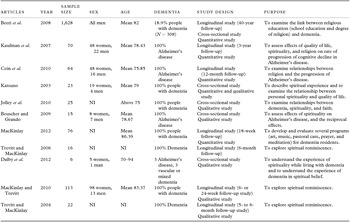
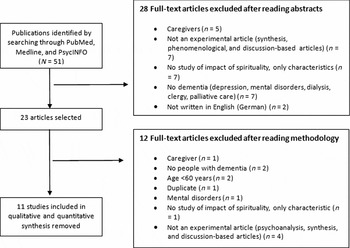
The electronic database search yielded 56 publications. After removal of duplicates, 51 full-text articles were kept for detailed analysis. Then, after reading first the abstracts and second the methodology, 28 followed by a further 12 articles were eliminated, because they did not met the inclusion criteria. In the end, 11 articles were selected (selection illustrated in Figure 1). The main characteristics and results of the studies retained are summarized in Table 1. The 11 articles selected included six longitudinal studies, four cross-sectional studies, and one both longitudinal and cross-sectional study, six qualitative studies, three quantitative studies, and two both qualitative and quantitative. The participants’ place of residence was also taken into consideration: in five articles, people still lived at home; in four articles, they were institutionalized in care homes; and in the remaining articles, they were divided between the two. The mean age was around 80.53 years (no mean age was available in two articles, and another two articles gave no indication of age). The studies involved a majority of women with the exception of one article, and a further three giving no information.
Main characteristics of the 11 articles

Abbreviation: NI, non-indication.
Identification of studies in the systematic review.

Methodological quality
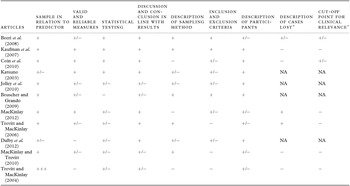
Each article was assessed for methodological quality by means of a checklist (Table 2). This quality judgment was used for the interpretation of the results. In accordance with the recommendations of Sanderson et al. (Reference Sanderson, Tatt and Higgins2007), articles were divided into two categories: “moderate to high quality” or “low quality.” In order to be judged as an article of “moderate to high quality,” the following four minimum requirements had to be met: (1) adequate sample size in relation to predictors, (2) use of valid and reliable measures, (3) use of appropriate statistical testing, and (4) discussion and conclusion in line with the results. Additional criteria were: (5) appropriate description of sampling method, (6) clear description of inclusion and exclusion criteria, (7) appropriate description of participants, (8) appropriate description of cases lost to follow-up (applicable for longitudinal studies), and (9) description of cut-off point for clinical relevance (applicable for longitudinal studies). From these criteria, the articles were classified as follows: six articles considered as having “moderate to high quality” (Katsuno, Reference Katsuno2003; Kaufman et al., Reference Kaufman, Anaki, Binns and Freedman2007; Beeri et al., Reference Beeri2008; Beuscher and Grando, Reference Beuscher and Grando2009; Coin et al., Reference Coin2010; Jolley et al., Reference Jolley, Benbow, Grizzell, Willmott, Bawn and Kingston2010) and five considered as having “low quality” (Trevitt and MacKinlay, Reference Trevitt and MacKinlay2004; Reference Trevitt and MacKinlay2006; MacKinlay and Trevitt, Reference MacKinlay and Trevitt2010; Dalby et al., Reference Dalby, Sperlinger and Boddington2012; MacKinlay, Reference MacKinlay2012).
Methodological quality

Abbreviation: NA, not applicable; +, present; −, not present; +/−, incomplete/partial.
*Applicable for longitudinal studies.
Effects of spirituality/religion on cognitive functions and coping strategies/quality of life. Cognitive functions
Three articles studied the effects of spirituality/religion on cognitive decline (Kaufman et al., Reference Kaufman, Anaki, Binns and Freedman2007; Berri et al., Reference Beeri2008; Coin et al., Reference Coin2010). In these studies, a positive effect of beliefs on maintaining cognitive functioning was found. For Coin et al. (Reference Coin2010), a higher level of religion in Alzheimer's disease correlates with a slower cognitive and behavioral decline. Patients with no or low religion (with a score of <24 according to the Behavioral Religiosity Scale (BRS; Adamson et al., Reference Adamson, Shevlin, Lloyd and Lewis2000), while a score of >24 represents moderate or high religiosity) had markedly worse total cognitive and behavioral test scores after 12 months. Global BRS and Francis Short Scale (Francis, Reference Francis1993) scores correlated significantly with variations in the Mini-Mental State Examination (MMSE; Folstein et al., Reference Folstein, Folstein and McHugh1975) after one year. Low religion coincided with a higher risk of cognitive impairment, considered as a 3-point decrease in the MMSE score. It is important to note that all of the participants were taking a cholinesterase inhibitor treatment at the outset of the study. For Kaufman et al. (Reference Kaufman, Anaki, Binns and Freedman2007), there was also a correlation between a slower rate of cognitive decline (measured by MMSE) and higher levels of spirituality and private religious practices, but there was no correlation between the rate of cognitive decline and quality of life (controlling for baseline level of cognition, age, sex, and education). In contrast, Berri et al. (Reference Beeri2008) indicated that the prevalence rates of dementia were higher (27.1%) for participants (only men) with an exclusively religious education compared to those with mixed education (12.6%) and secular education (16.1%). The more religion was practiced, the higher the prevalence rate was (9.7% < 17.7% < 14.1% < 19.3% < 28.8%).
Coping strategies and quality of life
Eight articles studied quality of life in a broad sense, in particular focusing on coping and adaptation strategies. A person's sense of well-being stems from satisfaction or dissatisfaction with the areas of life, which are important to him/her. For Beuscher and Grando (Reference Beuscher and Grando2009), spirituality and religion are a means of helping to accept having dementia, of finding reassurance and hope, and of staying connected. Most of the participants (14 out of 15) testified that their cognitive losses did not affect their spirituality or beliefs (they coped with the loss of self-esteem, independence, and social interaction), but did affect their practices (prayer and church activities). Personal faith, prayer, connection to church, and family support enhanced the ability of people in an early stage of Alzheimer's disease to keep a positive attitude as they faced living with their disease. For Katsuno (Reference Katsuno2003), there was a relationship between the system belief inventory and quality of life: findings suggest that those with an early stage of dementia often find personal spirituality and its internal meaning important in coping with their life situations, that is to say spirituality is associated with their perceived quality of life. Participants revealed an overall theme of “faith in God” and six related categories, which allowed a better quality of life: beliefs (a lifelong strong faith continues to exist in individuals even as they face dementing illness, and this faith reveals an important part of participants lives), support from God (people with early-stage dementia receive various forms of psychological support from God: help and guidance, strength, security, and comfort), purpose in life (people with deep faith trust God's love, are thankful for his life gift, and are satisfied with it), private practices (these are limited by cognitive changes but they still allow a personal relationship with God, mostly through prayer), public practices (even if practices become more private than public, people are still able to attend church and participate in social meetings), and changes due to dementia (increased awareness, decreased church attendance and need of assistance, doubt in faith). In a longitudinal study, MacKinlay (Reference MacKinlay2012) observed a reduction in levels of depression at the three-month follow-up in participants belonging to a pastoral group (results were not significant in art, music, prayer, and meditation groups). When measuring positive morale (Philadelphia Geriatric Center Morale Scale; Lawton, Reference Lawton1975), only the mode “attitudes toward own ageing” improved for all groups. In his two-way study, Dalby et al. (Reference Dalby, Sperlinger and Boddington2012) observed how older people's experience of spirituality/religion was affected by dementia and how spiritual/religious aspects of their lives affected their experience of dementia. Participants identified five super-ordinate themes of spirituality/religion: experience of faith (particularly the relationship and communication with God), searching for meaning in dementia, changes and losses in experience of the self (particularly changed experience of self and changed relationships with others and social isolation), staying intact by maintaining a sense of self or integrity (particularly through help from their family), and current pathways to spiritual connection and expression, such as spiritual values (love, service or giving), positive attitudes (blessings, humor, curiosity, hope, receptivity, gratitude, appreciation of beauty, and appreciation of the present), and connections with people. In the research of Jolley et al. (Reference Jolley, Benbow, Grizzell, Willmott, Bawn and Kingston2010), participants ranked their individual components of spiritual belief from the most to least important and the strongest to weakest through the Royal Free Interview for religious and spiritual beliefs (King et al., Reference King, Speck and Thomas1995): the presence and strength of belief was rated highest and the importance of practices ranked second. They described spirituality as being evident in everyday experiences and supportive in relation to life stresses (coping and impact on daily life), and they placed influence on world affairs and natural disasters at the lowest end of their belief practices. MacKinlay and Trevitt (Reference MacKinlay and Trevitt2010) examined spiritual reminiscence and two aspects were studied: “meaning in life” and “self-transcendence.” For the majority of the participants, meaning in life was provided by family and relationships, even if the people concerned were dead. In these reminiscence groups, participants transcended their vulnerability: they were able to engage spontaneously in supporting behaviors through speech, touch, listening to each other, and reflecting. They were willing to talk about the difficult aspects of their lives, as well as their happy memories, and were caring toward each other and reached out to provide support. In fact, spirituality allowed more communication and group interaction. Trevitt and MacKinlay (Reference Trevitt and MacKinlay2004) showed the importance of religion and God on patients’ lives. Indeed, memories of early church attendance illustrated that it was part of usual family life. Moreover, they valued church as an important part of their community, which added to the sense of community cohesion. The majority of the participants described an ongoing and constant relationship that always helped to sustain them through good and bad times, and to reduce their fears. Relationships were the most important source of meaning in life. In another study, Trevitt and MacKinlay (Reference Trevitt and MacKinlay2006) worked with moderate- to severe-stage dementia participants. Despite the advanced degree of their cognitive impairment, they still showed capacities of insight and humor. They underlined the importance of relationships (love and support from their family) to keep meaning in life. They also talked about their attendance at worship, especially through prayer (on their own or in an organized group). Participants in this study seemed to be able to speak and share significant issues of life and death. They also expressed a satisfaction with their lives and an acceptance of death.
Discussion
The aim of this literature review was to highlight the effects of spirituality and religion on health outcomes. In the majority of articles (10 on 11), positive effects of spirituality and religion were observed. These benefits allowed cognitive functions to improve, or at least stabilize, and they also enriched coping strategies enabling a better quality of life. These results confirm findings from previous studies.
Factors explaining the benefits of spirituality and religion on cognitive functioning would appear to be neurological. Indeed, a study showed that prayer usually correlates with better mental health because spiritual exercise strengthens the frontal circuits, trains episodic memory, and improves introspection and attention. Repeating prayers facilitate mental concentration and act as a word-repeating exercise (McNamara, Reference McNamara2002), which may reduce progression of disease. Nevertheless, practices are reduced because of the progressive difficulties in mobility in frail elderly people with dementia (Kaufman et al., Reference Kaufman, Anaki, Binns and Freedman2007). Moreover, participating in social (games, meals, celebrations, etc.) or individual (reading, watching TV, listening music, etc.) activities is intellectually challenging, requiring strategies, and engaging executive functioning (Coin et al., Reference Coin2010; Zhang, Reference Zhang2010).
One of the leading factors explaining the benefits of spirituality on quality of life is the search for meaning in life. Snyder (Reference Snyder2003) found evidence of a search for meaning in dementia. By putting their lives in the hands of a third party, namely God, people felt relieved from worrying about an uncertain future. They were confident, felt secure, and adapted better to the situation (Stuckey, Reference Stuckey2003). Kimble and McFadden (Reference Kimble and McFadden2003) observed that the disease did not destroy hope in people living with dementia. It seems important to emphasize the intrinsic nature of religion. Significant positive associations between intrinsic religion (religious attitudes, beliefs, and commitment) and subjective well-being have been highlighted (Koenig et al., Reference Koenig1992). On the other hand, a negative association has been observed between the intrinsic nature of religion and depression (Koenig, Reference Koenig1994).
Another factor that may explain the benefits of spirituality on quality of life is the maintenance of social interactions. Participation in community prayer sessions keeps people in touch with their social sphere, and this social support holds back sadness, anxiety, depression, and hostility (McNamara, Reference McNamara2002). It seems important to encourage an environment that allows people to interact. Indeed, the person and his/her loved ones work on enabling the person with dementia to maintain his/her integrity as a person (Dalby et al., Reference Dalby, Sperlinger and Boddington2012). Family relationships are an important source of meaning and connection (Trevitt and MacKinlay, Reference Trevitt and MacKinlay2004). The emphasis upon helping others as a means of preserving continuity of the self in the context of dementia is striking (Dalby et al., Reference Dalby, Sperlinger and Boddington2012). It should be noted that quotes from non-religious people attest to their ability to find equally meaningful inspirational or practical paradigms for effective coping with their dementia (Snyder, Reference Snyder2003).
Although the majority of these studies show the benefits of spirituality and religion on health outcomes in elderly people with dementia, it is important to note that these concepts alone do not allow improvement in health outcomes; they represent one form of action: by facilitating better outcomes, promoting coping strategies when the disease is diagnosed and in its daily management, helping to adapt to cognitive and behavioral disorders, and improving the quality of life. Moreover, certain criticisms can also be made. Regarding the form of articles, the main criticism is linked to the lack of rigor observed in the diagnosis of dementia. Indeed, in all the articles, the diagnosis of probable dementia was asserted. However, only one of these articles states that the diagnosis was established by a doctor upstream of the study, and the cognitive abilities of the participants were (re)assessed using the MMSE. Four articles had the diagnosis confirmed by a “professional,” and/or had participants conduct a battery of cognitive and neurological tests. Three articles only used the MMSE, and another also used some cognitive tests. Among all these articles, five specified a probable diagnosis (Alzheimer’s, frontal temporal, vascular or mixed dementia): one used the DSM-V (2013) criteria and the MMSE, three used medical examinations or professional advice (brain imaging, neurological assessment), and the fifth gave no indication. Finally, in three articles, no indication was given as to how the diagnosis was established. A second criticism is that scales and questionnaires used to evaluate spirituality and religion were very different (from 2 to 15 items) and not always validated. Some of them only measured the religious aspect (God and Jesus). No two studies used the same measure. This strong heterogeneity could affect the relevance of the results. Finally, we can highlight a lack of methodological rigor in general, with some studies not specifying their sample (proportion men/women, age, family situation, where they lived, presence or absence of religious affiliation or personal beliefs, etc.). Nevertheless, when making comparisons, it seems important to take into account the age of the participant, whether he/she is an isolated widower/widow living alone or in a nursing home or married surrounded by children and friends. Similarly, it could be assumed that the spiritual beliefs of an atheist are not expressed in the same way as those of a religious believer. Furthermore, in certain longitudinal studies, the outcome of lost cases was not specified. Finally, it is important to highlight that one article specifies that participants took a cholinesterase inhibitor treatment throughout the study, which may represent a bias in the results. Indeed, this kind of treatment aims to slow down the decline in everyday activities (efficiency overall cognitive functioning) and to improve some behavioral disorders (Evans et al., Reference Evans, Ellis, Watson and Chowdhury2000; Deschamps and Moulignier, Reference Deschamps and Moulignier2005). Thus, the question is whether the improvement in cognitive functioning was related to spirituality or taking medication.
It seems that people with dementia use spiritual and religious coping to manage the cognitive decline and uncertain future of dementing illnesses, to preserve their positive benefits and relationships, and maintain their quality of life. By asking questions about the person's hopes and fears, joys and sadness, and the meaning in their lives, it is possible to offer them a particular experience and create a contact at an individual level (Hudson, Reference Hudson2003). The review of these articles suggests that there is great promise in studying the role of spirituality/religion in the health and well-being of people with dementia. However, certain issues across studies have been identified, which could be addressed in future research to increase methodological rigor and thus improve interventions. It would be interesting to define a more precise diagnosis for dementia and to use suitable psychometrical measures. Moreover, to improve understanding of the relationship between spirituality/religion and dementia, longitudinal designs and potential negative influences of spirituality/religion should be included.
In terms of professional applications, it seems necessary to include a feeling of connection: being present, using techniques such as appropriate touch, eye contact, and a welcoming and unhurried approach to conversation (MacKinlay, Reference MacKinlay2012). Thus, spirituality can be enhanced through facilitating communication with techniques such as working from the assumption that the person is still there, avoiding concrete questions, asking questions about meaning, allowing time to respond, and leaving periods of silence (MacKinlay, Reference MacKinlay2012).
Conflict of interest
None. The authors have no direct or indirect financial interest in social networking sites.
Description of authors’ roles
All co-authors participated to a similar degree in this research and are in agreement with the content of the manuscript