I. INTRODUCTION
Owing to the unique physiochemical properties including high thermal conductivity, excellent wear resistances, good weldability, and antibacterial properties, Cu–Sn alloy powders have been widely applied in many fields, including ball grid array packages,Reference Lei, Huang, Cheng, Tang and Du1 metal three-dimensional printing,Reference Lu and Reynolds2 and lithium batteries.Reference Hassan, Lafforgue, Ayadi and Schmitz3–Reference Lu, Wang, Jiang, Zuo, Pan, Xu, Chu, Hu and Qi5 Generally, these materials are produced via conventional pre-infiltration of electrolysis copper and tin powder, mechanical chemical process, and atomization technology.Reference Pu, He, Ren, Wan and Jiang4,Reference Dai, Wang, Zhu and Zeng6–Reference Yakutik, Shevchenko and Rakhmanov8 Especially, with the advancement of the semiconductor packaging technology,Reference Pu, He, Ren, Wan and Jiang4 the microscale Cu–Sn particles with controllability narrowed particle size, good spherical morphologies, and smooth particle surface have attracting more and more attention due to their potential in many precision devices.Reference Lu and Reynolds2,Reference Hassan, Lafforgue, Ayadi and Schmitz3,Reference Miura, Dong, Fukue, Yodoshi, Takagi and Kawasaki9,Reference Lagutkin, Achelis, Sheikhaliev, Uhlenwinkel and Srivastava10 Usually, such spherical Cu–Sn alloy particles are usually fabricated by atomization technology, the punching remelting method, and the powder metallurgy method.Reference Lei, Huang, Cheng, Tang and Du1,Reference Lu, Wang, Jiang, Zuo, Pan, Xu, Chu, Hu and Qi5,Reference Lagutkin, Achelis, Sheikhaliev, Uhlenwinkel and Srivastava10,Reference Rashad, Pan and Asif11 Although the atomization technology and punching remelting method are mature industrial technology to fabricate spherical powder,Reference Dai, Wang, Zhu and Zeng6 good spherical morphology is still difficult to obtain and a large number of satellite drops are hard to avoid. The powder metallurgy method gives higher coordination number and resultant higher loose packing density, thereby leading to a more efficient densification during sintering. However, narrow size distribution, low energy, and high efficiency are hard to achieve. Although these methods have been successfully applied in industrial production, there are a few disadvantages, which are related to the particle size, the degree of sphericity, and microstructure of the metal particles.Reference Lei, Huang, Cheng, Tang and Du1,Reference Pu, He, Ren, Wan and Jiang4,Reference Masuda, Takagi, Dong, Yamanaka and Kawasaki12,Reference Cheng, Lei, Huang, Tang and Du13 Moreover, the current particle fabricating process are hindered by their technical difficulty to accurately control the volume of the droplets and the cooling environment of single droplets, which always brings out the diversity of the solidification process and final microstructure of the particles and results in the difficulty of investigating the solidification. Hence, there remains a need for improvement of the production method to meet the requirements for high-performance spherical metal particles, especially those requiring a good spherical morphology and narrow size distribution.Reference Lei, Huang, Cheng, Tang and Du1,Reference Hassan, Lafforgue, Ayadi and Schmitz3,Reference Dai, Wang, Zhu and Zeng6,Reference Cheng, Lei, Huang, Tang and Du13,Reference Haq, Akhtar and Malook14 Masuda et al. reported the solidification behavior of falling germanium droplets with the size range from 200 to 500 mm produced by the pulsated orifice ejection method (POEM).Reference Masuda, Takagi, Dong, Yamanaka and Kawasaki12 Miura et al. investigated the Fe-based monodisperse spherical particles with fully glassy phase using the POEM.Reference Miura, Dong, Fukue, Yodoshi, Takagi and Kawasaki9 The particles have perfect sphericity and narrow size distribution along with a homogeneous composition.
In this study, we aim to prepare monosized spherical Cu–20% Sn (wt%) alloy particles with diameters ranging from 70.6 to 334.0 μm by the POEM, which has a perfect sphericity shape and a narrow size distribution. In this process, the programmable constant pulse perturbation is applied directly on the molten alloy bottom near orifice, driving the melt to eject by overcoming additional pressure under curved surface to form the volume-controllable droplets, and then solidify into microspheres during free cooling.Reference Yakutik, Shevchenko and Rakhmanov8,Reference Miura, Dong, Fukue, Yodoshi, Takagi and Kawasaki9,Reference Haq, Akhtar and Malook14,Reference Tongsri, Tosangthum, Yotkaew, Muthitamongkol, Sri-on and Patakham15 Furthermore, the cooling rate and microstructure of the monosized spherical Cu–20% Sn alloy particle with different particle sizes were studied to calculate the effects of particle diameter on the cooling rate of single particles based on the Newton’s cooling law and then the effect of particle size on the secondary dendrite arm spacing.
II. EXPERIMENTAL PROCEDURE
The wetting properties of Cu–20% Sn alloy samples were evaluated by the contact angle measurements using the static drop method in an argon atmosphere. Directly before every test, each Cu–20% Sn alloy sample was cut into a cube of approximately 1 mm × 1 mm × 1 mm, ultrasonically cleaned in acetone and dried in air. The mass of each Cu–20% Sn alloy sample was measured with an accuracy of 0.0001 g before and after each test, and no mass change was observed. Well-polished, high-purity and porosity-free graphite substrates were used in the wetting test. Prior to the test, the furnace was heated and degassed under vacuum (10−4 Pa), then high purity argon gas (>99.9995%) was introduced. The equipment consists of a tubular furnace with an observation window which is connected to a computer-assisted system that allows real-time monitoring of the melting process on the substrate through successive image snaps. The sample was heated to the measurement temperature about 1223 K above the liquidus. After stabilizing the temperature, it was kept at this temperature for 10 min to allow wetting and during that time, images of the droplet were taken with a digital camera. For each test condition, at least three substrates were measured. All reported data were the average of the three measurements.
Crushed pieces of the raw Cu–20% Sn alloy were obtained from commercial sources as raw materials by Beijing COMPO Technology Co., Ltd., Beijing, China. Argon gas was used as impulse gas and cooling gas in this experiment. The preparation of particles was carried out by using home-made POEM equipment whose operation can be seen in Ref. Reference Novakovic, Lanata, Delsante and Borzone16. The graphite crucible as induction susceptor was heated up to 1223 K for 5 min to melt the Cu–20% Sn alloy. To eject the droplets, pulsated pressure was applied to the melt near the orifice by a vertically reciprocating action of the rod at a frequency of 100 Hz. When the piezoelectric driving device moves directly acting on the melt Cu–20% Sn alloy on the micropores of the graphite crucible, a drop of the tiny liquid is extruded through the bottom of the hole, and monosized spherical Cu–20% Sn alloy particles are formed under the action of surface tension, and then solidify during free falling in a cooling tube without containers. At the same time, another part of the liquid flows back to the alloy melt. A round-trip motion cycle of piezoelectric actuator forms a spherical Cu–20% Sn alloy particles. These particles flow through a stagnant argon gas atmosphere, fall into a particle collector. The heat transfer occurs between the static argon gas environment and the particles in the whole flight stage. Different sizes of Cu–20% Sn alloy particles can be fabricated by the POEM in a range between 70.6 and 334 μm. The secondary dendrite arm spacing of different sized particles was measured and related to the particle cooling rate based on the mathematical methods and experimental results.
The morphology of the samples was examined using a scanning electron microscope (SSX-550, Shimadzu, Kyoto, Japan). After being mounted in a matrix of epoxy resin and polished, the cross-sectional microstructure of monosized spherical Cu–20% Sn alloy particles was characterized by SSX-550 with energy dispersive X-ray spectroscopy (EDS). The sphericity was measured by using a particle size analyzer (Camsizer X2, Retsch Technology, Haan, Germany).Reference Lei, Huang, Cheng, Tang and Du1 The crystal structure of the particles was determined by X-ray diffraction (XRD) (D/MAX-RB, Rigaku, Tokyo, Japan). Differential thermal analysis to study the thermal properties of the monosized spherical Cu–20% Sn alloy particles was carried out over the temperature range from 323 to 1223 K at a rate of 10 K/min by using a thermal analyzer (STA 449F3, Netzsch, Selb, Germany).
III. RESULTS AND DISCUSSION
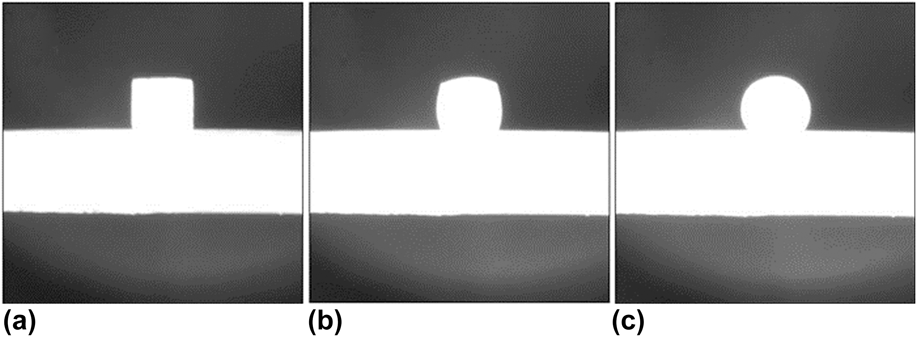
The wettability of the Cu–20% Sn alloy with the crucible was tested by using the sessile drop method in an argon atmosphere.Reference Novakovic, Lanata, Delsante and Borzone16–Reference Dong, Cui, Zhu, Xu and Yang18 Figure 1 shows the variation of a Cu–20% Sn cylinder on a graphite substrate during heating from room temperature to 1223 K. The result shows that the Cu–20% Sn melt was not wetted by the graphite substrate even when the temperature increased to 1223 K (the contact angle is 123°). Thermodynamically, Cu–20% Sn is chemically stable with graphite within this temperature range and can be partly verified by the sessile drop experiment where the Cu–20% Sn droplet can be easily separated from the graphite substrate after cooling down. The above analysis demonstrates that graphite can be acted as the suitable crucible and substrate materials for the Cu–20% Sn POEM experiment.
Macroscopic morphology changes of the Cu–20% Sn alloy with the graphite substrate when heating from room temperature to 1223 K. (a) At the beginning of melting, (b) in the melting process with a dwell time of 10 s, and (c) after melting at 1223 K with a dwell time of 10 min.

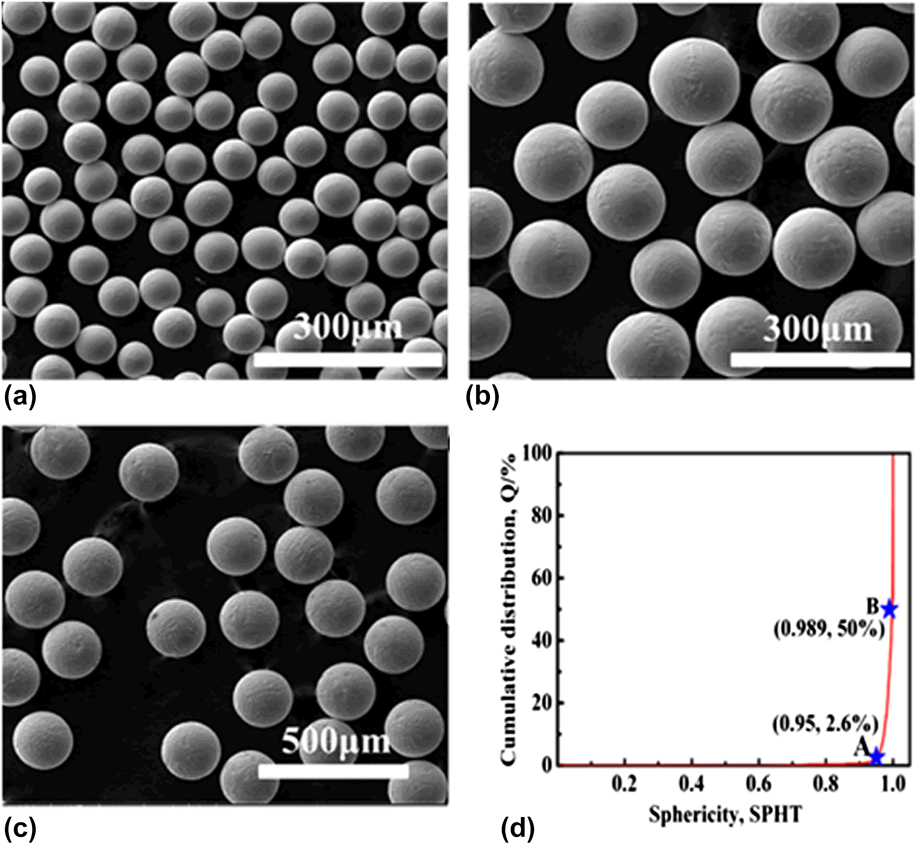
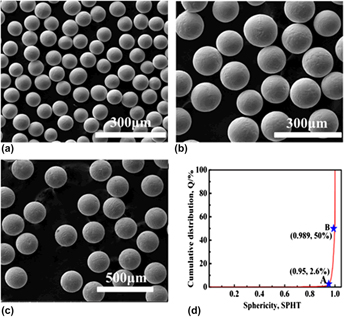
With different mechanical pressures and orifice sizes of the POEM instrument, particles with different diameters were prepared. Figure 2 shows the secondary electron images and sphericity of monosized spherical Cu–20% Sn alloy particles with various sizes. The SEM micrograph in Figs. 2(a)–2(c) reveals the monosized spherical Cu–20% Sn alloy particles with uniform particle size and narrow size distribution. The figures also exhibit that most of the particles are spherical and without any satellite particles. High sphericity of monosized spherical Cu–20% Sn alloy particles with diameters ranging from 70.6 to 334 μm is presented in Fig. 2(d). When the percentage of tested particles’ cumulative distribution is 2.6%, sphericity is 0.95 as point A indicated. When the percentage of the tested particles’ cumulative distribution is 50%, sphericity is 0.989 as point B indicated. Figure 2(d) also indicates that the sphericity of particles gradually tends to be 1 with the percentage of tested particles’ cumulative distribution more than 50%. Generally, Fig. 2 shows that monosized spherical Cu–20% Sn alloy particles obtained by the POEM have high sphericity and relatively narrow size distribution. The main reason is that the POEM can accurately control the volume of the droplets through regular pulse perturbation in the bottom of the crucible, and the monosized droplets provide the complete repeatability of the falling trajectory at regular period. In addition, the monosized particles formed by this method completely undergo the same cooling procedure. This means that all the particles completely repeat the identical cooling and solidification processes.Reference Rashad, Pan and Asif11
SEM images showing the spherical Cu–20% Sn alloy particle morphology. The average diameters with deviation by normal distribution are (a) 115.7 ± 4.7 μm, (b) 169.0 ± 5.7 μm, (c) 235.2 ± 6.5 μm, and (d) sphericity of Cu–20% Sn alloy particles with diameters 70.6–334.0 μm.

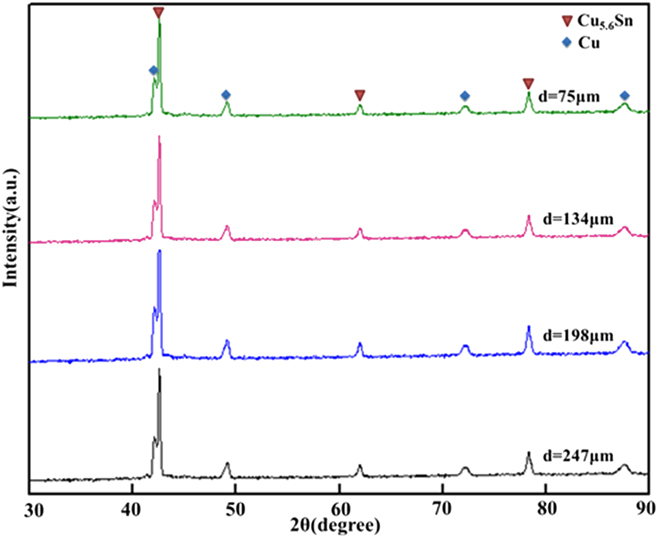
The XRD patterns of the as-prepared Cu–20% Sn particles with different sizes are given in Fig. 3. Although the particle size differs significantly from 75 to 247 μm, their XRD patterns are almost identical while the phases consist of the major Cu5.6Sn phase and Cu phase. The similarity of different-sized Cu–20% Sn spheres in phase composition indicates that their droplets underwent the similar solidification process as discussed in the below text.
XRD patterns of monosized spherical Cu–20% Sn alloy particles with different diameters.

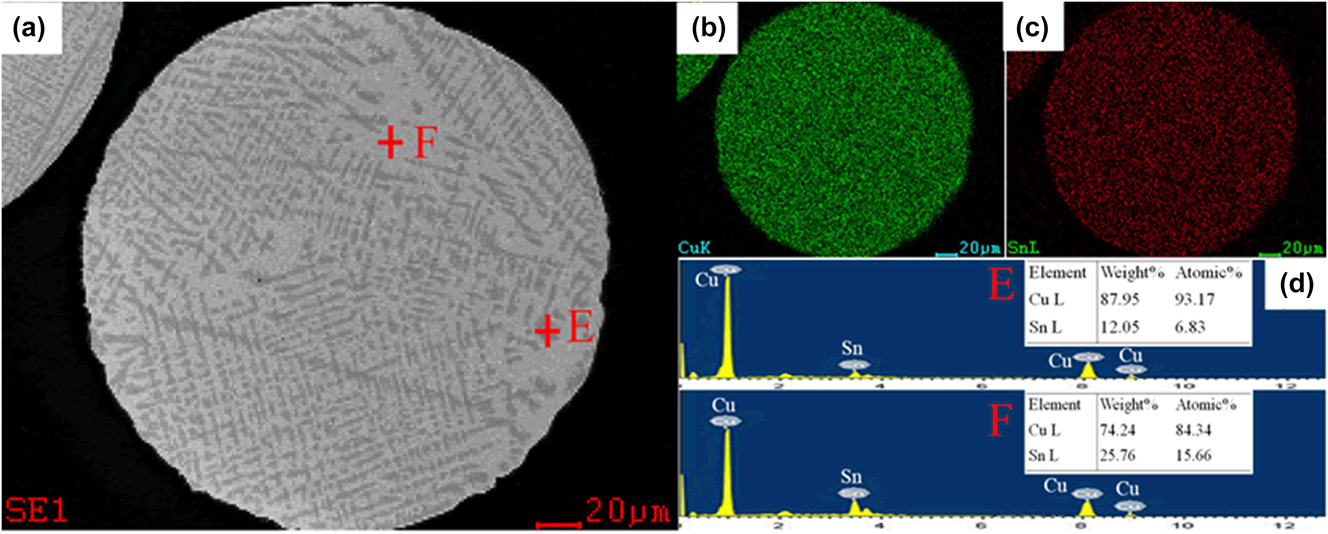
Figure 4 exposes the internal structure of a Cu–20% Sn alloy particle with diameter 247 μm. The cross-sectional micrography in Fig. 4(a) shows that the two phases (in black and gray color) are alternately distributed. According to the properties of the liquid–solid interface, the Cu–Sn alloy is the metal–metal eutectic structure, and the type of interface contact is rough–rough, so it is easy to form the eutectic structure. Element mapping reveals even distribution of Cu and Sn [Figs. 4(b) and 4(c)]. The composition rates of Cu and Sn for point E (dark-colored zone) and F (light-colored zone) from EDS analysis are shown in the insets of Fig. 4(d). For point E, the atomic percentages of Cu and Sn were 93.17% and 6.83%, respectively, while for point F, they are 84.34% and 15.66%, respectively.
(a) Cross section, (b) element mapping of Cu, (c) element mapping of Sn, and (d) selected zone EDS and compositions of monosized spherical Cu–20% Sn alloy particles by the POEM.

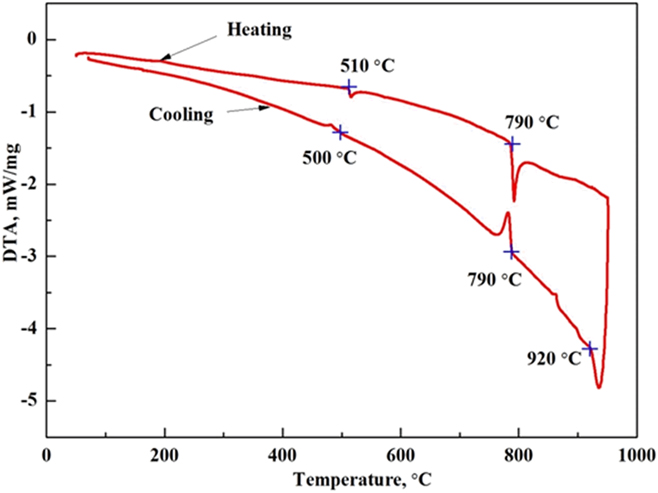
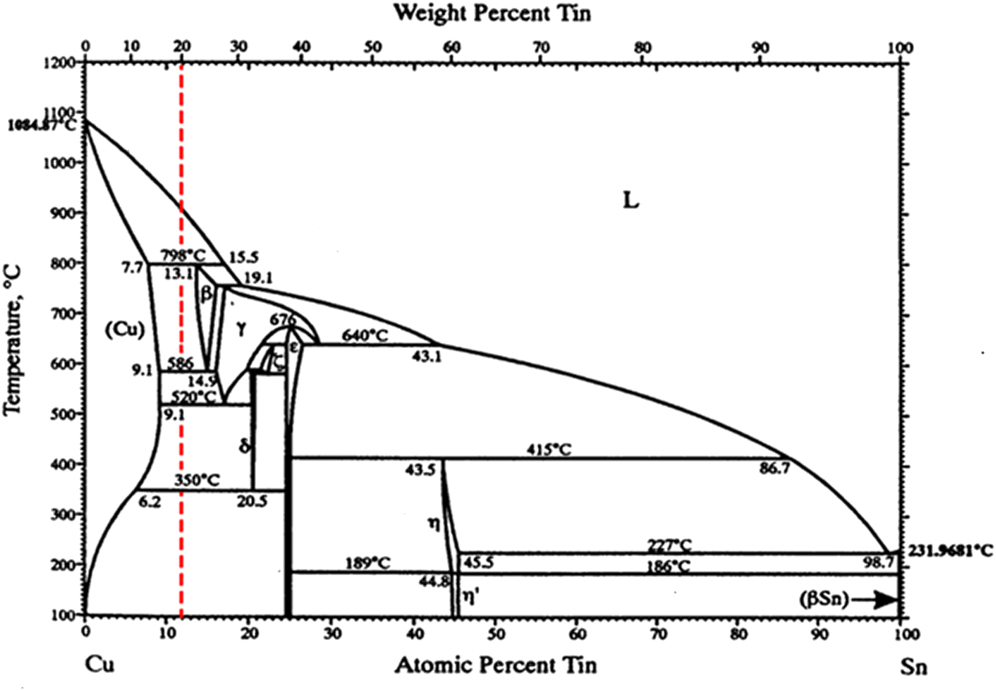
Figure 5 shows the DTA curves of the monosized spherical Cu–20% Sn alloy particles, while Fig. 6 gives the equilibrium phase diagram of the Cu–Sn binary system which was taken from the work of Seizo Nagasaki.Reference Haq, Akhtar and Malook14 As the dashed line shows in Fig. 6, when the Cu–20% Sn alloy is cooling from the liquidus line, the equilibrium precipitation sequence should be L → (Cu) → β → γ → δ → ε. However, it can be seen from Fig. 4(a) that only two solid phases exist in the sample: the Cu phase with face-centered cubic structure and the Cu5.6Sn phase with body-centered cubic structure (the composition was analyzed by X’Pert Highscore software, PANalytical, Almelo, the Netherlands). Combining the XRD results in Fig. 3, EDS results in Fig. 4(d), and the phase diagram in Fig. 6, it can be deduced that the dark-colored phase in Fig. 4(a) should be Cu, while the light-colored phase should be Cu5.6Sn (β). The reason why only these two phases were detected could be attributed to the rapid solidificating process of Cu–Sn droplets during the POEM process, and no further solid phase reactions like β → (Cu) + γ took place during the cooling process.
DTA curves of monosized spherical Cu–20% Sn alloy particles.

Cu–Sn phase diagram. Adapted with permission from Ref. Reference Saunders and Miodownik20. Copyright 1990 Springer Nature.
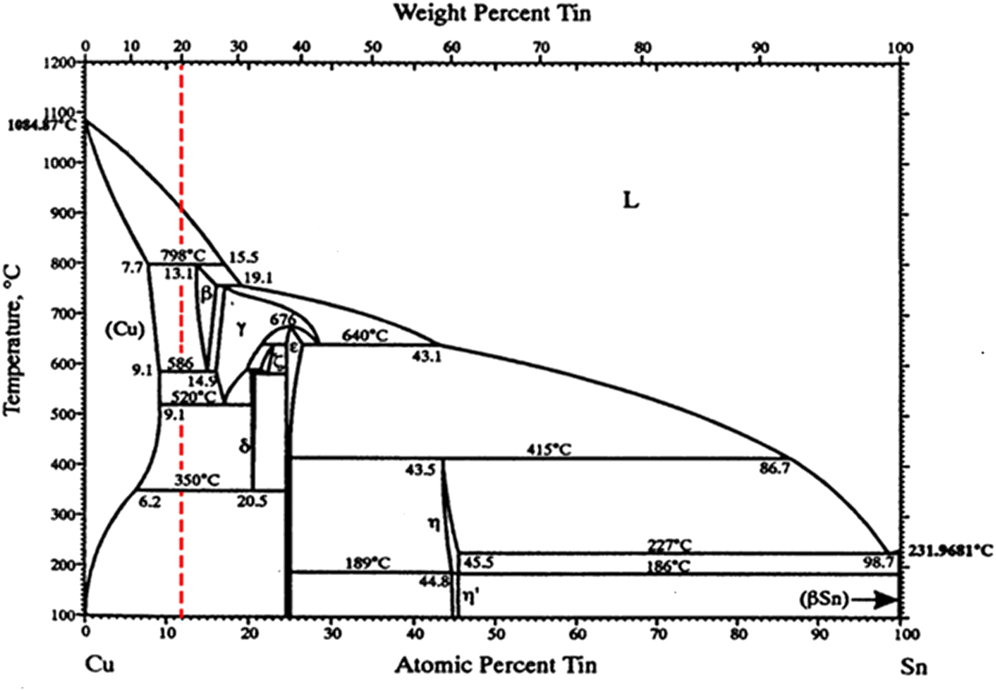
For Fig. 5, three sets of DTA tests were carried out by heating and cooling the alloy particles between 50 and 950 °C. The three cycle curves agreed with each other very well and thus only one cycle curve was given. The onset temperature of phase transformation points was marked as 510 and 790 °C during the heating process and 500, 790, and 920 °C during the cooling process. Considering the equilibrium phase diagram and the uncertainty of the measurement, the reaction occurring at 920 and 790 °C should be L → (Cu) and peritectic reaction (Cu) + L ⇆ β + (Cu5.6Sn), respectively. At around 500–510 °C, the eutectoid reaction γ → (Cu) + δ was measured, but the eutectoid reactions of β ⇆ (Cu) + γ at 586 °C and δ ⇆ (Cu) + ε at 350 °C in the equilibrium were not detected in the present work. As reported by Furtauer et al.,Reference Furtauer, Li, Cupid and Flandorfer19 the thermal effect of the second-order transition β ⇆ (Cu) + γ was very weak, so it was hard to confirm the relating phase regions and the transition temperature. As for the reaction δ ⇆ (Cu) + ε, it may be due to the low occurring temperature and the weak thermal effect at a temperature increasing rate of 10 °C/min, which was not detected by Furtauer et al.Reference Tongsri, Tosangthum, Yotkaew, Muthitamongkol, Sri-on and Patakham15,Reference Furtauer, Li, Cupid and Flandorfer19 either.
The POEM can produce particles with the same volume, geometry, and thermal history at the same cooling rate. In this section, the monosized spherical Cu–20% Sn alloy particles with diameters ranging from 70.6 to 334 μm prepared by the POEM are rapidly containerless solidification process.Reference Yu, Wang and Hong21 Here, it is aware that the microstructure has relation with the cooling rate as described in the beginning of this section. The secondary dendrite arm spacing of different-sized droplets was measured and was related to the particle cooling rate based on the mathematical methods and experimental results.Reference Zhang, Zhang, Wang and Huo22–Reference Pang, Xu, Li and Chen24 Because the thermal radiation and convection are the dominant approaches for the heat transfer process from the Cu–20% Sn alloy droplet to its environment, theoretical estimations are performed based on Newtonian heat transfer model.Reference Yan, Wang and Wei25 The cooling rate R c of the Cu–20% Sn alloy droplet during free fall is described in the following equation:
 $${R_{\rm{c}}} = {{{\rm{d}}T} \over {{\rm{d}}t}} = - {{6h} \over {\rho d{C_{\rm{d}}}}}\left( {T - {T_{\rm{g}}}} \right) - {{6\varepsilon \sigma } \over {\rho d{C_{\rm{d}}}}}\left( {{T^4} - {T_{\rm{g}}}^4} \right)\quad ,$$
where ρ is the density of droplet, d is the droplet diameter, C d is the specific heat capacity of the droplet, ε is the surface emissivity of the droplet, T is the droplet surface temperature, T g is the cooling gas temperature, σ is the Stefan–Boltzmann constant, and h is the effective heat transfer coefficient and consists of the additive contribution of convection and conduction heat transfer mechanisms in the environment.
The heat transfer coefficient h can be calculated by the Ranz–Marshall equation under the assumption that the falling particle in a stationary atmosphere is equal to a stationary sphere in forced convection:
 $${\mathop{\rm Re}\nolimits} \lt 1000,\;{\rm{Nu}} = 2.0 + 0.6{{\mathop{\rm Re}\nolimits} ^{{1 / 2}}}{\rm{P}}{{\rm{r}}^{{1 / 3}}}\quad ,$$
where
 $${\rm{Nu}} = {{hd} \over \lambda },\;{\mathop{\rm Re}\nolimits} = {{du{\rho _{\rm{g}}}} \over \mu },\;\Pr = {{{C_{\rm{p}}}\mu } \over \lambda }\quad .$$
Here, Nu, Pr, and Re are the Nusselt, Prandtl, and Reynolds number, respectively. λ, u, ρg, and μ are the thermal conductivity of the cooling gas, falling velocity of the particle, density of cooling gas, and viscosity of the cooling gas, respectively.
The release of latent heat is treated as a change of specific heat during solidification. According to the relation expression of latent heat investigated by Pan et al.,Reference Pan, Wang and Zhang26 the latent heat L can be expressed as follows:
 $$L = \sum\limits_{i = 1}^n {{x_i}{L_i}} + R{T_{\rm{m}}}\sum\limits_{i = 1}^n {{x_i}\ln {x_i}\quad .}$$
For spherical Cu–20% Sn alloy particles, L can be calculated as follows:
 $$L = {x_{{\rm{Cu}}}}{L_{{\rm{Cu}}}} + {x_{{\rm{Cu}}}}{L_{{\rm{Cu}}}} + R{T_{\rm{m}}}\left( {{x_{{\rm{Cu}}}}\ln {x_{{\rm{Cu}}}} + {x_{{\rm{Sn}}}}\ln {x_{{\rm{Sn}}}}} \right)\quad ,$$
where x Cu and x Sn are the mole fraction of x Cu and x Sn, respectively. T m is the Cu–20% Sn alloy melting point.
Based on the Newton’s free fall law, the single particle movement is described by the following equation:
 $$H = {V_0}t + {1 \over 2}g{t^2}\quad ,$$
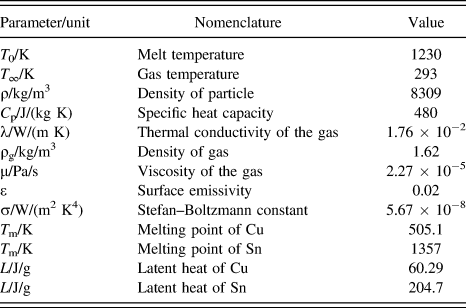
where H is the movement distance of particle, V 0 is the initial velocity of single Cu–20% Sn alloy particle, g is the acceleration of gravity, and t is the movement time. In this work, argon is the cooling gas. Thermophysical properties of the cooling gas and Cu–20% Sn droplets used in the simulation and calculation are listed in Table I.
Thermophysical properties of cooling gas and spherical Cu–20% Sn alloy particles.

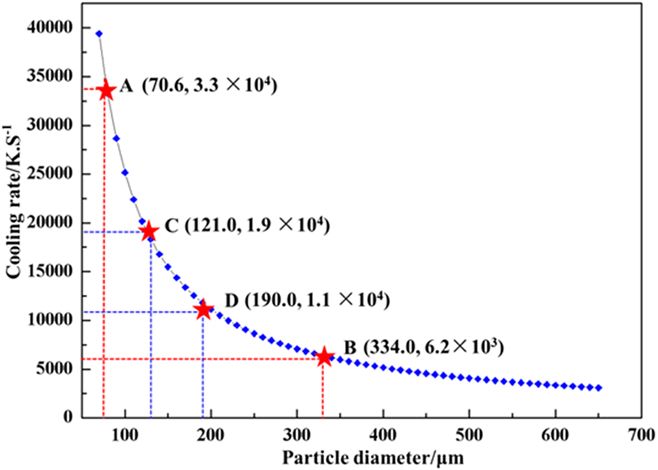
Figure 7 shows the relationships between the calculated cooling rates during free fall of Cu–20% Sn alloy particles. Evidently, the cooling rate decreases gradually with the particle diameter increasing. High sphericity of monosized spherical Cu–20% Sn alloy particles with diameters ranging from 70.6 to 334 μm is prepared by the POEM. The corresponding cooling rate is 3.3 × 10⁴ K/s as point A indicated and point B is the cooling rate 6.2 × 10³ K/s. When the particle diameter is greater than 334.0 μm, the cooling rate is less than 6.2 × 10³ K/s. At the same time, the cooling rate curve of particles declined slowly and gradually tends to be linear with the particle diameter more than 500 μm. Figure 7 also highlights that small particles can achieve a higher cooling rate as point A and point C shown. When the particle diameter is less than 70 μm, the cooling rate of particles can reach more than 3.3 × 10⁴ K/s. Meanwhile, the cooling rate decreases rapidly with particle diameter increased between 70.6 and 121 μm. Although the above equations can only provide a rough description of droplet heat dissipation, the calculated cooling rates are still helpful to explain the rapid solidification mechanism of Cu–20% Sn alloy particles.
Calculated cooling rate of spherical Cu–20% Sn alloy particles.

The calculated flight distance of the Cu–20% Sn alloy droplet is shown in Fig. 8. H and t represent the flight distances and flight time, respectively. From Fig. 8, the flight distances of the spherical Cu–20% Sn alloy droplet increase gradually with the flight time increasing. Mark A indicates that the flight time of 0.6 s corresponds to a flight distance of 3 m in this experiment, and these single droplets are collected in the particle collector.
Calculated flight distance of spherical Cu–20% Sn alloy particles with time.

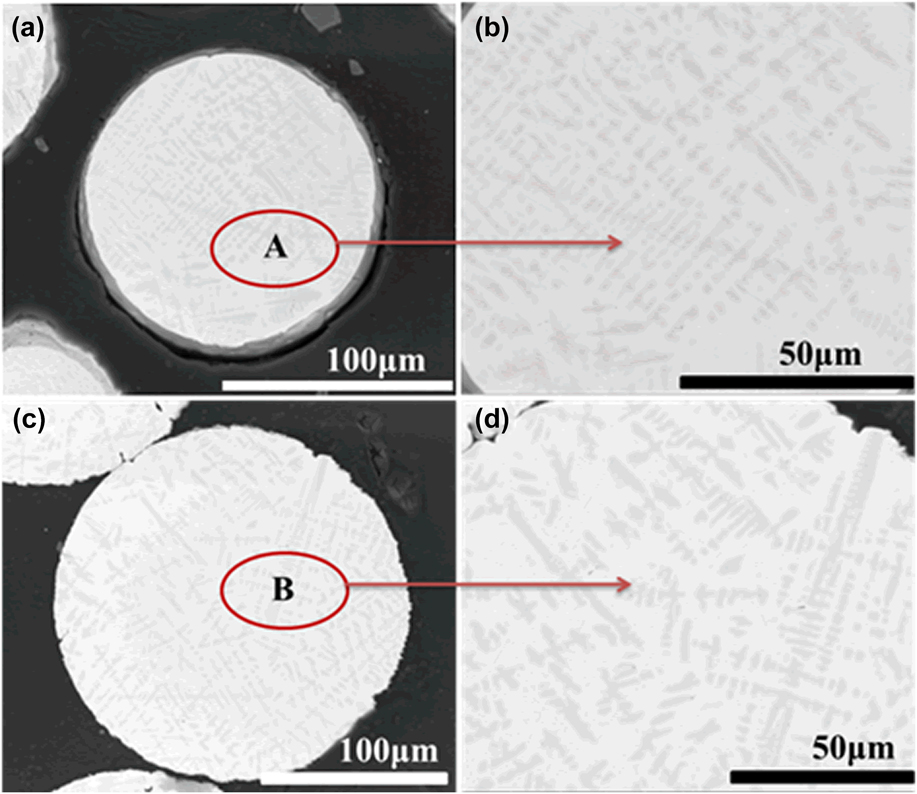
To study the influence of the dendrite spacing with different diameters of spherical Cu–20% Sn alloy particles, the secondary dendrite arm spacing of spherical Cu–20% Sn alloy particles with different sizes is measured. Figure 9 compares the dendrite characteristics of different diameter spherical Cu–20% Sn alloy particles. Figure 9(a) shows a dendrite microstructure of spherical Cu–20% Sn alloy particles with diameters 121 μm. Figure 9(b) shows the local details of the dendrite microstructure at the high magnification of the marked zone in Fig. 9(a). The calculated cooling rate is 1.9 × 10⁴ K/s as point C indicated in Fig. 7. Figure 9(c) shows the microstructure feature of spherical Cu–20% Sn alloy particles with diameter 190 μm. Figure 9(d) shows the local details of the dendrite microstructure at the high magnification of the marked zone in Fig. 9(c). The calculated cooling rate is 1.1 × 10⁴ K/s as point D indicated in Fig. 7. Compared with secondary dendrite arm spacing of Cu–20% Sn alloy particles with diameters from Figs. 9(a) and 9(c), the measured value of secondary dendrite arm spacing is 2.89 μm and 3.05 μm, respectively. From Figs. 9(b) and 9(d), the dendrite structure is denser and also consistent with the above measured results. The reason for this structural difference of different particle diameters is that the increase of these particle diameters may reduce the heat conduction inside the deformed particle, thus resulting in a cooling rate decrease and thereby dendrite arm spacing decreased.Reference Pan, Wang and Zhang26 Meanwhile, smaller particles have higher cooling rates, and the development of dendrite arms is restrained to some extent, thus dendrite arm spacing increased.
Dendrite feature of monosized spherical Cu–20% Sn alloy particles with different diameters, (a) particle diameter of 121 μm, (b) local details of the dendrite microstructure of part A, (c) particle diameter of 190 μm, and (d) local details of dendrite microstructure of part B.

IV. CONCLUSIONS
High spherical, monosized spherical Cu–20% Sn alloy particles with diameters ranging from 70.6 to 334.0 μm were successfully prepared by the POEM in the present work. Graphite was selected as a suitable crucible material for the following technological experiment because of low wettability and high chemical stability at high temperatures of the Cu–Sn alloy. The XRD, SEM, and DTA tests demonstrated that high sphericity, good spherical morphologies, and narrow size distribution along with a homogeneous composition of monosized spherical Cu–20% Sn alloy particles were obtained. Furthermore, the cooling rate is correlated with the particle diameter of spherical Cu–20% Sn alloy particles. When the particle diameter is less than 70 μm, the cooling rate of particles can reach more than 3.3 × 10⁴ K/s. Meanwhile, the cooling rate decreases rapidly when the particle diameter increased between 70.6 and 121 μm. Comparing the calculated and measured secondary dendrite arm spacing of spherical Cu–20% Sn alloy particles, the secondary dendrite arm spacing of spherical Cu–20% Sn alloy particles is found to increase with the increase of particle diameter. Smaller particles have higher cooling rates, and the development of secondary dendrite arm spacing is restrained to some extent.
ACKNOWLEDGMENTS
This work was financially supported by the Instrument Developing Project of the Chinese Academy of Sciences (Grant No. YZ201520) and the National Natural Science Foundation of China (Nos. 51501179, 51674232, and 51671181).