Adverse childhood experiences (ACEs) include child maltreatment, domestic violence, substance abuse, mental illness, incarceration, and single parenting (Felitti et al., Reference Felitti, Anda, Nordenberg, Williamson, Spitz, Edwards and Marks1998). Extensive research demonstrates that ACEs double risk for chronic diseases in adults such as heart disease, cancer, liver disease, lung disease, and autoimmune diseases, and quadruple risk for mental health problems including suicide, alcoholism, illicit drug use, depression, and dementia (Anda et al., Reference Anda, Felitti, Bremner, Walker, Whitfield, Perry and Giles2006; Brown et al., Reference Brown, Anda, Tiemeier, Felitti, Edwards, Croft and Giles2009; Felitti et al., Reference Felitti, Anda, Nordenberg, Williamson, Spitz, Edwards and Marks1998). While there is evidence that ACEs are linked to adult pathology through adoption of unhealthy lifestyles, there is also evidence that ACEs are associated with physiologic changes even in the presence of healthy lifestyles (Shonkoff et al., Reference Shonkoff, Garner, Siegel and Wood2012). These physiologic changes include activation of the hypothalamus–pituitary–adrenal (HPA) axis and sympathetic nervous system (SNS) with co-occurring alterations in immune system function (Chiang, Taylor, & Bower, Reference Chiang, Taylor and Bower2015; Repetti, Taylor, & Seeman, Reference Repetti, Taylor and Seeman2002; Shonkoff et al., Reference Shonkoff, Garner, Siegel and Wood2012).
Innate (or natural) immunity is the first line of defense against injury, infection, or necrosis. Harmful stimuli are eliminated and tissue repair is initiated through inflammation which involves granulocytes, including neutrophils, and macrophages, and the release of communication molecules called cytokines (Segerstrom & Miller, Reference Segerstrom and Miller2004). Adaptive (or acquired) immunity is a slower but more specific response that involves three-types of lymphocytes: T helper (CD4+) cells, T cytotoxic (CD8+) cells, and B cells. T helper cells release cytokines that amplify the activity of CD8+ T cells and B cells (Segerstrom & Miller, Reference Segerstrom and Miller2004). One subset of cytokines known as Type I interferons play a key role in protecting cells against viral infections (Trinchieri, Reference Trinchieri2010). Prolonged stress can stimulate immune cell production of the cytokines involved in inflammation while reducing the expression of Type I interferons and cytokines that support B cell antibody production, such that there is an increase in vulnerability to both infection and neoplastic disease, as well as autoimmune and allergic disease (Irwin & Cole, Reference Irwin and Cole2011; Miller, Chen, & Cole, Reference Miller, Chen and Cole2009). Inflammation is protective as an acute response, but when prolonged can become a toxic precursor to variety of diseases including depression, dementia, diabetes, cardiovascular disease, and some cancers (Murphy, Slavich, Chen, & Miller, Reference Murphy, Slavich, Chen and Miller2015).
The psychological stress response begins with a perception of threat or uncertainty by the central nervous system that triggers the HPA axis and/or SNS, and results in a transient reconfiguration of the immune system that involves both inflammation and suppression of some adaptive immune responses (Adamao, Reference Adamao2014). A broad literature demonstrates that stressors activate proinflammatory pathways, including laboratory studies of stressors like giving a speech or arguing with a spouse, and naturalistic studies of social difficulties, loneliness, and targeted rejection (Murphy et al., Reference Murphy, Slavich, Chen and Miller2015; Murphy, Slavich, Rohleder, & Miller, Reference Murphy, Slavich, Rohleder and Miller2013). The presence of a proinflammatory phenotype in response to early-life stressors has been observed in infants (David, Measelle, Ostlund, & Ablow, Reference David, Measelle, Ostlund and Ablow2017; Jiang et al., Reference Jiang, Tofail, Ma, Haque, Kirkpatrick, Nelson and Petri2017; Measelle & Ablow, Reference Measelle and Ablow2018), young children (Cicchetti, Handley, & Rogosch, Reference Cicchetti, Handley and Rogosch2015; Slopen, Kubzansky, McLaughlin, & Koenen, Reference Slopen, Kubzansky, McLaughlin and Koenen2013; Tyrka, Parade, Valentine, Eslinger, & Seifer, Reference Tyrka, Parade, Valentine, Eslinger and Seifer2015), and adolescents (Chiang et al., Reference Chiang, Ko, Bower, Taylor, Irwin and Fuligni2019; Miller & Chen, Reference Miller and Chen2010; Miller & Cole, Reference Miller and Cole2012). Several studies have demonstrated that adults with a history of child maltreatment or other ACEs have increased levels of inflammation as shown by elevations in white blood cell counts and circulating proinflammatory cytokines (Danese et al., Reference Danese, Moffitt, Harrington, Milne, Polanczyk, Pariante and Caspi2009; Danese, Pariante, Caspi, Taylor, & Poulton, Reference Danese, Pariante, Caspi, Taylor and Poulton2007; Howren, Lamkin, & Suls, Reference Howren, Lamkin and Suls2009; Surtees et al., Reference Surtees, Wainwright, Day, Brayne, Luben, Khaw and Khaw2003). Studies of chronic stressors (such as family stressors and trauma) suggest that inflammation persists, but is accompanied by alterations in cytokines and reductions in lymphocyte proliferation (Ehrlich, Miller, & Chen, Reference Ehrlich, Miller and Chen2015; Segerstrom & Miller, Reference Segerstrom and Miller2004).
Studies of gene expression offer a complementary approach to examining the impact of stress on cellular processes. “Gene expression” refers to the transcription of a gene's DNA blueprint into RNA molecules that subsequently serve as the template for producing the biologically active proteins that mediate cell function (including the cytokines noted above) (Ehrlich et al., Reference Ehrlich, Miller and Chen2015; Irwin & Cole, Reference Irwin and Cole2011; Segerstrom & Miller, Reference Segerstrom and Miller2004). Gene expression studies suggest the presence of a common biological pathway that is activated in response to stressful social environments and can increase risk for various chronic diseases (Cole, Reference Cole2013, Reference Cole2014; Schwaiger et al., Reference Schwaiger, Grinberg, Moser, Zang, Heinrichs, Hengstler and Kumsta2016). This common biological pathway is called the conserved transcriptional response to adversity (CTRA) and refers to SNS signaling that upregulates gene expression of proinflammatory cytokines, downregulates gene expression for Type 1 interferons, and stimulates hematopoietic output of classical monocytes (Cole, Reference Cole2019; Schwaiger et al., Reference Schwaiger, Grinberg, Moser, Zang, Heinrichs, Hengstler and Kumsta2016). CTRA profiles in blood are predictive of inflammation-related disease outcomes in cancer and general chronic disease (Antoni et al., Reference Antoni, Bouchard, Jacobs, Lechner, Jutagir, Gudenkauf and Blomberg2016; Knight et al., Reference Knight, Rizzo, Logan, Wang, Arevalo, Ma and Cole2016, Reference Knight, Rizzo, Wang, He, Logan, Spellman and Cole2019; Simons et al., Reference Simons, Lei, Beach, Barr, Cutrona, Gibbons and Philibert2017), and complement blood cytokine measures by quantifying cellular mediators of inflammation that traffic through blood to diseased tissues in atherosclerosis, cancer, infections, and other localized disease processes (Irwin & Cole, Reference Irwin and Cole2011; Miller et al., Reference Miller, Chen and Cole2009).
Studies of loneliness, poverty, bereavement, and chronic stress have all shown activation of the CTRA, which provides a biological mechanism linking adverse social environments with the development of inflammation-related diseases and reductions in antiviral defenses (Cole, Reference Cole2019). Two studies of pediatric asthma patients demonstrated CTRA activation in response to targeted rejection or harsh parent–child conflict (Ehrlich et al., Reference Ehrlich, Miller and Chen2015; Murphy et al., Reference Murphy, Slavich, Chen and Miller2015). One study of adolescents at risk for depression showed increased transcription factor activation related to CTRA (Murphy et al., Reference Murphy, Slavich, Rohleder and Miller2013). These studies suggest that CTRA activation may be a key component to biological mechanisms linking ACEs to poor health outcomes, but in order to translate these findings into preventive interventions, studies are needed on correlations with the assessment of ACEs and potential differences in biological response to ACEs by age group. Studying interferon and cell type profiles is particularly important to providing a more comprehensive understanding of immune reconfiguration, beyond the inflammatory response that is observed in response to both acute and chronic stressors. Evaluations of the immune system can be done at different levels, from gene expression to circulating cell counts. Studies of gene expression have the advantage of avoiding some of the challenges of interpreting circulating cell counts (Zhoua, Fragalaa, McElhaney, & Kuchel, Reference Zhoua, Fragalaa, McElhaney and Kuchel2010), and the added benefit of being feasible based upon the minimally invasive approach of dried blood spot (DBS) sampling (McDade, Williams, & Snodgrass, Reference McDade, Williams and Snodgrass2007).
The purpose of this study was to test the hypothesis that children with higher ACE scores would have alterations in blood gene expression profiles that resemble the CTRA in showing increased expression of pro-inflammatory genes. As exploratory hypotheses, we also tested for differential expression of Type I interferon genes due to their typical downregulation in the adult CTRA profile, and examined potential cellular origins of differences in gene expression. If children with higher ACE scores do have alterations in immune cell gene expression profiles, then these alterations could serve as a predictive biomarker of risk for adult pathology and an outcome biomarker to assess the potential impact of pediatric interventions.
Method
Participants and recruitment
Participants were recruited to attend a single follow-up research visit after receiving well-child care at one of two university-affiliated pediatric primary care practices. Pediatric patients were eligible for the research study if they were age 5–11 years old, English-speaking, and generally healthy based upon medical record review. Patients were excluded if they had a neurodevelopmental disability that would prohibit their participation in psychological testing or if they had a sibling already enrolled in the study. All eligible patients were mailed an information letter about the research study and called by phone within 1–2 weeks after their well-child visit. A total of 131 eligible patients were successfully contacted by phone, of whom 100 agreed to participate. The study was powered to detect the direct effect of ACEs on the total Pediatric Symptom Checklist score, a measure of psychosocial dysfunction that correlates with common mental disorders (target N = 89) (Gardner, Lucas, Kolko, & Campo, Reference Gardner, Lucas, Kolko and Campo2007; Jellinek et al., Reference Jellinek, Murphy, Little, Pagano, Comer and Kelleher1999; Murphy, Reed, Jellinek, & Bishop, Reference Murphy, Reed, Jellinek and Bishop1992). The collection of DBS samples was added as a secondary measure about halfway through the study, resulting in a total of 40 samples. The Institutional Review Board at our university approved this research study (IRB# 5140273).
Adversity measure
The Whole Child Assessment (WCA) was used to assess child adversity at the research visit (Marie-Mitchell et al., Reference Marie-Mitchell, Lee, Siplon, Chan, Riesen and Vercio2019; Marie-Mitchell, Watkins, Copado, & Distelberg, Reference Marie-Mitchell, Watkins, Copado and Distelberg2020). Ten questions were about child exposure to ACEs (Child-ACEs) based upon the categories described in the original ACE study, including child physical abuse, child sexual abuse, child verbal abuse, child physical neglect, child emotional neglect, domestic violence, substance abuse by a household member, mental illness of a household member, incarceration of a household member, and single parenting (Felitti et al., Reference Felitti, Anda, Nordenberg, Williamson, Spitz, Edwards and Marks1998). Six questions were about risk of Child-ACEs, including risk of emotional abuse, physical abuse, caregiver mental illness, caregiver alcohol abuse, and family dysfunction (Centers for Disease Control and Prevention & National Center for Chronic Disease Prevention and Health Promotion, 2009; Dubowitz, Lane, Semiatin, & Magder, Reference Dubowitz, Lane, Semiatin and Magder2012; Feigelman, Dubowitz, Lane, Grube, & Kim, Reference Feigelman, Dubowitz, Lane, Grube and Kim2011; Kroenke, Spitzer, & Williams, Reference Kroenke, Spitzer and Williams2003; Kroenke, Spitzer, Williams, Monahan, & Löwe, Reference Kroenke, Spitzer, Williams, Monahan and Löwe2007; Taj, Devera-Sales, & Vinson, Reference Taj, Devera-Sales and Vinson1998). Although most ACE scales count exposure to adversity only, the WCA includes questions about risk of adversity in order to both increase reporting of family stressors and opportunities for pediatric providers to prevent ACEs. Prior research suggests that adding questions about risk to the Child-ACE total score increases associations with child health outcomes (Marie-Mitchell et al., Reference Marie-Mitchell, Watkins, Copado and Distelberg2020). The Child-ACE exposure score was the sum of the 10 exposure questions, and the Child-ACE total score was the sum of the 16 questions about exposure and risk.
At the end of the research visit, research assistants reviewed questionnaires for caregiver disclosure of domestic violence, child maltreatment, or risk of child maltreatment. Further history was obtained to assess current safety and community resources were provided when indicated. Research assistants were prepared to report new cases of maltreatment to Child Protective Services, but all cases in this sample were previously reported.
Gene expression measure
Caregivers were notified that children could not participate in the research visit if they had been sick in the last 3 days, and if necessary rescheduled. In addition, after providing written consent and prior to beginning the research protocol, caregivers were asked whether the child had a fever in the last 3 days and whether they had used any medication within the last 24 hours. All participants responded negatively to these screening questions and all children had normal vital signs.
A trained research assistant collected DBS samples using a sterile disposable lancet and filter paper cards (Whatman #903, GE Healthcare, Pascataway, NJ) (McDade et al., Reference McDade, Williams and Snodgrass2007). The cards were allowed to dry at room temperature and then stored in a freezer until batch processing. RNA was extracted from 40 available DBS samples and subject to genome-wide transcriptional profiling by RNA sequencing as previously described (Ross, Carroll, Dunkel Schetter, Hobel, & Cole, Reference Ross, Carroll, Dunkel Schetter, Hobel and Cole2019; Ross, Cole, Carroll, & Dunkel Schetter, Reference Ross, Cole, Carroll and Dunkel Schetter2019). Briefly, total RNA was extracted (Qiagen RNeasy) and polyadenylated RNA was converted to cDNA (Lexogen QuantSeq 3’ FWD with low mass buffer) and sequenced on an Illumina HiSeq4000 instrument in the UCLA Neuroscience Genomics Core Laboratory, all following the manufacturers’ standard protocols for low-mass samples. Samples yielded an average of 14.3 million sequencing reads, each of which was mapped to the reference human transcriptome using the STAR aligner (94% average mapping rate) (Dobin et al., Reference Dobin, Davis, Schlesinger, Drenkow, Zaleski, Jha and Gingeras2013). The total number of reads for each human gene was normalized to transcripts per million total mapped reads, floored at 1 read per million to suppress spurious variability, and log2 transformed for analysis by linear statistical models as described below. Three samples failed to pass standard endpoint quality control criteria for DBS RNA sequencing (mean profile correlation with each other sample >.55) and were omitted from subsequent analyses, leaving a total of 37 RNA samples for analysis.
Statistical analysis
For the purpose of describing the study participants only, the sample was divided into those with a lower Child-ACE score (0–1) and higher Child-ACE score (2+) which categorization is consistent with our prior exploration of clinical outcomes associated with Child-ACE scores (Marie-Mitchell et al., Reference Marie-Mitchell, Watkins, Copado and Distelberg2020). The Mann–Whitney test was used to compare continuous variables and the Fisher's Exact test was used to compare categorical variables.
Primary analyses examined an a priori-specified 19-gene composite of pro-inflammatory gene transcripts (e.g., Interleukin-1B (IL1B), Interleukin-6 (IL6), Interleukin-8 (IL8), Tumor Necrosis Factor (TNF), Prostaglandin-Endoperoxide Synthase 2 (PTGS2)) that has been used in previous CTRA research (Cole, Reference Cole2019), with statistical analyses testing for association of their average expression level with the continuous Child-ACE scores while controlling for continuous age, continuous body mass index percentile, and indicator variables for participant sex, race/ethnicity (White/Black/Latino/Other), current insurance coverage, and household smoking exposure. Statistical significance of average association coefficients was derived from standard errors estimated by bootstrap re-sampling of linear model residual vectors to control for any potential correlation across genes. Secondary analyses examined Type I interferon gene expression by parallel analysis of an a priori-specified 34-gene composite (e.g., IFI-, MX-, and OAS-family genes) used in previous CTRA research (Cole, Reference Cole2019).
To explore the cellular mechanisms that might potentially be involved in ACE-related differences in gene expression, we also carried out Transcript Origin Analyses (TOA) as previously described using cell type-specific reference profiles from isolated leukocyte subsets (Black, Cole, Christodoulou, & Figueiredo, Reference Black, Cole, Christodoulou and Figueiredo2018; Cole, Hawkley, Arevalo, & Cacioppo, Reference Cole, Hawkley, Arevalo and Cacioppo2011). In these exploratory analyses, all genes showing >20% differential expression per ACE count (after adjustment for covariates) served as inputs into the higher-order TOA bioinformatics analysis, and statistical significance of TOA cell type-specific diagnosticity scores was derived from standard errors estimated by bootstrap re-sampling of linear model residual vectors to control for any potential correlation across genes. Because these analyses were exploratory and involved multiple cell types, statistical significance was based on Bonferroni-corrected p values adjusting for the 10 cell types examined (i.e., CD4+ T cells, CD8+ T cells, B cells, NK cells, DC1 dendritic cells, DC2 dendritic cells, DC3 dendritic cells, CD16-classical monocytes, and CD16+ nonclassical monocytes). Note that TOA does not attempt to quantify the relative prevalence of different cell types within the circulating blood cell pool, but rather attempts the more modest objective of determining whether the genes that are found to be differentially expressed (i.e., associated with Child-ACE scores) are predominately expressed by one or more specific subset of leukocytes (e.g., CD4+ T cells, CD8+ T cell, etc.) based on previous RNA profiling analyses of physically isolated reference cell samples (for more detail, see Black et al., Reference Black, Cole, Christodoulou and Figueiredo2018; Cole et al., Reference Cole, Hawkley, Arevalo and Cacioppo2011). TOA findings may reflect either differences in leukocyte subset prevalence (e.g., increased or decreased numbers of a given cell type) or differences in leukocyte activation (e.g., per-cell changes in RNA transcription rates and activation of a given cell type), or a combination of both processes.
Results
Sample characteristics
As shown in Table 1, higher Child-ACE exposure scores were associated with female gender, Medicaid insurance, and smoke exposure. Higher Child-ACE total score was only associated with Medicaid insurance. The median Pediatric Symptom Checklist total score was higher for higher Child-ACE scores, but this difference was nonsignificant.
Characteristics of children in research sample by Child-ACE score

Note: * p < 0.05; ACE = adverse childhood experiences; BMI = body mass index; PSC = Pediatric Symptom Checklist; SD = standard deviation.
Inflammatory gene expression
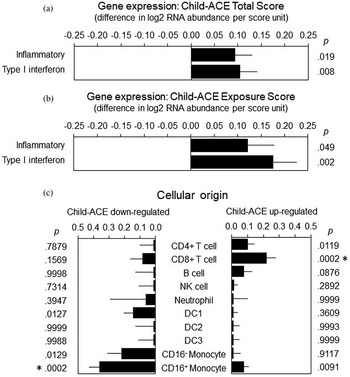
Primary analyses examined whether a pre-specified composite of 19 pro-inflammatory gene transcripts would show elevated levels of expression in DBS samples in proportion to the child's ACE total score (i.e., both exposure and risk). Results showed that was indeed the case (Figure 1a), with average pro-inflammatory gene expression elevated by 0.094 log2 RNA expression units with each Child-ACE total score point (± 0.036 standard error, p = .019) in analyses controlling for age, body mass index percentile, sex, race/ethnicity, current insurance status, and household smoking exposure. Similar effects emerged for the Child-ACE exposure measure that omitted measures based on risk and scored solely on reported exposures (0.121 ± 0.057 standard error, p = .049; Figure 1b).
Childhood adversity and gene expression profiles

Interferon gene expression
Secondary analyses examined whether a composite of 34 Type I interferon-related gene transcripts might also show differential expression as a function of Child-ACE scores. Average expression of the Type I interferon composite was elevated by 0.103 ± 0.037 log2 RNA expression units with each Child-ACE total score point (p = .008), and similar effects emerged for the Child-ACE exposure score (0.175 ± 0.051, p = .002).
Cellular origins
To identify potential cellular mechanisms of the observed differences in DBS whole blood gene expression, we conducted TOA testing for differential cellular origins of the 796 gene transcripts that showed >20% difference in average expression per Child-ACE total score point. Results implicated CD8+ T cell as the primary sources of the 759 gene transcripts upregulated in association with Child-ACE scores, and nonclassical (CD16+) monocytes as the source of the 37 downregulated genes (Figure 1c).
Discussion
The present study documents elevated levels of inflammatory gene expression in whole blood RNA samples from children in proportion to caregiver-reported exposure to ACEs early in life. These results are independent of major demographic confounders (age, body mass index percentile, sex, race/ethnicity), independent of parental risk factors (health insurance status, household smoking), robust to inclusion versus exclusion of risk factors (i.e., total vs. exposure Child-ACE scores) and are consistent with previous research linking ACEs to circulating inflammatory protein biomarkers. These results document the correlation between the Child-ACE score reported by caregivers completing the WCA and inflammatory gene expression in the child. As such, the present results suggest that alterations in immune cell gene regulation might represent one pathway by which ACE exposures come to be associated with greater levels of inflammation and elevated health risk later in life.
Results of the primary analysis linking ACE exposure to increased pro-inflammatory gene expression are consistent with previous research linking adverse life circumstances in adolescence and adulthood to increased expression of pro-inflammatory genes in circulating immune cells (Cole, Reference Cole2013, Reference Cole2014, Reference Cole2019; Schwaiger et al., Reference Schwaiger, Grinberg, Moser, Zang, Heinrichs, Hengstler and Kumsta2016). However, the results of secondary analyses examining Type I interferon-related gene expression and immune cell origins suggest that the transcriptomic correlates of ACE exposure in this sample of children does not resemble the classical CTRA profile observed in adolescents and adults. In the classical CTRA profile, elevated expression of pro-inflammatory genes is accompanied by decreased expression of Type I interferon genes, and involves upregulation of classical monocytes (Cole, Reference Cole2019; Schwaiger et al., Reference Schwaiger, Grinberg, Moser, Zang, Heinrichs, Hengstler and Kumsta2016). By contrast, the present analyses link ACE exposure to increased Type I interferon-related gene expression, decreased non-classical monocyte activity, and increased activity of CD8+ T cells (which is uncharacteristic of the classical CTRA profile).
Future research in larger samples is needed to confirm these results, and to further define the cellular and molecular mechanisms involved. Upregulation of Type I interferon-related gene expression along with increased activity of CD8+ T cells may reflect a pattern of generalized activation within the T cell compartment of the adaptive immune system, in contrast to the suppression observed in most previous CTRA studies. Three hypotheses may explain why our results differ from the classical CTRA pattern. (a) The anti-viral response of the immune system may vary for infants, young children, adolescents, and adults. Our sample only included young children (age 5–11 years old), in contrast to the older age samples of other studies that have evaluated CTRA in youth (Ehrlich et al., Reference Ehrlich, Miller and Chen2015; Miller et al., Reference Miller, Chen, Shalowitz, Story, Leigh, Ham and Cole2018; Murphy et al., Reference Murphy, Slavich, Rohleder and Miller2013, Reference Murphy, Slavich, Chen and Miller2015). Recent experience with differences in susceptibility to the coronavirus supports the merit of considering differences in immune response by age groups (Carsetti et al., Reference Carsetti, Quintarelli, Quinti, Mortari, Zumla, Ippolito and Locatelli2020). (b) The natural history of toxic stress may change with the temporal proximity of exposure to ACEs. This is consistent with literature on the normal function of Type I interferon in protection from disease by increased production in response to acute stimuli and decreased production when stimuli are prolonged (Trinchieri, Reference Trinchieri2010), as well as with studies of dysfunctional states (i.e., autoimmune disorders which are marked by persistent upregulation of basal T cell activity) (Trinchieri, Reference Trinchieri2010; Wahadat et al., Reference Wahadat, Bodewes, Maria, van Helden-Meeuwsen, van Dijk-Hummelman, Steenwijk and Versnel2018) and a broader literature on the influence of temporal parameters on immune response (Segerstrom & Miller, Reference Segerstrom and Miller2004). (c) ACE exposure may be correlated with increased exposure to or activity of viral infections, which could result in upregulation of both Type I interferon activity and CD8+ T cell activity as observed here. If subsequent research supports this hypothesis, then the basis for differential viral activity would become an important question for future ACE research.
Some limitations should be considered when interpreting these results. First, although we were able to detect statistically significant associations for the relationships examined, the sample size for this study was small and may have failed to detect other associations. Thus, our results should be considered preliminary and in need of replication. Second, although the results are consistent with the causal role of ACEs in health risks via chronic inflammation, the direction of the association cannot be determined from this study since it is cross-sectional. However, this study does have an advantage over adult studies of ACEs in that ACE exposure was measured based upon caregiver report, whereas the immune response was measured in the child and not likely to have influenced the caregiver report. Third, although associations with health outcomes is plausible based upon our prior exploration of Child-ACE scores (Marie-Mitchell et al., Reference Marie-Mitchell, Watkins, Copado and Distelberg2020), we were unable to conduct a broad examination of health outcomes in this sample so the health significance of the present results remain to be clarified in future research. Finally, future studies should extend the current RNA-based findings to include direct measures of inflammatory proteins (e.g., plasma cytokines) and cell populations (e.g., flow cytometry enumeration) that were not feasible in the context of the present study's DBS sampling method.
Preliminary analyses suggest that a brief questionnaire with caregiver-reported responses to questions about childhood adversity can distinguish young children at lower and higher risk for elevated levels of inflammatory gene expression. Our results also suggest that patterns of immune response may vary by age and temporal proximity to stressors. Of note to general pediatricians and population health researchers, our assessment of the immune system used DBS methods, which offers a minimally invasive and pragmatic approach to advancing precision medicine. While it is humbling to see this biopsychosocial process in children as young as 5–11 years old, it also underscores the need for early interventions to protect against the potential sequelae of adversity.
Acknowledgment
We are grateful for the support of the Loma Linda University Pediatrics Department.
Financial Support
This work was supported by the Loma Linda University Pediatrics Department Research Initiative (PRI #558502). The sponsor did not have a role in the study design, analysis, or preparation of this manuscript for publication.
Conflict of Interest
None.