Introduction
Ethical misconduct has the power to undermine the very foundation of a business or industry and yet, incidents of leader corruption – corporate or otherwise – persist. Corporate scandals, such as Enron (2001), WorldCom (2002), Lehman Brothers (2008), and FTX Trading (2022), illustrate how corporate unethical practices can not only destroy the company that performed the egregious acts but can also cause lasting damage to industry and the economy at large. The need to understand the social and organizational underpinnings of unethical practices inside the workplace is clear (Castro, Phillips & Ansari, Reference Castro, Phillips and Ansari2020). Unfortunately, the problem of corporate corruption continues despite a considerable amount of research in this area. With the introduction of generative AI and the expansion of the digital world within companies, unethical behavior in organizations will likely continue to worsen (Lobschat et al., Reference Lobschat, Mueller, Eggers, Brandimarte, Diefenbach, Kroschke and Wirtz2021; Rees & Müller, Reference Rees and Müller2023).
Existing models in research do not adequately depict how unethical activity initiates or persists in corporate settings (Rees, Tenbrunsel & Diekmann, Reference Rees, Tenbrunsel and Diekmann2022). This shortcoming is likely due to the extremely complex nature of this phenomenon. A recent trend in ethical research studies how groups or organizations collectively become corrupt (Castro et al., Reference Castro, Phillips and Ansari2020). While the premise is intuitively valid, the question is inherently complex and difficult to pursue. Consequently, there is a shortage of research and empirical data that tests the components of collective unethical behavior (Hassan, Wright & Yukl, Reference Hassan, Wright and Yukl2014; Treviño, Weaver & Reynolds, Reference Treviño, Weaver and Reynolds2006). In any case, studies no longer assume unethical behavior is the product of individuals acting alone but consider corporate unethical behavior to be a systemic issue with multiple components and processes (Key, Azab & Clark, Reference Key, Azab and Clark2019). Researchers investigate group, organizational, and societal level mechanisms such as teamwork, corporate governance, organizational culture, and societal norms to better understand why unethical decisions occur in the workplace (Liu, Ryan, Lin & Xu, Reference Liu, Ryan, Lin and Xu2023).
Building on the premise that ethical misconduct is a complex process, numerous explanations for corrupt business practices have emerged. One explanation is that individuals and leaders in organizations are not prepared, substantively, to manage ethical situations or behave ethically because of a lack of ethics in business education (Tang & Chen, Reference Tang and Chen2008). This gap in education is further exacerbated by the rapid expansion of generative AI (Borenstein & Howard, Reference Borenstein and Howard2021) and higher education’s slow transition to fully address it in business education. Another is the lack of consensus on a set of global ethical standards (Waddock, Reference Waddock2008). However, significant research does suggest that leaders (Antunez, Ramalho & Marques, Reference Antunez, Ramalho and Marques2024) are frequent contributors and initiators of ethical misconduct in organizations.
Study purpose
The purpose of the present study is to examine the commitment of followers after unethical decisions of their leaders given certain contextual factors. More specifically, this study will examine, through the charismatic, ideological, and pragmatic (CIP) model of leadership, whether followers maintain their commitment to their leaders when their leaders practice escalating unethical behavior given (1) the type of leader (CIP), (2) the type of leadership behavior (initiating structure vs. consideration), and (3) the presence or absence of justification of unethical behavior from the leader. To do this, we ask participants to learn about their leader, learn about their leader’s escalating unethical behaviors, and then ask them whether they still trust their leader, believe their values align with the leader, and whether they are still willing to follow their leader. Moreover, this study hopes to expand our available experimental data, which serves to substantiate theoretical claims for how leaders persuade followers to perpetuate unethical behavior. In the remainder of the introduction, we discuss the role of leadership and corporate ethics and how the CIP model of leadership provides a unique framework for examining unethical leader behavior. Specifically, we discuss why the sensemaking and visioning differences of CIP leaders may produce different follower outcomes.
Leadership and corporate ethics
Research has established the power unethical leaders can have on organizations (Mayer, Kuenzi & Greenbaum, Reference Mayer, Kuenzi and Greenbaum2010; Piccolo, Greenbaum, Hartog & Folger, Reference Piccolo, Greenbaum, Hartog and Folger2010). Various studies corroborate that leader characteristics like style, mentality, or identity can lead followers to adopt unethical behaviors (Ashforth, Reference Ashforth2001; Effelsberg, Solga & Gurt, Reference Effelsberg, Solga and Gurt2014; Mesdaghinia, Rawat & Nadavulakere, Reference Mesdaghinia, Rawat and Nadavulakere2019; Weaver & Agle, Reference Weaver and Agle2002). Therefore, a shift of focus on unethical or destructive leaders is necessary. However, examining leader characteristics or behaviors alone is no longer sufficient. A more holistic approach is required (Mackey, Ellen, McAllister & Alexander, Reference Mackey, Ellen, McAllister and Alexander2021).
Because research supports the idea that unethical leaders can negatively influence their organizations, there is a growing need to understand how unethical leaders affect their followers within organizations. Unfortunately, explaining how this works is more complex than simply ‘bad leaders make bad followers’. For example, while some corrupt leaders maintain the loyalty of their followers, others experience followers who defy them by attempting workarounds or leaving (Milosevic, Maric & Lončar, Reference Milosevic, Maric and Lončar2020). Still, it is not entirely clear why followers continue their commitment in the face of ethical misconduct. In light of the growing recognition that ethical misconduct is a complex phenomenon, there is an increasing need for research to look at the interactive process between leaders and their followers as well as possible contextual factors that influence follower loyalty (Thoroughgood & Sawyer, Reference Thoroughgood and Sawyer2018). This study explores the iterative process between leaders and their followers by exploring what happens to followers’ loyalty when different types of leaders make unethical choices given different kinds of behaviors and rationale.
CIP model of leadership
One critical role of a leader is to provide sensemaking for their followers, often through the articulation of a vision. This vision fosters trust and loyalty, which are essential for maintaining follower commitment. When crises arise, the leader must then focus on making sense of the situation for their followers to ensure followers stay. The present study focuses on the sensemaking process initiated and perpetuated by leaders by considering a model that categorizes leaders based on their sensemaking styles. This model is further useful because of the sensemaking that occurs when unethical leaders must justify their actions. Given that harmful decisions inevitably occur in the unethical behavior paradigm, leaders must provide additional sensemaking to repair trust and mitigate the consequences of their actions.
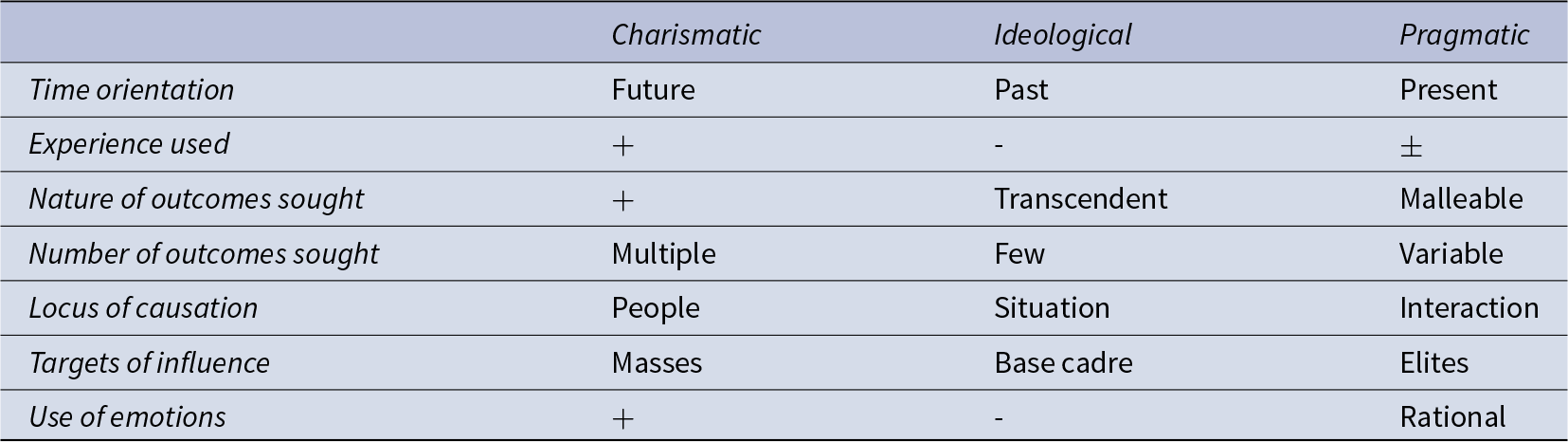
The CIP leadership model is one way to differentiate between leaders, based on three distinctive sensemaking styles used to problem solve and cognitively frame important issues (Bedell-Avers, Hunter & Mumford, Reference Bedell-Avers, Hunter and Mumford2008; Mumford, Reference Mumford2006). The model names seven cognitive framing features including (a) time orientation, (b) the types of experience used, (c) the nature of outcomes sought, (d) the number of outcomes sought, (e) the locus of causation, (f) the targets of influence, and (g) the use of emotions (Mumford, Reference Mumford2006). The CIP model suggests these seven cognitive framing categories combine to create three qualitatively distinctive rationales or responses to crises (Hunter, Cushenbery, Thoroughgood, Johnson & Ligon, Reference Hunter, Cushenbery, Thoroughgood, Johnson and Ligon2011). See Table 1 for a summary.
Style of influence differences of charismatic, ideological, and pragmatic leaders

Utilizing this model to examine the impact of leader ethical misconduct is compelling for three reasons. First, as a newer theory of leadership, it is key to continue to explore outcomes generated by leaders who utilize one of these styles. Second, the framework of this theory specifies how leaders articulate the vision across dimensions to influence and reach followers – often in response to crisis situations (Crayne & Medeiros, Reference Crayne and Medeiros2021; Lovelace, Neely, Allen & Hunter, Reference Lovelace, Neely, Allen and Hunter2019). That is, the distinctive styles across these three leader types, and how they attempt to influence followers, may produce different behavioral or cognitive outcomes among followers. Below, we discuss the theory and proposed leader differences in sensemaking following ethical misconduct (i.e., a crisis situation).
The charismatic leader is future oriented and uses positive models to evoke change. They seek to accomplish multiple positive goals that appeal to different stakeholders. The charismatic leader stresses the importance of employees and focuses on motivating their followers with positive emotions. Overall, they can be described as positive forward thinkers who may have a difficult time with prolonged hardships (Bass & Avolio, Reference Bass and Avolio1994; Mumford, Reference Mumford2006).
The ideological leader orients him or herself toward the past, concentrating on past successes and traditions that resonate with followers. For ideologues, it is most prudent to seek a small number of transcendent goals using past failures to motivate the correction of current problems. In general, ideologues stress their circumstances and use negative emotions to lead, trying to emphasize the danger that is ahead if things don’t revert to more traditional measures (Mumford, Reference Mumford2006; Strange & Mumford, Reference Strange and Mumford2002).
Pragmatic leaders often demonstrate a combination of both charismatic and ideological characteristics. They orient themselves both in the past and future, use a combination of negative and positive experiences and emotions, and emphasize controllable causes rather than people or circumstances. Primarily, pragmatics seek flexibility in their sense making to find the most effective goal or solution for the current situation (Mumford, Reference Mumford2006; Mumford & Van Doorn, Reference Mumford and Van Doorn2001).
The CIP model highlights the importance of understanding the interactive process between leaders and their followers. Thus, when looking at collective corruption, the interpretations and reactions of the followers become important. Consequently, we question what contextual conditions must be present for followers to be willing or unwilling to follow, or continue to follow, leaders.
Although the follower may react in a variety of ways, this study focuses on three variables that relate to follower commitment. The three follower responses include trust of the leader (Mayer & Davis, Reference Mayer and Davis1999), perceived value fit with the leader or value alignment (Cable & Derue, Reference Cable and Derue2002), and willingness to follow the leader (Follmer, Neely, Jones & Hunter, Reference Follmer, Neely, Jones and Hunter2019). First, we examine trust because it is highly unlikely that followers will comply to leader instructions when trust is absent or broken (Hollander, Reference Hollander2008; Mayer & Gavin, Reference Mayer and Gavin2005). Second, we examine value alignment given the knowledge that effective leaders maintain commitment from followers by creating a vision that aligns with follower values (Brown & Treviño, Reference Brown and Treviño2009). Finally, we consider followers’ willingness to follow. This gives us the most direct measure of a follower’s intent to stay with the leader (Kark, Shamir & Chen, Reference Kark, Shamir and Chen2003).
Using the CIP model of leadership as a framework, then question proposed is as follows: do the different styles in the CIP models elicit different levels of commitment by their followers? Specifically, when there is a crisis that involves leader unethical conduct – how does the leader attempt to help followers make sense of this behavior while not losing their trust, commitment, and value alignment with the leader? Although this specific question has not been tested using this model of outstanding leadership, a complementary framework for ethical decision-making provides the backdrop for potential hypotheses.
Leader sensemaking and ethical decision-making
Mumford et al. (Reference Mumford, Connelly, Brown, Murphy, Hill, Antes and Devenport2008) offered a sensemaking model of ethical decision-making, which has received attention, synthesis, and simplification over time (cf., Caughron et al., Reference Caughron, Antes, Stenmark, Thiel, Wang and Mumford2011; Thiel, Bagdasarov, Harkrider, Johnson & Mumford, Reference Thiel, Bagdasarov, Harkrider, Johnson and Mumford2012; Zeni, Buckley, Mumford & Griffith, Reference Zeni, Buckley, Mumford and Griffith2016). Overall, the model presents how an individual progresses through the cognitive stages to make a decision related to an ethical situation, often utilizing specific metacognitive reasoning strategies to work through the issue (Brock et al., Reference Brock, Vert, Kligyte, Waples, Sevier and Mumford2008). For example, utilizing Zeni et al.’s (Reference Zeni, Buckley, Mumford and Griffith2016) synthesized representation, individuals are utilizing obvious cues and information (conscious processing) along with subconscious information and intuition (subconscious processing) to determine whether an ethical problem exists. From here, individuals evaluate the overall ethicality of the situation utilizing (1) individual differences, (2) prior experiences and influence from (3) contextual factors. This evaluation leads to a tag of importance of the ethical issue at hand as well as a decision of subsequent behavior or thoughts. Contextual factors – where a leader has the opportunity to disrupt the sensemaking of the follower – are the key to how CIP leaders create influence in an ethical crisis situation – even one of their own making. As they do with visioning, CIP leaders create this impact through their sensemaking strategies.
For example, as charismatic leaders focus on the future time orientation, and reference future-oriented states in visioning for the organization and appealing to followers, it is likely that these future appeals will cause followers to move beyond or overlook current transgressions to continue toward future states. This is further enhanced by the charismatic leaders ability to empower people in the locus of causation for achieving future states, such that followers will engage an internal locus of control (e.g., ‘I’ can help get beyond this) versus and external locus of control (e.g., the ‘leader’ caused this and I cannot change it). Finally, charismatics, according to CIP theory target the masses in appeals, hence potentially diminishing perceived negative impacts of ethical misconduct on a ‘few’ – and refocusing followers on the vision and how it can benefit broader society and/or additional stakeholders.
In contrast, ideologues target the past in orienting followers. In addition, ideologues work to maintain cohesiveness through appealing to those past values (Mumford, Reference Mumford2006), which may be less appealing to followers who have seen or are encountering ethical misconduct in the present. Moreover, ideologues invoke the situation as a cause for the current state, which may draw attention away from leader behavior. Finally, and overall, the focus of pragmatic leaders on the issue, and solving the problem, may be incongruent with leaders who engage in misconduct related to the problems at hand in ways that are contrary to the vision presented.
Hypothesis 1: Charismatic leaders who engage in ethical misconduct maintain higher levels of follower trust, willingness to follow, and value alignment than pragmatic leaders.
Hypothesis 2: Ideological leaders who engage in ethical misconduct maintain higher levels of follower trust, willingness to follow, and value alignment than pragmatic leaders.
Type of ethical misconduct
The second contextual condition we examine is the nature of ethical misconduct. The behavioral approach to leadership provides a straightforward structure that allows us to study unethical behavior using the two categories encompassing the broad types of behaviors leaders consistently perform.
The behavioral approach to leadership is a long-standing theory of leadership that was generated from a collection of studies that occurred in the 1950’s and 1960’s (Bowers & Seashore, Reference Bowers and Seashore1966; Cartwright & Zander, Reference Cartwright and Zander1960; Stogdill, Reference Stogdill1963). After collecting and analyzing a comprehensive list of leader behaviors, researchers identified two major functions of leader activities. The first function is initiating structure or production orientated behaviors. Initiating structure consists of tasks such as goal setting, planning, delegating tasks, monitoring progress, and managing resources (Bowers & Seashore, Reference Bowers and Seashore1966; Stogdill, Reference Stogdill1963). The second function is entitled individual consideration or employee orientation, and encompasses all relationship building behaviors such as coaching, mentoring, or showing concern and support for followers (Bowers & Seashore, Reference Bowers and Seashore1966; Stogdill, Reference Stogdill1963). Although research has been somewhat inconclusive as to what combination of task and relationship-oriented behaviors is best, a meta-analysis discussing the behaviors and their relationship with different outcomes solidifies their importance to leaders (Judge, Piccolo & Ilies, Reference Judge, Piccolo and Ilies2004).
Although two behavior types have long been established, there is little research that examines how the interaction between behavior type and ethical misconduct affect follower perceptions and commitment. As mentioned earlier in this article, research has provided evidence that unethical behavior that aligns well with the organizational mission and appears to benefit the organization, tends to be more accepted by employees (Ashforth, Reference Ashforth2001; Effelsberg et al., Reference Effelsberg, Solga and Gurt2014; Weaver & Agle, Reference Weaver and Agle2002). We also have presented research that states individuals whose identities tend to align closely with the organizations are more willing to overlook unethical behavior for the good of the company. Based on this evidence, we suggest that unethical behaviors by leaders oriented toward initiating structure are more likely to be accepted by followers than those behaviors oriented toward consideration.
Hypothesis 3: Leaders who behave unethically towards people will have lower follower commitment – as measured by trust, willingness to follow, and value alignment – than leaders who behave unethically during tasks.
Justification of unethical behavior and sensemaking
The idea that corrupt activity is preempted by rationalizing objectionable behaviors into something more palatable is nothing new. Bandura’s theoretical idea of moral disengagement provides perhaps the most robust theory to explain this process (Bandura, Reference Bandura1999). He suggests individuals who want or need to justify actions that are not congruent with their values do three things, including (1) cognitive restructuring, (2) minimizing one’s actions, and (3) blaming the target (Bandura, Reference Bandura1991). Researchers seem to agree that unethical behavior is a product of this perverse line of reasoning rather than abnormal psychological conditions (Coleman, Reference Coleman1998). In fact, it is probable that corrupt individuals within organizations (a.k.a. white-collar criminals) do not view themselves as morally or ethically wrong, especially when they compare themselves to non-white collar criminals, even though the other criminals produce far less damage (Chibnall & Saunders, Reference Chibnall and Saunders1977; Coleman, Reference Coleman1998).
Although it seems clear that rationalization enables unethical actions, we still do not fully understand how the cognitive process of rationalization spreads or infiltrates throughout an organization. Based on previous research that shows the power of unethical leadership on employee outcomes it would be safe to assume that one major mechanism of group level rationalization is through leadership. However, how exactly this occurs within the leadership paradigm is unknown. Some research would indicate that followers learn by example, especially when unethical behaviors go unpunished or non-sanctioned actions are ignored. Following this line of reasoning, one might assume that rationalization almost occurs subconsciously. In fact, we have research to indicate that these shifts in ethical tolerance are not always conscious and do not always involve intentional reasoning (Treviño et al., Reference Treviño, Weaver and Reynolds2006). Still, this seems to imply followers have no moral awareness or moral decision-making power. Given this, if a leader provides justification for actions, would followers be more apt to maintain their commitment to the leader – thereby risking their own moral disengagement?
That is, are unethical leaders who provide justification for their actions, better received by their followers than those who do not provide justification for their unethical behaviors? Research suggests that this display of trust that the leader demonstrates by sharing a justification will result in increased follower acceptance (Graen & Uhl-Bien, Reference Graen and Uhl-Bien1995). Moreover, this action of leader sensemaking should reinforce the principles and values expressed in the original sensemaking and visioning to followers in the organizational address, thus interrupting followers’ evaluation of the unethical behavior through drawing ethical decision-making attention back to the contextual information first presented.
Hypothesis 4: Leader justification will create higher follower commitment – as measured by trust, willingness to follow, and value alignment.
Method
Sample and design
Sample
The participants in this study were undergraduate students at a large, public southwestern university. Overall, 154 participants completed the study for extra credit in an upper-level undergraduate course. Approximately 44% of the participants were male, with an average age of 23.26. Regarding the diversity of the sample, 3% were Native American (n = 5), 18% Asian (n = 29), 10% African-American (n = 16), 54% Caucasian (n = 83), and 15% chose not to specify ethnicity (n = 25).
Design
This was an experimental laboratory study, and we employed a 3 (leader type; CIP) × 2 (ethical misconduct type; related to tasks [i.e., initiating structure] or people [i.e., consideration]) × 2 (justification of ethical misconduct; justification or no justification) between-groups repeated measures design, with six different treatment groups. That is, each participant was assigned one leader, was informed of that leader’s unethical misconduct that escalated over three related instances (i.e., the misconduct became worse), and then finally either received video justification of the misconduct (or not). Participants were randomly assigned to conditions.
Procedure and manipulations
Researchers collected data during an approximately 2-hour session in a large computer lab in the on-campus university library. Each participant was assigned a computer and given earphones. The researcher gave group instructions to start and then allowed each participant to go at his or her own pace. Prior to the treatment, participants completed several covariate measures and demographic surveys (i.e., age, gender, work history).
During the session, participants received a hypothetical scenario where they took on the role of an employee in an oil and gas company. Then, the participant was introduced to the company chief executive officer (CEO) by reading a short description of him, as well as a short description of the organization. Manipulations of leader type and justification were delivered using videotaped leader displays to ensure the highest possible physical and psychological fidelity.
Manipulation: Leader type
The first independent variable manipulated between subjects was leader type (i.e., CIP). To develop descriptions and scripts for each leader, the researchers drafted a base leader description and leader speech. Using Mumford’s (Reference Mumford2006) CIP leadership model, researchers identified elements within the leadership description and motivational speech to vary by leader type. The description and corresponding speech mapped to the separate CIP leadership styles. For example, charismatic leaders focused on the future and used positive examples, ideological leaders focused on the past, utilized negative experiences, and pragmatic leaders focused on the present and used both positive and negative examples. Descriptions were then sent to seven individuals familiar with the CIP model of leadership. These individuals, all PhD holders in industrial and organizational psychology, were asked to categorize each leader as either CIP – based on the elements of the speech. Individuals categorized leaders into their appropriate type based on the speech and its characteristics with 100% accuracy for each of the seven expert raters.
Next, individuals were told to connect virtually to watch and listen to the CEO provide a video address to the entire organization. The video address contained the leader type manipulation, where the differentiating characteristics of CIP leaders were embedded into the video address. For example, the charismatic leader maintained a future orientation when referencing energy exploration and how the industry would change based on the work of the organization, ideological leaders focused on past history, referencing what the organization previously did and how the organization was not deviating from long-held values. And, finally, pragmatic leaders focused on the present and avoided emotional language (see Table 2 and Appendix A for specific differences).
Example embedded influence differences in speeches of charismatic, ideological, and pragmatic leaders

Following the organizational address by the CEO administered by video, each participant completed the leader liking covariate and baseline measures of trust in the leader, willingness to follow, and value alignment. Next, individuals were presented with a news article involving the organization and the CEO. These news articles varied between ethical misconduct that was related to either tasks and process (i.e., initiating structure) or people (i.e., consideration).
Manipulation: Ethical misconduct
The second independent variable manipulated between subjects was the type of ethical misconduct engaged in by the leader. Ethical misconduct type was linked directly to theories of behavioral leadership discussed above, and specifically initiating structure versus consideration. For initiating structure, the misconduct involved the leader being directly complicit in a small oil spill in the remote United States north, where the Environmental Protection Agency (EPA) was involved, and specific rules and procedures were violated. For consideration, the CEO allegedly provided differential treatment to two high potential employees – one man and one woman – favoring more networking and rotation opportunities for the man (i.e., gender discrimination). For brief descriptions of ethical misconduct items, see Appendix B.
Manipulation: Justification
In order to demonstrate the full scope of the leader’s ethical misconduct, additional details of the leader misconduct were provided via ‘news stories’ to the participants. After participants read the first news story, they watched a video of the leader responding to the media report. Participants in the justification condition then viewed a video of the CEO providing a rationale for what was happening in the presented situation, whereas participants in the no justification condition watched a video of the leader where no justification or rationale was presented by the leader. For the justification, the root of the rationale provided had language linking the justification of leader behavior to the organization, its goals, or needs of the individuals. The response was clearly structured not to admit wrongdoing, but to justify why actions had occurred in relation to the leader and/or vision of the organization. In the no justification condition, the response avoided directly addressing the misconduct and did not provide any rationale for the behavior in the scenario. Justification scripts are also contained in Appendix B.
After reading the initial news report and viewing (or note viewing) a justification video, participants then completed a time 2 measure of trust in the leader, willingness to follow, and value alignment. Then, a second news story was presented to all participants, and participants received (or did not receive) a justification video. Participants then completed a time 3 measure of trust in the leader, willingness to follow, and value alignment. Finally, a third news story was presented, where, for example, in the oil spill (e.g., initiating structure) scenario, the third news article read:
Documentation in the form of emails and memos from top management within the company instructed employees to ‘cut out’ and ‘delete’ sections of reports created by environmental scientists that suggested drilling in the current site where Panthera has recently started to drill would be detrimental to the surrounding ecosystem.
In the consideration news story, the final release read as follows:
Evan Granger, attorney at Granger, Jacobs and Wesson has filed a lawsuit against Richard Donovan, CEO of Panthera Energy, for sexual discrimination. Granger says that Donovan intentionally kept his clients, several former Panthera employees, from advancing within the company by intentionally stalling their training opportunities.
Next, participants received (or did not receive) a justification video and completed a time 4 measure of trust in the leader, willingness to follow, and value alignment.
Measures
Covariate measure: Liking
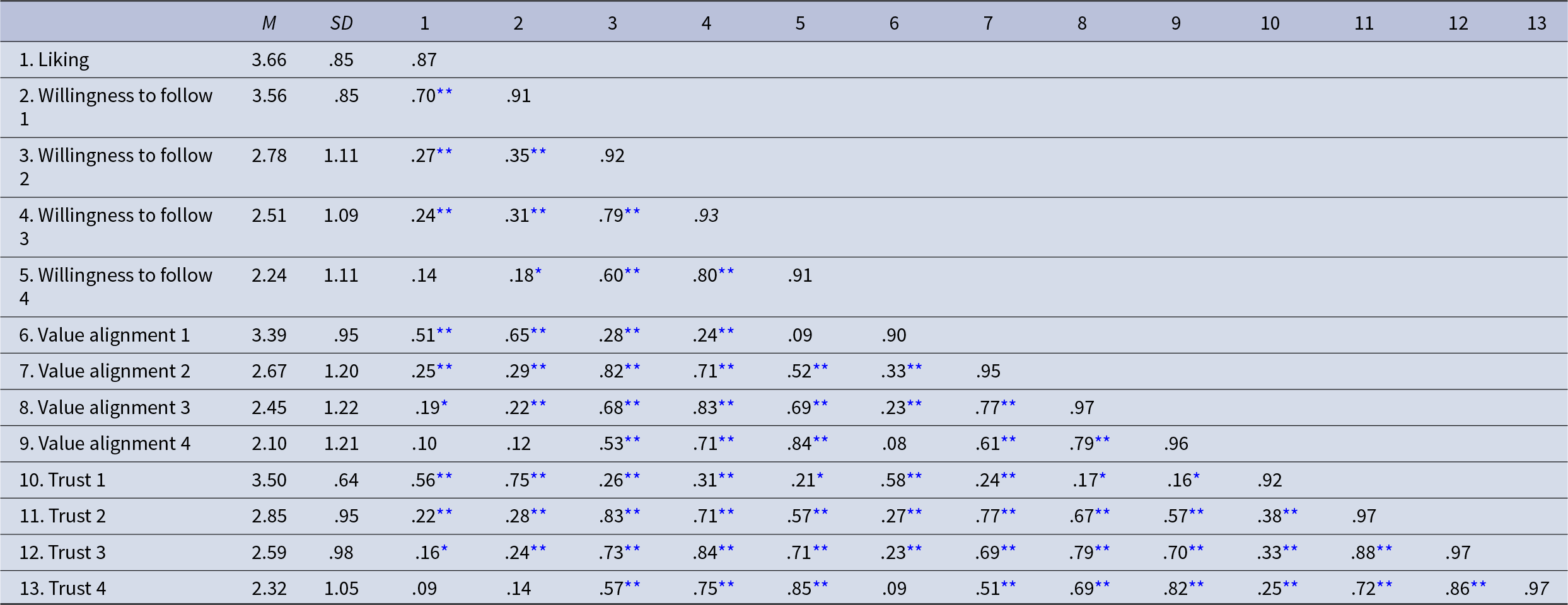
The first covariate measure was administered immediately following the leader making a video introduction to the participant. The 3-item Likert-type scale measure was adapted by Wayne and Ferris (Reference Wayne and Ferris1990), with items such as ‘I like this leader very much as a person’. Reliability for this measure was α = .87 (see Table 3).
Means, standard deviations, correlations, and reliabilities of study variables

Note: N = 154,
* p < .05; **p < .01.
Outcomes: Trust in the leader
Following Mayer and Davis (Reference Mayer and Davis1999), we utilized a dimensional measure of trust to reflect trust in the leader, utilizing ability, benevolence, integrity, and organizational dimensions of trust. Thus, dimensions of ability contained six items (e.g., ‘My leader is well qualified’), benevolence five items (e.g., ‘My leader would not knowingly do anything to hurt me’), integrity six items (e.g., ‘My leader tries hard to be fair in dealings with others’), and organizational trust four items (e.g., ‘I would be willing to let my leader have complete control over my future in this company’). Each of these dimensions were measured on a 5-point Likert-type scale from strongly disagree to strongly agree. Reliability of this measure was examined at each measurement point and ranged from α = .92–α = .97 (see Table 3).
Outcomes: Willingness to follow
Following Follmer et al. (Reference Follmer, Neely, Jones and Hunter2019), we utilized a 6-item Likert-type measure of willingness to follow the leader, measured at four points. Items were measures on a 5-point Likert type scale from strongly disagree to strongly agree. Items included ‘I would like to work with this leader on future projects’ and ‘If given the choice, I would rather not work with this leader’. Reliability of this measure was examined at each measurement point and ranged from α = .91–α = .93 (see Table 3).
Outcomes: Value alignment
Adapted from Cable and Derue (Reference Cable and Derue2002), this contained items such as ‘The things I value in my life are very similar to the things the CEO values’ and ‘This CEO’s values provide a good fit with the things I value in my life’. Items were measures on a 5-point Likert type scale from strongly disagree to strongly agree. Reliability of this measure was examined at each measurement point and ranged from α = .90–α = .97 (see Table 3).
Analysis
To analyze the results of this study, data were entered into a 3 (C, I, or P leader) by 2 (task or person misconduct) by 2 (justification vs. no justification) between subjects repeated measures multivariate analysis of covariance, with liking utilized as a covariate. The dependent measures were willingness to follow, trust in the leader, and value alignment, measured at four points in time.
Results
Means, standard deviations, correlations, and reliabilities for study variables are included in Table 3.
Hypothesis testing
For all hypothesis testing, initial leader liking was a significant covariate and thus controlled for in the analyses. To begin, hypothesis one stated charismatic leaders who engage in ethical misconduct maintain higher levels of follower trust, willingness to follow, and value alignment than pragmatic leaders. In examining the multivariate test for a main effect of leader type on any independent variable, this hypothesis must be rejected, as the multivariate test was not significant (Wilks λ (6, 278) = .959, F = .989, p = .43). Given the lack of multivariate significance for a between subjects effect of leader type, hypothesis two, stating ideological leaders who engage in ethical misconduct would maintain higher levels of follower trust, willingness to follow, and value alignment than pragmatic leaders, must also be rejected.
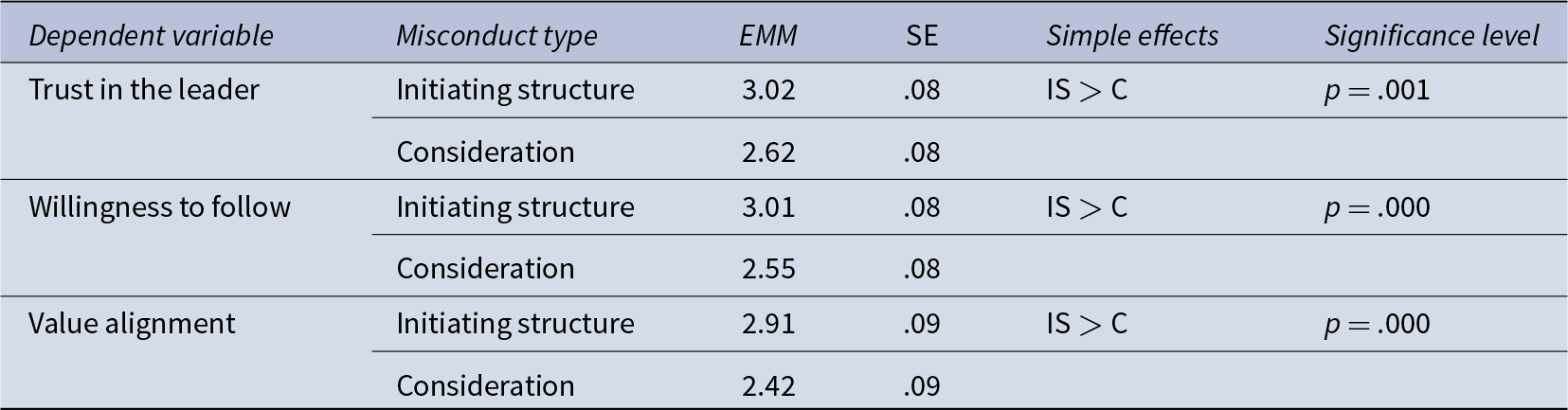
Related to misconduct type, hypothesis three posited that leaders who behave unethically toward people would have lower follower commitment – as measured by trust, willingness to follow, and value alignment – than leaders who behave unethically during tasks. Examination of the initial multivariate test (Wilks λ (3, 139) = .896, F = 5.366, p = .002) suggested, we could continue and analyze the univariate tests for misconduct type across dependent variables. Univariate tests for trust in the leader, F (1, 141) = 12.10, p = .001, ηp 2 = .079, willingness to follow, F (1, 141) = 15.15, p = .000, ηp 2 = .097, and value alignment, F (1, 141) = 14.08, p = .000, ηp 2 = .091 – were all significant. Table 4 displays the estimated marginal means and the significance levels of simple main effects.
Estimated marginal means and simple effects for univariate effects of misconduct type

As displayed in Table 4, significant differences exist – with means for initiating structure ethical misconduct being higher than consideration related ethical misconduct – for trust in the leader, willingness to follow, and value alignment. This suggests that CIP leaders who behave unethically related to task misconduct will, overall, not lose as much commitment as measured by the variables in the present study. This will be examined further in the discussion section.
Regarding hypothesis four, which stated leader justification will create higher follower commitment – as measured by trust, willingness to follow, and value alignment – there was not a significant multivariate effect indicated, (Wilks λ (3, 139) = .996, F = .192, p = .902), thus we rejected this hypothesis.
Supplemental analyses
When examining the results, two very interesting findings emerged that were not hypothesized. However, the information brought to bear by these results suggest they should be included in order to shed additional light on how ethical misconduct by CIP leaders is perceived.
Three-way interaction
First, we observed a significant three-way interaction of leader type, misconduct type, and justification, (Wilks λ [6, 278] = .876, F = 3.167, p = .005, ηp 2 = .064). Univariate tests suggested significant differences for willingness to follow (F [2, 141] = 5.994, p = .003, ηp 2 = .078) and value alignment (F [2, 141] = 5.243, p = .006, ηp 2 = .069), but not for trust in the leader (F [2, 141] = 2.548, p = .082, ηp 2 = .035). To help interpret this interaction, we began an examination of simple effects and examined plots of estimated marginal means.
We first examined simple multivariate effects and then simple univariate effects before testing any specific pairwise simple effects. Multivariate simple effects within leader type were not significant.
Multivariate simple effects for justification were only significant for ideologues facing consideration misconduct, (Wilks λ [3, 139] = .920, F = 4.006, p = .009, ηp 2 = .080). Univariate simple effects tests for willingness to follow and ideologues dealing with consideration misconduct (F [1, 141] = 4.4, p = .038, ηp 2 = .030) and value alignment for the same combination (F [1, 141] = 7.028, p = .009, ηp 2 = .047) were significant. Thus, ideologues who justify ethical misconduct related to consideration (estimated marginal means (EMM)) = 2.857, SE = .208) had followers more willing to follow than ideologues who did not justify such misconduct (EMM = 2.260, SE = .194) (p = .038). For value alignment, the same story persisted, where ideologues who justify ethical misconduct related to consideration (EMM = 2.859, SE = .234) garnered higher value alignment among followers than ideologues who did not justify (EMM = 2.010, SE = .218) (p = .009). The implications of these findings will be explored in the discussion section.
Multivariate simple effects for misconduct type were significant for charismatics in the justification condition (Wilks λ [3, 139] = .916, F = 4.240, p = .00, ηp 2 = .084). Univariate simple effects indicated significant differences for both willingness to follow (F [1, 141] = 12.127, p = .001, ηp 2 = .079) and value alignment (F [1, 141] = 6.964, p = .009, ηp 2 = .047). Thus, charismatics who justify ethical misconduct related to initiating structure (EMM = 3.148, SE = .202) had followers more willing to follow than charismatics who justify consideration misconduct (EMM = 2.176, SE = .193) (p = .001). For value alignment, the same story persisted, where charismatics who justify ethical misconduct related to initiating structure (EMM = 2.864, SE = .228) garnered higher value alignment among followers than charismatics who justify consideration misconduct (EMM = 2.036, SE = .217) (p = .009). The implications of these findings will be explored in the discussion section.
Multivariate simple effects for misconduct type were also significant for ideologues in the no justification condition (Wilks λ [3, 139] = .866, F = 7.164, p = .000, ηp2 = .134). Univariate simple effects indicated significant differences for both willingness to follow (F [1, 141] = 17.786, p = .000, ηp2 = .112) and value alignment (F [1, 141] = 16.453, p = .000, ηp2 = .104). Thus ideologues (EMM = 3.431, SE = .201) who do not justify ethical misconduct related to initiating structure had followers more willing to follow than if they do not justify consideration (EMM = 2.260, SE = .194) (p = .000). Similarly, related to value fit, ideologues not justifying initiating structure misconduct (EMM = 3.278, SE = .226) held higher value alignment than when not justifying consideration misconduct (EMM = 2.010, SE = .218) (p = .000). The implications of these findings will be explored in the discussion section.
Two-way interaction
Second, we observed a two-way interaction between time (the repeated measures variable) and misconduct type (Wilks λ [9, 133] = .768, F = 4.458, p = .000, ηp2 = .232). To be conservative, univariate results were analyzed under Greenhouse Geisser (i.e., sphericity not assumed), and resulted in significant tests for trust in the leader (F = 8.783, p = .000, ηp2 = .059), willingness to follow (F = 10.893, p = .000, ηp2 = .072), and value alignment (F = 7.844, p = .000, ηp2 = .053).
To explore simple effects, we again examined simple multivariate effects and then simple univariate effects before testing any specific pairwise simple effects. Here, the simple multivariate for misconduct type was significant (F [3, 139] = 5.366, p = .002, ηp2 = .104), as were univariates for trust in the leader (F [1, 141] = 12.098, p = .001, ηp2 = .079), willingness to follow (F [1, 141] = 15.148, p = .000, ηp2 = .097), and value alignment (F [1, 141] = 14.080, p = .000, ηp2 = .091). Simple pairwise effects indicate that trust (EMM = 3.018, SE = .082; M d = .401, p = .001), willingness to follow (EMM = 3.008, SE = .083; M d = .455, p = .000), and value alignment (EMM = 2.911, SE = .093; M d = .494, p = .000) are significantly higher, on the average, for initiating structure than consideration misconduct. Of course, this same result exists as our main effect of misconduct type, discussed earlier.
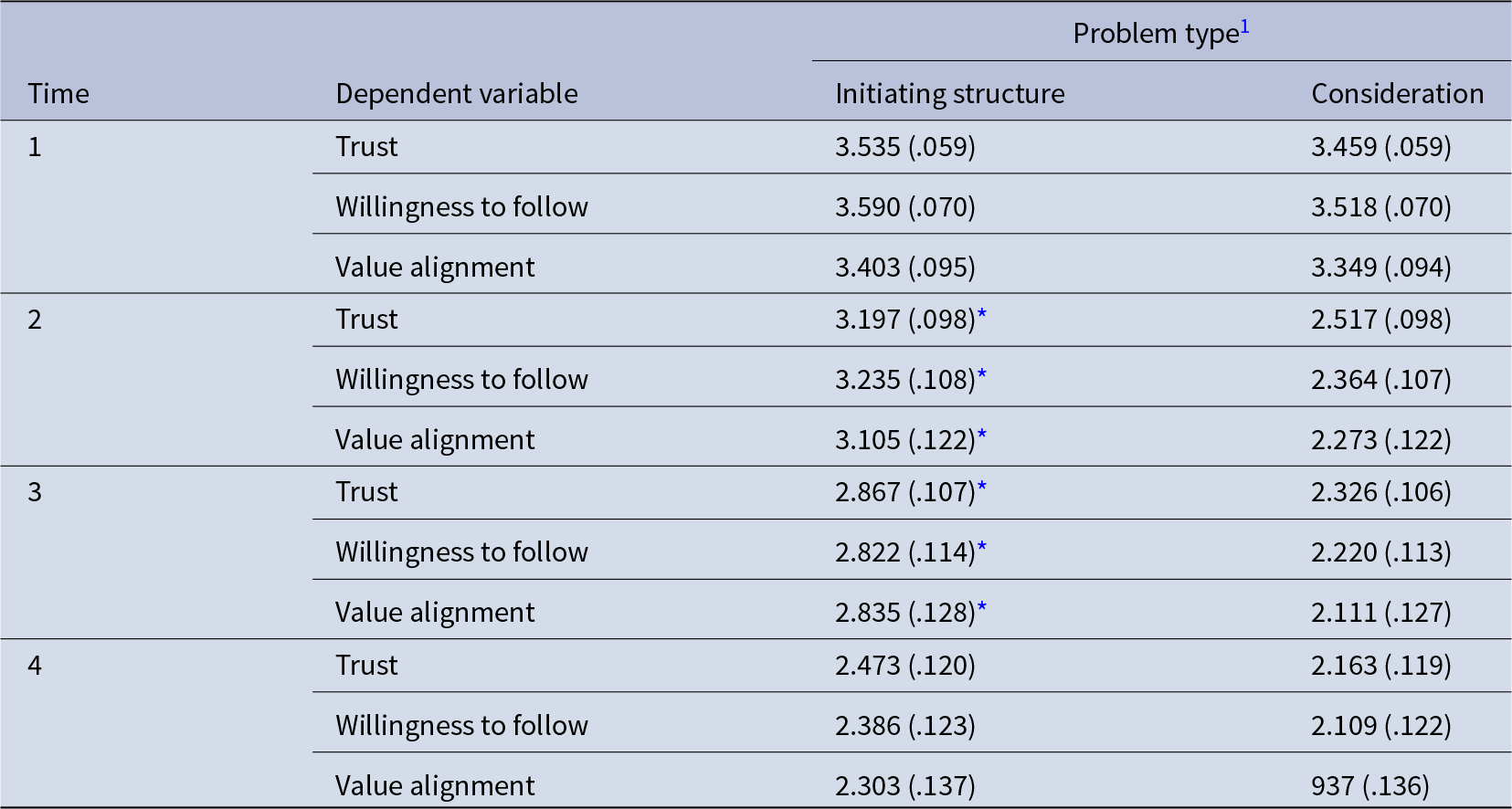
In addition, across time, multivariate simple effects test suggested differences at time 2 (Wilks λ [3, 139] = .809, F = 10.966, p = .000, ηp2 = .191) and time 3 (Wilks λ [3, 139] = .892, F = 5.619, p = .001, ηp2 = .108). Univariate simple effects confirmed differences for willingness to follow at time 2 (F [1, 141] = 32.553, p = .000, ηp2 = .188) and time 3 (F [1, 141] = 14.101, p = .000, ηp2 = .091), as well as value alignment at time 2 (F [1, 141] = 23.182, p = .000, ηp2 = .141) and time 3 (F [1, 141] = 16.165, p = .000, ηp2 = .103). Pairwise simple effects for these analyses are shown in Table 5. Overall, this interaction indicates that when CIP leaders engage in unethical acts related to tasks, overall commitment via trust, willingness to follow, and value alignment is significantly different immediately after a first instance of ethical misconduct and a subsequent unethical behavior incident – but not after a third incident along the same lines. These results are explored further in the discussion section.
Two-way interaction of time and misconduct type: estimated marginal means and simple effects

1 – Estimated marginal means presented, standard errors in parentheses.
* = significant difference of (IS– C) at p = .000.
Discussion
Limitations
Prior to discussing the broader implications of the present study, three key limitations should be mentioned. To begin, this study sought to determine if there were differences in CIP leaders regarding follower perceptions of unethical behaviors. It is possible the stylistic differences were not noticed by participants, leading to ineffective manipulation. This would be despite evidence, supported by subject matter experts (SMEs)s who reviewed the speeches, that leaders displayed such differences. Potentially, this could explain why there was not a specific main effect for leader type found. However, it is also plausible that participants were unable to recall specific elements of the speech that occurred at the start of the experiment, particularly when more recent events (presentation of the unethical events) required much of their cognitive attention and effort.
A second potential limitation is that participants may have had stronger negative reactions (i.e., moral awareness) to the scenario related to potential gender discrimination (i.e., the consideration problem) because of the region from which we drew participants. The individual in this region may have had reduced sensitivity to issues involving oil and gas extraction (i.e., the initiating structure problem), given that the region’s economy draws heavily on oil and gas, and had yet to be fully exposed to the potential negative effects of extraction and related activity (cf., Metz, Roach & Williams, Reference Metz, Roach and Williams2017). In future studies, we will certainly explore pilot studies to ensure that levels of sensitivity across misconduct types are relatively similar.
A third potential limitation is that our participants did not have an immediate and emotional connection to the leader presented. Thus, we did not allow participants’ interactions with a leader over time. Rather, we introduced the leader, the organization, and provided the leader speeches (which introduced their style) within the same session. While this is not ideal, the presence of significant effects suggests that further investigation, perhaps in the field, may be warranted. Moreover, it could indicate effects in the field being larger than those in the laboratory where true personal relationships do not exist. In addition, we did control for liking, as well as finding no significant differences (i.e., preferences) for trust, willingness to follow, or value alignment with our fictional leader at the baseline assessment (i.e., time 1).
Key findings and implications
For the present study, one key conclusion can be drawn from the initial hypotheses, and two important conclusions can be gleaned from supplemental analyses. We explore each in turn below.
First, CIP leaders will lose followers when they behave unethically toward people. This was evidenced by our main effect main effect of misconduct type (task vs. people). Put another way, leaders who behave unethically in the task environment (e.g., processes, procedures, tasks) will be able to maintain higher commitment through trust, willingness to follow, and value alignment. Of course, the interactions uncovered suggest a more nuanced explanation, yet the above statement holds true. Leaders who act unethically toward their followers will not maintain the commitment of followers. This notion is further supported by the findings of the two-way interaction of problem type and time, which clearly shows significant differences for ethical misconduct instance 1 (time 2) and ethical misconduct instance 2 (time 3) – across trust, willingness to follow, and value alignment. Moreover, the clear and drastic drop of commitment following unethical acts toward people provides a marked contrast to the task scenario. Within the sensemaking framework of the CIP, this could mean that followers clearly identified the situation as violating the commitment to people (charismatics), to values (ideologues), and to focusing on the problem facing the organization (pragmatics). This interpretation is supported by means of outcome measures, which show differences nearly leveling off at misconduct instance 3 (time 4) – suggesting that followers made their decision because of the incongruity that existed within leader behaviors pre and post misconduct. The finding that treating people poorly (vs. task misconduct) is more detrimental is in line with research on destructive leadership. For example, a meta-analysis by Schyns and Schilling (Reference Schyns and Schilling2013) show data clearly indicating destructive leaders will, over time, lose followers as followers resist leader behavior. These data also included lower commitment and lower job related attitudes of followers of destructive leaders (Schyns & Schilling, Reference Schyns and Schilling2013). Of import is how the authors define destructive leadership, which includes aspects of exertion of influence, occurrence over time, and perceived hostility of actions (Schyns & Schilling, Reference Schyns and Schilling2013). In this case, these characteristics of being destructive, one could argue, are more in line with the ‘people’ scenario – where it would appear the leader has targeted a female employee for harm (i.e., reducing development opportunities).
Next, we examined the supplemental analysis, which included a three-way interaction. The three-way interaction indicates there are specific situations where ideological and charismatic leaders will benefit from the justification of their unethical actions. Specifically, justification of gender discrimination (consideration misconduct) actually assisted ideological leaders in maintaining willingness to follow and value alignment. This finding is compelling and leads to several interesting potential explanations. For example, it is possible that the ideological leader, given their strong past orientation, may evoke perceptions of more traditional gender roles and expectations through the sensemaking process and appeals to the past. Second, the ideological leader may be able to move criticism (reduced commitment) and negative affect toward circumstances (i.e., the situation as the locus of causation) and away from themselves. Thus, this finding is very much in line with the method with which ideologues sensemaking for visions and crises. Moreover, it points to a very clear – and potentially dangerous – consideration related to followers. As Ligon, Logan and Derrick (Reference Ligon, Logan and Derrick2020) point out, likely followers of ideologues are generally conformers or ideological ‘in-group’ members. Potentially, this means such sensemaking justification would be even more powerful with more like-minded followers, increasing the ability of ideologues to behave unethically and unchecked if they continuously sensemake for followers. Future research should attempt to validate this finding across multiple crisis situations and additional misconduct categories to determine the effectiveness of these sensemaking strategies for various follower groups.
Third, charismatic leaders maintained greater commitment overall when they justified unethical task behavior versus justifying unethical and unequal treatment of people. Charismatic leaders focus on appealing to all individuals and their contributions (i.e., ‘Your unique contributions are shaping the future of the energy industry and your continued enthusiasm opens up a new world of possibilities for future generations’), it is possible, and likely, that such statements, coupled with the unethical actions created enough cognitive dissonance for individuals such that commitment dropped more significantly. More clearly, charismatic leaders who appeal to people, who trumpet peoples’ contributions, and then wrong those same people, likely create a circumstance where followers lose commitment regardless of rationalization. On the other hand, it is possible that through sensemaking in crisis, refocusing followers on change and overcoming errors allowed followers to be able to minimize the misconduct aspect (i.e., ignoring EPA regulations and rule) of this scenario in their own ethical decision process. Similar to ideological leaders, the ability of the charismatic leader to provide enough contextual information through sensemaking to interfere with, or distract, followers from recognizing an ethical issue is a key takeaway – and in line with the sensemaking aspect of CIP theory and seminal writings of charismatic leadership (Conger & Kanungo, Reference Conger and Kanungo1998; Conger, Kanungo & Menon, Reference Conger, Kanungo and Menon2000).
Future research
Future research on how leaders keep their followers in light of ethical misconduct could go a multitude of ways. One promising path forward is a longitudinal study. Preferably, this research would focus on one leader type and investigate a variety of unethical behaviors. Such research would be useful to recognize the series of events and behaviors that could potentially contribute to an undesirable leader maintaining power and influence over followers. Simply put, it would be good to know when enough is enough, and when, or even if, leaders finally lose the commitment of their followers. Here, Thoroughgood and Sawyer’s (Reference Thoroughgood and Sawyer2018) work on profiling types of followers and their potential for CIP leader types is a starting point.
Finally, future research should consider how to determine which specific influence mechanisms used by leaders are most or least powerful across a variety of unethical behaviors. Such research, on the positive side, would help to inform leaders who have made mistakes on the best way to regain follower commitment. Of course, such research may also help us understand the darker side of unethical leadership and hence illuminate some of the methods with which such leaders rise to and maintain their hold on organizations and followers. Future research should begin to focus in on the precise mechanisms operating both in the type of influence that accounts for the greatest change or lack thereof and the types of followers that are most vulnerable to such influence tactics in situations where leaders behave unethically.
Conclusion
With this study, we provide one of only a few to examine the sensemaking mechanisms within the CIP theory in an empirical setting. We examined whether CIP leaders using different sensemaking styles can impact the commitment levels among followers following an ethical misconduct event. We further extended this concept to determine whether additional sensemaking from leaders would mitigate the impact of unethical behavior from the leader. We have uncovered unique aspects of sensemaking and sensegiving, particularly for charismatic and ideological leaders, that may help explain how they can maintain follower commitment even in the midst of ethical crises created through their own misconduct. Finally, we offered insight as to how these particular findings related to the sensemaking processes of CIP leaders may allow for unethical leaders to persist in maintaining power.
Supplementary material
The supplementary material for this article can be found at https://doi.org/10.1017/jmo.2024.80.
Acknowledgements
A previous version of this paper was presented at the 2018 Annual Meeting for the Southwest Academy of Management, Albuquerque, New Mexico, in March of 2018. We would like to thank Caroline Wiegman and Jade Janacek for their work on portions of the data collection for this project. The authors declare no competing interests. Correspondence concerning this submission may be addressed to Dr. Ethan P. Waples, Associate Dean & Director of the MBA, College of Business, Metropolitan State University of Denver, Campus Box 13, P.O. Box 173362, Denver, CO, 80217 or ewaples@msudenver.edu.