Safe and effective performance among firefighters is key to protecting firefighter safety, health and wellbeing, to ensure mission completion and to protect the public during emergency response situations, including during disasters. Some research has examined factors that influence firefighter safety performance, namely safety behavior outcomes. Generally, this research has assessed direct relationships between safety climate and safety behaviors among firefighters. Reference Smith and DeJoy1,Reference Smith, DeJoy and Dyal2 Safety climate is generally thought of as employee perceptions regarding the relative importance of safety within a group or organization. Reference DeJoy, Schaffer and Wilson3 Past research in this area among firefighters has not included affective organizational commitment in tested models or analyses and has been absent from most of the literature in this field. Thus, the influence of safety climate on affective organizational commitment among firefighters and resultant influences on safety behaviors is not fully understood by researchers and practitioners.
Affective commitment is broadly defined as an attachment to one’s entity. Reference Meyer and Allen4 Thus, affective organizational commitment would be focused on commitment and attachment to the organization. Affective organizational commitment is a determinant of one’s dedication to his or her organization. Those with positive affective organizational commitment have been shown to participate in organizational activities and exhibit a willingness to pursue organizational objectives and goals. Reference Meyer and Allen4,Reference Rhoades, Eisenberger and Armeli5
In the context of the present study, safety climate is posited to influence firefighter affective organizational commitment. Clarke has illustrated this relationship outside of the fire service. Reference Clarke6 Safety climate, like other organizational antecedents, should be positively related to affective organizational commitment among the sample of firefighters surveyed. Furthermore, given the reasoning above, it is posited that affective organizational commitment will be associated with safety behavior outcomes to include both safety compliance behavior and safety participation behavior.
Safety behaviors generally explored in the literature are often associated with compliance behaviors and extra-role type safety behaviors such as safety participation or safety citizenship behaviors. Reference Neal and Griffin7 Safety climate has been linked to these behaviors in multiple industries, Reference Clarke6 and more recently within fire and emergency services. Reference Smith and DeJoy1,Reference Smith, DeJoy and Dyal2 But, there is a knowledge gap in that we do not fully understand the implications of affective organizational commitment on safety compliance and safety participation and whether this mediates the relationship between safety climate and these safety behaviors.
METHODS
Data Collection and Participants
Approval for this study was obtained from the Institutional Review Board at the University of Georgia. Data from 349 firefighters (Firefighters I-III) and company officers (Lieutenants and Captains) were included in this study: 23% were Firefighter I, 34% were Firefighter II, 24% were Firefighter III, 15% were lieutenants, and 4% were captains. Data from 12 respondents were not included as these were determined to be outlier cases based on DeCarlo’s Norm Test. The mean age for the sample was 36.45 (SD = 9.08). Participants mostly identified as white (93%), 3% identified as African-American or black, 1% identified as American Indian or Alaskan Native, 2 respondents (< 1%) identified as Asian-American, and 2 respondents (< 1%) identified their race as Other. Seven did not indicate race, but stated ethnicity as Hispanic. Most firefighters (77%) were married or living with a partner, 13% were single, and 10% were separated or divorced. Fifteen percent of the firefighters reported their highest degree as a high school diploma. Sixty-six percent reported earning some college or technical/vocational credit beyond high school. Ten percent reported earning an associate’s degree, 8% a bachelor’s degree and 1% a graduate degree.
Measures
Items associated with 4 constructs, including safety climate, affective organizational commitment, safety compliance, and safety participation were included in this study. Two types of safety behaviors were examined. The 2 behavior constructs are separate and distinct forms of behavior. Reference Neal and Griffin7 Both have relevance to effective emergency response. Safety compliance behaviors are essential to protecting firefighter health and safety and safety participation is essential to firefighter safety, ensuring participation in disaster and emergency response activities and with ensuring performance to protect the public during emergency response situations.
All items were assessed using a 5-point Likert-type scale from strongly disagree to strongly agree. Safety climate was assessed using the 6-item short safety climate scale that originated from Hahn and Murphy Reference Hahn and Murphy8 and adapted for use in the fire service. Reference Smith, Eldridge and DeJoy9 Affective organizational commitment was assessed using a 6-item scale from Rhoades, Eisenberger, and Armeli. Reference Rhoades, Eisenberger and Armeli5 Safety compliance and safety participation were both comprised of 3 distinct items each and originated from Neal and Griffin. Reference Neal and Griffin7
Analyses
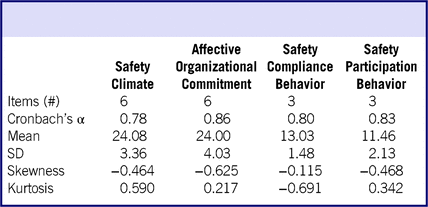
Data screening to ensure normality for structural equation modeling research was completed. Skewness and kurtosis values for individual items and scales, as presented in Table 1, were appropriate and normally distributed. Correlations between items were examined to ensure multicollinearity would not be problematic. Descriptive statistics and correlations for latent constructs are reported in Table 1.
Descriptive Statistics

Model Assessment and Analyses
Structural equation modeling (SEM), using Mplus v.7.2, was completed to examine model fit, to assess the measurement model and to assess whether the hypothesized paths were supported. Model fit is generally examined beyond the reported Chi-square test, which tests whether the posited model fits the data as well as a just-identified or saturated model. This test has been critiqued as being overly sensitive in structural equation modeling; thus, model fit statistics are generally examined when conducting structural equation modeling. For the present study, model fit was assessed using multiple fit indices including comparative fit index (CFI), the root mean square error of approximation (RMSEA) and the standardized root mean square residual (SRMR). Hypothesized paths were assessed by measure of unstandardized path coefficients, standard errors and significance values. With regard to the reported Chi-square result, it should be noted that the degrees of freedom signifies the difference between the number of observations in a model and the number of model parameters being examined.
RESULTS
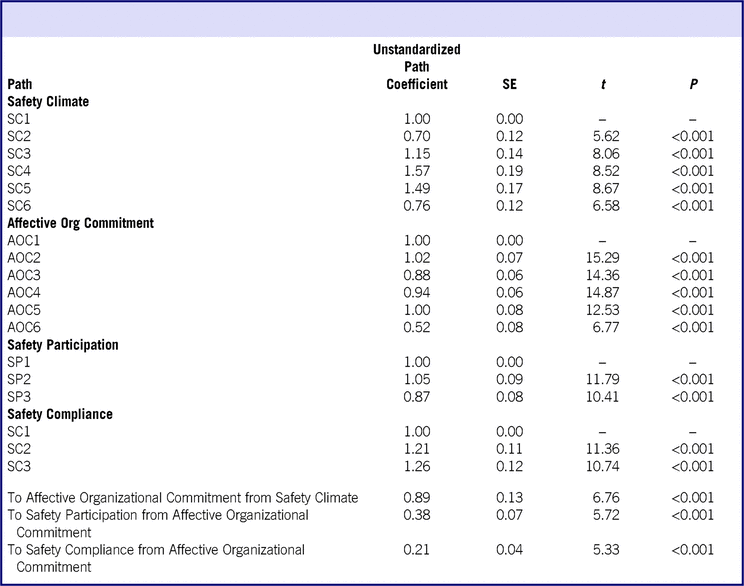
The overall fit of the hypothesized model was reasonably good as χ2 = 331.17, df = 131, P = 0.000, RMSEA = 0.07, SRMR = 0.08, and CFI = 0.91. As illustrated in Table 2, all paths were significant and in the hypothesized direction. Each of the items significantly loaded onto their respective factors in the measurement model assessment of the SEM. Furthermore, we were able to confirm the relationships that were hypothesized. Safety climate was positively associated with affective organizational commitment (B = .89; SE = .13; P = 0.00) and affective organizational commitment was both positively associated with safety compliance behavior (B = .21; SE = .04; P = 0.00) and safety participation behavior (B = .38; SE = .07; P = 0.00).
Results

DISCUSSION
This study has implications for both researchers and practitioners in the realm of fire and emergency services, public administration, and safety management. This research suggests that firefighter affective organizational commitment is predicted by positive safety climate perceptions, which are greatly determined by management’s overall commitment to safety. Reference DeJoy, Schaffer and Wilson3 Given the direction of these relationships, fire and emergency service leaders and administrators also need to understand that levels of commitment and firefighter attachment to their organizations can be diminished when firefighters do not perceive the safety climate to be positive. Weak or diminished safety climate perceptions could easily occur when firefighters perceive that leadership is influenced by outside factors Reference DeJoy, Smith and Dyal10 or are passive when it comes to addressing safety. Reference Smith, Eldridge and DeJoy9
The organizational sciences literature associated with affective organizational commitment is fairly robust and points to enhancements in performance. Reference Meyer and Allen4,Reference Rhoades, Eisenberger and Armeli5 Investigations in the context of safety are more limited Reference Clarke6 and essentially absent in the context of firefighter performance. The present study findings illustrate that affective organizational commitment is positively associated with safety behavior outcomes among firefighters. Ultimately, to effectively perform emergency service duties and to ensure successful mission completion, firefighters must protect and maintain their health. If injured or ill, firefighters cannot complete their duties, cannot achieve the mission, and may place the public, dependent upon their services, at risk. In the present study, affective organizational commitment was associated with both safety compliance behaviors and safety participation behaviors. Both are important to the protection of the individual firefighter, other firefighters, and the public. Reference Smith and DeJoy1
Ultimately, administrators and leaders should aim to enhance safety climate perceptions, along with other antecedents to commitment, to bolster affective responses, commitment to their organizations, and possibly commitment at other levels such as commitment to the supervisor and work group. Based on the measure of safety climate used in this research, this may be accomplished through enhanced safety feedback, management commitment to safety, and worker involvement in safety. Although beyond the scope of the present study, other antecedents that bolster affective commitment in organizations, such as positive work experiences, perceived organizational support, supervisor support for safety, quality leader-member exchanges and cohesiveness, should also be a focus of administrators and leaders to enhance safe behaviors and more distal outcomes.
This study addressed some knowledge gaps with regard to the relationships between safety, organizational affective commitment, and safety behavior outcomes. However, more research is needed in this area. Future research may explore whether organizational safety climate or work group safety climate Reference Smith, DeJoy and Dyal2 impacts affective commitment differently and whether various forms of commitment needs to be assessed at different levels.
A major assumption of this research is that affective organizational commitment and resultant safety behaviors could potentially result in more efficient and effective emergency response. This relationship needs to be further explored, particularly over time, within longitudinal studies and during emergency and disaster events. Furthermore, beyond examining the impact on safety outcomes, the influence of organizational affective commitment on other outcomes needs to be further assessed. It would be interesting to determine if these relationships extend to factors relevant to effective disaster and emergency response such as coping and resilience.
As with most research studies, there are limitations associated with the research that needs to be considered when interpreting the findings of this study. The development of the hypothesized model and causal assumptions were theoretically based. However, the analyses conducted do not allow for the complete assessment of causal relations. Furthermore, data are cross-sectional, which limits inferences to causality. Data were collected from career firefighters. Thus, generalizability to other firefighters, such as volunteer firefighters, is limited. Similarly, data were collected from firefighters within 1 region of the United States, which could potentially limit generalizability. Lastly, these data were collected from firefighters to include self-report data. Other modes of data collection were not completed to assess the proposed relationships by other means.
CONCLUSIONS
This study confirmed a model that describes the relationships between safety climate perceptions, affective organizational commitment, and fire and emergency worker safety behavior outcomes. Positive perceptions of safety climate were positively associated with positive perceptions of affective organizational commitment. And, affective organizational commitment was positively associated with both safety compliance and safety participation. These findings have implications that influence safety performance and ultimately may impact effective emergency response.Please check that affiliations of all the authors and the corresponding author details are correctly set.
Funding
This study was partially supported by the Emory University Center for Injury Control, with support from the Centers for Disease Control and Prevention.