Introduction
Declining biodiversity has become a major environmental problem almost everywhere on Earth (Hanski Reference Hanski2005). In Europe, Slovenia included, some of the most endangered habitats of many rare and endangered species are extensive grasslands (EGs), formed by traditional agricultural practices (Unuk et al. Reference Unuk, Pipenbaher and Škornik2018). A drastic decline in the number and area of EGs has been caused mainly by intensification, abandonment and fragmentation, even after measures to protect EGs were introduced (Cousins et al. Reference Cousins, Ohlson and Eriksson2007). Material subsidies such as agri-environmental schemes were implemented by policy-makers (Science for Environment Policy 2017) in order to prevent biodiversity loss. However, the subsidies have not been well employed (Kaligarič et al. Reference Kaligarič, Čuš, Škornik and Ivajnšič2019).
The most important element in the conservation of EGs is the final decisions made by grassland owners (Bennett et al. Reference Bennett, Roth, Klain, Chan, Christie and Clark2017). Adults are responsible for the majority of decisions that influence the environment, but the basic habits and predispositions determining how individuals respond in certain situations as adults are developed during childhood (Asunta Reference Asunta2003). Children are future decision-makers and potential grassland owners; therefore, awareness of the factors that form and affect their attitudes towards biodiversity (e.g., EG conservation) needs to be built. Attitudes form one of the most important factors in management practices (Šorgo et al. Reference Šorgo, Špur and Škornik2016); these are predictors of intentions, and intentions are predictors of actual behaviour (Ajzen Reference Ajzen1991). According to theory, behaviour towards the environment is influenced by a number of attitudes (Kellert Reference Kellert, Kahn and Kellert2002), among them by a moralistic attitude (MOR) (Špur et al. Reference Špur, Škornik and Šorgo2019), which indicates a concern with protecting nature and treating it with kindness and respect (Kellert Reference Kellert, Kahn and Kellert2002).
Several important factors may be relevant to a MOR towards nature, including knowledge about, experiences with and interest in nature. Increases in knowledge can lead to changes in interactions with the environment (van der Ploeg et al. Reference Van der Ploeg, Cauilan-Cureg, van Weerd and De Groot2011); however, the connection between knowledge and attitudes is not straightforward (Allum et al. Reference Allum, Sturgis, Tabourazi and Brunton-Smith2008) and knowledge alone is insufficient to promote environmental attitudes and behaviour (Carmi et al. Reference Carmi, Arnon and Orion2015). For instance, children’s experiences with the environment may also be relevant to encouraging pro-environmental attitudes (Farmer et al. Reference Farmer, Knapp and Benton2007) and consequently exerting a positive influence on adult behaviour (Vadala et al. Reference Vadala, Bixler and James2007). Moreover, interest in nature has a positive association with support for environmental protection. A higher level of interest in environmental issues suggests more positive attitudes towards environmental responsibility, so children who are interested in spending more time in the environment are more likely to develop pro-environmental attitudes (Cheng & Monroe Reference Cheng and Monroe2012). In addition, factors that shape moral attitudes towards the environment are also affected by sociodemographic data (e.g., age, gender). Age often has a negative association with support for environmental protection (Shibia Reference Shibia2010). Gender matters as well: for example, females may have less environmental knowledge than males (Kollmuss & Agyeman Reference Kollmuss and Agyeman2002).
In this paper, we examine factors that can help in developing children’s MOR. The reasoning follows the assumption that the acquisition of positive attitudes towards the environment and biodiversity preservation interventions can be influenced by environmental education and experiences (Jacobson et al. Reference Jacobson, McDuff and Monroe2015, Harring & Jagers Reference Harring and Jagers2017).
Specifically, our aim was to identify the factors that form and affect children’s attitudes towards species-rich EG conservation. The target group were 7th–9th grade lower-secondary school students (aged 12–15 years) from Slovenian basic 9-year compulsory schools. We selected three regions in Slovenia as the study area: two regions inside and one outside of Natura 2000 areas. In addition, we evaluated (tested) whether MOR towards EG conservation is influenced by gender or place of residence (inside/outside Natura 2000 regions).
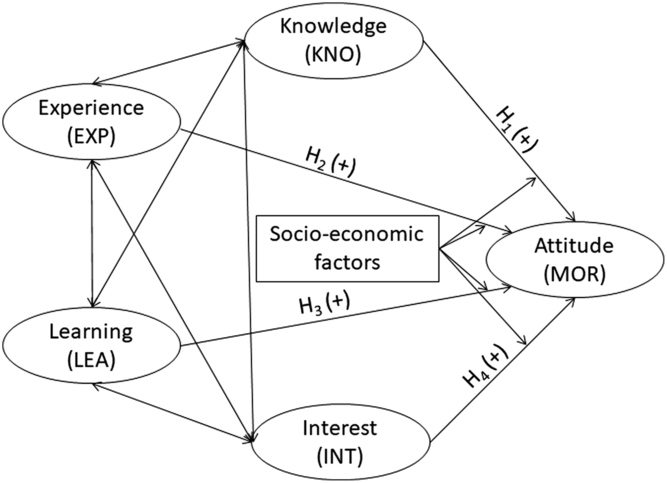
We hypothesized (Fig. 1) that MOR can be influenced by: knowledge about grasslands and their management (KNO; H1); experience with work on grasslands (EXP; H2); learning from a variety of sources (LEA; H3); and interest in grasslands and their management (INT; H4).
Hypothesized model of knowledge about grasslands and their management (KNO), experience with work on grasslands (EXP), learning sources about grasslands (LEA) and interest in grasslands and their management (INT) having an influence on the moralistic attitude (MOR) towards extensive grasslands. The one-way arrows represent the influence of each construct, the two-way arrows represent the correlation between two constructs. H = hypothesis; + sign = expected increase in MOR; – sign = expected decrease in MOR.

Methods
Study area
The study was conducted in three regions of Slovenia: Haloze (in the Drava River region), Goričko (in the Mura river region) and the Coastal-Karst region (Obalno-kraška). Given our intention to explore the effect of living in a Natura 2000 site, we selected Haloze in the Drava region and Goričko in the Mura region. The Coastal-Karst region and some parts of the Goričko and Drava regions are outside of Natura 2000 areas and were included as ‘controls’ primarily to test the potential effects of residency in a Natura 2000 area and secondarily to explore the potential for application of the scales in other regions. In Haloze, there are seven municipalities with c. 19 000 residents, and 7 elementary schools had 1376 pupils in the 2017/2018 school year. In Goričko, there are 11 municipalities with c. 26 000 residents, and 12 elementary schools had 1760 pupils in the 2017/2018 school year. In the Coastal-Karst region, there are 8 municipalities with c. 26 000 residents, and 24 elementary schools had 9152 pupils in the 2017/2018 school year (Statistični urad Republike Slovenije 2018).
Data sampling
The data sampling procedure was as described in Špur et al. (Reference Špur, Škornik and Šorgo2019). The invitation to participate in the survey was sent in May 2018 to the principals of nine elementary schools in the Drava region (seven of which are in the Haloze region), to the principal of one elementary school in Goričko and to the principals of three elementary schools in the Coastal-Karst region. The target group were elementary school children (7th–9th grade, ages 12–15 years) from Slovenian compulsory 9-year elementary school, which makes them lower secondary school students (International Standard Classification of Education 2). The questionnaire was distributed to 683 children and the response rate was 63.4%. Our intention was to collect at least 200 responses, which should be sufficient for the intended statistical procedures (Wolf et al. Reference Wolf, Harrington, Clark and Miller2013).
Two limitations of our study were its focus solely on the Goričko, Haloze and Coastal-Karst regions, and the municipality of residence and whether the municipality was within the Natura 2000 area as identified from the children’s postcodes. In many cases, however, the whole municipality was not in the Natura 2000 area. The municipality was determined as being part of a Natura 2000 area even though only a small percentage of the municipal area fell within the Natura 2000 area. In addition, only c. 10% of elementary school children from the Natura 2000 area were represented in our sample.
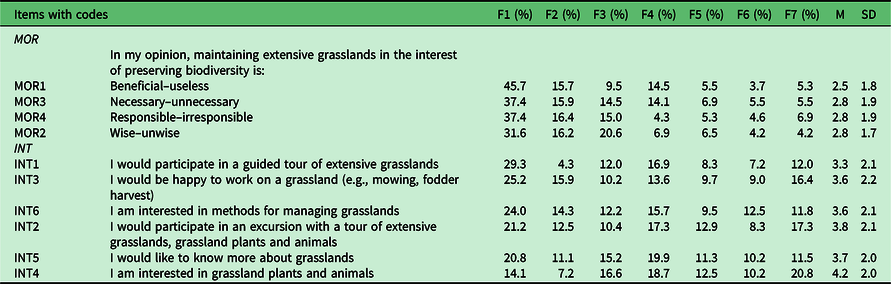
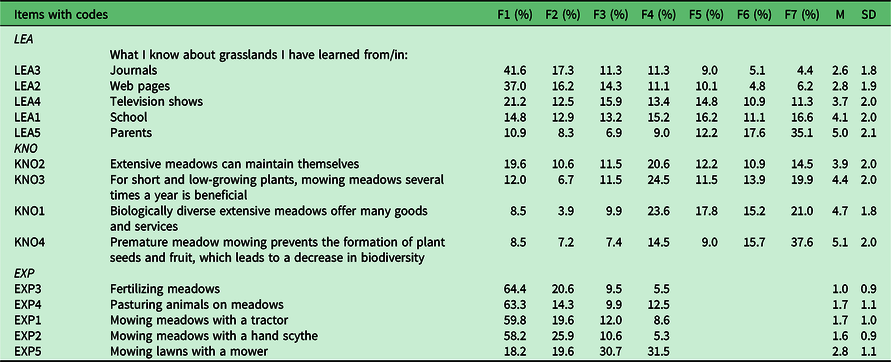
To measure the MOR towards EGs and interest in grasslands (INT) (Table 1), we used items from the Children’s Grassland Attitude Scale (CGAS) of Špur et al. (Reference Špur, Škornik and Šorgo2019). Knowledge about grasslands (KNO), experience with work on grasslands (EXP) and learning source about grasslands (LEA) were developed for the purpose of the present study (Table 2).
Frequencies (F1%–F7%), means (M) and standard deviations (SD) of the items forming the moralistic attitude towards extensive grasslands scale (MOR1–MOR4) and the interest in grasslands scale (INT1–INT6) (n = 433). A differential seven-point semantic scale was applied for the assessment of MOR. A seven-point Likert scale with responses ranging from ‘strongly disagree’ (1) to ‘strongly agree’ (7) was applied for the assessment of INT. Items are listed in descending order of F1 (%).

Frequencies (F1%–F7%), means (M) and standard deviations (SD) of the items forming the learning sources about grasslands scale (LEA1–LEA5), the knowledge about grasslands and their management scale (KNO1–KNO4) and the experience with work on grasslands scale (EXP1–EXP5) (n = 433). A seven-point Likert scale with responses ranging from ‘strongly disagree’ (1) to ‘strongly agree’ (7) was applied for the assessment of LEA and KNO. A four-point scale with the responses ‘never’ (1), ‘rarely’ (2), ‘often’ (3) and ‘regularly’ (4) was applied to the assessment of EXP. Items are listed in descending order of F1 (%).

Some of the proposed work on grasslands measured with the experience scale (EXP) would be inappropriate or even illegal for children between 12 and 15 years old (e.g., driving a tractor). However, empirically we have observed that children do participate in these activities.
The scores from the knowledge scale (KNO) obtained in a Likert scale ranging from 1 to 7 were converted for further analysis because the correlation (rv) between items of knowledge was low (<0.40). One of the preliminary intentions of assessing knowledge with the Likert scale, later excluded from this work, was to assess the children’s degree of certainty in their answers. The same approach was used, for example, in a Gallup poll assessing certainty about knowledge of evolution (Gallup Jr Reference Gallup1998). In order to examine the influence of KNO, we transformed this construct into a scale variable. For each correct answer, participants gained one point. Finally, we summarized all points earned from KNO1, KNO2, KNO3 and KNO4 (e.g., Bukenya et al. Reference Bukenya, Ahmed, Andrade, Grigsby-Toussaint, Muyonga and Andrade2017). Items KNO1 and KNO4 were correct, so those who chose values 5, 6 or 7 on the Likert scale received one point; otherwise, they received zero points. Items KNO2 and KNO3 were incorrect, so those who chose values 1, 2 or 3 on the Likert scale gained one point; otherwise, they received zero points.
The last part of the survey consisted of questions about demographic data (socioeconomic factors): gender, grassland ownership in the family, education level and place of residence (part of Natura 2000 Slovenia or not).
Statistical analysis
The main statistical procedures for testing the proposed model (Fig. 1) were: descriptive statistics to provide the basic features and distribution of the data; principal component analysis (PCA) to determine how and to what extent the observed variables (items) were linked to their underlying constructs (e.g., Bogner Reference Bogner2018); and structural equation modelling (SEM) with confirmatory factor analysis (CFA) to test the hypotheses and validity of the hypothetical model (Fig. 1) and to establish a model to most appropriately represent the collected data (e.g., Deng et al. Reference Deng, Sun, Zhao, Han, Yang and Feng2016). Before SEM, CFA needed to be performed in order to validate the hypothetical model. SEM effectively addresses numerous research problems involving non-experimental research and provides explicit estimates of measurement error variance (Byrne Reference Byrne2016). IBM SPSS Statistics 21 was used for PCA and IBM SPSS Amos 21 was used for CFA and SEM. Spearman’s correlations (rs) among items within hypothetical components were examined. Items with values of less than 0.4 and more than 0.8 were removed from further PCA to prevent error, unreliability and multicollinearity (Field Reference Field2009). After correlations among variables were tested (rv), PCA was performed. The number of retained components was selected according to parallel analysis (Patil et al. Reference Patil, Surendra, Sanjay and Todd2007). The items of the MOR and EXP constructs were recoded so that all items were in the same direction (e.g., 7 on the Likert scale expresses a positive attitude towards grasslands and less experience with grasslands, which indicates proper management of EGs). The results of Bartlett’s test of sphericity (p < 0.05) and the Kaiser–Meyer–Olkin measure of sampling adequacy (>0.50) were good, which means that PCA is useful in terms of our data (Field Reference Field2009).
Unidimensionality was examined through component loading, and items with a loading of <0.50 were excluded (Hair et al. Reference Hair, Hult, Ringle and Sarstedt2017). Factor rotation was initially performed by oblique direct oblimin rotation, and when it was found that components did not correlate above the 0.3 level, orthogonal varimax rotation was used (Špur et al. Reference Špur, Škornik and Šorgo2019). The number of retained components was based on parallel analysis because this is an eligible, consistent and widely used method for deciding on the number of factors (e.g., Çokluk & Koçak Reference Çokluk and Koçak2016). The reliability of the components was tested using Cronbach’s α (Cronbach Reference Cronbach1951) in order to indicate how strongly the measuring items held together in terms of measuring the respective component (e.g., Deng et al. Reference Deng, Sun, Zhao, Han, Yang and Feng2016). Differences in attitudes, knowledge, experience, sources of learning and interest between separate groups were examined with non-parametric statistics through the Mann–Whitney U test (two independent sample test). Where differences were found, effect sizes were calculated using the equation  ${r_e} = {{ - Z} \over {\surd N}}$, where Z = Kolmogorov–Smirnov Z and
 $\surd N$ = square root of the sample size (Field Reference Field2009). Separate analyses based on socioeconomic factors were used in SEM in order to examine the differences in paths from each construct to MOR. In validating the measurement models, the following assessments were examined: (1) composite reliability (CR) in order to indicate the reliability and internal consistency of a component (Fornell & Larcker Reference Fornell and Larcker1981); (2) convergent validity was checked by calculating average variance extracted (AVE > 0.50) in order to indicate the average percentage of variation explained by the measuring item for a component and to test whether a construct was well explained by its observed variables; and (3) discriminant validity in order to indicate whether the hypothetical model was free from redundant items, which was checked by average shared variance (ASV < AVE) and maximum shared variance (MSV < AVE) in order to indicate whether the variance explained by the construct was greater than the measurement error and greater than the cross-loadings. The construct validity was checked by observing thresholds of the root mean square of error approximation (RMSEA) with a value <0.08; goodness of fit (GFI) with values >0.90; comparative fit index (CFI) with values >0.90; and χ2/degrees of freedom (df) with values <3.0 (Byrne Reference Byrne2016, Hair et al. Reference Hair, Hult, Ringle and Sarstedt2017) in order to indicate how suitable the items were in measuring their respective components. Details of the data and models are available on request from the authors.
Results
We collected 433 questionnaires from children in grades 7–9, aged 12–15 years. The research sample consisted of 44.1% boys and 55.4% girls. The majority had no grassland ownership in the family (51.7%), most lived in municipalities within Natura 2000 areas (74.6%) and the majority were in the 9th grade (45.9%), followed by 8th grade (33.0%) and 7th grade (21.1%).
Most children agreed with the claim that maintaining EGs in the interest of preserving biodiversity is beneficial, but they showed less interest in grasslands and their management (Table 1). Moreover, the majority had little or no experience with work on grasslands (Table 2). The main source of information and knowledge about grasslands was their parents (Table 2).
Differences in attitudes, knowledge, experience, sources of learning and interest between separate groups were low (re < 0.03). For example, those who lived outside Natura 2000 areas were more in agreement that maintaining EGs in the interest of preserving biodiversity is beneficial.
All Spearman correlation coefficients (data available on request) at p < 0.001 levels among INT, KNO, LEA, MOR and EXP were in the range of 0.40–0.71. Non-significant results and results below the 0.4 level were found for the correlations between LEA5 and LEA1, LEA2 and LEA3 and between the items of KNO. Based on a correlation criterion of 0.40 < rv < 0.80, EXP5 was excluded from the initial pool.
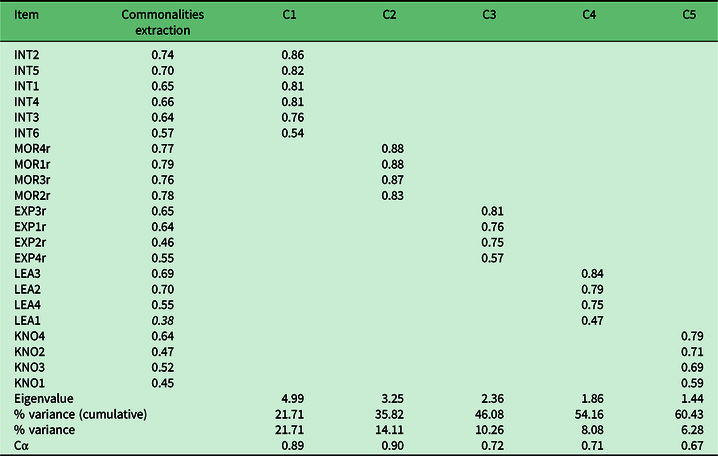
We performed a PCA with varimax rotation to check the unidimensionality of the constructs. All constructs except LEA were unidimensional, and factor loading of EXP5 was lower than for the others (0.50). According to these findings, LEA5 and EXP5 (Table 3) were excluded from the follow-up PCA.
Rotated component matrix of the principal component analysis with varimax rotation on items of the constructs of the interest in grasslands scale (INT1–INT6), the moralistic attitude towards extensive grassland scale (MOR1–MOR4), the experience with work on grasslands scale (EXP1–EXP5), the learning source about grasslands scale (LEA1–LEA4) and the knowledge about grasslands and their management scale (KNO1–KNO4) (Kaiser–Meyer–Olkin measure of sampling adequacy = 0.83, p < 0.001). Items are listed in descending order of factor loading of items in each component.

Based on the PCA, the extracted components C1–C5 explain 60.4% of the total variance, which means that they account for the major proportion of the variables (Fig. 2 & Table 3). All factor loadings (except LEA1) were above 0.50. According to parallel analysis, these five components can be retained. The most reliable component was MOR (Cronbach’s α = 0.90). The reliability of KNO was slightly below the desired Cronbach’s α level (>0.70), but still in an acceptable range.
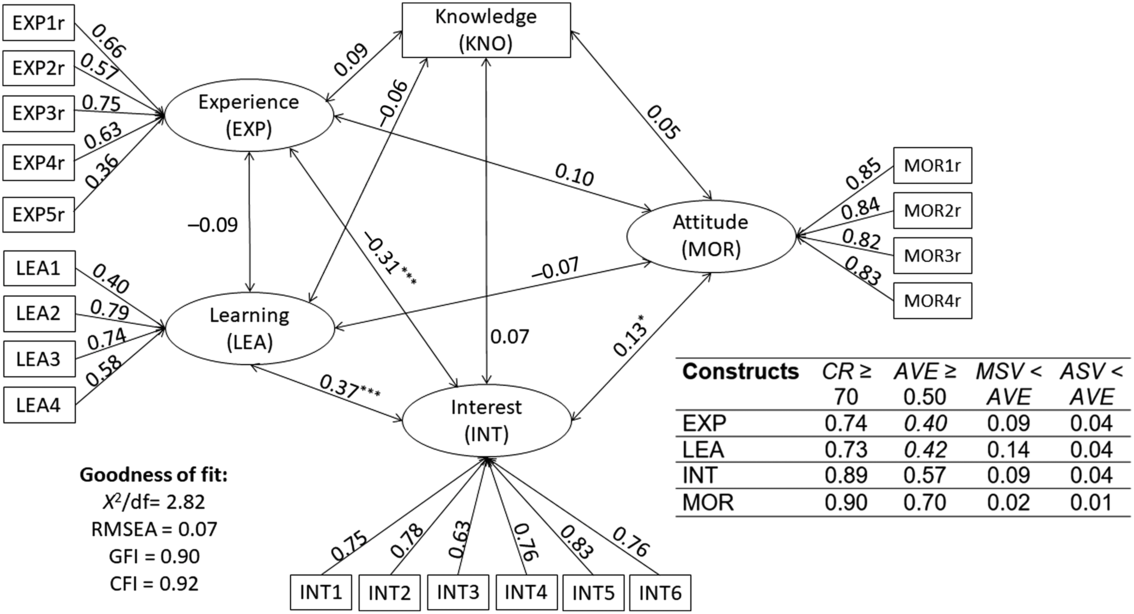
Correlations between the constructs of moralistic attitude towards extensive grasslands (MOR), knowledge about grasslands and their management (KNO), experience with work on grasslands (EXP), interest in grasslands (INT) and learning sources about grasslands (LEA) and fit indices of the hypothesized model based on confirmatory factor analysis. Explanations of item codes are in Tables 1 and 2. *p < 0.05, **p < 0.01, ***p < 0.001. AVE = Average Variance Extracted; ASV = average shared variance; CFI = comparative fit index; CR = composite reliability; df=degrees of freedom; GFI = goodness of fit index; MSV = maximum shared variance; r = recoded items; RMSEA = root mean square of error approximation.

Confirmatory factor analysis
The CFA showed significant rc correlations (p < 0.001) between components (Fig. 2). All parameter estimates (factor loadings) of items were significant at p < 0.001; they were therefore not assigned asterisks in Fig. 2 in order to show this. The highest correlation was between the constructs LEA and INT (rc= 0.37, p < 0.001). Correlations between constructs were lower than 0.85, reflecting the non-existence of redundancy among the constructs, and the model reached the desirable thresholds.
In order to improve the AVE of experience (EXP), EXP5, EXP2 and EXP4 were removed in this order, as well as LEA1 being removed in order to improve the AVE of the LEA construct. In the end, the CR of LEA was 0.60, which is lower than appropriate.
Structural equation modelling
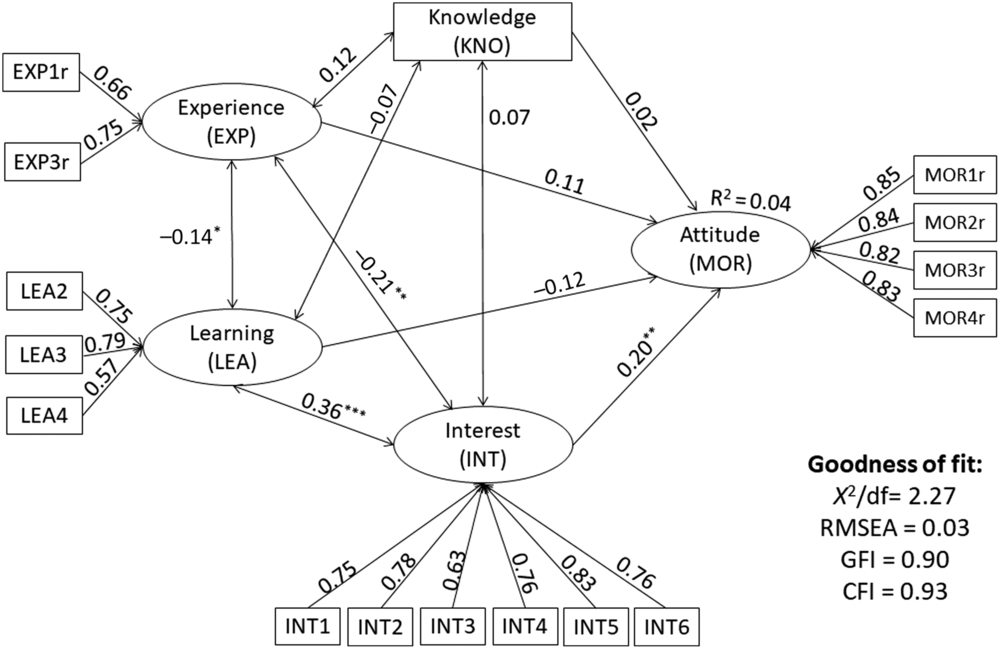
In the improved model based on CFA, only INT (β = 0.20, p < 0.01) had a statistically significant influence on MOR (Fig. 3). INT explained 4% of MOR variance, which means that the error variance of MOR is c. 96% of the variance of MOR itself. According to the model (Fig. 3), when INT went up by 1 unit, MOR increased by 0.20 units.
Results of regression path coefficients for knowledge about grasslands and their management (KNO), experience with work on grasslands (EXP), interest in grasslands (INT) and learning sources about grasslands (LEA) on the moralistic attitude towards extensive grasslands (MOR) based on the hypothesized model. *p < 0.05, **p < 0.01, ***p < 0.001. CFI = comparative fit Index; df = degrees of freedom; GFI = goodness of fit index; r = recoded items; R2 = squared multiple correlation; RMSEA = root mean square of error approximation.

Differences in paths
The statistical significance of paths from the constructs to MOR changed in groups based on socioeconomic factors versus the general model (Fig. 3). For example, a significant new path emerged from the LEA to the MOR among those who had grassland ownership in their family (β = –0.28, p < 0.01) and from INT to MOR among those who did not have grassland ownership in their family and among those who lived in Natura 2000 sites.
The greatest variance in the MOR attitude was explained in the model by those who were not living in a Natura 2000 municipality (R2 = 0.26).
Discussion
Our research provides new insights into the factors that shape children’s moral attitudes towards nature conservation. We found that the majority of children had a positive MOR towards maintaining EGs. Those who lived outside Natura 2000 areas were more inclined to believe that maintaining EGs in the interest of preserving biodiversity was beneficial. This result could be regarded at first glance as surprising, because residents of Natura 2000 areas should be better educated by the managers and supervisors of such areas and therefore be expected to be more aware of the rationale for the existence of such areas. However, residents often view Natura 2000 as a hindrance to progress (Šorgo et al. Reference Šorgo, Špur and Škornik2016, Špur et al. Reference Špur, Šorgo and Škornik2018), an attitude that may be reflected in the opinions of these children.
In contrast to our hypothesis H1, we found no significant influence of knowledge on MOR, but these results are in accordance with other findings (Bartiaux Reference Bartiaux2008) and the view that knowledge alone is not enough to promote environmental attitudes and behaviour (Carmi et al. Reference Carmi, Arnon and Orion2015).
Most of the children had active experience of mowing grass with a mower. As expected, their experiences with mowing meadows by tractor, using a hand scythe, fertilizing meadows or pasturing animals on meadows were generally passive; however, on rare occasions they actively participated in these activities. They had more experience working on the lawns around their houses than working on meadows, which was to be expected, because some methods of work on grasslands (e.g., tractor driving) are restricted adults. However, we emphasize here that experience with mowing a meadow by tractor could also mean participation as a passenger on the tractor or helping with the hay. Multiple experiences of work on grasslands indicate the intensive use of grassland and therefore EG mismanagement (e.g., mowing often and regularly). With this in mind, it can be expected that multiple experiences gained on intensively managed grasslands (e.g., lawns) will have a negative impact on attitudes towards the management of EG; rare interventions (e.g., mowing) or even the absence of intervention (e.g., fertilizing) would then indicate positive management of EGs. However, because experience of work on grasslands (EXP) did not increase MOR, we rejected our hypothesis H2, although there was a negative correlation between experience and interest, as well as between experience and learning source. More experience of work on grassland indicates intensive use, which is an inappropriate method of EG management; consequently, such children do not agree with preserving EGs. In addition, the more they had learned about grasslands from different sources, the less they participated in gaining experience with the intensive use of grasslands. Furthermore, these children had little or no experience with EGs. Perhaps they lacked the opportunities to gain experience working on grasslands because today machine management is more common than traditional methods (e.g., hay turning), through which they could participate and come into direct contact with meadows as in the past. In the case of machine management, children cannot work on grasslands alone, but they can monitor such work, help with the lighter activities and consequently gain more experience. The experiences measured in our study are more difficult to acquire in school. Schools can, however, provide other experiences, such as harvesting medical herbs, animal observation and so on in order to promote recognition of a variety of ecosystem services (Yli-Panula et al. Reference Yli-Panula, Jeronen, Lemmetty and Pauna2018).
Learning about grasslands from a range of sources (e.g., in school and from websites, journals, television shows and parents) did not increase MOR; therefore, we rejected hypothesis H3. However, we found a positive correlation between learning about grasslands from other sources (LEA) and interest in grasslands (INT). This means that children with more indirect experience with grasslands (learning from parents, in school, etc.) were more interested in grasslands. Although these children were too young to make and accept grassland management decisions, they could have an influence on their parents’ management decisions through subjective norms (Ajzen Reference Ajzen1991) or knowledge transfer. Thus, we found that for the majority of these children the main source of information and knowledge about grasslands was the parents and school. Therefore, knowledge transfer should not occur only from parents to children, but also from the children to the parents (Damerell et al. Reference Damerell, Howe and Milner-Gulland2013); children could, for example, transfer knowledge about appropriate grassland management (gained in school) to their parents.
Furthermore, we confirmed that interest in grasslands and their management (INT) increased MOR (hypothesis H4). The more interested children were in grasslands, the more positive was their attitude to preserving EGs. The main question here is how to increase the interest that influences MOR. One way is by offering children opportunities to gain more direct experience, which is positively correlated with interest. Moreover, we found that some children would be happy to work on grasslands, which could lead to an increase in interest in the preservation of EGs, because Vadala et al. (Reference Vadala, Bixler and James2007) found that those who do not enjoy environmental activities show less interest in activities to protect the environment. Although those children with positive attitudes towards work on grasslands are in the minority, they are an important group that could influence the development of positive attitudes by other children (e.g., through subjective norms; see Ajzen Reference Ajzen1991). In addition, we should focus on those who already have positive attitudes towards work on grasslands in order to encourage them to keep these positive attitudes until adulthood and after. Furthermore, we found a counterintuitive result in children’s interest in grasslands: most children strongly agreed with the item ‘I am interested in grassland plants and animals’, yet strongly disagreed with other interest variables (e.g., ‘I would like to know more about grasslands’). We can presume that children are only interested in grassland plants and animals (e.g., in observing them or harvesting medical herbs), but not in managing grasslands.
The gender factor (being female) and living in a Natura 2000 municipality moderate the influence of experience working on grasslands on MOR. Boys and those who own grasslands in their family had more experience of working on grassland. Those living outside of Natura 2000 areas had more experience with fertilizing a meadow than those living within Natura 2000 areas. These results indicate the more intensive use of grasslands outside of Natura 2000 areas. Moreover, learning from other sources (e.g., parents) had a positive influence on MOR among those who had grassland ownership in the family. Sharing experience and learning about grasslands is evidently easier in those families who own grasslands.
Conclusions
Interest in grasslands had a significant influence on children’s MOR. Level of interest was significantly correlated with experience of working on grasslands and with learning about grasslands from different sources. Therefore, children’s MOR can be influenced directly through fostering interest and indirectly by experience and learning through interest (as a mediator).
To stimulate children’s interest in grasslands, children should be offered more opportunities to gain vicarious (indirect) experience of grasslands, because indirect experience without physical contact (e.g., learning from parents, television shows, web pages, journals and in school) has a positive influence on children’s interest. Furthermore, children should transfer knowledge about appropriate grassland management to their parents while gaining vicarious experience (learning from parents) and consequently exert an influence on decisions about grassland management. We suggest that a worthwhile sequel to our work would be for parents to participate in the survey.
We reveal major misconceptions about EG management that should be clarified. The majority of these children believed that for short and low-growing plants (e.g., plants with rosettes), mowing meadows several times a year was more beneficial and that EGs could maintain themselves, both of which are incorrect.
Availability of data
The data that support the findings of this study are available from the corresponding author upon reasonable request.
Acknowledgements
We thank Michelle Gadpaille from the University of Maribor, Faculty of Arts for proofreading and other constructive suggestions. We are also grateful to Brigita Brajkovič, Davorin Horvat, Dejan Kopold, Dragica Šegula, Ivan Štrafela, Katja Breznik, Marija Breznik, Silvestra Klemenčič, Suzana Petek and Vida Lang for their help in collecting the data.
Financial support
The study was partly supported by the Slovenian Research Agency, core funding P1-0403, P2-0057 and J7-1822.
Conflict of interest
None.
Ethical standards
None.