Portugal and Spain have been at the heart of European history and have played a critical role in European (and world) affairs throughout the centuries. Yet decades of relative isolation under authoritarian regimes in the twentieth century left both countries at the margins of Europe, and they did not take part in the early stages of the process of European integration in the 1950s–70s. Fortunately, the success of processes of democratic transition in both countries in the second half of the 1970s paved the way for full membership in the European Community (EC).1
The terms European Community (EC) or European Union (EU) are used indistinctly to refer to the European integration process and institutions throughout the article.
The Iberian countries belonged to Europe and their entry into the EC was a reaffirmation of that fact. For Spain, Portugal, and their European Community partners this momentous and long awaited development has had profound consequences and has set in motion complex processes of adjustment. In the end, the idea of Europe became a driving force that moved reforms forward and was a fundamental factor for bringing together political stabilization, economic recovery, and democratic consolidation.
What can scholars and students of European politics learn from studying the experiences of Portugal and Spain in the European Union? At a time when European countries are on the threshold of major changes and seek ways to push forward the process of European integration, the lessons derived from analysis of the Spanish and Portuguese experiences should be instructive to scholars, students, and policymakers working on expansion and integration issues. Moreover, the examination of these two cases will shed new light on the challenges (and opportunities) that other countries face when trying to integrate regionally or into the global economy.
Iberian Lessons
The Iberian enlargement provides useful feedback for the new member states, not only for their negotiation strategies, but also in regards to the consequences of membership.2
Some observers have noted that these new members may learn even more from Greece than from Portugal and Spain. In Greece for instance, the government was reluctant to cede control of vital economic sectors; it was behind in consumer protection, environmental, and competition policies; and corruption was a systemic problem. In addition, Greece had weak civil institutions, which slowed the convergence process. For years Greece squandered the opportunities of EU membership through poor fiscal management, corruption, political cronyism, justice mismanagement, and misadministration and mismanagement of domestic and European funds. While fiscal discipline has been achieved, the change of attitudes and values is still a pending issue. See “Is Poland the new Greece? Why Warsaw's entry into the European Union may be rough,” in Financial Times, Monday, December 9, 2002, 11.
First, the democratic pre-requirement for membership is a powerful incentive for democratization and institutional reform. European integration had a very important effect on the Iberian democratization processes. The pressures induced by the democratization pre-requisite for membership; the effect of membership prospects on domestic policies and policy direction; and the involvement of political and economic elites in European institutions during negotiations, as well as their participation in European transnational networks, all had a very positive impact on the transitions to democracy (See Pridham 2002, 185–6). More importantly, Europe had a symbolic impact (i.e., “the identification of EU with liberal democracy and political freedom”).
At the same time, the EC had important indirect levers, particularly during the negotiations for accession, to influence the direction of events and the decisions of policymakers and economic actors (i.e., economic incentives). As a result Portugal and Spain undertook deep processes of institutional reforms. Hence, from a political standpoint EU integration has been an unmitigated success, as both countries have consolidated their democratic regimes and institutions. The two processes—European integration and democratization—were thoroughly intertwined.
The Iberian experience also illustrates that economic success drives public opinion. The decision to join the European Union in both countries was supported by most of the political parties. Eurobarometer polls consistently indicate that the overwhelming majority of the Iberian people supported EC membership and the process of European integration. Originally, this support hinged largely on the expectation that EC membership would increase economic growth and standards of living. Subsequently these polls indicate that this support has remained largely instrumental (particularly in Spain) because Iberian citizens have a very utilitarian concept of the European Union—that is, they evaluate the consequences of membership in terms of costs and benefits. Up to this point, since the membership benefits have been explicit (i.e., EU funds) and much larger than the costs, it is not surprising to find a comparatively high level of consistent support for the EU among Portuguese and Spanish citizens. It will be interesting to observe the evolution of support once these direct benefits are not so clear.
One of the most important lessons from the Iberian enlargement is that the terms of accession are not always final. Renegotiations after accession are possible and compensatory mechanisms can be developed. The Iberian experience shows that member states should try to find the best ways to maximize the benefits of membership once they are in. Indeed, Portuguese and Spaniards have learned that political power and influence in the EU rarely derive from the ability to outvote others. The key is the ability to build effective coalitions. They have often cooperated, but they have also worked separately and with other EU members. Portugal and Spain have chosen alliances depending on the issue at stake and they have learned to develop ad hoc coalitions with other members based on common interests with fruitful results (e.g., the cohesion policies). They have also learned that a nakedly selfish strategy that satisfies only particular needs is bound to fail. It should not be a zero-sum-game but instead a positive-sum-game. Paraphrasing former President Kennedy, member states should ponder, not only what the EU can do for them but also what they can do for the EU.
From an economic standpoint, Portugal and Spain also show that EU membership has both benefits and costs. It has been a catalyst for the final conversion of the Iberian countries into modern Western-type economies. The idea of Europe became a driving force that moved reforms forward and it was a fundamental factor for bringing together political stabilization and economic recovery. One of the key consequences of their access to the EU has been that it facilitated the modernization of the Iberian economies, as well as the implementation of the micro and macro economic reforms that successive Iberian governments undertook throughout the 1980s and 1990s (see Tovias 2002). In a context of strong support among Iberian citizens for integration, membership became a facilitating mechanism that allowed the Iberian governments to prioritize economic rather than social modernization and hence, to pursue difficult economic and social policies (i.e., to reform their labor and financial markets), without major short-term painful effects. Moreover, as a result of enlargement Iberian producers gained access the European and world markets, which provided additional incentives for investment and allowed for the development of economies of scale, resulting in increased competitiveness. Furthermore, both countries gained access to the EC market, thus attracting investment that would help build these new industries.
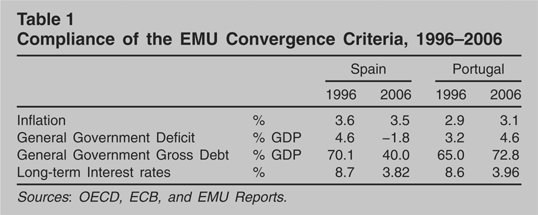
The Iberian economic record also shows that nominal convergence may be faster but that real economic convergence is slower.3
While there is significant controversy over the definition of real convergence, most scholars agree that per capita GDP is a valid reference to measure the living standards of a country.
Compliance of the EMU Convergence Criteria, 1996–2006

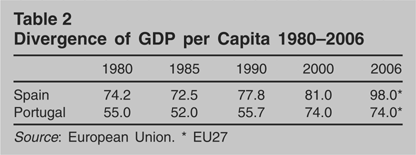
However, while there has been an important reduction in the economic differentials that separated each country from the European average, their income levels still remain behind the EU average (see Table 2).
Divergence of GDP per Capita 1980–2006

This data shows that nominal convergence has advanced at a faster pace than real convergence. Indeed, 20 years have not been long enough. Portugal and Spain's European integration has revealed both convergence and divergence, nominal and real. Since 1997 inflation in Spain has exceeded the EU average every year. In Portugal real convergence has been slowing down each year since 1998, turning negative in 2000, and both real and nominal divergence did not increase until 2006. In the first 15 years of membership per capita income in Spain increased “only” 11.5% and Portugal's 14.2%. Ireland's, in contrast, has increased 38%. Only Greece with an increase of 6.8% has had a lower real convergence than Spain and Portugal. A possible explanation for this development is the fact that while Spain has grown between 1990 and 1998 an average of 2.1%, Portugal has grown 2.5% and Ireland 7.3% over the same period. This growth differential explains the divergences in real convergence. Other explanations include: the higher level of unemployment (Spain's in the 1990s was 15.4%); the low rate of labor participation (i.e., expanding the Spanish labor participation rate to the EU average would increase per capita income higher than the EU average); the inadequate education of the labor force (i.e., only 28% of the Spanish potential labor force has at least a high school diploma, in contrast with the EU average of 56%); low investment in R&D and information technology (the lowest in the EU, with Spain ranked 61—spending even less proportionally than many developing countries including Vietnam); and inadequate infrastructures (i.e., road mile per 1,000 inhabitants in Spain is 47% of the EU average and its railroads are 73%). The inadequate structure of the labor market in both countries with high dismissal costs, a relatively centralized collective bargaining system, and a system of unemployment benefits that guarantees income instead of fostering job searches, have also hindered the convergence process.4
See “La Convergencia Real a Paso Lento.” El País, February 14, 2000.
Indeed, despite all the progress accomplished during the past two decades, the Spanish and Portuguese economies still confront challenges in the new millennium. They have not reached the development levels, particularly in technology, of the richest European countries and their competitive position has deteriorated lately. For instance, during the last decade Spain has accumulated intense disequilibria. While the economy continues with robust growth (3.4% in 2005 and 3.9% in 2006, more than double the rate in the euro zone area as a whole), economic success is being driven by the construction industry and private consumption (domestic demand has increased at rates of 10% in 2005), as well as residential investment. This, combined with high indebtedness levels (110% of the available income) and the negative contribution of the external sector to growth (i.e., in 2005 it rested two points to growth) raise questions about its sustainability. Furthermore, the lack of competitiveness is reflected in the record trade deficit: Spain's current account deficit reached 7.35% of GDP in 2006. Moreover, the Spanish inflation rate has exceeded the euro zone's by an average of more than 1 percentage point each year and in 2004 the gap widened to 1.5 points, Spanish labor productivity suffered the biggest fall in 2005 of all the countries in the OECD, with a drop of 1.3% (in the EU it was up 1.1%) and OECD data shows that during the 1994–2003 period Spain was placed next to last among 30 developed countries.
This data shows that EU and EMU membership have not always led to the implementation of the structural reforms necessary to address these challenges. On the contrary, it could be argued that the EMU has contributed to the economic boom in Spain fueled by record-low interest rates, thus facilitating the postponement of necessary economic reforms. Indeed, the reform of financial institutions does not necessarily bring about institutional changes in other areas (e.g., the labor market and fiscal policies). The virtual collapse of the European Monetary System in 1992, caused in part by successive devaluations of the Iberian currencies, showed the limits of financial and monetary instruments to impose institutional reforms in other areas and to balance domestic and external economic objectives. Institutional reforms require active policies by the governments that are willing to pay the short-term political price for unpopular policies. Portugal and Spain face a competitiveness challenge that requires significant structural reforms. This challenge, however, is not a problem of European institutions, but of national policies. In the end the Iberian experience illustrates that the process of economic reforms has to be a domestic process led by domestic actors willing to carry them out. The jury is still out regarding the domestic institutional impact of the EMU.
It is also important to note that the success of the Iberian countries was very influenced by the support they received from EU funds. During 1994–99, EU aid accounted for 1.5% of Spain's GDP and 3.3% of Portugal's. EU funding has allowed rates of public investment to remain relatively stable since the mid-1980s. The percentage of public investment financed by EU funds has been rising since 1985, reaching average values of 42% for Portugal and 15% for Spain. Moreover, the European Commission has estimated that the impact of EU structural funds on GDP growth and employment has been significant: in 1999, the contribution of these funds to GDP growth was 9.9% in Portugal and 3.1% in Spain in 1999. These funds, which amount to just over one-third of the EU budget, have contributed significantly to reduce regional disparities and foster convergence within the EU. As a result, major infrastructure shortcomings have been addressed and road and telecommunications networks have improved dramatically both in quantity and quality. In addition, increased spending on education and training have contributed to upgrade the labor force. In sum, these funds have played a prominent role in developing the factors that improve the competitiveness and determine the potential growth of the least developed regions of both countries (see Sebastián 2001, 25–6).5
In Spain these funds have represented 24% of the annual agrarian income (80,000 million euros in 20 years). They have also contributed to the dramatic improvement of infrastructures (40,000 euros in 20 years)—in 1986 Spain had 773km of highways, in 2006 6,267km, and 4km of each 10 have been funded with European funds. In 1986 it did not have any high-speed trains, today it has three lines and for every 100 euros invested in trains, and 38 have come from Europe. There are nine major ongoing infrastructure projects that will be partially funded with EU funds. Spain has also received 12,000 million euros from the cohesion funds that have helped fund projects such as the high-speed train from Madrid-Barcelona (3,518 million in EU funds).
Nevertheless, while acknowledging the critical role played by EU funds in the success of Iberian integration, it is also important to stress that successful integration is not only a budgetary issue. On the contrary, the Iberian experience shows that the main benefits of integration derive from the opportunities it generates in terms of trade and foreign direct investment (FDI). Portugal and Spain confirm that a critical factor to determine the final outcome of integration depends on the pattern of investment, which brings about important dynamic effects. Indeed, the opening up to international trade improves the potential for growth, lowers production costs and reduces the risk premium in response to a brighter macroeconomic outlook, which results from economic reforms. These developments help account for the increases in FDI in Portugal and Spain (where it reached a peak of 2.7% of GDP in 1990). FDI, in turn, has had very positive implications for the Iberian economies because it has facilitated the transmission of technology, has paved the way for advances in productivity, and has thereby fostered an increase in the potential GDP growth of both economies.
Indeed, receiving EU funds is by no means a guarantee of success.6
See “EU Novices Hope to Roar Like Irish ‘Celtic tigers’ Rather than Star in Greek Tragedy.” Financial Times, Thursday, April 22, 2004, 3; and “Coming Together: A Small Step for Europe's Economy but a Giant leap for the Continent.” Financial Times, Monday, April 26, 2004, 11.
Success is by no means automatic and while access to markets is important, EU membership is not enough. Economic success is contingent on the good use of regional projects and structural funds (i.e., transport projects). Spain is perceived as a case of success based on its regional policy and structural projects. Portugal, in contrast, has suffered from insufficient matching funds and implementation challenges. Success is largely determined by how countries exploit the advantages of membership, namely, access to EU markets and free movement of labor and capital. For instance, between 1985 and 2002 the ratio of the stock of inward FDI to GDP grew in Spain from 5% to 33% and in Portugal from 19% to 36%; whereas in Greece it fell from 20% to 9%. In addition, fiscal and monetary discipline; planning; as well as reforms are also critical. The countries that have performed the best within the EU are the ones that have followed this policy mix. This is so because stability influences the rate of growth and gives confidence to investors. For instance, Greece, one of the worst performers, ran fiscal deficits close to 10% until to 1996, and its public debt increased from 48% of GDP in 1986 to 111% in 1996. On the contrary, in Ireland, one of the best performers, public debt fell from 112% in 1987 to 38% by 2000. It is also critical not use funds to prevent economic reforms and support failing industries. The best models are Ireland with its investment in education (technical colleges), low corporate taxes, and flexible industrial relations, and Finland with its focus on innovation. Finally, it is also important to minimize expectations: Austria generated too many expectations to oversell EU membership to its citizens and when they failed to materialize, it created a backlash.7
Idem.
The difficulties the Iberian economies experienced in the early 1990s provide an additional lesson for new members, namely that “automatic pilots” do not work. The credibility of monetary and economic authorities cannot be built up by linking it to semi-rigid institutional mechanisms (as Spain and, to a lesser extent, Portugal tried to do in the late 1980s and early 1990s with EMS membership). On the contrary, it has to be earned through the adequate management of existing discretionary powers. Furthermore, the Iberian EMU integration shows that the consolidation of integration processes is contingent on the adequate coordination of macroeconomic policies among members prior to the (possible) adoption of a monetary currency. In Portugal and Spain EU integration required a set of measures including increased competition, the privatization of public enterprises, industrial restructuring, and deregulation. These measures translated into efficiency gains, which were reinforced by a more stable macroeconomic framework. At the same time, lower inflation and fiscal consolidation led to lower real (and nominal) interest rates, which, in turn, resulted in a higher sustainable growth. However, there have also been short-term costs associated with monetary integration. Indeed, the losses of the exchange rate and of monetary sovereignty require a process of nominal convergence and fiscal consolidation, as well as higher cyclical correlation, for EU membership to be successful. This should be taken into account for the eastern European economies—prior to monetary integration countries must carry out a process of modernization and nominal convergence without fixing their exchange rate.
The experience of Portugal and Spain also demonstrates the limits of peer pressure and the ability of the acquis communautaire to force change. The commission has pointed out in successive enlargement overviews of the 10 new EU countries the need to combat corruption and economic crime; strengthen independent judiciaries; and develop the capacity to implement the acquis. However, both Spain and Portugal (and Greece) have encountered (and still do) problems in all of these areas.
Finally, the Iberian enlargement also shows that patterns of migration can be reversed. Both Spain and Portugal were made to wait for accession in the 1980s, partly over immigration fears that never materialized. Fears of uncontrolled migration were not substantiated after 1986 (or even after the seven-year transition period). On the contrary, as a result of improved economic conditions in the Iberian Peninsula, one of the key results of EU access was that by 1995 there were 100,000 fewer Spaniards and 110,000 fewer Portuguese living in other EU member states than before enlargement. Furthermore, the reverse process took place, with thousands of Europeans (particularly from Germany and Britain) migrating to Spain. Such concerns are likely to prove to be unfounded again. The continuing existence of language, cultural, and structural barriers will most likely continue to hinder labor mobility in an enlarged Europe. In addition, the rapid economic growth of eastern European countries is likely to have the same effect that it had on migration patterns in Spain and Portugal after 1986. Finally, although it is likely that migration will cause difficulties in specific regions (especially on the eastern borders zones of Austria and Germany) and industries, the problem may not be excess migration from the east but too little. Given the EU's ageing population and its low fertility rates it will be important to facilitate the migration of young people from eastern Europe. In the end, instead of displacing local people from the labor market or lowering wages, immigrants from the new members states contribute to the host country's economy by adding value, creating jobs, and pushing up wages because they will be able to work legally (as several hundred thousand workers are currently illegally in the EU).8
See “UK Leads Way on Opening Borders to New Workers.” Financial Times, Friday, December 13, 2002, 2; and “Fears of Big Move West may be Unfounded.” Financial Times, Tuesday, December 2, 2002, 4.
Conclusions
For the Iberian countries the EU symbolizes modernization and democracy. The European integration process has facilitated the reincorporation of both countries to the international arena, contributed to the legitimacy of the new democratic regimes, acted as a buffer in controversial issues (such as decentralization in Spain and the implementation of economic reforms), and has facilitated and accelerated the process of convergence and modernization of financial, commercial, and manufacturing structures. The idea of Europe became a driving force that moved reforms forward and was a fundamental factor for bringing together political stabilization, economic recovery, and democratic consolidation. The examination of the Portuguese and Spanish experience in the EU leads to the following conclusions.
First, EU membership brings challenges and opportunities. While Spain and Portugal have benefited enormously from EU membership, they have also had to implement painful reforms in some sectors of their economies (e.g., some Spanish agriculture and farms) have suffered.
Second, success is not automatic and there are no guarantees. The economic performance of the Iberian economies has diverged. While the Spanish economy is currently booming, driven by internal demand and a bubble in the real state sector, Portugal has experienced one of the worst recessions of the last two decades.
Furthermore, EU membership helps those who help themselves and prepare to exploit the benefits of membership. The countries that have performed best (i.e., Ireland and Spain) are the ones that have used the EU funds wisely and have implemented the necessary economic reforms to take advantage of EU membership and attract foreign direct investment.
Finally, the EU and the EMU have limited direct powers to enforce outcomes. The experience of Spain and Portugal shows that the influence of indirect EU recommendations on policy and demonstration effects has been greater than direct action. It confirms the limits of peer pressure and the ability of the acquis communautaire to force change. While EU membership facilitates (and in many cases ameliorates) adjustment costs and provides impetus for reforms, the experience of Portugal and Spain shows that this is no substitute for the domestic implementation of reforms, which should proceed further in areas such as labor, product, and capital markets. Successful convergence and increasing competitiveness will hinge to a considerable degree on the ability of Spanish and Portuguese leaders to implement reforms in the face of domestic resistance. Lack of progress will bring economic stagnation or worse.