Iraq, North Korea, and Syria are historical enemies of the United States and have all pursued nuclear weapons, a technology that could radically shift the balance of military power with the United States in their favor. The United States launched a decisive war in 2003 in part to prevent Iraq from ever obtaining nuclear weapons. But the United States did not stop North Korea from doing so, despite long negotiations and at least one crisis in which war was threatened, in 1994. The United States also neither attacked nor even threatened Syria with war as it pursued its nuclear weapons program. Why the radically different outcomes across these cases?
In the cases of Iraq and North Korea, there was also substantial variation in the relationship between each and the United States over time. The final outcomes of war and successful proliferation occurred only after a long period of negotiations and threats. During this period, the US intelligence community obsessively monitored each state's nuclear weapons efforts, and sporadic crises arose in which the United States prepared itself for war, and sometimes even seemed on the verge of striking, only to end with a fading threat of war and continued negotiation. What explains this drawn-out process and the occurrence of crises?
Now the focus of many commentators on US foreign policy has shifted to Iran.Footnote 1 Will the United States (or its ally Israel) attack Iran to halt its nuclear progress? Should the United States simply tolerate Iran's efforts? Why does the United States not attack now, rather than continue to risk Iran acquiring nuclear weapons covertly?
To answer these questions, we analyze a formal model in which two states bargain repeatedly over disputed issues, while one potentially invests in and makes progress toward acquiring nuclear weapons that, once deployed, would increase its bargaining power, and the other imperfectly observes its efforts and progress and decides whether to attack to stop it. Because weapons development and observation occur over time, the model enables us to understand and make predictions about the sources of empirical variation in behavior across both countries and time. It also allows us to analyze the possibilities for policy-makers to shift underlying factors and thereby improve outcomes.
In the absence of a nonproliferation deal, the proliferant invests in a nuclear weapons program in the hope that acquiring the weapons will enable it to extract concessions from the United States. The United States tries to monitor the progress of this program, and as time passes, becomes increasingly worried that it is nearing completion. If, faced with a program known to be on the verge of success, the United States would not attack to prevent it, then eventual proliferation is inevitable. Otherwise, if the United States becomes confident enough of a program's imminent fruition, it will attack. Whether the interaction ends in war or proliferation then depends on whether the program succeeds before the United States becomes worried enough to attack.
Surprisingly, much of the variation in behavior is, from the point of view of the participants, essentially a result of chance. The specific instantiations of two stochastic elements—a proliferant's halting progress toward acquiring nuclear weapons, and the United States's noisy intelligence on its current stage of development—can make the difference between a final outcome of war or peace, prevention or proliferation, and also determine whether the road to this outcome is quick and calm or long and tense. They can render the United States surprised by a state's proliferation, or lead to slowly increasing apprehension about a proliferant's nuclear progress, peaking in crises that may end in war or merely a repeat of the cycle. A war may even turn out to be “mistaken,” in the sense that the proliferant was not about to acquire nuclear weapons. In short, these variables can easily have as large an impact on the outcome as previously studied factors such as the anticipated costs of war and effects on the balance of power of a state's acquisition of nuclear weapons.
We derive three observable implications from the model, test them against the historical record of proliferation interactions, and find strong support for the model. First, intelligence estimates of nuclear programs, especially after the programs’ early years, are focused on assessing the progress, rather than the existence, of these programs. Second, the serious consideration of preventive attack during peacetime is strongly associated with intelligence estimates that the program in question is nearing completion. Third, the course of intelligence estimates during a nuclear program tends to determine the character and outcome of the interaction between the proliferant and a potential attacker.
Our results also imply that many commonly advocated policies for suppressing proliferation may have the opposite of the intended consequences. For example, better intelligence can sometimes make proliferation less likely as the United States gets better at determining when the proliferant is close to success and preventing it. But under other conditions, it can make proliferation more likely because the increased patience of the United States in waiting for definitive intelligence gives the proliferant more time for its program to succeed. Increases in the sophistication of a proliferant's program generally decrease the probability of proliferation and can increase the chance of a mistaken attack because the United States more than compensates for the proliferant's sophistication by attacking sooner.
Our model is the first, to our knowledge, to treat states’ arming dynamically, which we show is essential to understanding most historical episodes of attempted proliferation.Footnote 2 Acquiring a consequential new military capability such as nuclear weapons often requires a substantial, but uncertain, length of time for research, development, and construction before the capability can be deployed. Consequently, a state that is attempting to monitor another's arming may be uncertain not only about whether a new capability is being sought, but also about precisely how soon this capability will be ready, and thus when it is no longer safe to put off the costs of preventive attack.
Previous models take arming to be static—capabilities are acquired instantly or in the very next period—and so cannot speak to the unfolding of these interactions over time.Footnote 3 In models of nuclear proliferation, this assumption typically leads in equilibrium to one state randomizing over whether to seek nuclear weapons, so that the key uncertainty driving behavior is over the existence of a program, while the other state randomizes over whether to attack to stop it.Footnote 4 However, we find little empirical evidence of uncertainty over a program's existence at any time when preventive attack might be seriously considered. Worse, these models produce no definite predictions for what should happen in most empirical cases. When the costs of attack are low enough relative to the consequences of proliferation so that preventive attack is potentially worthwhile, these models can predict only that attack may occur, since it is chosen at random.
By contrast, in our model the key uncertainty is over the progress of a program, which more plausibly arises from technological trial-and-error and imperfect intelligence gathering: neither weapons programs nor preventive attack are randomly chosen.Footnote 5 Our theory holds that program progress and intelligence estimates of it explain why, even when preventive attack is potentially worthwhile, it occurs in some cases and at some times but not others.Footnote 6 As a result, it yields specific predictions for all empirical cases, which we show are born out in most.
In this article we focus on “no-deal” equilibria in which the two sides do not agree to a nonproliferation deal. A companion article analyzes the viability of deals in which the proliferant eschews a weapons program in exchange for concessions from the United States. The possibility of a deal does not undermine the importance of the results we report here, for two reasons. First, in most empirical episodes of states pursuing nuclear weapons, no deal is ever made so that it makes sense to focus on what happens in a deal's absence. Second, we show in the companion article that a deal's viability depends strongly on a parameter—how well the United States can observe a proliferant's initiation (or restarting) of a weapons program, so that this cheating can be punished—that has no effect on the no-deal equilibria. Deal equilibria thus exist only under certain conditions, while the no-deal equilibria always exist, so that the results we report will remain valid whether a deal exists or not.
Set-up of the Model
We model the interaction between two states, A (“the United States,” referred to using feminine pronouns) and B (“the proliferant,” masculine), as they bargain over revisions to a prior division of a composite of disputed issues, represented by the unit interval.Footnote 7 In the first of infinitely many discrete periods of time, A first chooses whether or not to start a war with B. If A attacks, the game ends with a costly lottery. The value of this lottery to each player depends on the balance of military power between them, represented by A’s probability of victory in the war. The winner receives the entire contested stake in this and all future rounds; the loser gets nothing. Regardless of who wins, each player pays a positive cost of war, c A and c B respectively, in this and all future periods.
“War” here is intended to represent the most cost-effective option available to A for unilaterally ending or delaying B’s program. This may be a full-on invasion, such as the US war with Iraq in 2003, or it may instead be a limited set of strikes intended to destroy key nuclear facilities, as with Israel's attacks on reactors in Iraq and Syria. Which of these is chosen will depend on the costs of each option and its anticipated effectiveness at ending or delaying B’s acquisition of nuclear weapons, but this choice is not the focus of our analysis.Footnote 8
If A chooses not to attack, then she must offer to B a disposition of the contested issues. If B rejects the offer, war results, ending the game with the same costly lottery. If he accepts the offer, it is implemented immediately and the associated payoffs are realized.
This take-it-or-leave-it bargaining protocol offers a simple way to model the imposition of economic and political sanctions, which is often undertaken in response to states’ nuclear programs. Sanctions reduce the value B receives from international commerce and political influence, and so are akin to A making an offer that is less generous to B than the status quo. We ignore any cost incurred by A in imposing sanctions.Footnote 9
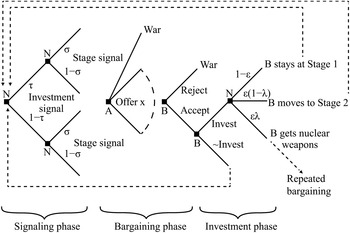
Peaceful acceptance by B of A’s offer is followed by an opportunity for B to invest in developing nuclear weapons (that is, to start a program or continue an extant one). To simplify the analysis, we assume that B’s development effort is all or nothing—the choice to pursue nuclear weapons is binary.Footnote 10 We also abstract away from any direct (budgetary) cost of B’s investment, taking this to be negligible.Footnote 11
B must master a series of technological prerequisites before he can actually deploy nuclear weapons. For simplicity of presentation, we assume there are only two prerequisites, which we take to be the production of fissile material in sufficient quantity, and the manufacture of viable weapons. Thus, there is a first or “early” stage of development where B has mastered neither, a second or “late” stage where B has mastered the production of fissile material but not the manufacture of weapons, and a third stage n where B has mastered both and is assumed to possess nuclear weapons.Footnote 12 B begins the game in the early stage.
Overcoming these hurdles is partly a result of trial and error so that the time at which B will master one and then the next cannot be perfectly predicted by either player. If B begins a round in the second stage and chooses to invest in that round, then he remains at the second stage with probability 1 – λ, and advances to acquiring nuclear weapons in that round with probability λ. If B begins a round in the first stage and invests, then he remains at the first stage with probability 1 – ε, advances to the second stage in that round with probability ε, and advances all the way to acquiring nuclear weapons in that round with probability ελ so that it is possible to master both stages in a single round.Footnote 13
This representation of the weapons development process is the central analytical innovation of this article; many of our results flow from it. It has two virtues. First, it is the simplest possible representation of the empirical fact that the development of any complex technology is both progressive and stochastic. Second, it is the simplest way to generate a quintessential feature of the empirical interactions we are interested in: the United States's intense focus on estimates of when B will get nuclear weapons. Although B’s chances of advancing to a given stage depend only on his current stage and his decision to continue trying, as time goes by, his probability of acquiring nuclear weapons will increase, and in the absence of contradicting intelligence, A’s estimate of his time to acquiring nuclear weapons will decrease.
If B’s development effort is successful and he acquires nuclear weapons, this immediately becomes common knowledge (for example, because of an easily observable test detonation).Footnote 14 The balance of power shifts in the next period, from p to p n < p, in B’s favor.Footnote 15
This assumption—that nuclear weapons improve B’s power—is crucial to all that follows. If they do not, then B has no incentive to acquire them, A has no reason to prevent this, and neither proliferation nor war occur. Despite the ongoing debate over this assumption, most US policy-makers seem to believe it, and there is some evidence that states seeking nuclear weapons do also.Footnote 16 Importantly, this assumption means that our model applies only to those states that anticipate gains from possessing nuclear weapons. It sets aside the many real-world states that see no net benefits, for whatever reasons—reliable security guarantee, benign security environment, moral commitment to nonproliferation—from possessing nuclear weapons. These states would not invest in a nuclear weapons program, and so will not be subject to preventive attack to stop such a program.
The first period ends after B’s progress or lack of progress is determined. The next period, and every subsequent period, differs in structure from the first only in that it begins with the possible reception of new intelligence by A. This takes the form of two signals that are assumed to be common knowledge.Footnote 17 The first signal, of the program's “existence,” indicates whether B invested in the last period or not. If B did invest, then with probability τ > 1/2, A receives a signal that he did, and with probability 1 – τ, A receives a signal that he did not. If B did not invest, then A receives a signal that he did not with probability τ′ > 1/2, and a signal that he did with probability 1 – τ′. Thus, A’s intelligence on B’s investment is prone to both false positives and false negatives. The second signal, of the program's “progress,” indicates the current stage of B’s program. A will receive a true signal of B’s current stage with probability σ, and an uninformative (that is, “null”) signal with probability 1 – σ. Thus, A’s intelligence on B’s progress is spotty, but accurate.Footnote 18 Figure 1 illustrates one such period.
A single period of the game

Each player's per-period payoff is assumed to be linear in her or his share of the value of the contested issues, while future payoffs are discounted by a factor of δ < 1 per period. Players’ preferences and all the exogenous parameters of the game are common knowledge.
Proliferation or War
To characterize the no-deal equilibria of the game, we first examine what happens when A knows that B’s program has reached the later stage of progress, so that proliferation is relatively near. This strongly affects what happens earlier in the game, when A is not sure that B’s program has reached this stage, so that proliferation may not be near.Footnote 19
A “no-deal equilibrium” is defined to be a Perfect Bayesian Equilibrium in which A never makes a positive offer that is more generous than is necessary to avoid immediate war.Footnote 20 Intuitively, the only reason A would ever make such an offer is to induce B not to invest, in the context of a deal trading these concessions for noninvestment.
Proliferation Is Near
We start with the “second-stage-known” subgame, when B has not yet acquired nuclear weapons, but is known with certainty by A to be in the second stage—because at some previous point in the game, A received a signal that B was in the second stage. We will show that, in the absence of a deal, B will always invest in a nuclear program, and then analyze the conditions under which A will either tolerate this program or attack to stop it.
Proposition 1:
Suppose that B is in the second stage and this is common knowledge. In any no-deal equilibrium of this subgame, B always invests, given the chance. If p – cA +
 $\displaystyle{{\delta \lambda} \over {1 - \delta}} $
(p – pn) < 1 +
 $\displaystyle{{\delta \lambda} \over {1 - \delta}} $
(cA + cB), there is peace and eventual proliferation. Otherwise, there is immediate war and no proliferation.
To understand this result, consider B’s perspective. In the absence of a deal, A will not reward noninvestment, or equivalently, penalize investment, so it makes sense for B to invest as long as there is some benefit from acquiring nuclear weapons (recall we assumed away any direct cost of a nuclear program). Once B is nuclear-armed, A will offer B just enough to make him indifferent between war and peace. Before B has nuclear weapons, he is weaker (that is, he expects to do less well in a war), and A will concede even less, because B will still prefer this to war and, in the absence of a deal, there is no reason for A to do otherwise. Thus, B can expect that acquiring nuclear weapons will bring bigger concessions from A, and so it always makes sense to invest in the absence of a deal.
Now consider A’s perspective. In a hypothetical world without nuclear weapons, A would offer B just enough of a compromise on their disputed issues to make B indifferent between accepting the offer and going to war—there is simply no reason for A to be any more generous than that. From A’s perspective, the problem with B pursuing nuclear weapons is that, once B has acquired them, A will have to make a more generous offer to avoid war. In the absence of a deal, A really only has two choices for what to do. First, A could attack B to try to prevent B from ever getting the weapons. Second, A could tolerate B’s nuclear program. If A chooses toleration, then until B gets nuclear weapons, A can offer B even less than she would in the hypothetical nonnuclear world, because she can take advantage of B’s expectation that the nuclear program will eventually be successful and lead to larger concessions from A. If instead A attacks, there will be no proliferation and subsequent concessions to B, but A will no longer have the chance to peacefully exploit B’s hopes, and will lose the surplus from peace (the avoided costs of war) she would have enjoyed even once B became nuclear-armed.
Proposition 1 specifies this tradeoff for A. The left-hand side of each condition represents the immediate payoff of attacking for A (p – c
A
) and the gain from avoiding the change in concessions A would have to make in perpetuity after B had obtained nuclear weapons, weighted by the probability of B’s program succeeding in the current period (
 $\displaystyle{{\delta \lambda} \over {1 - \delta}} $
(p – p
n
)). The right-hand side represents, in its first term, the immediate payoff of toleration: 1 is the most A could get in this period if B was willing to accept zero concessions for now to avoid war. Its second term represents the surplus A will enjoy from peace if B’s investment this round is successful (
 $\displaystyle{{\delta \lambda} \over {1 - \delta}} $
(c
A
+ c
B
)). If the left-hand side is smaller, then A is better off tolerating B’s program and taking advantage of B’s hopes in the meantime. If it is larger, then A is better off attacking to stop it before it is successful.
War is more likely to occur when the effect of proliferation on the balance of power (p – p n ) is higher. Then there is less for A to gain from taking advantage of B while his program is ongoing, and more to lose when it bears fruit. War is also more likely the smaller its costs; there is less surplus to lose from war, and if c A is smaller there is also less for A to gain from taking advantage of B prior to proliferation. More surprisingly, the effect of the probability that B’s program is successful in a given period (λ) is not always to raise the likelihood of attack. One might think that the more likely B’s program is to succeed, the sooner A will expect B to obtain the weapons and extract a better offer, thus making the commitment problem more severe and war more likely. But this happens only if the shift in power from proliferation exceeds the costs of war (p – p n > c A + c B ). When instead p – p n < c A + c B , the higher likelihood of proliferation is outweighed by the increased advantage A can take of B’s more optimistic hopes for success while the program is ongoing, and thus the incentives for war relative to toleration decrease.
To focus the remaining analysis on the most interesting behavior, we will assume that the unique no-deal equilibrium, once A knows that B has reached the second stage, is immediate attack. It is easily shown that, if instead toleration is the no-deal equilibrium in this subgame, then preventive war cannot occur in equilibrium. Intuitively, because the perceived risk of successful proliferation is highest when A knows that B’s program has advanced to the second stage, the commitment problem is most severe in this subgame. In earlier subgames, the perceived risk is lower and the commitment problem less severe because B’s program might not have reached the second stage. So, if A tolerates B’s program knowing that it is in the second stage, then she will also tolerate it earlier in the game, and there is never a preventive attack. In assuming that the no-deal equilibrium is war, we are setting aside cases in which proliferation is inevitable because A is unwilling to attack to stop B’s program, even once it is known to be nearing success.Footnote 21
Proliferation May Not Be Near
To analyze the earlier periods of the game in which B may have reached the second stage but A does not know this with certainty, we first show that, in the absence of a deal, B will always invest, given the chance. This means that, without contrary evidence, A will grow increasingly suspicious that B’s program has covertly reached the second stage. Once A is sufficiently convinced that this has happened, A will attack. Whether this happens, whether the war is “mistaken,” and the character of the road to war or eventual proliferation will depend on when B’s program makes progress and when A learns of this progress, both random from the players’ perspectives.
Proposition 2:
Suppose that the second-stage-known equilibrium is immediate war. In any no-deal equilibrium of the game, B always invests, given the chance.
In the absence of an agreement to avoid proliferation and war, A offers the bare minimum to B in each round. B will not get better offers unless and until he can successfully develop nuclear weapons. In any given round, investing in a nuclear program generates a chance that B will get, or at least get closer to acquiring (by mastering the first stage), nuclear weapons in the next round. By contrast, A would not reward B with more generous offers for not investing. Not investing thus only lowers the probability of having nuclear weapons in any future period, and lengthens the time during which B must suffer A’s poor offers. For this reason, B should never miss a chance to invest in nuclear weapons production.
Given that B is always investing in his nuclear program, A’s estimate of how likely B’s program is to have reached the second stage at any particular point in time will depend only on the stage signals A has received up to that point. Since in equilibrium B always invests, signals of whether B is investing are irrelevant to A. Any signal that B has invested only confirms what A already knows; any signal that B has not invested must be false.
Proposition 3:
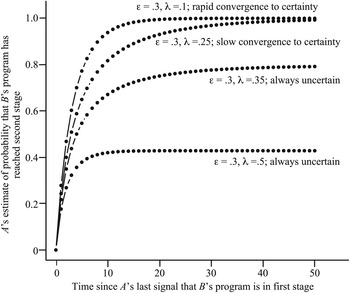
In any no-deal equilibrium, as time goes by without new intelligence on the stage of B's program, A's estimate of the probability that it has mastered the first stage and reached the second increases. If the first stage is easier to master than the second (that is, ε ≥ λ), A will eventually become almost certain the program has reached the second stage. If instead the second stage is easier, A will never become confident the program has progressed—A's estimate will converge to
 $\displaystyle{{\varepsilon - \varepsilon \lambda} \over {\lambda - \varepsilon \lambda}} $
< 1.
Proposition 3 specifies A’s estimate after a given time without a stage signal. To understand this result, consider that in each period without a signal of B’s stage, A must weigh two contradictory pieces of evidence. On the one hand, B has not yet gotten nuclear weapons, which suggests that in the last period his program was in the first stage rather than the second. On the other hand, time has passed and A knows B has been trying, so it is possible his program has mastered the first stage and moved to the second. Which of these weighs most heavily depends on whether it is easier for B to master the first stage or the second (that is, whether ε is greater than λ). If the first stage is easier, then over time, in the absence of an informative signal of B’s stage, A will eventually become almost sure that B has reached the second stage: intuitively, it is increasingly likely that B has mastered the easy stage but gotten stuck in the hard one. If instead the second stage is easier, then even after a great deal of time, A will still not be sure which stage B’s program is at: he could be stuck at either stage, and the harder it is to master the first relative to the second, the more likely it is he remains at the first. Figure 2 illustrates the change in A’s estimate as she waits without new stage intelligence for several different combinations of ε and λ. The limit to which A’s confidence that B has reached the second stage converges is important for determining what happens in later periods, as we will see
A grows more suspicious over time, but may never be certain

.
Before continuing, we assume that, when A knows that B’s program is in the first stage, A will not attack immediately. While this behavior is technically possible in equilibrium, we view this as an artifact of our simplification of the process of nuclear weapons development to just two stages. At any known stage of a program, immediate attack is in equilibrium if and only if p – c
A
+
 $\displaystyle{{\delta \gamma} \over {1 - \delta}}$
(p – p
n
) ≥ 1 +
 $\displaystyle{{\delta \gamma} \over {1 - \delta}}$
(c
A
+ c
B
), where γ is the probability of imminent proliferation (that is, the probability that the program succeeds in the very next period).Footnote
22
This condition can be satisfied only if γ is high enough. But empirically, in the early stages of a nuclear weapons program, the probability of imminent proliferation (γ) is approximately zero, because there are simply too many remaining prerequisites for states to master simultaneously. Thus, the condition for immediate attack in these early stages will not be met. Under this assumption, our results should be interpreted as governing what happens as B’s program transitions from the last stage that A would knowingly tolerate to the first stage at which she would attack immediately rather than wait any longer.
Proposition 4:
Suppose that the second-stage-known equilibrium is immediate war. In any no-deal equilibrium of the game, A tolerates B's program unless and until she becomes sufficiently confident that it has reached the second stage, and then attacks.
B’s steady investment confronts A with a tradeoff between the risk that B’s program will succeed in the next round and the costs of attacking to prevent it. Early on, B’s program is likely to be in the first stage, so that the risk of proliferation is low and A is content to watch and wait, putting off the costs of attack. If A receives a new signal that the program remains in the first stage, then she can assume that the program is not going well and safely wait. If instead A receives a signal that the program has reached the second stage, then she can be certain that proliferation is near and attacks to end the high risk of proliferation. But if A receives no new stage intelligence, she will not know for sure how the program is doing. As time passes, B’s program is increasingly likely to have made progress, so that A’s estimate of the risk of proliferation grows (by Proposition 3), and A’s tradeoff begins to shift in favor of preventive attack.
If her confidence that proliferation is near gets high enough, A will attack even without stage intelligence. It might then turn out that the program remained stuck in the first stage so that, in retrospect, it would have been better for A to wait rather than bear the costs of an unnecessary war. Going to war based on an (uncertain) estimate, rather than reliable information, is rational for A but poses the risk that the war is a “mistake.” To be clear, if this happens, A is not mistaken about B’s intentions—B is trying to obtain nuclear weapons—but is wrong about the progress he has made and thus the imminence of his success. A might well regret such a war.Footnote 23
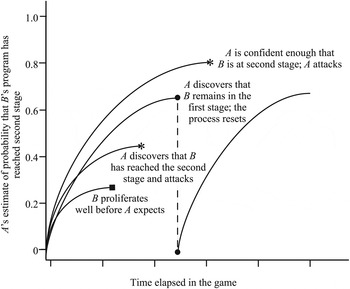
This relatively simple description of the equilibrium conceals the variation in behavior that can occur as it unfolds. This variation is driven entirely by the chance successes of both B’s nuclear program and A’s intelligence gathering. As a result of these stochastic elements, the game can end peacefully or violently, and with the occurrence of proliferation or its prevention. The final outcome can be reached quickly or slowly, and relations in the meantime can be pacific or crisis prone. There are four generic kinds of paths along which the equilibrium might travel, illustrated in Figure 3.
-
1. Surprise success: A tolerates B’s investment for the first few years since it is unlikely to be successful soon. But B’s program masters both stages of development unexpectedly quickly, and B acquires nuclear weapons. The process is calm and ends quickly in proliferation.
-
2. Hard intelligence of progress: A is content to tolerate B’s program initially, but receives intelligence that the program has advanced to the second stage and immediately attacks to stop the program. The process is quick and seems calm, but ends violently.
-
3. Growing suspicion of progress: Lacking recent intelligence on B’s program, A grows increasingly apprehensive about the prospect of its imminent success. A crisis arises (because the time is near when A would be worried enough to attack without hard evidence) and war occurs. The process is potentially long and ends violently.
-
4. Crisis defused: Lacking recent intelligence, A’s suspicions become persuasive and a crisis arises. War is threatened and appears imminent, but the arrival of intelligence that B’s program remains in the first stage defuses the crisis, and the process continues. The process is drawn out, tense, and dangerous.
There are many possible paths through the equilibrium

The stochastic elements of the game (nuclear program progress and the receipt of new intelligence) determine which kind of path is actually observed and are therefore central to explaining the variation we see empirically. Because the exogenous parameters σ, ε, λ, p, p n , cA, cB, δ) are relatively stable over time, the model suggests that much of the over-time variation in behavior observed in empirical episodes is driven by the stochastic elements. This might also be true for variation in behavior across proliferants, though the exogenous parameters do change substantially across cases and so may explain some of the cross-country variation. However, as we will see, this dependence on chance does not mean the model cannot be used to generate testable predictions.
Observable Implications
In the model, the occurrence of proliferation or preventive attack is closely related to the contemporaneous intelligence estimates of the potential attacker. We use this connection to derive three observable implications of the theory.
First, in the no-deal equilibrium, the essential issue for a potential attacker deciding what to do is the degree of progress a proliferant's nuclear program has made. In particular, how far off is its anticipated success, or equivalently, how long does the attacker have to act before it's too late? By contrast, there should be little uncertainty about the existence of a nuclear program, since in equilibrium the proliferant always pursues one. This prediction is importantly different from that yielded by previous models, which emphasize uncertainty about whether a state is seeking nuclear weapons at all but assume no uncertainty about progress.Footnote 24
H1
Intelligence estimates of nuclear programs should focus primarily on the progress of a program and the time at which it will succeed, rather than its existence.
Next, if a potential attacker would ever find it worthwhile to use force to prevent a proliferant from acquiring nuclear weapons, then in equilibrium she will do so only once proliferation is near. At any earlier point, the attacker should bide her time, putting off the costs of attack until the risk of proliferation is higher. From Proposition 1, a state would never be willing to attack unless the shift resulting from proliferation is large enough relative to the costs of preventive attack. This also differs from previous models in which the decision to attack is taken to be static so that no prediction about when an attack will occur can be made. By contrast, in our model the decision to attack or not is made repeatedly over time as the situation faced by the potential attacker changes.
H2
As long as the effect of proliferation on the balance of power is high enough relative to the costs of preventive attack, preventive attack should occur if and only if the program in question is estimated to be nearing success.
Finally, given the observed course of a program's progress and a potential attacker's intelligence estimates of it, the model implies that the interaction between proliferant and attacker should match a particular equilibrium path type. That is, the model predicts both the outcome of the interaction (for example, proliferation or attack?) and its character (for example, proliferation a surprise? War a mistake?). For example, if a potential attacker estimates for several years that proliferation is not near, but then receives hard intelligence that the proliferant's program has made progress and is nearing completion, the model implies that behavior will match the “hard intelligence of progress” path type, with peace up until the new intelligence is received, and then attack. Previous models are incapable of making such predictions since they take the behavior of interest to be a one-time, random choice in a mixed-strategy equilibrium.
H3
The proliferant/attacker interaction observed in each episode should match the equilibrium path type that corresponds to the observed course of the proliferant's program and the potential attacker's estimates of it.
Empirical Tests
Our universe of cases includes all those episodes in which a state pursued a nuclear weapons program. We take these episodes to be composed of all those state-years coded as pursuing nuclear weapons by Singh and Way (SW)Footnote 25 or as having a nuclear weapons program by Jo and GartzkeFootnote 26 (JG).Footnote 27 We exclude all those state-years in which a state was coded by SW as only “exploring” a nuclear weapons program, on the grounds that it is implausible that any other state would seriously consider a preventive attack in response to these usually quite tentative efforts.Footnote 28 We partition each state's set of years pursuing nuclear weapons into distinct episodes whenever some event occurs that can plausibly be regarded as “restarting” its pursuit of nuclear weapons, such as after a revolution occurs, a deal is agreed, or an attack destroys the key facilities.
To measure outcomes, we use the first year of nuclear arms possession recorded by SW and JG for episodes that ended in proliferation, and the years in which preventive attacks occurred as documented by Fuhrmann and KrepsFootnote 29 (FK) for those episodes that led to attack, updated to 2007. We also make use of data from FK on the occurrence or absence of “serious consideration of attack” (SCoA), defined essentially as a cabinet-level official deciding that the time is right for an attack. An attack must be seriously considered before it is undertaken, and almost half of SCoAs led to actual attack. Thus, even cases in which attack is seriously considered but not undertaken are relevant to testing our model's predictions about when such an attack is most likely to occur.Footnote 30
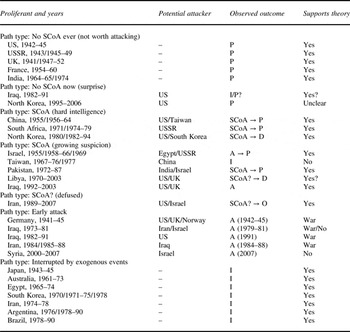
Table 1 lists the full set of twenty-seven episodes, with columns for each associated proliferant and the years it sought nuclear weapons, the states that seriously considered preventively attacking its program, and the outcome of the episode.Footnote 31
Episodes of proliferation or (serious consideration of) preventive attack

Notes: For outcomes: A = preventive attack; D = nonproliferation deal; I = episode interrupted by an unrelated, exogenous event; O = ongoing as of 2007; P = proliferation; SCoA = serious consideration of attack. Question marks are appended to each of the changes we have made to the original data.
For data on intelligence, we draw on the remarkable compilation of US government intelligence estimates assembled by Montgomery and Mount (MM).Footnote 32 This compilation covers eighteen of our twenty-seven episodes. (We use additional sources, detailed in the appendix, to cover the remaining nine episodes.) It contains roughly seventy “concrete, verifiable estimates of overall [nuclear] capabilities and intentions” produced by the US intelligence community.Footnote 33 We also use the appendix to MM, which offers a discussion of these estimates organized by episode and includes citations to many additional sources.
H1: Intelligence Estimates Primarily on Progress, Not Existence
To test this hypothesis, we evaluated each of the sixty-nine estimates on our episodes that were identified by MM. We counted the number that explicitly assess the progress of a state's nuclear program toward producing weapons, and also made a separate, more conservative count of how many explicitly offer a number of years until (or expected year at which) the program will succeed. We also counted the number that focus on the existence of a weapons program by answering whether a state intends to seek nuclear weapons, whether its program is oriented toward weapons, or whether a state intends to continue with an earlier nuclear weapon program. We then examined the estimates to ascertain any pattern in when they are concerned mainly with existence versus progress.
We find that forty-one of the sixty-nine estimates deal explicitly with the state of progress of a nuclear program toward successfully producing weapons. Of these forty, thirty-seven offer an explicit expected year of success or number of years to success. We find that twenty-four of the sixty-nine estimates are concerned with the existence of a weapons program. This evidence supports our hypothesis in that progress estimates outnumber existence estimates by almost two to one. However, given that one-third of the estimates deal with existence, it is plain that uncertainty about whether a state is pursuing nuclear weapons is also important.
Closer examination reveals a clear pattern in when existence or progress are the main concern of an estimate. All but three of the twenty-four estimates concerned with existence are made in the early years of an episode, when a state has recently chosen to initiate or restart a nuclear weapons program (sometimes in violation of a nonproliferation agreement), and the United States is attempting to assess whether the state is in fact seeking weapons. In the latter half or so of these episodes, the question of existence almost always gives way to confidence that a state is seeking weapons and a focus instead on assessing its progress toward the bomb. The only exceptions are South Africa, where the United States remained uncertain of its weapons intent until its program was nearly completed, and Brazil and Argentina, where the last estimate in each episode concludes that a weapons program is being abandoned.
This pattern makes intuitive sense. When a state has just decided—or is in the process of deciding—whether to pursue nuclear weapons (for example, India in the mid-1960s), or whether to renege on a deal and restart pursuit (for example, North Korea in the late 1990s), there may be little concrete evidence of this decision, and US estimates turn mostly on tenuous judgments of the state's internal political calculus. However, as the program advances, large funds and staffs are allocated, new facilities are constructed and completed, and foreign materials or expertise are imported. These may all generate signals of nuclear weapons pursuit that remove ambiguity and lead the United States to confidently assume that a weapons program is ongoing, so that intelligence estimates later in a program's course are devoted to assessing its progress and expected date of success.
H2: Preventive Attacks Associated with Near-Success Estimates
To test this hypothesis, we first need to determine which episodes meet the condition upon which this hypothesis depends—that the effect of proliferation must be high enough relative to the costs of attack—otherwise attack will never be considered regardless of intelligence estimates. We then use the intelligence estimates on each of these episodes to measure when a program was estimated to be nearing success, and compare this with the instances in which preventive attack occurred or was at least seriously considered.
We exclude the United States, USSR, United Kingdom, France, and India from the test set as not meeting this condition. Germany and Japan, the only plausible potential attackers of the US program, were incapable of launching an attack on facilities in the US homeland. The dominant explanation in the literature for the US failure to attack the Soviet program is that this would likely have required a major bombing campaign and escalated to a large war with prohibitive costs.Footnote 34 The USSR could reasonably anticipate that any preventive attack on the British or French programs would escalate to a large war with the United States, making the costs prohibitive. During the 1960s, changes in how the superpowers dealt with proliferation rendered the British and French experience of pursuing nuclear weapons under the secure protection of a superpower unique: later allies suspected of doing so faced suspensions of aid and threats of abandonment.Footnote 35 Moreover, a superpower might plausibly refrain from defending an ally if another state preventively attacked its nuclear program, as evident in US efforts to obtain consent from the USSR for an attack on China's program.Footnote 36
India was the only exception to this rule. The United States actually considered giving India nuclear weapons in the 1960s, while the USSR signed a cooperation treaty with India and gave it substantial aid in the 1970s, suggesting that neither disfavored its proliferation enough to attack to stop it.Footnote 37 Of India's other potential attackers, Pakistan suffered internal turmoil after military defeats at India's hands in 1965 and, more decisively, in 1971, and so was in no position to attack its program, while China lacked the capability to attack the program except by invading or using nuclear weapons and thereby starting a large war with prohibitive costs.Footnote 38
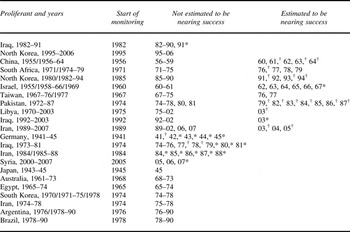
Table 2 shows the years of each of the remaining nineteen episodes we use in the test. Each row ends with the last opportunity for preventive attack, taken to be the last serious consideration of attack or the acquisition of nuclear weapons, whichever is later. The table marks the year intelligence monitoring began. Before this point, a potential attacker is unaware of or not paying attention to a program and so obviously will not consider an attack. Thus, these years cannot reveal anything about the relationship between estimated progress and attacks, and so are excluded from the test.Footnote 39 Years in which a likely potential attacker estimated the program to be nearing success—within four years of acquiring nuclear weapons—are also indicated.Footnote 40 Finally, years in which preventive attack was seriously considered or actually occurred are also marked.
Near-success estimates and (serious consideration of) attacks

Notes: Episodes are shown by two-digit years. *Years in which a preventive attack occurred. †Years in which preventive attack was seriously considered but did not occur.
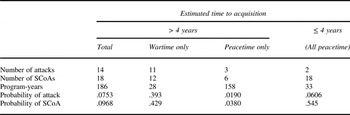
We counted every year after the start of intelligence monitoring in which the associated program was estimated to be nearing success, and the number of these years in which either an attack or serious consideration of attack occurred, and then did the same for every year in which the program was not thought to be near success. The results are presented in Table 3, with columns for program-years in which a program's success was estimated at more than four years away and at less than four years away.
Correlation between near-success estimates and (serious consideration of) preventive attack

Note: SCoA = serious consideration of attack.
Preventive attacks on nuclear programs are fairly rare, considered seriously in only thirty-six of the 219 program-years in the data, with only sixteen actual attacks resulting. More attacks occur with far-from-success estimates than with near-success estimates, both absolutely (fourteen to two) and relative to program-years (.0753 to .0606). This would seem to contradict our theory, though the relative difference is not statistically significant (p = .5 in a one-tailed exact test). Including attacks that were only seriously considered, the same number occur with far-from-success estimates as with near-success ones (eighteen), but in relative terms, SCoAs are over five times as likely to occur with near-success estimates (.0968 versus .545), with the difference statistically highly significant (p = .0000). It appears that although serious consideration of attack is much more likely with a near-success estimate, many more of these considerations are resulting in actual attacks under far-from-success than under near-success estimates (fourteen of eighteen versus two of eighteen).
The picture becomes clearer when we separate the data into program-years during which an unrelated war was ongoing between the proliferant and the potential attacker, and program-years in which no such war was occurring. Here, “unrelated” means simply that the war did not start because of the proliferant's nuclear program. The divided data are shown in the middle columns of Table 3: no such wars were ongoing in any of the program-years with near-success estimates, so these data are not divided. Almost all of the attacks (eleven of fourteen) and most SCoAs (twelve of eighteen) under far-from-success estimates took place during ongoing wars. Our model is set in a peacetime context, with bargaining ongoing between the proliferant and the potential attacker. Thus, strictly speaking, program-years in which an unrelated war is ongoing do not fit the scope conditions of the theory and so should be excluded from the test. Instead, we first test the hypothesis using only the peacetime program-years, and then return to the wartime data.
When we compare only peacetime years, our hypothesis is strongly supported. One more attack occurs under far-from-success estimates than under near-success estimates (three versus two), but attack is more than three times as likely to occur with a near-success estimate (.0190 versus .0606), though this difference is not quite significant statistically (p = .16). The results are even starker with SCoAs, with three-fourths of all peacetime SCoAs taking place with near-success estimates (eighteen of twenty-four), and a SCoA more than fourteen times as likely to occur with a near-success than with a far-from-success estimate (.0380 versus .545), with the difference highly significant (p = .0000).Footnote 41
Turning to the wartime data, consider how this context would be expected to alter our model's predictions. There might be no bargaining during a war, though that by itself would not qualitatively alter our results. But there is another, more consequential difference: the costs of a preventive attack would be greatly reduced during a war. These costs are, principally, the expected retaliation by the proliferant and possibility of escalation to a large war; violation of the norm against unprovoked attack; and international condemnation or sanctions in response to the attack or the civilian casualties it causes.Footnote 42 But since the two states are already at war, a preventive attack would pose no risk of provoking a large war, and it might be hard for the proliferant to impose additional damage, not already being inflicted in the course of the war, in retaliation for the attack.Footnote 43 Similarly, there is no norm against attacking nuclear facilities as part of an ongoing war, and international condemnation or sanctions in response to an attack or the civilian casualties it caused would be unlikely. Moreover, these costs would be greatly reduced only so long as the war continues. In the model, if during some period the costs of preventive attack are greatly reduced, but expected to rise back to peacetime levels soon, there will be powerful incentives to strike, regardless of the stage of the program. A war presents a fleeting opportunity for a cheap preventive attack on a nuclear program, and is therefore extremely tempting even if the program is not estimated to be nearing success. Thus, the prevalence of SCoAs during wartime (twelve in twenty-eight wartime program-years), and the high frequency with which they result in actual attacks (eleven of twelve), are explicable by a simple extension of the model.
H3: Episodes Should Fit Corresponding Equilibrium Paths
Table 1 specifies our matching of each of our twenty-seven episodes to a possible equilibrium path type in the model, based on the course of the associated intelligence estimates by a potential attacker. The first group involves those cases, discussed earlier, where there is reason to believe that the costs of preventive attack were high enough relative to the effects of proliferation, so that, in accordance with Proposition 1, it would never be worth it for a potential attacker to use force to delay or halt a program. Since no attack or even serious consideration thereof occurred in these cases, they are assessed as supporting the theory.
The next group corresponds to the equilibrium path of “surprised by success”: the proliferant made rapid progress toward nuclear acquisition, but this was not observed and so was underestimated by the potential attacker until it was too late (or would have been, in the case of Iraq 1982–91, were it not for the Gulf War). As expected, these cases show no serious consideration of attack because the potential attacker thinks it is safe to put off the costs of attack until the risk of imminent proliferation is higher. This fits the conventional wisdom on Iraq's progress and estimates of it leading up to the Gulf War, though it can be taken as support for the theory only given the uncertain counterfactual that Iraq would have gotten the bomb if not for the war. We tentatively also assign North Korea 1995–2006 to this path type, but whether this is actually an accurate interpretation of the limited declassified intelligence on this episode remains to be seen; we therefore code its support for the theory as unclear.
For the episodes in the third group, estimates of the program in question were based on excellent intelligence and proved accurate, and eventually judged that nuclear acquisition was near. As expected in the “hard intelligence of progress” equilibrium path, these near-success estimates motivated a potential attacker to seriously consider taking preventive action and so these cases support the theory.
The next group is similar, in that eventually the potential attacker estimated that success was near, but in these episodes the estimates were extrapolated from guesses about how long it would take the program in question to master the various technological steps, rather than from hard intelligence, and so were highly uncertain. As expected in the “growing suspicion” equilibrium path, these estimates almost always led to serious consideration of preventive attack, the one exception being Taiwan: we are unaware of any evidence that China seriously considered attacking Taiwan's program in 1976–77. The intelligence that led Egypt and the USSR to consider preventively attacking Israel's program, and India and Israel to consider attacks on Pakistan's program, proved accurate in retrospect. However, the near-success estimates of both Libya's and Iraq's programs in 2003 proved inaccurate because neither state's program had progressed much at all. Thus, the Iraq War was a mistake in that proliferation was not likely to occur soon, and an attack on Libya's program would have been, too.
Up to the end of our data set in 2007, the case of Iran since 1989 appears to match the “defused crisis” equilibrium path. During the early 2000s, the United States and Israel discovered more and more about the assistance Iran had received from the A.Q. Khan proliferation ring, and their estimates of the time until Iran's acquisition of nuclear weapons quickly ratcheted downward. We cannot be certain whether a preventive attack was seriously considered in 2003–2005, when these estimates dropped below our threshold of four years or less.Footnote 44 But whether a SCoA occurred or not, in the latter half of 2005, the United States and Israel apparently received new information that led to revised estimates, placing the success of Iran's program in the middle of the next decade.Footnote 45 The receipt of new intelligence suggesting that Iran's program had not progressed as far as observers feared seemed to defuse the incipient crisis, and no attack occurred. Whether attack was seriously considered or not, the rise and fall of a crisis over Iran's program, corresponding to first more threatening and then suddenly more reassuring estimates, supports our theory.
The next group contains episodes that do not match any of the equilibrium path types in our model. These episodes saw preventive attacks occur even when it was clear that the attacked program was still in an early stage of development, contrary to our theory. Most of these attacks occurred during ongoing wars that were not fought over nuclear programs, with the attacker taking advantage of the temporarily reduced costs of preventive attack to strike early: the United States, United Kingdom, and Norway attacking Germany's heavy water plant during World War II; Iran attacking the Osirak reactor in Iraq and Iraq attacking the Bushehr reactor in Iran during the Iran-Iraq War; and the United States attacking Iraq's nuclear facilities in the Gulf War. However, three attacks (drawn from six serious considerations of attack) occurred even in the absence of an ongoing war: Israel's attacks on Iraq's program in 1979 and 1981, and on Syria's program in 2007.
Our theory cannot explain why Israel chose to attack so early in these two episodes, but we can offer some possible alternative explanations. First, attacking later is often more difficult militarily, since a more advanced program typically presents a larger number of targets that may be more fortified. Although major powers usually have the military capability to attack at any point, smaller powers with more constrained capabilities may fear that an effective strike will become infeasible as the target set grows and is hardened, leading a state like Israel to attack early. Second, attacking later is cheaper politically, since as a program advances, its military intent becomes less plausibly deniable, making it easier to justify an attack and lessen the risk of harsh international reactions. For major powers especially, the declining political costs of striking later ought to outweigh the modestly increasing military costs. By contrast, Israel is already, to some extent, disfavored within the international community, and so may place little weight on the higher political costs of striking early. Finally, we can identify some idiosyncratic factors in each of Israel's three early attacks. The 1979 attack on Iraq's program involved only sabotage and assassination in third countries, and thus was far cheaper than the typical attack involving air strikes or invasion of the targeted country, which might have led to its early occurrence. At the time of the 1981 Osirak strike, Israel apparently estimated that Iraq was no more than five years away from getting nuclear weapons, close to our threshold for nearing success (four years or less).Footnote 46 Moreover, Iraq's military was heavily committed to the war with Iran so that the costs of an attack for Israel would be temporarily greatly reduced, as we discussed earlier. Last, considered in isolation, Syria's program was clearly not nearing success when Israel struck Syria's not-yet-operational reactor in 2007. However, Syria's program was receiving extensive assistance from North Korea and possibly also Iran, and this outside help might have greatly shortened Israel's estimate of how long it would take Syria to get the bomb. Our data do not allow us to discern which, if any, of these alternative explanations is right, so further investigation of these anomalous cases would seem warranted.
Finally, there is a group of episodes whose outcomes we cannot assess because the associated programs were interrupted early. But given that none of these programs was believed to be nearing success, our theory predicts that no attack or serious consideration of attack should have occurred. The absence of any serious consideration of attack in these program-years thus supports the theory. In all, the overwhelming majority of the episodes feature the behavior our model predicts, given the course of intelligence estimates in these episodes.
Changing the Parameters of Proliferation
Although the stochastic elements of the game determine the particular path taken through it in equilibrium, the exogenous parameters determine the probabilities of the different paths. Thus, these parameters can still have substantial effects on the expected behavior, and so policy-makers might be tempted to manipulate them to secure desired objectives. However, we will see that these parameters’ effects on the outcomes are quite often counter to initial intuitions, and may sometimes be hard to predict. For brevity, we present only highlights here. The online appendix contains a comprehensive analysis including formal propositions and proofs.
In particular, we are interested in the effects of the proliferation-generated shift in power (p – p n ), the costs of attacking to prevent it (c A + c B ), the technological sophistication of the proliferant (ε and λ), and the quality of A’s monitoring of the proliferant's progress (σ). All of these vary across cases, and all are potentially manipulable by policy. We focus on the effects these have on four statistical properties of the no-deal equilibrium: the probability of eventual proliferation; the probability of eventual preventive war; the probability of a mistaken war (in the sense that B’s program was still in an early stage when A attacked); and the expected time to war or proliferation (the “length” of the game). These properties seem likely to be the most relevant to policy-makers.
Large-enough increases in the effects of proliferation, and large-enough decreases in the costs of preventive attack, reduce the chance of proliferation and the expected length of the interaction and increase the likelihood of war and mistaken war.Footnote 47 Generally, large-enough increases in the technological sophistication of the proliferant have the same effects.Footnote 48 These changes in the parameters make A less willing to wait before attacking in the absence of reassuring intelligence. Waiting longer before attacking gives A more time to enjoy the surplus from avoiding war, as well as more time for new intelligence on B’s program to come in, possibly revealing that it remains at the first stage, so that A need not attack after all. But it also exposes A to an increasingly large risk that B’s program will succeed, forcing A to offer better concessions once B has nuclear weapons. When proliferation has stronger effects or is anticipated to happen sooner (because B’s program is more sophisticated), or when attack has lower costs, this tradeoff is tipped in favor of attacking sooner because the risk of proliferation is higher relative to the benefits of delay. The quicker A will resort to attack, the fewer chances there will be for B’s program to succeed, so that proliferation is less likely and war more so. Moreover, A will be readier to attack based on her suspicions rather than on hard intelligence, making a mistaken war more likely.
Although these effects seem intuitive, they have some counterintuitive implications for US policy. First, intuition suggests that new missile defense and preemptive strike capabilities would discourage proliferation because they would lessen the value of nuclear weapons for proliferants as a counter to US military superiority. However, by rendering proliferation less bad for the United States (akin to decreasing p – p n ), these capabilities would also lead the United States to delay attacking a proliferant's program, raising the probability that the proliferant succeeds in getting nuclear weapons. This would make a potential proliferant more willing to pursue a program in the first place, so that acquiring such capabilities might actually encourage proliferation—the opposite of the intended effect. Similarly, any international effort to curtail the consequences of proliferation by reducing the resulting shift in power—say, by stopping the proliferation of effective delivery vehicles such as ballistic missiles—may encourage nuclear proliferation by rendering the United States more tolerant of the risk.
Second, better capabilities for preventive attack, such as low-yield nuclear weapons for destroying deeply buried nuclear facilities, intuitively ought to deter states from pursuing nuclear weapons and thereby reduce the need for the United States to launch preventive attacks. However, unless these new capabilities suffice to cause proliferants to abandon their programs altogether, they will make preventive attack only more likely because the United States becomes less willing to delay war as a result of the lower costs or higher efficacy of preventive attack these capabilities would bring. They would also increase the likelihood of wars occurring when the United States was mistaken about the degree of advancement of the target's program.
Finally, foreign assistance with nuclear technology or native technological sophistication may not be advantageous for a proliferant, at least to the extent that these are externally observable. If they increase the ease of a proliferant's development of nuclear weapons enough, they will lead the United States (or another such state) only to attack sooner, so that the eventual acquisition of nuclear weapons actually becomes less likely and the proliferant will be left worse off. Paradoxically, even though the proliferant was more sophisticated, a US preventive attack launched without definitive intelligence that the targeted program had reached a late stage of progress is also more likely to be mistaken. In reverse, international efforts to cut off outside help and curtail the supply of nuclear materials and expertise, if they are effective enough at slowing a proliferant's program, may actually make proliferation more likely because they render the United States (or others) willing to wait longer before attacking.
Next, consider an increase in A’s intelligence capability for monitoring the progress of B’s program. This generally increases A’s willingness to wait before attacking and decreases the chance of mistaken war.Footnote 49 With better monitoring, waiting is more likely to lead to new intelligence that will reassure A either that her suspicions are wrong (if a new signal reveals B’s program has not made progress), or that she is right to attack now (if it instead reveals the program is nearing success). Because A is willing to wait longer before attacking without hard intelligence on B’s progress, and more likely at any point to receive definitive intelligence, a mistaken war is more easily avoided.
However, better intelligence capabilities have competing effects on the chances of war versus proliferation and the length of the interaction depends on the other parameters. On the one hand, better monitoring means that A is more likely to catch B once his program has made progress, shortening the game and making war more likely and proliferation less so. On the other hand, A is also more likely to detect it if B’s program has not progressed, dispelling A’s suspicion that proliferation is imminent and so giving B more time for his program to succeed, which lengthens the game and makes war less likely and proliferation more. For low-enough σ and a short-enough game, the latter effect can dominate: B is likely to be in the first stage for most of the game so that a stage signal to A is likely to buy B more time. If either of these conditions is not met, then B is more likely to reach the second stage and be exposed to detection and subsequent preventive attack so that the former effect generally dominates.
The implication of these effects is that, although improvements to US intelligence capabilities would unambiguously lessen the likelihood of mistaken wars, they would not necessarily reduce the probability of proliferation. If the United States was unwilling to wait very long before attacking to halt the program, and had poor intelligence to start, then improvements in monitoring might actually increase the probability of proliferation by rendering the United States more complacent. Whether improvements will lower the likelihood of proliferation thus depends sensitively on the initial conditions.
Conclusion
Perhaps our most important result for empirical scholars is the finding that much of the over-time variation, and at least some of the cross-country variation, in proliferation interactions is driven by stochastic elements such as when a proliferant's program will make progress and when this will be observed by its opponent. Together with the small number of cases of nuclear weapons programs in the empirical record, this suggests that there are fundamental limits to our ability to make inferences about the role of exogenous factors, such as the effects of proliferation, the costs of war, the quality of intelligence, and the sophistication of a proliferant's program and its outside assistance. These factors affect only the expected outcome in a given case; the actual outcome is still highly variable because of the stochastic elements.
Many statistical studies to date have gotten around the small number of weapons programs by designating the country-year or dyad-year as the unit of analysis, a technique that greatly increases the number of observations and thereby the apparent strength of any patterns in the data.Footnote 50 These studies typically assume either that observations are independent over time, or that any unit-specific dependence over time decays rapidly. Our model implies that this approach may be problematic: behavior in the model depends heavily on what has happened in earlier time periods, and for some values of the exogenous parameters, this dependence may be long lasting. This suggests that statistical analyses of the record can be improved by resorting either to more detailed, theoretically informed modeling of the temporal dependence in these interactions, or to the more conservative approach of treating a country or dyad, rather than a country-year or dyad-year, as the modeled unit of analysis.
Turning to formal theories of arming, our model assumes that the effects on the balance of power are more about whether a state has a particular weapon than about how many it has. This seems in keeping with much of the nuclear weapons literature, but it may be true of other military technologies as well. The focus so far on theoretical models of arming quantity, rather than quality, is undoubtedly useful. But in the modern era, the research and development of better weapons may be as important as the conscription of more soldiers and the manufacture of more guns and raises different theoretical issues. The most salient of these is the fact that development takes time, so that the effect of acquiring the weapons is delayed, and subject to prevention, whether by war or by deal. Unfortunately, studying over-time variations requires the use of infinite-horizon, dynamic games that can be difficult to analyze, rather than the simpler finite-period or repeated games that are more typically used.
For policy-makers, the most important advice to follow from our work is that many commonly advocated policy initiatives with respect to nuclear proliferation may have counterintuitive and unintended consequences. Missile defense, preemptive strike capabilities, better intelligence, sabotage of proliferant programs, and diplomatic efforts to cut off outside assistance to a proliferant's program can sometimes improve the prospects for stopping proliferation, but they can also sometimes undermine them. Which occurs depends on whether the mooted policy initiative will be substantially or only modestly effective in shifting the underlying parameters, and also sometimes on the details of the particular case. This means that each policy aimed at suppressing proliferation can only be evaluated by considering its effects on each potential proliferant the United States will face because a policy that discourages some potential proliferants may encourage others.
Supplementary Material
Supplementary material for this article is available at http://dx.doi.org/10.1017/S0020818316000230.