Introduction
Frailty is a complex health state of increased vulnerability to stressors because of impairments in multiple systems. It has been associated with adverse outcomes such as disability, falls, hospitalization, and death (Fried et al., Reference Fried2001). The prevalence of frailty increases with aging, affecting nearly 40% of those aged 85 years and older (Rockwood et al., Reference Rockwood2004). Recent studies suggest that the etiology of frailty involves the interaction of several factors, such as malnutrition and vitamin D deficit (Chang et al., Reference Chang, Chan, Kuo, Hsiung and Chen2010), increased markers of oxidative stress (Serviddio et al., Reference Serviddio2009), and neuroendocrine dysregulation (Leng et al., Reference Leng, Hung, Cappola, Yu, Xue and Fried2009). Frailty constitutes a heterogeneous clinical syndrome that can include several different medical conditions, such as cardiovascular diseases, musculoskeletal disorders (arthritis, osteoporosis, and fractures), gastrointestinal diseases (intestinal difficulties, pyrosis, or reflux), and cognitive impairment (Rockwood et al., Reference Rockwood2005). Physical inactivity is a major risk factor for frailty (Fried et al., Reference Fried2001). Although frailty may be related to disability, multiple chronic conditions, and aging, most studies now suggest that it is a distinct medical entity (Fried et al., Reference Fried, Ferrucci, Darer, Williamson and Anderson2004; Bergman et al., Reference Bergman2007).
Frailty manifests itself by physical capacity impairments, such as muscular weakness and slow walking speed, along with other physiological markers (e.g. fatigability, sedentarity, and unintentional weight loss) (Fried et al., Reference Fried2001, Reference Fried, Ferrucci, Darer, Williamson and Anderson2004; Ferrucci, Reference Ferrucci, Windham and Fried2005). In the literature, frailty has also been associated with a decrease in other physical capacities, such as reduced balance, speed, endurance, dexterity, and muscle density (Brown et al., Reference Brown, Sinacore, Binder and Kohrt2000; Cesari et al., Reference Cesari2006). Whereas physical impairment is the main hallmark of frailty, evidence suggests that other dimensions, such as cognitive status and psychological well-being, might also be taken into account to fully understand the frailty syndrome.
The cognitive dimension of frailty remains largely understudied, although recent reports suggest that cognitive deficits could be important features of this complex health state (Walston et al., Reference Walston2006; Bergman et al., Reference Bergman2007). Few studies have assessed cognitive status in frail older adults and those that have done so have used global clinical measures such as the Mini-Mental State Examination (MMSE). These studies report reduced cognitive performance in frail older adults (Fried et al., Reference Fried2001; Rochat et al., Reference Rochat2010; Matusik et al., Reference Matusik2011) and some showed that frailty status could be a strong predictor of gross cognitive decline (Samper-Ternent et al., Reference Samper-Ternent, Snih, Raji, Markides and Ottenbacher2008). However, the MMSE has been developed to detect dementia and major cognitive decline and therefore the cognitive profile associated with frailty remains poorly documented. The present study aimed to improve understanding of the relationship between frailty and specific cognitive functions that are often impaired in aging, such as memory, executive functions, and processing speed.
It has been recently reported that frailty can alter psychological well-being. In fact, frail older adults report more depressive symptoms than non-frail older adults (Rochat et al., Reference Rochat2010). Moreover, a recent study that measured functional health and well-being using the SF-36 questionnaire found that frailty is significantly associated with lower scores on health-related quality of life (Masel et al., Reference Masel, Graham, Reistetter, Markides and Ottenbacher2009). The SF-36 is considered a reliable measure of health-related aspects of quality of life, but it neglects many other domains (Hays et al., Reference Hays, Hahn and Marshall2002) such as marital satisfaction, affectivity, housekeeping efficacy, and perception of physical capacity. In the present study, the impact of frailty on the quality of life was assessed on a larger spectrum of quality of life domains.
In sum, whereas physical impairments associated with frailty have been extensively studied, the cognitive and psychological dimensions of frailty remain under-investigated. The present study aimed to compare the performance of frail and non-frail older adults on a variety of cognitive and quality of life measures.
Methods
Participants
Eighty-three community-dwelling older adults aged between 61 and 89 years participated in this study. They were recruited via advertisements placed in newspapers and posted at locations near the research center where the experiment took place (e.g. pharmacy, bank, and hospital). All participants signed a consent form approved by the ethical committee of the research center.
Participants were categorized as frail if they met two of the three following diagnostic criteria: (1) three of the five symptoms of frailty defined by Fried and colleagues (2001) (muscular weakness, slow walking speed, fatigability, sedentarity, and unintentional weight lost); (2) a score of 28 or less out of 36 on the Modified Physical Performance Test (Brown et al., Reference Brown, Sinacore, Binder and Kohrt2000); and (3) identified as frail by the geriatrician's evaluation using the frailty index (Rockwood et al., Reference Rockwood2005). Based on these criteria, 39 participants were categorized as frail and 44 as non-frail.
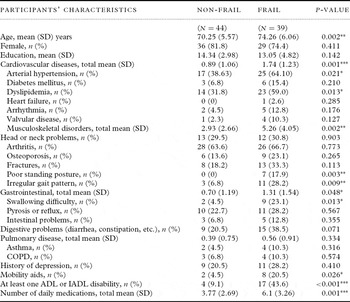
Table 1 presents the demographics and medical characteristics of participants. Significant differences were found between frail and non-frail individuals on age, F(1,81) = 9.84, p = 0.002; activities of daily living (ADL) and instrumental activities of daily living (IADL), χ2(1, n = 83) = 13.02, p < 0.001; cardiovascular diseases, F(1,81) = 11.62, p = 0.001; musculoskeletal disorders, F(1,81) = 9.75, p = 0.002; gastrointestinal diseases F(1,81) = 4.02, p = 0.048; mobility aids, χ2(1, n = 83) = 4.97, p = 0.026; and daily medication, F(1,81) = 12.71, p = 0.001.
Medical characteristics of frail and non-frail participants

Note: χ2 tests were run on categorical variables, and ANOVA were applied to continuous variables. SD = standard deviation. *p ≤ 0.05 **p ≤ 0.01 ***p ≤ 0.001.
Measures
Physical capacity
The physical capacity assessment included functional capacities (Modified Physical Performance Test) (Brown et al., Reference Brown, Sinacore, Binder and Kohrt2000), grip strength (hand-held dynamometer), physical endurance (6-minute walk test) (Enright et al., Reference Enright2003), mobility (timed up and go test) (Podsiadlo and Richardson, Reference Podsiadlo and Richardson1991), and gait speed (mean score of comfortable and maximum gait speed) (Bohannon, Reference Bohannon1997).
Cognition
The cognitive assessment included global cognitive functioning (Mini-Mental State Examination) (Folstein, Reference Folstein, Folstein and McHugh1975) along with other cognitive measures. Abstract verbal reasoning was assessed with the similarities subtest of the 3rd edition of the Wechsler Adult Intelligence Scale (WAIS–III) (Wechsler, Reference Wechsler1997). Processing speed, working memory, episodic memory, and executive functions were assessed with composite scores. Composite scores (X) were created based on an equally unit-weighted approach using z-scores: composite score (X) = mean (z-score A, z-score B, z-score C, . . .). All measures of each composite score were highly intercorrelated and had been found to measure a specific cognitive function. The composite score for processing speed was derived from the digit-symbol coding subtest of the WAIS–III (Wechsler, Reference Wechsler1997), the Trail Making Test, part A (Reitan, Reference Reitan1958), and the color naming and reading conditions of the Modified Stroop Color-Word Test (Bohnen et al., Reference Bohnen, Jolles and Twijnstra1992). Working memory was assessed using a composite score from the letter-number sequencing and digit span backward subtests of the WAIS–III (Wechsler, Reference Wechsler1997). A composite score from the Rey Auditory Verbal Learning Test (Rey, Reference Rey1941) served as an index of episodic memory. Executive functions were assessed using a composite score that included performances obtained from the Trail Making Test, part B (Reitan, Reference Reitan1958) and the interference and flexibility conditions of the Modified Stroop Color-Word Test (Bohnen et al., Reference Bohnen, Jolles and Twijnstra1992). The executive functions composite score was calculated after controlling for processing speed: composite executive function score (X) = mean (z-score Trail Making Test part B minus part A, z-score of the interference condition of the Stroop minus the color naming and reading conditions of the Stroop test, z-score of the flexibility conditions of the Stroop minus the color naming and reading conditions).
Quality of Life
The Quality of Life Systemic Inventory questionnaire (QLSI) (Duquette et al., Reference Duquette, Dupuis and Perrault1994) was used to assess participants' capacity to achieve their goals in 28 life domains (e.g. marital satisfaction, self-esteem, sleep). This questionnaire was chosen because it enables the evaluation of an individual's quality of life in detail through the analysis of multiple domains not yet evaluated in frail older adults. These domains are grouped into the following nine subscales: physical health, leisure activities, social/family, housekeeping, affectivity, cognition, finances, marital satisfaction, and spirituality. The total score provides a global quality of life score. An additional module was added to assess self-perception of physical capacity, including energy level, strength, physical endurance, and flexibility. For all QLSI domains, the quality of life score corresponds to the gap between self-set goals and the actual situation. Higher scores (indicating a wider gap) indicate a poorer quality of life.
Statistical analyses
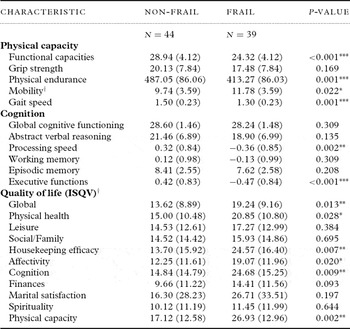
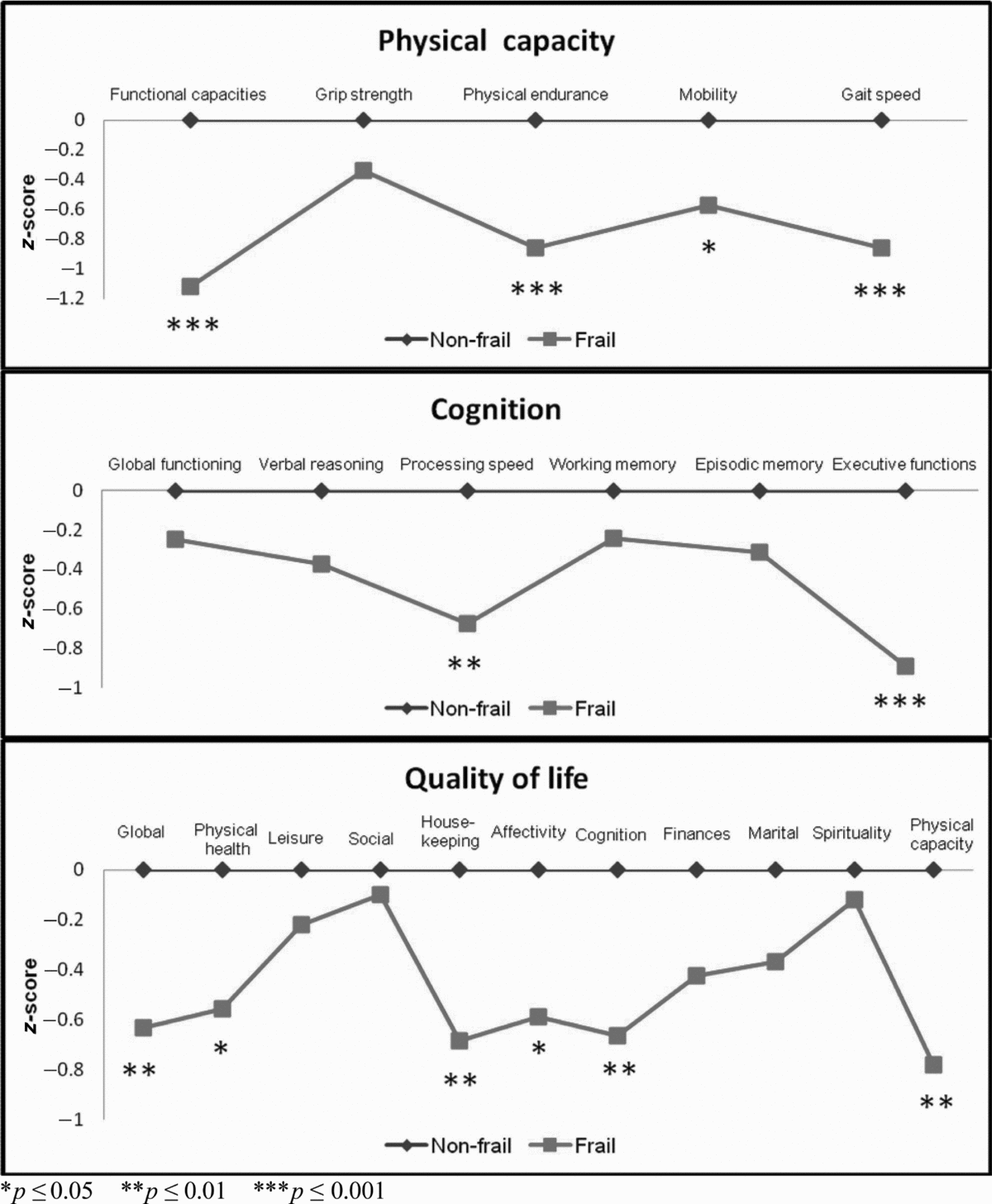
A multiple analysis of covariance (MANCOVA) was performed on scores of physical capacity, cognition, and quality of life tests, with frailty status (frail vs. non-frail) as the between-subject factor. To control for group differences reported in Table 1, age, ADL, IADL, cardiovascular and gastrointestinal diseases, musculoskeletal disorders, use of mobility aids, and medication were used as covariates in all the analyses. All reported p-values lower than 0.05 were considered statistically significant. Table 2 presents scores (adjusted with covariates) obtained for the three domains of interest (physical capacity, cognition, and quality of life) for non-frail and frail participants. In order to illustrate the extent to which frail participants differed from non-frail individuals on the multiple dimensions, and to allow comparison of both groups on a common scale for all variables, z-scores were computed based on covariate-adjusted scores (corrected for age and medical characteristics) and using non-frail scores in each dimension as normative value. Standardized z-scores ((frail mean – non-frail mean)/non-frail standard deviation) of frail older adults are presented in Figure 1 for each measure of the three dimensions of interest.
Comparison of frail and non-frail participants on physical capacity, cognition, and quality of life

Note: †A lower score on these measures indicates better performance. Mean scores and (standard deviation) are estimated after adjustments for age, ADL and IADL, cardiovascular and gastrointestinal diseases, musculoskeletal disorders, use of mobility aids, and medication. MANCOVA results show that the detrimental effect of frailty is specific on cognitive functioning (executive functions and processing speed). Global quality of life was affected, which can be explained by specific altered components: physical health, cognition, affectivity, housekeeping efficacy, and perception of physical capacity. All physical capacity except grip strength was diminished in frail older adults. *p ≤ 0.05 **p ≤ 0.01 ***p ≤ 0.001.
Standardized z-scores illustrate the differences between frail and non-frail participants in tests measuring physical capacity, cognition, and quality of life. Levels of significance are based on the MANCOVA results (see text for details).
Results
Physical capacity
Results of the MANCOVA indicated that physical capacity was significantly lower in frail compared with non-frail participants: functional capacities, F(1,74) = 21.21, p < 0.001; physical endurance, F(1,74) = 12.38, p = 0.001; gait speed, F(1,74) = 12.28, p = 0.001; and mobility, F(1,74) = 5.44, p = 0.02. Grip strength was lower in frail compared with non-frail older adults, but this difference did not reach a significant level, F(1,74) = 1.93, p > 0.05. The mean z-score gap (see Figure 1) between frail and non-frail participants for all physical capacities assessed was 0.75, with a standard deviation of 0.30.
Cognition
Significant differences were found between frail and non-frail participants on executive functions, F(1,74) = 17.36, p < 0.001, and processing speed, F(1,74) = 9.64, p = 0.003. There was no difference between groups on global cognitive functioning, F(1,74) = 1.00, p > 0.05, working memory, F(1,74) = 1.00, p > 0.05, episodic memory, F(1,74) = 1.61, p > 0.05, and abstract verbal reasoning, F(1,74) = 2.33, p > 0.05. The mean z-score gap between frail and non-frail participants for all cognitive functions was 0.46, with a standard deviation of 0.26.
Quality of life
Global quality of life was lower in frail compared with non-frail participants, F(1,74) = 6.62, p = 0.01. More specifically, differences between groups were observed in perceived physical capacity, F(1,74) = 10.03, p = 0.002; housekeeping efficacy, F(1,74) = 7.77, p = 0.01; cognition, F(1,74) = 7.26, p = 0.01; affectivity, F(1,74) = 5.57, p = 0.02; and physical health, F(1,74) = 5.14, p = 0.03. No significant difference between groups was found on social/family interactions, F(1,74) = 0.18, p > 0.05, spirituality, F(1,74) = 0.20, p > 0.05, leisure activities, F(1,74) = 0.82, p > 0.05, marital satisfaction, F(1,32) = 1.74, p > 0.05, and finances, F(1,74) = 3.11, p > 0.05. The mean z-score gap between frail and non-frail participants for all quality of life measures was 0.47, with a standard deviation of 0.24.
Discussion
The goal of this study was to assess the impact of frailty on specific aspects of cognition and quality of life, after strict control of several demographic and medical characteristics. This statistical control was done in order to assess specific effects of frailty in different key dimensions of everyday life.
In line with previous studies, our results suggest that frailty can significantly affect physical and functional capacities. Indeed, frail participants scored lower compare to non-frail participants on all physical capacity measures, except for grip strength after controlling for covariates. This is not surprising given that some of the physical capacity measures were considered for the frailty diagnosis (e.g. gait speed and performances on the Modified Physical Performance Test).
A major contribution of the present study was to assess specific aspects of cognitive performance in frail and non-frail participants. Our results suggest that cognitive deficits associated with frailty are specific to certain cognitive domains and can be observed in the absence of more global cognitive deficit as assessed with the MMSE. Frail participants showed lower scores on executive functions and processing speed measures compared with non-frail participants. However, the two groups were equivalent on measures of verbal reasoning, working memory, and episodic memory. This suggests that specific neuropsychological tests that target processing speed and executive functions help to dissociate frail and non-frail older adults. Deficits in executive functions and processing speed have been reported in older adults with cardiovascular diseases (Jokinen et al., Reference Jokinen2011). Interestingly, the present deficits were observed in frail elders after controlling for cardiovascular risk factors. This suggests that decline in executive functions and processing speed associated with frailty cannot be explained only by a specific medical condition, such as cardiovascular diseases. Impaired executive functions may have devastating consequences for older adults, as they involve a wide range of important capacities, such as the ability to organize and plan, inhibit inappropriate behavior, and adapt to new situations (Miyake et al., Reference Miyake, Emerson and Friedman2000). Impaired processing speed can also be critical, as this cognitive process is involved in everyday functions such as learning and driving (Edwards et al., Reference Edwards, Delahunt and Mahncke2009). Moreover, even without physical impairments, impaired executive functions and processing speed have been associated with reduced mobility and increased risk of falling (Yogev-Seligmann et al., Reference Yogev-Seligmann, Hausdorff and Giladi2008).
The present study also explored the potential impact of frailty on a variety of quality of life domains. Results suggest that frailty can have a negative impact on self-perception of physical capacity, general health, cognition, housekeeping efficacy, and affectivity. In several other domains (e.g. spirituality, marital satisfaction, and finances), quality of life was reported as equivalent among frail and non-frail participants. These results have important implications for clinicians who want to improve psychological well-being in frail older adults.
This study has some limitations. The cross-sectional design does not allow conclusions to be drawn on the relationship between the multiple dimensions of frailty. While the results suggest that, along with physical capacity impairments, frailty is associated with decline in cognitive performances and quality of life, whether the psychological distress is the by-product of physical capacity decline, cognitive impairments, or both, should await further study.
Conclusion
In addition to physical capacity, frailty is associated with cognitive and psychological symptoms. These symptoms should be taken into account to better encompass the complexity of the frailty syndrome, and a multidimensional approach should be used to assess the impacts of intervention programs devoted to frail older adults.
Conflict of interest
None.
Description of authors' roles
F. Langlois and L. Bherer conceptualized and designed the study, and wrote the paper. F. Langlois performed data management and statistical analyses. Medical examination was performed by T.T. Minh Vu, and M-J. Kergoat assisted in elaborating the frailty assessment. K. Chassé performed the physical capacity assessment. The quality of life assessment was designed and validated by G. Dupuis.
Acknowledgments
This study was supported by a grant from the Comité Aviseur de la Recherche Clinique of the Institut universitaire de gériatrie de Montréal. F. Langlois was supported by a PhD fellowship from the Canadian Institutes of Health Research (CIHR), and L. Bherer was supported by the Fonds de la Recherche en Santé du Québec (FRSQ) and the Canadian Research Chair Program (Tier 2).