Recently, there has been much debate about the grain size of orthography–phonology correspondences that are initially used by children when learning to read and spell (e.g., Goswami, Ziegler, Dalton, & Schneider, 2003; Hulme et al., 2002; Ziegler & Goswami, 2005). Cross-linguistic research has indicated that the level of phonological awareness initially used in reading and spelling is influenced by the orthography to be learned and the phonology of the spoken language corresponding to that orthography (Goswami, 1999). A considerable amount of research has been conducted on literacy development in Indo-European languages, but much less research has been conducted on Asian languages. Indonesian provides an interesting case study as it uses the same Latin-based alphabetic script as English, but in contrast has a high degree of orthographic transparency and the syllable is a highly salient unit, as it is both multisyllabic and has clear syllable boundaries. In the current study, the phonological grain size predominantly used by children learning to read and spell in Indonesian was investigated.
INDONESIAN LANGUAGE AND ITS ORTHOGRAPHY
Indonesian was decreed as the national language in 1928, and the adoption of the present Latin-based alphabetic orthography dates only from 1972 (Prentice, 1987; Sneddon, 2003). Indonesian is part of the Western Malayo-Polynesian subgroup of the Malayo-Polynesian branch of the Austronesian languages, which also includes languages such as Tagalog and Tongan. It is a standardized dialect of the Malay language. The spelling and grammar of Indonesian has undergone several readjustments before arriving at its present form, which is now taught and used at schools in Indonesia (Sneddon, 2003; Tim Penyusun Kamus Pusat Bahasa, 2001). Indonesian is spoken most extensively in urban areas, and less so in the rural parts of Indonesia where local or regional languages are predominantly spoken.
The alphabet used in Indonesian overlaps with 25 letters of the English alphabet; “x” is only used in loan words. Furthermore, there is a correspondence between the names of letters and the sounds that they make in words in Indonesian. Indonesian is a highly transparent language with almost a one-to-one correspondence between phonemes and graphemes except for the letter “e,” which has two phonemic forms “

” and “e,” and the grapheme–phoneme relationship is also transparent (Prentice, 1987). Indonesian has five pure vowels (a, e, i, o, and u) and only three diphthongs written as “ai,” “au,” “oi” and few consonant clusters (Moeliono & Dardjowidjojo, 1988; Pusat Bahasa Departemen Pendidikan Nasional, 2003).
The syllable is a salient unit in Indonesian, as it is predominantly bi- and multisyllabic, and monosyllabic forms are infrequent. Furthermore, it has a simple syllable structure and clear syllable boundaries. Most syllables have the following structure: consonant–vowel (CV), CVC, or CVCC; but CVV, CCV, VC, V, and VCC are also possible (Prentice, 1987). With regard to pronunciation of words, the allocation of stress in each word is relatively regular, with stress on either the penultimate or the final syllable of the word (Goedemans & Zanten, 2000; Gomez & Reason, 2002).
Indonesian has a rich transparent system of morphemes or affixations. It has about 25 derivational affixes (Prentice, 1987). Colloquial spoken Indonesian often uses nonaffixed forms. Affixes serve at least one semantic function, and vary depending on the word class of the stem. For example, the stem word makan (to eat) becomes makani (devour), termakan (to be eaten), makanan (food), and pemakan (eater). There are irregularities, however, in how some affixes are spelled, as they change depending on the context. Indonesian children need to be able to read and understand affixes early, as many instructions in worksheets and exercise books are written in this form. Affixes are in general formally taught in Grade 3 upward.
The salience of the syllable in Indonesian is reflected in the teaching method adopted, which predominantly consists of teaching children the correspondences between whole spoken and written syllables rather than the correspondence between letters and phonemes. Reading instruction emphasizes the learning of syllables, chunking or segmenting, and blending. The course of the teaching of reading usually progresses according to the following pattern. Students are first introduced to the alphabet; subsequently, they are instructed to rehearse sets of syllables with a simple pattern of C and V. For example, students learn the combination of the letters b + a, b + i, b + u, b + e, and b + o then produce the syllables ba, bi, bu, be, and bo. Then they rehearse these syllables and mix the syllables to form a word, such as i + bu becomes “ibu” (mother). The teaching of the CV syllabic pattern is then followed by the CVC syllabic pattern and more complex CV combinations (Dewi, 2003). The reading instruction is very similar to the instruction used in other syllable-prominent languages, for example, Bahasa Malaysia and Brazillian Portuguese (Cardoso-Martins, 1995; Gomez & Reason, 2002; Liow & Lee, 2004).
BACKGROUND LITERATURE
Phonological awareness, the child's awareness that spoken words can be broken down or manipulated into smaller units of sound, is one of the critical skills in the acquisition of reading in an alphabetic orthography (Bradley & Bryant, 1983; Stanovich, Cunningham, & Cramer, 1984; Tunmer & Nesdale, 1985). Furthermore, children who are having difficulties in learning how to read and write often have difficulties in phonological awareness tasks (Hansen & Bowey, 1994; Snowling, Goulandris, Bowlby, & Howell, 1986). An awareness of syllables, onsets, and rimes appears to develop prior to reading instruction, whereas an awareness of phonemes takes time to develop, and develops in conjunction with learning to read an alphabetic orthography as grapheme information helps with this process (Goswami, 1999). The units that are the best predictors of reading depend on the developmental stage of the children being studied. Prior to reading when children are 3 or 4 years old, larger grain sizes, syllables, and rimes predict reading, whereas when children begin to learn to read and spell at 5 or 6 years, phonemes are found to be robust predictors of reading and spelling in alphabetic orthographies (Bradley & Bryant, 1983; Byrne & Fielding-Barnsley, 1993; Caravolas & Bruck, 1993; Caravolas, Hulme, & Snowling, 2001; Cardoso-Martins, 1995; Goswami, 2002; Hulme et al., 2002; Maclean, Bryant, & Bradley, 1987). Subsequently, as reading proficiency increases, single grapheme–phoneme decoding appears to be augmented by processing of larger multigrapheme units. English children in their second year of primary school are more sensitive to the frequencies of rime structures than children in their first year (Duncan, Seymour, & Hill, 2000). Moreover, morphological awareness has been found to be a good predictor of reading and spelling in older English children (Carlisle, 1995; Treiman & Cassar, 1996). In sum, it appears that more proficient readers are able to operate at different grain sizes depending on the demands and nature of the literacy task and the characteristics of the particular orthography (Goswami et al., 2003).
In addition, children's knowledge of the letters of the alphabet has been found to be a robust predictor of reading (Bradley & Bryant, 1991; Cardoso-Martins, 1995; Foulin, 2005) and of initial spelling achievement (Muter, Hulme, Snowling & Taylor, 1997; Shatil, Share & Levin, 2000). Letter knowledge plays an important role, as it appears that letter–name knowledge helps children connect print to speech and acquire the alphabetic principle, that is, that written graphemes stand for phonemes in speech (Treiman, Tincoff, & Richmond-Welty, 1996). This effect is enhanced in languages such as Turkish where letter names and letter sounds correspond to a much greater extent than English, as the names of the letters contain the phoneme that the letter typically represents, which facilitates learner's access to phoneme–grapheme correspondence rules (Öney & Durgunoğlu, 1997).
In English, a relatively deep alphabetic orthography, there has been much debate about what grain size beginner readers initially use, whether beginners start with whole words followed by phonemes or intermediate subsyllabic units such as onsets and rimes (e.g., Duncan, Seymour, & Hill, 2000; Treiman & Zukowski, 1996; Ziegler & Goswami, 2005). It has been proposed that children initially adopt a whole word lexical approach in learning to read in English (Frith, 1985). Stuart and Coltheart (1988) found that reading errors made by English beginning readers involved reading one word for another and substituting visually similar words for the target word, which gives evidence for the use of a lexical (whole-word) reading strategy. In contrast, in German, a relatively transparent language, children's errors in lexical reading are mostly nonwords that share letter-sound correspondences with the target sounds, which indicate that German beginning readers are using a sublexical, phonemic route (Wimmer & Hummer, 1990). In addition, it has been found that German children use a similar sublexical approach in reading familiar and nonwords, whereas English children appear to use different strategies, that is, a lexical approach initially for reading words and a sublexical approach when reading nonwords (Wimmer & Goswami, 1994). In addition, the performance of German first grade children in nonword reading correlated highly with their reading of familiar words, whereas it was nonsignificant in English children, which confirms that a similar approach is used by German beginning readers to read both nonwords and familiar words (Wimmer & Goswami, 1994). This suggests that German beginner readers due to the transparency of the orthography have ready access to grapheme–phoneme correspondence rules, whereas English beginning readers due to the inconsistency or irregularity of the orthography use a lexical strategy initially for word recognition (Goswami et al., 2003).
In English, researchers have also found a strong connection between rhyming ability and early reading (Bradley & Bryant, 1983; Bryant, MacLean, Bradley, & Crossland, 1990). It has been speculated that the reason for this is that there is a relatively high degree of spelling–sound consistency at the level of the rime, whereas English graphemes can be pronounced in multiple ways and their pronunciation can be spelled in multiple ways (Goswami, 2002; Treiman, Mullennix, & Bijeljac-Babic, 1995). This has not been observed to such a great extent in more orthographically transparent languages (Goswami, 1999, 2000; Wimmer & Goswami, 1994) and in multisyllabic languages where the unit rime corresponds to a segment larger than the syllable (Cardoso-Martins, 1995).
Recent research on Asian orthographies has highlighted the syllable as an important unit of processing, and deemphasized the degree of prominence of the phoneme in these languages. Research investigating children acquiring Kannada, a semisyllabic Indo-Dravidian script, indicates that the optimal unit for beginners is the syllable, although more proficient readers and spellers can also manipulate phonemes (Padakannaya, Rekka, Vaid, & Joshi, 2002). Research on spelling in Malaysian children has found that even though the language is very predictable at the phoneme–grapheme level, early spelling tends to be based on encoding at the syllable and morpheme rather than the phoneme level (Liow & Lee, 2004). Liow and Lee (2004) suggest that as syllables are such salient units and receive equal stress in Malaysian, children can pick up sizable reading–spelling units without accessing grapheme–phoneme correspondences. It is important to note in relation to the present study that Malaysian and Indonesian are variants of the same language and the major differences between Indonesian and Malaysian are lexical rather than grammatical (Prentice, 1987).
In other languages where the syllable is a salient unit, it has also been found that the syllable plays a significant role in reading acquisition; for example, in Portuguese, a multisyllabic language, the syllable is a salient and clearly distinct phonological unit for beginner readers, and it has been found that both syllabic awareness and phoneme awareness significantly predict reading (Cardoso-Martins, 1995). In Spanish, another syllable prominent language with clear syllable boundaries, syllabic awareness has also been found to be an important predictor of reading ability (Carillo, 1994; Jimenéz González & del Rosarion Ortiz González, 2000).
The unit size that reading instruction focuses on has been found to affect phonological awareness development (Goswami, 2002). Cardoso-Martins (2001) investigated the grain size Brazilian children use when learning to read Portuguese after receiving instruction through two different reading approaches: a phonics approach, and a whole word followed by a syllabic approach. She found that children learning to read via the phonics approach relied on a phonetic cue strategy from the beginning of learning to read, whereas children learning to read by the whole-word approach could not read any unfamiliar words or pseudowords after 3 months of reading instruction, and most reading errors were due to refusals to read the pseudowords. She concluded that children do not begin at the grapheme–phoneme level unless explicitly instructed at this level. Hence, children learning to read relatively transparent orthographies do not necessarily access and utilize phoneme–grapheme correspondence rules if the unit focused on during reading instruction does not match that level and focuses on a different grain size.
There are shared representations that underlie both the reading and spelling acquisition process (Curtin, Manis, & Seidenberg, 2001; Holmes & Carruthers, 1998), and similar predictors for reading and spelling have been found in different orthographies; for example, in both Turkish and German, relatively transparent orthographies, letter knowledge and phonemic awareness have been found to be significant predictors of both spelling and reading (Öney & Durgunoğlu, 1997; Wimmer & Hummer, 1990). Researchers have suggested that spelling tasks reveal more about a child's phonological knowledge than reading does, as greater awareness of orthographic units are required than in the reading process (Alcock & Ngorosho, 2003; Lennox & Siegel, 1993). In English, children can read more words than they can spell (Treiman, 1997), whereas in more transparent orthographies such as Italian and Spanish, children can spell most of the words that they can read, and can even spell words they cannot read (Borzone de Manrique & Signorini, 1994; Thorstad, 1991).
Based on previous research and the characteristics of Indonesian, a number of predictions can be made. As there is a close correspondence between the names of letters and the sounds the letters make in words in Indonesian, it can be predicted that letter knowledge will play a significant role in reading acquisition and be a predictor of reading in Indonesian, in particular in the early stages of learning to read. As there is a transparent relationship between the orthography and Indonesian oral language, almost a one-to-one correspondence between graphemes and phonemes, in conjunction with the close correspondence between the letter names and sounds, then these characteristics of Indonesian are expected to facilitate access to grapheme–phoneme correspondence rules, and hence the phoneme will be the prominent unit for beginner readers as is the case for German (Wimmer & Hummer, 1990). Additional clues about the level of processing can be gained from an analysis of word and nonword reading errors, that is, children will make nonword errors rather than whole word errors if processing at the sublexical level.
Alternatively, as the syllable is such a salient phonological unit in Indonesian, it is predicted that sensitivity to the syllable and a syllable strategy for decoding and encoding printed words in Indonesian is likely to be adopted by young children in the early stages of literacy acquisition, especially as the teaching approach corresponds to these salient units. Based on their study of spelling in Malaysian children, Liow and Lee (2004) have suggested that as the syllable is such a salient unit that possibly segmentation at the phoneme level is unnecessary. On this basis, it can be predicted that Indonesian children will find tasks involving judgments about syllables easier than those involving onsets and rimes or phonemes, and furthermore, that the syllable will be a predictor of both reading and spelling, but in particular, spelling based on Liow and Lee's (2004) research.
In addition, as affixes are salient units in Indonesian, it is expected that morpheme awareness will play a predictive role in reading and spelling when the children are older and the demands of the task require it, for example, when spelling or reading long multisyllabic, affixed words, which is common in Indonesian. As Indonesian is a multisyllabic language and the onset-rime is not such a salient unit, performance is expected to be lower on these phonological awareness tasks, and this level or grain size is not expected to be a predictor of reading in Indonesian.
METHODOLOGY
Participants
Seventy-three children (45 boys, 28 girls) from Grade 1 participated in the present study. They were recruited from a public school in a large city in Indonesia. They were tested in the middle of the school year, after 6 months of schooling. At initial assessment the children ranged in age from 5 years 9 months (5;9) to 7;11 (mean = 6;10, standard deviation = 0.45). The children were retested 1 year later when the majority of them were in Grade 2 (three children were retained in Grade 1 because of poor academic performance). Some of the children did also speak Sundanese; however, they were all fluent in Indonesian and it was their dominant language.
Procedure
The children's level of phonological awareness as well as their letter knowledge, reading, and spelling abilities was assessed initially after 6 months of schooling in Grade 1 and subsequently 1 year later when the majority of children were in Grade 2. In Grade 1, five tasks of phonological awareness were administered individually to each child; rhyme detection, syllable segmentation, onset detection, syllable deletion, and phoneme deletion tasks. In addition, children were assessed on letter knowledge and word and nonword reading. One year later when the majority of children were in Grade 2, children were reassessed on these tasks, and in addition, assessed on a morpheme deletion task and a spelling test of both stem and affixed words. In Grade 2 at the time of testing two children had left the school and four children were absent; hence, 67 children were tested on the phonological awareness, letter knowledge, and reading tasks. When the spelling test was administered one additional child was absent; hence, only 66~children were assessed on spelling. The number of test items administered at the second assessment time a year later in Grade 2 was increased in an effort to avoid the ceiling effect. All testing was carried out in a quiet room in the children's school, except for the spelling test, which was conducted in their classrooms. The individual assessment took approximately 30 to 40 min per session. The assessment tasks are described below, and the test items are included in Appendix A.
Phonological awareness tasks
Syllable segmentation
To detect children's awareness of syllables in words, children were asked to clap the number of syllables in bi- and multisyllabic words, for example, muka and transmigrasi. Three practice items were given followed by 20 test trials. The syllable segmentation task is a relatively easy task, and is acquired relatively early by children, as it appears to assess the ability to detect rhythm in a language rather than an awareness of the syllable (Adams, 1990). The number of test items was not increased at the second time of testing in Grade 2. Reliability (Cronbach α) was .86.
Onset detection
The ability to detect onset was assessed using an oddity task. The task consisted of sets of three words, for example, rusa lima rabu, and the child was asked to say which one began with a different sound from the other two words, that is, which is the odd one out. The onsets used in the task were composed of single phonemes, and hence, also assessed children's initial phoneme awareness. The child was given three practice trials followed by 15 test trials in Grade 1 and 20 test trials in Grade 2. Reliability (Cronbach α) was .77.
Rhyme detection
The ability to detect rhyme was evaluated through a version of the oddity task as was used in the onset task. The child's task was to identify the word that did not rhyme with the other two words. The task consisted of three training trials followed by 15 experimental trials in Grade 1 and 20 experimental trials in Grade 2. In each trial the child heard three different bisyllabic words and had to identify the word that did not end with the same sound as the other two words, for example, pantai pisau hijau.
Syllable deletion
The child's task consisted of deleting the first syllable of the word, for example, bapak becomes pak. All test items were bi- and multisyllabic. There were three practice trials followed by 15 test trials in Grade 1 and 20 test trials in Grade 2. Reliability (Cronbach α) was .75.
Phoneme deletion
The child's task was to delete the first phoneme from 15 words in Grade 1 and 20 words in Grade 2 after three practice trials, for example, mata becomes ata. Reliability (Cronbach α) was .96.
Morpheme deletion
The morpheme deletion task was administered to children only at the second time of testing in Grade 2. In the first 10 items children were required to delete the prefix in the first 10 trials, for example, memberi to beri, and to delete the suffix in the succeeding 10 trials, for example, bacakan tobaca. All test items were bi- and trisyllabic. Reliability (Cronbach α) was .81.
Letter knowledge, reading, and spelling
Letter knowledge
The child was shown 26 lowercase letters printed randomly on a card and asked to name each one of them. A response was considered correct if the child either named the letter or pronounced a syllable beginning with the phoneme corresponding to the target letter. Reliability (Cronbach α) was .86.
Word reading
The child was asked to read 20 and 30 common or familiar words from a word list in Grade 1 and Grade 2, respectively, which were constructed from words used to teach reading in Indonesian beginning reader primers, for example, ibu, aku, bola. The word list was composed of bi- and multisyllabic words with a maximum of five syllables. Reliability (Cronbach α) was .95.
Nonword reading
Nonword reading is particularly useful as it assesses the child's phonological decoding skills and ability to map phonemes onto graphemes. In the present study the child was asked to read 20 and 30 nonwords from a word list in Grade 1 and Grade 2, respectively, which was constructed based on the word reading list, for example, ibo, aco, boka. Reliability (Cronbach α) was .93.
Error analysis
Errors for both word and nonword reading were also recorded and later classified as either phonological or lexical errors for Grade 1 children based on Defior, Martos, and Cary's (2002) classification system. Phonological errors involved producing another nonword that is incorrect in some way as it involved a deletion, substitution, or inversion of some part of the target nonword. Lexical errors involve producing a real word for the nonword. Further, the errors classified as phonological errors were also analyzed for retention of the syllable unit, for example, for the nonword hicap the second syllable is retained as in hacap, or for the word mangga the first syllable is retained as in mang.
Spelling
The spelling test consisted of 20 bi- and trisyllabic stem words, for example, aku, kancil, nyamuk, and melati, and 20 multisyllabic affixed words, for example, memakan, menolong, and mengumumkan. When each word was presented to the children in their classrooms, it was also presented in a sentence to ensure that the children understood the word to be spelled. The word was then repeated as necessary, and the children wrote the word down. Reliability (Cronbach α) for spelling stem words and affixed words was .91 and .91, respectively.
RESULTS
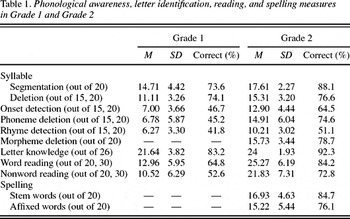
The means and standard deviations for the phonological awareness measures for Grades 1 and 2 are presented in Table 1. It can be seen that in Grade 1 Indonesian children perform the highest on the syllable segmentation and deletion tasks. The most striking result is the growth in phoneme awareness from 45.2% in Grade 1 to 74.6% in Grade 2, whereas performance on rhyme awareness increased the least. It can be seen that Grade 1 children found the syllable awareness tasks easier than the onset, rime, or phoneme tasks. In Grade 2, the syllable segmentation task was close to ceiling (88%), and performance on onset, phoneme, and morpheme tasks was comparable. Children had the lowest performance on the rhyme task.

In addition, Grade 1 children on average could identify 83% of the letters of the alphabet and were able to read about 65% of the common words and 53% of the nonwords. Letter knowledge reached ceiling in Grade 2 (92%). Both word and nonword reading increased by about 20% from Grade 1 to Grade 2. Performance on word reading was higher than nonword reading, and spelling stem words was higher than spelling affixed words.
Concurrent predictions of reading ability in Grade 1 and Grade 2
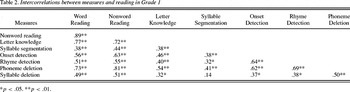
Table 2 presents the raw correlations between concurrent reading and phonological awareness measures at the first time of testing in Grade 1. A number of patterns are evident in these correlations. As expected, there are significant correlations between the different phonological measures, with the exception of the syllable segmentation and syllable deletion tasks. The syllable detection task involves identifying the syllables in a word by clapping, whereas the syllable deletion task involves removing the initial syllable from the word. It appears from this result that the two tasks are assessing somewhat different abilities. Adams (1990) has suggested that the syllable detection task assesses the ability to detect rhythm in a language rather than an awareness of the syllable, whereas the syllable deletion task requires both a syllable manipulation and has a memory requirement. All of the phonological measures were significantly correlated with reading.

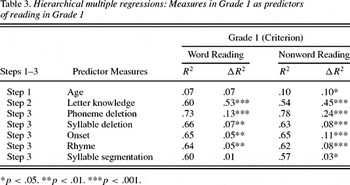
To assess the power of each of the measures of phonological awareness as predictors of reading ability, hierarchical regression analyses were computed with word and nonword reading as the criterion. In each of the hierarchical regression analyses, age and letter knowledge were entered at Steps 1 and 2. As research indicates that letter knowledge is such a robust predictor of reading, it was entered at Step 2 after chronological age and prior to the phonological awareness measures. As correlations between phonological awareness measures were relatively high, each of the phonological measures was then in turn entered in Step 3 to reveal unique variance of the measure. From inspection of Table 3, it is apparent that phoneme deletion accounted for the largest proportion of unique variance, in particular, for nonword reading but also for word reading (24% nonword reading, 13% word reading). The other phonological awareness measures accounted for smaller proportions of the variance. Even when letter knowledge is inserted into Step 7 after all the phonological awareness measures, it still accounted for a significant proportion of the unique variance, 16% of variance for word reading, and 8% of variance for nonword reading.

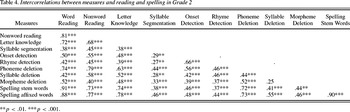
Table 4 presents the concurrent raw correlations between reading, spelling, and phonological awareness measures in Grade 2. There are significant correlations between the different phonological measures with the exception of the syllable deletion and morpheme deletion tasks, which could imply that they are assessing somewhat different abilities. Each of the phonological measures is significantly correlated with reading and spelling. The reading and spelling scores are strongly correlated; particularly noticeable is the strong correlation between word reading and spelling stem words (.91) and affixed words (.88).

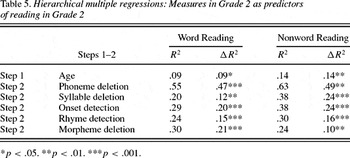
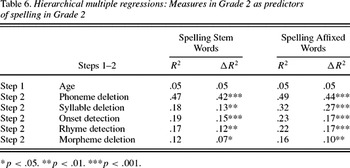
As syllable segmentation and letter knowledge had reached ceiling in Grade~2, they were not included in the regression analyses for Grade 2. To assess the power of each of the phonological awareness measures as concurrent predictors of reading and spelling ability in Grade 2, a series of hierarchical multiple regression analyses were performed with reading (word and nonwords) and spelling (stem and affixed words) as the criterion. In each of the hierarchical regression analyses, age was entered at step 1, then each of the following five phonological awareness measures were in turn entered in Step 2 to reveal unique variance of the measures; phoneme deletion, syllable deletion, onset detection, rhyme detection, and morpheme deletion. From inspection of Table 5, it is apparent that in Grade~2, phoneme deletion accounted for the largest proportion of the variance for both word and nonword reading (47 and 49%, respectively), and the other phonological awareness measures accounted for a lesser proportion of the variance. Syllable deletion accounted for 24% of unique variance in nonword reading, compared to 12% of unique variance in word reading. In contrast, morpheme deletion accounted for 21% of unique variance in word reading, compared to 10% of unique variance in nonword reading. Similarly for spelling in Table 6, phoneme awareness accounted for the largest proportion of the variance for both spelling stem and affixed words (42 and 44%), and noticeably syllable deletion accounted for a significant proportion of the variance (27%) for spelling affixed words (Table 6). Morphological awareness and the other phonological awareness tasks accounted for a smaller proportion of the variance.


Longitudinal predictions of reading and spelling ability
There were significant correlations between all phonological awareness measures in Grade 1 and Grade 2, with the exception of the syllable deletion task with the syllable segmentation, onset, rhyme, and morpheme tasks, and the syllable segmentation task with the morpheme deletion task. Both syllable tasks in Grade~1 did not correlate significantly with the morpheme deletion task in Grade 2. All phonological measures were significantly correlated with reading and spelling.
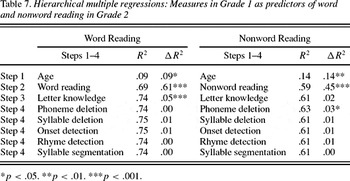
To assess the power of each of the phonological awareness measures in Grade~1 as predictors of reading and spelling ability in Grade 2, a series of hierarchical multiple regression analyses were performed with reading (word and nonwords) and spelling (stem and affixed words) as the dependent variables. In the hierarchical regression analyses for reading, age was entered at Step 1, then either word reading or nonword reading at Time 1 was entered at Step 2, and letter knowledge was entered at Step 3. As intercorrelations between phonological measures were relatively high, then each of the phonological measures were in turn entered in Step 4 to reveal unique variance of the measure. From inspection of Table 7, it can be seen that letter knowledge plays a unique role in word reading, whereas in nonword reading phoneme awareness also plays a unique role.

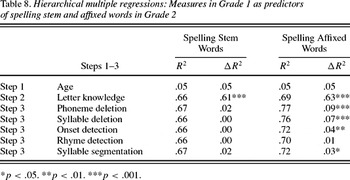
Autoregressive controls for prior spelling knowledge could not be included, because spelling was not assessed in Grade 1. Hence, the hierarchical regressions (Table 8) for spelling control for age and letter knowledge were conducted at Steps 1 and 2 only. Then in Step 3 each of the phonological measures was entered in turn to reveal unique variance of the measure. For spelling stem words, letter knowledge accounts for a significant proportion of the unique variance but the phonological awareness measures did not. In contrast, for spelling affixed words, letter knowledge in conjunction with syllable deletion, phoneme deletion, and onset detection accounts for a significant proportion of the unique variance. In the current study the onsets used in the onset task were composed of single phonemes, and hence, also assess children's initial phoneme awareness.

These data indicate that, in relation to word reading and spelling stem words, letter knowledge plays the prominent role, whereas to read nonwords it is important to be able to isolate phonemes. Furthermore, when it comes to spelling affixed words, an ability to be able to isolate both syllables and phonemes appears to be advantageous.
Analysis of word and nonword reading errors in Grade 1
Reading errors when reading words and nonwords can give us valuable clues about the levels of processing that children use when initially learning how to read in different orthographies. From error analysis of the nonword reading task, it was found that 84% of errors were phonological nonword errors and 16% were lexical errors, and for word reading, 74% of errors were phonological nonword errors and 26% were lexical errors. Hence, it can be seen that the majority of errors were phonological and more lexical responses were given for word reading than nonword reading. The recognition of words and nonwords was highly correlated in both Grade 1 and Grade 2 at .89 and .81, respectively (Tables 2 and 4), also reflecting the influence of a transparent orthography. The nonword responses or phonological errors were further analyzed for retention of the syllable in the child's response, for example, for the word “khidmat” the response was “hadamat,” and hence the syllable “mat” was retained. It was found that 18% of all phonological errors for word reading and 31% of all phonological errors for nonword reading retained a syllable from the original word in the response, which indicates that recognition at the level of the syllable is important particularly when reading nonwords.
DISCUSSION
The present study aimed to investigate the relative prominence of phonological awareness measures of different grain sizes as concurrent and longitudinal predictors of reading and spelling in Indonesian beginner readers. It was speculated that as the syllable has high perceptual saliency in Indonesian and based on research on spelling in Malaysian (Liow & Lee, 2004), that the syllable tasks would be relatively easy for the children and that syllable awareness would be a predictor of in particular spelling but also reading. The prediction that performance would be high on the syllable tasks was supported by the results on both the syllable segmentation and deletion tasks. In relation to the prediction that the syllable would be a predictor of reading and spelling, the concurrent analyses from Grade 1 and also Grade 2 indicate that syllable awareness does play a significant role in initial reading and spelling. However, when autoregressive effects are controlled for in the longitudinal analyses then the power of the syllable declines and the phoneme is the only phonological awareness measure that continues to play a significant predictive role. In relation to spelling affixed words the syllable appears to play a prominent role, even though autoregressive effects were not controlled for.
The results in general indicate that the phoneme is the prominent unit in the early acquisition of reading and spelling in Indonesian, as it was found to be a concurrent predictor of reading for both word and nonword reading for Grade 1 and Grade 2. Furthermore, the word and nonword reading errors, which were predominantly nonword or phonological errors, also supports this level of processing. Hence, it appears that the transparency of the language and the close correspondence between letter names and letter sounds facilitates access to the smallest grain size, the phoneme in Indonesian beginner readers.
However, the pattern is more complex, as revealed by results from Grade 1 measures as predictors of reading and spelling in Grade 2; the phoneme is a significant predictor of reading for nonword reading but not for reading familiar words or for spelling stem words. Letter knowledge appears to play a particularly prominent role for word reading and spelling stem words, as presumably the close correspondence between letter names and sounds enables access to letter-sound relations in these tasks. However, when the task is to spell multisyllabic affixed words, an awareness of both phonemes and syllables appears to be advantageous and facilitates this process. Hence, the results in general indicate that the phoneme is the prominent phonological unit in the early acquisition of reading and spelling in Indonesian, but the syllable also plays a significant role.
The current study did not reveal the same degree of prominence of the syllable and morpheme as in Liow and Lee's (2004) study on the spelling errors of Malay children. This can partially be accounted for by differences in the focus and methodology used, as Liow and Lee focused on spelling only and the analysis of spelling errors made to stem and affixed words. This difference in results due to methodology is supported to some extent by the results found in the present study on reading errors, which reveals a more complex pattern in relation to what phonological units are accessed by the child; the prominent level was the phonological level, but lexical and syllabic strategies were also utilized to decode both familiar words and nonwords. The lexical approach was used more often for the reading of familiar words, and the syllabic approach was used more frequently when attempting to read nonwords, which is a particularly challenging task for beginner readers. In English, a less transparent orthography it has been suggested that children adopt a strategy of reading by analogy to read new words (Wimmer & Goswami, 1994). Indonesian children adopt a similar strategy, but rather than focusing on the rime as occurs in English, the focus is on the syllable, a more salient unit in Indonesian.
Larger grain sizes, that is, syllables and rimes, have been found to be robust predictors of reading in preliterate children; however, once children start to learn to read an alphabetic orthography then phoneme awareness plays the dominant role (Bradley & Bryant, 1983; Byrne & Fielding-Barnsley, 1993; Caravolas & Bruck, 1993; Caravolas et al., 2001; Cardoso-Martins, 1995; Goswami, 2002; Hulme et al., 2002; Maclean et al., 1987). In the current study, the phonological awareness of beginner readers who had attended school for the preceding 6 months was investigated. However, if preliterate children had been studied, then based on previous research, it is expected that larger grain sizes, for example, syllables or rimes, would have been found to be predictors of reading in Indonesian. Previous research has also indicated that as children gradually become more proficient readers then phoneme awareness is augmented by an increased sensitivity to larger grain sizes, for example, the rime in English children, whereas in Indonesian the syllable appears to be the more functional unit (Duncan et al., 2000). It was also expected that as Indonesian has such a rich, relatively transparent system of affixes, the morpheme would play a significant role in later literacy acquisition. In the current study, it was found that the morpheme plays a role in both reading and spelling in Grade 2.
Clearly, additional research is required to further investigate phonological awareness and literacy acquisition in Indonesian. Moreover, research on other non-Indo-European languages, with the syllable as a salient unit, in particular alphasyllabic orthographies, which share the characteristics of both alphabetic and syllabic scripts, offer particularly interesting opportunities to investigate the degree of prominence of the syllable relative to the phoneme in learning to read and write. In addition, more systematic studies are needed to investigate the effects that different language and literacy tasks have on the particular grain size used by children when learning to read and write in different orthographies.
In summary, Indonesian provides a clear advantage for beginner readers because of its phonologically transparent orthography and the close correspondence between the names and sounds of letters of the alphabet, which helps learners understand the sounds that letters represent. Results from the current study indicate that letter knowledge and the phoneme play a prominent role in learning to read and write in Indonesian, which concurs with research on other orthographically transparent languages, for example, German and Turkish (Öney & Durgunoğlu, 1997; Wimmer & Hummer, 1990). However, additional language-specific factors play a role as certain features of the language and orthography are highlighted or more salient than others, and hence, are accessed more readily by the child. In Indonesian, the syllable appears to be particularly salient, and serves a functional role in decoding and encoding written text, in particular when the demands of the literacy task require it, for example, when processing long multisyllabic affixed words.
APPENDIX A