INTRODUCTION
Community composition is dramatically altered when a key member of the community is affected by any biotic or abiotic factor (Sagarin et al., Reference Sagarin, Gaines and Gaylord2006). That could be the case of many bio-engineering species that expand their distribution range and consequently introduce in a new receptive community. In this context, the shift in geographical ranges of marine species due to climate change is being increasingly recognized (Southward, Reference Southward1991; Sagarin et al., Reference Sagarin, Barry, Gilman and Baxter1999; Parmesan et al., Reference Parmesan, Gaines, Gonzalez, Kaufman, Kingsolver, Townsend Peterson and Sagarin2005), although examples for South America are still scarce or not conclusive (Orensanz et al., Reference Orensanz, Schwindt, Pastorino, Bortolus, Casas, Darrigran, Elíıas, López Gappa, Obenat, Pascual, Penchaszadeh, Piriz, Scarabino, Spivak and Vallarino2002; Rivadeneira & Fernández, Reference Rivadeneira and Fernández2005). However, the impact of some recent, human-mediated biological invasions has already had a significant ecological impact in the region (Orensanz et al., Reference Orensanz, Schwindt, Pastorino, Bortolus, Casas, Darrigran, Elíıas, López Gappa, Obenat, Pascual, Penchaszadeh, Piriz, Scarabino, Spivak and Vallarino2002).
Mussel beds are a conspicuous feature of Uruguayan rocky shores, providing important economic and ecological services (Riestra & Defeo, Reference Riestra, Defeo and Rey2000; Borthagaray & Carranza, Reference Borthagaray and Carranza2007). Since the Uruguayan coast is under the influence of the the Río de la Plata estuary, one of the largest estuaries of South America, a salinity gradient roughly oriented east–west can be identified. Based on salinity, three main regions can be identified: a west region influenced by fresh water (<1 ppt), a central region that is influenced by water of variable salinity (1–30 ppt) and an east region open to ocean waters (>30 ppt) (e.g. Giménez et al., Reference Giménez, Borthagaray, Rodríiguez, Brazeiro and Dimitriadis2005). Along this gradient, the intertidal mussel beds changes in species composition and structure. Currently, the western region is characterized by the invasive mussel Limnoperna fortunei living in crevices, pools or under stones (C. Clavijo, personal communication). Brachidontes darwinianus and Mytella charruana occupy consolidated substrata along the central region (Maytía & Scarabino, Reference Maytía and Scarabino1979; Neirotti, Reference Neirotti1981), overlapping with Brachidontes rodriguezii from the eastern half of the central region and being replaced by this species in the eastern region (e.g. Amaro, 1967; Milstein et al., Reference Milstein, Juanicó and Olazarri1976; Maytía & Scarabino, Reference Maytía and Scarabino1979). Mytilus edulis, in turn, is distributed from the eastern half of the central region, being the dominant mussel species in this zone. The commercially exploited mussel beds located at Isla Gorriti (34°57′S 54°58′W) and Isla de Lobos (35°0′S 54°53′W) comprise M. edulis platensis, B. rodriguezii and B. darwinianus in decreasing order of abundance (Riestra, 1998; Hernández & Defeo, Reference Hernández and Defeo2005).
While the above mentioned species are mostly restricted to temperate waters, recent populations of the brown mussel Perna perna are distributed along the Atlantic coast of South America from Rio de la Plata, to Recife, Brazil, where they present a large gap north to the Caribbean shores of Venezuela (Wood et al., Reference Wood, Apte, MacAvoy and Gardner2007). In the southern part of its distribution range, early reports exist for Santa Catarina, south-east Brazil (von Ihering, Reference Ihering1900), but the first Uruguayan records date from the 1950s (Barattini et al., Reference Barattini and Uretta1961; Amaro, Reference Amaro1965; Klappenbach, Reference Klappenbach1965). Orensanz et al. (Reference Orensanz, Schwindt, Pastorino, Bortolus, Casas, Darrigran, Elíıas, López Gappa, Obenat, Pascual, Penchaszadeh, Piriz, Scarabino, Spivak and Vallarino2002) suggest that its presence in Uruguayan waters may reflect a mixture of human-mediated and natural episodes, taking into account that there is evidence that man contributed to the dispersion of this species during the 19th Century, or even earlier (Carlton, Reference Carlton1985). The species is not represented in Uruguayan Quaternary deposits (Clavijo et al., Reference Clavijo, Scarabino, Rojas and Martínez2005), but fossil Perna were recorded from the late Oligocene/early Miocene of Argentina (del Rio, Reference del Rio2004). This mussel is currently distributed in the eastern region of the Uruguayan coast, from Punta del Este to Punta de La Coronilla, in depths ranging from the intertidal to 8–9 m, (Scarabino et al., Reference Scarabino, Zaffaroni, Clavijo, Carranza, Nin and Menafra2006a). Some Uruguayan intertidal beds of P. perna were heavily exploited from 1960 to the early 1970s, when local extinctions were reported (Scarabino et al., Reference Scarabino, Zaffaroni, Clavijo, Carranza, Nin and Menafra2006a). Strong recruitment was detected again during the late 1990s (Orensanz et al., Reference Orensanz, Schwindt, Pastorino, Bortolus, Casas, Darrigran, Elíıas, López Gappa, Obenat, Pascual, Penchaszadeh, Piriz, Scarabino, Spivak and Vallarino2002).
Since all available evidence points out that the presence of P. perna in the Uruguayan coast dates from the second half of the 20th Century, and given its current abundance, it is straightforward to hypothesize that its presence had caused profound changes in the structure of the mussel beds. However, there is no previous direct quantitative information to directly asses the effects of P. perna on the benthic biota. In this vein, the aim of this study was to analyse the current patterns in zonation, abundance and dominance patterns in a mussel bed located in the oceanic extreme of the Uruguayan coast. This allows a depiction of the current state of the community after the arrival of P. perna. Further, we tested the hypothesis that exposure and tidal level modulate the interspecific competition for space between mussel species. These results will improve our understanding of the effect of an exotic species in a native mussel matrix.
MATERIALS AND METHODS
Study area
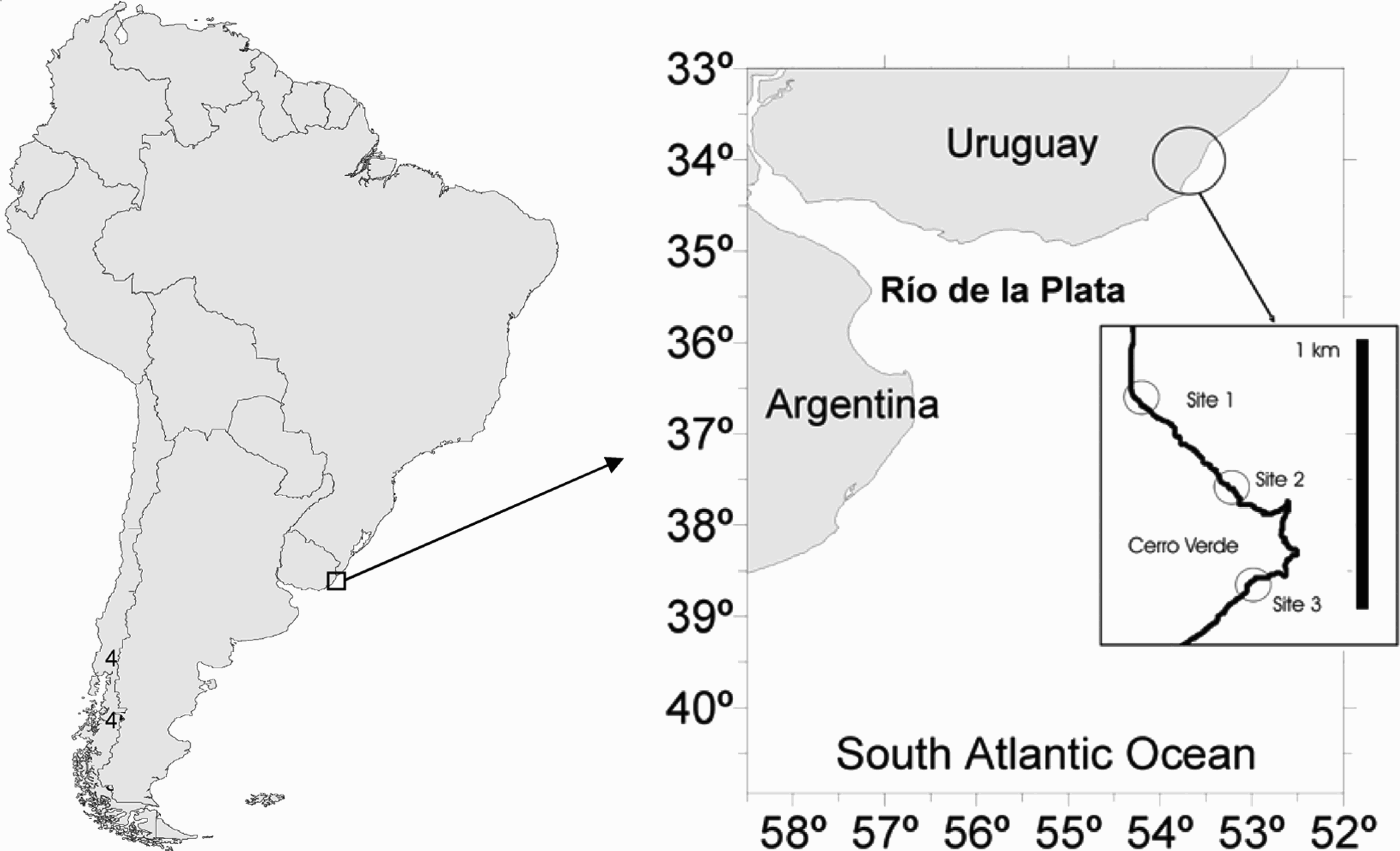
Cerro Verde (33° 57′S 53°30′W) is a rocky cape on the east coast of Uruguay (Figure 1) affected by semidiurnal, low-amplitude tides (range <0.5 m) that are largely controlled by wind conditions (direction and speed). The rocky platforms have a smooth slope, with a width ranging from 15 to 23 m, and are exposed to different degrees of wave action according to its orientation. These platforms follow a classical zonation scheme (Stephenson & Stephenson, Reference Stephenson and Stephenson1949), in which three zones can be identified: a high intertidal zone dominated by a cyanobacterial film, a middle intertidal zone dominated by barnacles and a low intertidal and shallow subtidal zone characterized by a dense cover of mussels and/or macroalgae. This site harbours a rich hard-substrata benthic fauna, a yet undefined number of fish species (e.g. endangered sharks Mustelus schmitti, M. fasciatus) and marine birds, mammals (Otaria bryonia, Arctocephalus australis) and sea turtles (Chelonia mydas), and it has been proposed as one possible marine protected area in Uruguay (IUCN Uruguayan Comitee, 2002).
Map of the South American Atlantic coast, showing the study region along the coast of Uruguay and the three sampling sites: (1) protected; (2) intermediate; and (3) exposed.

Sampling design
Sampling was carried out on intertidal and shallow subtidal (i.e. depth <1.5 m) rocky platforms of the Cerro Verde area during 2005 and 2006. Three sampling sites 500 m apart were chosen along the coast: (1) wave-exposed; (2) wave-intermediately exposed; and (3) wave-protected (Figure 1). Within each site and tidal level, at least two quadrants of 20 × 20 cm were randomly placed at each one of the three tidal levels defined above. The sampling was repeated six times (February, July and November 2005; February, April and October 2006). Nearly 14,000 mussels were collected, identified and measured (shell length to the nearest 0.1 mm). Voucher material is deposited at the Museo Nacional de Historia Natural of Montevideo (MNHNM).
Data analysis
Since we were interested in the main characteristics of the ‘mature’ mussel bed, we avoided analysing recent recruits, and restricted the analysis to mussels larger than 10 mm. We then calculated mean and standard deviation of the relative and absolute abundance for each species, and then examined the dominance trends in relation to site and tidal level. Overall differences in species relative and absolute abundances were assessed by means of a one-way analysis of variance (ANOVA).
Also, mean size (as shell length) and standard deviation of size (as shell length SD) were calculated for each species in each replicate sample. A two-way ANOVA was used to evaluate the role of tidal level and exposition, (Level and Site, both factors as within-subject, repeated measures) and sampling occasion (Time; between subject factors) on relative abundance, density, mean size and size SD of Brachidontes rodriguezii and Perna perna. The low number of individuals of Mytilus edulis and Modiolus carvalhoi precluded a similar analysis for both species. The size structure of each species population is reported as maximum shell length (MSL) and the 90th percentile of the shell length frequency distributions (SLFDs).
RESULTS
Zonation patterns: abundance, dominance and size structure of the mussel populations
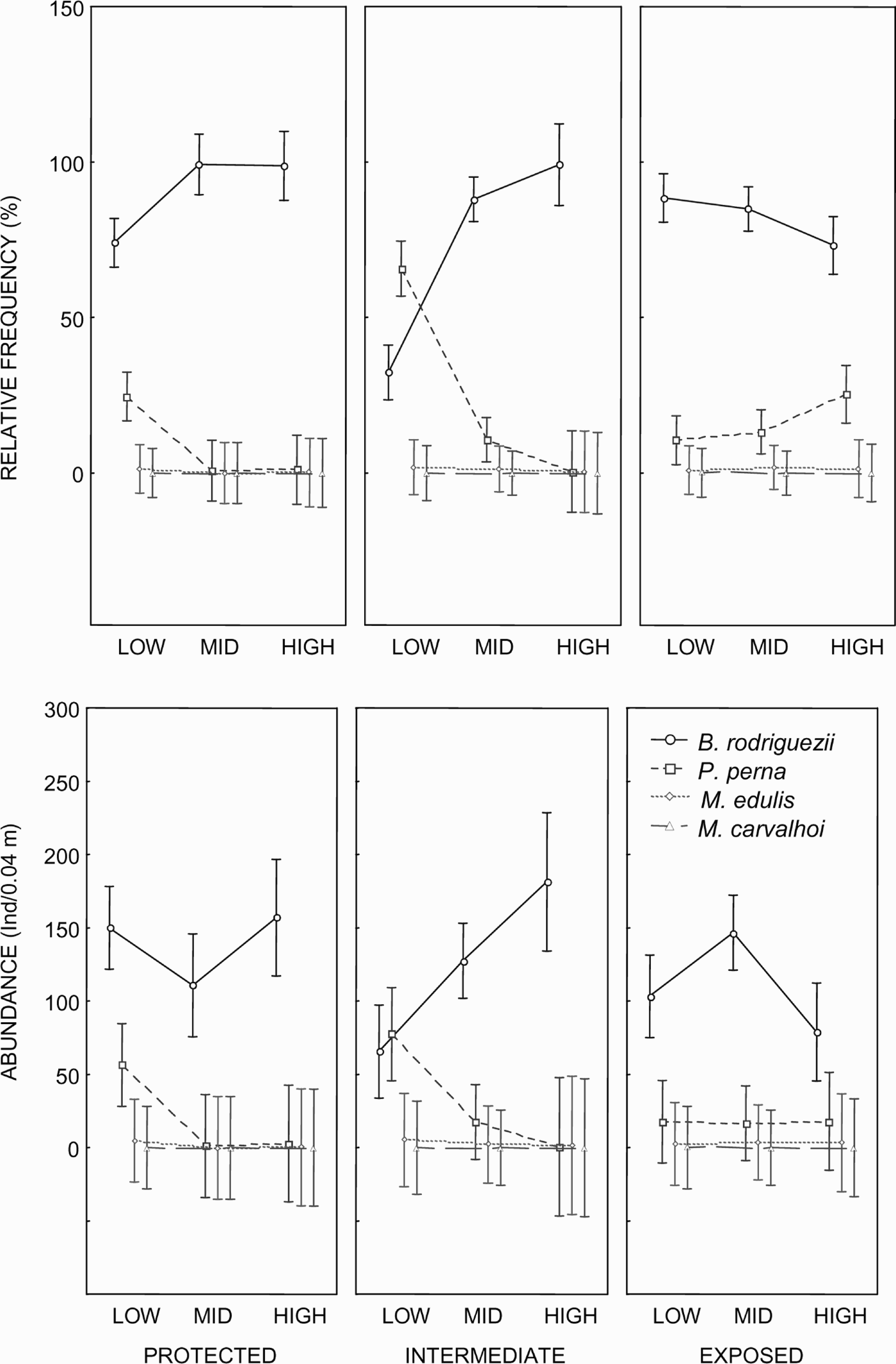
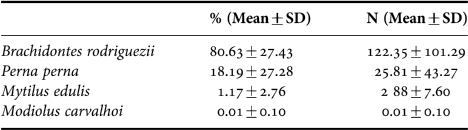
Absolute (F(3, 411) = 112.63, P < 0.01) and relative (F(3, 411) = 398.03, P < 0.01) abundances differed between species. Overall, Brachidontes rodriguezii showed the highest abundance (122.3 ±101.3 ind/0.04 m2), followed by Perna perna, Mytilus edulis and Modiolus carvalhoi (the latter <0.01±0.1 ind/0.04 m2). This also held true for the relative frequencies (Table 1). The dominance of B. rodriguezii was consistent across all tidal levels in all sites in terms of absolute and relative abundance, with the exception of the shallow subtidal at the intermediate site, where P. perna dominated over this species in terms of relative abundance (Figure 2). Concerning the size structure of each population, P. perna exhibited larger sizes (MSL = 99.6 mm; 90th percentile = 52.7 mm), than B. rodriguezii (MSL = 45 mm; 90th percentile = 29.1 mm) and Mytilus edulis (MSL = 35.5 mm; 90th percentile = 28.9 mm). Specimens of Modiolus carvalhoi averaged ~10 mm shell length (Figure 3).
Abundance and relative frequency of the four mussel species in relation with tidal level (LOW: low intertidal, MID: mid intertidal and HIGH: high intertidal) and exposure (protected, intermediate or exposed).

Shell length frequency distributions (SLFDs) for the dominant mussel species, Brachidontes rodriguezii, Perna perna and Mytilus edulis.

Mean (±SD) relative (%) and absolute abundance (N; ind/0.04 m2) for the four mytilid species at Cerro Verde-La Coronilla rocky intertidal.

Intraspecific comparisons: densities, relative abundances, mean size and heterogeneity in SLFDs
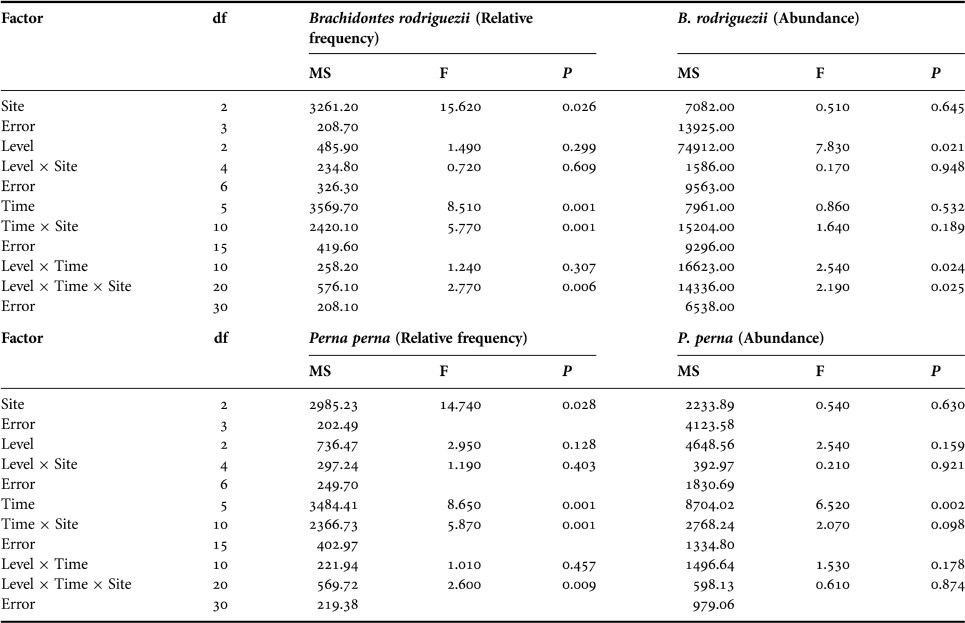
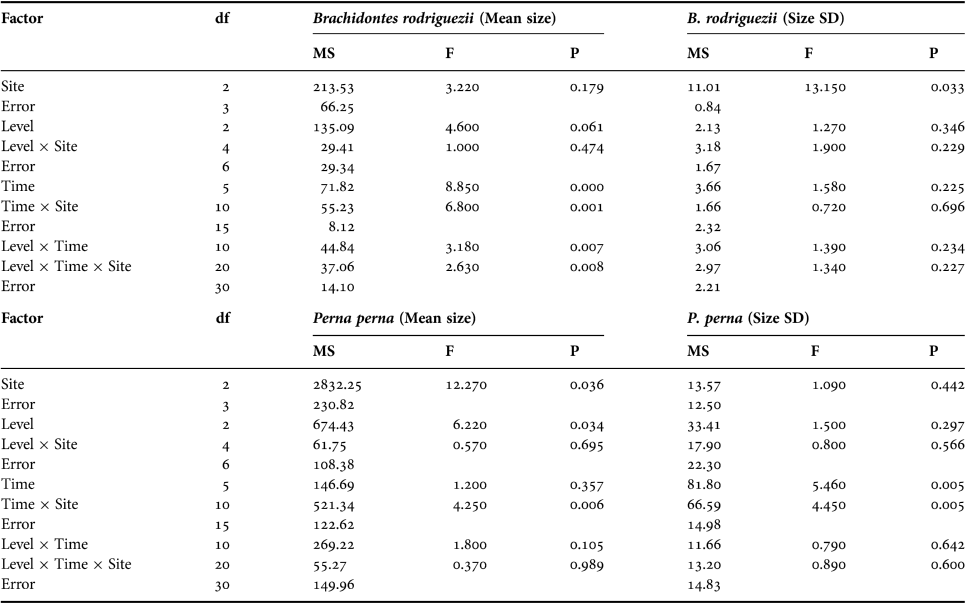
Relative abundances (%) of B. rodriguezii showed high variability and was affected by Site, Time, and the interactions Site × Time and Level × Site × Time. Despite the high level of variability, there was a trend of higher relative abundances or B. rodriguezii at the protected site. The lowest relative abundance for B. rodriguezii was noticed in spring 2005 and summer 2006 at the intermediate site. In spring 2005 abundances increased towards the low intertidal at the intermediate site, while decreasing in the other two sites. A similar pattern was observed in autumn 2005, but the increasing trend towards the low intertidal occurred at the exposed site (Table 2). Density showed differences in relation to Level and the interactions Level × Time and Level × Time × Site. Densities tended to increase towards the low intertidal, except in summer 2006, when the highest overall density was (418 ind/0.04 m2). Trends in mean size between sites and tidal levels were also dependent on the sampling occasion, with a significant effect of Time and the interactions Time × Site and Level × Time × Site. For instance, larger individuals in the protected site occurred at the high intertidal in spring 2005 and spring 2006, while the opposite pattern occurred in summer 2005. In autumn 2006 and summer 2006, mean size peaked and dropped at the mid intertidal respectively. However, heterogeneity in SFDs as shown by the dispersion measure (SD) only showed variation in relation with Site being significantly higher at the Exposed site (Table 3).
Analysis of variance (repeated measures) of relative frequency and abundance values for Brachidontes rodriguezii and Perna perna. There are three levels for Site (exposed, protected and intermediate), and three for shore level (low, mid and high). Time is the repeated measures factor (six sampling times).

Analysis of variance (repeated measures) of mean and standard deviation of size (shell length) for Brachidontes rodriguezii and Perna perna. See details for ANOVA design in Table 2.

The relative abundance of P. perna showed a complementary pattern in relation with B. rodriguezii. Density was not affected either by Site or Level, but showed significant differences between sampling occasions. Peaks in density were detected in summer 2006 and spring 2005 (50.19 and 56.65 ind/ 0.04 m2 respectively, see Table 2). Mean size differed between tidal Level and Site, also affected by the interaction Time × Site. The higher mean sizes occurred at the high intertidal. At the protected site, mean size peaked in winter 2005 (59.54 mm) and summer 2005 (57.28 mm). Time and Time × Site affected the dispersion measure, with all values ranging from 7 to 14 mm except in summer 2006 and summer 2005 (2.03 mm; Table 3).
DISCUSSION
Our results showed that Perna perna is well established at the east region of the Uruguayan coast, reaching an average of 20% of total mussel cover at the study area. At some particular places, P. perna dominated over Brachidontes rodriguezii, both in terms of absolute abundance and relative frequencies. This dominance relative to the number of individuals may have profound ecological effects, since P. perna can grow up to 15 cm, thus changing disproportionately the micro-scale habitat structure with respect to Brachidontes beds. In turn, the blue mussel Mytilus edulis seems to be out-competed by B. rodriguezii and P. perna, since this species accounted for less that 2% of total mussels. The ability to withstand heat and/or desiccation stress has been suggested as a putative factor which explains why B. rodriguezii is competitively superior to M. edulis platensis (Adami et al., Reference Adami, Tablado and López Gappa2004). The other mytilid species found (Modiolus carvalhoi) seems to represent a marginal ‘sink’ population sustained by occasional immigrants carried by warm waters (Zaffaroni, Reference Zaffaroni2000; Scarabino et al., Reference Scarabino, Zaffaroni, Clavijo, Carranza, Nin and Menafra2006a). However, the lack of previous data for this area precluded further support for this hypothesis.
Most likely, the observed structure and species composition of the mussel beds at Cerro Verde-La Coronilla may have been affected by the effects of climate change in the last 60 years. Poleward shifts in species and communities in response to climate change has been documented elsewhere (Sagarin et al., Reference Sagarin, Barry, Gilman and Baxter1999; Parmesan et al., Reference Parmesan, Gaines, Gonzalez, Kaufman, Kingsolver, Townsend Peterson and Sagarin2005), and it may well be the case for P. perna, showing a sequence of range expansion–contraction over historical time (Orensanz et al., Reference Orensanz, Schwindt, Pastorino, Bortolus, Casas, Darrigran, Elíıas, López Gappa, Obenat, Pascual, Penchaszadeh, Piriz, Scarabino, Spivak and Vallarino2002). In this vein, at the population level, changes in the abundance of macroinvertebrate species documented in the rocky intertidal community of Pacific Grove (California) are consistent with the predicted effects of recent climate warming and also are related to geographic ranges of species during the last 60 years (Sagarin et al., Reference Sagarin, Barry, Gilman and Baxter1999). In addition, at the community level, climate change alters drastically predicted interspecific interactions with deep effects on community structure and demography (Sagarin et al., Reference Sagarin, Gaines and Gaylord2006).
The dominance relationship between P. perna and B. rodriguezii, when examined by means of sample percentages, showed an inverse trend. This is due to the fact that both species together accounted for more than 98% of the mussels, and necessarily an increase in the relative abundance of one species led to a proportional decrease in the other. The main environmental factor that modulates this relationship may be associated with site specific topographic features, since an effect of tidal level was not evident. In addition, significant differences were detected with respect to sampling occasion. We argue that the variability detected with respect to sampling occasion is mainly due to the effect of within-site small scale heterogeneity (e.g. differences in orientation and/or texture of the substratum). Supporting this hypothesis, Penchaszadeh (1973) has observed that vertical beds of B. rodriguezii were more stratified and therefore had higher density and biomass per unit area than horizontal ones. In this vein, temporal differences may not be ascribed to changes in per cent abundance within the same patch due to differential recruitment, growth or mortality. This fact also precludes the potential for temporal autocorrelation.
Empirical studies show that wave-exposed shores exhibit larger sizes, higher mortality and higher growth rates than sheltered shores (McQuaid & Branch, Reference McQuaid and Branch1985; McQuaid & Lindsay, Reference McQuaid and Lindsay2000). In particular, results from intertidal banks of P. perna in Santos (Brazil) showed that the brown mussels from beds of the exposed side of the bay are larger than those from beds of the protected site. However, this can be due also to the lower extraction rate in the exposed side beds (Henriques et al., Reference Henriques, Marques, , Pereira and Bastos2004). Also, these authors reported significant between-site variability in mean shell length. However, our results showed that P. perna grew larger at the protected site. This also held true for B. rodriguezii. These results can be explained if factors other than wave exposition modulate growth. Dislodgment by high wave action may be responsible for the smaller mean sizes at the exposed site, and may also cause the transport and subsequent re-attachment of some individuals at the upper intertidal, also explaining why larger sizes are generally found at the mid intertidal. Also, the differential dislodgment by the wave action could in part explain the heterogeneity in SFDs showed by the dispersion measure (SD) found for B. rodriguezii at the exposed site. The effect of other factors (e.g. differential predation) is excluded as potential explanations to this pattern. With the exception of the whelk Stramonita haemastoma, large predators are absent in the system under study; the hypothesis of attachment and reattachment of mussels is supported from field observations.
Overall, for B. rodiguezii, mean density was higher at the protected site and at the upper intertidal, while P. perna showed higher densities at the intermediate site and low intertidal. These results, though not always statistically significant, pointed out different response in species density associated with tidal and exposure levels. A putative effect of small scale variability in topography is worth taking into account, even though Erlandson & McQuaid (Reference Erlandsson and McQuaid2004) showed that variability in mussel cover is less well explained by topography at this scale. However, they also showed that especially at larger local scales, steeper slope and aspect towards waves tended to be associated with higher mussel cover, while gullies and big crevices were negatively correlated with mussel cover.
Since mussels are often dominant species in intertidal systems, and because their beds are key in maintaining species richness at the landscape level (Gutiérrez et al., Reference Gutiérrez, Jones, Strayer and Iribarne2003), a clear knowledge of their ecology should be important for conservation of benthic environments. In particular, we showed in a recent article the importance of mussel beds as a local enhancer of species richness in the system here studied (Borthagaray & Carranza, Reference Borthagaray and Carranza2007). Additionally, invasion of native mussel assemblages by exotic mussels often affect at least some relevant features of the community structure. In the case of South African P. perna beds invaded by Mytilus galloprovincialis, these effects ranged from subtle (variations in density of associated fauna largely due to variations in the density of barnacles) to the replacement of the indigenous mussel Aulacomya atra and the exclusion of the limpet Scutellastra granularis from primary rock space (Steffani & Branch, Reference Steffani and Branch2005; Hanekom, 2007). The effect of invading species may be also be strengthened by environmental factors, such as wave exposure: on exposed shores where M. galloprovincialis achieves maximal recruitment and growth, limpets are likely to become completely displaced, but semi-exposed shores offer a refuge preventing extinction of the limpet (Steffani & Branch, Reference Steffani and Branch2005). In the present paper, we demonstrated that P. perna is an important contributor to the structure of musssel beds. Taking both factors into consideration, we strongly stress the need to evaluate rigorously the effect of P. perna on the mussel beds, taking into account the ecological interactions with native mussels and associated macrofauna and algae.
ACKNOWLEDGEMENTS
We acknowledge financial support from the Maurice Lang Foundation through Rufford Small Grants for Nature Conservation. A.I.B. is supported by the Millennium Centre for Advanced Studies in Ecology and Research on Biodiversity, ICM P05-002, Universidad de Chile and by FONDAP-Fondecyt 1501-0001 to the Centre for Advanced Studies in Ecology and Biodiversity, P. Universidad Católica de Chile. D. Calliari, M. Rodríguez, L. Rubio and SCUBA divers P. Píriz and J. Durán are acknowledged for their help during field and laboratory work. A.C. acknowledges CSIC and PEDECIBA for financial support, and Marina and Estela for effective support.