INTRODUCTION
Proponents of descriptive representation are primarily interested in how representatives from minority groups can use elected office to bring about policy outcomes favored by minorities. Though the initial policy agenda may not be favorable toward citizens of minority status, elected officials from minority groups can introduce bills, give speeches, and frame issues from a minority perspective. In time, this changes the policy agenda and leads to substantive representation of minority interests (Banducci, Donovan, and Karp Reference Banducci, Donovan and Karp2004; Eulau and Karps Reference Eulau and Karps1977; Haider-Markel Reference Haider-Markel2007; Kingdon Reference Kingdon1995).
However, descriptive representation is not only for minorities. The same psychological processes that cause members of minority groups to represent minority attitudes on issues influence the behavior of majority group members (Mansbridge Reference Mansbridge1999). This is one reason why members of Congress develop a “home-style” when interacting with their constituents. When people think that their congressional representative has a similar view of the world, or the same mannerisms; they are more likely to trust their member of Congress (Fenno Reference Fenno1978). This trust gives the House member more legislative latitude in policy negotiations. As such, elected officials can count on those with whom they share demographic traits and group memberships to be more trusting of them, even when they disagree about policy particulars. This incentivizes elected officials to be as open about membership in relevant social groups as possible.
To date, most of the literature on descriptive representation concerns social identities (i.e., race, gender) that are readily visible. However, it is likely that social identities that can be hidden from public view (i.e., sexual preference, religion) could function similarly to those that cannot be hidden (Haider-Markel Reference Haider-Markel2007). It may even be that religious social identities have a more powerful influence on attitudes about elected officials than other dominant identities. After all, members of religious groups tend to share a common view about how the world should be organized, and what is good and bad for society (Friesen and Ksiazkiewicz Reference Friesen and Ksiazkiewicz2014). In addition, religion binds people together into a community with a sense of shared fate.
The descriptive representation model holds that people from social groups are more trusting of elected officials from their own social groups, even if policy outcomes are not particularly beneficial to the minority group (Banducci, Donovan, and Karp Reference Banducci, Donovan and Karp2004; Bobo and Gilliam Reference Bobo and Gilliam1990; Haider-Markel Reference Haider-Markel2007). In the United States, religious identity is an important part of private and public life. As such, we expect that people who share a religious identity with their elected officials will be more likely to approve of and trust them.
In this article, we argue that religion based descriptive representation influences individual evaluations of their elected officials. When elected representatives share a religious identity with their constituents, we expect greater trust in and approbation of the job performance of that elected official. To date, much of the literature on descriptive representation focuses on shared gender or racial characteristics. Yet, we think that elected officials who share religious identity with their constituents might also descriptively represent these constituents. In the remaining sections, we explain why religion based descriptive representation influences individual evaluations of the job performance of their elected representatives. We use data from a nationally representative survey conducted during the 2010 election (Cooperative Congressional Election Study), a national survey fielded in the summer of 2015, and data on the religious affiliation of House members to demonstrate that people are more trusting in and supportive of elected officials with a common religious identity. The findings are the first to demonstrate that descriptive representation works with religious identities and that the effects are similar in magnitude to race.
RELIGION AS A SOCIAL IDENTITY
Religious identity is complex. Generally, the strength of attachment to a religious identity is measured by the importance of religion to an individual, but this may not be entirely appropriate. The strength of attachment to any social identity is contextual. The definition of social categories depends on the group to which one is comparing. When compared to atheists, belief in God becomes the relevant distinguishing feature; when compared to men, gender is relevant; when compared to Russians, nationality is relevant; and when compared to Catholics, denomination is relevant.
For many, religious identity is less about what one believes and how one practices their religion and more about the church into which one was baptized as a child (Day Reference Day2011). Day (Reference Day2011) estimates that as many as three-quarters of North American Christians do not attend church weekly and in Europe the figure could be as high as 90%. For these Christians, religious identity comes not from shared beliefs or practices, but from being raised in a church. Many of these people described religion as “an ascribed identity from which they could not disassociate themselves” (Day Reference Day2011,180).
For others, religion is defined by shared beliefs, symbols, and rituals. This is because historically, religious belief has been essential for group survival. One of the primary challenges in pre-modern society involved encouraging people to sacrifice their own self-interest for the greater good of the group. Secular communes often failed because appeals to altruism were insufficient to motivate members of society to sacrifice for the common good. By contrast, religious communes were more successful because group members were more willing to sacrifice (Sosis Reference Sosis2000; Sosis and Alcorta Reference Sosis and Alcorta2003). This is because religious rituals and behaviors that are costly to cooperating group members signaled the presence of devotion and intentions to cooperate with the group. This allowed group members to reliably detect the presence of freeloaders and buffer the group against defection and freeriding (Norenzayan and Shariff Reference Norenzayan and Shariff2008).
Particularly when the group believed in Deities that punished immoral behavior, the fear of retribution motivated group members to sacrifice their own self-interest for the group interest (Johnson and Bering Reference Johnson and Bering2006). As a result, religions create a moral code based on symbols, shared destiny, and shared beliefs that bind people into tight knit communities (Graham and Haidt Reference Graham and Haidt2010). This can blind people to the shortcomings of their own religion and the positive features those who belong to other religious groups (Haidt Reference Haidt2012). Recent cross-national research from eight diverse societies of hunter-gatherers, herders, horticulturalists, and fully market-integrated populations with beliefs ranging from ancestor and garden spirits to Hinduism, Buddhism, and Christianity demonstrated that people who share a belief in moralistic gods are significantly more likely to respond favorably toward each other (Purzycki et al. Reference Purzycki, Apicella, Atkinson, Cohen, McNamara, Willard, Xygalatas, Norenzayan and Henrich2016). People are more willing to sacrifice their self-interest to benefit those with whom they share belief in a common Deity. Although these participants lived in varied cultural, economic, and social situations and had never had direct social contact with each other, shared religious belief motivated cooperation. Affiliation with a religion creates a powerful social identity that strongly influences attitudes about those who are and are not affiliated with one's own religious group (Altemeyer and Hunsberger Reference Altemeyer and Hunsberger1992).
Often, the symbols and attire that demonstrate affiliation with a religious group can be hidden from public view. In this way, religious group membership is a social identity that can be hidden. This means that religious social identification will not always be the dominant social identity influencing attitudes. Sometimes, religious and national identification are so intertwined that many see an attack on religion as an attack on national identity (Muldoon et al. Reference Muldoon, Trew, Todd, Rougier and McLaughlin2007). Sometimes, religious and national identity conflict with each other. Verkuyten and Yildiz (Reference Verkuyten and Yildiz2007) study of Dutch Muslims demonstrates that individuals can have strong identification with conflicting social groups. Dutch Muslims who think that Islam is persecuted by the Dutch government were found to have weaker national identification and a stronger identification with their religion. This is consistent with studies of social identity among Greek and Italian immigrants in Australia. When these immigrants were with Australian friends or at school, the Australian national identity was dominant. However, when these immigrants were with family, relatives, other immigrants, or at weddings, the Greek/Italian identity was dominant (Rosenthal and Hrynevich Reference Rosenthal and Hrynevich1985). Context influences when one social identity becomes more relevant than another.
Internal commitment to the norms of the social group also influence how one's social identity influences attitudes. When faced with a threat to one social identity from those who belong to another social group with which one also identifies, most people will adopt the view consistent with the high-status social group (Verkuyten Reference Verkuyten2004). However, when one's internal commitment to the social group being threatened is stronger, it can lead to dis-identification with the high-status group. Dutch Muslims with strong social and behavioral Muslim identities were more likely to abandon their national identities when they thought that Dutch society persecuted Muslims (Verkuyten and Yildiz Reference Verkuyten and Yildiz2007).
This suggests that the strength of religious identity in a particular context depends on how committed one feels toward their religion, and the costs and benefits associated with religious identification at a given moment. One might not ever attend church, yet feel strong identification with their religion because it was fundamental to their childhood or home experience (Day Reference Day2011). Similarly, religious identity might weaken among strict adherents to particular faith in contexts where religion does not seem relevant. For example, religious identity is unlikely to influence group work in math courses, because religious beliefs are not the most relevant identity in that context.
In early American political life, it was difficult to be elected to public office without affiliating with a religious group (Tocqueville Reference Tocqueville1835). And, while religion has a strong history of independently influencing United States political outcomes, recently members of religious groups have tended to affiliate with one political party or the other (Layman Reference Layman2001). As such, religious identity is often relevant in American political life. One of the consequences of this is that the public uses religious affiliation as a cue for the political ideology of candidates and elected officials. As American Catholics have become more Republican, the public has come to see Catholic candidates as more conservative, the same is true of Evangelical Protestants (McDermott Reference McDermott2007; Reference McDermott2009). These effects are strongest among the most religiously committed. The stronger the affiliation with a religious tradition, the more likely someone is to evaluate an elected official's political ideology on the basis of their religious identity, rather than their voting record (Jacobsmeier Reference Jacobsmeier2013).
DESCRIPTIVE REPRESENTATION
From an institutional design perspective, there are a variety of ways to think about representation. The dominant view is that representation occurs when the interests of a population are congruent with the policy outcomes of the body that represents them. However, this is not the only perspective on representation. Pitkin (Reference Pitkin1967) argued that a representative body is best characterized as a sample of the population it aspires to represent. In this sense, representation is less about the outputs of a representative body and more about how well the representative body is a representative sample of the population being represented. The emphasis is “on being something rather than doing something” (Pitkin Reference Pitkin1967, 61).
Descriptive representation can lead to other positive outcomes even when it does not lead to substantive representation. This is because descriptive representation ensures that “on any given topic every opinion, or every worthwhile opinion, in the country finds its spokesman” (Griffiths and Wollheim Reference Griffiths and Wollheim1960). Considerable empirical evidence suggests that when minorities are better represented in legislative bodies, it results in a measurable shift in what is discussed. An increase in minority representation often leads to different kinds of bills being introduced, which alters the policy agenda (Bratton Reference Bratton2002; Haider-Markel Reference Haider-Markel2007). In addition, minority women in Congress use their floor time to speak against stereotypes of welfare mothers as irresponsible and incapable of providing for their families (Hawkesworth Reference Hawkesworth2003), and may feel a responsibility to advocate for the interests of poor, minority women (Wong Reference Wong2006). As a result, minority groups are more likely to have their voices heard when members of their group win elections. Laws may not change immediately, but those in power are introduced to the concerns of minority groups through descriptive representation (Bratton and Haynie Reference Bratton and Haynie1999).
In turn, this influences minority attitudes and behavior. In the United States, increased minority representation is associated with higher public evaluations of the legitimacy of Congress. When represented by members of their own minority groups, people are more likely to think that their views are being represented in the legislature and to participate in politics (Banducci, Donovan, and Karp Reference Banducci, Donovan and Karp2004) . In part, this is because minority legislators work to mobilize new minority voters and include them in the political process (Gay Reference Gay2002), and in part because minority representation increases minority trust in government (Bobo and Gilliam Reference Bobo and Gilliam1990; Howell and Fagan Reference Howell and Fagan1988). Combined, this leads to greater minority approval of the elected officials from minority groups (Banducci, Donovan, and Karp Reference Banducci, Donovan and Karp2004).
Representation is more than policy congruence. People who trust their elected representatives are more likely to support them even when they disagree about the particulars of policy (Eulau and Karps Reference Eulau and Karps1977). As such, members of Congress often develop a “home-style” orchestrated to create greater trust among their constituents (Fenno Reference Fenno1978). The “home-style” consists of language, apparel, symbols, and mannerisms that are familiar to the constituents in the Representatives’ home district and is designed to convince them that their member of Congress is like them. People who perceive commonality between themselves and those who represent them are more likely to trust, and support them notwithstanding divergence on policy preferences (Eulau and Karps Reference Eulau and Karps1977; Fenno Reference Fenno1978).
Although the dominant view of descriptive representation emphasizes the advancement of minority group interests, the principles are general enough to apply to any group. Fenno (Reference Fenno1978) demonstrated that members of Congress spend considerable effort “fitting in” with majority groups in their home district. It makes sense that every ambitious politician would try to elicit trust from any group of voters in society. This allows them to develop support that does not depend on specific policy outcomes. Moreover, it makes sense that the same processes that lead minority groups toward greater trust in elected officials from their social groups would lead to greater public support for anyone from any social group. When group membership is not readily visible descriptive representation continues. Even when people can conceal group membership “in the closet,” members of the social group are more supportive of elected officials who share the group identity (Haider-Markel Reference Haider-Markel2007).
This suggests that religious identity can have a politically relevant, independent influence on public attitudes about elected officials. In American society, we should expect that most of the time, partisan identity does not conflict with religious social identity (Layman Reference Layman2001). As such, it is likely that attitudes motivated by religious social identity will appear similar to attitudes motivated by partisan social identity. However, because the two identities are distinct, and can be more or less dominant in different contexts, we should be able to distinguish support motivated by one from support motivated by the other. Given what we know about descriptive representation, partisan identity should influence trust in and approval of elected officials who share a partisan identity. However, no matter how strongly religious affiliation is used as a cue for political ideology, partisan affiliation should not influence trust in or approval of elected officials derived from a shared religious identity; these attitudes are motivated by religious identities. As such, controlling for partisanship, we expect higher public trust in and approval of elected officials who share a religious identity (H1). In addition, because a strong commitment to religion makes it more difficult to abandon religious identity in favor of another socially relevant identity like partisanship, we expect strength of religious commitment to moderate the relationship between shared religious identity and trust in or approval of one's representative. A shared religious identity will be associated with stronger approval of one's representative among those for whom religion is important, whereas shared religious identity will matter less in the approval evaluations of those for whom religion is not important. (H2).
METHODS
Study 1
The first set of analyses utilizes data from the 2010 Cooperative Congressional Election Study (CCES). This specific data set came from the contribution of 30 teams, in 2010, of a national sample of 55,400 cases. The questionnaires used by these teams comprised half of the common content questions, designed to study congressional elections and representation on a very large scale national survey. The other half of the surveys are questions developed by each individual team. The data used in this study came from the common content. There were two sets of interviews conducted by the research teams. The first was a “Pre-Election wave that was conducted during October, 2010, and gauged issue preferences, knowledge of the candidates, some demographics, and vote intentions. The Post-Election wave was conducted the two weeks following Election Day (Ansolabehere Reference Ansolabehere2012. The CCES Common Content data includes five parts: “sample identifiers (including state and congressional district), profile questions (largely demographic), pre-election questions, post-election questions, and contextual data (including candidate names and parties, election results, and roll call votes)” (Ansolabehere Reference Ansolabehere2012).
The correspondence between the religious identity of members of the House of Representatives and their constituents is the focus of this study. The CCES asked very detailed information about the specific religious identity of each respondent.Footnote 1 By contrast, members of Congress do not typically provide such detail when describing their own religion. The religion of every member of the House of Representatives was reported by the Pew Research Center in 2008 for the 111th Congress (Pew Research Center 2008). Of the 534 members of the 111th Congress, only 5 did not specify any religious affiliation, one was atheist, and none described themselves as religiously unaffiliated, Hindu or Jehovah's Witness. Fortunately, the CCES categorized each respondent's religious identity identically to the codes used by Pew to categorize the religious identity of House members. That is, after asking very specific denominational information, the CCES coders created a variable that matches the Pew study and coded each respondent into one of the eight religious categories, as listed in Figure 1. For instance, a respondent who selected Greek Orthodox, Russian Orthodox, Orthodox Church in America, Armenian Orthodox, Eastern Orthodox, Serbian Orthodox, or Other Orthodox was classified as Eastern Orthodox by Pew and the CCES. Members of Congress, like John Garamendi, who described themselves as non-denominational Christian as well as those who identify as Christian Science were coded as “something else.” Those who refused to identify with a religious tradition were coded as missing values, and Members of Congress who described themselves as “atheist,” “Unitarian,” or selected “none” are categorized as “nothing in particular.” Of course, this coding scheme is far from perfect, particularly when it comes to Protestants; Evangelical members of Congress are treated the same as Episcopalians. However, the data easily distinguish between Mormons, Jews, Catholics, Buddhists, Muslims, and those without any religious affiliation.
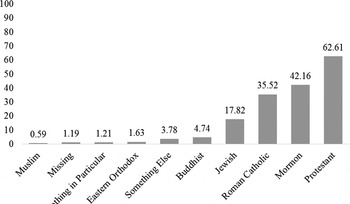
Percent of respondents who share religion with member of congress by denomination. Source: CCES (2010) and Pew Research Center (2008).

The categorized religions of the members of the House of Representatives were then matched with the religions of the respondents of the CCES data. The variable “religion match” is coded “yes” if a survey respondent has the same religion as their member of Congress and “no” if not. Figure 1 shows the percent of respondents in each religious category who happen to share a religious identity with their House representative. Only one Muslim and four Eastern Orthodox respondents happened to have a House member that shared their religious identity. Only three members of Congress identified as Unitarian, Pew labeled these “nothing in particular.” As such, respondents who reported a belief in Native American religions, or those who called themselves “spiritual, but not religious” were classified as matching if their member of Congress was Unitarian; there were 100 respondents in this category. Although a strong majority Protestants (62.61%) share a religious identity with their House representative, there is quite a bit of diversity among various religious traditions whose House members share a faith with their constituents. There is at least as much diversity as one would find in studies of race and descriptive representation.
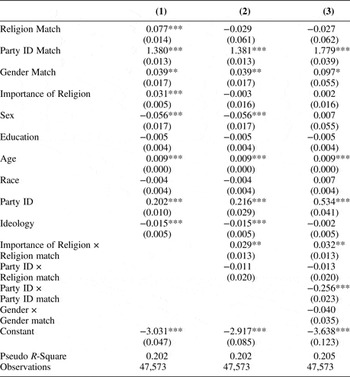
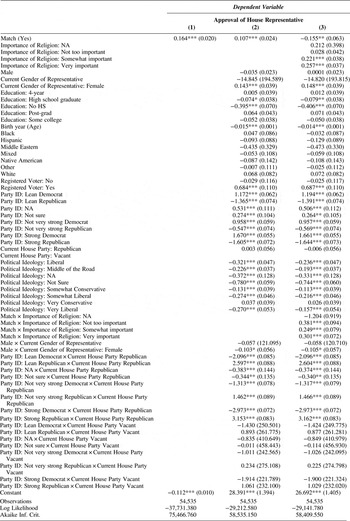
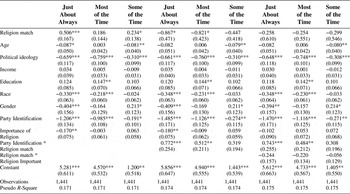
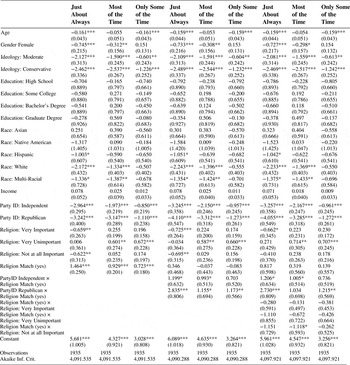
To measure shared partisanship and gender, we followed the same method of matching respondents’ reported party identification and gender with that of their House representative. In addition, we include controls for the dominant demographics that we know influence political attitudes. Party identification is coded 1–3 with 1 representing Democrats, 2 for Republicans and 3 for Independents; political ideology is scaled 1–5 with 1 representing very liberal. We also include education levels coded 1–5 where 1 represents less than high school and 5 graduate school of some kind; and race has seven categories including those who identify as multi-racial. Finally, we expect that people for whom religion is important will be more likely to approve of a House member who shares a religious identity than those for whom religion is not important. We will estimate this interaction in later models, so we include it in the baseline model. It is coded 1–4 where 4 represent a response that religion is very important. Our dependent variable is the dichotomized response to the question, “Do you approve of the way “House Member's Name” is doing their job?” The methodological appendix contains the results of three probit regression models that predict approval ratings of the members of the House of Representatives.
Most of the control variables in these models are statistically significant and in the expected direction, and the model fit statistics suggest that this model accounts for a reasonable amount of variation in the approval ratings of House members. Consistent with theoretical expectations, the gender match and party identification match variables are statistically significant and positive. Furthermore, religion match is statistically significant and positive, suggesting that people who share a religious identity with their House members are more likely to approve of their performance (H1).
The second model includes two interaction terms that are central to our overall argument. The first is an interaction between the importance of religion and religion match. In the baseline model, those for whom religion is more important are more likely to approve of their House member, all else equal. We expect shared religious identity to moderate this relationship. Those for whom religion is important will be more likely to approve a House member that shares their religious identity than those for whom religion is not important. In addition, religious and partisan identities have become closely aligned in United States politics (Jacobsmeier Reference Jacobsmeier2013; Layman Reference Layman2001), which raises the possibility that what appears to be religious descriptive representation might be partisan-based representation. To account for this, we include an interaction between respondents’ party identification and religion match.
In this interaction model, most of the covariates have identical coefficients and standard errors as in the first model. Additionally, the model fit statistics suggest that this model is practically the same as the first. The interaction between religion match and respondent party identification fails to achieve statistical significance. Yet, the gender, religion and party identification match variables retain statistical significance. This suggests that the relationship between shared religious identity and approval of one's House representative is not moderated by partisan identity. When it comes to congressional representation, partisan representation is distinct from religious descriptive representation. However, the interaction between importance of religion and religion match is statistically significant. Although significant in the baseline model, the direct effect of the importance of religion is not significant in this model. This suggests that the relationship between importance of religion and approval of House members is moderated by a shared religious identity (H2). These findings suggest that religious identity has an influence on congressional approval ratings that is distinct from partisan identity.
We would like to know something about the size of the effect of religious descriptive representation relative to the influence of gender or partisan based representation. Obviously, partisan representation is not strictly identity based, so we expect party identification match to have a much larger effect. The final model includes the two interactions from the previous model as well as interactions between respondent gender and gender match, and party identification and party identification match.
The dominant view of gender based descriptive representation is that female constituents are more likely to approve of their House member when they have the same gender. We find some evidence for this in our models. In the baseline model, the coefficient for gender match is statistically significant and positive, suggesting that people are more likely to approve of House members of the same gender. In this final model, however, the interaction between gender match and gender is not statistically significant. This suggests that women may be more likely to approve of female House members, but the same is also true for men. This finding might surprise some, however we think that this is congruent with the argument we make concerning religious descriptive representation. Each of us has a variety of social identities that can be salient at a given point in time. When 50% of the population shares a social identity, it is unlikely to have as strong an influence on attitudes as an identity shared with a much smaller subset of the population. The influence of religious identity on approval of one's House member is likely explaining the same variation as gender-based support. Religious identity has a stronger influence on support for House members than gender.
Consistent with our expectations, partisan identity moderates the influence between party match and approval of one's House representative. The significant interaction coefficient suggests that the relationship between party match and approval depends on the respondent's partisanship. Democrats and Republicans are significantly less likely to approve of their cross-partisan House members and significantly more likely approve of their co-partisan House members than Independents.
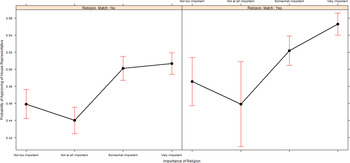
These two additional interactions slightly improve model fit, but do not cause significant changes to the model. The coefficient for the interaction between importance of religion and matching religious identity is significant at the 0.01 level and the size of the coefficient decreases slightly. Thus, while partisan based representation is a significant explanation for congressional approval, it does not tell the entire story. Religious identity has a significant, independent influence on congressional support that changes depending on the importance of religion (H2). Just how large is this effect? With a sample size in excess of 47 thousand respondents, statistical significance can be achieved with a very small effect. Figure 2 plots the predicted approval of House members for each level of religious importance for respondents by shared religious identity.
Religious importance and shared religious identity's influence on congressional approval ratings. Note: Points are the model predicted probability of approving of one's House member, bars are the 95% confidence interval.

The two largest differences are among those for whom religion is “not at all important” and religion is “very important.” Among those for whom religion is “very important,” the predicted probability of approving of their representative is 0.55 if they share a religious identity and 0.52 if they do not share a religious identity with their House Representative. By contrast, among those for whom religion is “not at all important” the predicted probability of approving of one's House member is 0.45 if they share a religious identity and 0.43 if they do not share a religious identity with their House representative. Approval of House members decreases by two points if they share a religious identity with constituents for whom religion is “not at all important”; whereas approval increases by three points among those for whom religion is “very important.” This suggests that the importance of religion is a key indicator of the salience of religious identity.
In all, the substantive difference in House member approval ratings attributed specifically to shared religious identity seems small. However, we think that compared to the size of gender based descriptive representation effects, the influence of religion based descriptive representation is quite large. It would be difficult for any form of identity based descriptive representation to rival that of partisanship in today's political climate, but the findings presented here suggest that for many people, religion based descriptive representation is a reality. Again, we want to reiterate that the influence of shared religious identity on approval ratings of one's own House member is substantively large and distinct from partisan, or ideological considerations.
The preceding analyses have a few major limitations. First, we do not know whether respondents in the CCES actually know that their House representative shares a religious identity. Given how little most people know about politics (Delli Carpini and Keeter Reference Delli Carpini and Keeter1996), it seems unlikely that respondents would know the religious identity of their House representative. Second, religion and politics have become intertwined in American politics. Since we know that people use religion as a cue for the political ideology of House members (Jacobsmeier Reference Jacobsmeier2013), it is possible that these findings are simply functioning as an instrumental variable for political ideology.
Study 2
The first study operationally defined descriptive representation as approval of one's House representative. Yet, representation could also be thought of in terms of trust in the elected officials. Approval ratings and trust are not equivalent and are clearly derived from different processes (Miles Reference Miles2015), however descriptive representation might increase trust in elected officials just as it increases approval. Modern Americans are much less trusting of their government today than they were a half century ago. For the last few years, “government” has been rated the biggest problem facing America (Saad Reference Saad2016). In 1958, 73% of Americans reported that they trust the government in Washington to do the right thing “most of the time.” However, by February, 2014 only 24% of Americans reported the same level of trust in Washington. Partisanship explains some of the variation in reported trust in Washington. Early in the George W. Bush administration — when Republicans controlled the House, Senate and White House — trust in Washington among Republican Americans was close to the 1958 level of trust. Similarly, in April 2010 — when Democrats controlled the House, Senate and White House — trust in Washington among Democrats was near 40% (“Public Trust in Government: 1958–2014” 2014). Yet, partisanship alone cannot explain the decades-long steady decline in trust that the American public expresses in the government.
Hetherington and Rudolph (Reference Hetherington and Rudolph2015) propose that political polarization in the United States electorate is largely responsible for the decline in political trust. They argue that as the two political parties in America have become more ideologically distinct, ordinary people from one party have developed strong, negative feelings toward members of the other political party. As a result, when a representative from one party gives a speech, ordinary people of the opposing party have angry responses to policy proposals from the speech. These negative feelings toward opposing party identifiers has also led partisans to become much less trusting in government. When politics are polarized, the government is less likely to pass significant legislation, which perpetuates the view that the government is dysfunctional (Hetherington and Rudolph Reference Hetherington and Rudolph2015).
Yet, individual evaluations of government trust are complex (Citrin and Green Reference Citrin and Green1986). While most agree that trust evaluations reflect a “basic evaluative orientation toward the government founded on how well the government is operating relative to people's normative expectations.” (Miller Reference Miller1974), policy outputs certainly influence public trust evaluations. Miller (Reference Miller1974) found that the Vietnam War and Civil Rights legislation eroded public trust in government among white respondents, but the same Civil Rights legislation increased trust in government among African-Americans. Institutional performance also influences trust in government. Citrin and Green (Reference Citrin and Green1986) argue that presidential approval strongly influences trust in government, while others have noted that both congressional (Hibbing and Theiss-Morse Reference Hibbing and Theiss-Morse2002) and social service organization (Keele Reference Keele2007) performance can also influence public trust in government.
These alone cannot explain why citizens in advanced democracies are becoming less trusting of both government leaders and government institutions (Norris Reference Norris1999). Dalton (Reference Dalton2005) argues that as democracies work to improve the human condition, public expectations of their government change. Those who are least trusting of government tend to be those highest in education and social status. The cognitive skills that accompany greater education and wealth motivate people to expect more from their political system. As such, public trust in government may be on the decline because expectations are rising (Dalton Reference Dalton2004; Reference Dalton2005). If so, declining political trust may be a feature of democratic systems of government, and people should become comfortable with governments operating without the trust of their constituents.
However, consistent with the findings in the first study and our general argument, shared religious identity might influence trust in elected officials. Among the first survey items shown to predict trust in government was a battery of questions that measured the ethical qualities of elected officials. Those who thought that hardly any elected officials were “crooked” were more likely to trust government than those who thought that quite a few people running government were. For many, trust in government is not much different than individual trust. When people think that another person is dishonest or self-centered, they are less likely to trust that person. Finally, belief in God is a strong predictor of interpersonal trust (Gervais, Shariff, and Norenzayan Reference Gervais, Shariff and Norenzayan2011). The same processes that motivate those who believe in God to distrust those who do not could function at a lower level. If so, people would be more likely to trust someone (or a President) when they think that they share a common religious belief.
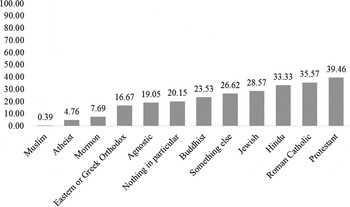
Using a national survey conducted in June 2015, we conducted another study to overcome some of these limitations. Clear Voice Research recruited 2,118 participants in their online panel to participate in a research project about political attitudes, of those 1,935 completed the entire survey. Respondents were 50.7% male, 80.6% white, 33.7% Democrat, and 24.7% Republican. Most of the respondents had completed at least some college (78.1%) and 86% of them reported an annual income of less than $100 thousand. Using language from Gallup surveys, respondents were asked to identify the religious identity of President Obama. Much to our initial surprise, close to 25% of the respondents thought Obama was Muslim. By September 2015, surveys conducted following a Trump rally found similar proportions of Americans believing that Obama was Muslim, which alleviated our initial concerns. In addition, respondents were asked about their own religious affiliation. We matched individual responses on these two questions, without regard for the accuracy of the information about the President's religion. That is, if a Muslim thought Obama is Muslim, we count that as a shared religious identity because descriptive representation is matter of perception. Figure 3 shows the percent of respondents who match religious identity with the President based on their perception of his religious identity. A handful of respondents who identify with minority religions also believe that Obama shares their religious belief, but most people thought that Obama was Protestant (correct), Catholic, non-religious or something else.
Percent of respondents who believe that they share a religious identity with President Obama by denomination. Source: Author's data.

We asked participants the standard question about how often they think that they can trust the government in Washington to do what is right. The next question asked, “How much of the time do you think you can trust President Obama to do what is right?” Individual evaluations of how much they trust government are influenced by policy related concerns, institutional performance evaluations, and public expectations. It is likely that trust in President Obama depends on public expectations of the President, his performance, and some policy related concerns. However, because the question of trust deals with an individual, these evaluations are less likely to be motivated by strict policy concerns and are more likely to be influenced by personal characteristics. The correlation between responses on these two questions is moderate (r = 0.44) and twice as many people report trusting Obama (39.66%) as trusting Washington (20.22%). This suggests that the two trust evaluations are distinct and influenced by different considerations. We expect that people who share a religious identity with president Obama to be more likely to trust him, all else equal (H1).
We follow the same estimation strategy for this study as we did for the previous. We predict trust in President Obama with a multinomial probit regression model with “never” as the baseline category. We control for the same demographics as before: Party identification is coded 1–3 with 1 representing Democrats, 2 for Independents and 3 for Republicans; political ideology is scaled 1–7 with 1 representing very liberal. We also include education levels coded 1–5 where 1 represents less than high school and 5 graduate school of some kind; and race has six categories including those who identify as multi-racial.Footnote 2 The importance of religion question is worded differently; but it is coded 1–4 where 1 represents a response that religion is extremely important and 4 indicate that it is ‘not at all important’.
Since belief that President Obama is Muslim is associated with extreme conservatism and opposition to Obama, the models were run both with and without respondents who thought Obama was Muslim and the results do not change. The reported models used the truncated data, because the size of the effects are smaller. The coefficients in the models are consistent across response categories and are in the expected direction. All else equal, someone who shares a religious identity is significantly more likely to respond that they trust President Obama and the same is true for liberals and Democrats. By contrast, older people are significantly less likely to trust President Obama. There are significant racial differences: racial minorities are more likely to trust President Obama than white people. Also consistent with the dominant view, those for whom religion is important are less likely to say that they trust Obama “just about always”; they are more likely to respond that they “never” trust him.
The next model includes an interaction between partisanship and religion match. This model explains a little more variation than the first model. In this model, the main effect of religion match and importance of religion are not statistically significant, but the interaction between partisanship and religion match is significant, suggesting that the relationship between partisan identity and trusting President Obama to do what is right is moderated by a shared religious identity. Finally, the evidence suggests that respondents for whom religion is important will be more likely to trust Obama if they share a religious identity. In sum, there is a significant main effect between shared religious identity and the probability of trusting President Obama. In addition, a shared religious identity moderates the relationship between partisanship and the probability of trusting the president and the relationship between the importance of religion and trust in President Obama.
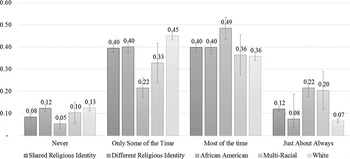
Just how much does shared religious identity influence public trust of President Obama? Figure 4 displays the predicted probability of trusting President Obama for racial categories and for shared religious identity categories. Conventional wisdom holds that African Americans overwhelmingly support, approve of, and trust President Obama. All else equal, the probability of an African American reporting that they trust Obama “just about always” is 0.22, “most of the time” is 0.49, “only some of the time” is 0.22 and “never” is 0.05. By contrast the probability of a white person reporting that they trust Obama “just about always” is 0.07, “most of the time” is 0.36, “only some of the time” is 0.45 and “never” is 0.13. As expected, racial identity is associated with quite a gap in trust of the President. Though not as large, the trust gap based on religious identity is quite substantial. All else equal, someone who shares a religious identity is 60% more likely to report trusting the President “just about always” and 32% less likely to “never” trust President Obama than someone who does not. Not all of these differences are statistically significant, but the overall pattern is consistent with theoretical expectations. It seems that when people share a religious identity with public officials, they are more likely to trust them (H2).
Predicted trust in President Obama by shared religious identity and race. Note: Entries are the model predicted probability of trusting President Obama, bars are the 95% confidence intervals. Calculated with the effects package in R 3.12. Total column less than 1 due to rounding.

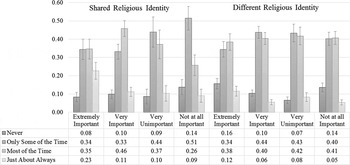
Religious identity moderates the relationship between the importance of religion and trust in President Obama. The main effect suggests that those who place a higher importance on religion are less trusting of the President, but this relationship changes depending on the perceived religious identity of President Obama. Figure 5 displays the predicted probability of each response among those who believe that they share Obama's religion and those who do not. Among those for whom religion is “extremely important,” the probability of trusting Obama “just about always” is nearly twice as high if they believe that they share a religious identity with the President than it is if they do not. Similarly, the probability of trusting Obama “never” is twice as low among this group, when they think that they share a religious identity with the President.
Model predicted trust in President Obama by shared religious identity and the importance of religion. Source: Author's data. Note: Entries are the model predicted probability of trusting President Obama, bars are the 95% confidence intervals. Calculated with the effects package in R 3.12.

Among those for whom religion is “very important” we see a similar pattern. Those who think that they share a religious identity with the President are more likely to trust him “always” and less likely to trust him “never” than those in this group who do not share a religious identity with the President. However, a shared religious identity does not change trust in the President among those for whom religion is not an important part of their life. We think that the consistency of the pattern of findings combined with the magnitude of the predicted differences in presidential trust among those for whom religion is important provides substantial evidence in support of our argument that religious identity influences approval of and trust in public officials (H2).
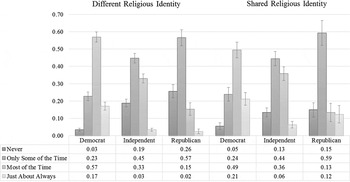
Are there clear partisan differences? Does shared religious identity moderate the influence of party identification and trust in the President? Figure 6 displays the model predicted support for partisans who do and do not share a religious identity with the President. For Democrats, the probability of trusting President Obama does not change much when respondents share a religious identity with the president. Among Independents, those who share a religious identity with the President are twice as likely to report trusting Obama “just about always” as those who do not.
Model predicted trust in President Obama by partisan identity and shared religious identity. Source: Author's data. Note: Entries are the model predicted probability of trusting President Obama, bars are the 95% confidence intervals. Calculated with the effects package in R 3.12.

Among Republicans the difference is substantial. The predicted probability of a Republican trusting President Obama “just about always” is 0.12 if they share a religious identity with Obama whereas it is 0.02 if they do not. It may seem like a small difference, but these numbers suggest that Republicans who share a religious identity with Obama are 500% more likely to trust him than Republicans who do not. Republicans are 42% less likely to “never” trust the president than Republicans who do not share a religious identity with President Obama. Perhaps because religious Americans are largely divided along party lines, the influence of religious descriptive representation on trust in Obama is much larger among Republicans than among Democrats and Independents.
In total, the findings presented in this article suggest that religious identity influences approval of and trust in elected officials. The dominant view of descriptive representation is that public officials who share demographic characteristics with their constituents can represent these groups, even when they disagree about policy specifics. The central question of this paper is whether religious identity is strong enough to allow for descriptive representation. The findings presented here suggest that shared religious identity strongly influences support for elected officials. The second question is if religious based descriptive representation is independent of racial and partisan based identities. Again, these findings suggest that religious identification has a substantial independent influence on support for elected officials. It is difficult to think of a group that would be less likely to trust President Obama in 2015 than Republicans. Yet, a Republican who shared a religious identity with the president was substantially more likely to trust him than one who did not.
CONCLUSION
Some might argue that religion in America becomes so closely aligned with partisan identity and political ideology that we can no longer distinguish an independent influence of religion on public attitudes (Jacobsmeier Reference Jacobsmeier2013; Layman Reference Layman2001). The evidence presented here suggests that although the dominant political parties in America count on the support of adherents to specific religious traditions, religion continues to independently influence public attitudes about elected officials. This supports continued interest in identifying, specifying, and describing the contexts in which religious identity influences institutional, candidate, and policy support in America.
Second, the descriptive representation model is an appropriate way to think about the influence of religion on public support for elected officials. Religion forms a moral code for believers that shapes how they decide what is and is not acceptable behavior (Graham and Haidt Reference Graham and Haidt2010), how society should be organized (Friesen and Ksiazkiewicz Reference Friesen and Ksiazkiewicz2014; Ludeke, Johnson, and Bouchard Reference Ludeke, Johnson and Bouchard2013), and how elected officials should behave. In addition, religious identity has a powerful influence on how believers relate to other people in society; the irreligious in society are viewed with skepticism by the religious (Gervais, Shariff, and Norenzayan Reference Gervais, Shariff and Norenzayan2011). The findings presented in this article suggest that religious identity influences how people evaluate the performance of House representatives and trust in the President. The pattern of predicted trust in President Obama comparing those who share his racial identity to whites and those who share his religion to those who do not is remarkably similar. The strength of the relationship between shared religious identification and trust in President Obama functions similarly to the relationship between race and trust in the President. This could be one reason why the myth that Obama is Muslim persists. For Republicans, recognizing that Obama shares their faith might motivate trust in a political opponent. It may be more psychologically comforting to find evidence that Obama has a different faith, than to confront the dissonance.
Finally, group based descriptive representation influences attitudes in a variety of social groups. The same psychological processes that influence support for members of minority groups influence the attitudes of members of majority groups. People are more likely to trust others who are similar to themselves. Shared group identity is one cue that an elected official can be trusted to look out for the needs of group members. When social identities collide, attitudes are influenced by the dominant social identity. As such, the stronger the identification one has with the relevant group identity, the more likely the identity will be to influence their evaluations of elected officials who share the group identity. Yet, this only applies to social identities that can be hidden from public view. Identities, like race and gender, which are easily discerned might always have a dominant influence on attitudes because people cannot hide their affiliation with these groups.
Some of the findings we present are based on a survey conducted during the 2010 congressional election. It is possible that both partisanship and religious identity were primed by the election environment. It is also possible that people were thinking more about the job performance of their House representative than they normally do. As such, the size of the effects we present could be artifacts of the election calendar and might be smaller in non-election seasons. Although, the findings from a survey conducted early in the summer of 2015 make it less likely that the results are an artifact of the survey timing, it is also a snapshot in time. Future work should examine the influence of religious based descriptive representation with more data points and from a developmental perspective.
METHODOLOGICAL APPENDIX
Predicting approval of one's own house member

Predicting approval of one's house member (categorical independent variables)

Predicting trust in President Obama

Trust in Obama (non-truncated data model)

APPENDIX OF RELIGIONS
The data that was used for this paper came from the Cooperative Congressional Election Study (CCES) which included a sample of 55,400 people in a national survey system (Ansolabehere, 2010). The CCES contained responses to the questions “How important is religion in your life?” and “What is your present religion, if any?” These variables were the focus of the research of this paper. However, because there are over 300 religions in the United States and many have names that may be overlapping but are very different in ideology and theology, each is very unique in and of itself. In order to accommodate these many different religions, the CCES asked the question of “What is your present religion, if any?” and had follow up questions in order to determine the specific religion to which each respondent identified with. These included the specific denomination, sect or group of Protestant Church, Baptist Church, Methodist Church, Nondenominational or Independent Church, Lutheran Church, Presbyterian Church, Pentecostal Church, Episcopal Church, Christian Church, Congregational Church, Holiness Church, Reformed Church, Adventist Church, Catholic Church, Mormon Church, Orthodox Church, Jewish Group, Muslim Group, Buddhist Group, and Hindu Group (Ansolabhere, 2010). This allows the CCES to narrow down the responses of the survey respondents to the specific religion each person adheres to. The Pew Research Center compiled a list (Pew Research Center 2008) of all the religions that the members of Congress identify themselves as. This list included the Senators and Representatives of the 111th Congress. For the purposes of this research, we used only the Representatives and their self-identified religions.
The CCES categorized the very specific religions into more broad categories for question V219, “What is your present religion, if any?” contained the responses of “Protestant, Roman Catholic, Mormon, Eastern or Greek Orthodox, Jewish, Muslim, Buddhist, Hindu, and Agnostic, Nothing in Particular, Something Else, Skipped, and Not Asked” (Ansolabhere, 2010). The following are the categories and questions which narrowed down the type of religion to the more broad religions. The V# is the number to the corresponding question.
V220 Protestant Church-To which Protestant church or group do you belong?
-
• Baptist
-
• Methodist
-
• Nondenominational or Independent Church
-
• Lutheran
-
• Presbyterian
-
• Pentecostal
-
• Episcopalian
-
• Church of Christ or Disciples of Christ
-
• Congregational or United Church of Christ
-
• Holiness
-
• Reformed
-
• Adventist
-
• Jehovah's Witness
-
• Something else
-
• Skipped
-
• Not Asked
V234 Catholic Church-To which Catholic church do you belong?
-
• Roman Catholic Church
-
• National Polish Catholic Church
-
• Greek-rite Catholic
-
• Armenian Catholic
-
• Old Catholic
-
• Other Catholic
-
• Skipped
-
• Not Asked
V235 Mormon Church-To which Mormon church do you belong?
-
• The Church of Jesus Christ of Latter-day Saints
-
• Community of Christ
-
• Other Mormon
-
• Skipped
-
• Not Asked
V236 Orthodox Church-To which Orthodox church to you belong?
-
• Greek Orthodox
-
• Russian Orthodox
-
• Orthodox Church in America
-
• Armenian Orthodox
-
• Eastern Orthodox
-
• Serbian Orthodox
-
• Other Orthodox
-
• Skipped
-
• Not Asked
V237 Jewish Group-To which Jewish group do you belong?
-
• Reform
-
• Conservative
-
• Orthodox
-
• Reconstructionist
-
• Other
-
• Skipped
-
• Not Asked
V238 Muslim Group-To which Muslim group do you belong?
-
• Sunni
-
• Shia
-
• Nation of Islam (Black Muslim)
-
• Other Muslim
-
• Skipped
-
• Not Asked
V239 Buddhist group-To which Buddhist group do you belong?
-
• Theravada (Vipassana) Buddhism
-
• Mahayana (Zen) Buddhism
-
• Vairayana (Tibetan) Buddhism
-
• Other Buddhist
-
• Skipped
-
• Not Asked
V240 Hindu Group-With which of the following Hindu groups, if any, do you identify with most closely?
-
• Vaishnava Hinduism
-
• Shaivite Hinduism
-
• Shaktism Hinduism
-
• Other Hinduism
-
• Skipped
-
• Not Asked
*All questions and religion names come from the CCES data set (Ansolabhere, 2010).
We obtained the information of the members of Congress through the Pew Research Center which did a report (Pew Research Center 2008), where they identified the members of Congress from the 111th Congress. Because this report and the CCES were recorded at different years, the members of Congress in the report and those of the CCES were not the same. There are many members who are still the elected officials so we only had to determine the religions of a few new members of Congress in 2010, which we used Wikipedia to complete the list. From this list of religions, we used the classifications above to categorize the members of Congress according to the same way that respondents were classified; the more specific religions expanded into more broad categories.
From these two lists, we matched every respondent with their member of Congress. This was possible through the CCES data which had previously determined this. We then matched the religion of the respondent to the religion of the member of Congress. If they did match, then we coded it as a “1”. If the religions did not match, then it was coded as a “0”. This is the variable which we used to perform the models in our research.