Introduction
Data on male-to-female ratio at birth, known as the sex ratio at birth (SRB), is vital for the study of population transition in a country. However, ‘Given the incompleteness in birth registration in India’, Sen (Reference Sen2003, p. 1297) feels, ‘that ratio is difficult to calculate’. Some other experts, for example, Das Gupta & Bhat (Reference Das Gupta and Bhat1997), Sudha & Rajan (Reference Sudha and Rajan1999) and Bhat (Reference Bhat2002), also hold the same view. As these data are not easily accessible, scientists often use world average data on SRB for the study of Indian population transition. Here an attempt is made to address the problem by using available reliable statistics. Actually SRBs in different populations remain above unity at around 1.047, normally varying only within narrow limits. Its level varies from race to race and time to time within a race, depending on various factors. There are as many as 30 or more known determinants that could cause change in SRB (Graffelman & Hoekstra, Reference Graffelman and Hoekstra2000). These can be divided into biological and cultural factors. The biological factor is that the round-shaped Y chromosomes can move faster through the cervical mucus than the elongated X chromosomes. Or, for unknown reasons, the Y chromosomes appear to be more successful at fertilizing the egg in the mother's uterus (Roberts, Reference Roberts1972; Vear, Reference Vear1978; Catalan et al., Reference Catalan, Frank and Norppa2000). The male-biased cultural factor can also affect sex ratio at conception, known as the primary sex ratio (PSR), as well as SRB (Kumm et al., Reference Kumm, Laland and Feldman1994). Thus the sex ratio at birth in India might be naturally more biased towards boys.
By nature, a considerably larger number of male embryos are conceived than female ones, leading to a high PSR. The range of PSRs can be between 1.250 and 1.600 (Klasen, Reference Klasen1994; Junhong, Reference Junhong2001). Generally female fetuses are subject to more miscarriage in the early gestational age and male ones in the later gestational age (Hytten, Reference Hytten1982; Waldron, Reference Waldron1998; Halder & Fouzdar, Reference Halder and Fouzdar2006). Afterwards male fetuses are more subject to spontaneous miscarriage (Hytten, Reference Hytten1982).
It is striking that the SRB in India has long been well above the standard or world average prior to the commencement of sex-selective abortion in the mid-1980s. Some studies dealt with the issue on a small regional basis. However, in an all-India-level study, Visaria (Reference Visaria1971) argued that observed SRBs were in line with those of other populations, while another study using national-level data reported a noticeably higher SRB than the world average value (Pakrasi & Halder, Reference Pakrasi and Halder1971). Despite some data showing high SRB, some demographers appear reluctant to accept it (Agnihotri, Reference Agnihotri2000) or to recognize changes usually take place in it (Dreze & Sen, Reference Dreze and Sen1995).
Rising sex ratio at birth
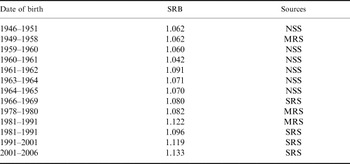
The high sex ratio in India is often attributed to excess female mortality without considering the possibility of high SRBs, particularly when the country is characterized by high SRBs. Also, a few data are available from reliable sources for the second half of the 20th century, but researchers do not use many of these. Instead they estimate SRB values in their studies. For example, Klasen (Reference Klasen1994) ‘predicted’ SRB for the early 1970s – it was about 1.038. However, the empirical ratio in the late 1960s was as high as 1.080 (Table 1). Life expectancy has been in upward trend. So, the SRB in the 1970s, as per positive relationship between change in life expectancy at birth (e 0) and SRB, is expected to be more than 1.080 (Klasen, Reference Klasen1994; Klasen & Wink, Reference Klasen and Wink2002). Instead of depending upon estimated data, the observed ones should be used wherever available, particularly where they are considered consistent and reliable. The expert committee with the Office of Registrar General of India (ORGI) recognizes the Sample Registration System generated data as consistent and reliable (Technical Group on Population Projection, 1996). According to the latter source, the values of the SRBs in 1966–69 were as high as 1.080 (India), 1.054 (Kerala), 1.129 (Rajasthan and Punjab) or even 1.143 (Haryana). For Uttar Pradesh the SRBs were 1.114 (urban) and 1.111 (rural) in 1968–1970. These ratios might have raised doubts on their quality. Accordingly in defence of the quality of the official data, the report states that
…the births are checked and verified to ward off any kind of systematic bias which would lead to continuous suppression of female births. It is obvious that there is male predominance at birth. … The argument of under-registration of female deaths, as of births, can be voiced, but the data are carefully scrutinized and, in any case, are sufficiently accurate to point out the trend. (Sinha, Reference Sinha1973, pp. 81–82)
Sex ratio at birth (SRB) in India, 1946–2006

NSS=National Sample Survey; MRS=Medical Registration System; SRS=Sample Registration System of the Office of Registrar General, India.
Sources: Das Gupta et al. (Reference Das Gupta1955); Nanda (Reference Nanda1993); Hudson & den Boer (Reference Hudson and den Boer2004); Indian Statistical Institute, Calcutta, NSS Report Nos 154, 153, 175, 177, 180; ORGI (1972, 2001, 2003, 2005, 2007).
The official expectation for the natural SRB was 1.050. But it was admitted by the Registrar General that the ratio was as high as 1.119 for ever-born babies (Nanda, Reference Nanda1993). Before commencement of the Sample Registration System, the Registrar General already collected data on two million live births in hospitals in different parts of the country in 1949–58 and reported the SRB to be 1.062. The Sample Registration System based SRB values were 1.093 and 1.095, respectively, for the periods 1981–1984 and 1981–90. Additional data on six million live births in urban medical establishments in different parts of the country during 1981–1991 gave the highest ever ratio of 1.122 (Nanda, Reference Nanda1993). Again, for 2.3 million institutional deliveries of live births that took place in various parts of the country, the ratio recorded was as high as 1.099 in the 1990s (Premi, Reference Premi2001).
Another official and reliable source of information is the National Sample Survey. According to this source also, the SRBs were higher for quite a long period of time, as displayed in Table 1. Thus it would not be unreasonable to hold the idea that the SRB in India has long been higher than the world average. Certainly, there could be some factors behind this. Here the SRB data cannot be considered as natural for the period since the mid-1980s because of the introduction of prenatal sex-detection techniques followed by sex-selective abortions. Sex-selective abortions obviously have had an impact on the SRB. Thus SRB data are being deviated from the natural category. Accordingly, the ratio has gone up sharply to the level of 1.133. Natural SRB data since the mid-1980s are rarely available. Therefore, these have to be estimated.
Sex ratio at birth statistics from reliable sources
One thing is common for the retrospective SRB data collected by different agencies through respondents' memory recall: the ratios get steadily higher and higher as the recall period becomes longer. The retrospective National Sample Survey (NSS) data were collected by Das Gupta et al. (Reference Das Gupta1955) on behalf of the Indian Statistical Institute (ISI). Thereafter, the ISI itself conducted a NSS to collect current data several times. From the mid-1960s ORGI started collection of data through the Sample Registration System. Das Gupta et al. (Reference Das Gupta1955) probably for the first time conducted a sample survey on the SRB at the national level for 1951 and preceding years, whereas the Census Commissioner estimates SRB through census samples on 1981 and 1991 populations. The above sources involved retrospective data collection.
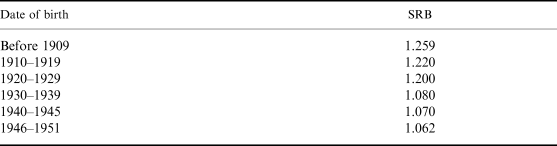
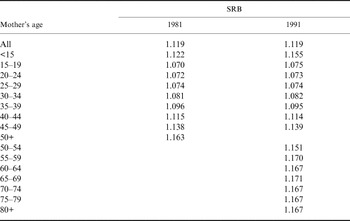
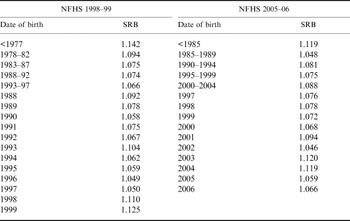
Table 1 presents various forms of data on SRB as collected by different agencies. The SRB in the NSS data appears to be around ‘normal’, but it monotonically increases to an extremely high level on going back retrospectively, from 1.060 in 1946–51 to a high value of 1.259 prior to 1910, as depicted in Table 2. There has long been a strong son preference in India. Mothers themselves are not free from this. Perhaps this might bias memory in favour of births of sons vis-á-vis daughters. Since the SRB data for the 1991 census correspond to those for the 1981 census, they could be cross-verified, as given in Table 3. Mothers of a cohort should ideally show the same SRB at two points in time, such as 1981 and 1991. But this is not so observed. For example, mothers aged 45–49 in 1981 reported the SRB of their ever-born children to be 1.138. At this age, if they were no more fertile then after ten years in 1991 at their age 55–59 the SRB of their children should not have changed. However, in 1991 the ratio concerning them as reported rose to 1.170 (Table 3). Of course, some of the mothers of that cohort will have died between 1981 and 1991. It is unlikely that these deaths could explain the lower SRB in 1981 fully. This implies that as mothers get older the memory could recall relatively better birth of their son(s) than that of daughter(s) (Table 3). A similar tendency was observed in the NSS (Table 2) and NFHSs (Table 4) in India, and in census sample surveys in China also (see Coale & Banister, Reference Coale and Banister1994). (Exceptions are for 1998 and 1999 for India. The 1998–99 NFHS-2 reported the current ratios for these years to be 1.110 and 1.125, respectively. Later, in the NFHS-3 held in 2005–06, the SRB for 1998 and 1999 had lower values of 1.078 and 1.072, respectively.) Women can remember the birth of sons better than that of daughters. This, it seems, has happened due to son preference.
National Sample Survey generated sex ratio at birth (SRB) in India, 1901–1951
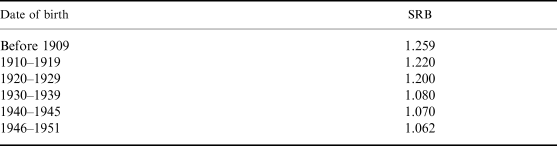
Source: Das Gupta et al. (Reference Das Gupta1955).
Census sample survey generated sex ratio at birth (SRB) for ever-born children in India by mother's age in 1981 and 1991

Sources: Fertility Tables, Part VI A&B, Census of India 1981, Series 1; Fertility Tables, Part VI F, Census of India 1991, Series 1.
National Family Health Survey (NFHS) generated sex ratio at birth in India, 1977–2006

Some dependable data for the 1970s
Quality data on SRB at the all-India level for the 1970s are difficult to access. However, some microstudies containing these data over different parts of the country are available for different points in time during the decade. These data, it seems, have some known level of reliability. In the middle of the 1970s, a few anthropological microsurveys were undertaken that collected birth statistics. Among these, Sarkar (Reference Sarkar and Singh1989) found SRBs in southern Rajasthan among the Bhil was 1.441 (or 89/62) and among the Garsia tribal populations, 1.230 (i.e. 123/100). Barua (Reference Barua and Singh1989) surveyed the 24 Parganas districts of West Bengal. There SRBs were reported to be 1.103 (i.e. 270/245) and 1.357 (i.e. 315/232) among two different groups of populations. Gandhi (Reference Gandhi and Singh1989) found the ratio of 1.220 (i.e. 456/374) among the Maheswari community in Marwar region of Rajasthan. Sahu & Dhar (Reference Sahu, Dhar and Singh1989) observed a wide range of SRBs among the Kunbis of Nagpur district in Maharashtra, ranging from unity to 1.200 in different groups out of 1000 births. A study by Gulati & Sirajuddin (Reference Gulati, Sirajuddin and Singh1989), based on hospital records in Madras (now Chennai) city, reported the ratio of 1.233 (i.e. 53/43). Ramamma & Mukherjee (Reference Ramamma and Mukherjee1977) found a high SRB, 1.348 (i.e. 1285/953), in a Tirupati hospital in 1973–74. Bhattacharyya (Reference Bhattacharyya1991) got the ratio 1.079 (i.e. 657/609) for the births in some hospitals in Mysore in 1977. Kulkarni & Kulkarni (Reference Kulkarni and Kulkarni2000) reported a higher ratio of 1.089 among 8831 babies born with low birth weight at seven private hospitals in Pune during 1970–1979. Bhattacharyya et al. (Reference Bhattacharyya, Dutta and Bhattacharyya1985) found the SRB on the Andaman Islands in 1977–1978 among some tribals to be 1.046 (i.e. 91/87). Srivastava et al. (Reference Srivastava, Choudhury, Sankhyan and Sahay1995) observed among the Jaunsari community in the hilly areas of Uttar Pradesh in 1979–1981 that the SRB at the first order of birth was very high at 1.135 (i.e. 915/806). Bhattachryya & Bhattachryya (Reference Bhattachryya and Bhattachryya1990) reported, on the basis of Mysore City Hospital data, that the SRB was 1.110 (i.e. 373/336) in 1978. In Vellore region the ratio was 1.049 (rural) and 1.062 (urban) among non-consanguineous births, while it was 1.045 (rural) and 1.008 (urban) among consanguineous births (Rao, Reference Rao and Lukacs1984). The above data were collected for individual research purposes and have a known level of dependability.
There are also some official attempts at collection of SRBs. Karnataka Bureau (1976) reported the ratio by rural and urban break-up in the state in 1973 and 1974. In 1973 these were 1.035 (rural) and 1.07 (urban); in 1974, they were 0.992 (rural) and 1.096 (urban). There was a scheme to keep flawless medical records in five hospitals located in different parts of West Bengal. There the SRB was recorded to be 1.074 for around 2000 annual births in the decade 1971–1980 (WBSBHI, relevant years). Hudson & den Boer (Reference Hudson and den Boer2004) stated that in some states in 1978, 1979 and 1980 the medical registration system generated SRBs turned out to be 1.070, 1.112 and 1.067, respectively. These statistics, of course, were computed on a small number of observations, and the methodologies for collection of such data were not uniform. Nevertheless, these provide us with a pretty good idea about SRBs for the 1970s.
Biology and sex ratio at birth
There are a number of biological causes of low SRB, and many of them persist in India. Owing to the relative biological disadvantage in survival of male zygotes as compared with female ones, male rate of spontaneous abortions and stillbirths always outstrip the loss of female fetuses in the whole gestational period. Male–female ratio at spontaneous abortion is noticeably high in the early gestational period (Hytten, Reference Hytten1982; Halder & Fouzdar, Reference Halder and Fouzdar2006). Thus, at the end of the first quarter or phase of pregnancy the embryo sex ratio remains higher than the PSR. In the course of time the sex ratio of fetuses continues to fall until birth (Hytten, Reference Hytten1982). Among the world populations the value of the SRB is the lowest among the black community, high in Europe and somewhat higher in several Asian countries (James, Reference James1987). High SRBs vis-á-vis European level are also seen among those Asian populations settled abroad. For instance, this was found among the Philippino and Chinese babies born in the United States (James, Reference James1985, Reference James1987). A higher SRB has also been reported for orthodox Jews (Guttentag & Secrod, Reference Guttentag and Secrod1983).
Although it is commonly believed that the SRB among the black community is low (<1.042), this is not always true. One reliable study, for example, shows that the SRB in parts of Nigeria was 1.120 during 1991–2000 (Sule & Modugu, Reference Sule and Madugu2004) and 1.070 between 1961 and 1980. Similar evidence of a high SRB (about 1.060) is reported in countries such as Uganda and Camaroon (Rehan, Reference Rehan1982) in Africa. On the basis of available historical statistics, the SRB in the early eighteenth century was 1.066; and in the twentieth century it fell to 1.057 in Western Europe (Graffelman & Hoekstra, Reference Graffelman and Hoekstra2000). It is often argued that due to decline in birth rate, fetal death, stillbirth rate and decline in the sex ratio at stillbirth, the SRB has long been rising (Davis et al., Reference Davis, Gottlieb and Stampnitzky1998). Actually, SRB is not a constant as such. Usually it exhibits an upward trend with socioeconomic development and improvement in public health. It is sometimes assumed that the value of SRB can be taken as 1.050 as the standard value. So this should prevail in India too, and for all time (see, for example, Sen, Reference Sen1990, Reference Sen1992; Dreze & Sen, Reference Dreze and Sen1995). But due to the racial factor it differs from population to population. It could also vary from time to time within a population depending upon the status of public health and many other factors (James, Reference James1987, Reference James2008; Chahnazarian, Reference Chahnazarian1988). Therefore, it is not justified to use world or North American data for the study of the Indian situation.
Among many possible causes of the skewed SRB, there are four major factors relevant to India. These are son preference, eclampsia, hepatitis B virus infection, and smoke-polluted environment in cooking. A new social factor has emerged since the mid-1980s. This is sex-selective abortion. India has long been characterized by its son preference. According to scientists, parents' preference for sex of offspring has the potential to alter natural PSRs and SRBs (Kumm et al., Reference Kumm, Laland and Feldman1994). Eclampsia causes a hypertensive state in pregnant women (Davis et al., Reference Davis, Gottlieb and Stampnitzky1998) – there is a positive relationship between the hypertensive state of mothers and SRB. It has been observed in England that mothers with no, mild, moderate or severe preclampsia have had SRBs of 1.050, 1.091, 1.110 and 1.190 respectively (Gruenwald, Reference Gruenwald, Butler and Alberman1969). This implies that when intensity of eclampsia rises, SRB increases. The problem of eclampsia persists widely in India, and it remains one of the major contributors to maternal and perinatal life risk. Over recent decades, the prevalence of preclampsia has been found at varied levels from place to place from about 8% to 17% of deliveries among hospital patients. It is of severe type in rural areas (Das & Chatterjee, Reference Das and Chatterjee1975; Upadhyay, Reference Upadhay1975; Nanavati & Patel, Reference Nanavati and Patel1998; Chatterjee & Basu, Reference Chatterjee and Basu2000). Biologists observe that it is not likely that eclampsia determines fetal sex, but fetal sex and other aspects of fetal genotype can lead to the development of eclampsia (James, Reference James2006). This implies that significantly high PSRs take place in India, as indicated by the wide prevalence of eclampsia.
As already noted, since the incidence of preclampsia in a developing country like India is usually estimated from hospital-based information, this may not be truly representative of the population as a whole (Chatterjee & Basu, Reference Chatterjee and Basu2000). This is particularly because until 2005–06 only 46.6% of the live births in India took place with the attendance of health personnel (IIPS, 2007), and merely 26.7% of live births were attended (in 2006) by qualified professionals (ORGI, 2007). Obviously, the rest of the births take place in a primitive way, particularly in rural areas, and it is plausible that the prevalence of eclampsia is higher among this group of women, and that it is of a severe type. Female poor health is widespread and maternity care sub-standard, so the maternal mortality ratio is high. The official estimate was 301 in 2001–03 (Central Bureau of Health Intelligence, 2008). However, the World Bank (2009) estimate was much higher – 450 in 2005. The impact of eclampsia on SRB in India has been traced in recent years. Bhaumik et al. (Reference Bhaumik, Ghosh, Halder, Mitra and Manna2000) observed the SRB level of eclamptic mothers to be as high as 1.311.
Another factor, it is argued, partly responsible for an extremely high SRB is the prevalence of hepatitis B virus (HBV) infection among fertile women. Biologists have found that hepatitis B and toxoplasma carrier mothers have an excess of sons at birth (James, Reference James2008). This hypothesis was tested by Oster (Reference Oster2005) in her spatial and temporal investigation. This study finds a direct relationship between these factor and the variable. However, according to Klasen (Reference Klasen, Basu and Kanbur2009) the relationship between HBV infection and SRBs is extremely weak. Other investigations (e.g. Lin & Luoh, Reference Lin and Luoh2008) also found that HBV prevalence pushed up SRBs but to a marginal magnitude in China. Again, in a study in this journal James (Reference James2008) suggests that HBV carrier status has an excess of male baby births due to biomedical reasons. He reiterates that the association between HBV and SRB is highly significant (W. H. James, personal communication). Thus it appears that biological scientists have found a positive relationship between HBV infection and SRB in human beings, while others did not see it in populations of different countries. On skewed SRB in north India, Halder (Reference Halder2006) noted that prevalence of neural tube defect is common and that it is higher among Sikhs. This causes extremely low spontaneous abortion in the early gestation period. According to him, a genetic factor along with environmental and social factors are acting together on the skewed sex ratio in India.
There is a significant positive relationship between women's smoking habit and SRB (Bottini et al., Reference Bottini, Megrini, Cosmi, Gloria-Bottini, Saccucci, Joro, Bargamaschi and Bottini2004). About 17% of adult women in India (in 2002–04) have the habit of smoking (NIPCCD, 2007) and they are generally also victims of smoke-related health hazards. While all Indian women cook, about three-quarters of households used to use agricultural and animal waste as the main sources of energy for cooking. This causes serious smoke-related health problem. This alone has facilitated more than half of tuberculosis infections among Indian adults (Mishra et al., Reference Mishra, Retherford and Smith1999). In the late 1990s in Tamil Nadu, for example, most females of age 15–45 years cooked every day for an average of two hours and 45 minutes (Parikh & Laxmi, Reference Parikh and Laxmi2000). As a result, approximately 4–6% of the national burden of disease was caused by indoor air pollution leading to 450–500 thousand premature deaths annually (Smith, Reference Smith2000). Primitive sources of energy produce heavy smoke. Women, while cooking, inhale smoke in heavy doses. So, this environment in which women cook for several hours daily is injurious to their health. In consequence women with inferior health are likely to give birth to more male babies (Davis et al., Reference Davis, Gottlieb and Stampnitzky1998). Another important factor that has a role in change in the SRB is the sex ratio at stillbirth. A fall in stillbirth rate leads to some rise in the SRB. It has been found that stillbirth rate has declined from 17 in 1970 to 9 in 2006. However, the proportion of maternal deaths caused by eclampsia to total maternal deaths remained almost unchanged at 14% in 1966 and 13% in 1994, and thereafter declined to 8.3% in 1998.
It is plausible that populations with a low health standard have a relatively low SRBs due to, among other things, the aforesaid relative excess loss of male fetuses (Hytten, Reference Hytten1982; Davis et al., Reference Davis, Gottlieb and Stampnitzky1998). Understandably, when public health is improved, the rate of loss of fetuses, including stillbirth, is reduced – the SRB goes up as the relative disadvantage of male fetuses is curtailed to a considerable extent. In developed countries, the reduction of relative male vulnerability has been realized at the advanced gestational stage and at stillbirth (Klasen, Reference Klasen1994). In India, even at the end of 20th century, stillbirths constituted a major proportion of perinatal mortality, most of which could have been prevented by necessary antenatal care, timely referral services and medical attention (Nayak & Dalal, Reference Nayak and Dalal1993; Das et al., Reference Das, Satapathy and Panda2005). As generally the sex ratio at stillbirth used to be significantly high (1.361 in the late 1960s), the declines in the incidence of stillbirths in recent decades might have pushed up the SRB to some extent.
There is another factor that may have contributed to the change in SRB. It has been noticed in several developed countries that warfare has the effect of raising the SRB (Graffelman & Hoesktra, Reference Graffelman and Hoekstra2000; Gutierrez-Adan et al., Reference Gutierreze-Adan, Pinato and de la Fuente2000). This is likely to be due to the widened parental age gap during and after big wars (Manning et al., Reference Manning, Anderton and Shutt1997). On the contrary, despite general improvement in public health in recent decades, the SRB in several industrially developed countries has showed a decreasing trend, arguably due to environmental degradation during the second half of the past century (Davis et al., Reference Davis, Gottlieb and Stampnitzky1998). The other major reason for India's increasing SRBs since the mid-1980s is sex-selective abortion, which relatively adversely affects females. It is estimated that on average per year more than one million female and 0.42 million male feticides are committed (Seth, Reference Seth2007). These factors have jointly led to a high SRB. Female-selective abortions are practised among Indian-origin people even in England and Wales. There SRB has risen significantly in recent times. Thus bride shortage is logically apprehended in the relevant birth cohort (Dubuc & Coleman, Reference Dubuc and Coleman2007). Here it could be mentioned that although India has long had high SRBs and high sex ratios, it has never demonstrated bride shortage. On the contrary, the country always had a substantial groom deficit in the 20th century (Seth, Reference Seth2008). This happens to be a paradoxical phenomenon.
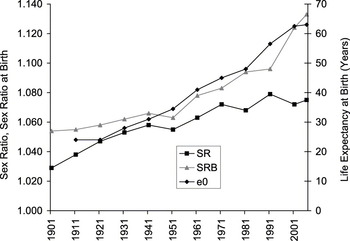
The high PSR is basically responsible for the high SRB. Excess male conceptions are always towards balancing the relative loss of male fetuses owing to their biological disadvantages. It has been postulated that there is a positive link between the rise in e 0 and the SRB. An extension of life by ten years could lead to an increase in the SRB by 0.9 percentage points (Klasen, Reference Klasen1994; Klasen & Wink, Reference Klasen and Wink2002). When this hypothesis was applied, the SRB was likely to be higher than that in the base period, and it continues to rise on proceeding with increasing e 0. In India, at the e 0 of 46 years the SRB stood at 1.078 in 1964–69. The e 0 continued to rise slowly but steadily from 24 years at the beginning of the 20th century to 63 years in 2006. On the basis of Klasen's law of direct association between change in e 0 and change in SRB, the natural values of the latter were estimated be around 1.088, 1.094 and 1.095 in 1991, 2001 and 2006, respectively. The observed SRB figures for 1951 onwards and estimated figures for 1941 and the preceding period (for which the empirical data are not available) corresponding to e 0 are illustrated in Fig. 1. It shows that SRB has been rising with a rise in e 0 even before female-selective abortion started. So, the hypothesis of a positive relationship between e 0 and SRB is valid in the Indian context also.
Life expectancy at birth (e 0), sex ratio at birth (SRB) and sex ratio (SR) in India, 1901–2006. Sources: Table 1; Malaker & Guha Roy (Reference Malaker and Guha Roy1990); Nanda (Reference Nanda1993); Census of India (2001), Report and Tables on Age, vol. 1; Central Statistical Organisation, India, Statistical Abstract: India, different issues.

The second phase of balancing between sexes begins after birth through excess male infant deaths. This is due to the fact that male babies, even with equal care as for female ones, have a lower survival probability. However, socioeconomic development in India in general and advancement of health care in particular have reportedly reduced male vulnerability more than that of females. This could have made a significant contribution to changes in the population sex ratios. In developed countries death rates have fallen so significantly that almost everybody could survive till the age 50 (David & van den Oever, Reference David, van den Oever and Mahadevan1986). Until recent times the sex ratio in the section of population unaffected by war in developed countries has been increasing. In other words, in developed countries in the population of age between 0 and 59, the sex ratio has been increasing (Seth, Reference Seth2004). The overall upward trend of the sex ratios is possibly due to the non-occurrence of war and/or greater decline in male mortality. The same is true for India (Bhat, Reference Bhat2002). This phenomenon suggests that improvements in health standards have reduced male biological disadvantages more than those of females.
Conclusion
Getting quality data on sex ratio at birth in India is a ‘difficult’ task. Here these data were compiled from reliable sources for the second half of the 20th century. Data were estimated for the first half of the said century. On the basis of available dependable statistics, it is clear that the SRB in India has long been higher than the natural value of around 1.050 often observed in different populations. This had been so long before the use of fetus sex-identification technologies. There are some biological factors behind this along with cultural ones. It is observed that the SRB has been rising since the 1950s. This was due to general improvement in public health as reflected in the extension of life expectancy. Due to the combined effect of several factors, the SRB has been increasing. The ratio was 1.060 in the 1950s, and around 1.070 in the 1960s. It reached a remarkably high level of 1.133 in 2001–2006. The sharp rise in the SRB since the mid-1980s is significantly owing to sex-selective abortion relatively disfavouring females. Whatever factors have played roles in determining SRB, the fact is that its values have been substantially high in India as compared with Western countries, even before fetus sex detection become possible.
Acknowledgments
This is a revised version of the author's unpublished doctoral thesis, submitted to the National Institute of Technology Durgapur in 2006. The author would like to express his gratitude to Professor A. M. Goon for valuable comments and suggestions, to Sankar Aku Bhattacharya for explaining a few medical points and to Professors S. C. Sikdar and P. P. Sengupta for their research guidance and spontaneous support. The assistance of Nabin Manik, Subhasis Maity and Ajanta Haldar of Jadavpur University, and Jiban Biradar and Anil Memane of Gokhale Institute in computer use, is appreciated. The author is also grateful for the comments received from Professor William H. James, and to Professor Arup Maharatna for reading earlier drafts and offering detailed comments and editorial help.