Introduction
Disruptive behaviors are among the most prevalent and costly childhood psychiatric disorders in industrialized countries (Shaw et al., Reference Shaw, Hodgkins, Caci, Young, Kahle, Woods and Arnold2012; Rivenbark et al., Reference Rivenbark, Odgers, Caspi, Harrington, Hogan, Houts, Poulton and Moffitt2018). They are associated with a range of negative long-term outcomes including educational underachievement, unemployment, and lower earnings (Feinstein, Reference Feinstein2000; Healey et al., Reference Healey, Knapp and Farrington2004; Knapp et al., Reference Knapp, King, Healey and Thomas2011; Fergusson et al., Reference Fergusson, Boden and Horwood2013). These outcomes can lead to sustained economic adversity associated with increased risk of psychological distress, psychiatric morbidity, violence, higher allostatic load, and premature mortality (Paul and Moser, Reference Paul and Moser2009; Sareen et al., Reference Sareen, Afifi, McMillan and Asmundson2011; Chetty et al., Reference Chetty, Stepner, Abraham, Lin, Scuderi, Turner, Bergeron and Cutler2016; Mok et al., Reference Mok, Antonsen, Pedersen, Carr, Kapur, Nazroo and Webb2018). One important indicator of sustained economic adversity is long-term welfare receipt. To our knowledge, no study has generated trajectories of welfare receipt across early adulthood and examined the childhood behaviors associated with chronic receipt. If early behaviors are associated with increased risk of chronic welfare receipt, then it is crucial to identify them as early as possible so that at-risk children can be monitored and supported.
A wide range of early personal and family characteristics are known to influence a child's future economic circumstances. Childhood IQ and family background are perhaps the most well-documented (Fergusson et al., Reference Fergusson, John Horwood and Ridder2005; Hanushek and Woessmann, Reference Hanushek and Woessmann2008). But they are also difficult to modify. Recent work has therefore turned attention to other early characteristics, such as childhood disruptive behaviors (Vergunst et al., Reference Vergunst, Tremblay, Nagin, Algan, Beasley, Park, Galera, Vitaro and Côté2019a, Reference Vergunst, Tremblay, Nagin, Algan, Beasley, Park, Vitaro and Côté2019b), self-control (Moffitt et al., Reference Moffitt, Arseneault, Belsky, Dickson, Hancox, Harrington, Houts, Poulton, Roberts and Ross2011), and prosocial traits (Jones et al., Reference Jones, Greenberg and Crowley2015), which are arguably more malleable (Heckman, Reference Heckman2006; Heckman et al., Reference Heckman, Stixrud and Urzua2006), and therefore relevant targets for intervention (Heckman et al., Reference Heckman, Pinto and Savelyev2013).
This body of work shows that inattentive, hyperactive, and aggressive behaviors assessed from age 6–10 years, and low self-control – the ability to delay gratification, regulate emotion, and control impulses – from age 3 to 11 years, consistently predict unemployment, lower earnings, and less wealth in early adulthood (Feinstein, Reference Feinstein2000; Healey et al., Reference Healey, Knapp and Farrington2004; Knapp et al., Reference Knapp, King, Healey and Thomas2011; Galéra et al., Reference Galéra, Bouvard, Lagarde, Michel, Touchette, Fombonne and Melchior2012; Daly et al., Reference Daly, Delaney, Egan and Baumeister2015). This work is highly relevant for researchers and policy makers interested in developing and testing screening tools and intervention programs designed to monitor and mitigate the harmful effects of early behavioral problems and low self-control, but it is subject to at least six limitations (Vergunst et al., Reference Vergunst, Tremblay, Nagin, Algan, Beasley, Park, Vitaro and Côté2019b).
First, previous studies linking childhood behaviors to economic circumstances have typically used outcomes that span only a few years (Feinstein, Reference Feinstein2000; Knapp et al., Reference Knapp, King, Healey and Thomas2011; Vergunst et al., Reference Vergunst, Tremblay, Nagin, Algan, Beasley, Park, Vitaro and Côté2019b). The use of trajectory modelling is a promising alternative because it provides a more dynamic and continuous assessment of an individual's economic situation compared to assessments made at a single time point. Second, most studies linking early behaviors to economic outcomes have used self-reported outcome data which are vulnerable to reporting and recall bias. The use of administrative data (i.e. government tax returns), which are usually supplied by impartial third parties (i.e. employers or governmental agencies), should provide more reliable estimates of individual and family economic circumstances especially over long follow-up periods. Third, previous studies have frequently used behavior assessments made in middle childhood [e.g. age 10 years (Feinstein, Reference Feinstein2000; Knapp et al., Reference Knapp, King, Healey and Thomas2011)] or combined assessments across multiple years [e.g. from age 3 to 11 years (Moffitt et al., Reference Moffitt, Arseneault, Belsky, Dickson, Hancox, Harrington, Houts, Poulton, Roberts and Ross2011; Fergusson et al., Reference Fergusson, Boden and Horwood2013)]. From the point of view of developing screening tools and preventive interventions, behavior assessments should be made as early as possible (e.g. in kindergarten), where teachers have a sense of normative behavior, population-wide assessment is feasible, and children who require intervention are most likely to benefit (Heckman, Reference Heckman2006). Fourth, several studies have combined multiple behavioral predictors (e.g. inattention, hyperactivity, aggression) to form composite indices (Moffitt et al., Reference Moffitt, Arseneault, Belsky, Dickson, Hancox, Harrington, Houts, Poulton, Roberts and Ross2011; Fergusson et al., Reference Fergusson, Boden and Horwood2013). This approach makes it difficult to identify the unique contribution of specific behaviors, or the mediating pathways that account for the associations, a necessary step if children are to be identified and targeted with selective and indicated interventions programs, which are more efficient and effective than generic non-targeted (universal) interventions. Fifth, previous studies have rarely considered the effects of prosocial traits which could augment earnings and protect against long-term welfare need or counteract the negative effects of disruptive behaviors. Finally, few studies have focused on males from low income backgrounds, who are at higher risk of early behavioral problems (Mazza et al., Reference Mazza, Lambert, Zunzunegui, Tremblay, Boivin and Côté2017) and of economic adversity in adulthood. Identifying early behavioral problems associated with high welfare receipt trajectories in this population should yield high returns for individuals and society.
This study had two aims. First, to generate trajectories of welfare receipt from age 19–36 years in a sample of boys from low-income backgrounds. Second, to examine the longitudinal association between five prevalent kindergarten behaviors – inattention, hyperactivity, aggression, opposition, and prosociality – and trajectories of welfare receipt, after adjustment for IQ and family adversity. Childhood behavioral ratings were obtained from kindergarten teachers when children were aged 5–6 years and welfare use data were obtained from government tax return records. To examine the possibility of interactive rather than additive effects, two-way interactions between all behaviors were examined.
Methods
Participants and behavior assessment
Participants in this study were part of a longitudinal study of male antisocial behavior started in 1984 (Nagin and Tremblay, Reference Nagin and Tremblay2001). The boys (n = 1040) were recruited from Caucasian French-speaking families and assessed by kindergarten teachers when they were aged 5–6 years while attending one of 53 schools in the poorest neighborhoods of Montreal, Canada. Participants with at least three tax returns between age 19–36 years were included in the study (n = 1000; 96.2%). Included and excluded participants did not differ in any of the baseline characteristics. The study was approved by the University of Montreal ethics board and Statistics Canada. Informed written consent was obtained from the children's parents prior to participation.
Behavior ratings were made by the child's teacher using the well-validated Social Behavior Questionnaire (Tremblay et al., Reference Tremblay, Loeber, Gagnon, Charlebois, Larivée and LeBlanc1991; Murray et al., Reference Murray, Obsuth, Eisner and Ribeaud2017). Behaviors were assessed using the following items. Inattention (four items): poor concentration, distracted, ‘head in the clouds’, lack of persistence. Hyperactivity (two items): agitated/fidgety and moves constantly. Opposition (five items): disobeys, doesn't share materials, blames others, inconsiderate, and irritable. Physical aggression (three items): fights with other children, bullies/intimidates other children, kicks/bites. Prosociality (10 items): tries to stop quarrels or disputes, will invite bystanders to join in a game, will try to help someone who has been hurt, etc. Items were rated on a three-point scale: never/not true = 0, sometimes/somewhat true = 1, often/very true = 2 and summed for each behavior. Cronbach's α for inattention, hyperactivity, opposition, aggression, and prosociality were 0.81, 0.89, 0.84, 0.87, and 0.92.
Child IQ was assessed at age 13 years using the Sentence Completion Task (Lorge and Thorndike, Reference Lorge and Thorndike1950). The test consists of 13 sentences each of which contains one missing word which must be selected by the participant from a list of five options to complete the sentence (mean = 9.03, s.d. = 2.13, range = 0–13). The instrument correlates highly with other verbal and non-verbal measures of intelligence and educational attainment across respondents by sex, ethnicity, and socioeconomic status (Veroff et al., Reference Veroff, McClelland and Marquis1971). IQ is generally stable between childhood and adolescence (Séguin et al., Reference Séguin, Boulerice, Harden, Tremblay and Pihl1999; Mackintosh, Reference Mackintosh2011) so the assessment at age 13 provides a good estimate of the child's cognitive abilities at age 6 years. The correlation between the Sentence Completion Task and the vocabulary and block design sub-test of the Wechsler Intelligence Scale for Children–Revised at age 10 years was 0.67 when conducted on a subsample of 80. To adjust for the children's family background (which is known to be associated with future economic outcomes) we created a family adversity index. Family adversity was calculated by combining the following variables assessed at age 6 years: parents' education level, family structure (intact v. non-intact), parents' age at birth of their first child, and parents' occupational status based on criteria in Blishen et al. (Reference Blishen, Carroll and Moore1987). The mean scores for the mothers' and fathers' occupational status in this sample correspond to jobs such as file clerk, hospital attendant, or unskilled factory worker. Families at or below the 30th percentile for each of these indices (or a non-intact family) were coded as having 1 adversity point. The cut-off for the age of first parenthood was 20.8 years for mothers and 23.7 for fathers. Scores were standardized on a 0–1 scale. For comparison of the boys' behaviors, verbal IQ, and family adversity at age 6 years with a population-based sample, see (Vergunst et al., Reference Vergunst, Tremblay, Nagin, Algan, Beasley, Park, Vitaro and Côté2019b).
Outcomes
Welfare receipt and earnings were obtained from government tax return records (Statistics Canada) via a data linkage with the Montreal Longitudinal-Experimental Study. Tax return data included participants' pre-tax earnings (i.e. wages, salaries, and commissions, not including income from capital gains, social assistance support, marital status, and number of children living in the household). In the province of Quebec, social assistance support (hereafter referred to as welfare) provides ‘last resort’ financial support to people without income who are no longer eligible for unemployment insurance (excluding those with severely limited capacity for work) (Government of Quebec, 2018). Welfare receipt was coded dichotomously (received = 1, not received = 0) for each year of follow-up. Personal earnings at follow-up were averaged for the two most recently available years at the time of analysis (2014/2015, r = 0.93). Earnings data were collected as Canadian dollars but are reported as US$ throughout this article (CAD$1 = USD$0.75). Information on high school graduation was obtained from the Québec Ministry of Education records for all participants.
Trajectory modeling
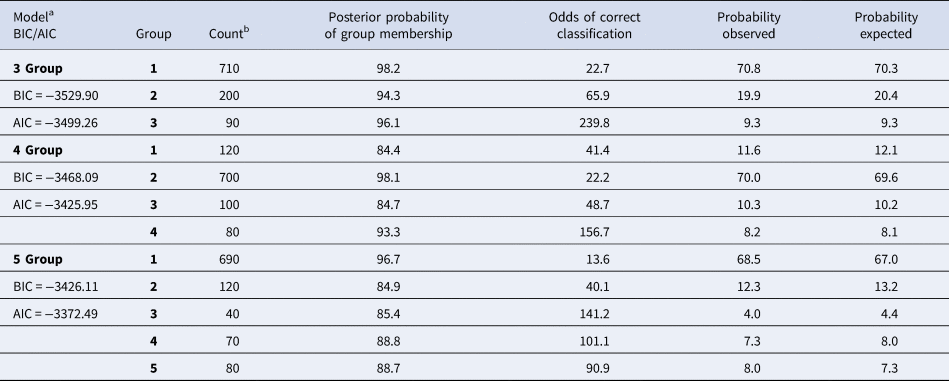
Group-based trajectory modeling was used to estimate trajectories of the annual probability of welfare receipt from age 19 to 36. The probability of welfare receipt was specified as following a quadratic function of age. Of the 1000 participants included in the study, 680 (68%) had tax returns for all 18 years, 850 (85%) for at least 15 years, and 930 (93%) for at least 12 years. Final model selection is based on methodological considerations – namely the Bayesian Information Criterion (BIC) and Akaike Information Criterion (AIC) and model adequacy tests – as well as substantive considerations including model parsimony and the aims of the study (Table 1) (Nagin, Reference Nagin2005).
Model adequacy tests for the three-group model and two next best-fitting models
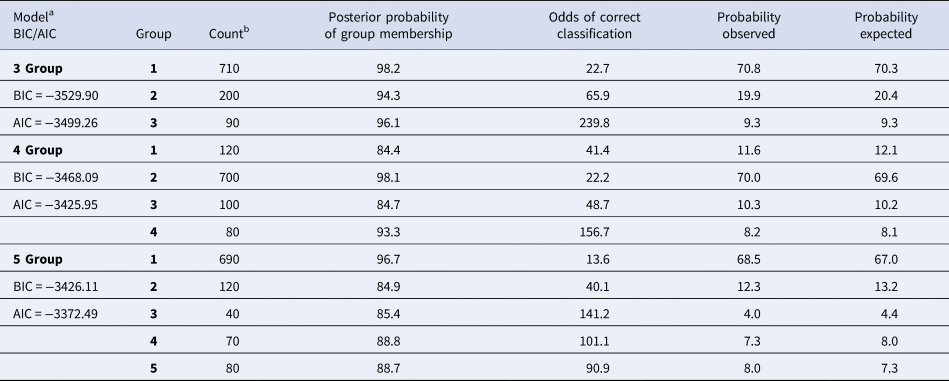
a We used group-based trajectory modeling to identify trajectories of high/chronic welfare receipt among males from low-income backgrounds. A three-group model was selected based on the Bayesian Information Criterion (BIC) and Akaike Information Criterion (AIC) numbers, model adequacy tests, and the overall explanatory power of the model compared to the next best-fitting models (four and five groups). For the three-group model, the average posterior probability of group membership for group assignments based on the maximum posterior probability rule exceeded the 0.7 threshold recommended by Nagin (Reference Nagin2005), passed the odds of correct classification test, and his recommendation that the estimated probability of group membership for each group be close to the proportion assigned to the group.
b Displayed counts are rounded to base 10 in accordance with Statistics Canada's confidentiality (non-disclosure) rules.
Analyses
After confirming the missing at random assumption, missing data were managed using multiple imputations by chained equations. Models were estimated across 50 datasets and the results pooled, with the specification for clustering of scores at the school and classroom levels. Multivariable models were estimated using mixed effects multinomial logistic regression within a generalized structural equation modelling framework with adjustment for clustering at the school and classroom levels based on clustered standard errors. Results are presented as relative risk ratios (RRR). Based on Olivier et al.’s (Reference Olivier, May and Bell2017) criteria, relative risks ratios of 1.22, 1.86, and 3.00 are small, medium, and large effect sizes respectively. Two-way continuous interactions between the five childhood behaviors were examined in a single model after first centering the interaction terms.
A variance inflation factor test of multicollinearity revealed that aggression and opposition were highly correlated, approaching but not exceeding the recommended threshold (>5). As a sensitivity analysis, these variables were standardized then summed to create a single item which was entered into the regression model as a sensitivity analysis. To test whether the number of children living in the household influenced whether welfare support was received, we adjusted for the presence of children and the total number present in the household.
Analyses were conducted using Stata 15. Significance was set at 0.05 and all tests were two-tailed.
Results
Trajectories of welfare receipt
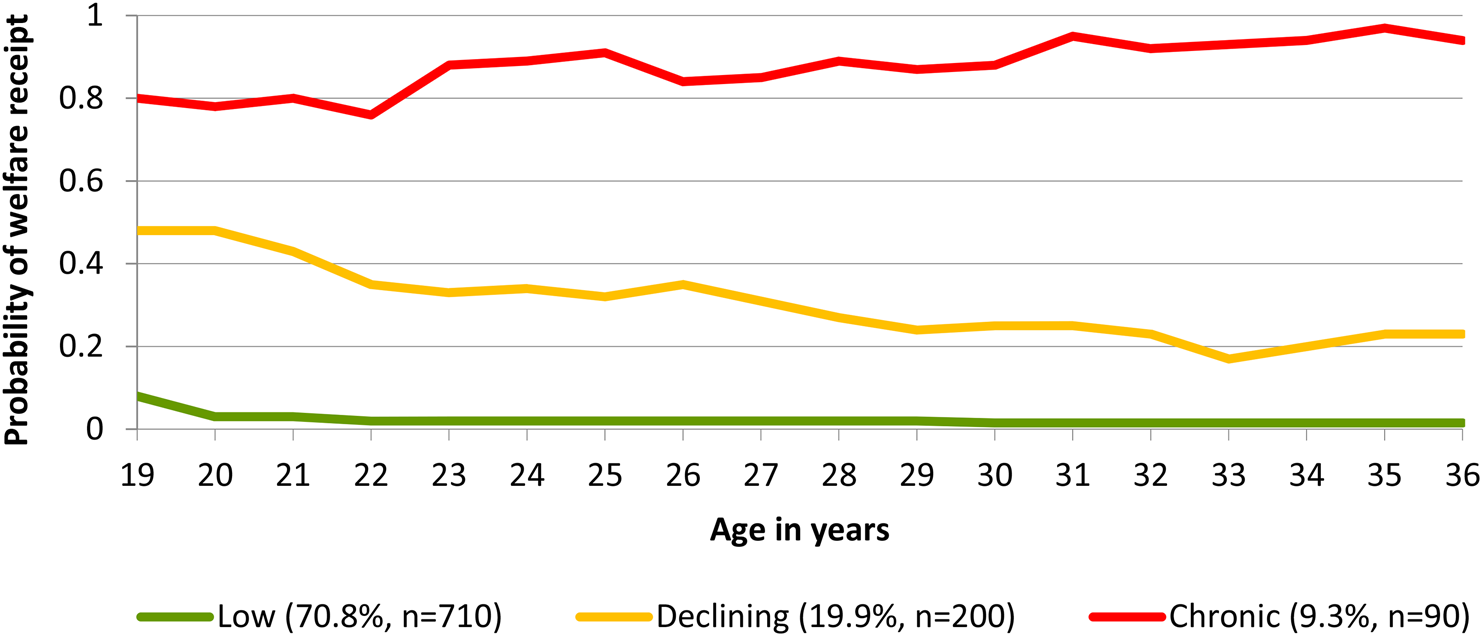
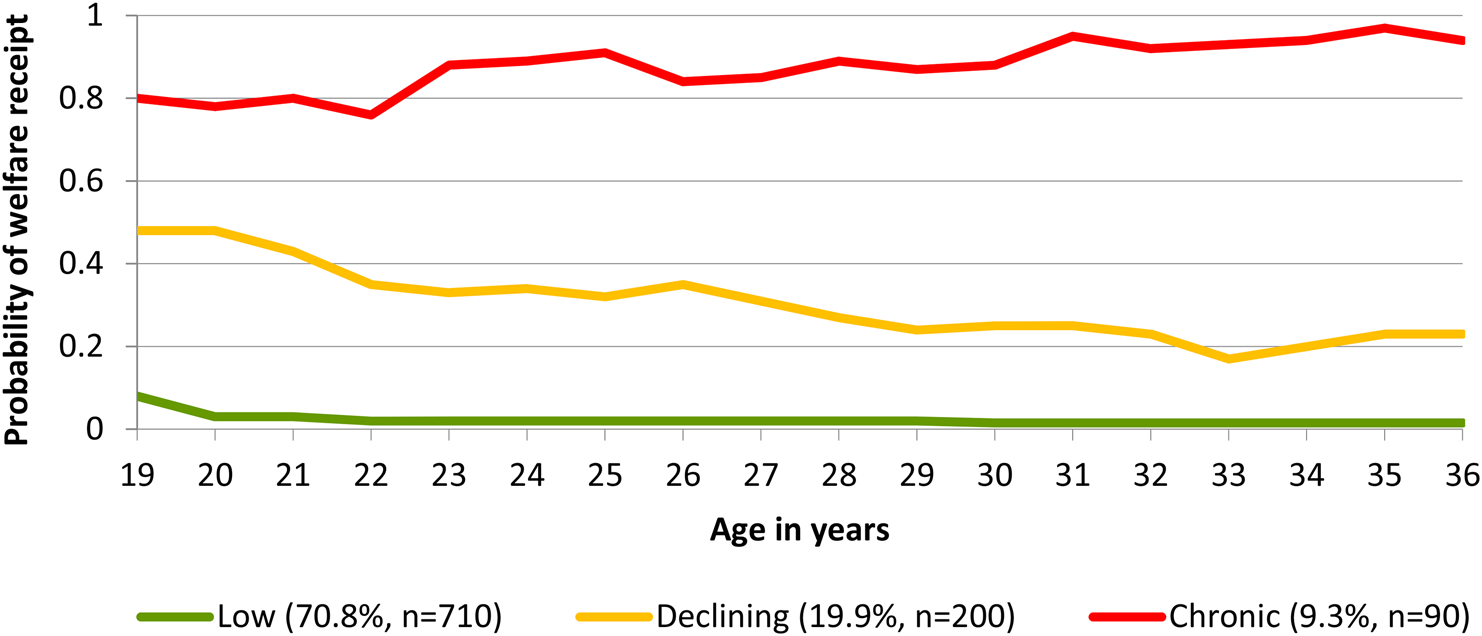
Trajectories of welfare receipt from 19–36 years are shown in Fig. 1. Over the range of 3–5 trajectory groups both BIC and AIC increase with the number of trajectory groups. However, the size of the chronic trajectory group, which is the substantive focus of this analysis, does not materially change. For this reason, we selected the more parsimonious three-group model. Model fit indices are shown in Table 1. The final model was composed of three trajectories of welfare receipt: low (70.8%), declining (19.9%), and chronic (9.3%).
Trajectories of welfare receipt for boys from low income backgrounds. Trajectories represent the probability of receiving any welfare support for each year of follow-up from age 19 to 36 years. Thus, for participants in the chronic group, the probability of receiving support was around 80% at age 19, rising to nearly 100% by their mid-30s, while for participants in the low group, the probability of receiving welfare support was close to zero throughout.
Behavioral predictors of welfare trajectories
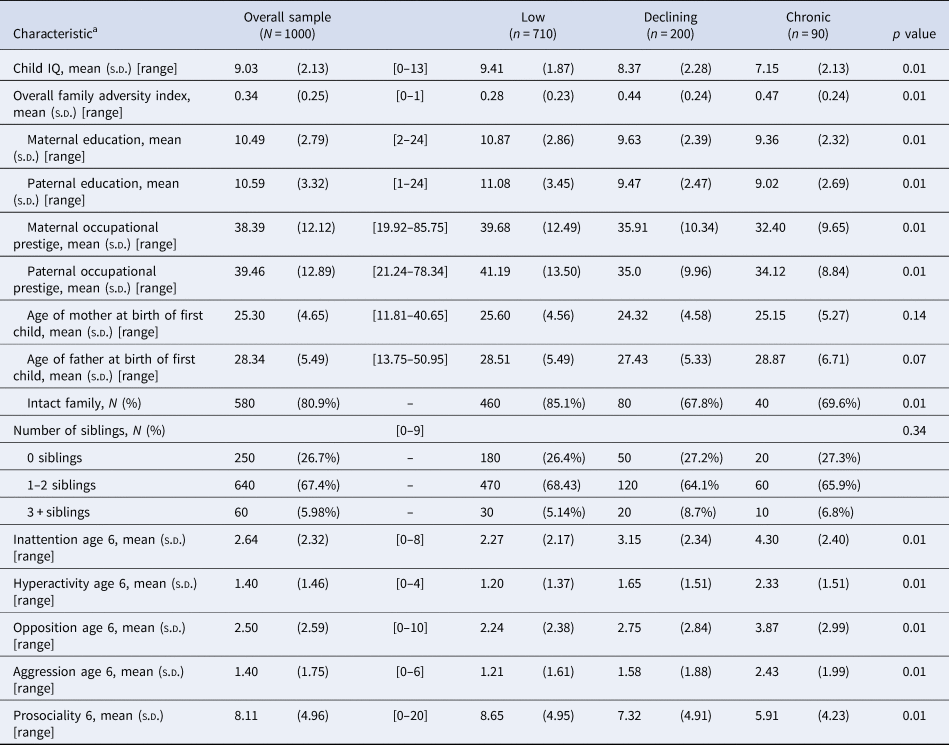
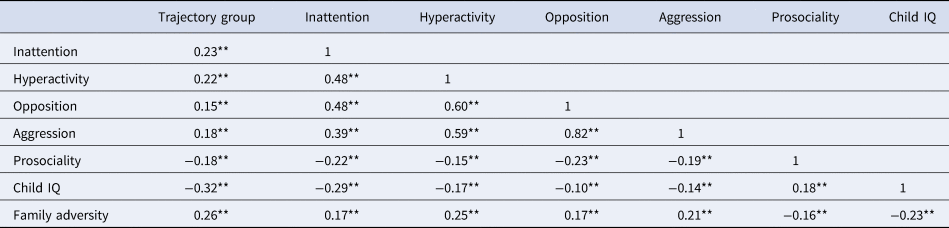
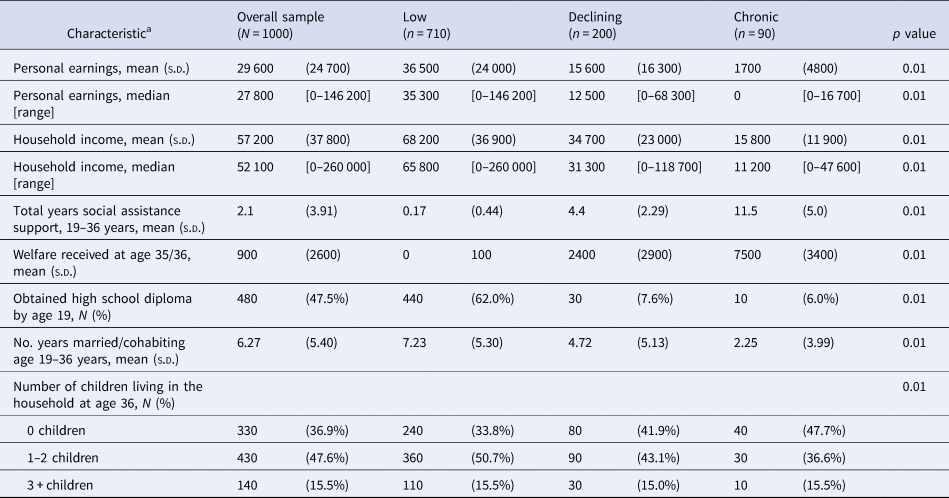
Childhood behaviors and family characteristics for the three trajectory groups are shown in Table 2. Participants in the chronic welfare group had more behavioral problems, lower prosociality, and higher family adversity at baseline compared to the declining and low groups. Bivariate associations for all predictor variables are shown in Table 3. The economic and family characteristics at follow-up for each trajectory group are shown in Table 4. Again, participants in the chronic trajectory, when compared with participants in the low trajectory group, had substantially lower personal earnings ($1700 v. $36 500) and household income ($15 800 v. $68 200), spent fewer years partnered (2.3 v. 7.2 years), were less likely to have obtained a high school diploma by age 19 years (6.0% v. 62.0%), and were less likely to have children living in the household at follow-up (52.3% v. 66.2%).
Personal and family characteristics of the sample at age 6 years by trajectory group
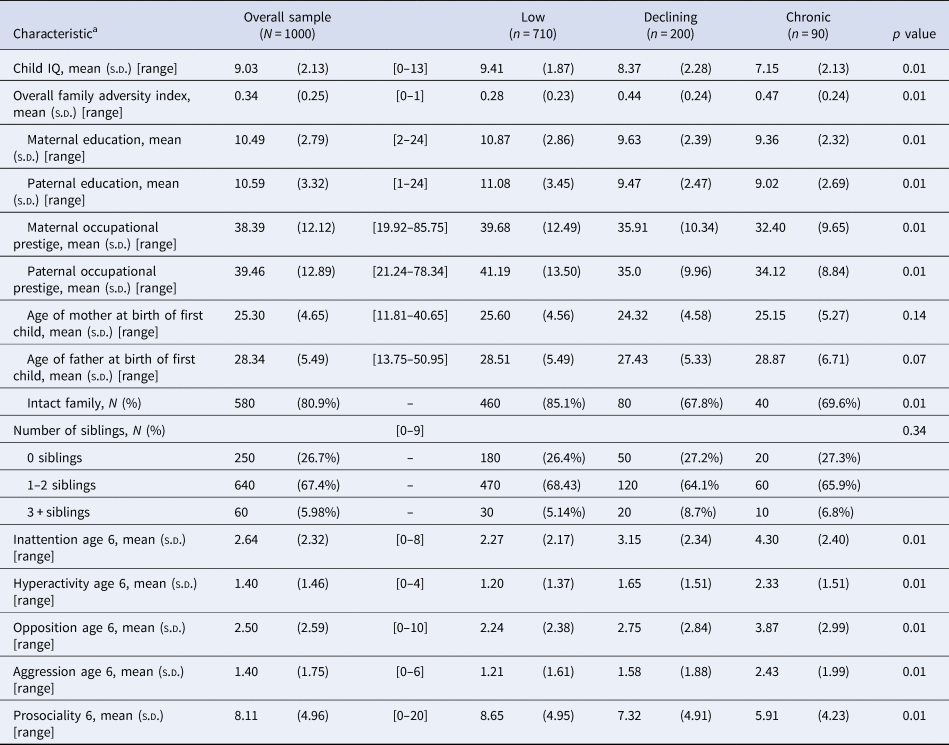
a Up to 12.2% missing data, except for Intact family which had 29.3% missing data. In accordance with Statistics Canada's confidentiality (non-disclosure) rules, percentages are rounded to one decimal point and counts are rounded to base 10. p values based on between-group comparisons using one-way ANOVA for continuous variables and χ2 tests for categorical variables.
Bivariate associations for all variables included in the model
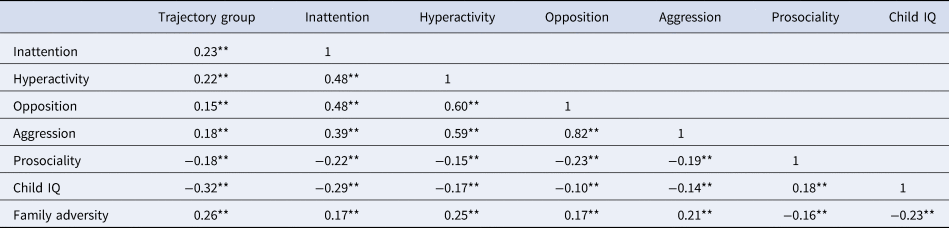
**Significant at the 0.01 level. Trajectory groups coded as low = 0, declining = 1, rising = 2, chronic = 3.
Income and family characteristic at age 36 years
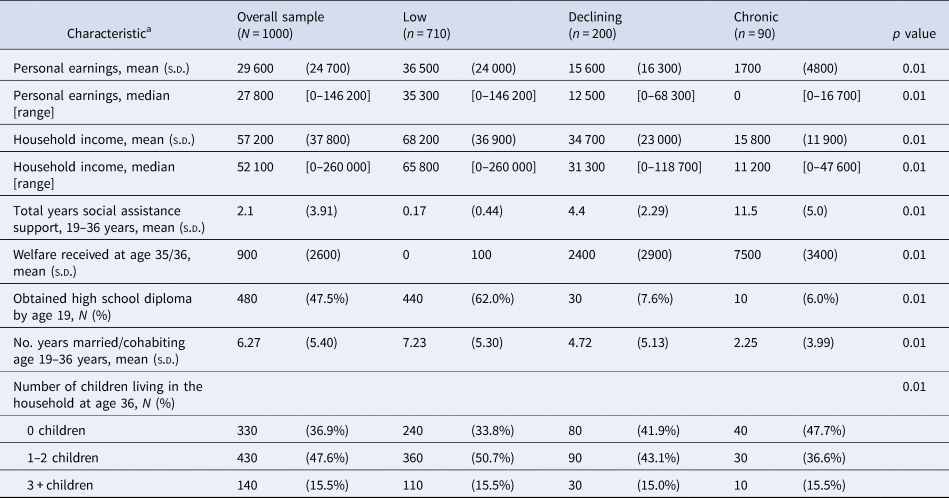
a Up to 3.2% missing data. In accordance with Statistics Canada's confidentiality (non-disclosure) rules, displayed counts are rounded to base 10 and percentages to one decimal point; earnings are rounded to the nearest hundred, and ranges represent the mean of the 5 lowest and 5 highest scores respectively and are therefore a conservative estimate of the upper limit. Personal earnings, household income, and welfare receipt are for the 2014/2015 period shown in US$. p values based on between-group comparisons using one-way ANOVA for continuous variables and χ2 tests for categorical variables.
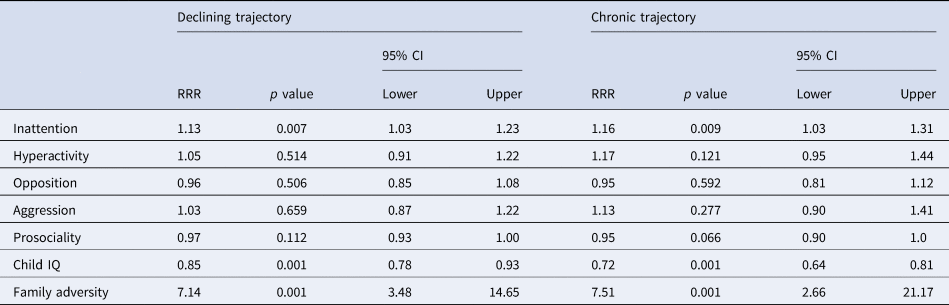
Table 5 shows the mixed effects multinomial logistic regression model comparing the chronic and declining trajectories to the low trajectory. Compared with the low group, boys with higher inattention at age 6 years were more likely to be in the chronic or declining trajectories: a 1-unit increase in inattention (mean = 2.64; s.d. = 2.32, range = 0–8) was associated with an increased risk of 1.16 and 1.13, respectively, holding all other variables constant. Hyperactivity, opposition, aggression, and prosociality were not independently associated with trajectories of welfare receipt. Low child IQ and family adversity were associated with following both chronic and declining trajectories of welfare receipt. No two-way interactions were found. The first sensitivity analysis showed that the combined opposition-aggression variable was not significant and did not alter the results of the overall model (online Supplementary eTable 1). Adjustment for the presence of children, including the number of children present in the household, did not alter the results.
Multinomial logistic regression model of the association between behaviors at age 6 years and welfare trajectory group membership
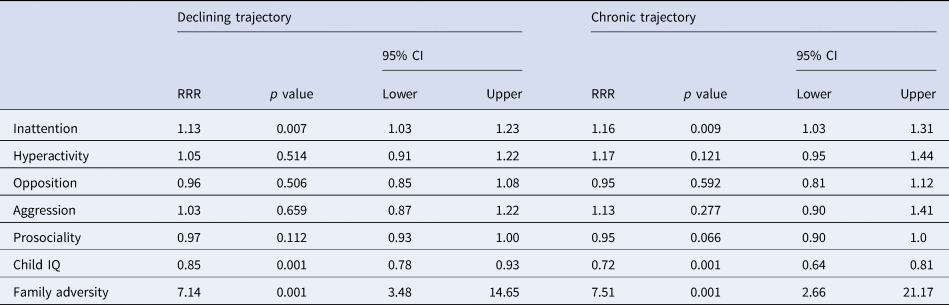
RRR, relative risk ratio; CI, confidence intervals.
Relative risk ratios represent the risk of being in the target group (chronic or declining) relative to the reference (low) group, holding all other variables constant. Based on Olivier et al.'s (Reference Olivier, May and Bell2017) criteria, relative risks ratios of 1.22, 1.86, and 3.00 are small, medium, and large effect sizes, respectively.
Discussion
Drawing on birth cohort data and government tax records spanning three decades, this study is the first to examine associations between childhood behaviors and trajectories of welfare receipt in males from disadvantaged neighborhoods of a large North American city. While more than two thirds received little or no welfare support through early adulthood, nearly one in 10 followed a trajectory of chronic receipt with the probability of receiving support rising from around 80% at age 19 years to almost 100% by 36 years. Chronic welfare receipt was predicted by teacher-ratings of inattention at age 6 years, after adjustment for the child's IQ and family adversity. Hyperactivity, opposition, aggression, and prosociality were not independently associated with trajectories of higher welfare receipt. Overall, the relative risk ratio effect sizes were the largest for family adversity followed by child IQ and inattention.
Studies of trajectories of long-term welfare receipt are scarce. Previous work shows that the proportion of participants following trajectories of chronic welfare receipt vary from 3.8% in a Finnish population sample (Ilmakunnas and Moisio, Reference Ilmakunnas and Moisio2019), to 6.9% for low-income households in South Korea (Kim and Shin, Reference Kim and Shin2014), to 10.1% among African American women living in low-income neighborhoods of Chicago (Juon et al., Reference Juon, Green, Fothergill, Kasper, Thorpe and Ensminger2010). While methodological and contextual differences (e.g. retrospective designs, variable follow-up durations, different legislative jurisdictions) preclude direct comparisons of these results, one of the most consistent findings of these studies is the link between family adversity and high subsequent welfare receipt. The present study confirms this finding but goes further to show that, beyond family adversity, early childhood behaviors represent an additional and independent early risk factor for long-term welfare receipt, and therefore constitute an important target for monitoring and intervention efforts starting in kindergarten (Heckman, Reference Heckman2006).
Previous work has linked early childhood inattention (Feinstein, Reference Feinstein2000; Vergunst et al., Reference Vergunst, Tremblay, Nagin, Algan, Beasley, Park, Galera, Vitaro and Côté2019a, Reference Vergunst, Tremblay, Nagin, Algan, Beasley, Park, Vitaro and Côté2019b), poor socio-emotional skills (Jones et al., Reference Jones, Greenberg and Crowley2015), negative peer relations (Feinstein, Reference Feinstein2000), and low prosocial behavior (Vergunst et al., Reference Vergunst, Tremblay, Nagin, Algan, Beasley, Park, Vitaro and Côté2019b) with lower earnings in early adulthood. We extend these findings to show that inattention, assessed at a single time point in kindergarten, is associated with sustained economic adversity spanning nearly two decades. We found no evidence that externalizing problems in kindergarten – including hyperactivity, aggression, and opposition – were associated with increased risk of following trajectories of higher welfare receipt. Although previous work has linked prosocial behaviors in kindergarten to higher earnings (Vergunst et al., Reference Vergunst, Tremblay, Nagin, Algan, Beasley, Park, Galera, Vitaro and Côté2019a, Reference Vergunst, Tremblay, Nagin, Algan, Beasley, Park, Vitaro and Côté2019b), it was not associated with lower rates of welfare use in this study, although prosociality approached but did not pass the significance threshold. The failure to find significant interactions between behaviors is consistent with at least two previous studies (Knapp et al., Reference Knapp, King, Healey and Thomas2011; Vergunst et al., Reference Vergunst, Tremblay, Nagin, Algan, Beasley, Park, Galera, Vitaro and Côté2019a).
No previous study to our knowledge has linked childhood externalizing behaviors and conduct problems to future welfare use, although several have linked these traits to earnings, with mixed results. Some studies have linked these behaviors to lower earnings (Healey et al., Reference Healey, Knapp and Farrington2004; Fergusson et al., Reference Fergusson, Boden and Horwood2013), others report no association (Jones et al., Reference Jones, Greenberg and Crowley2015; Vergunst et al., Reference Vergunst, Tremblay, Nagin, Algan, Beasley, Park, Galera, Vitaro and Côté2019a), and one found they were associated with higher earnings, at least for economically active males (Knapp et al., Reference Knapp, King, Healey and Thomas2011). These differences may be explained by inconsistent methodologies including the age at which aggression was assessed (e.g. early v. late childhood), the measurement tools used (e.g. combining multiple behaviors across multiple years), and the behaviors included in the model. Taken together with other recent evidence (Jones et al., Reference Jones, Greenberg and Crowley2015; Vergunst et al., Reference Vergunst, Tremblay, Nagin, Algan, Beasley, Park, Vitaro and Côté2019b), our findings suggest that inattention, at least when assessed at a single time point in kindergarten, is a more powerful predictor of future economic circumstances than are externalizing behaviors.
Family adversity at age 6 years was by far the strongest predictor of a child's future welfare receipt. This finding is consistent with a rich literature documenting the association between childhood poverty and poor social and economic outcomes in adulthood (Duncan et al., Reference Duncan, Yeung, Brooks-Gunn and Smith1998; Wagmiller and Adelman, Reference Wagmiller and Adelman2009), and as such is unsurprising. But the finding underscores, once again, the importance of reducing childhood adversity as a means of enhancing the life prospects of children and strengthening social and economic participation.
Effect sizes for behaviors were in the small range. This is unsurprising given the focus on specific behaviors based on a single assessment made in kindergarten and the long duration of follow-up, and they are therefore likely to be conservative estimates. In practical terms, however, the effect represents the differences between no welfare use and chronic receipt across nearly two decades, which are strikingly different outcomes. Furthermore, the effect size concerns only welfare receipt and does not consider the wider potential public health benefits that early intervention and support for disruptive behaviors might deliver. It is notable that participants in the chronic trajectory group, compared with the low trajectory group, had lower household income ($68 200 v. $15 800), were much less likely to have obtained a high-school diploma by age 19 (6.0% v. 62.0%), and spent fewer years married or partnered during follow-up (2.3 v. 7.2 years), indicating diminished opportunities for participation, greater social and economic marginalization, and a weakened safety net in the face of adverse life events.
Several mechanisms may underlie the associations observed in this study. Previous work demonstrates that inattention predicts poor peer relations (Mrug et al., Reference Mrug, Molina, Hoza, Gerdes, Hinshaw, Hechtman and Arnold2012), antisocial behavior in adolescence (Thapar et al., Reference Thapar, van den Bree, Fowler, Langley and Whittinger2006), substance dependence (Pingault et al., Reference Pingault, Côté, Galéra, Genolini, Falissard, Vitaro and Tremblay2013), and low education attainment (Pingault et al., Reference Pingault, Tremblay, Vitaro, Carbonneau, Genolini, Falissard and Côté2011), which can harm occupational attainment and performance, leading to lower earnings and increased need for welfare support. Compared to hyperactivity and aggression, which typically decline across development, inattention symptoms are relatively stable from infancy through late adolescence (Vergunst et al., Reference Vergunst, Tremblay, Galera, Nagin, Vitaro, Boivin and Côté2019c) and could impact directly on occupational adjustment, performance, and earnings, and consequently increase the need for welfare support. It is striking that only 6% of participants in the chronic trajectory had obtained a high school diploma by age 19, which represents a significant barrier to obtaining more skilled and often better paid jobs.
This study has several implications for early behavior monitoring and support. First, behavior assessments should begin in kindergarten where they can be inexpensively administered by teachers in a context that lends itself to epidemiological surveillance (nearly all children attend kindergarten). Second, teachers have a sense of normative behavior and their behavior ratings have been shown to have good reliability and predictive validity across a range of outcomes (Pingault et al., Reference Pingault, Tremblay, Vitaro, Carbonneau, Genolini, Falissard and Côté2011, Reference Pingault, Côté, Galéra, Genolini, Falissard, Vitaro and Tremblay2013). Third, where intervention is indicated, early initiation will minimize the accumulation of negative life events (e.g. school failure, peer rejection, delinquent behavior, substance dependence) and enhance the likelihood of intervention success (Heckman, Reference Heckman2006). For children aged 5–8 years, interventions that reduce inattention (Diamond and Lee, Reference Diamond and Lee2011; Shaw et al., Reference Shaw, Hodgkins, Caci, Young, Kahle, Woods and Arnold2012) and promote prosocial behaviors (Durlak et al., Reference Durlak, Weissberg and Pachan2010, Reference Durlak, Weissberg, Dymnicki, Taylor and Schellinger2011) should enhance social integration, education attainment, and economic participation, especially for males.
Strengths and limitations
To our knowledge, this is the first study to examine the association between childhood behaviors and trajectories of welfare receipt. The approach provides a more complete picture of individual economic circumstances over time and eliminates the problem of brief fluctuations and random noise that arise from using snapshots taken at a single time point. The study strengths are its long duration of follow-up (30 years), prospective design, large sample size, objective measurement of welfare receipt, and its focus of specific behavioral predictors in early childhood.
Several limitations should be highlighted. This study did not examine mechanisms underlying the observed associations. Future studies should examine mediating and moderating (protective/promotive) factors so that they can be included in the development of targeted intervention programs. Annual welfare receipt was coded dichotomously (received v. not received) and therefore represents the probability of receipt rather than the dollar amount received by individuals. Furthermore, this study focused on males from low income backgrounds – who are more like to have early behavioral problems and to face lower lifetime earnings – which reduces the generalizability of findings. Future work should examine welfare trajectories in population samples that include males and females. Finally, the associations observed in this study are based on assessments made at a single time point, which is practical from a screening and early intervention point of view; however, their robustness should be confirmed using assessments across multiple time points.
Conclusions
Kindergarten teachers can identify boys from low socioeconomic backgrounds at risk of chronic welfare receipt independent of their IQ and family background. Boys from low-income backgrounds who are high in inattention should be monitored from kindergarten onwards and should be offered preventive interventions and support.
Supplementary material
The supplementary material for this article can be found at https://doi.org/10.1017/S0033291719002058
Acknowledgements
We are grateful to Helene Beauchesne and Lucille David for the supervision of data collection, and Lyse Desmarais-Gervais, Pierre McDuff, Muriel Rorive, Hélène Beaumont and Qian Xu for management of the databank.
Financial support
This study was conducted with support from the Quebec's CQRS and FCAR funding agencies, Canada's NHRDP and SSHRC funding agencies, the Molson foundation, the National Consortium on Violence, and Statistics Canada. Francis Vergunst was funded by a Fonds de Recherche du Québec Santé (FRQS) postdoctoral fellowship. Yann Algan received funding from the European Research Council under the European Union's Horizon 2020 research and innovation program (Grant Agreement no.647870). Sylvana M Côté received funding from the Initiative of Excellence (Idex) University of Bordeaux via the Origin Chair.
Role of the funder/sponsor
The sponsors had no role in the design and conduct of the study; collection, management, analysis, and interpretation of the data; and preparation, review, or approval of the manuscript; and decision to submit the manuscript for publication.
Conflict of interest
None.