INTRODUCTION
Individuals who suffer from Amyotrophic lateral sclerosis (ALS) usually die from respiratory failure. Non-invasive ventilation (NIV) can palliate symptoms of respiratory failure; improve quality of life (QOL), and somewhat increase survival (Lo Coco et al., Reference Lo Coco, Marchese, Pesco, La Bella, Piccoli and Lo Coco2006; Lechtzin et al., Reference Lechtzin, Scott, Busse, Clawson, Kimball and Wiener2007). However, long-term mechanical ventilation (LTMV) via a tracheotomy remains the only means to prolong the life of individuals with ALS by many years (Borasio & Voltz, Reference Borasio and Voltz1998). Nevertheless, many ALS patients are unable to tolerate using NIV or simply refuse any means to palliate symptoms of respiratory distress.
Very little empirical data exists concerning how individuals with ALS actually make decisions about assisted ventilation. Young et al. (1993) explored patients' perspectives of assisted ventilation and described a number of factors pertinent to decision-making. However, the study was carried out when the use of NIV was not yet common practice.
The clinical consensus on factors that are important for decision-making and assisted ventilation is largely based on years of clinical experience in caring for ALS patients (Mitsumoto et al., Reference Mitsumoto, Bromberg, Johnston, Tandan, Byock, Lyon, Miller, Appel, Benditt, Bernat, Borasio, Carver, Clawson, Del Bene, Kasarskis, Legrand, Mandler, McCarthy, Munsat and Newman2005) and may make assumptions about factors that are important to them and their families. The paucity of empirical data may influence how and what information is provided in the clinical setting, thereby introducing a bias in the recommendations that impact patient decisions.
The purpose of this research is to explore the experience of decision-making about assisted ventilation for ALS patients. We chose, as a target population, ALS patients followed at a Canadian ALS clinic, which cares for close to 200 people with ALS. Of these patients, approximately 3% use LTMV and 14.5% use NIV. The clinic offers access to a specialized multidisciplinary team to assist with symptom management and liaise with publicly-funded agencies that provide home services. The publicly-funded health care system covers the actual cost of the ventilatory equipment and the professional services associated with home ventilation.
METHODS
Within the scope of qualitative methodologies, a phenomenological approach using individual, semi-structured, in-depth interviews was chosen. Phenomenology is distinct in that it assumes that there is an essence to shared experience and that there exists basic elements in the phenomenon under study (Wimpenny & Gass, 2000; Patton, Reference Patton2002). Accordingly, this approach facilitated understanding of the common elements when people with ALS consider exploring treatment options to manage respiratory symptoms. At the same time, it revealed the unique features of every individual case.
A maximum variation sampling strategy was used (Wimpenny & Gass, 2000). As such, patients were approached for participation in the study to ensure diversity of age, gender, ALS type, speed of progression, or choice of strategy to manage respiratory symptoms. Consideration was also given to whether potential participants gave the impression that they would have something to say on the topic in question and could elaborate on their experience. Only individuals with whom discussion pertaining to treatment choice for respiratory failure was documented, and who's forced vital capacity (FVC) was below 60% of the person's predicted value, were recruited for the study. These criteria ensured that potential participants had already considered the various strategies available to manage respiratory symptoms and were able to reflect on the experience of breathing difficulties and consider interventions for symptom control. Prior to enrolment of participants, Research Ethics Board approval was granted and consent was obtained from each participant.
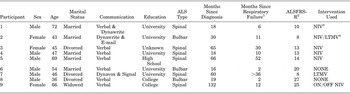
From January to July 2006, a total of 10 semi-structured interviews were conducted with nine participants. The sample included six men and three women. One woman was interviewed twice: once while she was using NIV intermittently and again after she had initiated LTMV to explore possible differences in her decision-making process regarding the two methods used to manage respiratory failure. Six individuals were using NIV: some at night only, some intermittent during the day and night, and one participant used the NIV continuously except for brief moments when eating. Two participants were using LTMV, and two were not using any form of assisted ventilation at the time of the interview. Table 1 illustrates the characteristics of the nine participants interviewed.
Characteristics of the participants

1Respiratory Failure: Forced Vital Capacity below 60% of the person's predicted value.
2Amyotrophic Lateral Sclerosis Functional Rating Scale, Revised.
3Non-invasive ventilation.
4Long term mechanical ventilation.
Each one-hour interview was conducted in the participant's home. An interview guide with open-ended questions allowed for exploration of the person's values, emotions, understanding, and experience pertaining to management of respiratory failure. In some cases, family caregivers were present and participated in the interview to facilitate communication and expression of the thoughts of the person with ALS.
The interviews were tape recorded and transcribed by the interviewer verbatim. Each transcript was examined for significant statements related to the decision-making process for management of respiratory failure. As data collection and analysis continued, categories of significant statements were grouped together and themes were identified. Participants (or, if they had died, their caregivers) confirmed the emergent themes.
POTENTIAL LIMITATIONS OF METHODS
As an occupational therapist working in the ALS clinic for more than 10 years, the interviewer knew the participants already. Even though precautions were taken to distinguish this person's clinical and research roles, some aspects of her clinical role may have influenced the findings. Nevertheless, other advantages may offset this limitation, such as her ability to overcome the specific impediments to communication of each of the participants.
RESULTS
Six main themes emerged that are pertinent to decision-making about assisted ventilation: (1) the meaning of the intervention, (2) the importance of context, (3) the importance of values, (4) the effect of fears, (5) the need for information, and (6) adaptation to or acceptance of the intervention.
The Meaning of the Intervention
Participants distinguished clearly between what NIV and LTMV represented to them. NIV was considered as a means to relieve symptoms of respiratory failure, “…a way of helping me, like my chair helped me to move around, this will help me… [Breathe better?] Yes.” One participant compared NIV to a pacifier because it was so soothing to him. In contrast, except for two participants who denied knowing anything about the use of LTMV, the people interviewed considered LTMV as a choice between life and death.
Participants expressed that NIV offered advantages of being non-invasive, having no risks, and being easy to introduce or discontinue. In contrast, the invasiveness of LTMV was a deterrent, as was the perception that the machine took over their breathing. Many participants associated LTMV with being on the verge of dying, restricted to a bed, and unable to move around or engage with others. For all participants, the importance of being in control of their condition was emphasized. With respect to both NIV and LTMV, fears of developing a dependency toward the machine and triggering a more rapid deterioration of the ALS were mentioned.
The Importance of Context
All participants discussed how assisted ventilation limited their functional status. For some, trying to anticipate future disabilities was very problematic and affected their choice of interventions. For others, it kept them undecided: “…‘let's leave the trach as a possibility’. We're not saying ‘no’ to it but… I would probably be paralyzed, and unable to talk, and unable to eat. I would only be able to see and think. I would not wish this life.”
The need for support (e.g., the availability of subsidized adaptive equipment, accessible housing, family and community support) affected choices about assisted ventilation for all participants.
Some participants discussed financial implications; however, these implications appeared to be more of a preoccupation for the people with ALS than for their family.
The Importance of Values
Ability to communicate, relationships, autonomy, life, and QOL were some of the values that affect decision-making.
Ability to Communicate
The value of communication was emphasized by everyone interviewed and the ability to communicate was identified as the most important factor in deciding about treatment options to manage respiratory failure. As one participant commented: “…as long as I can properly communicate with my voice, my eyes or a machine or whatever, I want to have a respirator… But as soon as I can no longer communicate, that's it! I don't want anything else to be done.”
Relationships
All participants discussed how relationships with significant people impacted their decision-making. Participants discussed their options with the people close to them and wanted their opinion. The pleasure and sense of purpose that results from significant relationships were considered. A desire to protect loved ones (e.g., from responsibilities associated with caregiving) influenced participants' decision-making as did worries about becoming a burden and caregiver burnout.
Autonomy
All participants and family members emphasized the importance of self-determination in decisions about assisted ventilation. Those with ALS reported valuing their decisional autonomy, wanting to be involved and respected in the decision-making process, and wanting to have the final say in what interventions they would try.
All but one participant stated that they felt the decision to use assisted ventilation was their own even though they had considered the opinion of others. One person uniquely perceived that the disease itself had taken away his autonomy; he felt he had no control over his decision to use assisted ventilation and in fact used NIV nearly continuously, pausing for brief periods when eating.
Family members, while consistently endorsing the participants' right to self-determination, discussed needing some guidance about how to follow through with those wishes, both in the current situation and in their future role as surrogate decision-maker. In some cases, tensions within the family were noted when family caregivers wanted persons with ALS to make decisions about how to manage the illness but the person with ALS did not feel ready to do so.
Life
The value of life and the will to live were clearly important for decision-making. All participants talked about not being ready to die. One explained that: “Any living person's will to survive is primordial and outweighs many other concerns or reasons.” A few participants raised the issues of assisted suicide and euthanasia to emphasize that they thought these were not acceptable options. Others stated that discontinuation of assisted ventilation is acceptable when communication became impossible.
Quality of life
All participants talked about the affect of QOL (including the ability to communicate, eat, move around, and be surrounded by loved ones) on decisions about assisted ventilation. Some talked about where one lived as affecting QOL. One anticipated regretfully that “with a tracheostomy, I'm stranded to a nursing home.”
The Effect of Fears
Fears brought on by the imminence of death were felt by all participants. The main fears that affected their decisions about assisted ventilation were about respiratory failure, choking, running out of air, discomfort, disease progression, being a burden, and how and when they would die. In fact for many, the fears of the process of death and respiratory distress were greater influences on their decision-making than the fear of death itself. Ideation about death and fear pertaining to the process of death came particularly at night for some and indirectly motivated the use of assisted ventilation. “… [before NIV] you cannot sleep, you think demons come out in the night, whatever unlikely or unthinkable occurs to you in the night when you can't sleep or even move your limbs make you feel you are in a grave or a casket. You are completely at the mercy of others, a virtual prisoner in your own body.” For participants, NIV or LTMV ensured a better sleep, and as a result ideations and fears of death were lessened once these interventions were initiated.
The Need for Information
The participants described a variety of information needs. Some wanted to know how death from respiratory failure usually proceeds. Participants who used assisted ventilation emphasized the need for regular contact and sustained information since ALS is a degenerative condition. Even if they felt well informed, some participants had a poor understanding of how respiratory symptoms, NIV, or LTMV could impact their daily life. Some believed that LTMV required them to be bed-bound in a nursing home. Misconceptions about the technical aspects of assisted ventilation were revealed as well.
There was agreement that timing and how information was delivered affected decisions made. However, there was no consensus regarding the best time and method to provide information. Most people with ALS said that they did not want information before it was needed to make decisions, because information tended to discourage them. In contrast, for family members, information was a means to feel empowered and in control, and so they emphasized needing information about ALS, its symptoms, and management strategies at the onset of the disease.
Adaptation To or Acceptance of the Intervention
Decision-making about assisted ventilation for worsening ALS involves repeated steps of adaptation and acceptance. Despite ALS having a relatively predictable disease trajectory, whether by lack of knowledge or lack of accommodation, some experienced disease progression as unpredictable and ungrounding. As one person noted “…with ALS there's no ruler…to measure where you're at…. It's not being able to know what's normal or what's next.” Many participants referred to the numeric value of their FVC to objectify their need for an intervention. They also discussed how they had to confirm, often by a trial period, that an intervention did in fact improve their symptoms before deciding to continue using it.
All the participants who used assisted ventilation discussed the process of acceptance of assisted ventilation. The interviews highlighted that acceptance was intervention-specific. The decision to use NIV typically followed some kind of a crisis situation. The crisis could be a sudden worsening of respiratory distress that required a trip to the hospital, or it could be indirect effects of respiratory failure such as frequent awakenings with disturbing nightmares. In contrast, participants who had considered using LTMV preferred that it be planned ahead to avoid intubation in a crisis situation.
Acceptance of any form of assisted ventilation was a lengthy process that involved gradual familiarization with the equipment. Acceptance was facilitated if the person could gradually come to grips with the idea before being confronted by the equipment itself. This pattern was similar to their process of accepting other assistive devices, such as a walker or a wheelchair.
DISCUSSION
Collectively, the findings illustrate factors pertinent to decision-making about assisted ventilation from the perspective of ALS patients who had experienced such decision-making followed at a Canadian ALS clinic. In light of the small sample size and the qualitative nature of this study, the findings cannot be generalized to other clinical settings, yet the findings may resonate with other ALS patients, caregivers and health professionals who are similarly situated. While there was much similarity among experiences and opinions of these research participants (e.g., about the importance of others, context, and the effect of fears in decision-making), some variations (e.g., the degree of autonomy experienced during decision-making) were also noted.
This research supports the underlying assumption of the American Academy of Neurology that high priority should be placed on patient autonomy in the therapeutic relationship (Miller et al., Reference Miller, Rosenberg, Gelinas, Mitsumoto, Newman, Sufit, Borasio, Bradley, Bromberg, Brooks, Kasarskis, Munsat and Oppenheimer1999). However, where participants vary in their preferred approach to decision-making (a sign that autonomy plays out differently for different people), healthcare professionals will need to plan with each patient what supports for decision-making will respect that person's autonomy. The findings also suggest a caution: that an emphasis on the patient as decision-maker can give rise to moral tensions, for example, between the individual with ALS and family members, or within one individual when conflicting values lead to a moral impasse.
Participants' current and anticipated physical status affected decisions about assisted ventilation. Functional capacity both triggered a decision-making process about management options, and factored heavily into how the options were assessed. Similarly, Young et al. (Reference Young, Marshall and Anderson1994) found that the severity of disability was identified as the second most important factor influencing decisions about assisted ventilation. For many participants, the ability to communicate was the most important factor in deciding whether to use (or continue) assisted ventilation. Other studies (Hirano et al., Reference Hirano, Yamakzaki, Shimizu, Togari and Bryce2005; Hecht et al., Reference Hecht, Hillemacher, Gräsel, Tigges, Winterholler, Heuss, Hilz and Neundörfer2002) also confirm this finding.
The importance of the meaning participants attributed to the interventions was central to their decision-making. Our participants tended to perceive LTMV as an artificial means to go on living whereas NIV was perceived as assisting their natural breathing. Dependence upon an artificial form of respiration, when one's natural ability to breathe ceased, was a compelling reason for many to reject LTMV. This was so notwithstanding the relevant differences with respect to risks, financial costs, and technical and caregiving requirements that each entails.
Our participants' decision-making included considerations for how decisions would impact the significant people in their lives. In addition, societal influences, such as, availability of adapted equipment, accessible housing, and home care services were considered. The influence of these factors may result, in part, from their impact on QOL, as noted in a recent study by Foley et al. (Reference Foley, O'Mahony and Hardiman2007) where participants confirmed that services and support received contribute to well being and coping.
Our participants also talked about how both positive emotions (such as love and wanting to protect others) and negative emotions (such as fear related to choking, dying of respiratory distress, or being locked in) were influential in decision-making. Importantly, the inclusion of all these influences in deliberation illustrates a process of decision-making that is neither wholly rational nor self-interested. These participants consistently and explicitly presented themselves as embodied, socially-situated persons whose decision-making necessarily was informed by the many factors that touched that self-understanding.
Healthcare professionals must recognize that ALS patients and family members may have different information and support needs. In our study, patients' preferences about information and decision-making seem to be tied to the progression of the disease, whereas family members needed information and support on a different time-table that anticipated and prepared them for what may occur as the ALS progresses.
Being guided by those we interviewed, we suggest health professionals consider adopting a therapeutic approach that considers the existential components of the decision-making process, as well as the physical and emotional elements that are currently the main focus of attention in the medical profession. The findings from this study support modifications to clinical practice to assist patients with decision-making about assisted ventilation, and to assist caregivers in their supportive roles. Healthcare professionals who want to facilitate decision-making about assisted ventilation must provide patients and families with relevant scientific evidence and help them to assess that evidence in light of risks and benefits of the interventions. They must also address other factors that impact the needs and interests of the patient and family (such as patients' specific context, definition of QOL, fears, and the impact of interventions on significant relationships), in a manner suited to each patient and family. When to start discussions about assisted ventilation and which information to provide should be tailored to each patient's and family's decision-making process. These discussions should occur periodically at major milestones throughout the disease to account for their changing information needs.
There is a need for further research concerning the numerous factors that may affect decision-making about assisted ventilation for individuals with ALS and the extent to which these factors are being addressed by health care professionals.
ACKNOWLEDGMENTS
The authors thank all the individuals with ALS and their caregivers who so generously donated their time and energy to participate in our research. Thank you as well to the (Montreal Neurological Hospital ALS clinic staff) for their own enthusiasm for this research and for facilitating recruitment of study participants, and to the McGill Qualitative Health Research Group for valuable feedback with respect to study design.