Introduction
Horseweed, also known as marestail, is a common weed found in pastures, agricultural fields, riparian areas, and roadsides in Oklahoma and throughout the entire United States. It is native to North America (Holm et al. Reference Holm, Doll, Holm, Pancho and Herberger1997) and a member of the Asteraceae (Gleason and Cronquist Reference Gleason and Cronquist1963). It is an erect herb, growing up to 2.5-m tall. It has a panicle inflorescence with individual capitula containing yellow disk and white ray flowers. When fertilized, these capitula can produce thousands of tiny seeds. Like many members of the Asteraceae, these seeds have an attachment known as a pappus that aids windblown seed dispersal (Weaver Reference Weaver2001).
According to a survey conducted by the Weed Science Society of America in 2017, horseweed is considered the third most problematic weed for row crop producers in the United States (WSSA 2017). Horseweed has many adaptive abilities that contribute to its success as a weed. A study using paraquat resistance as a marker found that less than 5% outcrossing occurred during horseweed reproduction. Therefore, self-pollination occurs more readily because the majority of flowers are pollinated prior to the capitula fully opening (Smisek et al. Reference Smisek, Doucet, Jones and Weaver1998). Horseweed plants can produce up to 200,000 seeds per single plant and these can then be dispersed up to 122 m downwind (Bhowmik and Bekeck Reference Bhowmik and Bekech1993; Regehr and Bazzaz Reference Regehr and Bazzaz1979). Horseweed seed is unique in that it has no dormancy period; thus, once the seed contacts the soil surface, it can germinate if conditions are suitable (Buhler and Owen Reference Buhler and Owen1997). Therefore, although horseweed is traditionally considered a winter annual, it can behave like a summer annual under certain conditions (Buhler and Owen Reference Buhler and Owen1997; Weaver Reference Weaver2001).
Though horseweed has many attributes that make it successful, traditionally it has not been considered a major agronomic pest, because of its susceptibility to tillage (Bhowmik and Bekeck Reference Bhowmik and Bekech1993). However, since conservation tillage and no-till acres have increased, horseweed has become one of the most problematic weeds for farmers involved in these systems (Brown and Whitwell Reference Brown and Whitwell1988; VanGessel Reference VanGessel2001). As mechanical control of this plant decreases, chemical management often increases, further selecting for herbicide-resistant biotypes and ultimately complicating a producer’s weed management decisions. If plants are not managed in wheat, they may lead to unnecessary equipment costs and/or discounts at the elevator due to excessive grain moisture from green plants at harvest or dockage from weed seeds present in harvested grain (Fast et al. Reference Fast, Medlin and Murray2009; Lyon et al. Reference Lyon, Smith and Jones1994).
As of this writing, there are 39 documented, unique cases of herbicide resistance in horseweed in the United States (Heap Reference Heap2019b). Among these documented cases, horseweed is resistant to four herbicide sites of action: photosystem I inhibitors, photosystem II inhibitors, enolpyruvylshikimate-3-phosphate synthase inhibitors, and acetolactate synthase (ALS) inhibitors. In Oklahoma, horseweed resistant to glyphosate and ALS inhibitors have been documented (Heap Reference Heap2019b). Horseweed plants resistant to the ALS herbicides metsulfuron and chlorsulfuon were confirmed from screening populations that occurred in field sites of these studies (data not shown) (Heap Reference Heap2019a).
There are several herbicides available for POST horseweed control in wheat. Still effective, widely used, and one of the oldest synthetic herbicides available, 2,4-D is used for broadleaf weed control on approximately 20% of wheat grown in the southern Great Plains region (USDA-NASS 2018). Similar to 2,4-D, 2-methyl-4-chlorophenoxyacetic acid (MCPA) can be an effective option for horseweed control in wheat; however, control with MCPA alone on horseweed is often less compared with 2,4-D alone or when mixed with another herbicide (Kruger et al. Reference Kruger, Davis, Weller and Johnson2010; Mahoney et al. Reference Mahoney, McNaughton and Sikkema2016). Similar to 2,4-D, other common synthetic auxins used for horseweed management in wheat include dicamba and fluroxypyr.
Another group of herbicides that can be applied PRE and POST in wheat are those that inhibit the ALS enzyme. Currently, there are 161 recorded weed species that are resistant to ALS herbicides; therefore, this site of action has the largest number of resistant species compared with all other modes (Heap Reference Heap2019c). Horseweed in the United States has been documented to have resistance to three of the five ALS herbicides used in the present study (Heap Reference Heap2019b).
A premix of a new synthetic auxin and an ALS inhibitor, halauxifen-methyl (halauxifen) and florasulam, has been introduced to the market. Halauxifen plus florasulam (Dow AgroSciences, Indianapolis, IN) is applied at a single-use rate of 5.25 g ae ha−1 plus 5.25 g ai ha−1, respectively. Application timing for best control of horseweed is recommended at a height of 10 cm or less (Anonymous 2018). Syngenta (Basel, Switzerland) also has released a new POST broadleaf herbicide in small grains. The premix contains the 4-hydroxyphenylpyruvate dioxygenase inhibitor bicyclopyrone, and bromoxynil, a photosystem II inhibitor. It is labeled for use at 37 to 49 g ai ha−1 bicyclopyrone and 175 to 233 g ai ha−1 bromoxynil. This combination is packaged in conjunction with the spray additive CoAct+™ (Syngenta, Basel, Switzerland) and it is also recommended that a crop oil concentrate at 1% vol/vol be added to the spray mixture. Application timing is recommended for horseweed up to a 7.5-cm rosette (Anonymous 2016). Finally, a new premix being marketed by DuPont (Wilmington, DE) and that contains an ALS inhibitor, thifensulfuron, and a synthetic auxin, fluroxypyr, is labeled for use in wheat, barley, and oat. The maximum rate labeled for a single application is 22 g ai ha−1 thifensulfuron and 114 g ae ha−1 fluroxypyr for weeds 10 cm or smaller (Anonymous 2015).
To effectively control horseweed in wheat will require a combination of newer herbicide chemistries, incorporation of multiple herbicide sites of action, and the application of nonchemical weed control methods. However, as new herbicide products are developed, it is imperative to determine their effectiveness at managing weed populations, evaluate their likelihood of crop injury, and gain a better understanding of how they will perform in different environments across a region. The goal of this study was to evaluate horseweed control with previously available products as well as newer products at three locations across Oklahoma.
Materials and Methods
Field experiments were conducted near Altus, Perkins, and Ponca City, Oklahoma, during the 2016 to 2017 and 2017 to 2018 winter wheat growing seasons (October to June). However, for the purposes of this article, field seasons are referred to as the year in which harvest took place. During the 2017 field season, the Altus site (34.51ºN, 98.99ºW; elevation, 419 m) was planted to wheat, and the Perkins (35.99ºN, 97.04ºW; elevation, 287 m) and Ponca City (36.62ºN, 97.02ºW; elevation, 365 m) sites were fallow. In 2018, the Altus and Ponca City sites were planted to wheat and the Perkins site was fallow. All fields were planted using a grain drill with 19-cm row spacing. The Altus site was on a Hollister silty clay loam soil (fine, smectitic, thermic Typic Haplusterts) with a pH averaging 7.5. The Perkins site consisted of two different soil types: Konawa fine sandy loam with an average pH of 5.8 (fine-loamy, mixed, active, thermic Ultic Haplustalfs) and Pulaski fine sandy loam with a pH averaging 6.5 (coarse-loamy, mixed, superactive, nonacid, thermic Udic Ustifluvents). The Ponca City site was on a Norge silt loam with an average pH of 5.8 (fine-silty, mixed, active, thermic Udic Paleustolls). Soil organic matter at each site was less than 1.5%.
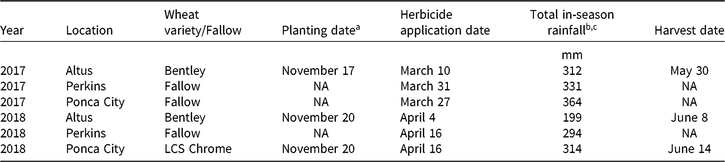
In general, rainfall at each location was less during the 2018 field season as compared with the 2017 field season. During the 2017 field season, Altus received 312 mm of rainfall, Perkins received 331 mm, and Ponca City received 364 mm. In the 2018 field season, Altus received 199 mm of rainfall, Perkins received 294 mm, and Ponca City received 314 mm. For harvested sites, rainfall was calculated from planting date until harvest date. For fallow sites, rainfall was calculated from the herbicide application date until the final rating date (Table 1) (Oklahoma Mesonet 2018).
Agronomic practices and rainfall at Altus, Perkins, and Ponca City, Oklahoma, during the 2016–2017 and 2017–2018 seasons.

a Abbreviation: NA, not applicable.
b All rainfall data collected from the Oklahoma Mesonet (mesonet.org).
c For fallow sites, rainfall was determined from herbicide application timing to final rating. Rainfall for planted sites was determined from planting date to harvest date.
All studies were arranged in a randomized complete block design with three to four replications. Individual plots were 4.1-m wide by 7.6- or 9.1-m long. Horseweed densities per plot ranged from 5 to 300 plants per plot with the average being 30 per plot. Herbicide applications were made using a CO2-pressurized backpack sprayer calibrated to deliver 93 L ha−1 at 4.8 km h−1. All treatments were applied POST. Herbicides treatments are listed in Table 2. Herbicide treatments were applied using water as the carrier and two treatments, (1) halauxifen plus florasulam and (2) halauxifen plus florasulam plus MCPA, were also applied using 28% urea–ammonium nitrate as the sole carrier. All treatments containing an ALS-inhibiting herbicide included a nonionic surfactant at 0.25% vol/vol. Fertilizer application and disease management were standard for wheat grain production in the southern Great Plains (Hunger and Marburger Reference Hunger and Marburger2018; Raun and Zhang Reference Raun and Zhang2006).
Herbicides and application rates for 2017 and 2018 horseweed control trials at Altus, Perkins, and Ponca City, Oklahoma.

a Abbreviation: MCPA, 2-methyl-4-chlorophenoxyacetic acid.
b Rate for 2,4-D when mixed with halauxifen + florasulam.
c Rate for 2,4-D applied alone.
d Rate for dicamba when mixed with halauxifen plus florasulam or metsulfuron.
e Rate for dicamba when mixed with chlorsulfuron plus metsulfuron, thifensulfuron plus fluroxypyr, or applied alone.
f Nonionic surfactant at 0.25% vol/vol was included with all treatments that contained an acetolactate synthase herbicide.
g Rate for MCPA when mixed with halauxifen plus florasulam.
h Rate for MCPA when mixed with metsulfuron plus chlorsulfuron or thifensulfuron plus fluroxypyr.
Weed size at application was variable across sites. It was not uncommon to have larger fall-germinated rosettes mixed in with small spring-germinated rosettes. Size was determined by measuring the width of the rosettes, and all applications, with the exception of Ponca City in 2017 and Altus in 2018, had not reached the bolting stage yet. Visual weed control estimates were recorded approximately every 2 wk beginning at 14 d and continuing to 56 d after treatment (DAT) using a scale of 0% (no weed control) to 100% (complete control). Wheat injury also was evaluated using a scale of 0% (no injury) to 100% (wheat death). Regarding wheat growth stage, all herbicides were applied within the recommended timing per their label and no injury was observed (data not shown); however, weed size was sometimes outside of the recommended labelled timing of the herbicides used.
Wheat was harvested with a Wintersteiger small plot combine (Wintersteiger Inc, Salt Lake City, UT). Because of the presence of glume blotch at the Altus site in 2018, stand height was reduced and, therefore, harvesting with the small plot combine was not possible. Instead, two 3-m rows were harvested per plot using hand-held, battery-powered shears. Samples were later threshed to separate grain from the chaff using a Vogel Nursery Thrasher (Bill’s Welding, Pullman, WA).
Univariate analysis was performed on all responses to test for stable variance (SAS, version 9.4; SAS Institute Inc., Cary, NC). No data sets were transformed, because transformation did not increase stabilization. Data sets were analyzed using PROC MIXED in SAS, with the pdmix 800 macro described by Saxton (Reference Saxton1998), and treatments were separated by Fisher protected LSD at an α level of 0.05. In the model, fixed effects included herbicide treatment and random effects included replication. There was a significant year and location effect (P < 0.05) for horseweed visible weed control 7 to 8 wk after application and wheat yield for all site-years; however, data were grouped by horseweed size at time of application to best condense six site-years of results.
Results and Discussion
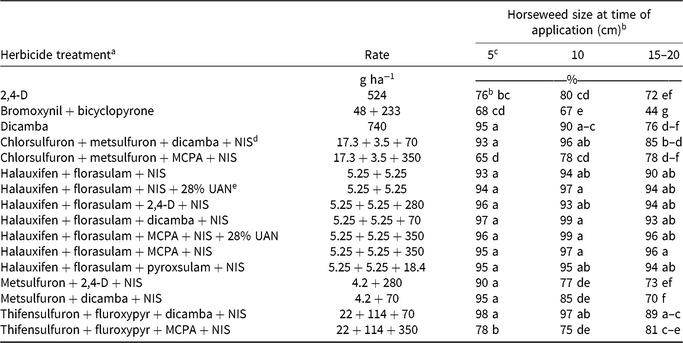
Horseweed rosettes at Altus in 2017 and Perkins in 2018 were approximately 5 cm, on average, at time of application. Horseweed control of 90% or more occurred in all but four treatments (Table 3). Treatments with 90% or greater control included dicamba alone, all seven treatments containing halauxifen plus florasulam, metsulfuron plus dicamba or 2,4-D, and thifensulfuron plus fluroxypyr plus dicamba. The lowest horseweed control (65% to 78%) followed applications of 2,4-D alone, bromoxynil plus bicyclopyrone, chlorsulfuron plus metsulfuron plus MCPA, and thifensulfuron plus fluroxypyr plus MCPA. Mix partner had little effect on horseweed control except that when MCPA was replaced with dicamba in mix with chlorsulfuron plus metsulfuron and with thifensulfuron plus fluroxypyr, control increased by 28% and 20%, respectively.
Percent visual control grouped by horseweed rosette size at time of application after various herbicide treatments 7–8 wk after application in Oklahoma During the 2016–2017 and 2017–2018 winter wheat growing seasons.

a Abbreviations: MCPA, 2-methyl-4-chlorophenoxyacetic acid; NIS, nonionic surfactant; UAN, urea–ammonium nitrate.
b Means within a column followed by a common letter were similar according to Fisher protected LSD at P < 0.05.
c Rosettes of 5 cm were sprayed in Altus in 2017 and in Perkins in 2018. Rosettes of 10 cm were sprayed in Perkins in 2017 and in Ponca City in 2018. Rosettes of 15–20 cm were sprayed in Ponca City in 2017 and in Altus in 2018.
d NIS at 0.25% vol/vol was included with all acetolactate synthase herbicides.
e UAN (28%) was used as the sole carrier for treatments having UAN listed as a component. For all other treatments, water was used as the carrier.
At Perkins in 2017 and Ponca City in 2018, average rosette size was 10 cm. Horseweed control from most treatments were similar and achieved 90% to 100% horseweed control, with 10 treatments reaching greater than 90% control (Table 3). Control in the range of 75% to 80% was achieved after treatment with 2,4-D alone, chlorsulfuron plus metsulfuron plus MCPA, metsulfuron plus 2,4-D, and thifensulfuron plus fluroxypyr plus MCPA. The lowest level of control (67%) followed an application of bromoxynil plus bicyclopyrone. Similar to what was observed at the 5-cm rosette size, dicamba in place of MCPA mixed with chlorsulfuron plus metsulfron or thifensulfuron plus fluroxypyr improved horseweed control by 18% and 22%, respectively; however, this trend did not occur in mixes with halauxifen plus florasulam.
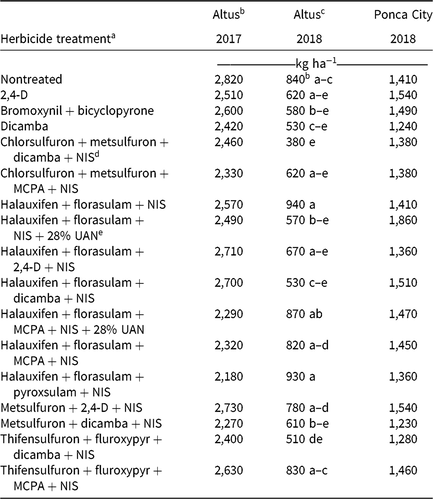
In 2017 at Ponca City and at Altus in 2018, horseweed rosettes at time of application averaged 15 to 20 cm in diameter with some plants starting to bolt. All treatments containing halauxifen plus florasulam and thifensulfuron plus fluroxypyr plus dicamba controlled horseweed similarly, with control ranging from 89% to 96% (Table 3). Chlorsulfuron plus metsulfuron plus dicamba and thifensulfuron plus fluroxypyr plus MCPA controlled horseweed 85% and 81%, respectively. The following treatments achieved 70% to 78% control: 2,4-D alone (72%), dicamba alone (76%), chlorsulfuron plus metsulfuron plus MCPA (78%), metsulfuron plus 2,4-D (73%), and metsulfuron plus dicamba (70%). The lowest level of horseweed control (44%) occurred with bromoxynil plus bicyclopyrone. Yield also was collected from three of the six site-years. At Altus in 2017 and at Ponca City in 2018, no statistical differences were found (Table 4). At Altus in 2018, differences were observed, but they did not seem to be correlated with herbicide treatments. A lack of correlation was likely due to disease pressure at the site and sampling error that exists with extrapolating yield from hand-harvested subsamples.
Winter wheat yield at Altus and Ponca City, Oklahoma in 2017 and 2018.

a Abbreviations: MCPA, 2-methyl-4-chlorophenoxyacetic acid; NIS, nonionic surfactant; UAN, urea–ammonium nitrate.
b Rosettes of 5 cm were sprayed in Altus in 2017 and 15- to 20-cm rosettes were sprayed at Altus in 2018. Rosettes of 10 cm were sprayed in Ponca City in 2018.
c Means within a column followed by a common letter were similar according to Fisher protected LSD at P < 0.05.
d NIS at 0.25% (vol/vol) was included with all acetolactate synthase herbicides.
e UAN (28%) was used as the sole carrier for treatments having UAN listed as a component. For all other treatments, water was used as the carrier.
All herbicide applications that included halauxifen plus florasulam and thifensulfuron plus fluroxypyr plus dicamba were in the top-performing group of treatments for controlling horseweed that ranged from 5 to 20 cm at time of application. Similarly, in a greenhouse study conducted by Kumar et al. (Reference Kumar, Jha and Jhala2017) using seed collected from various glyphosate-resistant and -susceptible horseweed populations from Nebraska and Montana, 93% control of glyphosate-susceptible plants from Nebraska was achieved with halauxifen plus florasulam applied at 5.25 g ae ha−1 and 5.25 g ai ha−1, respectively—the same rates used in this experiment. Kumar et al. (Reference Kumar, Jha and Jhala2017) also observed similar results when halauxifen plus florasulam was tested on glyphosate-resistant horseweed from Nebraska; however, efficacy decreased to 85% in glyphosate-resistant horseweed from Montana.
In the same study, Kumar et al. (Reference Kumar, Jha and Jhala2017) also observed 82% to 96% control of glyphosate-resistant horseweed from Montana and Nebraska following the use of bicyclopyrone plus bromoxynil applied at 212 g ai ha−1 3 wk after application. These results vary drastically from those found in the present study, in which horseweed control with bicylopyrone plus bromoxynil never exceeded 68%. This product contains a 4-hydroxyphenylpyruvate dioxygenase inhibitor as well as a photosystem II inhibitor; therefore, the symptomology appeared quickly and initially seemed severe. However, between 4 and 6 wk after application, regrowth often appeared, which almost always resulted in a flowering plant. Differences in control observed in this study compared to those reported by Kumar et al. (Reference Kumar, Jha and Jhala2017) could be a result of observation under field conditions compared with greenhouse conditions, along with the extended period of monitoring of control that took place in this experiment. The Kumar et al. (Reference Kumar, Jha and Jhala2017) experiment took place in the greenhouse and control was reported up to 3 wk after treatment.
In a field study conducted by Kruger et al. (Reference Kruger, Davis, Weller and Johnson2010), 90% control of glyphosate-resistant horseweed was observed with 560 g ha−1 2,4-D ester when applied to plants taller than 30 cm. Wiese et al. (Reference Wiese, Salisbury and Bean1995) found that in fallow conditions, 2,4-D ester at the same rate was effective at controlling similarly sized horseweed. This is contrary to the results found in the present study, in which 2,4-D at 524 g ae ha−1 was never in the top-performing group of herbicide treatments, with control ranging from 72% to 80% regardless of rosette size at time of application. Lack of adequate control was often a result of regrowth observed after application. Mahoney et al. (Reference Mahoney, McNaughton and Sikkema2016) observed somewhat greater control (89%) when 2,4-D was applied at 528 g ai ha−1 to 3- to 5-cm tall glyphosate-resistant horseweed 8 wk after application.
In our experiment, control with dicamba alone was in the top-performing group of treatments for 5- and 10-cm rosettes at time of application. However, once horseweed reached 15 to 20 cm, with some plants starting to bolt, efficacy decreased to 76%. This was in contrast to Kruger et al. (Reference Kruger, Davis, Weller and Johnson2010), who found that dicamba applied at 280 g ae ha−1 was effective at controlling 98% of glyphosate-resistant horseweed taller than 30 cm at time of application. Differences in control could be due to variation in application rate, because the rate used in this study was half that used in the work of Kruger et al. (Reference Kruger, Davis, Weller and Johnson2010).
Several studies have confirmed the effectiveness of different ALS herbicides at controlling horseweed (Geier et al. Reference Geier, Stahlman, Peterson and Claassen2011; Kumar et al. Reference Kumar, Jha and Jhala2017; Wiese et al. Reference Wiese, Salisbury and Bean1995). According to a report from Oklahoma State Extension, 2.5- to 7.5-cm horseweed rosettes were controlled almost 100% after an application of chlorsulfuron plus metsulfuron at the same rate used in this study (Armstrong Reference Armstrong2011). However, with the extensive use of these products in the past 35 or more years, reduced efficacy due to confirmed herbicide resistance has been recorded (Heap Reference Heap2019b). In the present study, ALS plus auxin mixtures that did not include halauxifen plus florasulam controlled horseweed at varying levels (78% to 98%), likely due to presence or absence of ALS-resistant horseweed biotypes and mix partner. Results of preliminary greenhouse experiments suggest that ALS-resistant horseweed plants were present at every site (data not shown). In addition, when dicamba was used in place of MCPA in mix with chlorsulfuron plus metsulfuron or thifensulfuron plus fluroxypyr, horseweed control increased by 18% to 28% at the 5- and 10-cm rosette timings. This trend was not observed at the 15- to 20-cm timing; however, the importance of weed size at time of 2,4-D, dicamba, and MCPA application has been well documented (Everitt and Keeling Reference Everitt and Keeling2007; Siebert et al. Reference Siebert, Griffin and Jones2004).
Horseweed management in Oklahoma has become increasingly important because of its adaptive biology and herbicide-resistance potential. Results from this study provide producers with an update on herbicide management of horseweed in winter wheat. Overall, several treatments were effective at controlling horseweed across multiple stages of growth; however, mixes that included halauxifen plus florasulam and thifensulfuron plus fluroxypyr plus dicamba were the most effective and consistent, and were in the top-performing group of herbicide treatments (Table 3). Dicamba alone also was an effective treatment when rosettes were 10 cm or smaller. Dicamba in place of MCPA in mixes with chlorsulfuron plus metsulfuron or thifensulfuron plus fluroxypyr increased horseweed control at 5- and 10-cm application timings. Bromoxynil plus bicyclopyrone consistently provided the least control and will not be recommended for horseweed control in winter wheat in Oklahoma. Finally, the presence of ALS-resistant horseweed plants contributed to a treatment’s effectiveness and should be considered when selecting a management plan.
Acknowledgements
The authors are grateful for partial funding provided by the Oklahoma Wheat Commission, FMC, Syngenta, the Oklahoma Agricultural Experiment Station, and the Oklahoma Cooperative Extension Service. This research would not have been possible if not for support from local landowners, including Bryan Vincent, Wayne and Fred Schmedt, Doug Merz, and Guy Hudson. Work on this project also was enhanced by technical support from Kail Cole, Grace Ogden, Tyler Roberts, and Bre Stribel. No conflicts of interest have been declared.