Introduction
Fresh water is a natural resource with a simple chemical composition: two hydrogen atoms and one oxygen atom. It is also a scarce and expensive resource as far as human exploitation is concerned. As a cultural resource, it helps to define collective and individual attitudes, social patterns and ways of living and thinking. Its study can be approached from diverse perspectives,Footnote 1 including technological, economic or financial,Footnote 2 or it can be regarded as a resource-waste system regulated by a metabolism.Footnote 3 Urban historians have approached water studies from the point of view of their management and regulation, from medical knowledge and its relationship with public health, and also in terms of its uses and its impact on urban space and its inhabitants. While the study of its management involves administrative and political concepts, the organization of water provision raises questions of efficiency, such as the volume and quality necessary to guarantee the cleanliness of the water supplied or its availability for different uses, taking into account its consumers and their changing needs. This last approach is the one employed in this article.
This article analyses Spanish state legislation to establish whether its laws tended towards the improvement of the overall health of the inhabitants of Bilbao between 1890 and 1910.Footnote 4 It also considers the diligence of the local authorities, in this case the Bilbao City Council, in offering essential infrastructures and public services such as domestic water supply, and the extent to which they responded to contemporary scientific, medical and technological advances, within their financial constraints. Given that the municipality was ultimately responsible for providing drinking water and sewage treatment, as well as implementing urban planning and housing construction standards, this article also examines how far it was able to make home-owners renovate the sanitary facilities in their properties. It is one thing to say that the city must make essential services available to citizens, and quite another to put it into practice or enforce it.Footnote 5 Thus, in line with the historiography, the main objective of this article is to analyse the extent to which there was a democratization in the access to and use of water in the home in Bilbao around the turn of the twentieth century.Footnote 6 We will link the theoretical and the practical organization of water through its different uses. Investigation of the process through which water reaches citizens is particularly revealing because it sheds light on the factors at play from spring source to domestic tap, but it is also important to consider who the ultimate beneficiaries were. In early twentieth-century Bilbao, water did not reach everybody, and this article is interested in identifying who it reached and why.
Bilbao around 1900: water supply in an industrializing town
Because of its location at a ford on the lower course of the Nervión–Ibaizabal river, Bilbao was historically the main population centre in the valley of the same name. The city was wedged between the river and two low-altitude mountain chains. Bilbao cannot be understood without its estuary, which acted as an interior sea port throughout the nineteenth century and at least until the 1940s. The town was, from the sixteenth century at least, an important centre of production and commercial intermediation between the Castilian Plateau and the ports in Atlantic Europe.
Bilbao underwent intense and profound demographic and socio-economic changes in the last third of the nineteenth century. The proximity of iron ore deposits determined the industrial character of the Nervión–Ibaizabal valley, especially in the municipalities on the left bank of the Bilbao estuary. Urban spaces overlapped with the industrial – iron and steel industry, shipyards and metal constructions – in a combination that, even at the end of the twentieth century, brought to mind sordidness and abandonment. With the founding of banks, insurance companies and the stock exchange, Bilbao was consolidated as a financial centre, a hub of commercial activity and administration, as the headquarters of provincial and national institutions. Its industrial century (1876–1975) was a key element in Spain's economic acceleration and forms an essential part of the narrative of the construction of the nation-state, congruent with developments in other parts of western Europe.Footnote 7
The transformation of Bilbao included the expansion of its geographical space, which extended to the annexation of neighbouring municipalities.Footnote 8 This alteration of the inherited urban landscape was abrupt, intense and affected social groups differently. While a large part of the working-class population was concentrated in the peripheral districts, the oldest part of the city was inhabited by a heterogeneous population which worked in commerce and the liberal professions and, finally, what was termed the ‘enlargement’ (‘Ensanche’) was dominated by a financial and industrial bourgeoisie. In short, Bilbao was a complex and diverse city.Footnote 9
The inhabitants of Bilbao were supplied with water from springs and streams originating from the surrounding mountains until well into the nineteenth century. This water, which was collected in several reservoirs built between 1755 and 1760,Footnote 10 was transported from one bank of the river to the other and accessed by the population through public fountains. This was not the only water available to the municipality.Footnote 11 The municipality also owned a mill and its corresponding dam from 1844 onwards; this was elevated only about four metres above the level of the equinoctial tides, and took 15,000 cubic metres per day from the river without using pressure. The water was used for watering the streets and cleaning the primitive sewage system. This mode of supply continued without significant variations until 1857, when service norms and regulations were published.Footnote 12 Some years later, new natural springs were added to this network and their water, conducted by means of an aqueduct, was also used to supply the public fountains. This water was of better natural quality, since it originated on the slopes of the mountains surrounding Bilbao, and was selected by the city council and the board of owners in 1873 to provide a single service, under municipal control, for domestic supply.Footnote 13
The volume of water involved was exceedingly small by modern standards. However, the uses to which most of the inhabitants put water were limited: water was for drinking and cooking. The water supply was scarce and user demand reflected this socio-economic reality. Personal and domestic cleanliness, including the washing of scarce household goods, such as crockery and linen, was considered to be of secondary importance. But water quality was not considered a cause for significant public concern: quality was judged on the basis of oral tradition, or, occasionally, chemical analysis. Private wells were also used by the population that had access to them, even though from the second half of the nineteenth century onwards scientists suspected them of being the origin of cholera, typhoid fever and other water-borne diseases, due to their easy contamination with sewage.Footnote 14
The annexation by Bilbao of the neighbouring municipalities of Abando and Begoña (1870), together with urbanization and house-building in the Ensanche, was accompanied by the completion of various infrastructure projects, including the supply of water to the newly incorporated areas and extension of the existing system.Footnote 15 The political, administrative and technological decisions adopted by the city council in 1877 determined the evolution of the service for the next half century.Footnote 16 Two new water supplies, potable but of limited volume, were incorporated. Bilbao City Council agreed to take up to 15,500 cubic metres per day of non-potable water directly from the Nervión–Ibaizabal river. The water was pumped up to 80 metres high to be able to distribute it, pressurized, to local dwellings.
By 1900, the main water springs provided a minimum of 3,000 cubic metres per day of drinking water in low flow, which was stored in two tanks with intermittent pressure to meet the needs of the houses located at the highest points in the central districts.Footnote 17 The non-potable water taken directly from the river Nervión–Ibaizabal was pumped by using turbines to two deposits located 80 metres high from the river to an average volume of 8,000 cubic metres per day. In total, this amounted to little more than 55 litres per day per capita of potable water and 113 litres per day of non-potable water. This double supply system continued into the 1930s.
From 1857, the water collection and supply network, as well as that of the collection and treatment of sewage, fell under Bilbao City Council's control, and no private companies were established that might offer similar services in competition.Footnote 18 The quality and volume of domestic water and its related taxes were the object of intense debates among the political parties represented on the council, and also among the citizens, through local print media. The fact that water was considered as an essential public good meant that the public nature of the ownership and management of the service was never questioned.
Drinking water, distributed exclusively by meter since 1895, was provided to those domestic subscribers who were able to pay for it. Measuring devices were provided, which allowed the municipality to control reliably the water consumption of individual households. It could only be used for drinking and preparing food and for industrial uses where this type of water was essential. The rates appliedFootnote 19 and the supplementary fees for connection to the general network were so numerous and onerous that the number of users who had access to clean drinking water at home was limited.
On the other hand, river water was also distributed at home, although this was unsuitable for drinking. There were two categories for its use: first, in private homes, it was used for cleaning floors and household utensils, as well as for use in toilets, bathtubs and fire hydrants. It was supplied freely, with few restrictions and at a reasonable price, in order to facilitate the city's salubriousness.Footnote 20 Secondly, for other non-potable uses in buildings, including taps installed in a building entrance or courtyards used by tenants in stables and garages, and in industrial establishments, usage of this water supply was metered,Footnote 21 to control its use and avoid possible abuses and waste.
This double system also brought about controversies centred on the quality of the water supplied.Footnote 22 Although its chemical composition was verified by analysis carried out in the municipal laboratory, this did not prevent the city council from mixing the water considered potable with that taken from the Nervión–Ibaizabal river when the former was scarce during the summer.Footnote 23 Moreover, this was done in the knowledge that river water, even when filtered, still collected industrial and urban waste from the riverside municipalities and was, therefore, bacteriologically unsuitable.Footnote 24
Studying users and water uses in Bilbao
The remainder of this article draws upon two broad categories of primary sources in order to shed light on the users and uses of water in Bilbao. These are, first, Bilbao's list of inhabitants of 1900,Footnote 25 complemented with data from Bilbao's Nomenclature and its Municipal Statistics Bulletin. Secondly, the article uses the written records of the water service, an extensive archive deposited at the Provincial Historical Archive of Bizkaia (AHFB). This approach combines the object and subject of our research; the water and the users of this essential service, as well as its distribution in the city at the end of the nineteenth century.
For the listing of inhabitants, the methodology developed by the Demography and Urban History Group for the Basque Country has been used.Footnote 26 This research group works on two main fields of enquiry: the study of the Basque population and urban history. Its demographic methodology implied that as the population was above 5,000 inhabitants (the threshold for sampling), we might choose a sample of families with a 99 per cent confidence and a ±2 per cent error for transcription. This also includes a representative selection of several streets from each of the districts of Bilbao. The sample offers information on 1,382 families, which amounts to almost 6,000 inhabitants. In addition, the information collected in the listing of inhabitants provides individual data such as street name and house number, district, sex, age, marital status, relationship to the head of the family, municipality and province of birth, years and months of residence in Bilbao, profession and literacy.
From a methodological perspective, the economic activity was analysed, using a socio-professional categorization based on the Historical International Standard Codification of Occupations (HISCO).Footnote 27 There are some limitations presented by the lists of inhabitants in relation to economic activity. A feature they share is the concealment of female activity around the turn of the twentieth century, replaced by an assumption of domesticity.Footnote 28 Information was only properly collected in the case of single women, but once they married, the lists invariably considered them to be ‘housewives’. This concealment largely removes female economic activity from the statistical and documentary record, becoming an ‘unofficial’ and unverifiable reality.
Along with the qualitative documentation relating to the actions implemented by the city council regarding the collection and transport of water resources, the organization and management of the service was analysed using quantitative sources. More specifically, the registries of subscribers to the domestic water service for 1898, which are the closest chronologically to the 1900 list of Bilbao inhabitants, were transcribed.
The sources include two types of registry books. The first one contains a complete list of subscribers to the service, mostly property owners: the street and number where the property was located, the floor and flat (left, right, etc.) of each of the dwellings that had water at home, type of service provided and the uses for which it was intended.Footnote 29 This was transcribed in its entirety, with a total of 12,418 entries. The second book comes from a report prepared by the water service's chief engineer, intended for internal discussion by the members of the Bilbao City Council. Amongst other data, it contains a complete list of the 187 existing streets in the city and their inhabitants, grouped into 14 districts, with their corresponding area, measured in hectares.Footnote 30 As indicated above, the home service included levels of quality.
This registry book provides data on the domestic drinking water supplied in all streets, differentiating between whether it was supplied to complete buildings, to the building entrance or courtyards or to individual flats, as well as the number of installations in commercial or industrial establishments. It also reports non-potable water, also served at home, in the same streets and districts, with different specifications. The data distinguishes between three services: freely supplied (i.e. non-metered) water, specifying the type of facilities that could be served; non-potable water, metered, without specified uses; and non-billable water of both types, i.e. all the services the Bilbao City Council had installed in municipal buildings (offices, markets, hospitals, nursing homes), together with the facilities located on public roads and for general use. This broad typology has been broken down according to the following categories: first, public fountains (some with drinking water, others non-drinking); secondly, laundries and industrial facilities, urinals and toilets, all using non-drinking water; and, thirdly, hydrants used in streets and gardens, supplying non-drinking water. Finally, the water service regulations and the municipal ordinances related to the construction of houses will be analysed, in order to identify changes in policy, together with the data related to the personnel assigned to the service.
The same sources make it possible to perform an additional socio-spatial analysis, by combining the lists of subscriptions and cancellations from the water service with the information from the list of inhabitants of 1900. The ultimate goal of this cross-checking is to identify the familial, social and professional characteristics of the service users in the 14 districts into which Bilbao was divided. The information provided by the list of inhabitants, together with the registries of subscribers to the water service, allows us to answer several questions: who enjoyed the services of potable and non-potable water; who could afford, in early twentieth-century Bilbao, to pay for domestic water supplies; and where the users of the service were located in the urban space, by district. The combination of demographic information with the subscriptions and cancellations data from the supply service allows us to answer these questions and to analyse the social and spatial inequalities among the city inhabitants.
The uses of water in Bilbao
The domestic supply of drinking water in Bilbao was scarce and expensive. An indication of its shortcomings and the difficulties faced by the city council in administering and managing water can be found not only in the 55 litres assigned per person per day but also the type of tap – with a press button that could provide a maximum of 10 litres per pulsation – introduced by the city in 1895. To avoid so-called waste and the need continually to inspect domestic plumbing installations, the council also approved a new regulation in 1895. From that year, water would be served exclusively metered, and its use would be reserved for drinking and the preparation of food. In contrast, the service would be permanent, meaning the distribution network remained open and continuously supplied, so that the subscriber could use it at any time of the day.Footnote 31
The regulations and ordinances approved by the city council relating to the construction of new buildings and the renovation of existing ones, however, did not address a single article to the introduction of running water to homes.Footnote 32 This was for one reason only: the council could not guarantee potable water to all the inhabitants who asked for it.Footnote 33 The number of subscribers to the service increased greatly from 1888 onwards, when meters were first installed on a voluntary basis.Footnote 34 The number of meters rose from 262 to 3,055 in 1898, 2,676 of which were installed in homes, and the rest in industrial establishments.
Given the restrictive nature of their use, each home had only a single tap or pipe supplied with drinking water.Footnote 35 The connection could be made for the whole building, at the building entrance or backyard (in both cases by a single meter), or in certain homes (one counter for each of them). In total, 5,542 households had potable water.Footnote 36 The distribution by districts (Table 1) shows the spatial and social segregation of Bilbao in relation to the supply of water at home.Footnote 37
Buildings and homes with potable water and subscribers by district, 1898.

Source: AHFB-AMB Fourth Section, 0262/005.
In the San Vicente district, situated in the recently built part of the Ensanche, and characterized by newly constructed buildings, 2,273 homes were supplied with water. The districts of Santiago, Mercado, San Nicolás and Hospital, all of which were located in the Old Town, also enjoyed greater levels of water provision. These were the districts in which most of the local shops were situated, and also where shop owners and white-collar workers lived. San Francisco, especially the streets perpendicular to the left bank of the estuary, also contained new housing for the wealthy classes. Campo Volantín district, where the town hall was located, was characterized by a more heterogeneous and mixed building type and residential mix. By contrast, Bilbao La Vieja, Cortes and Zamacola were districts where the less affluent classes resided and, amongst them, most of the immigrants who moved to the city in search of work. Finally, Olaveaga-Zorroza and Buya-Artigas, located outside of the city's boundaries, as well as Mallona, had the oldest homes, many of them rural and poorly endowed.Footnote 38
In order to examine the domestic drinking water service in more detail, certain streets from the 14 districts were selected, taking into account their representative status and number of inhabitants (Table 2). In San Vicente, the most populated district, three streets were analysed. Gran Vía, the city's main artery, in addition to housing the headquarters of banks, insurance companies and institutional buildings, stands out as 89 per cent of homes there had taps. Hurtado de Amézaga and Fernández del Campo streets followed closely behind in coverage. The streets of the Old Town also presented high proportions of houses with taps. In Correo, located in the Santiago district, 87 per cent of homes were similarly equipped. Ascao and Artecalle, belonging respectively to the San Nicolás and Mercado districts, presented smaller figures (50.8 per cent and 43.7 per cent, respectively). In all of these districts, commercial activity was noteworthy. Campo Volantín district presented a variety of types of housing. Its main street, Paseo del Campo de Volantín, which ran parallel to the estuary, was comprised of single-family villas built in the 1860s and 1870s, which were inhabited by the wealthiest families in the city. In contrast, in Castaños, where houses were inhabited by workers, only 7 per cent of them had running water installed at home. Zamacola and Hospital also housed a diverse population, which is reflected by the percentages of homes supplied with drinkable water. A similar situation prevailed in Iturburu Street and in Achuri, where the hospital and the railway station that linked Bilbao with San Sebastián were located. From the San Francisco district, two streets were analysed: in Hernani, perpendicular to the estuary, with homes built at the end of the nineteenth century, close to 40 per cent of homes were equipped with plumbing, which was much higher than in San Francisco Street, where in over 1,000 homes only 9 per cent of households had potable water. The reason for this precarious situation was its proximity to one of the most depressed districts, Cortes, where the main street had almost 400 homes, of which a mere 6.1 per cent were equipped with taps. The remainder of the streets were situated in rural districts, with farmsteads dedicated to farming and cattle raising and which predominantly relied upon their own water supply.
Homes supplied by drinking water, 1898.

Source: AHFB-AMB Fourth Section, 0262/005.
In Table 3, data from the two documentary sources referred to above has been combined: the list of inhabitants of 1900 and the list of subscribers to the water service. If the average family size is calculated, it reveals that drinking water was offered to 39.1 per cent of Bilbao's population. The most remarkable feature of the service distribution across the various districts is the diversity it presents. In the peripheral districts, specifically Buya-Artigas, Mallona Olaveaga-Zorroza or San Mamés, there was no supply of domestic water, or, if it did exist, it was limited. In the traditional heart of the city, in the area surrounding the Old Town (San Nicolás, Santiago, Hospital and Market), the figures are much higher, ranging from 22 per cent to over one third of the population benefiting from the service. The district of Santiago stands out with figures peaking at 86.5 per cent, the highest take-up in the city. The traditional districts of Bilbao, those on the left bank of the estuary, namely San Francisco, Cortes and Bilbao La Vieja, did not present high uptake, since the proportion of the population that enjoyed the service ranged from 6.6 per cent to 26.6 per cent. The Bilbao Ensanche, whose construction was approved in 1876, stands out: there, potable water service at home was a reality in 1900. Practically 80 per cent of the population of San Vicente enjoyed this service (Figure 1). The positive correlation between the construction of new housing and the infrastructural provision of essential services is more than evident.
Distribution of population supplied with domestic water, Bilbao, 1900.

Source: List of inhabitants of Bilbao, 1900, and AHFB-AMB Fourth Section, 0262/005.
Districts and population reached by potable water domestic service, 1898.

Who could afford the substantial expenditure that was involved in having drinking water supplied to the home in 1900? Bilbao at this point was experiencing strong population growth, including significant immigration from nearby municipalities and neighbouring provinces. Its population grew by a spectacular 3.88 per cent annually from the previous population census in 1887, partly as a result of the annexation of the Abando municipality and industry demand for more workers.
As Table 4 shows, Bilbao was configured as a city of largely unskilled, male production workers. Bilbao's socio-professional characterization was due to those, predominantly male, workers who worked in the traditional sales sector (over 10 per cent). Furthermore, in a city in which the female population was either economically classified as inactive (specifically as housewives), or unclassified altogether, 18.8 per cent of women worked in the service sector, of which 91.6 per cent were domestic servants. In the period under examination, the service sector was acquiring momentum, reflected in both the highly qualified liberal and technical professionals (5.7 per cent) and white-collar workers (5.4 per cent).
Professional activity by gender (ages 15–64), Bilbao, 1900 (%).

Source: List of inhabitants of Bilbao, 1900.
These broad characteristics mask remarkable internal differences by district, which presented markedly different socio-professional configurations. Almost half of the unskilled workers resided in San Francisco, Cortes and Bilbao La Vieja. At the opposite end of the social pyramid, the small numbers of professionals belonging to the economic elites of the town were based in Santiago, in the centre of the Old Town, and in the new district of San Vicente, specifically in its main artery, Gran Vía. Logically, it was these two districts that accounted for the other major activity in Bilbao, domestic service.Footnote 39 Of the maids in Bilbao, 70 per cent were concentrated in these two districts, especially in San Vicente. Commercial activity was spread throughout the city, both in the working-class areas and in the traditional and new districts.
The city's economic and professional elites were more likely to demand drinking water at home. These elites were concentrated in two districts: San Vicente and Santiago (38.4 per cent and slightly less than 20 per cent of the total of the individuals in the HISCO Major Group 0, respectively). Both districts employed 70.5 per cent of domestic service workers. These two districts concentrated the greatest demand for drinking water in the city, specifically, 80 per cent of the population living in San Vicente and Santiago enjoyed this service at home.
At the opposite end of Bilbao's social pyramid were the production workers. They predominantly resided on the left bank of the estuary, specifically in the districts where the immigrant population had traditionally settled: Cortes, San Francisco and Bilbao La Vieja. The three districts together constituted almost half of Bilbao's production workers (47.4 per cent), but, in contrast with the urban elite, the local population that could afford to access the water service at home varied from only 6 per cent to 26 per cent.
Affluent citizens had greater access to drinking water at home. However, the scarcity of the resource forced even those citizens – as well as those who simply could not afford it – to turn to non-potable water to satisfy the rest of their basic needs. During the dry season, an average of 8,000 m3/d of water was consumed, which meant an average consumption of 113 litres per capita per day.Footnote 40 At the same time, the volume of water consumed by the population and the uses to which it was put were changing gradually. Private sanitary facilities were becoming more common, in line with a process of specialization in the different rooms in the home. Standardization in the manufacture of sanitary fittings, together with advances in scientific and medical knowledge, facilitated this development.Footnote 41 These changes also affected the supply of water to kitchens and bathrooms, although these were not present in all households, as we will show.Footnote 42 In short, the domestication of waste, as well as the assumption of new values related to personal hygiene were practices that began to be defined at the turn of the twentieth century.Footnote 43
As mentioned above, this service was classified into two types. On the one hand, there was the metered service, which was installed in building entrances or courtyards in the case of private properties, to be used in farms, private laundries, stables, garages and water fountains, as well as in commercial and industrial establishments. The extent of its provision grew remarkably: from 91 meters in 1888, to 1,123 in 1898. On the other hand, there was the non-metered, freely supplied water service, reserved for the cleaning of homes, cutlery and linen, and sanitary appliances. The 1895 regulation established that officials at city hall in charge of the service would carefully detail the number of taps and water-related accessories installed in the homes, thus providing the exact number of sanitary devices in every house in Bilbao.
The total number of kitchen sinks in homes in 1898 was 8,936, much higher than the 2,396 recorded 10 years later (see Table 5). This shows that a growing number of residents had, at least, this minimal equipment. The distribution by district shows a lower degree of socio-spatial segregation, except for Bilbao La Vieja, Hospital, Cortes and Zamacola, which present the lowest ratios, between 1.75 and 10.11, for every hundred residents. Unsurprisingly, these were the districts where the bulk of the working-class population lived, and these residents suffered from the most acute shortage of drinking water. A similar situation prevailed in the neighbourhoods outside the city walls, where rural dwellings had their own, albeit more primitive, water supply.
River water facilities in Bilbao districts, 1898.

Source: List of inhabitants of Bilbao, 1900, and AHFB-AMB Fourth Section, 0262/005.
The installation of indoor toilets was the most important development during this period because of both the public and private connotations implied by the disposal of human waste.Footnote 44 Toilets were frequently placed in hidden-away places in homes, generally near the kitchens, in windowless rooms or rooms with windows overlooking inner courtyards, and sheltered from view.Footnote 45 In the space of a decade, from 1888 to 1898, the number of toilets installed in homes quadrupled (from 2,110 to 7,222, see Table 5), the vast majority of which were equipped with automatic flushing. However, if we compare the number of toilets with the total population of Bilbao, the ratio is less positive: that is, in 1898 only 11 out of every 100 inhabitants enjoyed this basic installation in their homes, which was a lower proportion than in other European and North American cities.Footnote 46 Those inhabitants who lacked access to those networks (water and/or sewage plumbing) had to settle for dry toilets or, more usually, were obliged to use boxes; at the appointed time, a cart would pass and, at the sound of a bugle, collect what they contained.Footnote 47
The positioning of toilets is clear proof of social inequality and the spatial segregation of Bilbao's inhabitants (see Figure 2).Footnote 48 In the district of San Vicente, in the bourgeois Ensanche, 22 out of every 100 inhabitants had a toilet inside their home. Santiago and San Nicolás, both of which were commercial districts inhabited by the liberal professionals, presented ratios close to 18 per cent. By contrast, in the districts where the working-class population lived, Bilbao La Vieja, Cortes and San Francisco, the ratio of toilets for every 100 inhabitants was under 10 per cent, similar to the situation in Campo Volantín, Hospital and Market, districts which were more socially heterogeneous. In stark contrast, the inhabitants of Bilbao who lived in the districts located in the outskirts, where the streets were not connected to the supply network, lacked any toilet provision inside their homes, despite the fact that the rates applied to the supply of non-potable water for toilets were unusually low: five pesetas per year, according to the regulations. Set against this, however, was the price of the plumbing installation, as well as the cost of the devices themselves; nor were there many establishments in which they could be purchased, at least according to the city's commercial yearbooks.Footnote 49
Flats supplied with river water in the districts of Bilbao, 1898.

The consequences of the low proportion of toilets were evident. Urban life was becoming more complex; an extensive network designed for the collection of urban waste was required.Footnote 50 The modification or reconstruction of sanitation involves public intervention; it can never be considered a neutral issue, as decisions about it are taken by social agents with their own strategies and interests.Footnote 51 The General Public Health Instruction, approved in 1904, regarded the municipalities as responsible for water supply and waste disposal, including compliance with the provision of sanitary appliances.Footnote 52 But there was also a private dimension.
The cholera epidemics of 1885 and 1893 were decisive events in prompting the construction of the new sewage system in Bilbao, a project designed by the engineer Recaredo Uhagón, who would also direct its construction from 1895.Footnote 53 To complete the system, the city council approved in 1897 a regulation for the construction of toilets and drainage in dwellings. This regulation established that a toilet should be installed in all new build houses, and that, in any house of multiple occupation, there should be one toilet for every six apartments.Footnote 54 Owners of existing houses that had water supplied to their toilets but lacked automatic flushing devices were urged to modify the channelling of sewage as the sanitation works allowed. The ultimate responsibility fell on the owners of the buildings and not the municipal authorities.Footnote 55 As the reports relating to the execution of the works indicated, the owners’ activity had intensified by the time the sanitation works ended in 1903.Footnote 56 The number of properties where modifications had been made to connect wastewater to the general sanitation network was 1,160 out of a total of 1,770. However, only 5,267 toilets were connected to the general sanitation network.Footnote 57 The system built by Uhagón relied on a generous consumption of water to ensure its effectiveness. The rest of the facilities that lacked wastewater evacuation continued to dump their waste into private wells.Footnote 58
The slow pace in the change of popular habits regarding personal hygiene can also be observed by analysing the evolution of the installation of bathtubs. The 106 bathtubs installed in Bilbao homes in 1898 (Table 5) are an obvious sign that they were still regarded as a luxury item, reserved for the most affluent neighbourhoods.Footnote 59 The city inhabitants cleaned themselves at home, equipped with jugs and basins. Sponge baths, which were commonly used for personal hygiene, often with washbasins installed in the bedroom for a ‘fragmented toilette’, were one thing; whole baths were another.Footnote 60 Figure 2 shows that bathtubs were reserved for a few inhabitants: 84 of them were located in the district of San Vicente, 18 in Santiago, 2 more in the cottages of Campo Volantín and 1 in Hospital and in Mercado, respectively. If any of the rest of Bilbao's inhabitants wanted to take a full bath, they had to go to the small number of private establishments equipped with bathtubs or to the municipal showers located in the Achuri and Santiago districts, opened to the public in 1915.
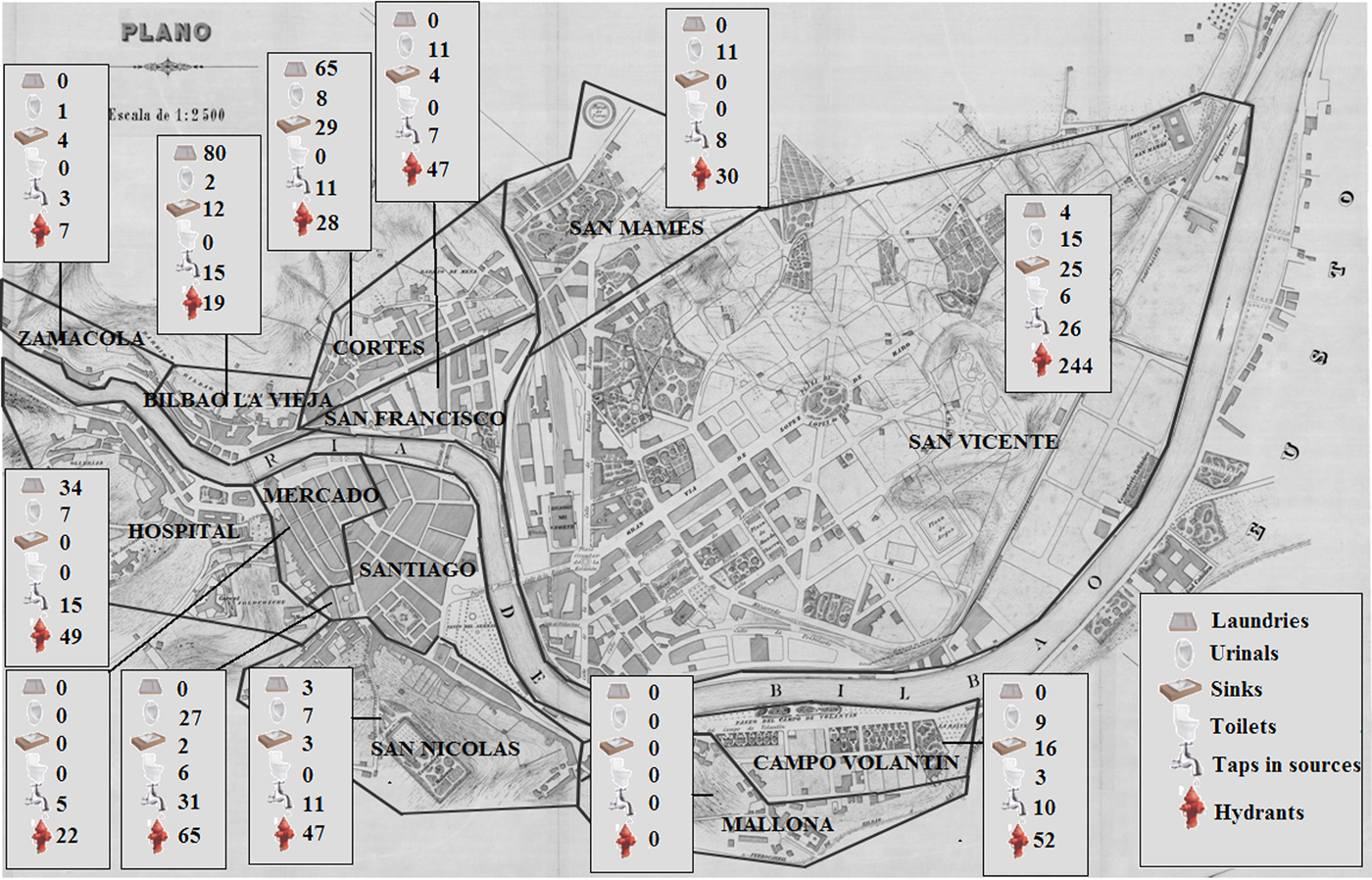
Those inhabitants of Bilbao who did not have water at home could always access it freely through public fountains in the streets. Their number rose from 42 in 1888 to 155 10 years later (Figure 3). The shortage of drinking water and the poor quality of the non-potable water taken from the river led to continuous exhortations from the city council both publicizing the number of public fountains with drinking water,Footnote 61 and insisting on the proper use of river water – for toilets, to clean rooms and household utensils only.Footnote 62 The number of public fountains providing non-potable water decreased from 45 to 2 during the same period, partly out of concern that the water might be incorrectly used, either by mistake or simply because of ignorance, and partly as a covert way of forcing people to subscribe to the domestic water service.
Public water service in the districts of Bilbao, 1898.

The number of public urinals, reserved exclusively for men, across the city did not change, but the number of public toilets, which were for both sexes, rose from 8 to 15, from 1888 to 1898. These were prominently located in busy districts: 6 were installed in the San Vicente district, on Uribitarte Street, near the docks; 2 more were located on El Arenal, a recreational space for the inhabitants of Bilbao; 4 others were situated in La Rivera, in the vicinity of the municipal food market, both in the district of Santiago. Finally, the remaining 3 were located in the Campo Volantín district, in the plaza that gave access to the Archanda funicular, another popular walking area.Footnote 63
The number of public laundries also grew considerably over the same period. These establishments had different sections for lathering, rinsing and bleaching, and users had access to a washboard or stone. Only women were able to access these facilities freely; men were limited to loading laundry at certain times. The location of laundries in Bilbao again shows the social and spatial structure of the town. Figure 3 shows that it was the working-class districts – Cortes, Bilbao La Vieja and Hospital – that had the largest facilities. Women generally did their own family's laundry, but they also did laundry for the better-off, in exchange for payment. In the latter case, the task was carried out either in situ or at smaller public facilities that existed in the central districts.
Finally, the presence of hydrants in the city for watering streets as well as for fire extinction should be noted. Their number and location depended on the size of the buildings in each district, and there is no obvious pattern to their distribution that relates to either the importance of the streets or the buildings themselves.
Conclusion
Since the mid-nineteenth century in Spain, town and city halls have held exclusive rights to the water supply. This supply could be organized on a public or private basis, and in the latter case, by means of administrative tenders to one or more companies. In order to understand the significance of this service, it is important to analyse its technical and financial viability and conditions, and any economic profits it may have produced. Attention must also be paid to how the service was managed, whether the operation was in private hands, or under municipal management. Medico-scientific developments and their repercussions for public health have been the subject of published case-studies, some contemporaneous, and are the starting point for more recent historiographical studies. Recently, researchers have adopted a global perspective: the water-cycle in its entirety has been the focus of attention in the so-called socio-urban metabolism. These perspectives, whether taken together or independently of each other, are relatively common in European historiography, but are still underexplored in Spain.
This article presents perspectives which may be considered novel in the field of urban history. Whilst giving previous studies their due, this article offers two documentary and methodological particularities worthy of mention and, to date, never before considered together, in spite of the wealth of interpretative possibilities they offer. First, it gives an analysis of the municipal register of inhabitants and the lists of subscribers to the water board, followed by mapping this data to plans of the city. Second, the article offers a holistic view of an essential service which enables a better understanding of the day-to-day life of the city's inhabitants.
The municipal registers provide demographic information, and paint a social picture of the city, bringing to the fore those citizens who were directly affected by the water supply service. The lists of subscribers provide a clue to the network of water pipes throughout the city's streets, squares and neighbourhoods. They also allow for the identification of the buildings and homes which had running water and related facilities including bathrooms, kitchens and bedrooms, as well as permitting the study of the volume and quality of water consumed. But not every citizen enjoyed water at home, and in those cases, people used the public water supply, taking differentiated volumes and qualities of drinking and non-drinking water from fountains, washhouses, drinking troughs and standpipes in streets and squares. This combination of sources gives an insight into the make-up of Bilbao society at the end of the nineteenth century – how its inhabitants lived and what districts they lived in. In other words, the social make-up of the city is revealed through one vital variable, access to water, and this in turn illustrates the socio-spatial segregation of the city.
The second feature of this article has been the elaboration of an urban cartography and its relationship to dwelling spaces. Both the social and cultural factors which influenced the citizens' daily lives and their water-related habits were considered, and the resulting map highlights the socio-spatial segregation existent in Bilbao. This mapping has enabled us to reconstruct the image of the city's environmental memory, based on geo-referenced documentation and by looking district by district and street by street at the distribution of the water supply.
A detailed break-down of the documentation has enabled us to produce a social geography of water supply. The key concept here, and the third conclusion of this article, is the social inequality it has uncovered. The water supply network was constructed using public funds, and financed using the taxes and duties levied on the entire population. However, the population of Bilbao did not have equal access to the water supply. The municipal authorities saw the city's water as a money-making commodity, over and above its social role.
One of the consequences of this approach was the existence, until well into the 1930s, of a double system of drinking and non-drinking water supply. Can this be seen as a lack of municipal diligence? It contradicted the scientific discourse of the time and the regulatory criteria lengthily described in the municipal ordinances. Once the pipes were laid, it would have been necessary to overcome the resistance of the landlords, and data suggests that any significant improvements to the sanitation facilities of their properties were slow to materialize. Such improvements would also have been dependent on the population's perception of the relevance of water to public and private health, and their acceptance of habits which encouraged its daily use. Nevertheless, there were positive developments, the most important of which was that approximately 40 per cent of the population of Bilbao had a private supply of drinking water, a not inconsiderable figure in the socio-economic context of contemporary European cities.