Spiritual diaries and autobiographies are the foundations upon which the historiographical edifices of early modern religious practice and selfhood have been built. Scholars ranging from Max Weber to Peter Lake have used diaristic materials as evidence of internalization and interiority, in particular in the history of Calvinism and Puritanism. In contrast, this article will locate diaries and autobiographies as much in the public context of the religious community as in the realm of the private self. By intertwining aesthetic, historical, and literary concerns, this article will show how diaries were also read, circulated, and cherished in families and among wider religious communities.
Calvinism loomed large in Weber's attempt to explain the birth of the “spirit of capitalism” and the emergence of modern Western culture: its predestinarian theology bred “inner loneliness” and “the inner isolation of the individual”; its ascetic of self-control enabled the “spirit of capitalism” to emerge and to prosper. Where he used evidence, rather than instinct, Weber relied heavily on diaries and memoirs to construct his narrative. Although diaries were kept by those of other persuasions, only the “Reformed Christian,” in Weber's telling phrase, “felt his pulse with its aid.”Footnote 1 Weber's argument has, of course, attracted considerable debate and criticism. The majority of such criticism has been directed at the relative merits of his conclusions, or his presumptions, rather than his treatment of source material. His simplistic and misleading characterization of autobiographical writing, however, is deeply problematic. Revealingly, Weber did not pause to consider the nature of his sources but treated them as windows into early modern souls. Ironically, Weber's only extended example came from Benjamin Franklin's Autobiography—a source that conveys the spirit of the emergent age but is hardly a clear lens through which to view his culture. It was an essay in construction, not a reflection of inner thought; it was addressed to Franklin's son but clearly designed for the press; it was drafted and redrafted over several years; and it was then lost, continued at the request of a reader (Abel James), and never finished. As such, the autobiography was a multilayered exercise in the construction of the self, a public and private text, and hardly a source upon which an argument such as Weber's can be balanced with much hope of success.Footnote 2
For all its distance from the sources, Weber's paradigm of individualism and interiority has attracted a loyal band of followers. Until recently, and with the important exception of the work on women's diaries and autobiographies discussed below, the prevailing mode of work on autobiographical writing was Weberian in that it equated interior piety with individualism. This is particularly true of the work of those such as John Stachniewski and Michael Mascuch, who have devoted book-length studies to self-writing.Footnote 3 In the words of Stachniewski, “Puritanism responded to and in some ways fostered individualism, as we know” and “the autobiography sharply defines the alienated individual.”Footnote 4 These statements fly in the face of what we know from manuscript and printed sources. Similarly, Weber's model of modernity has until recently encouraged historians to place interior piety and private belief at the heart of Puritanism. The Puritan diary sustained this faith. For William Haller, “the diary like the autobiography … was the Puritan's confessional.” Haller urged that the act of writing down one's spirituality, and thus ultimately reaching an audience, should not blur the focus on the confessional nature of this material.Footnote 5 For many writing after Haller, there appears to have been little to be said on the subject of the Puritan diary. Even Patrick Collinson, to whom the study of Puritanism owes so much, appears to have avoided the subject, despite writing sensitively on the ways in which printed collections of lives, from John Foxe to Samuel Clarke, sustained the godly throughout the later sixteenth and seventeenth centuries. More recently several historians, prompted by new historicist impulses (if not always their sympathies), have given new life to studies of Puritan diaries and autobiographies. Margo Todd, drawing on Stephen Greenblatt's seminal Renaissance Self-Fashioning, has written of the ways in which Puritans like Samuel Ward fashioned their identities through their diaries. Ward's diaries did not simply reflect his Puritanism; they were part of it. Furthermore, in an illuminating article, Tom Webster has tried to establish a dialogue between historians and literary critics on the subject of self-writing. Drawing attention to the complexity of diaristic genres, Webster has shown how diaries and memoirs provided material sites for fashioning the godly self.Footnote 6
For all the sophistication of this work, many of the more fundamental aspects of Puritan diaries and autobiographies are still assumed, not scrutinized. Attention is drawn toward the function of self-writing in creating godly identity, while there is very little discussion of what contemporaries used diaries for and the place they occupied in their religious culture.Footnote 7 Without asking these questions, Puritanism remains inherently Weberian: the “belief” extracted from diaries and autobiographies is an interior thing, internalized through writing. For all that we have learned from thinking about diaries and autobiographies as sites of self-fashioning, this article advocates taking a backward step in order to analyze how diaries were read by their writers and by others, how they were preserved for posterity, and how they were used as part of godly belief.
Spiritual diaries emerged in the 1580s and were soon recognized as a key component of Puritan practical divinity. Their emergence, notwithstanding scriptural injunctions and model texts such as Augustine's Confessions, can be located relatively precisely because they sprung from a distinctive theological context: experimental Calvinism.Footnote 8 Spiritual diaries are examples of the search for marks of election that was at the heart of this strand of Calvinism—they appear to show individuals testing their spiritual condition and attempting to discern marks of election in the routine of daily life. As a practice, diary keeping dovetailed with the religious duty of self-examination around which a Calvinist “how-to” literature quickly developed. Such self-examination was not theologically distinct—indeed, the practice was encouraged for post-Reformation English Catholics—but it was stressed much more strongly by experimental Calvinists than by others.Footnote 9 They needed assurance of their election, and the sheer volume of the Calvinist literature on self-examination is testimony to its particular importance for them. Calvinists like John Brinsley, Richard Rogers, Henry Scudder, and many others cornered the market in works that encouraged self-examination as part of the godly life.Footnote 10
Surprisingly few of these books specifically advised diary keeping—theologically it was self-examination, rather than the specific act of writing, that was necessary. The earliest works that did so emerged out of the same strand of experimental Calvinist religiosity and tellingly had their origins in sermons preached to particularly intense (and perhaps particularly literate) congregations. They include John Beadle's Journal or Diary of a Thankful Christian (1656), a remarkably extensive call to diary keeping, and a sermon of 1643 in which Hugh Peter implored his hearers to keep a “day booke” in which they should write their sins on one side of the page and God's providences on the other.Footnote 11 Later in the century, calls to keep diaries became more frequent and were to be heard in more mainstream Protestant contexts rather than predominately among experimental Calvinists.Footnote 12 In both the literature on diary keeping and self-examination, there are few explicit directions that these were to be purely personal exercises. Instead, whatever we might deduce from calls such as John Brinsley's that self-examination be performed in a “most secret” place must be tempered by the overall context of such works, which consistently placed the family at the heart of godly religiosity.Footnote 13
Re-evaluating the reading and circulation of this strand of self-writing in such a theological context also provides a welcome opportunity to engage with and subtly refine the contested historiography of Puritanism. Although this historiography defies straightforward characterization, it might be seen as going through four more or less distinct phases in the past sixty years or so.Footnote 14 Its modern historiography began with Christopher Hill's efforts to see Puritanism as an ideology opposed to the alliance of church and state—a dissenting minority who pushed events onward toward a “bourgeois” revolution.Footnote 15 Fraught with difficulties, this interpretation could not survive a wave of revisionism that emerged out of Patrick Collinson's The Elizabethan Puritan Movement and culminated in his The Religion of Protestants. Collinson, together with Peter Lake and Nicholas Tyacke, demonstrated that far from being a radical minority, Puritans were at the heart of the late Elizabethan and Jacobean religio-political establishment.Footnote 16 A third overlapping phase, with many of the same participants, sought to pay further attention to exactly what Puritanism was and, in particular, the relative degree to which it was either radical or conservative. Faced with attempts to reinvent Puritanism as a radical Calvinist cadre that wrested control from the mainstream of the English church, Patrick Collinson, Kenneth Fincham, Peter Lake, and Nicholas Tyacke all insisted that Puritans were the most active proponents of the Calvinist consensus that had come to dominate the church.Footnote 17 They diverged, however, when it came to the radicalism of this group. Where Collinson and Tyacke essentially viewed Puritans as hardly distinguishable from the Calvinist bedrock of the church, others—notably Fincham, Lake, and Tom Webster—argued for Puritanism's rightful position as a more distinct grouping that, while it operated within the religious establishment, was not simply a subset of it, and contained a series of positions that ranged from the moderate to the more radical.Footnote 18
In recent years there has been a subtle but crucially important shift in interpretation whereby Puritanism is considered a form of religious culture. This fourth phase has approached the question of the radicalism of Puritanism afresh by locating the debate in a broader analytical framework. While still rooted in an understanding of ecclesiology and theology, the debate thus encompasses other aspects of the Puritan style of religiosity, such as sermon gadding, fasting and prayer, social networks, and conferences, which were also central to Puritan religious identity. This approach is to be found in more recent work by Nicholas Tyacke and Patrick Collinson, in an important collection entitled The Culture of English Puritanism, and it is now gaining currency as a new orthodoxy on the subject in pathbreaking articles and monographs by David Como and Peter Lake. The importance of this scholarship is that it marries theological discussion with vital cultural practices. In doing so it alerts us more clearly than ever to the fact that Puritanism was at once composed of different and in some ways competing strands that contained the potential to undermine both religious unity and the social order.Footnote 19
This understanding of Puritanism as religious culture allows for a more nuanced account of godly diaries and autobiographies, in particular the place they occupied in this culture. Furthermore, when combined with an exploration of how diaries and autobiographies were read, shared, and circulated as texts and objects among godly communities, it allows us to reconsider both the importance of such writings and, in turn, the nature of Puritan culture itself.Footnote 20 Recent research on women's diaries and autobiographies has not only revealed the extent to which self-writing was one of the ways in which women participated in public as well as private forms of writing but has also served to draw out the complexities of such writing in general. Sheila Ottway's work on Anne, Lady Halkett and Ramona Wray's work on Mary Rich have both demonstrated how diaries and autobiographies were shaped by other textual experiences as well as being written for a purpose (such as defending one's reputation) and constructed for a readership. In particular, Elizabeth Clarke's exemplary study of Elizabeth Jekyll's spiritual diary has drawn out many of the complexities of self-writing, notably drawing attention to the “scribal publication” of manuscript diaries and autobiographies and to the ways in which such memoirs could be edited and repackaged for later audiences and political purposes.Footnote 21 The impact of these studies has been such that surveys of women's writing now recognize audience alongside selfhood as essential components of early modern autobiographical literature.Footnote 22
This article builds upon this work and explores some of the more public, as opposed to simply interior, aspects of self-writing in the godly community. The terms “godly” and “Puritan” will be used interchangeably to signify this culture, a position that is in keeping with the emerging consensus on the subject.Footnote 23 Thinking about Puritanism as a religious culture also allows me to span the long seventeenth century and to draw out the continuities between early Stuart Puritanism and later forms of Nonconformity and dissent. This is not to argue that the two were the same—although many Puritans would become Nonconformists after the Restoration, the precise theological context had shifted decisively—rather, it is to argue that the styles of piety evoked are similar enough to warrant a joint discussion.Footnote 24 Godly religious culture emerges from a detailed consideration of these sources not as a triumph of the individual, the interior, and the private on the high road to modernity but as a culture forged through the intersections of the public and the private and of the individual and the communal. In the daily life of the godly, these memoirs were at once facets of internalization and externalization, of sociability and the self.
Before examining the roles they played in godly religious culture, it is worth asking exactly what diaries and autobiographies were. This might seem rather obvious—the spiritual diary being a piecemeal, frequently daily, account of religious life, while the spiritual autobiography, written in retrospect, was a reflective account of a narrative of religious experience. However, as much recent work by literary scholars has clearly demonstrated, such neat distinctions do little justice either to the element of reflection and self-fashioning in the diary or to the ways in which what historians have called diaries and autobiographies cross and recross lines of genre.Footnote 25 Both diaries and autobiographies frequently included other material—prayers, sermon notes, history, poetry, meditations, lists of providences, and so on—that demonstrate the error in calling the books in which they were contained simply diaries or autobiographies. The abiding characteristic of autobiographical and diaristic writings was fluidity. The “autobiography” of the Manchester Nonconformist Henry Newcome may serve as an example. This account was compiled with the aid of his diary, with some entries repeated verbatim and others not. Henry Newcome began it, but as his energy failed him, his son took over the transcription. After Newcome's death, his son also finished it off by copying into it the assessment of Newcome's character given in the “lean-to” life attached to the printed version of his father's funeral sermon. The “autobiography” was thus part diary, part autobiography, part biography, and part printed life.Footnote 26 The volumes of many others were equally composite in nature. The “diary” of the Manchester wig-maker Edmund Harrold is reminiscent of a commonplace book as it progresses. The autobiography of the Yorkshire Nonconformist Oliver Heywood resembles a diary in its later pages, with regularly compiled entries made under dated headings. Likewise, many of Heywood's subsequent diaries display a style of continuous narration that is more often associated with biography.Footnote 27 These memoirs were heavily intertextual. Lives relied on diaries, and both frequently relied on other books written by their subjects, such as books of family history, account books, and other volumes of diaries.Footnote 28
The distance between original texts and more modern scholarly editions has obscured our view of this material. The early twentieth-century edition of Ralph Josselin's diary omitted three-quarters of its content on the rather dubious grounds of duplication.Footnote 29 “Un-historical,” puzzling, and offensive material, such as Henry Newcome's emotive recollection in his autobiography of a Lancashire man who had buggered a cow, was left out.Footnote 30 These sins of omission are, however, less important than those of commission. Margo Todd has illuminated how the much-used edition of Samuel Ward's diary presents a narrow, decontextualized, and downright misleading impression of Ward's Puritanism.Footnote 31 Alice Thornton wrote and rewrote three thematic volumes of autobiography, not the single chronological account presented in the Surtees Society edition.Footnote 32 Even when editions do not distort the contents of diaries and autobiographies, they rarely give any indications as to their size, layout, and presentation—important aspects which often yield clues to possible usage.
Despite scant discussion in the secondary literature, one aspect of the composite nature of these volumes stands out—the autobiographical abstract with which so many diaries began. Samuel Rogers began his diary in distinctly reflective mode—“I have long bene thinking of a general view of my life,” before introducing his mini-autobiography: “To begin then, and dally no longer; The first 13. yeares of my life.”Footnote 33 These short autobiographies followed a familiar pattern, bringing the account from the author's birth, upbringing, and education, through frequently errant youth, and up to the time at which the diary began. They preface a host of well-known diaries, including those of Adam Martindale, John Evelyn, and Ralph Josselin, who prefaced his diary with “a summary view” of his life, taking the reader from his birth in 1617 until his diary keeping began in 1644.Footnote 34 The composite nature of these accounts is also emphasized by those that began with prefatory letters to friends and family.Footnote 35 Such letters, while signaling questions of audience and authorial intention, render clear-cut divisions between “diary” and “autobiography” problematic. Although it will not do to use the words interchangeably, I want to think about diaries and autobiographies side by side as forms of self-writing. Although there are clearly tensions between these forms of representation, I think this has the advantage of making us rethink the amount of reflection that went into diary keeping.
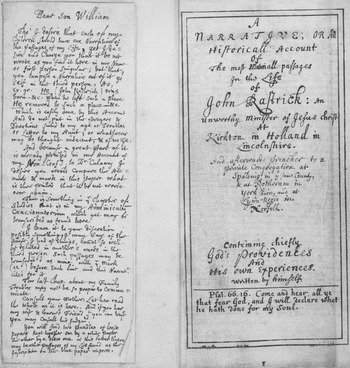
There is considerable evidence that this literature was written to be read. Most straightforwardly, both biographical and diaristic literature addressed readers directly. Many were prefaced with dedicatory epistles and letters to the reader. The author of an autobiography-cum-diary entitled “The Secret Travell” declared that it was written for “what use it might be for my self & others.”Footnote 36 No doubt self-consciously imitating the aesthetics of printed publications, the eloquent London turner Nehemiah Wallington began several of his historical, meditative, and diaristic writings with letters “to all readers,” “to the reader,” and “to the christian reader.”Footnote 37 The after-dissenter John Rastrick even prefaced his autobiography, much of the material for which he had extracted from his diary, with a letter to his son William that he pasted onto the leaf facing his title page.Footnote 38 (See fig. 1.) In the letter, he willed that each of his children should have a copy of his life but not before William had changed it into a third-person narrative and excised the chapter on his family troubles, his letter to his aunt, and “whatsoever may be thought indecent.” He then addressed all of his children with an alternative prefatory letter in which he explained his purposes in writing his life story.Footnote 39 Like Rastrick, a host of diary and memoir writers addressed their children and grandchildren in the desire that their life stories would be treasured as examples: Sarah Savage wrote her diary because she thought “it may be useful to some of mine,” Samuel Clarke originally designed his manuscript autobiography for his children
—“A Narrative; or, An Historicall Account of the Most Materiall Passages in the Life of John Rastrick,” MS HM 6131, fols. 1v–2r, HEHL. This item is reproduced by permission of the Huntington Library, San Marino, California. On the left is the pasted-in letter to William Rastrick with instructions for making copies of the manuscript. Adjacent is the hand-drawn title page, clearly designed to mimic the aesthetics of print.

in 1660, and Henry Newcome compiled his autobiography for his children to read—as we will see, his advice did not fall upon deaf ears.Footnote 40
As well as prefatory letters, which both mimicked the conventions of print and suggested the possibility of readers, many diaries and autobiographies contained further epistles, such as letters addressed directly to readers or those transcribed from letters sent or received. Rastrick, for example, included a letter he had written to his aunt in his memoir.Footnote 41 As the century wore on, spiritual covenants became a striking feature of diaries and autobiographies. The diary entry for Ralph Josselin's thirty-ninth birthday in January 1655/6 was also a covenant in which Josselin described his spiritual condition in the year in which he thought the world would end. It was designed for repeated use. Josselin signed it and made a note that he should “often read this, as well as remember it.”Footnote 42 Rastrick transcribed into his narrative two covenants he had made as a young man as evidence of his spiritual unworthiness. A third, made a little later, addressed God as a familiar and intimate correspondent—“Still the same sins!—Lord!” he began.Footnote 43 Others, such as Oliver Heywood, set aside individual volumes to record their yearly covenants. Heywood reread each one before starting afresh and cursing himself for not keeping his promises.Footnote 44 The reader “imagined” by these authors is of course God, but the familiar style of address highlights how diaries were sites of conversation and thus ways of externalizing the author's inward state.
The style of writing in many memoirs is indicative of an audience beyond God. Many directed their families to read their autobiographies and appear to have continued conversations with them (and others) through their memoirs. Alice Thornton frequently addressed her readers directly, reminding them of incidents she thought especially important: “as I have declared in part in this book” and “as I have related it in this booke” were her favorite phrases for grabbing the reader's attention.Footnote 45 Such forms of address are perhaps to be expected in biographical works, but they are strikingly direct in more diaristic writing. Diarists made frequent interjections to their readers. Writing an entry for 30 August 1587, Richard Rogers pondered over what a reader might make of his diary: “He that should read my former writeing would thinck that I might have continued a month after in veary gracious and godly manner.” Elsewhere he appears to have carried on conversations with the reader of his diary: “Thus I have sett downe some part of those thinges which have fallen out this month.”Footnote 46 Self-conscious in style, such interjections also guided readers through these books. Nehemiah Wallington mapped out a course through his sins and meditations, musing “Now to write something conserning Repentance” and explaining “the cause of the writting downe of my sinnes is this.”Footnote 47 Wallington was particularly drawn by direct forms of address—he tugged at the sleeve of his readers: “By the way let me tell you the truth” and prodded them to take notice—“Now a word or two of what I hard on the Fast Day.”Footnote 48 The tone is similar to the conversational beginning of Samuel Rogers's diary, a conversation sustained as he nudged his readers with asides such as “as you may suppose” and reminded them of his inner turmoil: “I am almost ashamed to set to writing concerning any thing.”Footnote 49
Many writers addressed the readers they feared might read their work. Ralph Josselin, writing an entry for the day on which the fire of London began, warned “quis legens hoc temperet a lachrimis” (anyone reading this should refrain from tears).Footnote 50 When Samuel Rogers scrubbed away at the full name of an intimate friend in his diary to leave just the initials “M. S.” remaining in its place, we must suppose that he was trying to conceal the friend's identity from a potential reader who might dip into the diary. After securing a placement in the household of Lady Mary Vere, Rogers used Latin to criticize his patron Lady Margaret Denny, probably as a precaution against prying eyes.Footnote 51 Likewise, Henry Newcome recalled how he had written of the indiscretions of “Martha, a servant that would not hold her tongue, nor mind her business” in Latin in his diary, presumably as a means of concealing sensitive information from equally nosy servants. Instructively, when he wrote the story up into his autobiography, he did so in English.Footnote 52 Adam Eyre used cipher to obscure entries in which he recorded his qualms about a possible affair.Footnote 53 Codification was a way of limiting readership, not obliterating it. The invocation of a feared reader was a literary conceit, but it was also a way of guiding real readers through the text.
Also suggestive of writing for a readership is the constant cross-referencing and intertextuality among diaries and memoirs. Several writers referred their readers (or perhaps themselves) to other books they had written. Alice Thornton noted that the details of her family troubles were better described elsewhere: “As more at large may appeare in my first booke in pages 194, 195, 196 with all the other circumstances about the affaire.” “I have written a whole paper booke upon this great deliverance of my soule,” she urged in passages on illness in her autobiography.Footnote 54 Oliver Heywood used marginal notes such as “referre to my little black book with clasps” and “other examples see in my book with rough cover” to cross-reference his notebooks.Footnote 55 Nehemiah Wallington sent readers of his “The Growth of a Christian” to consult his “Records of Gods Mercies pag 471” and a book “by me called a Bundel of Marcys.” In the “A Record of the Mercies of God,” he referred them back to “The Gro[w]th of a Christian.”Footnote 56
The contents of clerical diaries frequently suggest that they were written as part of ministerial duty—that they were objects which crossed between public transcript and private faith. The diaries of Oliver Heywood were simultaneously public and private documents, part of, rather than a retreat from, ministerial duty. Ralph Josselin's diary may have functioned in a similar way—as part of his ministry and of the religion of the parish. Josselin's record of deaths in the parish, notably at times of epidemic and disease, and his judgments of the sins of the departed are both suggestive of a book that did not simply reflect his ministry but was itself an integral part of it.Footnote 57 As such, these records of mortality functioned as official records to be consulted by Josselin and other officials and maybe even as a repository of local information for godly parishioners.Footnote 58
What is apparent from the words of these books is also apparent from their form, structure, and appearance. The aesthetics of diaries and memoirs give us further reasons to think that they were frequently written with readers in mind. It is helpful here to think not of text or object but as both functioning together—the textual and aesthetic features working in combination. If printed books were by their nature designed for an audience, manuscripts that mimicked their appearance were similarly intended. Manuscript memoirs and diaries were punctuated by the features of printed publications, features that appealed to a readership.
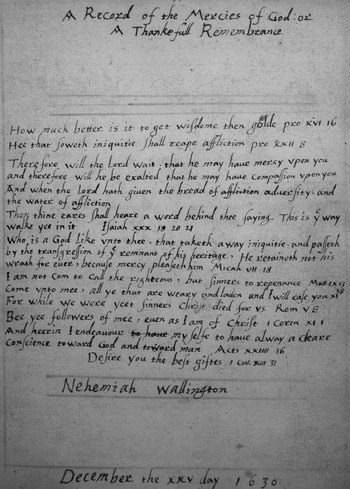
Most immediately, manuscript diaries and autobiographies mirrored print in their title pages. John Rastrick's autobiography and Nehemiah Wallington's “A Record of the Mercies of God” both display the hallmarks of seventeenth-century printed books: a ruled border, title, date, author, and biblical quotation (see figs. 1 and 2).Footnote 59 These title pages anticipated readers. They were more common in autobiographies than in diaries like Wallington’s, but they clearly suggest that they were written to be circulated and read. That many Nonconformists after the Restoration, who were denied freedom in the printed arena, presented their memoirs in this way suggests that we should examine such writing both as a form of “publication” designed to be read, as well as a means through which to articulate the self.
The majority of diaries and memoirs lacked elegant hand-drawn title pages, but they did not lack other features that illuminate their intention of reaching readers. Many gave their volumes titles. Ralph Josselin called his diary “A Thankfull Observacion of Divine Providence and Goodnes Towards mee and a Summary View of my Life: by mee Ralph Josselin.” John Hopkins, an Oxfordshire clergyman, labeled his diary-cum-sermon book “The Prodigal's Teares; or, The Poor Sinner.” Adam Eyre entitled his diary “A Dyurnall, or Catalogue of all my Accions and Expences from the 1st of January, 1646.”Footnote 60 Adam Martindale's title married self-writing and the detachment of the biographical tradition: he called it “The Life of Adam Martindale Written by Himself.”Footnote 61 Many other diaries and memoirs carried no title but were certainly designed for circulation, such as the autobiography of the Jesuit John Gerard.Footnote 62
—Nehemiah Wallington, “A Record of the Mercies of God; or, A Thankefull Remembrance,” MS 204, GL, title page. By permission of the Guildhall Library, City of London. Wallington's title page comprises date, title, a series of biblical quotations, and a hand-drawn border.
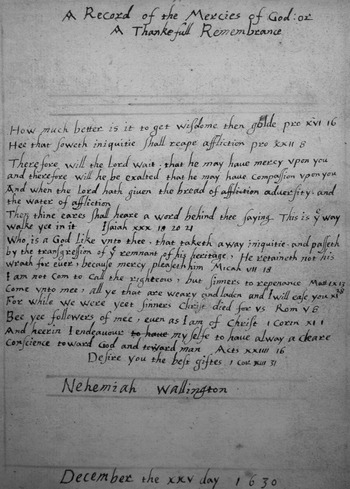
There was much more to these books than their titles. Diaries and memoirs contained numerous other features that were usually associated with printed publications and were designed to steer readers through their texts. The manuscript autobiography of the lawyer, nonjuror, and writer Roger North began with a thematic index, complete with page numbers.Footnote 63 Nehemiah Wallington began his “A Record of the Mercies of God” with a six-page table of the contents of his spiritual memoir, with page numbers and thematic subdivisions. His volumes also contained indexes, which I will return to in order to show how he reread his own work.Footnote 64 It is noteworthy that like title pages, dedicatory epistles and letters resembled those found in printed books. John Rastrick's prefatory letter (see fig. 1) is clearly set out in the manner of print, with short paragraphs and the recipient of the letter centered at the top of the page. Other writers mimicked both the words and the format of print in their prefatory matter. Alice Thornton, for example, began her autobiography with “a preface to the booke.”Footnote 65 Wallington's dedicatory epistles also mirrored the look of print. The aesthetic properties of dedicatory epistles and prefaces suggest that, like printed books, they were designed often with aspirations of reaching audiences beyond their dedicatees.
Many diaries and memoirs concluded with postscripts. Wallington finished the text of his “A Record of the Mercies of God” with “my postscript to my loving wife[,] children[,] and friends.” His “Growth of a Christian” ended with an entry for the last day of the year 1642–43, which was a short prayer in which Wallington anticipated anyone who might claim that he wrote his diary out of “abundance of pride[,] hypocrisy[,] and vaine glory.”Footnote 66 Samuel Rogers even concluded his diary “Finis Anni 1638.”Footnote 67 The appearance and the existence of opening, introductory, and concluding features are indicative of the reader assumed or imagined by the writers of diaries and memoirs.
Looking further inside these books, other textual and aesthetic features reinforce the notion of a readership. Wallington wrote his manuscripts with short running titles, both of the name of the volume and the chapter on which he was engaged.Footnote 68 Others, including Ralph Josselin, John Rastrick, and Alice Thornton, wrote under chapter headings of events, journeys, and themes. Each is suggestive of making the text easier for a reader to negotiate, albeit on the author's terms. Despite lacking many of the features that would immediately suggest an audience, the chapters in Adam Martindale's autobiography, which divided his life story into seven-year periods, show that even the most unlikely looking manuscript could be constructed for a potential readership. It is possible that Martindale's text was a first attempt at what he hoped would end in printed publication, rather than a manuscript he wished to circulate.Footnote 69
Even the simplest features of many of these memoirs point toward their design for readers. They include numbering pages, writing in clear paragraphs, using a wide margin, spacing the text neatly over the page, and using catchwords to guide the reader to the next page.Footnote 70 Likewise, “manicules” (Bill Sherman's inspired word for the ubiquitous marginal pointed hand), marginal notes, asterisks, and footnotes were used by diarists and memoir writers to grab the attention of readers.Footnote 71 These features are noticeable in the work of Edmund Calamy, Lady Margaret Hoby, Oliver Heywood, Henry Newcome, Richard Rogers, Samuel Rogers, Ralph Josselin, and many others.Footnote 72 Even the simple act of writing a daily entry, set apart from previous entries with a clearly marked date, was in some respects to make a journal more accessible for future readings.Footnote 73 The very size and condition of these books can give us clues as to potential usage. What may seem like evidence of scruffiness and a lack of concern for circulation was for Grace Mildmay the exact opposite: her crossings out and editorial interventions were designed to make her book of meditations more accessible for her descendants.Footnote 74 Although not the kind of evidence that should be used on its own, the size of such books is suggestive. Many were clearly working books that would slip easily into the author's pocket. Although hefty in its modern edition, Ralph Josselin's diary contained just 182 pages and measured around fifteen by twenty centimeters.Footnote 75 Philip Henry's diaries were exceptionally small, measuring just five by ten centimeters. The majority of Oliver Heywood's working volumes measured seven by thirteen centimeters, and their condition—with well-thumbed pages but with original bindings and clasps often intact—suggests that they have been both read and treasured throughout the centuries.Footnote 76 Likewise, the size and condition of Edmund Calamy's autobiography, which was elegantly presented in two large folios, reveals it as a fair copy in waiting for the press.Footnote 77 When combined with the physical state and size of volumes, these print-inspired features cast light upon how the contents of these volumes might have been read and circulated in the godly community.
The stimulation for writing a diary or an autobiography, where inner feelings found their place, was as likely to have been personal as it was divine. Many were encouraged by a charismatic individual, the advocation of a sermon, or a model proposed in a book. Both before and during the writing of diaries and memoirs, authors were inspired by godly example. In part, such inspiration helps to explain why so many of these memoirs—supposed articulations of the self—share so many characteristics.Footnote 78 In an age of household piety, it is no surprise that the examples provided and the exhortations made within the family provoked many to keep records of their lives. Diary keeping and memoir writing were integral features of the evangelical family religion that spanned the seventeenth century and church divides.Footnote 79 There are several instances of dynastic diary keeping. Philip Henry was a prolific diarist, and both his son Matthew and his daughters Sarah Savage and Ann Hulton followed his example. These diaries, along with other manuscript books, notably a book of “scripture questions,” played a key role in their domestic devotion.Footnote 80 For some, such as Samuel Rogers, whose wider kin included the noted diarist Richard Rogers, inspiration could be drawn from more distant family.Footnote 81 The example of godly individuals set others on their way. In his autobiography, Henry Newcome recalled the inspiration to start a diary: “In the year 1646, when I had been two years at Cambridge, upon some working of my soul … I was induced to begin a diary. It was chiefly begun upon the occasion of hearing that Dr. Ward, (the late Master of Sydney, and Margaret professor in Cambridge,) had left a diary of his life in his study, from his being sixteen years of age. I thought it was a very brave thing … and so set upon it.”Footnote 82 In turn, Newcome, who wrote his autobiography “especially for the use of my children after me,” inspired his own children, notably Henry Newcome Junior, whose diary for 1696–1713 closely mirrors the accounts of his father.Footnote 83
The examples of preachers and teachers provided further stimuli. It is suggestive that Samuel Ward composed his diary in a notebook in which he had originally kept notes of sermons by Laurence Chaderton. Margo Todd has suggested that Ward's diary keeping was thus an extension of his “ongoing endeavor to follow Chaderton's directions, to imitate his godly life, and to reflect his understanding of the church.”Footnote 84 Many diarists and autobiographers, such as Oliver Heywood and Thomas Jollie, recalled the influence of godly preachers as they embarked upon their self-examinations.Footnote 85 The sermon that was to become John Beadle's Journal or Diary of a Thankful Christian (1656) prompted Arthur Wilson to embark upon his journal.Footnote 86 Occasionally, we can eavesdrop on preachers specifically promoting diary keeping. In 1643, Nehemiah Wallington noted the advocations that Hugh Peter made during his sermon: “If you will see marcy goe deepe down into selfe deniall … be un unwise but keepe your day booke wright down your sins in one side, and on the other side God's providence how the Lord delivered you from dangers[.] Wright down littell marcys … Tell the Lord wee live by mercy.” Peter's words appear to have cheered the usually gloomy Wallington, who interspersed his own commentary into his sermon notes: “This matter delivered did like me well because by God marcy I practis it already,” and he was particularly glad of the reminder because it prompted him “to begin to doe it in a more exact maner.”Footnote 87
For others, the inspiration to keep a memoir and guides on how to do so came straight out of other books. Unfortunately, much of the historiography begins and ends with Richard Rogers, who both kept a diary and allegedly advocated such a practice in his Seven Treatises.Footnote 88 Diarists and memoir writers certainly drew inspiration from Rogers—Margaret Hoby read Seven Treatises while writing her diary, and John Bruen abridged it, perhaps for the use of his family and godly boarders—but Rogers's chapter, “Of Viewing the Day,” as Tom Webster has argued, advocated only the religious duty of self-examination, not the practice of diary keeping.Footnote 89 As the seventeenth century progressed, the how-to literature became more specific and inspired several would-be diarists. Mary Rich, the diary-keeping Countess of Warwick, counted John Beadle's Journal or Diary of a Thankful Christian, a manifesto for spiritual diary keeping, among her favorite books. Seventeenth-century collections of lives, notably those compiled by Samuel Clarke, had a significant effect in inspiring life writers, although, as Patrick Collinson has argued, we should not forget the inspiration that was taken from the work of John Foxe. Henry Newcome recalled the impact that Foxe's tale of John Careless had made upon him, Nehemiah Wallington began his “Coppies of Profitable and Comfortable Letters” with a series extracted from the Acts and Monuments, and Lady Grace Mildmay may have been prompted into autobiographical mode by the receipt of a gift of the Acts and Monuments from her mother shortly before her death.Footnote 90
At times, printed books went beyond inspiration and became more rigid templates within which personal accounts were framed. Dionys Fitzherbert, whose autobiographical writings have been used as evidence of narrative authority and madness, was perhaps not as eccentric as she first appeared. As David Como has recently shown, she structured her recollections around John Freeman's The Comforter (London, 1600), a printed guide to the torments of, and deliverance from, religious despair.Footnote 91 In other instances, it was the form of the actual book in which diaries and memoirs were written that helped to shape the content. Sir Robert Markham used an interleaved printed almanac to keep his diary. This account and the diary of Anthony Hammond, who wrote on an interleaved copy of The Ladies Diary; or, The Woman's Almanack, for the Year of our Lord, 1717, are clear examples of the interplay between printed book and manuscript life. The personal record was shaped by the printed, with entries limited in space if they were to run alongside the almanac's calendar.Footnote 92
While many diarists and autobiographers took previous examples within the genre as their lead, many others made reference to printed lives as a way of reinforcing their own godliness. This unremarkable phenomenon serves to display the level of intertextuality in diaries and memoirs. Henry Newcome referred to a string of seventeenth-century lives in his autobiography, including those of Bishop Hall and Dr. Staunton. For several weeks in 1682, Newcome read the life of John Angier, either in a manuscript borrowed from Oliver Heywood or in Heywood's printed version. Samuel Clarke's compendium of godly lives had a particular resonance. Newcome noted that reading Clarke “shame[d] me greatly but I desire[d] to be provoked to endeavour by the strength they had, to do something of what they did.”Footnote 93 In turn, Clarke's compilations, especially his Marrow of Ecclesiastical History, brought exemplary life stories like that of John Bruen to a wide readership and were unmatched as templates for writers of future godly lives.Footnote 94
This textual patterning gathered pace when diarists read the lives of other diarists. Henry Newcome read the diary of his friend John Machin and used it to prepare a printed biography.Footnote 95 Edmund Harrold read the funeral sermon of Henry Newcome twice before selling it on.Footnote 96 Adam Martindale made frequent references to the printed version of John Angier's life, sending readers to specific page numbers.Footnote 97 Oliver Heywood acknowledged his debt to the exemplary self-examination of his father-in-law and fellow diarist John Angier. Angier's diary was Heywood's key source for writing his father-in-law's biography. And yet this biography bears such close relation to Heywood's own autobiography, finished by 1666, that the influence may be the other way around. Certainly Heywood ensured that Angier's life set an example, not least because he distributed at least ninety-six copies of the printed life among friends and sympathizers.Footnote 98 The frames of reference were cyclical, with Heywood copying great chunks of Clarke's Lives into his own books of memoranda and at other times circulating Clarke's Martyrology.Footnote 99 Heywood was a keen reader of lives, and those of Clarke, Richard Rogers, Mr. Machin, Dr. Winter, Joseph Alleine, and Mr. Janeway appeared on his book list.Footnote 100 The immense popularity of Clarke among diary and memoir writers might not be surprising, but it is problematic for a historiography that stresses the individualism of diarists. Although it would require comparative textual analysis that is beyond the scope of this article, it would certainly be possible to argue that the strength of textual influences like Clarke actually point to diaristic writing becoming less individualistic (and more stylized) as the seventeenth century wore on. This is not to deny the relative continuity of influences over the seventeenth century but rather to suggest that when Puritanism was driven underground in the years following the Restoration, such textual patterning became stronger as the shared text, whether in manuscript or in print, became more important in the maintenance of godly sociability. While this thesis awaits examination, the popularity of Clarke serves meanwhile to reinforce the point that there was significant textual, as well as oral and personal, modeling of these accounts. Diarists and autobiographers rarely wrote their selves simply through divine inspiration; worldly influences included family members, preachers, and printed books. Together they help to explain the striking similarities of so many early modern spiritual diaries and autobiographies.
It is now clear that diarists and autobiographers, often inspired by texts, sermons, or individuals, were well aware that their memoirs might be read. For many, the impulse to write overlapped with the desire to fashion in writing an identity for future readers. Neither of these findings necessarily contradicts the majority of the historiography on this subject, armed as it is with the literary devices of the feared reader and the imagined reader. The real, historical reader, however, places it in significant danger. The historiography has grudgingly admitted that printed memoirs and diaries were exercises in construction but has, in general, clung to manuscript diaries and autobiographies as sacred texts—private documents displaying interior belief. It assumes a rigid distinction between print and manuscript that is untenable in light of studies on the circulation of “literary” manuscripts and the phenomenon of “scribal publication.”Footnote 101 Even the few studies that entertain the possibility that manuscript memoirs were read tend to downplay its significance.Footnote 102 Despite this, there is considerable evidence that manuscript diaries and autobiographies circulated and were read. The remainder of this article explores how this reading was done. It reveals that such reading was a social experience for the godly family and wider community and as such revises the assumptions of a historiography that connects self-writing with privacy and internalized religious belief.
Diarists and autobiographers clearly reread their own work. For some, like Oliver Heywood, the very purpose of writing had been to keep a record of their spiritual state against which to judge their future progress. Similarly, Edmund Harrold noted “reflecting upon my past life,” while Ralph Josselin recorded “looking backe into my wayes.”Footnote 103 “Reflecting” and “looking back” need not necessarily have involved reading, although the comments of Richard Rogers—“After looking backe, I acknowledge that my course hath been farre unbeseeminge one who hath so longe geven name to the gospel”—suggest that this was likely.Footnote 104 In other instances, marginal notes and markings are indicative of rereadings, usually some time after the original diary or memoir was composed. Though he never explicitly mentioned rereading his diary, the asterisks Samuel Rogers made alongside significant entries suggest that he either marked entries of special interest to return to them later or that he re-marked them at a later rereading.Footnote 105 The content of handwritten marginal notes unambiguously reveals later rereadings. Richard Rogers's marginal notes show him repeatedly rereading his diary: a single entry of 1589 (on his liberty to preach) was revisited with subsequent marginal notation in 1608, 1613, and 1618. Such annotation is testimony to the continued engagement that diarists had with their work, often into old age.Footnote 106 Oliver Heywood, who had declared that one of his reasons for keeping a diary was to “reflect on what I have done or misdone in my by-past days,” did just that, adding marginal notes to his autobiography-cum-diary years after he had finished writing it.Footnote 107
Some of the more ponderous diarists reflected upon rereading their work. Never one to refuse an invitation to navel-gazing, Ralph Josselin recalled his entry of the previous year, which he had urged himself to reread, when compiling the entry for his fortieth birthday in January 1656/7. He noted, with some satisfaction, “I viewed with joy, the passages of Jan 26 1655, blessing god for it, often read it.”Footnote 108 Oliver Heywood mused, “Upon review of my diary, in the year 1693” and noted that he “lookt back on my life.”Footnote 109 Rereading diaries was often the starting point for autobiography. Thomas Jollie's “note-book” was, in fact, a revised transcript of his diary: he wrote his diary entries at regular intervals into the fair copy that survives.Footnote 110 Henry Newcome's autobiography digested chunks of his diaries, where his rereading of earlier diaries was also recorded. In his diary for 1666 he noted, “I had two or three years since began to review my own diary, and to collect some memorials of the Lord's dealings more historically, for the use of my children when I am gone; and I had carried it on for some few years as my work on Sabbath days, for any spare time I had in the evening.”Footnote 111 A flurry of entries, now only known to us through his autobiography, recalled this process of diary reading and excerpting. Some are especially revealing, notably when he recorded
I read in these collections, as I had time this day. Sure my life hath been a life of great troubles. And yet the Lord hath taken the memory of many of them quite away, (so little hurt have they done me;) that I had quite forgot many smart passages, if they had not been recorded by me. The day after I read in these old passages. O what a life of sorrows have I had! What sorrows have I needed! What sorrows have I been helped with, and delivered from! And how little have I been improved by them!Footnote 112
Newcome was aware that the act of rereading his diary was more than an excavation of his youthful self and interior belief. In an entry for 20 August 1684, he recorded, “My cousin Fulford, who married my cousin Sarah Manwareing, came to see us out of Warwickshire, and brought his wife with him … she desired me to find her age if I could. Upon searching for it in my old diary, I had many wonderful things brought to my remembrance of God's dealings with me, both outwardly and inwardly, thirty-four years ago.”Footnote 113 Newcome's diaries were repositories of the collective memory that sustained personal and familial piety. Even at the very end of his life, when he reread the abstract of the diary, rather than the diaries themselves, the practice continued. It was left to his son Henry to transcribe his final entries into the abstract. They powerfully evoke the place of the diary as a living object in the godly family: “Aug 25 1695, I read in the abstract of my Diary some things that might be of use to me, from what I found of God's love in the days of old: and he is the same, and his compassions fail not. Decline I do sensibly. Oh, that the inward man might a little put up.”Footnote 114 Rereading one's diary was not simply a process of introspection; it could also be to partake in the shared faith of familial piety.
Nehemiah Wallington provides an extended example of continuous rereading of diaristic material. Wallington made fair copies of many of his diaries and books before rereading these revised writings later in life.Footnote 115 His comments on rereading are illuminating. In his book of judgments on sabbath breakers, for example, which he had started in 1632, he returned twenty-six years later to note: “May the xxiiii 1658 I did read over the most part of this booke but haveing written the most part of it in a nother booke, I forbare to take any furder notice of it for at the present I am very ele in my body.”Footnote 116 He usually took more notice. On the unused sheets at the end of his book of letters, Wallington recalled revisiting the text and what he had learned from it: “1658. June the xxiii By the marcy of God I have read over this my writing Booke which is Coppies of precious letters where in I observe a few things.” These things were noted in a numbered thematic list, which directed any future readers to the pages on which he found particularly noteworthy passages. Wallington wrote for action, as the notes demonstrate: “3. Rules for Comfort p. 149”; “4. Observations of the danger in immoddarat Sorrow p. 152.”Footnote 117
Wallington also read over his “Growth of a Christian” on 16 June 1658 and at the end of the volume drew up an extensive thematic table of his observations on his near deathbed review of his sins, again citing the page numbers within the book. These ranged from episodes that he may have intended to set a personal example, such as his getting up early on the sabbath and his “end in bying pamflets,” to examples drawn from his life that were of more widespread appeal to the godly doubter in search of assurance: “Grounds of spirituall peace p. 202 230;” “Reasons why we must know the sin of our heart 247.” Rereading these books played a part in Wallington's triumph over doubt, and the table of his rereading suggests that he wanted future readers to turn to his books and extract information when they needed assurance of their salvation. As if to confirm this, one of the themes was singled out for special mention and badged with a manicule. It read: “To keepe a Day Book to writ down our Sinns and Gods Marcys p. 214.”Footnote 118
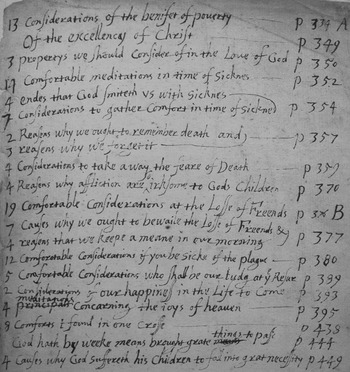
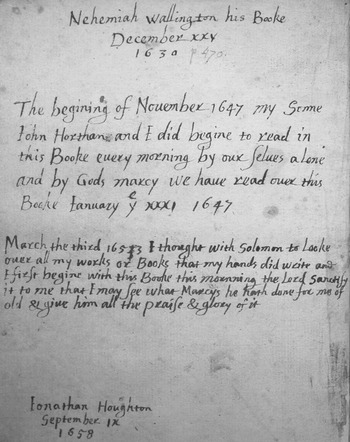
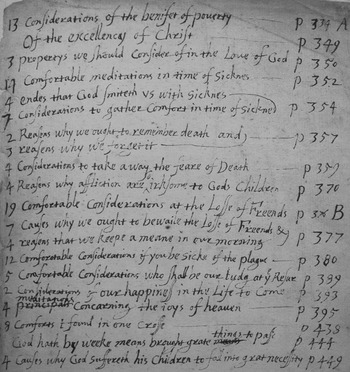
Perhaps surprisingly, not all of this apparently doubly inward practice of rereading one's life story was internalized. Wallington reread his “A Record of the Mercies of God” at least twice. He noted rereading the volume on 21 May 1658, as the breath began to rattle in his throat: “I have by Gods marcy read over this my writting booke which I have read over many times but now I observe more then in former tim I did which I have handed and here follows some of that which I obsarve for my souls good.” A most extensive list of his rereading, directing future readers toward useful passages, followed (see fig. 3).Footnote 119 Other rereadings were communal. A note at the opening of the manuscript reads: “This begining of November 1647 my sonne Iohn Horthan and I did begine to read in this Booke every morning by our selves alone and by Gods marcy we have read over this Booke Ianuary the xxxi 1647” (see fig. 4).Footnote 120 Rereading what has consistently been taken to be one of the most internalized records of Puritan sin was thus both a process of internalization and externalization. As we will see, the sharing of the godly life was an integral part of the sociability of Puritan culture.Footnote 121
—Nehemiah Wallington, “A Record of the Mercies of God; or, A Thankefull Remembrance,” MS 204, GL, unpaginated endpaper. By permission of the Guildhall Library, City of London. The final page of the table Wallington made of the important themes he noted on rereading the volume, complete with page numbers. Its purpose, especially given the existence of a more detailed table of contents at the start of the volume, is likely to have been to direct future readings.
The primary venue for this shared reading was in the family. Many of the families exhorted to read diaries and autobiographies took easily to such practice. Not only did Henry Newcome's sons assist their father in completing the abstract of his diary—they also reread it. At the back of Henry Newcome's autobiography, Peter Newcome compiled “Notes from the dyary” with a list of important points that resembled Wallington’s. These ranged from personal notes about his father's
—Nehemiah Wallington, “A Record of the Mercies of God; or, A Thankefull Remembrance,” MS 204, GL, unpaginated page at start of volume. By permission of the Guildhall Library, City of London. This page, which originally noted simply the date at which Wallington started this book and which precedes the title page, was later used to record subsequent rereadings. It also carries the signature of Jonathan Houghton, who signed those volumes he inherited after Wallington's death.

record of his idleness and neglect of duty to more general comments upon greed, ambition, and hypocrisy.Footnote 122 It is probable that what remains as the autobiography began with Peter Newcome abstracting notes from it into a commonplace book, before he reversed the volume and simply copied it all out. Families, from the Newcomes to the Rastricks and the Mildmays, proved faithful godly readers.
Diaries and memoirs were cherished by families long after their authors’ deaths. Authors were frequently keen to ensure their work remained in the family. Alice Thornton bequeathed her autobiographical writings to her daughter Alice, Henry Newcome left his diaries and papers to his son Henry (perhaps this is why his other son, Peter, transcribed the autobiography), and John Rastrick planned to leave each of his children a copy of his autobiography.Footnote 123 The bequest of the diaries of the Salter and Merchant Adventurer John Mounsell reveals that they had been kept in duplicate while alerting us to unnoticed connections between diary-keeping kin. Mounsell's will directed that his second son Jonathan should receive six volumes of his diaries, covering the years from 1581 to 1636. If his eldest son, Peter, happened to take any of these volumes away to Ireland, Mounsell stipulated that Jonathan was to receive “the greate booke of my life bound in red leather with twoe broade claspes which containes all the said sixe bookes.” And Mounsell's will also informs us that he was the uncle of William Whiteway of Dorchester, another notable godly diarist.Footnote 124 The transfer of ownership was frequently symbolically marked by family members signing these accounts as they passed down through generations. Jonathan Houghton, Nehemiah Wallington's son-in-law, with whom he had read some of his books, signed and dated the volumes he received on Wallington's death.Footnote 125 The nineteenth-century divines J. Fawcett and Thomas Raffles signed Oliver Heywood's diary for 1677–80, thereby associating themselves with the godly figurehead. That Richard Astlee, who married Heywood's great-great-granddaughter, signed several of Heywood's volumes at least signals the possibility that they were treasured by and used in the family as their author had intended.Footnote 126 Such continued use is further suggested by those records to which were appended tables of the births and deaths of later family members.Footnote 127
Diaries and autobiographies were also read by wider audiences. This manifested itself in circulation in different directions: they were produced and procured in matters of contention, and they were shared among broadly like-minded religious communities. The presentation of diaries in disputes betrays modern notions of their secrecy. Alice Thornton used her autobiography to repair her reputation after a family dispute. Away on business, Alice sent her servant Dafeny Lightfoot back to the family home:
By her I sent my owne Booke of my Life, the collection of God's dealings and mercys to me and all mine till my widowed condition. That she might be able to sattisfy all my friends of my life and conversation,—that it was not such as my deadly enymyes sugested … which I knew would take away all those scruples and false calumnyes against my proceedings … this poore woman did shew the said bookes to my aunt Norton and severall other friends, as my lady Wivell, which sent to her to lett her know how much I was wronged, and to speake to her about me, with great greife and many teares did expresse her concerne, and pittied my case, saing that I had ever bin a most vertuous woman all my life, and now to be soe abused, did wound her very hart; and soe gett my booke of her to read, which she did with a great delight, as she said, and yett with much greife to see me soe greatly wronged by those I had done so much for.Footnote 128
In Scotland, one Robert Ross dramatically produced a “buk wretten with his allin hand” before the Kirk Sessions. This book was a diary of what he claimed were numerous occasions of premarital sex he had had with Janet Bull. Almost matching Nehemiah Wallington in his desire to record his wrongdoings, Ross complained that the diary showed that he had deserved a greater punishment for his premarital excesses than the minister to whom he had confessed them had assigned.Footnote 129 At other times, the authorities seized diaries as evidence of misdemeanor. Richard Steele, minister at Hanmer, Flintshire, and friend of Philip Henry and Henry Newcome, had his diary seized in April 1665 amid the national crackdown on Nonconformity. This sparked anxiety in Newcome, who knew it was his duty to record the interventions of God in the world but feared what trouble it could bring. He nervously noted that “some passages in it they interpreted to the worst of actions.” The seizure of Steele's diary prompted caution in the diaries of both Newcome and Philip Henry.Footnote 130
The circulation of diaries among the spiritually like-minded is difficult to trace. For some, such as Nehemiah Wallington, reading the diaries of the godly beyond the household remained a spiritual pipe dream. For Wallington, at least, neither would this fantasy bring spiritual comfort: “it is not a great mercy that I being as great a sinner as others that he gives me a breathing time and that while I am a reading of the miserys of others they mite have bine reading of my meserys.”Footnote 131
But the sharing of diaries and autobiographies beyond the household was part of a broader godly culture, and it appears to have provided both sustaining example and the food of spiritual comfort. Reading the diary of another member of the brethren was to participate in shared faith and to experience their own personal experiences. Such reading displayed the intimacy of a family account while also demonstrating the greater depth of godly textual networks. Again, it is those writers usually taken as the standard bearers of interiority who show us how much this sharing mattered. Ralph Josselin, for example, noted in an entry for 6 April 1657 that he “Saw part of Mrs Mabel Ellistons diurnal of her life, full of spiritual observations and sweetnes.”Footnote 132 One Mrs. Meeke lent Henry Newcome the diary of her recently deceased husband, which he held on to for some time before returning it to her via a friend.Footnote 133 Vavasor Powell, deep in a sickness that he feared would be his last, feared for the state of his soul. To examine himself in these fears, he called out for his diary, but tellingly it was not to hand, since he had “lent it to a Christian Friend that was far distant.”Footnote 134 In the intimacy of the godly community, the diary was clearly a shared text as well as a coveted object. Such shared experiences in the godly community established and inspired a tradition of diary writing and preservation. Richard Rogers noted that reading the diary of a godly friend, which he called “the writeinges of an other brother about his estat,” prompted him “to write, and to bring my hart into a better frame.”Footnote 135 The tradition of self-writing was bred by social networks and by shared reading.
Even where direct evidence of diarists reading each other's memoirs is absent, their sociability and religious networks are striking. Just one or two examples will display the extent to which networks of diarists stretched over time and space. Ralph Josselin, for example, met Mary Rich, Countess of Warwick (1624–78) and spiritual diarist while visiting Lady Honywood and kept up correspondence with her thereafter. Josselin shared so much with, and lived so close to, Samuel Rogers that it is improbable they were strangers. He also corresponded with those who had left for America, including Thomas Shepard, whose life story is so famous.Footnote 136 Similarly, Oliver Heywood was the common thread between a long chain of Nonconformist diarists in the north of England, including John Angier, Henry Newcome, Thomas Jollie, Adam Martindale, and others. These northern diarists, along with Roger Lowe, Edmund Harrold, Matthew Henry, Philip Henry, and Sarah Savage are linked through friendships, correspondence, family ties, and a shared style of religious culture.Footnote 137
This sociability and sharing of diaries and memoirs is further suggested simply by the afterlives of diaries. Just as diaries and memoirs were copied, circulated, and passed down through generations of godly families, so they were also cherished as key texts and as badges of evangelical identity in the wider godly community. They were “scribally published” by their authors and further disseminated as they were transcribed by godly readers.Footnote 138 Owning an original was to connect directly with the fervor of one's predecessors, and thus godly diarists and figureheads sought out the life stories of those who had gone before them. The possible trajectory of the diary of Samuel Rogers is instructive here. Tom Webster has plausibly suggested that the diary remained with Rogers's immediate family until passing into the hands of Richard Baxter, along with Richard Rogers's diary, which then passed into the hands of the clergyman turned historian and journalist Roger Morrice.Footnote 139
This article has illuminated how early modern diaristic and autobiographical material was written and designed to be read. By examining such books as physical objects, as well as texts, it has shown how self-writings were designed in the knowledge that the act of writing created the potential for reading. The inspirations from family and friends and the written and spoken word show how self-writing was modeled from the outside, not just written from the inside. And godly memoirs were indeed read, cherished, and circulated: they were an integral part of a Puritan culture that had sociability at its heart.
By emphasizing the communal aspects of self writing, this article challenges influential portraits of the age—Weber's paradigm of modernity and Foucault's analysis of self-writing and “technologies of the self” as key steps in the transformation of society.Footnote 140 Diarists and autobiographers wrote their lives to share and exchange them in the religious community. The article also revises our understanding of the culture of Puritanism, in particular of the interiority and individualization at its heart. The reading and sharing of diaries and autobiographies shows how Puritan culture was at once internal and external, individual and communal. This was not lost on contemporaries, who often displayed greater insight into what they were doing than have their historians: Oliver Heywood acknowledged “I often thought if my inside were turned outward to the view of others it would be an hideous & monstrous sight”; Ralph Josselin knowingly reflected upon his “inward and outward mercys”; and, eloquent to the last, Nehemiah Wallington described his mercies as “sometimes inward & some time out ward & some times … both.”Footnote 141 By examining these memoirs as multilayered sites of conversation, the interactive nature of godly culture becomes clear.
A more refined history of Puritanism, intertwining the history of the family, intellectual culture, social relations, as well as theological debate, is now needed. Interweaving cultural and intellectual concerns will move debates beyond definition games and enable us to probe further into the culture of Puritanism. In particular, the effort must be made to put aside the traditional divisions of the historiography of religious practice and belief, especially the divisions between bookish, interiorized Protestantism (and especially Puritanism) and ritualized and communal Catholicism. Diaries and memoirs have been clung onto, and used so unproblematically, because they appear to encapsulate these divisions and, in turn, to cast light upon what it meant to be godly. In fact, only through connecting such memoirs with their use do we get to the heart of Puritanism. Godly writers wrote to share their life stories, to set godly examples, and to judge their own sins. To share, read, and listen was to participate in the collective faith of the godly religious community.