Introduction
Approximately one billion people globally live in communities where consanguineous marriage is practised (Bittles & Black, Reference Bittles and Black2010). Consanguineous marriages are considered respected practices in many societies and are traditional in various cultures in Asia, the Middle East and among some migrant communities in North Africa, Australia, Europe and North America, where intra-familial unions account for 20–50% of all marriages (Tadmouri et al., Reference Tadmouri, Nair, Obeid, Al Ali, Al Khaja and Hamamy2009). Generally, the highest frequencies of consanguineous marriages are reported among the least educated and more traditional rural areas in the world, and countries with higher consanguinity rates generally have a significantly lower understanding of the genetic risks of the practice (Sandridge et al., Reference Sandridge, Takeddin, Al-Kaabi and Frances2010).
Clinical genetics defines a consanguineous marriage as a ‘union between two people who are second cousins or closer with an inbreeding coefficient (F) equal to or higher than 0.0156’ (Bittles, Reference Bittles2001). The inbreeding coefficient (F) is a measure of the proportion of loci at which the offspring of a consanguineous union is expected to inherit identical gene copies from both parents; this includes marriages between first cousins, first cousins once removed and second cousins (Bittles, Reference Bittles2001).
The reasons for the preference for consanguineous marriages are often economic as they have the benefit of protecting property and land, but also have the advantage of supporting close family ties, improving the compatibility of the wife and her husband’s family and decreasing the risk of divorce (Khan et al., Reference Khan, Sultana and e Siraj2011). However, in spite of the perceived social and economic benefits, there are increased risks of genetic disorders in the offspring of couples with consanguineous unions. Research has shown that an extra 1.7–2.8% risk of having a child with an autosomal recessive disorder is associated with first cousin marriage (Bittles & Black, Reference Bittles and Black2010). These include multifactorial disorders, or those that occur due to gene–environment interaction such as spina bifida, cardio-metabolic diseases and some forms of congenital heart diseases (Centre for Genetic Education 2016). However, the incidence of BRCA1 and BRCA2 and other tumour suppressor gene carriers is lower in the offspring of consanguineous unions than those of non-consanguineous ones (Pervaiz, Reference Pervaiz2015).
Consanguineous couples should be aware of the increased risk of congenital disorders in offspring as a consequence of consanguineous marriage. Therefore, this study was conducted with the aim of exploring the present status of various types of marital union in the Pashtun population of Khyber Pakhtunkhwa (KP) province, Pakistan, and to estimate the public’s knowledge and understanding of the genetic risks associated with consanguineous marriage.
Methods
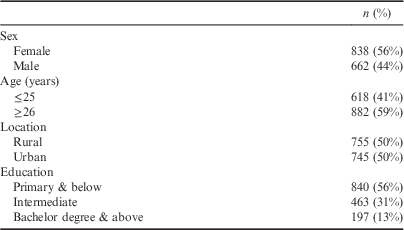
This retrospective study was carried out over an 11-month period from April 2015 to February 2016. A door-to-door survey was conducted in different urban–rural areas of Khyber Pakhtunkhwa province. A questionnaire was designed and a total of 1500 individuals (662 males and 838 females) were interviewed (Table 1). Only those respondents interested in providing complete information were included in the study. Detailed information was obtained from all respondents regarding their educational level, marriage type, consanguinity level, rural–urban origin and demographic parameters after their formal informed consent had been obtained. A five-point response scale was used to assess the respondent’s knowledge about the risks of consanguineous marriage. Respondents were asked how high they perceived the risk that consanguineous couples could have genetically affected offspring compared with non-consanguineous couples (strongly disagree, 1; strongly agree, 5).
Demographic characteristics of respondents, KP province, 2015–16, N=1500

Up to second cousin marriage was considered consanguineous for statistical analysis of the different parameters. Analysis was performed using SPSS Version 20. The mean inbreeding coefficient was obtained using the formula σ=ΣP i F i , where P i is the proportion of a certain type of consanguineous marriage and F i is the coefficient of inbreeding of that type of consanguineous marriage calculated from the weighted average of consanguineous union types (Bittles & Black, Reference Bittles and Black2010). Association between groups was measured using a standard χ 2 test for categorical frequency data. Differences between groups were measured using Mann–Whitney tests for non-normally distributed continuous ordinal data and Kruskal–Wallis tests for non-normally distributed variables with more than two groups. Significant level was considered at p≤0.05.
Results
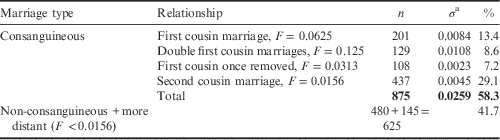
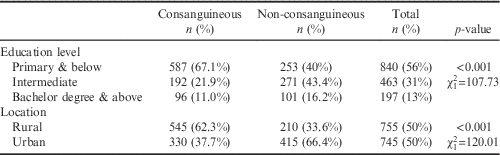
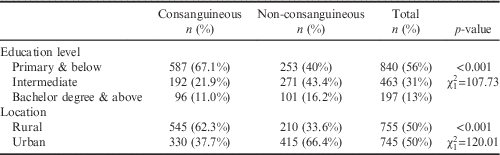
Consanguineous marriages were found to be more frequent than non-consanguineous marriages at 58.3% (n=875). The mean coefficient of inbreeding was 0.0259. The results indicated that second cousin marriage was the dominant type of marriage (n=437, 29.1%), followed by first cousin marriages (n=201, 13.4%) (Table 2). Education level showed a strong negative relation with the incidence of consanguineous marriage (primary: n=587, 67.1%; intermediate: n=192, 21.9%; bachelor degree and above: n=96, 11%) (p<0.001). Also, a significantly higher consanguinity rate was reported in the rural (n=545, 62.3%) than the urban population (n=330, 37.7%; p<0.001) (Table 3).
Prevalence of consanguinity, percentage of different types of consanguineous marriages and mean inbreeding coefficients (σ), N=1500
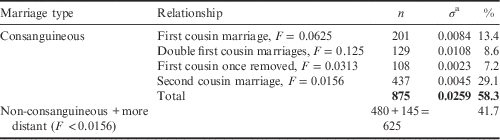
a σ is the mean inbreeding coefficient=ΣP i F i , where P i =N i /1500.
Prevalence of consanguineous marriages by education level and urban–rural location, KP province, 2015–16, N=1500
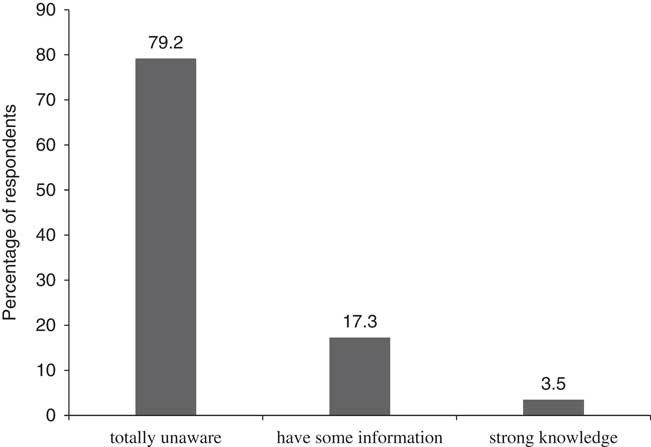
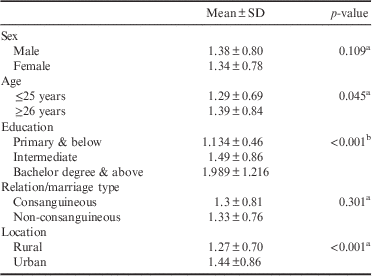
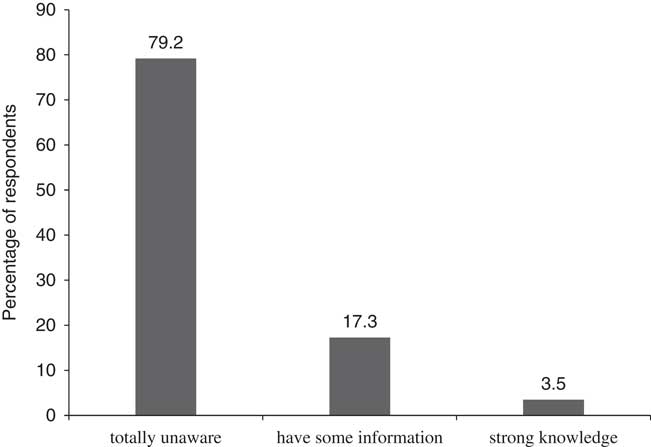
In response to the question ‘Do you think that consanguineous parents are more likely to have affected children than non-consanguineous parents?’, 79.2% (n=1188) of respondents were fully unaware, 17.3% (n=259) had some information, while only 3.5% (n=53) of the respondents were highly informed (Figure 1). On the five-point response scale, sex (p=0.109) and marriage types (p=0.301) did not exhibit any significant difference in the awareness of risk. However, respondents in the higher age group showed significantly greater awareness (mean=1.39±0.84) than respondents in the lower age group (mean=1.29±0.69) (p=0.045). With increasing level of education, awareness about consanguinity associated risk increased significantly (p<0.001), being lowest for primary/lower (mean=1.134±0.46) and highest for the bachelor degree level and above (mean=1.989±1.216). Likewise, significantly higher awareness was reported by urban respondents (mean=1.44±0.86) compared with those from rural areas (mean=1.27±0.70) (p<0.001) (Table 4).
Respondents’ awareness of the risks associated with consanguineous marriage, KP province, 2015–16, N=1500
Respondents’ awareness about consanguinity risks on a five-point response scale, KP province, 2015–16, N=1500
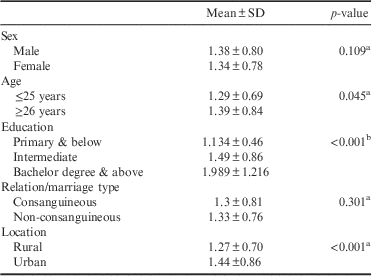
a Mann–Whitney test.
b Kruskal–Wallis test.
Means based on a five-point scale, higher scores being more favourable (showing greater awareness).
Discussion
This study confirmed that there is a high level of consanguineous marriage in the Pashtun population of KP province, Pakistan (58.3%), with a mean inbreeding coefficient of 0.0259. Similar results have been obtained from the past investigations in other parts of the country. For instance, Jabeen and Malik (Reference Jabeen and Malik2014) reported a mean inbreeding coefficient of 0.0348 with a total of 62% consanguineous marriages in Azad Jammu and Kashmir. Similarly, another study on 1800 females in the Sargodha-Punjab district reported 56–72% intrafamilial marriages with an inbreeding coefficient of 0.0348 (Hina & Malik, 2014). In most cases, low socioeconomic status, lower education level, rural location and an early age at marriage have been found to be associated with consanguinity (Sthanadar et al., Reference Sthanadar, Bittles and Zahid2014). In addition, 55% consanguinity was reported in district Peshawar (Wahab et al., 2006) and 34% in district Swat (Wahab & Ahmad, 1996). Almost all of the research on the effect of rural–urban location on the prevalence of consanguineous marriage has confirmed that the incidence in rural areas is greater than in urban areas (Jabeen & Malik, Reference Jabeen and Malik2014). The reason for this can be explained by the prevalence in Pakistani rural society of large family organizations with various overlapping generations and with large sibships in each generation. People with close kinship mostly cohabit or live in a close neighbourhood. This situation facilitates intrafamilial unions. Conversely, people of various ethnic groups live in urban societies with reduced sibships and in smaller family groups.
In this study, the male participants did not differ greatly from the females in their awareness of the risks of consanguineous marriage, although their attitudes were slightly more positive. However, a significantly higher level of knowledge and understanding was noted in respondents in the higher age groups. The same was true for high education status and the urban location of the respondents. This may partly be due to the lack of knowledge and education in the general public, because the literacy rate in Khyber Pakhtunkhwa province is only 47%, with the male and female literacy rates being 72% and 35%, respectively. In many areas, education is not considered necessary for females – a situation that is more common in rural areas (Mustafa, Reference Mustafa2012).
Similarly, some of the positive (although insignificant) risk awareness responses of families with consanguineous marriages could be due to these families being advised by their doctors to take genetic tests in order to assess the risk of recessive and multifactorial disease in their offspring. This mostly occurs in cases of recurrent pregnancy loss in consanguineous couples.
The overall consanguinity rate in the target population was found to be very high, and was combined with a minimum understanding of its genetic risks. Apart from a limited number of individuals, the Pashtun population has no information about the genetic risk of consanguinity. Therefore, different strategies should be implemented in order to offer general information about the risks. Genetic counselling should be introduced immediately to increase risk awareness and reduce the negative health consequences of consanguineous marriage for existing and future generations.
Acknowledgments
The authors gratefully acknowledge the financial support provided by Abdul Wali Khan University Mardan in Pakistan for this project (Reference No. F.16-5(6)/P&D/AWKUM/360). The authors are very grateful to the participants for their sincere responses to the questionnaire/interview. The authors have no conflicts of interest to declare.