Introduction
The European earwig, Forficula auricularia Linnaeus (Dermaptera: Forficulidae), is widely distributed throughout Canada and the United States of America. The biological cycle of this species has been investigated in several studies. Previous studies described the epigeal (e.g., above ground) phase of the female biological cycle and documented two reproductive cycles, which resulted in two population peaks of larval and adult cohorts each year (Beall Reference Beall1932; Lamb and Wellington Reference Lamb and Wellington1975). These studies were conducted under field conditions in Vancouver (British Columbia, Canada), which has a mild-temperate climate. In the process of preliminary genetic studies made in 1987, inbreeding between females and males from Vancouver and Montréal (Québec, Canada) failed to produce offspring (J.-C.T., unpublished data).
More recent studies, using mitochondrial analysis (Wirth et al. Reference Wirth, Le Guellec, Vancassel and Veuille1998; Guillet et al. Reference Guillet, Josselin and Vancassel2000), revealed that the North American taxon F. auricularia is comprised of at least two sibling species (“A” and “B”), and that Montréal’s population belonged to sibling species “A”. These two sibling species occupy different climate zones, and differ in reproductive phenology. Sibling species “A” produces one clutch per year, and occurs in cold-temperate climates, whereas sibling species “B” produces two clutches a year and occurs in mild-temperate climates.
Gingras and Tourneur (Reference Gingras and Tourneur2001) found that in semi-natural conditions, under the cold-temperate climate of Montréal (Québec), the hypogeal (e.g., below ground) phase of reproductive females produced a unique brood, suggesting one larval and adult cohort a year. However, if the epigeal phase of the biological cycle of the Vancouver sibling species “B” is well established (Lamb and Wellington Reference Lamb and Wellington1975), epigeal phase of the Montréal sibling species “A” is yet to be studied.
This study has two goals. The first goal is to describe the seasonal trends of the epigeal phase of sibling species “A” under natural conditions in three locations in eastern Canada (Montréal, Québec; Fredericton, New Brunswick; Truro, Nova Scotia) with slightly different cold-temperate climates, and to determine the seasonal timing and number of larval and adult cohorts occurring each year. The second goal is to ascertain whether the three studied populations in eastern Canada all belong to the same sibling species “A”, as opposed to sibling species “B” occurring in Vancouver.
Material and methods
We closely followed the protocol/procedures used by Lamb and Wellington (Reference Lamb and Wellington1974, Reference Lamb and Wellington1975). Seasonal trends in population structure during the epigeal phase were determined by regularly collecting earwigs while they were resting during the daytime. Grooved board traps provided as daytime shelters consisted of two parts, a pine board (25×4×2 cm) with two longitudinal 5×5 mm grooves, and a Masonite cover plate (Masonite International, Tampa, Florida, United State of America), held together with two rubber bands. Each trap was monitored weekly by removing the cover plate, and tapping the earwigs into a plastic vial through a wide-mouth funnel. Counts were documented per trap, per visit.
Field sampling occurred at Deux-Montagnes (45.533°N, 73.899°W, elevation 82 m), ~20 km northwest of Montréal; at Fredericton (45.962°N, 66.666°W, elevation 17 m); and at Truro (45.371°N, 63.264°W, elevation 18 m), ~20 km north of Halifax, on the campus of the Nova Scotia Agricultural College.
Traps were installed after the frost barrier melted in the spring, and were checked until after the first autumnal frost. The exact dates varied between study sites. Traps were installed at Deux-Montagnes on 31 May 1987 and 7 May 1988 and monitored until 23 October 1987 and 1 November 1988, respectively. Traps were installed at Fredericton on 9 May 2015 and monitored until 2 November 2015. Traps were installed at Truro on 21 May 1988 and monitored until 26 November 1988.
Each site was divided into two strata: herbaceous and arborescent. In the herbaceous stratum, the traps were randomly placed on the lawn. In the arborescent stratum, traps were placed on the trunk of varied species of trees, at ~1 m above the ground level; tied in place with nylon fabric rope. The number of traps installed was identical per stratum but varied per location: 90 traps/stratum at Deux-Montagnes, 40 traps/stratum at Fredericton, and 48 traps/stratum at Truro.
Since the number of traps and sampling days differed between sites, results are summarised as “catch per unit effort” and used to determine the population size/structure during the epigeal phase at each site (Lamb and Wellington Reference Lamb and Wellington1974). In this study, all traps deployed during a site visit are considered a single unit effort. Lamb and Wellington (Reference Lamb and Wellington1974) considered estimates of mean catch per trap based on a sampling period of one day were not reliable, and Chant and McLeod (Reference Chant and McLeod1952) found that weather could alter the catch from night to night. Consequently, all traps were installed at twilight and collected the morning (usually about 48 hours). However, in Fredericton they were deployed only for one night to minimise disturbance to the property owner.
Immature instars were distinguished by change in body size, thorax characteristics, forceps size and shape, and wing pads presence/absence (Crumb et al. Reference Crumb, Eide and Bonn1941; Lhoste Reference Lhoste1957). Following examination and data collection, earwigs were released at the collection site. All vernal females trapped at the onset of each study were isolated in Petri dishes and fed ad libitum until their death.
For the second goal, experimental crosses were conducted in the laboratory. Earwig larvae of the last two instars were collected from all the sites. Virgin females, at the imaginal moult stage, were isolated in 10-cm Petri dishes containing a thin layer of moist sand and fed carrot and pollen ad libitum. Crosses among all three populations were made, using males and females coming from each population, and maintained isolated before mating. Mated pairs were kept at 10±1 °C. Once a week, the pairs were observed, food replaced, and humidity of the substrate re-established. The food and males were removed once eggs were laid. Number of eggs produced and offspring per clutch were recorded and per cent hatch rate calculated.
Results and discussion
Duration of the epigeal phase
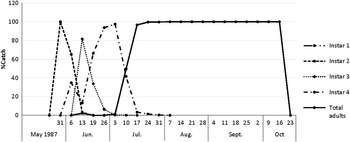
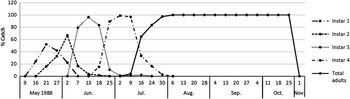
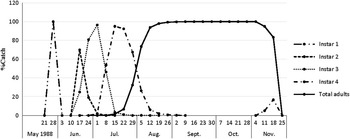
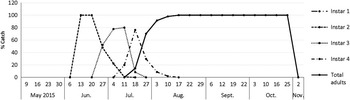
In Montréal, Fredericton, and Truro, earwigs were present in traps from mid-May to mid-November (Figs. 1–4). This period is much shorter than that for populations reported in other studies: early April to end of November in Vancouver, British Columbia, Canada (Beall Reference Beall1932; Lamb and Wellington Reference Lamb and Wellington1975); early March to the end of November in Bristol, United Kingdom (Phillips Reference Phillips1981), and mid-January to early December in Southampton, United Kingdom (Carillo Reference Carillo1985). The colder climatic conditions in eastern Canada, as compared with the milder climates of western Canada and the United Kingdom, explain this shorter free-foraging period.
Seasonal change in proportion of instars of Forficula auricularia in 1987 from Deux-Montagnes (Montréal, Québec, Canada).

Seasonal change in proportion of instars of Forficula auricularia in 1988 from Deux-Montagnes (Montréal, Québec, Canada).

Seasonal change in proportion of instars of Forficula auricularia in 1988 from the Nova Scotia Agricultural College (Truro, Nova Scotia, Canada).

Seasonal change in proportion of instars of Forficula auricularia in 2015 from Fredericton (New Brunswick, Canada).

In eastern Canada, vernal adults and first and second instars are not found on the ground until after the frost barrier is gone in mid-May (Gingras and Tourneur Reference Gingras and Tourneur2001). For this reason, they were not found in traps until approximately two months later than that those in Vancouver, three months later than those found in Bristol, and four months later than those found in Southampton.
Adult earwigs start to bury themselves in the ground following the first autumnal night frosts (Carillo Reference Carillo1985). In Montréal, this occurred in October (16 October 1987; 25 October 1988); in Fredericton and Truro it occurred in November (18 November 1988; 12 November 2015, respectively), and none were found past November.
In this study, the disappearance of earwigs occurred a month earlier than studies conducted in Vancouver and Bristol and two months earlier than studies conducted in Southampton. The other studies were conducted in western Canada and the United Kingdom, which have milder maritime climates.
Age structure of the populations
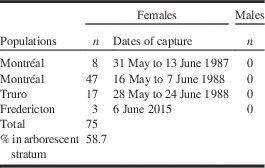
The seasonal trends in life history stages were similar for all three study sites. A few vernal females (Montréal three and 11, Fredericton three, and Truro 14) were found in the traps from mid-May to the third week of June (Table 1). Only a single vernal female (from Fredericton) laid 19 eggs (observed 16 May) and died a few days later. This single observation was probably the result of a delayed oviposition, as observed by Gingras and Tourneur (Reference Gingras and Tourneur2001) rather than tending a second brood. Furthermore, Gingras and Tourneur (Reference Gingras and Tourneur2001) have also shown that if the female survives, its oviposition is delayed until the temperature increases sufficiently in the spring.
Vernal adults caught in the different studied populations of Forficula auricularia from eastern Canada.

No vernal males were found. This absence agrees with their short survival time found in previous studies conducted by Gingras and Tourneur (Reference Gingras and Tourneur2001). However, the absence of vernal males is quite different from the findings in spring populations from Vancouver and Bristol, which are predominately male (Lamb and Wellington Reference Lamb and Wellington1975; Phillips Reference Phillips1981).
Nymphal development progressed during the weeks between mid-May to the penultimate week of July in Montréal, and the penultimate week of May to mid-August in Fredericton and Truro (Figs. 1–4). Each instar constituted most of the population structure once it appeared; and each instar phase lasted two to three weeks. Chronologically, the first instar appeared in traps from 21 to 28 May, the second instar dominated from 31 May to 17 June, the third instar dominated from 13 June to 1 July, and the fourth instar dominated from 2 to 22 July. By August 100% of the population consisted of adults. Timing of nymphal phase differed between our sites in eastern Canada and studies conducted in other geographic locations. In our study, fourth instars were not found in traps before mid-June or after mid-August. In comparison “occasional nymphs were recovered from the surface of the soil during November to March” in Edinburgh, United Kingdom (Behura Reference Behura1956), and “in one occasion 4th instar nymphs were found in the Botanical Garden in April” in Southampton (Carillo Reference Carillo1985). At my study sites, populations consisted entirely of adults after mid-August in Montréal, in the third week of August in Fredericton, and in mid-September in Truro. In comparison, Vancouver in western Canada, had two cohorts each year, with the emergence of adults a month later than the fourth instars from the first cohort, and two weeks before adult emergence from the second cohort (Lamb and Wellington Reference Lamb and Wellington1975).
Our results demonstrate that only one brood occurred naturally in the three studied populations of eastern Canada, and concur with Bolwig (Reference Bolwig1944) who reported that only one brood occurred naturally in Denmark. However, ours differ fundamentally from those of Beall (Reference Beall1932) and Lamb and Wellington (Reference Lamb and Wellington1975) in Vancouver; Behura (Reference Behura1956) in Bristol; and Carillo (Reference Carillo1985) in Southampton. In each of those geographic areas both instars and adults showed two peaks of abundance, providing direct evidence that a second cohort did occur in the lifecycle of these populations.
The sex ratio of teneral (new generation) adults
In this study, there was a slightly skewed sex ratio, with males accounting for 44.6% (n=30 555), 33.3% (n=776), and 49.7% (n=22 955) in Montréal, Fredericton, and Truro, respectively. These results agree with other studies occurring across broad geographical regions and different climatic zones: 42.1% (Beall Reference Beall1932) and 50% (Lamb and Wellington Reference Lamb and Wellington1975) for the population of Vancouver, and 49.6% (Behura Reference Behura1956) in Bristol.
Inbreeding results
The populations from our three study sites in eastern Canada were reproductively compatible. Approximately 69.9–84.1% of laid eggs hatched and produced viable neonate hybrids (Table 2). This suggests that the populations belong to the same sibling species.
Interbreeding of female and male of Forficula auricularia of the different populations of eastern Canada.

*A female did not lay eggs.
n, number of females in experiment; M, Montréal; F, Fredericton; T, Truro.
Timing mating
Mating pairs of new generation (teneral) adults were observed in traps from mid-August to mid-October, in Montréal, Fredericton, and Truro. These data agree with those observed by Lamb and Wellington (Reference Lamb and Wellington1975) in Vancouver, and by Behura (Reference Behura1956) in Edinburgh under laboratory conditions.
However, no mating pairs of vernal adults were observed in Montréal, Fredericton, or Truro. These data are consistent with males dying before egg hatching occurs in semi-natural conditions in Montréal (Gingras and Tourneur Reference Gingras and Tourneur2001), yet differ from those of Lamb and Wellington (Reference Lamb and Wellington1975) from Vancouver where mating pairs were found to be common in mid-May.
Habitat distribution
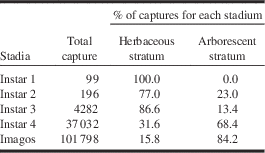
As observed under natural conditions, the habitat distribution of the European earwig varied strongly during the free-foraging period (Table 3). The majority of the first, second, and third instars were retrieved in the herbaceous strata (first instar 100%, second and fourth instars 68.4%, and adults 84.2%).
Stadia repartition of Forficula auricularia caught in each stratum: all populations taken in account.

These data agree with the general trends previously described by Beall (Reference Beall1932), Phillips (Reference Phillips1981), and Carillo (Reference Carillo1985), and with Lamb and Wellington (Reference Lamb and Wellington1974) who said when speaking about the epigeal “free-foraging” phase “thus the period is primarily one of movement, feeding, and growth”. They also agree with results of Chant and McLeod (Reference Chant and McLeod1952), who stated “earwigs may spend much time in shrubs or trees after leaving their nests, even though they are primarily terrestrial”.
Conclusion
This study demonstrated that only one breeding cohort occurs annually in the lifecycle of F. auricularia population located in Montréal, Fredericton, and Truro.
These three populations also had a short epigeal period, with a single reproductive cycle per female producing one cohort per year. The annual phenology of the European earwig in eastern Canada suggests that the cold-temperate climates prevailing in this region is approaching cold tolerance of this univoltine species by limiting several critical stages.
Furthermore, interbreeding of these three eastern populations, including Montréal’s sibling species “A”, in a laboratory environment resulted in high rates (>70%) of viable offspring. Successful mating with viable offspring revealed that the three eastern populations were of the same sibling species “A”.
Acknowledgements
I am indebted to several undergraduate students for their help with collecting earwigs: Sophie Lessard (in 1987) and Stéphanie Cazelais (in 1988) from l’Université du Québec à Montréal; Philip W. Maxwell (in 1988) from the Nova Scotia Agricultural College; and Amélia Cole (in 2015) from St. Thomas University. I am deeply grateful to Dr. Claude Guertin for reviewing, correcting, and improving the English. I also would like to thank Dr. Jean-Pierre Le Blanc, whose helpful comments improved earlier drafts; Claire Cole my administrative assistant; and two anonymous reviewers for their comments and suggestions.