Introduction
The traditional health care systems objective of distributive justice has been accompanied over time by other objectives related to cost control, efficiency, value and quality (Cutler, 2002). Health care reforms have developed accordingly. In their efforts to make the public sector more efficient and effective, governments have changed the structures and patterns for the delivery of services, allocation of resources and monitoring of activities. Bevan et al. (Reference Bevan, Helderman and Wilsford2010) refer to the triangle of equity, efficiency and cost as an overarching bane of health economists and health policy analysts. In primary care, at least seven potentially conflicting objectives have been identified, namely effectiveness, productivity, accessibility, continuity, quality, equity and responsiveness (Lamarche et al., Reference Lamarche, Beaulieu, Pineault, Contandriopoulos, Denis and Haggerty2003). Different organizational and other characteristics of providers may be associated with different possibilities of achieving various objectives of primary care. Smaller practices have, for instance, been associated with a higher patient satisfaction in terms of access and continuity of care compared with larger practices (Campbell et al., Reference Campbell, Ramsay and Green2001a; Kontopantelis et al., Reference Kontopantelis, Roland and Reeves2010). Small practices may on the other hand experience diseconomies of scales, especially if payment to providers is fixed. With fixed payment per registered individual (capitation) for instance, providers are given incentives to register many individuals in order to balance off costly patients with great needs with registered individuals with less demand (Barnum et al., Reference Barnum, Kutzin and Saxenian1995; Jegers et al., Reference Jegers, Kesteloot, De Graeve and Gilles2002).
Swedish primary care is traditionally based on primary care units with between four and eight general practitioners and a broad responsibility for individuals based on geographical area. It can best be described as an integrated community model, which ideally performs well with respect to effectiveness, productivity, continuity, equity and quality, but often display problems with accessibility and responsiveness (Lamarche et al., Reference Lamarche, Beaulieu, Pineault, Contandriopoulos, Denis and Haggerty2003). Similar to other Nordic countries, major changes and market-like structures have been implemented in Swedish health care since the early 1990s. Freedom of choice of primary care provider for citizens combined with freedom of establishment for providers accredited by the local county councils is mandatory in Sweden since 1 January 2010. Individuals may register with any provider accredited by the local county council. The reform has been gradually implemented throughout the 21 county councils, responsible for the organization and provision of health care in Sweden, since 2007 (Anell, Reference Anell2011). Since the introduction of the reform, there has been an increase in the number of primary care providers by more than 20% (Swedish Competition Authority, 2010). New providers are predominately smaller and privately owned compared with providers that were established before the reform. There is thus a new diversity among health care providers in Swedish primary care. The intended mechanism behind expanded patient choice and provider competition is that it should improve the efficiency, quality and responsiveness of providers in relation to their patients through market mechanisms (Le Grand, Reference Le Grand2007, Reference Le Grand2009; Anell, Reference Anell2011). As patients can shift provider in case they are not satisfied with their current provider, they can cause a loss of income for the providers (Dixon and Le Grand, Reference Dixon and Le Grand2006; Fotaki et al., Reference Fotaki, Roland, Boyd, McDonald, Scheaff and Smith2008). More generally, actors in health care systems are linked by different accountability relationships (Smith et al., Reference Smith, Anell, Busse, Crivelli, Healy, Lindahl, Westert and Kene2012). Accountability involves both the rendering of an account and the consequent holding to account (Smith et al., 2010; Greiling and Spraul, 2010). The rendering of an account is about performance monitoring and reporting. The consequent holding to account involves mechanisms for corrective action, that is, those actions which actors involved in accountability relationships may use to hold providers to account for their services provided. Thus, for a choice system to work in practice, citizens need to be both interested and informed enough to be able to make a choice of provider in case they are not satisfied (Hibbard and Peters, Reference Hibbard and Peters2003; Le Grand, Reference Le Grand2007, Reference Le Grand2009; Anell, Reference Anell2011).
In order to make informed choices, individuals need information about, for instance, availability of services and treatment options to make a choice of provider or treatment alternative. In parallel to market-like reforms in primary care, the gathering and compilation of comparative information about the quality of providers in Sweden has been improved and made available to citizens. One way of gathering empirical information about patient satisfaction with different providers is through patient surveys. Since 2009, a National Patient Survey in primary care is administered annually to all health care providers in Sweden in participating county councils. In the 2010 survey, 16 out of 21 county councils participated (SALAR, 2011). Such information is intended to guide individual choices as well as the public payers’ performance evaluation of providers. When presenting the information to the public, the results from the survey are summarized into eight broad categories regarding the perceived quality of the provider. The categories are overall impression, respectful and considerate attendance, participation in decisions, information about medical condition, accessibility, confidence, need of care adequately taken care of and if they would recommend the provider to others (Institute for Quality Indicators, 2011; SALAR, 2011).
Comparative information about provider performance generated through survey tools is often used to evaluate the overall performance of providers without critically reflecting about underlying factors. Underlying factors such as structural and organizational characteristics of practices are likely to differ with respect to how easily they can be controlled by providers. This, in turn might have implications for the mechanisms for corrective action of providers, as one general principle is that actors should only be held accountable to factors that are possible for them to control. Moreover, for the public payers it is important to bear in mind the many and potentially conflicting goals of health care that providers are faced with, when acting upon such information (Browne et al., Reference Browne, Roseman, Shaller and Edgman-Levitan2010). Providers are faced with the challenge of meeting the expectations of their patients as well as the demands from the public payer through conditions for accreditation and payment. Solutions to the fulfillment of objectives related to individual patient's preferences may not correspond to solutions related to county council preferences.
Purpose
The purpose of this study was to analyze variation in patient satisfaction, with respect to organizational and structural factors, including the mix of registered individuals, among primary care providers. Secondary objectives were to discuss the results with respect to the provider's ability to control information about the performance generated through survey tools and potential dilemmas in the achievement of various objectives of primary care.
Empirical materials
Two main sources of empirical material were used. Information about perceived patient satisfaction was collected from the National Patient survey in primary care 2010 (Institute for Quality Indicators, 2011). There is one version of the questionnaire for patients having visited a nurse and one for patients having visited a doctor. The survey includes 54 questions related to perceived quality of the provider, that is, seven regarding availability, five regarding the reception at the facility, 22 regarding the actual doctor/nurse visit, five regarding lab and other medical tests, nine regarding the overall impression and six about background characteristics of the respondent. The latest survey was administered by mail to a random sample of patients having visited the provider during the period September–October 2010. A total of 135,300 respondents answered the questionnaire in 2010, a response rate of 57.9%. Of them, about one-third was for nurse visits and two-thirds for doctor visits. In the present study, the responses for Region Halland (7989 questionnaires whereof 5561 for doctor visits), Region Skåne (24,663 questionnaires whereof 16,669 for doctor visits) and Västra Götalandsregionen (VGR; 32,442 questionnaires whereof 22,010 for doctor visits) are used (Institute for Quality Indicators, 2011; SALAR, 2011).
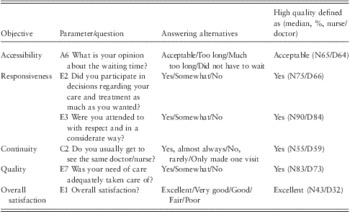
The questions from the patient survey, selected for this study together with the chosen definition of high patient satisfaction, are presented in Table 1. The choice of questions to include in the analysis was based on commonly discussed objectives in primary care according to previous research (e.g. Starfield, 1998; World Health Report, 2000; Lamarche et al., Reference Lamarche, Beaulieu, Pineault, Contandriopoulos, Denis and Haggerty2003) and the mode in which the results from the National Patient survey are presented to citizens (Institute for Quality Indicators 2011; SALAR, 2011). The questions can be linked to four of the seven objectives that primary care should deliver, according to Lamarche et al. (Reference Lamarche, Beaulieu, Pineault, Contandriopoulos, Denis and Haggerty2003), that is, accessibility, continuity, quality and responsiveness. In addition, one question reflecting patients overall satisfaction was included. The chosen questions also represent four of the eight categories into which results from the National Patient survey are summarized and presented to the public.
Measure of patient satisfaction and definition of high satisfaction

Information about size, location, owner, number of visits, time of establishment and characteristics of registered individuals was collected from the county councils. All providers in VGR (208 providers), Region Skåne (154 providers) and Region Halland (48 providers) at the time of the 2010 national patient survey in primary care were included. About one-fourth of the providers were established in connection with or after the reform and 57% of the providers were publicly owned. Information about average-adjusted clinical groups (ACG) and care need index (CNI) for registered individuals (group level) was available for the providers in Region Skåne and VGR. ACG is a measure of overall illness, which quantifies morbidity by grouping individuals based on their age, gender and the constellation of diagnoses over a defined time period (Reid et al., Reference Reid, MacWilliam, Roos, Bogdanovic and Black1999). CNI is a measure of social deprivation related to seven factors, for example education and unemployment (Sundquist et al., Reference Sundquist, Malmström, Johansson and Sundquist2003).
Analysis
Regressions analysis was used to analyze the relation between dependent and independent variables (Hill et al., Reference Hill, Griffiths and Judge1997). The dependent variables in each regression were different aspects of patient satisfaction, defined as the proportion of patients who perceived the quality as high according to the definitions in Table 1.
The independent variables were characteristics of the providers, reflecting organizational and structural differences, including the mix of registered individuals. The choice of independent variables was based on assumptions regarding what factors might have an impact on provider performance, in a situation with freedom of choice of provider for citizens and competition among providers and where providers have a comprehensive financial responsibility for registered individuals (Campbell et al., Reference Campbell, Ramsay and Green2001a, Reference Campbell, Ramsay and Green2001b; Le Grand, Reference Le Grand2007, Reference Le Grand2009; Kontopantelis et al., Reference Kontopantelis, Roland and Reeves2010; Anell, Reference Anell2011; Glenngård et al., Reference Glenngård, Anell and Beckman2011):
• Size (number of registered patients).
• Number of visits per registered patient.
• Doctor visits as a proportion of all visits among registered patients.
• Establishment of provider(s) in the municipality in connection with reform (0 = No/1 = Yes).
• Provider established in connection with or after the reform (0 = No/1 = Yes).
• Type of owner, private or public (0 = Private/1 = Public).
• Type of owner, independent private provider (0 = Other/1 = Independent private providers).
• Provider located in VGR (0 = No/1 = Yes).
• Provider located in Region Halland (0 = No/1 = Yes).
• Located in the two largest cities in the sample, that is, Malmö or Gothenburg (1 = Yes/0 = No).
• Overall illness among registered individuals (average ACG).
• Social deprivation among registered individuals (0 = Low/1 = High, defined as the group of providers with the 20% highest CNI).
The general approach to analyzing the impact of different characteristics of the providers on patient satisfaction was to start by including all explanatory variables. Then, non-significant variables were excluded and different models were analyzed. The choice of final models was done with respect to the model with the highest value of explained variance of the dependent variable (adjusted R 2), controlled for multicollinearity between independent variables. In the final models, variables reflecting structural differences with respect to localization (located in large city, average social deprivation, average overall illness), regardless of significance level are included. The rational for including these variables that are expected to be difficult for providers to control is to analyze to what extent other variables have an impact on patient satisfaction. All other variables in the models are included only when significant at 5% level (p < 0.05).The variable reflecting social deprivation is treated as a binary variable based on the fact that providers with the 20% highest CNI in Skåne and VGR are allocated extra resources to compensate for a higher expected primary care need due to higher social deprivation among registered individuals. Multicollinearity between independent variables was assessed by checking the tolerance and the variance inflation factor (VIF) values for each independent variable in the model. Tolerance values below 0.25 and VIF values >4 were not accepted (Pallant, Reference Pallant2007). The data collected were coded and analyzed using SPSS 17.0.
Results
On an overall level, bivariate correlation analysis showed that perceptions regarding the different aspects of patient satisfaction for both nurse and doctor visits were correlated (at 1% level). This result implies that providers that have satisfied patients regarding one question also tended to have satisfied patients regarding other questions. The exception was the question about accessibility regarding nurse visits, which was only correlated with a few of the other questions. Regarding multicollinearity, no value of VIF >2 and no value of tolerance <0.5 was observed.
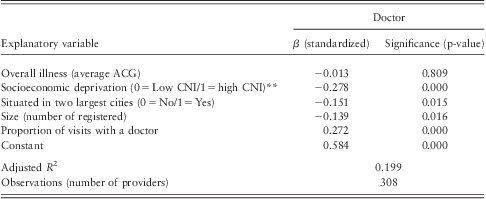
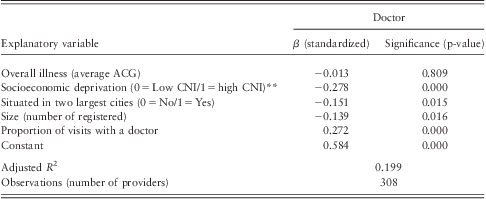
Smaller practices, where registered individuals had a low social deprivation on average, and where a large proportion of all visits were with doctors were perceived as having a better accessibility (Table 2). No model was found to explain more than 10% of the variation regarding accessibility of care for nurse visits.
Accessibility of care
ACG = average-adjusted clinical groups; CNI = care need index.
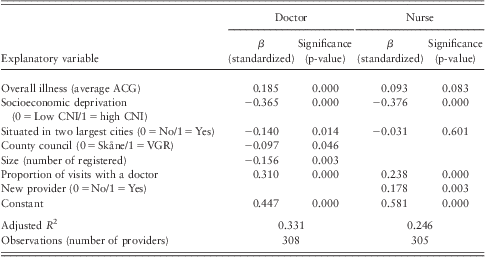
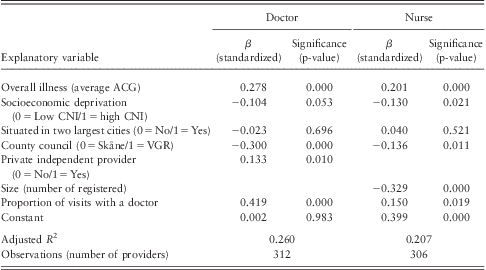
A high proportion of doctor visits, smaller practices and a low average social deprivation among registered individuals were associated with higher patient satisfaction for both doctor and nurse visits regarding participation (Table 3). A high overall illness among registered individuals was positively correlated with patient participation. Being located in the two largest cities was, however, associated with a lower participation. For nurse visits, being established in connection with or after the introduction of the reform were also positively correlated with patient participation.
Participation in decisions regarding care
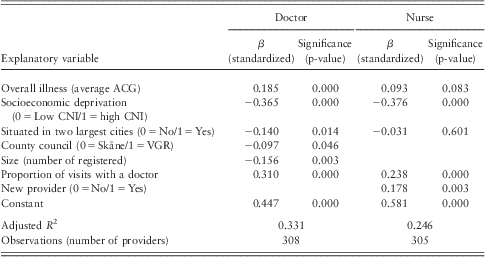
ACG = average-adjusted clinic group; CNI = care need index; VGR = Västra Götalandsregionen.
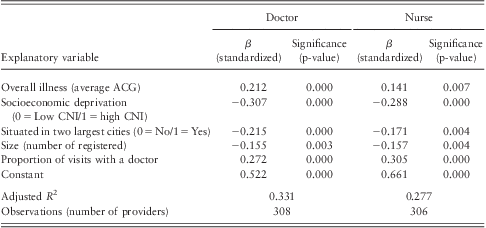
Regarding consideration and respect, a high proportion of doctor visits, a low social deprivation and a high overall illness among registered individuals were associated with higher patient satisfaction for both doctor and nurse visits (Table 4). Smaller practices were also positively correlated with consideration and respect for nurse visits.
Attended to with consideration and respect
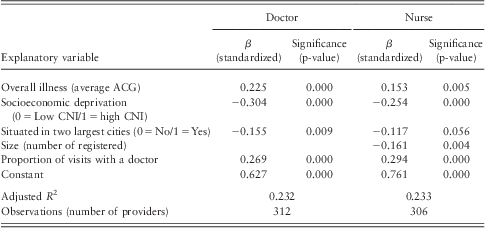
ACG = average-adjusted clinic group; CNI = care need index.
A high proportion of doctor visits and high overall illness was positively correlated with continuity of care, whereas the opposite relation was found for high social deprivation among registered individuals, similar to other dimensions of perceived patient satisfaction (Table 5). Moreover, perceptions about continuity of care were found to be correlated to type of owner for doctor visits, where independent private providers were perceived as being the best at providing continuity. Size was negatively correlated to continuity of care for nurse visits but not for doctor visits.
Continuity of care
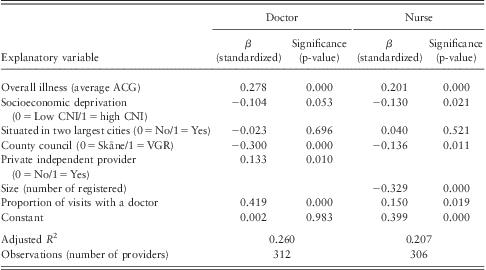
ACG = average-adjusted clinic group; CNI = care need index; VGR = Västra Götalandsregionen.
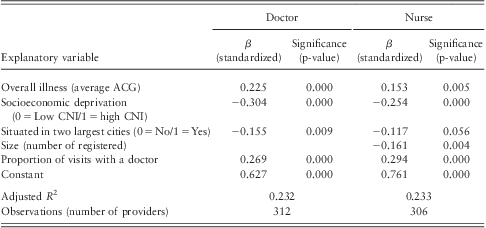
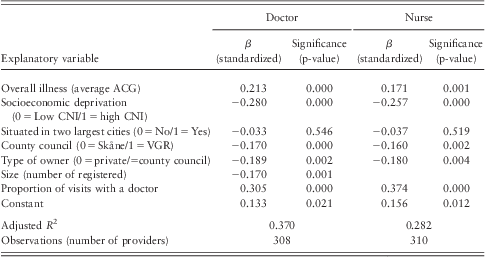
With respect to the question on the need of care being adequately taken care of, the final models were similar for doctor visits and nurse visits (Table 6). A high proportion of doctor visits, a smaller number of registered individuals and high overall illness was associated with higher patient satisfaction, whereas the opposite relation was found for high social deprivation among registered individuals. Also being located in the two biggest cities was associated with a lower patient satisfaction.
Need of care adequately taken care of
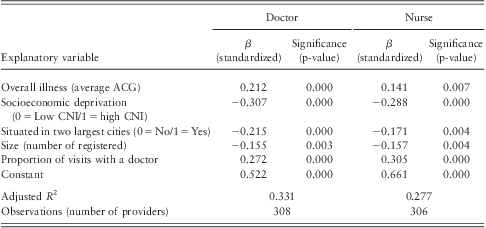
ACG = average-adjusted clinic group; CNI = care need index.
A high overall illness and a low social deprivation among registered individuals and a high proportion of doctor visits were positively correlated with overall satisfaction (Table 7). Overall satisfaction was also correlated with county council, where providers in Skåne were found to perform better than providers in VGR for both nurse and doctor visits. Being located in Halland was associated with a higher perceived overall satisfaction compared with both Skåne and VGR, but Halland was not included in the final models due to missing information about overall illness and social deprivation about registered individuals. Moreover, overall satisfaction was positively correlated with private providers for both doctor and nurse visits. Size was negatively associated with overall satisfaction for doctor visits, but no systematic variation was found for this parameter with respect to nurse visits.
Overall satisfaction with provider
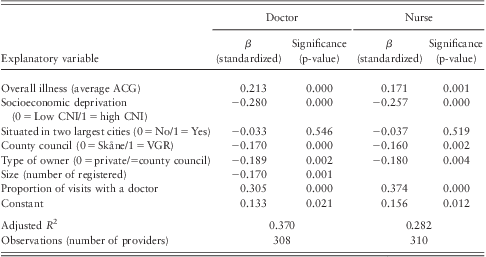
ACG = average-adjusted clinic group; CNI = care need index; VGR = Västra Götalandsregionen.
Discussion
Comparative information about patients’ experience with providers collected through survey tools are becoming increasingly more common and used in the assessment of providers by individuals and payers (Smith et al., Reference Smith, Mossialos, Papanicolas and Leatherman2010). Such information about provider performance is often used to evaluate the overall performance and to identify differences between, for example, public and private providers without critically reflecting about underlying factors. The results in this study indicate that factors that are of relevance for how well providers perform according to such surveys are more or less possible to control for providers. This might in turn have consequences for the use of such information by individuals and payers. Moreover, having in mind the potentially conflicting objectives of health care is important when collecting, analyzing and acting upon comparative information about providers (Browne et al., Reference Browne, Roseman, Shaller and Edgman-Levitan2010). Primary care should fulfill a number of conflicting objectives and there is no simple solution on how to best organize primary care services to achieve fulfillment of one objective without adverse consequences for the fulfillment of other objectives (Lamarche et al., Reference Lamarche, Beaulieu, Pineault, Contandriopoulos, Denis and Haggerty2003; Bevan et al., Reference Bevan, Helderman and Wilsford2010).
The fulfillment of objectives related to patient satisfaction was analyzed with respect to several characteristics of providers, based on information from a national patient survey in primary care. The sample of slightly more than 400 primary care providers located in three county councils represents about one-third of all primary care providers in Sweden. The principle for payment and conditions for accreditation of providers as well as for registration of individuals with a provider in the three county councils are similar to the primary care models practiced in a majority of the county councils in Sweden. The availability of alternative providers is, however, higher in the sample compared with in many other county councils.
On an overall level, the finding that the perceptions regarding the different questions were correlated implies that providers that have satisfied patients regarding one question also tended to have satisfied patients regarding other questions. The models used to analyze the six chosen questions indicate that there were systematic variation in patient satisfaction with respect to both organizational and structural factors, including the mix of registered individuals among providers. In line with the finding about correlation between the questions, different factors tended to affect the different aspects of patient satisfaction in similar directions although to different extent. The factors reflecting organizational and structural differences included in this study are, however, not the only factors of relevance for patients’ perceptions about the quality of services provided among primary care providers. Factors reflecting expectations and preferences in primary care among individual patients are for instance not included in the models.
Differences in patient satisfaction with respect to type of owner were found for two questions. Private providers were associated with different perceptions regarding patient satisfaction for one aspect, that is, overall satisfaction. For all other aspects, no significant correlation was found between patient satisfaction and the private/public dimension. In another recent Swedish study, based on a population survey in the same county councils as included in the present study, it was found that a majority of the respondents had no opinion about whether private health care providers provide better services than public providers (Glenngård et al., Reference Glenngård, Anell and Beckman2011). Moreover, regarding continuity of care for doctor visits, independent private providers were associated with higher patient satisfaction.
With regard to location, providers in the two largest county councils (Region Skåne and VGR) were associated with a lower continuity of care compared with the county council of Halland. Being located in the two biggest cities in the sample (Malmö and Göteborg) was associated with a lower satisfaction among patients regarding several of the included dimensions of patient satisfaction. One possible explanation is that individuals who live in large cities have higher expectations on primary care services in general and on accessibility in particular due to the short distance to alternative health care providers, including emergency care hospitals.
The mix of registered individuals was found to be correlated to patient satisfaction for all aspects investigated. The most common factor associated with a lower satisfaction among patients was high social deprivation (CNI) among registered individuals with a provider. All aspects of patient satisfaction included in this study were negatively correlated to this parameter. This is in line with findings by Kontopantelis et al. (Reference Kontopantelis, Roland and Reeves2010) and Campbell et al. (Reference Campbell, Ramsay and Green2001b) who have demonstrated that patients living in socio-economically deprived areas tend to be less satisfied with services. The opposite was found for overall illness of individuals (ACG). A high overall illness among registered individuals was found to be positively correlated with patient satisfaction for almost all aspects included in the study. This may, however, also reflect the fact that the elderly are more satisfied since the number of diagnoses and the number of health care visits commonly increases with age. A limitation in the current study is that no variable reflecting only age of registered individuals was included.
There was no systematic variation in patient satisfaction with respect to a high total number of visits per registered individual. But all aspects of patient satisfaction investigated were positively correlated with a high proportion of all visits being with a doctor. Thus, the organization of work seems to be an important factor for patient satisfaction. Possible explanations to this finding are related to both expectations among patients and the character of the visit. If patients expect that they will see a doctor there is a risk of being dissatisfied with the visit if they get to see a nurse instead, irrespective of the actual content or quality of the visit. Moreover, if an increased proportion of all visits occur with nurses, the content of nurse visits will change since more focus has to be directed at the clinical content of the visit and thereby perhaps less focus is directed at, for example, responsiveness of staff in relation to their patients. One of the ideas of the model of team-based primary health care, which is practiced in Sweden, is, however, that the substitution of physician labor input for non-physician labor input, such as nurses, has benefits for patients and also leads to efficient use of resources. It is expected to shorten waiting times and improve services as physicians can devote more time to patients with severe problems (Jessup, Reference Jessup2007; Yarnall et al., Reference Yarnall, Østbye, Krause, Pollak, Gradison and Michener2009). Also the primary care models practiced in the three county councils included in this study are based on the rationale that individuals should register with a primary care unit rather than with a general practitioner (Anell, Reference Anell2011). In light of the shortage of physicians in Swedish primary care, this is indeed important in order to improve access to primary care services. However, the results in this study indicate that satisfying patients’ perceptions about quality of care while at the same time using scarce resources for primary care in an efficient way is a difficult task.
Size, more specifically a smaller number of registered individuals were associated with a higher satisfaction among primary care patients for all aspects. This was especially pronounced with regard to the continuity of care for nurse visits. This finding is in line with previous studies, where it has been demonstrated that smaller practices are associated with a higher patient satisfaction regarding access and continuity of care (e.g. Campbell et al., Reference Campbell, Ramsay and Green2001a; Kontopantelis et al., Reference Kontopantelis, Roland and Reeves2010). Small practices may, however, experience diseconomies of scale in other dimensions. The payment principle in Swedish primary care is primarily based on fixed capitation combined with a comprehensive financial responsibility for services. This gives providers incentives to have many registered individuals in order to balance off costs for patients with great needs with individuals expected to have lesser demands (Barnum et al., Reference Barnum, Kutzin and Saxenian1995; Jegers et al., Reference Jegers, Kesteloot, De Graeve and Gilles2002). One possible way to solve this potential dilemma is to organize several smaller units in a chain of providers in order to balance off costs between providers if necessary.
A higher patient satisfaction associated with a higher overall illness among registered individuals is at least theoretically possible for the providers to control with other means than geographical location in a system based on freedom of choice of provider for citizens. By hiring a specialist in diabetes or geriatric care, for instance, and communicating this, it might be possible to attract individuals with certain diagnoses and thereby a high overall illness. On the other hand, such individuals are potentially costly, and providers may also need economic incentives to attract individuals with expected great care needs, that is, risk-adjusted care payment (Le Grand, Reference Le Grand2009; Miller, Reference Miller2009). More or less sophisticated systems for risk-adjusting the capitation to providers is practiced in the three county councils included in this study. In Halland, a model based on age is practiced, and in Skåne and VGR, a model based on risk-adjusted capitation with respect to both overall illness and social deprivation is practiced. This theoretically gives providers in Skåne and VGR incentives to attract less healthy individuals, whereas the opposite is the case in Halland (Anell, Reference Anell2011).
Providers risk not being favored by individuals when they make a choice of provider if they are located in areas with high socio-economic burden. This risk can to some extent be mitigated by establishing only in areas with a low socio-economic burden. This is of course not a desired scenario as socially deprived individuals have a greater expected need of health care services and thus would benefit from more and better quality services rather than the contrary. The whole idea behind expanded patient choice and provider competition is that it should improve the efficiency, quality and responsiveness of providers in relation to their patients through market mechanisms (Le Grand, Reference Le Grand2007; Anell, Reference Anell2011). As patients can shift provider in case they are not satisfied with their current provider, they can cause a loss of income for the providers (Dixon and Le Grand, Reference Dixon and Le Grand2006; Fotaki et al., Reference Fotaki, Roland, Boyd, McDonald, Scheaff and Smith2008). If providers choose not to establish in areas with a high socio-economic burden, this mechanism risks failing, leading to increased inequalities. People in lower socio-economic groups often have lesser capabilities to exercise choice compared with people with higher income and/or education who are more articulate, have better skills in searching for information and are more able to travel to non-local providers (Barr et al., Reference Barr, Fenton and Blane2008; Fotaki et al., Reference Fotaki, Roland, Boyd, McDonald, Scheaff and Smith2008).
In order for increased patient choice to contribute to the efficiency, quality and responsiveness of health care systems, individuals must actually use the information available to make informed choices (Hibbard and Peters, Reference Hibbard and Peters2003). Previous Swedish studies have shown that individuals are interested in making a choice of provider (Anell et al., Reference Anell, Rosén and Hjortsberg1997; Hjelmgren and Anell, Reference Hjelmgren and Anell2007), but that they are rather passive in their search for information (Nordgren and Åhgren, Reference Nordgren and Åhgren2010; Glenngård et al., Reference Glenngård, Anell and Beckman2011). Individuals tend to get their information from providers that they have previously been in contact with. Hibbard and Peters (Reference Hibbard and Peters2003) suggest three processes to enhance the individuals’ use of comparative information: lowering cognitive effort, helping people to understand the experience of a choice and highlighting the meaning of information. The results in this study perhaps have implications primarily for highlighting the meaning of information. Variation in patients'assessment of provider performance was found with respect to the location, organization of work as well as to the mix of registered individuals. This adds to the complexity of using aggregated comparative information about providers to base individual choice of providers upon. If information about provider behavior is largely influenced by factors that are not related to actual differences in provider behavior, such information is perhaps not accurate to base decisions about choice of provider upon. It is important but perhaps even more difficult for citizens than for other actors to consider underlying factors affecting aggregated information about providers. One solution could be comparing providers in groups with similar conditions, regarding mix of registered individuals instead of comparing all providers without reflecting upon underlying factors of importance for patients’ assessment of provider behavior. Then the risk of not being favored when individuals make their choice of provider associated with being located in socio-economically deprived areas is less prominent. On the other hand, information showing that individuals in socio-economically worse of groups tend to be less satisfied with services provided indicates that providers serving such individuals might have to change their organization of work to better meet the needs of their patients.
The analysis about patient satisfaction in primary care related to the characteristics of individuals in this study was conducted based on aggregated information about mix of individuals with each provider. Different individuals, however, have different needs and expectations regarding primary care and thus prefer different solutions to the delivery of such services (Hjelmgren and Anell, Reference Hjelmgren and Anell2007). Moreover, information about patient satisfaction is likely not the only kind of information that individuals are interested in when making their choice of provider. Clinical performance measures might be equally important. If people have access to and actually use accurate comparative information about providers, they may also choose a provider that is best capable of meeting their individual needs and expectations. This is indeed important for the intended mechanisms with increased patient choice in primary care to work in practice.
Acknowledgement
The author is grateful for valuable comments from Anders Anell, Lund University School of Economics and Management and from anonymous reviewers on an earlier version of this paper. The author also gratefully acknowledges research grants from Vinnvård.