Early life experiences exert a profound influence on behavioral development (Charney & Manji, Reference Charney and Manji2004; Nemeroff, Reference Nemeroff2004). Yet the effects of early experience may be buffered or exacerbated by genetic factors, suggesting that Gene × Environment (G × E) interactions contribute to complex behavioral traits, although consistent replication has proved challenging (Barr, Newman, Shannon, et al., Reference Barr, Newman, Shannon, Parker, Dvoskin and Becker2004; Caspi et al., Reference Caspi, McClay, Moffitt, Mill, Martin and Craig2002, Reference Caspi, Sugden, Moffitt, Taylor, Craig and Harrington2003; Cicchetti, Rogosch, & Sturge-Apple, Reference Cicchetti, Rogosch and Sturge-Apple2007; Foley et al., Reference Foley, Eaves, Wormley, Silberg, Maes and Kuhn2004; Karere et al., Reference Karere, Kinnally, Sanchez, Famula, Lyons and Capitanio2009; Kaufman et al., Reference Kaufman, Yang, Douglas-Palumberi, Houshyar, Lipschitz and Krystal2004; Kim-Cohen et al., Reference Kim-Cohen, Caspi, Taylor, Williams, Newcombe and Craig2006; Newman et al., Reference Newman, Syagailo, Barr, Wendland, Champoux and Graessle2005; Nilsson et al., Reference Nilsson, Sjöberg, Wargelius, Leppert, Lindström and Oreland2007; Stein, Schork, & Gelernter, Reference Stein, Schork and Gelernter2008; Suomi, 2006; Vanyukov et al., Reference Vanyukov, Maher, Devlin, Kirillova, Kirisci and Yu2007; Zalsman et al., Reference Zalsman, Huang, Oquendo, Burke, Hu and Brent2006; although see Haberstick et al., Reference Haberstick, Lessem, Hopfer, Smolen, Ehringer and Timberlake2005; Munafò, Durrant, Lewis, & Flint, 2009; Surtees et al., Reference Surtees, Wainwright, Willis-Owen, Luben, Day and Flint2006). This irregularity may result from competing Gene × Gene (G × G) or G × E interactions (Gottlieb, Reference Gottlieb2007) that influence behavioral outcomes. Indeed, the two best-characterized functional polymorphisms in the serotonin (5-HT) pathway have repeatedly been shown to differ in their association with psychological outcomes based the physical, psychological, and genetic environment of the individual; the serotonin transporter promoter polymorphism (5-HTTLPR) and the monoamine oxidase A-untranslated variable nucleotide tandem repeat polymorphism (MAOA-uVNTR).
The 5-HTTLPR (rh5-HTTLPR in rhesus macaques) polymorphism is a 44-bp insertion/deletion region (21-bp ortholog in rhesus macaques) located in the serotonin transporter gene promoter region. The presence of the insertion region characterizes the long allele, the absence of the insertion characterizes the short allele. The short, “low activity” allele is so named because it is associated with lower transcriptional efficiency of the transporter gene, the protein product of which regulates 5-HT reuptake from the synaptic cleft (Bradley, Dodelzon, Sandhu, & Philibert, Reference Bradley, Dodelzon, Sandhu and Philibert2005; Hranilovic et al., Reference Hranilovic, Stefulj, Schwab, Borrmann-Hassenbach, Albus and Jernej2004; Lesch et al., Reference Lesch, Bengel, Heils, Sabol, Greenberg and Petri1996). Possession of a short 5-HTTLPR allele has been associated with lower levels of 5-hydroxyindoleacetic acid (5-HIAA), a 5-HT metabolite in cerebrospinal fluid (CSF) in humans (Williams et al., Reference Williams, Marchuk, Gadde, Barefoot, Grichnik and Helms2003), and with a higher risk of anxiety-related traits (Gunthert et al., Reference Gunthert, Conner, Armeli, Tennen, Covault and Kranzler2007; Lesch et al., Reference Lesch, Bengel, Heils, Sabol, Greenberg and Petri1996; although see Middeldorp et al., Reference Middeldorp, de Geus, Beem, Lakenberg, Hottenga and Slagboom2007; Rogers, Shelton, Shelledy, Garcia, & Kalin, Reference Rogers, Shelton, Shelledy, Garcia and Kalin2008). The experience of early stress exacerbates the influence of the low activity genotype on behavioral outcomes, and may partly explain failures to replicate 5-HTTLPR behavior associations. For example, individuals with low activity 5-HTTLPR genotypes who experienced early life stressors exhibit the highest depression scores (Caspi et al., Reference Caspi, Sugden, Moffitt, Taylor, Craig and Harrington2003; Cicchetti et al., Reference Cicchetti, Rogosch and Sturge-Apple2007; Eley et al., Reference Eley, Sugden, Corsico, Gregory, Sham and McGuffin2004; Kaufman et al., Reference Kaufman, Yang, Douglas-Palumberi, Houshyar, Lipschitz and Krystal2004; although see Surtees et al., Reference Surtees, Wainwright, Willis-Owen, Luben, Day and Flint2006), higher rates of suicidality (Gibb, McGeary, Beevers, & Miller, 2006), greater alcohol use (Kaufman et al., Reference Kaufman, Yang, Douglas-Palumberi, Crouse-Artus, Lipschitz and Krystal2007), and higher anxiety (Stein et al., Reference Stein, Schork and Gelernter2008) compared with other groups.
The MAOA-uVNTR polymorphism (rhMAOA-LPR in rhesus macaques) is located on the X chromosome, and consists of an upstream variable number of tandem repeats (uVNTR) including 2, 3, 3.5, 4, or 5 30-bp repeats in humans (Sabol et al., Reference Sabol, Hu and Hamer1998) or 5, 6, or 7 18-bp repeats in rhesus macaques (Newman et al., Reference Newman, Syagailo, Barr, Wendland, Champoux and Graessle2005). The number of repeats in this promoter region impacts the production of monoamine oxidase A (MAOA), an enzyme responsible for the oxidation/inactivation of the monoamines norepinephrine and 5-HT (Sabol et al., Reference Sabol, Hu and Hamer1998). “High activity” MAOA-LPR alleles (3.5 and 4 repeats in humans; 5 and 6 repeats in rhesus macaques) are so named because they confer greater transcriptional efficiency (Newman et al., Reference Newman, Syagailo, Barr, Wendland, Champoux and Graessle2005; Sabol et al., Reference Sabol, Hu and Hamer1998). Low activity MAOA-uVNTR alleles are associated with lower levels of CSF 5-HIAA in humans (Williams et al., Reference Williams, Marchuk, Gadde, Barefoot, Grichnik and Helms2003), and a greater risk for aggressive and impulsive behavior in humans (Manuck et al., Reference Manuck, Flory, McCaffery, Matthews, Mann and Muldoon1998). Genotypic influences are exacerbated by early experiences, as men and women who had a low activity MAOA-uVNTR genotype and who had been abused as children showed an increased risk for antisocial behavior (Caspi et al., Reference Caspi, McClay, Moffitt, Mill, Martin and Craig2002; Foley et al., Reference Foley, Eaves, Wormley, Silberg, Maes and Kuhn2004; Kim-Cohen et al., Reference Kim-Cohen, Caspi, Taylor, Williams, Newcombe and Craig2006; Nilsson et al., Reference Nilsson, Sjöberg, Wargelius, Leppert, Lindström and Oreland2007; Taylor & Kim-Cohen, Reference Taylor and Kim-Cohen2007; Vanyukov et al., Reference Vanyukov, Maher, Devlin, Kirillova, Kirisci and Yu2007; although see Haberstick et al., Reference Haberstick, Lessem, Hopfer, Smolen, Ehringer and Timberlake2005) impulsivity (Huang et al., Reference Huang, Cate, Battistuzzi, Oquendo, Brent and Mann2004), and aggression (Frazzetto et al., Reference Frazzetto, Di Lorenzo, Carola, Proietti, Sokolowska and Siracusano2007).
The cumulative effects of early adversity, 5-HTTLPR and MAOA-uVNTR genotype on psychiatric outcomes have also been described in humans. As might be expected, the inheritance of the two low activity genotypes, when combined with adverse early experience, conferred the highest risk for violent behavior and depressive symptoms of all groups (Cicchetti et al., Reference Cicchetti, Rogosch and Sturge-Apple2007; Reif et al., Reference Reif, Rösler, Freitag, Schneider, Eujen and Kissling2007). Just as the “low-risk” alleles of serotonin pathway genes are thought to buffer individuals from the effects of early stress, these studies suggest that, even in the presence of one “high-risk” genotype, the presence of other low-risk gene variants may buffer individuals from adverse outcomes.
Rhesus macaques are invaluable models for understanding the influence of experience and serotonin pathway genes on the development of complex behavioral traits. First, functional rh5-HTTLPR and rhMAOA-LPR orthologs are present in rhesus macaques. In addition, experimental manipulation of individual early experiences in rhesus macaque models allows for the discrimination of true serotonin pathway G × E interactions, as opposed to the gene–environment correlations that can confound human studies (Jaffee & Price, Reference Jaffee and Price2007). Finally, it has been suggested that the impact of serotonin pathway G × E interactions on adult behavior may be rooted in the developmental timing of the early stressor (Ansorge, Zhou, Lira, Hen, & Gingrich, Reference Ansorge, Zhou, Lira, Hen and Gingrich2004); animal studies allow for the assessment of the developmental timing of these interactions influencing behavioral or psychiatric outcomes. For example, following a well-established maternal separation procedure for rhesus macaques, Champoux and colleagues (2002) showed that infants who are removed from their mother on the first day of life and reared in a nursery (NR), and which also possess the low activity rh5-HTTLPR genotype, show lower orientation scores (a predictor of impulsivity later in life) at 1 month of age compared with infants that were mother reared regardless of their rh5-HTTLPR genotype, or with other NR infants that had a high activity rh5-HTTLPR genotype. Similarly, Spinelli and colleagues (2007) showed that these maternally deprived short-allele carrying infants showed a higher risk for behavioral pathology (high emotionality and reduced exploration) at 6 months of age. Our group has previously shown that infant rhesus macaques that carry the low activity rhMAOA-LPR genotype and are reared in small social groups are at higher risk for expression of aggressive behaviors during a stressful situation, whereas those reared by mothers alone in a restricted environment exhibit greater rates of behavior thought to reflect anxiety (Karere et al., Reference Karere, Kinnally, Sanchez, Famula, Lyons and Capitanio2009). Similar findings have been reported following multiple types of early life stress in rhesus macaques (Barr, Newman, Lindell, et al., Reference Barr, Newman, Shannon, Parker, Dvoskin and Becker2004; Kraemer, Moore, Newman, Barr, & Schneider, Reference Kraemer, Moore, Newman, Barr and Schneider2008; McCormack, Newman, Higley, Maestripieri, & Sanchez, Reference McCormack, Newman, Higley, Maestripieri and Sanchez2009). Although these experimental paradigms for macaques are not perfect approximations of early trauma experienced by humans, these studies support the notion that serotonin pathway G × E interactions influence behavioral response to stress early in life in a rhesus macaque model.
The developmental sequelae by which genes confer risk following early life experiences are not well known. Evidence that 5-HTTLPR × MAOA-uVNTR × Environment interactions influence behavioral response during or immediately following an early life stressor will lend insight to the ontogeny of risk for behavioral dysfunction. In the present study, we investigated the combined effects of rh5-HTTLPR and rhMAOA-LPR genotypes and early environment on the quality of behavioral response to stress in infant rhesus macaques. First, we assessed behavioral response to social/maternal separation and relocation at weaning (90–120 days) in male and female infants. Behavioral activity and emotional reactivity are distinct aspects of infant stress response in humans (Bell, Reference Bell1975). Analysis of infant behavioral stress response revealed similar dimensions in rhesus macaques (Golub, Hogrefe, Widaman, & Capitanio, Reference Golub, Hogrefe, Widaman and Capitanio2008). Composites reflecting each of these dimensions were thus generated for the present analysis. Infants were genotyped for rh5-HTTLPR and rhMAOA-LPR polymorphisms and were grouped based on putative gene activity. We selected for analysis 68 infant pairs matched for rearing history, genotype, sex, age at testing, and weight at testing. We hypothesized that high-risk low activity rh5-HTTLPR and rhMAOA-LPR alleles would be associated with the greatest reactivity in response to stress in infants that experienced early stress.
Method
Subjects
Sixty-eight matched pairs of male (n = 18 pairs) and female (n = 50 pairs) infant rhesus macaques (Macaca mulatta) were selected from a large cohort of animals that were subjects in a biobehavioral assessment project conducted at the California National Primate Research Center (CNPRC). Subjects were matched for sex, age at testing (90–122 days, mean = 108.1 days), weight at testing (0.77–1.39 kg, mean = 1.07 kg), and genotype (see next paragraph). Maximum differences between members of any pair were 6 days in age (mean = 1.0 day), and 0.30 kg in weight (mean = 0.07 kg). One member of each pair was raised with its mother in half-acre outdoor field cages at the CNPRC, a group referred to here as field cage reared (FR) animals. Each enclosure contained a large social group comprising at least six genetically distinct matrilines with extended kin networks. FR animals were drawn from 15 different enclosures. The other member of each pair was nursery reared (NR). These animals were separated from their mothers on the first day of birth and reared in an incubator for 1 month, after which they were housed in indoor individual cages (0.46 × 0.61 × 0.69 m) with intermittent or continuous access to a sex-matched, same-aged pair mate.
Each pair included one FR individual and one NR individual that were matched based on rh5-HTTLPR/rhMAO-A-LPR genotype activity. Individuals belonged to one of six possible genotype activity groups: (a) high rh5-HTTLPR/high rhMAO-A-LPR (H/H; n = 15 pairs), (b) high rh5-HTTLPR/heterozygote rhMAO-A-LPR (H/Het; n = 9 pairs), (c) high rh5-HTTLPR/low rhMAO-A-LPR (H/L; n = 16 pairs), (d) low rh5-HTTLPR/ high rhMAO-A-LPR (L/H; n = 11 pairs), (e) low rh5-HTTLPR/heterozygote rhMAO-A-LPR (L/Het; n = 7 pairs), and (f) low rh5-HTTLPR/low rhMAO-A-LPR (L/L; n = 10 pairs). (See Genotyping Methods for definitions of “high,” “heterozygote,” and “low” activity rh5-HTTLPR and rhMAOA-LPR.) Pairs were also selected for low (<12.5%) pairwise relatedness, sex, age at testing, and body weight at testing. Only two genotype groups included individuals that were more than 12.5% related. Within the H/Het group, two NR individuals were 25% related. Within the H/L group, two individuals (one FR, one NR) were 18% related. Removal of these pairs from the analysis did not change the significance or pattern of results and were therefore included. The mean relatedness of all 136 subjects was <0.001%.
Biobehavioral assessment
FR infants were separated from mothers in the field cage setting and NR infant pairs were separated from each other. Animals were then transported to an unfamiliar testing suite, and were housed for the next 25-hr in individual cages (0.81 × 0.61 × 0.66 m) in a temperature-controlled room under a 12:12-hr light–dark cycle. Infants experienced a variety of standardized procedures over the 25-hr period designed to assess behavioral and physiological reactivity (see Capitanio, Mason, Mendoza, Del Rosso, & Roberts, 2006). In the present study, we utilized data from one of these assessments, the Human Intruder Test.
Human Intruder Test
Each animal was removed from the temporary home cage and placed in a testing cage measuring 38.7 × 52.0 × 39.0 cm, which had a clear plastic front between the subject and the human intruder. Each animal was tested in four 1-min trials in fixed order, and behavioral responses were videotaped, with the camera approximately 1 m from the testing cage. The human intruder was always female and between 1.7 and 2 m in height. For the first trial (profile far) the intruder positioned herself 1 m in front of the testing cage and presented her left profile to the animal for 1 min. At the end of the minute, the intruder moved sideways toward the animal's cage, positioning herself 0.33–0.5 m from the front of the testing cage, still holding the profile position (profile near). One minute later, the intruder moved back to 1-m distance and made (and maintained) direct eye contact with the animal (stare far). After 1 min, the intruder moved to the near position while maintaining eye contact for 1 min (stare near). Behavioral responses were recorded from the videotapes by an experienced technician who had been trained by an expert in primate behavior and had demonstrated 85% or better agreement on the occurrence of the behaviors (see Table 1). Annually, the technician reestablished reliability at the 85% or better level either with herself (intraobserver reliability, demonstrated by coding a tape that had been coded years earlier and comparing the codings) and/or with another technician using the same ethogram (see Ethogram, Table 1).
Human intruder ethogram

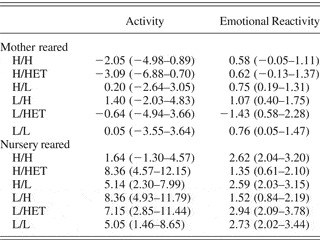
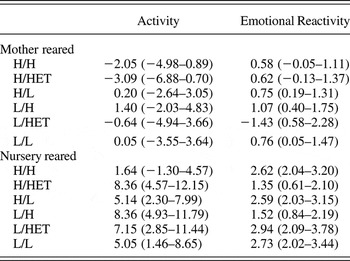
Means and confidence intervals of rearing and genotype groups
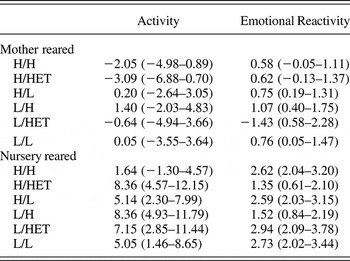
Note: H/H, High rh5-HTTLPR/high rhMAO-A-LPR; H/HET, high rh5-HTTLPR/heterozygote rhMAO-A-LPR; H/L, high rh5-HTTLPR/low rhMAO-A-LPR; L/H, low rh5-HTTLPR/high rhMAO-A-LPR; L/HET, low rh5-HTTLPR/heterozygote rhMAO-A-LPR; L/L, low rh5-HTTLPR/low rhMAO-A-LPR.
Blood sampling and DNA extraction
Blood for genotyping was collected at a separate time from behavioral assessment, during routine health checks while the animal resided in their natal cages (field cage or nursery) at the CNPRC. Blood was collected via femoral venipuncture, decanted to EDTA-coated tubes, and stored at 4ºC until separation, usually within 24 hr. Blood was centrifuged at 1500 × g for approximately 30 min at 4ºC. Plasma was removed and white blood cell layer removed to a fresh tube. Genomic DNA was extracted from white blood cells according to manufacturer's instructions using a Qiagen DNeasy Tissue kit. Briefly, cells were lysed, and DNA precipitated using 100% ethanol. The supernatant was applied to a spin column and serially washed with a buffer containing ethanol. DNA was then eluted with an elution buffer and stored at 4ºC until use.
Genotyping
Rh5-HTTLPR
Primers were designed from the published sequence of the rh5-HTTLPR (Genbank accession number AJ544234). Each 25-μl polymerase chain reaction contained 100 ng DNA, 10 pmol of each primer, 1.5 mM MgCl (Promega, Madison, WI), enhancer buffer with betaine, 10× amplification buffer (Promega), 2.0 µM dNTP, and 0.5 U Taq Polymerase (Promega). Primers were as following: F1 5′GGCGTTGCCGCTCTGAATGC 3′; R1 5′ACCTAGACGCCAGGG 3′. PCR cycling parameters were: (a) initial denaturation for 5 min at 95ºC, (b) 35 cycles at 95ºC for 1 min, 52ºC for 1 min, and 74ºC for 1 min, (c) a final primer extension at 74ºC for 10 min. Following amplification, rh5-HTTLPR products were cleaved using restriction enzyme PST I for at least 1.5 hr at 37ºC. Samples were electrophoresed on a 3% agarose gel with ethidium bromide for DNA fluorescence. Long and short alleles of this polymorphism have been characterized in macaques (Lesch et al., Reference Lesch, Meyer, Glatz, Flügge, Hinney and Hebebrand1997). Animals with two long rh-5HTTLPR alleles yielded bands at 41, 45, 50, 87, 151, and 302 bp. Animals with two short alleles yielded bands at 45, 50, 87, 172, and 302 bp. Finally, animals with one of each long and short allele yielded bands at 41, 45, 50, 87, 151, 172, and 302 bp. Gels were visualized using ultraviolet light, and representative genotypes were confirmed via sequencing. Genotypes were grouped for analysis according to putative activity based on previous reports of gene expression associated with promoter variants (Lesch et al., Reference Lesch, Bengel, Heils, Sabol, Greenberg and Petri1996): high (long homozygosity, l/l) or low (short homozygosity, s/s or long/short heterozygosity, l/s).
RhMAOA-LPR
Primers were designed from the published sequence of the rhMAO-A-LPR (Genbank accession number AJ544234). The forward primer was fluorescently labeled at the 5′ end with FAM. Each 20-μl reaction contained 200 ng of DNA, 10 pmol of each primer, 1× PCR buffer, 1.25 mM MgCl2, 2.0 mM dNTP, and 0.5 U of Taq DNA polymerase (Applied Biosystems, Bedford, MA). PCR reactions were performed on an ABI 9700 with the following profile: (a) initial denaturation for 3 min at 95ºC; (b) 35 cycles of 95ºC at 1 min, 57ºC at 1 min, and 72ºC at 1 min; (c) and a final primer extension at 72ºC for 10 min. The PCR products were electrophoresed on an ABI 377 DNA analyzer and analyzed using STRand software (UC Davis Veterinary Genetics Laboratory). Samples were also run on a 3% agarose gel for confirmation. Sequencing of rhMAOA-LPR was carried out using an ABI 377 DNA sequencer on a 6% polyacrylamide gel using manufacturer's instructions. Five-, 6-, and 7-repeat alleles have been characterized in macaques. The location of MAOA is on the X chromosome; thus, males are hemizygous and females are either homozygous or heterozygous. Genotypes were grouped according to putative activity based on previous reports of gene expression associated with promoter variants (Newman et al., Reference Newman, Syagailo, Barr, Wendland, Champoux and Graessle2005): high (5-, 6-repeat hemizygosity, homozygosity, or heterozygosity); high activity/low activity heterozygote (5/7- or 6/7-repeat heterozygosity); or low (7-repeat hemizygosity or homozygosity) for analyses. There is little in vivo or in vitro evidence regarding the impact of high/low heterozygosity for rhMAOA-LPR on measures of serotonin function or behavior, so heterozygotes were grouped separately.
Statistics
Composites for behavioral response to a human intruder were created based on our own previous work and the work of others suggesting that emotional reactivity and activity are latent factors that describe both human and nonhuman primate infant behavior during challenging circumstances involving social separation and exposure to a novel environment (Bell, Reference Bell1975; Capitanio et al., Reference Capitanio, Mason, Mendoza, Del Rosso, Roberts, Sackett, Ruppenthal and Elias2006; Golub et al., Reference Golub, Hogrefe, Widaman and Capitanio2008). Means for each recorded behavior exhibited (see Ethogram, Table 1) across all four conditions (profile far, profile near, stare far, stare near) was computed for each animal in this sample. The Z-scores were then calculated for each behavior to normalize the data. We used Cronbach alpha tests to establish internal consistency reliability among behaviors hypothesized to reflect emotional reactivity and behavioral activity. For the behavioral activity composite, the highest reliability (Cronbach α = 0.87) was found when the Z-scores of the following behaviors were combined: mean proportion of time spent active during all four conditions and mean rate of environmental exploration during all four conditions. For the emotional reactivity composite, the highest reliability (Cronbach α = 0.73) was found when the Z-scores of the following behaviors were combined: mean rates of coo vocalization, bark vocalization, lip smacks, fear grimaces, threats, and tooth grinds during all four conditions. Composite scores were log transformed for analysis. Behavioral activity and emotional reactivity composites were positively correlated (r = .31, p < .001).
Analyses of variance were conducted using SPSS 15.0 statistical software. A preliminary analysis revealed no sex differences in our measures, so all analyses combined males and females. Separate three-way analyses of variance were conducted for activity and emotional reactivity, which included rearing (FR and NR), rh5-HTTLPR genotype activity (high and low), and rhMAO-A-LPR genotype activity (high, heterozygote, and low). T tests were used for all post hoc analyses. The variance accounted for by each statistically significant variable or interaction is reported as partial eta squared.
Results
Behavioral activity
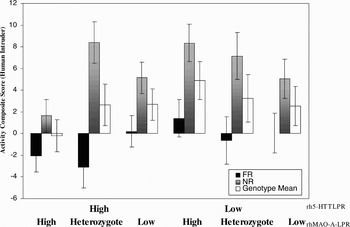
Main effects of either genotype were not detected, nor were single Genotype × Rearing interactions (p > .05). A main effect of rearing history and a trend level interaction between rh5-HTTLPR and rhMAOA-LPR genotypes influenced behavioral activity scores in the Human Intruder Test. Overall, NR infants exhibited higher behavioral activity compared to FR infants, F (1, 124) = 41.85, p < .001, partial η2 = .25 (see Figure 1). The interaction between rh5-HTTLPR and rhMAOA-LPR approached significance, F (1, 124) = 2.82, p = .059, partial η2 = .05. Post hoc tests revealed that H/H infants were less active than both L/H (t = 3.0, p < .01) and L/Het (t = 2.03, p < .05) infants, regardless of rearing history.
Activity composite scores in response to human intruder. NR (grayscale bars) infants were more active than FR infants (black bars). H/H infants were significantly less active than L/H and H/Het individuals across rearing groups (white bars). Values are means ± standard error of the mean.

Emotional reactivity
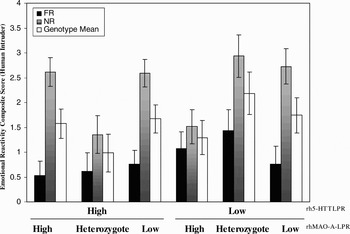
Main effects of either genotype were not detected, nor were single Genotype × Rearing interactions (p > .05). A main effect of rearing history, an interaction between rh5-HTTLPR and rhMAOA-LPR genotypes, and a three-way interaction among rearing history, rh5-HTTLPR and rhMAOA-LPR genotypes significantly impacted infant emotional reactivity during the Human Intruder Test. Overall, NR infants exhibited higher emotional reactivity scores than FR infants, F (1, 124) = 50.01, p < .001, partial η2 = .287 (see Figure 2. A significant interaction between rh5-HTTLPR and rhMAOA-LPR genotypes was found, F (1, 124) = 4.27, p < .05, partial η2 = .06, and post hoc analysis showed that H/Het and L/H infants were less emotionally reactive than did other genotype groups (t tests, p < .05). A significant three-way interaction, however, indicated that this G × G interaction differed between rearing groups, F (1, 124) = 3.31, p < .05; partial η2 = .05. Specifically, only among NR monkeys were H/Het and L/H infants less emotionally reactive than all other genotype groups (multiple t tests, all p < .05). Among FR infants, genotype groups did not differ from each other (p > .05).
Emotional reactivity composite scores in response to human intruder. NR H/Het and L/H infants displayed significantly less emotional reactivity than all other NR genotype groups (p < .05). Values are means ± standard error of the mean.

Discussion
Our findings provide one example of the complexity of genetic and environmental interactions that contribute to behavioral development in infant rhesus macaques. Our results suggest that G × G interactions between two well-characterized serotonin pathway polymorphisms influenced two different aspects of response to a stressful situation in infant rhesus macaques, although the direction of results were not strictly as hypothesized. Infants with two high activity genotypes tended to be less behaviorally active than other infants, whereas infants with the L/H or H/Het genotype were less emotionally reactive than other groups. These epistatic interactions (Falconer & Mackay, 1996) were particularly potent in infants who experienced species atypical, and possibly “adverse,” rearing. Previous studies have indicated that the effects of early experience are modulated by single polymorphisms in the 5-HT pathway (Champoux et al., Reference Champoux, Bennett, Shannon, Higley, Lesch and Suoml2002; Karere et al., Reference Karere, Kinnally, Sanchez, Famula, Lyons and Capitanio2009). We extend these earlier findings to illustrate that environmental influences on behavior are moderated by the cumulative effects of multiple loci and that the combined effects of early life stress and “risky” versus “protective” genotypes are not linear in their association with behavior. These results do point to the exciting possibility that G × G or G × E interactions that predispose infants toward particular behavior patterns can be exacerbated or attenuated by genetic or environmental factors.
Our data demonstrate the association of G × G interactions with two distinct behavioral dimensions. The present results indicate that H/H infants showed lower behavioral activity compared with L/H and L/Het infants. In contrast, L/H and H/Het groups showed lower emotional reactivity scores compared with other genotype groups. Although the results pertaining to the individual responses are important, understanding the integrated patterns of response to a stressful situation may be more informative. In humans and macaque infants, the low activity 5-HTTLPR allele has often been associated with “anxiety,” often operationalized as enhanced affective response and/or reduced motor activity (Auerbach et al., Reference Auerbach, Geller, Lezer, Shinwell, Belmaker and Levine1999; Bethea et al., Reference Bethea, Streicher, Coleman, Pau, Moessner and Cameron2004; Champoux et al., Reference Champoux, Bennett, Shannon, Higley, Lesch and Suoml2002; Kraemer et al., Reference Kraemer, Moore, Newman, Barr and Schneider2008). In contrast, in the present study, H/H animals showed comparable levels of emotional reactivity with other genotype groups but lower behavioral activity. Our results are consistent with one previous G × E study in rhesus macaques that showed that in the presence of peer-rearing (similar to our nursery rearing paradigm), the high activity rh5-HTTLPR genotype was associated with enhanced emotionality and reduced behavioral activity response to stress in 6-month-old macaques (Spinelli et al., Reference Spinelli, Schwandt, Lindell, Newman, Heilig and Suomi2007). We suggest that only high activity rh5-HTTLPR infants that also possess high activity rhMAOA-LPR show this pattern of behavior. The opposite pattern of behavior (comparable and high behavioral activity with other genotype groups but lower emotional reactivity) exhibited by L/H and H/Het infants, in contrast, resembles a pattern that has been associated with later impulsivity in adult humans (Colder, Mott, & Berman, Reference Colder, Mott and Berman2002; Olson, Bates, Sandy, & Schilling, Reference Olson, Bates, Sandy and Schilling2002). If true, it may be that H/H infants exhibit the greatest anxiety in response to a human intruder, regardless of rearing, whereas L/H and H/Het infants exhibit the least behavioral inhibition in response to a stressful situation. Future studies should investigate this possibility using additional measures of infant temperament.
Notably, the joint influences of rh5-HTTLPR and rhMAOA-LPR on our emotional reactivity measure were most apparent in NR infants. Many studies have shown that genotypic effects are exaggerated in individuals with adverse early experiences (Barr, Newman, Lindell, et al., Reference Barr, Newman, Shannon, Parker, Dvoskin and Becker2004; Barr, Newman, Shannon, et al., 2004; Bennett et al., Reference Bennett, Lesch, Heils, Long, Lorenz and Shoaf2002; Caspi et al., Reference Caspi, McClay, Moffitt, Mill, Martin and Craig2002; Champoux et al., Reference Champoux, Bennett, Shannon, Higley, Lesch and Suoml2002; Manuck, Flory, Ferrell, & Muldoon, Reference Manuck, Flory, Ferrell and Muldoon2004; Reif et al., Reference Reif, Rösler, Freitag, Schneider, Eujen and Kissling2007; Spinelli et al., Reference Spinelli, Schwandt, Lindell, Newman, Heilig and Suomi2007). We expected that NR infants with high-risk genotypes would be more emotionally reactive than other groups, but instead found that this group was only one of four groups that exhibited comparable and high emotional reactivity. We did observe, however, that with the exception of the H/L group, the possession of either one or two low-risk alleles, or advantageous early rearing, was associated with diminished behavioral response in at least one dimension. If we assume that a reduction in either behavioral activity or emotional reactivity is a risk-avoidance strategy, it may be that such a reduction reflects better adaptation in response to stress. The lack of significantly lower scores on one or both dimensions compared with any other group that characterized high-risk (NR individuals with two low activity genotypes), as well as H/L infants, in contrast, may be considered a maladaptive response to a stressful situation. Corroborating evidence must be put forth before conclusions can be drawn, however.
Previous studies have described genotype-based differences in NR, but not FR, infant rhesus macaques (Champoux et al., Reference Champoux, Bennett, Shannon, Higley, Lesch and Suoml2002; Spinelli et al., Reference Spinelli, Schwandt, Lindell, Newman, Heilig and Suomi2007; but see Karere et al., Reference Karere, Kinnally, Sanchez, Famula, Lyons and Capitanio2009; Newman et al., Reference Newman, Syagailo, Barr, Wendland, Champoux and Graessle2005). Our results align with these previous findings. Why should genetic susceptibility to behavioral responsiveness differ between NR and FR infants? We suggest one experimental, one developmental, and one evolutionary reason why this may be the case, and recognize that they are not mutually exclusive. First, because elements of the testing conditions (e.g., being without mother, human proximity, indoor housing) may have been more similar to conditions experienced regularly by indoor-housed NR infants, they may have been less stressed by the situation, allowing true individual differences in behavioral traits emerge. A second possibility is that genotype–behavior associations emerge earlier in development in NR infants than in FR infants, because of the absence of a mother. A third explanation for our findings is that natural selection has maintained in the population genotypes that cause infants to react more strongly to challenges presented by atypical environments (Wendland et al., Reference Wendland, Hampe, Newman, Syagailo, Meyer and Schempp2006). Genotypes that promote behavioral reactivity to unfavorable, but not to favorable, conditions may confer an adaptive advantage within species-atypical or disadvantageous environments.
The mechanisms by which multiple genotypes and experience interact to influence behavior are unknown. It is possible that the combined influence of these genetic variants and experience may have altered 5-HT function, with consequences for behavior. Human and nonhuman primate studies indicate that adverse early experience, as well as low activity 5-HTTLPR and MAOA-LPR alleles are associated with lower CSF 5-HIAA (Bennett et al., Reference Bennett, Lesch, Heils, Long, Lorenz and Shoaf2002; Higley & Linnoila, 1997; Manuck et al., Reference Manuck, Flory, Ferrell and Muldoon2004). In the present study, NR L/L infants may have had the lowest 5-HT function. These infants also exhibited among the highest rates of both behavioral activity and emotional reactivity during testing. This is consistent with some studies showing that low CSF 5-HIAA is associated with hyperactivity and aggression early in life in humans (Clarke, Murphy, & Constantino, Reference Clarke, Murphy and Constantino1999). However, similar behavior patterns were observed in infants with different genotypes, and potentially distinct 5-HT function. The mechanisms of gene–environment–behavior associations in these infants therefore remain to be explained. Developmental events may play an important role in our findings: it is possible that genotypes exert specific and yet uncharacterized influences on brain development early in life that may predict adult 5-HT function or the function of other neural systems. In support of this notion, we have demonstrated, along with others (Champoux et al., Reference Champoux, Bennett, Shannon, Higley, Lesch and Suoml2002; Spinelli et al., Reference Spinelli, Schwandt, Lindell, Newman, Heilig and Suomi2007), that behavioral effects of G × E, and now G × G, interactions are measurable early in life in rhesus macaques.
We have presented evidence that G × E interactions influence behavior in both male and female infants. Sex is an important factor in MAOA-association studies, as the MAOA gene resides on the X chromosome. As a result, at least two issues must be considered while interpreting MAOA association studies. The first is that males are hemizygous (i.e., have one copy of the gene) and females are either homozygous or heterozygous (i.e., have two copies of the gene) for the MAOA polymorphism. This means that in females one of the two X chromosomes in any given cell is inactivated, and the patterns of X inactivation are unknown. In the present study, we addressed this issue by categorizing females with two versions of the high activity allele as high activity; any cell, regardless of which X chromosome was inactivated, would have an active high activity allele. In parallel, females with two low activity alleles were categorized as low activity. In the case where females possessed two alleles with different activity (high/low activity “heterozyotes”), we created separate groups for analysis. The second issue is more complex, as it is possible that incomplete X chromosome inactivation (Carrel & Willard, Reference Carrel and Willard2005; but see Nordquist & Oreland, 2007) may lead to sex differences in MAOA genotype potency and corresponding MAOA activity. Previous studies have indicated that brain MAOA activity does not differ based on sex (Meyer et al., Reference Meyer, Ginovart, Boovariwala, Sagrati, Hussey and Garcia2006), however. In addition, we did not find that genotype was differentially associated with behavior between male and female infants. In genotype groups that included males and females (i.e., H/H, L/H, H/L, and L/L), G × G and G × E interactions influencing behavior were identical between sexes (data not shown); further, there were no sex differences in behavioral stress response to the human intruder. It appears that at this early stage in development, G × G and G × E interactions influence infant rhesus macaque behavior similarly between sexes.
The consequences of G × G × E interactions that influence behavior in nonhuman primates are not known. Recent work from our group have demonstrated, however, that emotional reactivity and activity measured early in life predict juvenile and adult outcomes, such as adult personality (Sullivan & Capitanio, 2008), social relationship quality (Weinstein & Capitanio, Reference Weinstein and Capitanio2008), and reproductive strategies (Hinde & Capitanio, Reference Hinde and Capitanio2009). If true, our work lends support for the notion that the impact of G × G × E interactions extends to important aspects of social life.
Replications of published studies illustrating G × E interactions influencing behavior have been somewhat inconsistent, posing challenges to the notion that G × E interactions are ubiquitous in their influence on behavioral development (Gottlieb, Reference Gottlieb2007). Our data suggest that G × E interactions influencing behavior may be either offset or intensified by related G × G or G × E interactions at an early stage in development. Although the present findings must be replicated, we propose that consideration of the developmental timing of compensatory or competing G × G or G × E interactions will strengthen the search for risk factors for behavioral dysfunction and disease.