Device closure of secundum atrial septal defects is now an accepted mode of treatment in selected patients with a suitable defect at any age.Reference Vogel, Berger, Dahnert, Ewert and Lange1–Reference Hijazi, Cao, Patel and Rhodes5 Immediate- and intermediate-term studies have reported upon the procedural success of this treatment method, as well as immediate complications such as embolisation, thrombus formation, residual interatrial shunts, and thromboembolic events.Reference Berger, Ewert and Bjorn tad6, Reference Chessa, Carminati and Butera7 There are, however, limited data on the intermediate-term outcome of device closure of atrial septal defect with special reference to complications.Reference Chessa, Carminati and Butera7–Reference Spence and Qureshi9 The major concerns have been development of erosions and, more recently, development of aortic regurgitation.Reference Amin, Hijazi, Bass, Cheatham, Hillenbrand and Kleinmann10, Reference Schoen, Boscheri and Lange11
We report our experience of device closure of secundum atrial septal defect using an Amplatzer Septal Occluder in 205 consecutive patients with special reference to medium-term complications. We have previously reported our initial experience of device closure of atrial septal defect.Reference Sadiq, Akram and Butt12
Patients and methods
Between October, 1999 and April, 2009, 205 consecutive patients with significant secundum atrial septal defect underwent transcatheter closure. The study was carried out at an adult tertiary care hospital and later, from 2006 onwards, at both the adult hospital and The Children's Hospital by the same team. The study protocol received approval from the research ethics board from both the hospitals.
The age of the whole population ranged from 16 months to 55 years (median 18 years). There were 120 female and 97 male patients. There were 98 adults – over the age of 18 years – and none under 1 year of age. The body weight ranged from 10 to 97 kilograms (median 48 kilograms). There were four patients with multiple or fenestrated defects and one adult patient with a significant residual defect after previous surgical closure. Evaluation before the procedure included a standard 12-lead electrocardiogram, chest X-ray, transthoracic echocardiogram, and transoesophageal echocardiography in patients over 18 years of age.
Echocardiography assessment
We used the initial transthoracic echocardiogram to confirm the diagnosis and assess the suitability for device closure. Sub-costal views were used in young children and thin adolescents to determine the location of the atrial septal defect, its diameter, and all the relevant margins. Patients over 18 years of age underwent a transoesophageal echocardiogram before the procedure.
In addition to evaluation for suitability, left and right ventricular systolic function was also assessed. Right ventricular systolic pressure was estimated from tricuspid regurgitation jet velocity, when present. Patients with severe pulmonary hypertension were not considered for transcatheter closure.
The procedure and the device
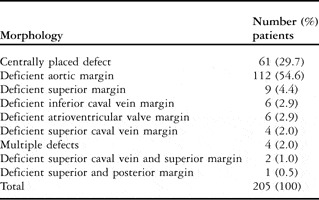
The defect was re-evaluated with a multiplane transoesophageal echocardiogram to determine its morphology, suitability, and size in all patients before the procedure in the catheter lab. The anatomic characteristics of the ostium secundum atrial septal defect have been defined by Podnar et al.Reference Pondar, Martanovic, Gavora and Masura13 and we used the same classification to describe the anatomic position of the atrial septal defects (Table 1). Instead of describing rims in their spatial orientation, such as superior anterior or inferior posterior, we used adjacent anatomical landmarks, aorta, inferior caval vein, and superior caval vein as proposed by Shrivastava and Radhakrishnan.Reference Shrivastava and Radhakrishnan14 Vascular access was obtained from the femoral vein, and heparin (80–100 International Units per kilogram) was administered. The Amplatzer Septal Occluder (AGA Medical Corporation, Plymouth, MN, USA) was the only device used.
Morphology of atrial septal defect in 205 consecutive patients.

Balloon sizing
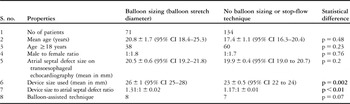
For the initial series of 71 patients (Group A), the “stretch” diameter of the atrial septal defect was measured using a 24- or 34-millimetre sizing balloon (AGA Medical Corporation Plymouth, MN, USA). After the concerns about oversizing,Reference Amin, Hijazi, Bass, Cheatham, Hillenbrand and Kleinmann10 from 2005 onwards we mainly used either stop-flow technique (32 patients) or, in patients with rigid margins, we did not balloon size at all (Group B). In these patients, a device 1–2 millimetres larger than a colour flow diameter of atrial septal defect was used. Table 2 shows the baseline characteristics of patients with or without balloon sizing.
Comparison of the patients with or without balloon sizing (balloon stretch diameter) – (n = 205).

Implantation technique
The right upper pulmonary venous deployment technique was preferably used and is now routinely used as our first option. The device and the adjacent structures were examined by transoesophageal echocardiography to ensure that there was no encroachment of the device on the atrioventricular valves or the right pulmonary vein. After releasing the device from the cable by unscrewing it, a final transoesophageal echocardiographic examination was undertaken to demonstrate the position of the device and any residual shunting. In 15 patients with large atrial septal defects, the balloon-assisted technique was used to close the defects.Reference Dalvi15
All patients were discharged on aspirin 3–5 milligrams per kilogram per day for 6 months. Warfarin was added in patients with a history of paroxysmal atrial fibrillation or arrhythmia and in those who developed atrial fibrillation after device closure. Before discharge, an electrocardiogram, a biplane chest X-ray, an echocardiogram, and – where appropriate – 24-hour Holter monitoring were performed.
Follow-up
Follow-up examinations including electrocardiogram and transthoracic echocardiography were scheduled at 1, 3, 6, and 12 months and yearly thereafter. The follow-up examination also included a 24-hour Holter electrocardiogram recording in adults or in patients with complaints of palpitation or concern about possible arrhythmia.
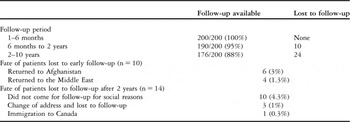
Early follow-up (mean 2.3 plus or minus SD 1.2 months, median 1.8 months, range 1–6 months) was available in all patients. Medium-term follow-up (mean 5.2 years, 6 months to 10.3 years, median 5.8 years) data were available in 176 (88%) patients. Of the remaining 24 patients, 14 were followed up to 2 years, while 10 patients were lost to follow-up after early follow-up. It was possible to question the relatives of these patients to discover their status; however, no other follow-up details were possible, as some had left the country permanently, and others – all female patients – were unwilling to follow-up for various social reasons (Table 3).
Available follow-up at different time intervals.

Statistical analysis
Data were entered in SPSS v.14 software and analysed through its statistical package. The mean, median, range, and standard error were calculated for the numerical data. Frequencies were calculated for categorical data. Chi square test was used as the test of significance to determine any significant difference between various subgroups. Yates correction was applied where data were small. Spearman's coefficient (R) was calculated to determine any significant correlation between various subgroups – with regard to age, gender, size of the atrial septal defect, device size, device/defect size ratio, anatomical position of the atrial septal defects, and the use of balloon-assisted technique – and the occurrence of complications, taking p < 0.05 as significant.
Results
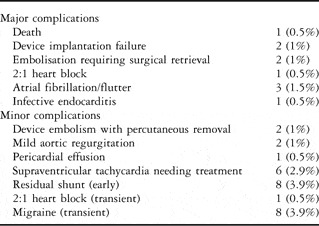
Transcatheter atrial septal defect occlusion was performed successfully in 200 out of 205 patients, with a success rate of 98%. There was failure of deployment in two patients, and the device embolised immediately in two patients and within 24 hours in another two. The details are discussed in the complications sections below.
On transoesophageal echocardiography, the maximum defect diameter ranged from 10 to 36 millimetres, while balloon stretch diameter, when used, varied between 14 and 38 millimetres. The mean difference between defect diameter on transoesophageal echocardiography and balloon stretch diameter was 3.66 plus or minus 0.2 millimetre (median 3 millimetres, range 0–9 millimetres). The devices implanted ranged from 12 to 40 millimetres in size, the device size being larger when balloon stretch diameter was used (mean 26 plus or minus 1 millimetre versus 23 plus or minus 0.5 millimetre, p = 0.002). The mean device size to defect ratio was 1.2 plus or minus 0.01 millimetre. The ratio was higher in patients in whom balloon sizing was performed with balloon stretch diameter (1.31 plus or minus 0.02 versus 1.17 plus or minus 0.01, p ≤ 0.001; Table 2). The procedure time was 20–167 (median 46) minutes and the fluoroscopy time was 2.5–60 (median 10) minutes. There were four patients with multiple/fenestrated defects who were also treated with a single device.
Immediate complications
Failure of deployment occurred in two patients. In a 35-year-old female, the atrial septal defect measured 24 millimetres on a two-dimensional plane and 26 millimetres on colour Doppler. The balloon stretch diameter was 30 millimetres. Despite repeated attempts and the use of different techniques – before the balloon-assisted technique was available – a 32-millimetre device placement failed to function. In the second patient, an 8-year-old, the margins of the defects were too floppy to hold the device despite the successful placement of a 26-millimetre device in a 21-millimetre defect. The device was removed before release and the procedure was abandoned.
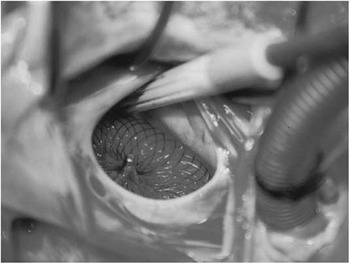
Embolisation of the device occurred immediately after deployment in two patients. In both, the devices were successfully retrieved by transcatheter technique. In one patient, the atrial septal defect was closed with a larger device in the same setting, while the other underwent surgical closure of the atrial septal defect subsequently. In two other patients, the device embolised within 24 hours of the procedure and both patients underwent surgical removal of the device and atrial septal defect closure simultaneously. Of the two patients, one was a 5-year-old girl (20 kilograms), in whom a 20-millimetre device was used for an 18-millimetre defect. The second was an 18-year-old, in whom a 26-millimetre device was used for a 23-millimetre defect. The device had migrated to the left atrium by the time the patient was placed on cardiopulmonary bypass (Fig 1). Device embolisation was associated with short inferior caval vein margin (p = 0.03).
Intra-operative view of the device seen through the secundum atrial septal defect laying entirely in left atrium.

Arrhythmias such as supraventricular tachycardia, needing medical treatment, occurred in six cases, including one patient who developed 2:1 heart block during the procedure early in our experience. In another patient, 2:1 heart block was noted with a 22-millimetre device before it was released. The defect measured 19 millimetres and a 20-millimetre device was used instead with no immediate or long-term change on surface electrocardiogram and complete closure. Both patients had relatively short inferior caval vein margins and the occurrence of 2:1 heart block was associated with short inferior caval vein margins (p < 0.001).
There was one patient, a 26 year-old-man, who complained of chest pain after the procedure and on echocardiography showed a small pericardial effusion. The patient was managed conservatively and the effusion disappeared over the next few days. Transoesophageal echocardiography confirmed no evidence of perforation or erosion.
The incidence of residual leak was 4% – 8 out of 200 patients – by 24 hours after atrial septal defect closure – Table 4. Residual shunt was associated with short superior caval vein margin (p < 0.001). There was no difference in the risk of residual shunt in the two groups in whom balloon stretch diameter was used, leading to a larger size device in Group A compared with Group B, in whom balloon sizing was not used and hence a smaller device size (p = 0.1).
Complications of device closure of atrial septal defect.

There were eight patients (3.9%) who reported new-onset migraine with aura. It resolved in all of them in 2–8 weeks and did not need more than routine analgesics. None reported a recurrence or worsening of the existing migraine.
There was an 8-year-old boy with an inherited form of cardiomyopathy in addition to a large atrial septal defect. He was admitted with biventricular failure and needed inotropic support. After detailed discussion with the family, he underwent successful atrial septal defect closure. Despite initial improvement, however, the right ventricular function continued to deteriorate and the patient died 15 days later with low cardiac output and multi-organ failure.
Medium-term complications
No deaths occurred during the medium-term follow-up. Erosions, late embolisation, thrombus formation, and thromboembolic events were not observed in any patient. Small residual shunt was noted in only 3 out of 200 patients (1.5%).
Early in our experience, one patient was treated for possible infective endocarditis 3 months after the implantation. This 3-year-old presented with fever of more than a 1-week duration. There was no echocardiographic evidence of vegetations, and blood cultures were negative. However, he was treated with intravenous antibiotics for 4 weeks. The child was well during the longer-term follow-up. This rare complication has been reported in the literature.Reference Wilkinson and Goh3
New aortic regurgitation developed in two (1%) patients after closure of atrial septal defect. The regurgitation jet was central and mild in both patients. Increasing device-to-defect ratio correlated with the development of aortic regurgitation and was higher when the device-to-defect ratio was more than 1.3:1 (p = 0.001). Both defects were posterior to the aorta with absent aortic rim. Trivial-to-mild aortic regurgitation, present before device closure, continued to persist in six patients. In addition, there was no change in patients with associated mild mitral regurgitation, that is 11 patients.
There was one child with 2:1 heart block who did not need a pacemaker; however, the heart block has persisted. A 24-hour Holter recording has shown a good chronotropic response. Atrial fibrillation occurred in three adult patients (1.5% of all) at a mean of 2 weeks (10 days to 4 weeks) after the procedure. These patients were 26, 41, and 46 years old at the time of the procedure. Atrial fibrillation was paroxysmal in one patient (0.5%) and new atrial fibrillation occurred in two adult patients. The two patients with the new onset responded to anti-arrhythmic treatment, which could eventually be discontinued after 1 and 2 years, respectively. There was a 26-year-old patient with paroxysmal chronic atrial fibrillation alternating with atrial flutter who needed cardioversion; this patient subsequently needed a pacemaker for sinus node dysfunction with prolonged pauses.
Discussion
Interventional atrial septal defect closure is now widely practised and has replaced surgery in a majority of patients with secundum atrial septal defect.Reference Vogel, Berger, Dahnert, Ewert and Lange1–Reference Berger, Ewert and Bjorn tad6 Intermediate- and long-term data have started emerging and are comparable to surgery.Reference Chessa, Carminati and Butera7–Reference Spence and Qureshi9 Our report is the experience of a single team from tertiary cardiac and paediatric centres from a developing country, where there are major cost implications. Our inclusion criteria are stringent, as the family has to bear the cost of the device in a majority of cases and embolisation of a device or need for a second device becomes a major financial burden. These strict inclusion criteria may partly explain such a low incidence of complications in our series.
The intermediate- and long-term issues after device closure of atrial septal defect mainly relate to mechanical complications, thromboembolism, and arrhythmias, more so in adults. Atrial septal defects are very close to the aorta/aortic root, and this association remains regardless of the type of device used. The close proximity may cause distortion of the aortic framework and may affect not only the non-coronary cusp causing aortic regurgitation, but rarely may also lead to aortic to atrial fistulas and disruption of the aorta through the atrial wall producing erosion/perforation.Reference Amin, Hijazi, Bass, Cheatham, Hillenbrand and Kleinmann10, Reference Schoen, Boscheri and Lange11, Reference Divekar, Gaamangwe, Shaikh, Raabe and Ducas16–Reference Raghuram, Krishnan, Kumar and Balamurugan18
Cardiac perforations related to the technique can occur during catheterisation or just before hospital discharge. With later perforations, patients may present with haemo-pericardium, pericardial effusion, and cardiovascular collapse. Perforations may also result in sudden death.Reference Amin, Hijazi, Bass, Cheatham, Hillenbrand and Kleinmann10, Reference Divekar, Gaamangwe, Shaikh, Raabe and Ducas16 The anterosuperior atrial wall and adjacent aorta are the vulnerable sites. Perforations have occurred up to 6 months after implantation. Divekar et alReference Divekar, Gaamangwe, Shaikh, Raabe and Ducas16, in a retrospective review, found 24 events with the Amplatzer device. There were 10 patients who were under 18 years of age. Amin et alReference Amin, Hijazi, Bass, Cheatham, Hillenbrand and Kleinmann10 reported on all patients who developed haemodynamic compromise after atrial septal occluder placement. A total of 28 cases – with 14 in the United States – of adverse events were reported. All erosions occurred at the dome of the atria, near the aortic root. A deficient aortic rim was noted in 89% and the defect was described as high, suggesting deficient superior rim. The device to unstretched atrial septal defect ratio was significantly larger in the adverse event group when compared with the United States Food and Drug Administration trial group. The incidence of device erosion in the United States was 0.1%. It was postulated that patients with a deficient aortic rim and/or superior rim may be at higher risk for device erosion. Furthermore, an oversized device may increase the risk of erosion. In our series, 55% of patients had a deficient aortic rim. However, no patient developed cardiac perforation or erosion during follow-up and only one patient developed pericardial effusion immediately after the procedure, with no haemodynamic compromise, and this resolved spontaneously.
There are a few reports of sudden deaths in patients after device closure of atrial septal defect. Chessa et alReference Chessa, Carminati and Butera7 reported on 417 patients, who underwent device closure of atrial septal defect and reported a sudden death in one patient 1.5 years after device closure. One can speculate that erosion with cardiac tamponade may be the reason.Reference Amin, Hijazi, Bass, Cheatham, Hillenbrand and Kleinmann10 Anatomic variant coronary arteries may also be a reason for post-interventional fatalities. Scholtz et alReference Scholtz, Jategaonkar and Faber22 have reported an unusual complication of systolic compression of left coronary artery by the left atrial disc, noted on angiography, in a patient with single coronary artery originating from the right aortic sinus. The only death in our series, in a child with right ventricular cardiomyopathy, was not directly related to the procedure. This child was on inotropic support, before device closure was attempted. After transient improvement, his condition deteriorated a few days after device closure. In retrospect, device closure should not have been attempted.
Development of aortic regurgitation is another important concern in the long term. Schoen et alReference Schoen, Boscheri and Lange11 reported on the long-term follow-up of 240 consecutive patients. Newly developed or increasing aortic regurgitation was observed in 9% of patients with atrial septal defect and 10% of patients with persistent foramen ovale closure. It is postulated that the cause for developing aortic regurgitation may be overgrowth of the device by tissue, leading to changes in interatrial septal geometry and traction on the root of the non-coronary aortic cusp. The incidence of aortic regurgitation was only 1% in our series. Aortic regurgitation, the sole identifiable factor, was found in both patients from the time when balloon stretch diameter was used to select the device size, and increasing the device-to-defect ratio correlated with development of aortic regurgitation. Therefore, oversizing may be a contributing factor, although further long-term data are required on both groups to establish a clear relationship. The other observation was that both these defects were just posterior to the aorta and the aortic rim was completely absent. No augmented splaying of the right and left atrial device disc around the aortic root was obvious in both patients with aortic regurgitation. Our patient numbers with this problem are small. We found no significant changes in function of the other heart valves.
Residual shunts are more frequent with device closure than with surgical closure of atrial septal defects.Reference Rao, Berger and Rey19, Reference Worms, Rey and Bourlon20 Various devices have different incidence of residual shunts, mainly related to their design. Rao et al reported residual shunts in up to 45% of patients on colour Doppler with the buttoned device,Reference Rao, Berger and Rey19 while another series reported residual shunt in 37% patients with the same device.Reference Worms, Rey and Bourlon20 The incidence is very low with Amplatzer Septal OccluderReference Chessa, Carminati and Butera7–Reference Spence and Qureshi9 and this was the case in our series too, with only three patients (1.5%) with a small clinically insignificant residual leak on follow-up. We found a positive correlation of a short superior caval vein margin with a higher incidence of a residual shunt.
The incidence of thrombus formation on transoesophageal echocardiography was 1.2% in atrial septal defect patients and 2.5% in persistent foramen ovale patients in a study of 1000 patients who underwent device closure.Reference Krumsdorf, Ostermayer and Billinger21 Post-procedure atrial fibrillation and persistent atrial septal aneurysm were significant predictors of thrombus formation. The Amplatzer device was found to be significantly less thrombogenic than the Cardio SEAL and Star FLEX devices.Reference Krumsdorf, Ostermayer and Billinger21, Reference Scholtz, Jategaonkar and Faber22 We did not perform transoesophageal echocardiography routinely during the follow-up, but there was no evidence of thrombus formation in any of our patients immediately or on late follow-up on transthoracic echocardiography. The use of Warfarin in high-risk patients and a small number of adults over 40 years of age may have contributed to the lack of this complication in our series.
Closure of an atrial septal defect causes an abrupt overloading of the left ventricle, resulting in an increase in myocardial oxygen consumption. This is generally well tolerated but may be harmful in elderly patients, in patients with reduced left ventricular function, and in patients with ischaemic heart disease.Reference Shaheen, Alper and Rosenmann23–Reference Schubert, Peters, Abdul-Khaliq, Nagdyman, Lange and Ewert25 In our series, the oldest patient was 55 years old and we did not encounter this complication in any of the patients.
Another important issue that also relates to the age at the time of atrial septal defect closure is the occurrence of arrhythmias. Surgical closure of an atrial septal defect is shown to improve long-term cardiac mortality and morbidity; however, atrial arrhythmias remain an important determinant of late cardiac morbidity in this population.Reference Gatzoulis, Freeman, Siu, Webb and Harris26, Reference Ghosh, Chatterjee, Black and Firmin27 In patients in the 60- to 84-year age group, new paroxysmal atrial fibrillation occurred in 16 out of 96 (17.9%) patients, after device closure in a recent report.Reference Jategaonkar, Scholtz, Schmidt and Horstkotte28 Our study does not have any patient above 60 years of age and includes three adult patients who experienced atrial fibrillation 2–4 weeks after device closure. Of the three patients, one has needed cardioversion and subsequent pacemaker implantation but the other two responded to medical treatment.
Another concern, particularly during young age, is the development of heart block. Younger age, large-size devices, and deficient inferior caval vein rim appear to be the contributing factors.Reference Nehgme, Huddleston and Cheatham29 Both our patients were young – that is, under 12 years – and also had short inferior caval vein margins. In defects with deficient inferior caval vein margin, the device probably affects the atrioventricular node, which is at the apex of the triangle of Koch, explaining the association. The risk is lower when compared with surgery, and chronotropic impairment is less frequent than in post-surgery patients with better exercise capacity.Reference Nehgme, Huddleston and Cheatham29–Reference Suda, Raboisson, Piette, Dahdah and Miró31 There was one patient in our initial experience who developed second-degree heart block; however, this has not changed in the longer-term follow-up and there is good chronotropic response. In another patient, heart block could be avoided by removing the original device and implanting a smaller device with no residual shunt.
Study limitations
Medium-term follow-up data were available in 176 out of 200 (88%) patients. Our centres are tertiary referral centres, with patients being referred from all over the country, including neighbouring Afghanistan. Therefore, not all the patients may be available for follow-up, once they return to their home. It was possible to check the life status of patients from near relatives; however, late follow-up was not available in those patients who had emigrated. Furthermore, some female patients did not come for clinical follow-up for social reasons. However, the baseline characteristics of patients lost to follow-up were similar to those of the group of patients with late follow-up data.
Conclusion
Device closure of secundum atrial septal defect using Amplatzer Septal Occluder is a safe and effective technique with good results in the medium term. The complications, mortality, and morbidity are low. Short inferior caval vein margin correlates with an increased risk of embolisation and short superior caval vein margin with a residual shunt. The risk of developing aortic regurgitation is low and correlates with increased device-to-defect ratio. Arrhythmias, such as atrial fibrillation, may occur in some adults; however, the majority of the patients respond to medical treatment.
Acknowledgements
We would like to thank Dr Ahmad Usaid Qureshi for his help in the statistical analysis.