

Published online by Cambridge University Press: 15 April 2003
The literature on civic engagement points to a number of factors that shape the socialization process, such as family background, socioeconomic status, school involvement, and location and type of community. In recent years, theorists have focused on another aspect of youths' lives as a potential facilitator of civic engagement—their participation in school-based community service. Studies show that service and activism during youth are associated with life-long civic engagement involving voting, trust in government, and involvement in voluntary organizations (e.g., Youniss, McLellan, and Yates 1997; Stewart, Settles, and Winter 1998; Jennings 2002). Because service is believed to foster a sense of civic identity, many policy makers and educators have called upon school districts to implement programs requiring students to perform service as a prerequisite for graduation.
*This research was funded by a grant from the William T. Grant Foundation. The authors thank Jeffrey McLellan and Alice Melnikoff for their assistance.
Other commentators, however, have questioned whether service (voluntary or mandated) has the capacity to turn youth into active and engaged citizens who are capable of assessing and solving problems. For example, a recent report by the National Association of Secretaries of State (1999) asserted that even though rates of service are increasing, youth involvement in formal political activities has remained decidedly individualistic. Others view mandated service as contradictory, especially when compared to volunteer service. These criticisms are based on the idea that required service can take away youths' intrinsic motivation, provoking the question as to whether such policies lessen the quality of the service experiences or even turn youth off to future volunteerism altogether (Sobus 1995; Stukas, Snyder, and Clary 1999).
A recent estimate indicates that 19% of public high schools require students to perform community service, up from 16% in 1996 (Chapman and Kleiner 1999). Despite the increasing popularity of required community service and service learning programs, empirical evidence to support either side of this controversy is inconsistent. Research has yielded mixed or null results, lacks comparison groups, is missing longitudinal designs, has not controlled for variations in intensity of service, and lacks contextual data on program philosophy (Melchior 1997; Niemi and Chapman 1999).
The current study examined students from a public high school in a middleclass suburban town, outside Boston, MA. In 1997, the school board in this town implemented a policy that required all students, starting with the class of 2001, to perform community service as a prerequisite for high school graduation. The stated purpose of the requirement was to enhance students' personal and civic development. The graduating classes of 1998, 1999, and 2000, attending the school at the time the requirement was initiated, were exempt from this policy.
The timing of our study in conjunction with the start of the service requirement allowed for a naturally occurring quasi-experimental study of students in the same high school; some with a service requirement, and some without. This design allowed us to ask two questions related to whether the service requirement had a negative or positive effect on students' interest in service. One question was whether or not students went on to do voluntary service after completing the requirement. The other question was whether students' intentions to volunteer in the future, after graduating from high school, were lowered or raised after finishing the 40-hour requirement.
The longitudinal sample in this study consisted of three grade 11 to 12 cohorts, from the graduating classes of 2000, 2001, and 2002. Data were collected between 1998 and 2002, at the beginning (September) and end (May) of each school year. A total of 486 of a possible 645 students (75%) were included in the study because they had the necessary data present at three points in time: the beginning of 11th grade, the end of 11th grade, and the end of 12th grade. Seventy-eight percent of the students in the school were White, with the remaining students of Asian, African American, and Hispanic descent. Nearly half of the students in this study were Catholic, nearly onequarter were Protestant, with the remainder primarily of Mormon, Jewish, or other faiths. Ten percent of students did not affiliate with any religion. Approximately 93% of the graduates of this high school went on to college.
Because the purpose of this study was to examine effects of required service, all students who were required to perform service (the classes of 2001 and 2002) were combined into one cohort (n=312). The class of 2000 (n=172), the last class not required to do service, was utilized as a comparison cohort.1
Independent t-tests were used to assess differences between the classes of 2001 and 2002, and revealed similarities across all but one of 15 background variables. These similarities justified combining the classes into one-cohort. Tests were employed to examine differences between the required and non-required cohort and to justify their comparison. Independent t-tests revealed differences between cohorts in three of 15 study variables, thereby justifying their comparison.
To complete the 40-hour requirement, students were responsible for designing and implementing their own service experiences. Students could engage in a single service activity or many, over a concentrated or extended period of time, during any grade of high school. Most any type of service was allowed to count toward the requirement provided that at least one unrelated person was helped by the service. Common types of service included tutoring, teaching, coaching, working at local shelters or nursing homes, and organizing food or clothing drives. Service was almost always done under the auspice of the school, a community-based, or religious organization. To gain credit toward the 40-hours, students needed to provide a written reflection describing the nature of the service, as well as how the experience benefited the recipient and themselves. Students also provided an adult or supervisor's signature as proof that the service was performed.
At each assessment, students were asked whether they had performed voluntary or required service during the previous year. Table 1 lists rates of participation. We found that students with the requirement were involved in volunteerism at increasing rates over time, while their participation in required service decreased over time. As well, these students were involved in either service (required or voluntary, or both) at increasing rates over time. Rates of volunteerism in the non-required cohort increased from grade 10 to 11, and decreased slightly from grade 11 to 12. When comparing the required and nonrequired cohorts, we found that students in the required cohort were more involved in either service (required or voluntary) at each grade than students in the non-required cohort. Among students in the required cohort, the increased volunteerism, decreased required service, and between-cohort difference in either service participation was attributable to the 40-hour mandate.

To determine whether the service requirement affected rates of volunteering, we examined more closely the intra-individual patterns of volunteering before and after the 40-hour requirement was completed. Students could have finished the requirement either by the end of grade 10, by the end of grade 11, or by the end of grade 12. Figure 1 shows rates of volunteerism over time according to when students finished the service requirement. Among the grade 10 or 11 finishers, not only did the requirement not detract from volunteerism, but it was followed by higher rates of volunteerism after completion of the 40-hours of service.

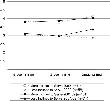
At each assessment students were asked to rate from 1 to 5 the likelihood that they would perform voluntary community service after graduation from high school. Figure 2 shows mean scores for four groups of students who differed by cohort (required and nonrequired) and by inclinations to service (more-inclined and less-inclined). In the non-required 2000 cohort, students in the more-inclined to serve group were defined as having volunteered in at least two of the three years during grades 10 through 12. The students who were less-inclined to serve in the 2000 cohort did service either one year or not at all during grades 10 through 12. According to these criteria, 114 students were more-inclined to serve and 58 were lessinclined to serve. Figure 2 shows that these groups differed at each grade in their intentions to volunteer in the future. Further, students who were moreinclined to serve showed an increase across grades in their intentions to volunteer in the future, whereas students less-inclined to serve showed a decrease in their intentions.

The comparable groups in the 2001/02 cohort were defined by two criteria. Students who were more-inclined to serve completed the 40-hour requirement in grade 10 or 11. Students who were less-inclined to serve waited until their senior year to complete the requirement and had not performed any voluntary service prior to completing the requirement. These groups differed at each grade on the measure of intentions to do service in the future. In the required cohort, 164 students were more-inclined to serve and 71 were less-inclined to serve.2
A sample of required students (n=77) were not included in the more-inclined and less-inclined groups. Students in this group were similar to the more-inclined group across study measures. These students were not included in the more-inclined group because they did not complete the requirement until grade 12, and were not included in the less-inclined group because they had volunteered prior to finishing the requirement. Mean scores (SD) for this group for intended volunteerism were: 3.61 (1.16) at the start of grade 11; 3.76 (1.08) at the end of grade 11; and 3.87 (.99) at the end of grade 12. Regression analyses revealed that this subsample of students did not differ from the more-inclined to serve groups in the required and non-required cohorts.
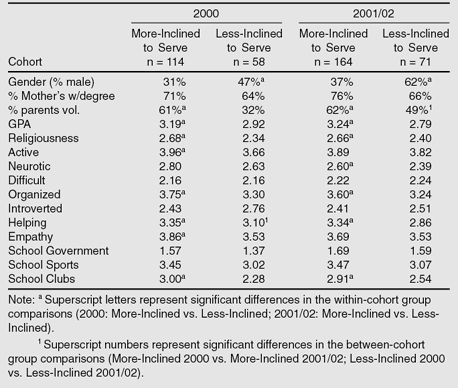
We next established that students who were more-inclined to serve were dissimilar on our background measures from those students who were lessinclined to serve.3
Background measures included: gender, parent's volunteerism (volunteered or not), mother's education (college graduate or not), religiousness (importance of religion on a 4-point scale), and GPA (cumulative grade point average on a 4-point scale). Personality disposition measures were utilized as a partial control for individual differences. A set of five measures was used to approximate the “Big 5” personality assessment for an adolescent population (Barber 1998). Big 5 measures included active, organized, neurotic, introverted, and difficult (Cronbach alpha's between.74 and.88 for the five scales). Two measures were used for prosocial personality characteristics (Penner et al. 1995); helping and empathy (Cronbach alpha's of.80 for both scales). Extracurricular activities were assessed by involvement in school clubs, school sports, and school government, as measured on a 5-point scale from 1=never to 5=daily.
Pearson Chi-square statistic (X2) with the Haberman's adjusted residuals (HAR) was employed to test differences for the categorical variables and independent t-tests tested differences among the scaleable variables.

The question of whether the requirement affected intentions to volunteer in the future can now be addressed more precisely. Figure 2 shows that there was no difference in intention between the 2000 and 2001/02 cohorts for those students more-inclined to do service. Scores for these groups were high and increased slightly across grades. There was, however, a difference between cohorts in students who were less-inclined to do service. Students in these groups had low intentions at the beginning and end of grade 11. But at the end of grade 12, the 2001/02 students who had completed the requirement had higher scores than the 2000 students who had no requirement. It appears that the experience of service, albeit through a mandate, had a positive impact on these students' intentions to volunteer in the future.
We checked these findings by performing regression analyses that took account of individuals' intentions from prior grades and background factors, and looked explicitly at the requirement in determining the outcome measure of intended volunteerism at the end of grade 12. The first regression analysis (Model 1) contrasted the required and non-required students with a greater inclination to serve. It was found that none of the background factors predicted change in intentions from the start of grade 11 to the end of grade 12. The only factor that predicted the outcome was these students' prior intentions at the start and end of grade 11. This finding concurs with our assignment of these students to groups with a clear inclination toward voluntary service. The second regression analysis (Model 2) for the students less-inclined to serve was equally illuminating. Again, only one factor predicted the outcome of intention to volunteer in the future at the end of grade 12. This predictor was whether or not required service had been done during grade 12. In short, completion of the 40-hour requirement accounted for the increase in the intention scores for the 2001/02 cohort. Table 3 lists the results from the two regression models.

Service is often viewed as an outcome of individual initiative and psychological dispositions. There is some evidence to support this stance, but the viewpoint falls short of telling a full and more interesting story. For a more complete picture, we turn to Verba, Schlozman, and Brady's (1995) theoretical model of Civic Voluntarism. Verba et al. invert the standard “rational choice” question of why an individual would bear the cost of getting involved; instead they pose the fresh question of: Why not get involved? Their answer consists of three parts. One is the availability of resources such as time, money, and skills, with emphasis on their underlying conditions such as education and social position. Another is engagement, which includes a sense of efficacy, interest in politics, and psychological concern for the common good. The third is recruitment or being asked to participate. Individual dispositions fall into the second category and comprise but one piece of a larger whole. This model helps to account for our findings as follows.
We found that students who were inclined to serve voluntarily were more likely to be female, have parents who had volunteered, were more religious, belonged to school organizations, and had high grade point averages. Students less inclined to serve voluntarily were more likely to be male, have parents who did not volunteer, were less religious, did not belong to school clubs, and had lower GPAs. The characteristics of the former students seem to be logical forerunners of the resources that Verba et al. found to predict participation in adults. For instance, years of schooling predicted adult involvement whereas GPA predicted service in the students in our sample. And involvement in high school government predicted later volunteerism in Verba et al.'s adults, whereas membership in school organizations was associated with a greater inclination to be involved in service among the students in our sample.
Verba et al. provide a long list of dispositions that indicate engagement in politics and civil society. We found two dispositions that were associated with the students who were more inclined to perform service. One was the personality characteristic of being organized. The other was interest in helping other people in need.
Verba et al. noted that most studies of volunteerism neglected to assess the factor of being invited to participate. For example, being a member of networks of activists has been found to be a key feature that explains sustained activism throughout adulthood (e.g., McAdam 1988; Teske 1998). In our study, three factors were associated with students being more inclined toward service. One was having parents who volunteer. The second was belonging to school organizations, which can be presumed to afford opportunities for service. And the third was the school requirement, which mandated 40 hours of service for all the students. The power of this last factor was seen in the effect the experience of service had on the measure of intention to do service in the future. Prior to meeting the requirement, the 2001/02 students who were less inclined to do service scored low on this measure and were indistinguishable from their less-inclined peers in the 2000 cohort. After having done service, however, scores for future intentions in the 2001/02 students rose significantly and became distinctly higher than those of their 2000 peers. Results in the regression analysis confirmed that the change in this measure was due to having done service and not to other factors.
Given this pattern of findings, one might argue that for students who are already inclined to serve the school-based requirement adds little value. These students live in a resource-rich environment, are disposed to engagement, and have numerous opportunities to participate in service. It follows that students in the 2000 cohort, without the requirement, and of 2001/02 with the requirement, ought to appear similar across background measures, which, indeed, we found. The critical test of required service, then, falls to the comparison of students who were disinclined toward service in the 2000 cohort, who had no requirement, and of 2001/02 with a requirement. The result of importance, then, centered on the latter students whose intentions to do future service rose markedly once they experienced service.
The contrast between the 2000 and 2001/02 disinclined students leads directly to a major policy issue. Schoolbased required service has been a contentious topic since its introduction, with opponents claiming that mandated service is an oxymoron which infringes on adolescents' need for autonomy and on individual liberty. Were these claims accurate, one would expect that the requirement either would de-motivate students already inclined to service or antagonize students who were averse to service. Neither proved to be the case. Students who where more inclined to volunteer completed their requirement quickly and then went on to do volunteer service at high rates in their remaining years in school without the added motivation of a service requisite. At the same time, the less inclined students who waited until grade 12 to finish the requirement responded to that experience with increased intentions to volunteer after their high school graduation. There is no evidence that the requirement turned students off to service, but quite a bit of support for the notion that required service was a positive motivating force.
All of these findings may be viewed in the context of what we know about long-term civic participation of individuals who were actively engaged during their youth. In what is surely one of the sturdiest longitudinal findings in the life span literature, it has been demonstrated that youthful activism is a strong predictor of lifetime involvement with outcomes including likelihood of voting and membership in voluntary organizations. The definition of youth activism ranges from serious participation in the civil rights struggle in the South during the 1950s and 1960s (e.g., Fendrich 1993; McAdam 1988) or antiwar movement in the 1960s and 1970s (e.g., Jennings 2002; Stewart, Settles, and Winter 1998), to involvement in school organizations (Hanks and Eckland 1978) or in 4-H community projects (Collins 1997; Ladewig and Thomas 1987). Although one cannot artificially create historical crises or social movements, policy makers can design programs of service that help youth experience political agency and instill a sense of social obligation (Raskoff and Sundeen 1999). As Jennings notes, the breadth of this definition of activism should not detract us from the larger message challenging policy makers “… to develop more institutionalized and regularized ways of instilling [in youth] the habit of participation” (p. 322). This habit, we have argued, may be the basis of an identity in which individuals come to understand themselves as political actors who are obligated to be participatory citizens (Teske 1997; Youniss and Yates 1997).

Rates of Service Participation by Grade Level by Cohort


Percentages and Means of the Study Variables by Students who were More- and Less-Inclined to Serve by Cohort

Total R2 at Each Step and Standardized Regression Coefficients for the Final Step of the Hierarchical Regressions Predicting Intended Future Volunteerism at the End of Grade 12