In Europe, large amounts of concentrates as sources of easily degradable carbohydrates and proteins are fed to cattle in beef and dairy production systems in order to achieve high productivity per animal. This results in high-input high-output systems requiring a large surface of arable land in Europe and overseas which could be alternatively used for production of directly edible human food (Cassidy et al. Reference Cassidy, West, Gerber and Foley2013). The concentrate feedstuffs for ruminants increase the production pressure on global arable land if they are not real by-products of other industries. Focusing on the animal, it appears that feeding concepts with high dietary concentrate levels neglect the basic ability of the ruminant to convert fibre-rich grass-swards efficiently (Knaus, Reference Knaus2009; Clauss et al. Reference Clauss, Hume and Hummel2010). These considerations justify the differentiation between the conversion of feedstuffs which are edible for humans and of those which are not (Wilkinson, Reference Wilkinson2011; O'Mara, Reference O'Mara2012). In this perspective, ruminant production gains a higher productivity compared with production with monogastric animals if it is grass-based because it competes less for food directly edible by humans (Wilkinson, Reference Wilkinson2011; O'Mara, Reference O'Mara2012). In roughage-only dairy feeding systems the amount of milk produced per unit of forage can be significantly higher than in systems supplementing concentrates (Ertl et al. Reference Ertl, Knaus and Steinwidder2014). Against the background of globally limited resources and growing demands for food production (Pelletier & Tyedmers, Reference Pelletier and Tyedmers2010) this appears a strong reason to develop dairy production systems which are based less on concentrates than is common. Reducing the protein supplements is of particular interest, because of the ecological and social side-effects of global soybean production (von Witzke et al. Reference Von Witzke, Noleppa and Zhirkova2011).
Concerns may be raised regarding the physiological need for high nutrient concentrations in high-yielding cows (Gross et al. Reference Gross, van Dorland, Bruckmaier and Schwarz2011). In less intensive systems with cattle breeds which represent rather dual-purpose types it might be easier to reduce concentrates in dairy production, because these breeds are expected to be more adaptable to lower nutrient density (Knaus, Reference Knaus2009; Ivemeyer et al. Reference Ivemeyer, Walkenhorst, Holinger, Maeschli, Klocke, Spengler Neff, Staehli, Krieger and Notz2014). Recent results from semi-intensive production systems in Switzerland and Austria show that reducing or omitting concentrates is possible without impairing animal health and fertility (Horn et al. Reference Horn, Steinwidder, Pfister, Gasteiner, Vestergaard, Larsen and Zollitsch2014; Ertl et al. Reference Ertl, Knaus and Steinwidder2014; Ivemeyer et al. Reference Ivemeyer, Walkenhorst, Holinger, Maeschli, Klocke, Spengler Neff, Staehli, Krieger and Notz2014). Feeding less easily degradable protein might even bring a metabolic advantage, since in the rumen less ammonia is produced, which has to be detoxified by the cow's metabolism, limiting endogenous amino acid availability (Parker et al. Reference Parker, Lomax, Seal and Wilton1995).
Recent experiences in Switzerland show that feeding concentrates lower in CP than recommended by the national feeding recommendations (Agroscope, 2013) does not reduce the milk protein yield as much as calculated (Furger et al. Reference Furger, Kunz, Schaffner, Schwarzenberger, Bürgisser, Peer and Brandenburger2013; Ivemeyer et al. Reference Ivemeyer, Walkenhorst, Holinger, Maeschli, Klocke, Spengler Neff, Staehli, Krieger and Notz2014). This indicates that the protein efficiency of the dairy cow might be higher than assumed in the equations of the national recommendation frameworks (Leiber, Reference Leiber2014). Several recent studies show that the protein efficiency (ratio of milk protein to feed protein) increases as dietary protein concentration decreases (Kälber et al. Reference Kälber, Kreuzer and Leiber2012; Staerfl et al. Reference Staerfl, Amelchanka, Kälber, Soliva, Kreuzer and Zeitz2012; Cantalapiedra-Hijar et al. Reference Cantalapiedra-Hijar, Peyraud, Lemosquet, Molina-Alcaide, Boudra, Nozière and Ortigues-Marty2014). This might be partly a result of lower N- and amino acid losses during ammonia production and detoxification (Parker et al. Reference Parker, Lomax, Seal and Wilton1995) but also of increased urea recycling to the rumen, which can amount to more than 50% of the total N intake (Røjen et al. Reference Røjen, Lund and Kristensen2008). Further, decreasing dietary CP should result in lower N losses via urinary and milk urea (Spek et al. Reference Spek, Dijkstra, van Duinkerken, Hendriks and Bannink2013). Therefore, it might be expected that the N-conversion efficiency from feed to milk would rise if protein concentrates are restricted or omitted and roughage quality remains good. However, the available data are still scarce and more experimental and practice-based data on protein efficiency in low-concentrate feeding systems are needed.
Since roughage-only diets may be less dense in nutrients, a high feed intake of the animals becomes more important. This should be subject of breeding goals for cows adapted to such feeding regimes, but also feed quality and the feeding techniques and sequences are of relevance in this context (Macleod et al. Reference Macleod, Colucci, Moore, Grieve and Lewis1994; Lyman et al. Reference Lyman, Provenza, Villalba and Wiedmeier2011). One factor triggering intake could be the diversity of the feed offered. Feeding different roughages separately and not just in a mixture might influence ruminants’ appetite (Villalba et al. Reference Villalba, Provenza and Han2004; Lyman et al. Reference Lyman, Provenza, Villalba and Wiedmeier2011) but data concerning sequential feeding of roughages differing in nutrient composition, conservation type and taste are apparently lacking.
Milk quality may be significantly affected by feeding strategies. Forage-concentrate proportions and the origin of roughages affect the concentration of value-giving n-3 fatty acids (FA) and conjugated linoleic acids in milk fat (Khiaosa-ard et al. Reference Khiaosa-ard, Klevenhusen, Soliva, Kreuzer and Leiber2010; Shingfield et al. Reference Shingfield, Bonnet and Scollan2013). Also, FA profiles may be indicative of shifts in rumen fermentation (Fievez et al. Reference Fievez, Colman, Castro-Montoya, Stefanov and Vlaeminck2012; Shingfield et al. Reference Shingfield, Bonnet and Scollan2013) and thus be used for the evaluation of feeding situations.
Against the background of the mentioned aspects, the aim of the study presented here was (i) to evaluate the effects of reducing protein concentrates on feed intake, animal performance, protein efficiency and milk quality in a dairy system with a moderate milk type cow breed in order to contribute controlled experimental data for low-concentrate dairy production systems, and (ii) to assess whether or not a partial disintegration of a mixed ration and sequential feeding of the roughages has any influences on feed intake and performance.
Materials and methods
Experimental protocol
In a dairy herd of an organic farm in Switzerland (Münsingen, Berne), 24 cows (Swiss Fleckvieh) were assigned to two different experimental groups, group Prot+ and group Prot−. One cow in group Prot− had to be excluded owing to data losses in intake recording. Groups were balanced for milk yield, milk protein concentration and days in milk. The respective averages for Prot+ and Prot− were: milk yield, 26·1 ± 5·4 and 24·5 ± 6·6 kg/d; milk protein concentration 3·15 ± 0·22 and 3·30 ± 0·42 g/100 g milk; and 89 ± 78 and 113 ± 78 d in milk. Four cows of Prot+ and two cows of Prot− were primiparous. The experiment was carried out in January, February and March 2014. Cows were kept in a stanchion barn with separated feeding places, which allowed individual feeding and weighing of the roughages and residuals. They had access to a farmyard outside the barn for 1 h every second day. They were milked twice daily at 6·00 and at 17·00. The animal trial was approved by the veterinary authorities (approval No. 75656; Veterinäramt Aargau).
Before the experiment started, all cows were fed with a TMR, composed of dry matter (DM) proportions of 0·3 maize silage, 0·32 grass silage, 0·21 hay, 0·09 dried alfalfa meal, 0·05 potatoes and 0·03 soybean cake. The nutrient concentrations are shown in Table 1. The TMR was always available ad libitum, being freshly offered several times between 6·00 and 8·00, 10·00 and 12·00, 16·00 and 18·00, and at 19·00. The cows were individually supplemented with two concentrates, according to milk yield (nutrient concentrations and components see Table 1); provided during the milking time. All cows had ad-libitum access to water at any time.
Nutrient concentrations in the feedstuffs used

† Concentrate 1 (No 1064, Lehmann Biofutter, Gossau, Switzerland) based on soybean cake, wheat, barley, rapeseed cake, corn, and sunflower cake.
‡ Concentrate 2 (No 1078, Lehmann Biofutter, Gossau, Switzerland) based on soybean cake, rapeseed cake, and sunflower cake.
During Period 1, the supplementary concentrates of group Prot− were reduced to zero within 3 d. From then on, group Prot− received no more individual supplementary concentrates during the whole experiment. However they still received the soybean cake which was part of the TMR. Group Prot+ received always the same concentrate amounts as initially (concentrate 1: 1·45 ± 0·66 kg DM; concentrate 2: 0·98 ± 0·26 kg DM). Period 1 lasted for 21 d with the last 4 d serving for sample and data collection. Until and during Period 1 all cows received the TMR1, which was the same as fed before. Subsequently to the sample collection days of Period 1, Period 2 started. The concentrate allocation to both groups remained the same, but TMR1 was replaced by TMR2 (composed of DM proportions of 0·35 maize silage, 0·38 grass silage, 0·06 hay, 0·11 dried alfalfa meal, 0·06 potatoes and 0·04 soybean cake; nutrient concentrations see Table 1) for both groups, meaning that part of the hay was not included in the TMR anymore. In lieu thereof, in the time between 6·00 and 8·00, all cows received high-quality hay ad libitum, instead of TMR, during the whole Period 2, which also lasted for 21 d with the last 4 d serving for sample and data collection.
During the respective four collection days of both periods, daily feed intake was completely recorded for each individual cow by hand weighing of the feed offered and the refusals. Milk yield was recorded and individual milk samples were drawn in the evening of day 1 and the morning of day 2, the evening of day 3 and the morning of day 4. Evening and subsequent morning samples were aliquotely mixed and stabilised with Bronopol® for analysis. A second aliquot of the milk samples was frozen for later FA analysis. Individual faecal samples were taken from the rectum in the afternoon of the respective days 2 and 4 of each collection period. Feed samples of all roughages were drawn at days 1 and 3. Faeces and forage samples were dried immediately after collection at 60 °C for 48 h and subsequently ground through a 1·0-mm sieve for analysis.
Analyses
Forage and faeces samples were analysed by near infrared spectroscopy with regression equations for organic matter, crude ash, CP, neutral detergent fibre (NDF), acid detergent fibre (ADF), lignin, and net energy for lactation (NEL) with a FOSS 5000 (Foss, Eden Prairie MN, USA) by and according to the methods of Cumberland Valley Analytical Services, Maugansville MD, USA (CVAS, 2008). Bronopol stabilised milk samples were analysed by medium infrared spectroscopy (MilkoScan 4000, Foss Electric, Hillerød, Denmark) with regression equations for protein, fat and urea. Milk FA were analysed after thawing the frozen samples. Transesterification to fatty acid methyl esters (FAME) was done following the method for cold base-catalysed transesterification provided by Suter et al. (Reference Suter, Grob and Pacciarelli1997). Subsequently, FAME were analysed on a GC (6890N, Agilent Technologies Inc., Santa Clara CA, USA) equipped with a Supelcowax™ 10 column (60 m, Supelco, Bellefonte PA, USA) and a MS detector (5973, Agilent Technologies Inc.). Carrier gas was He. Injection was 3 μl with a split ratio of 1:5. Oven temperature settings were: 50 °C for 1 min, increase of 15 deg/min up to 200 °C, increase of 3 deg/min up to 230 °C, isothermal for 50 min.
Data calculations and analysis
Apparent protein digestibility was estimated based on the assumption that lignin would be totally indigestible. The equations for the estimation were:
 $${\rm Digestibilit}{{\rm y}_{{\rm prot}}}\, = \,{\rm 1} - ({\rm protei}{{\rm n}_{{\rm faecal \, amount}}}\,/{\rm protei}{{\rm n}_{{\rm intake \, amount}}})$$
 $$\hskip -3pt \eqalign{{{\rm Protein}_{\rm faecal \, amount}} = {\rm faecal \, amount}[{\rm g \, DM}/{\rm d}] \times {\rm faecal \, CP}[{\rm g}/{\rm kg \, DM}]}$$
 $$\hskip -3pt\eqalign{{\rm Faecal \, amount}[{\rm g DM}/{\rm d}] = {\rm ligni}{{\rm n}_{{\rm intake}}}[{\rm g}/{\rm d}]/{\rm ligni}{{\rm n}_{{\rm faecal \, conc}}}[{\rm g \, lignin}/{\rm kg \, faeces}]}$$
Protein efficiency was calculated as the ratio of milk protein secretion to CP intake.
Data were analysed in a linear mixed model considering group and period as fixed effects and cow as random effect. The interaction of group and period was also included in the model. Where applicable (milk and protein yields as well as milk composition), baseline values, recorded 1 week before the experiment started, were included in the model as covariates with ‘variance components’. Normality of random effects was verified. Data were processed with the statistical software SPSS® V21.
Results
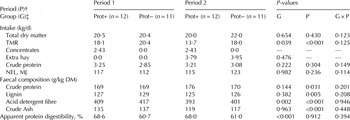
Omission of individually fed concentrates led to a significantly increased intake of TMR in group Prot− during the whole experiment (Table 2). This compensated the DM intake from concentrates by almost 100%, if compared with group Prot+. Crude protein intake was numerically lower in Prot− but neither CP intake nor NEL intake were statistically affected by the group factor. Separate feeding of hay in the morning combined with the reduction of hay in the TMR (Period 2) did not influence total DM intake nor the intake of CP or NEL. Faecal concentrations of CP, lignin and crude ash were the same in both groups; ADF was increased in group Prot− (Table 2). During Period 2, faecal concentrations of CP increased while those of lignin, ADF and crude ash decreased in both groups. The estimated apparent protein digestibility was clearly higher in Prot+ than in Prot−.
Feed and nutrient intake, faecal composition, and apparent protein digestibility by period and group

† Period 1: all roughages fed within TMR; Period 2: sequential feeding of hay and TMR.
‡ Prot+: receiving on average 2·4 kg/d individually fed concentrates; Prot−: receiving no individually fed concentrates.
Milk and milk protein yield were numerically but not statistically lower in Prot−; milk yield decreased in both groups by 1 kg/d on average from Period 1 to Period 2 (Table 3). Milk protein concentration was not affected by group but increased in all cows in Period 2. Milk fat was not affected by any factor. Milk urea was decreased in Prot− and increased in both groups during Period 2. Protein efficiency (the ratio of secreted milk protein to ingested protein) was identical in both groups but was reduced in Period 2.
Milk and protein yields, milk composition, and protein efficiency by period and group

† Period 1: all roughages fed within TMR; Period 2: sequential feeding of hay and TMR.
‡ Prot+: receiving on average 2·4 kg/d individually fed concentrates; Prot−: receiving no individually fed concentrates.
Milk FA profile was shifted towards a higher proportion of saturated FA and a lower proportion of mono- (MUFA) and polyunsaturated FA (PUFA) in Prot− compared with Prot+ (Table 4). Within PUFA, mainly the proportions of linoleic acid (18:2 n−6) and of the conjugated linoleic acid (18:2 c9, t11) were reduced in Prot− (Fig. 1). Branched-chain FA (Table 4) and saturated odd-chain FA (Table 4) were higher in Prot− than in Prot+ across both periods.
Linoleic, α-linolenic and conjugated linoleic acid [g/100 g FAME] in milk fat by group and period. Prot+: receiving on average 2·4 kg/d individually fed concentrates; Prot−: receiving no individually fed concentrates. Period 1: all roughages fed within TMR; Period 2: sequential feeding of hay and TMR.

Milk fatty acid profiles (g/100 g fatty acid methyl ester) by period and group

† Period 1: all roughages fed within TMR; Period 2: sequential feeding of hay and TMR.
‡ Prot+: receiving on average 2·4 kg/d individually fed concentrates; Prot−: receiving no individually fed concentrates.
Discussion
The core aim of the current study was to assess the effects of omitting individually fed protein concentrates on feed intake, milk and milk protein yields as well as indicators of feed protein efficiency in a moderate milk-type dairy cow breed in order to contribute controlled experimental data for low-concentrate dairy production systems. As a second factor, a manipulation of the roughage feeding system towards a sequential feeding of different roughage types was included in the study. The hypothesis behind that factor was that cattle might increase their intake when more diversity in the feeding schedule is offered.
Intake and protein efficiency as affected by dietary concentrates
Group Prot− compensated the omission of individual concentrates by 100% in terms of DM with an increased roughage intake if compared with group Prot+. This is in line with other studies reporting substitution rates for concentrates which are even clearly higher than 100% (Berry et al. Reference Berry, Sutter, Bruckmaier, Blum and Kreuzer2001; Lascano & Heinrichs, Reference Lascano and Heinrichs2011). By the increased roughage intake, the cows of group Prot− fully compensated for the NEL intake. The resulting similar intake of CP in both groups indicates that the effect of feeding protein concentrates on CP intake in the given herd with the given roughage quality was marginal. However, it has to be considered that the level of individually fed concentrates in the current study was generally low and the amount of omitted concentrates made up only about 10% of the whole diet (in terms of DM), while the soybean cake of the TMR remained in the diet of both groups.
The degradability of CP in roughages is lower than in soybean-based concentrates. This became obvious from the group effect on estimated apparent CP digestibility, which was large and to the advantage of the concentrate feeding. The values are closely comparable to data published by Røjen et al. (Reference Røjen, Lund and Kristensen2008) and Cantalapiedra-Hijar et al. (Reference Cantalapiedra-Hijar, Peyraud, Lemosquet, Molina-Alcaide, Boudra, Nozière and Ortigues-Marty2014) and show the expected effect of easily degradable CP in the concentrates.
Although it has to be noted that the protein efficiency was relatively low compared with literature values (Nousiainen et al. Reference Nousiainen, Shingfield and Huhtanen2004; Cantalapiedra-Hijar et al. Reference Cantalapiedra-Hijar, Peyraud, Lemosquet, Molina-Alcaide, Boudra, Nozière and Ortigues-Marty2014), the maintained protein efficiency in Prot− was an important result of the current study. On the basis of apparently digestible CP, group Prot+ must have been much better supplied with degraded protein. However, milk and milk protein yields were not significantly affected by the group factor, although a numerical difference to the advantage of group Prot+ was visible in both periods with P-values <0·15. The fact that protein efficiency (the ratio of milk protein to ingested CP) was almost identical in both groups, despite the clearly lower apparent CP digestibility in group Prot−, showed a considerable metabolic capacity of the cows to increase the endogenous protein utilisation for milk production if digestible CP was reduced. Based on intake, protein efficiency was equal in both groups (Table 3). Based on the apparently digested CP, the efficiency of the diet containing protein concentrates (Prot+) appeared to be even lower than that of the pure TMR and hay diets (Prot−). The finding of increased protein efficiency at low dietary protein supply is in line with earlier results (Nousiainen et al. Reference Nousiainen, Shingfield and Huhtanen2004; Røjen et al. Reference Røjen, Lund and Kristensen2008; Kälber et al. Reference Kälber, Kreuzer and Leiber2012) and supports the hypothesis that dairy cows of a moderate milk-type are able to compensate reduced dietary CP concentrations to some degree (Knaus, Reference Knaus2009; Furger et al. Reference Furger, Kunz, Schaffner, Schwarzenberger, Bürgisser, Peer and Brandenburger2013).
An important mechanism behind these results was probably lower ruminal ammonia production (Parker et al. Reference Parker, Lomax, Seal and Wilton1995) and higher urea recycling into the rumen (Røjen et al. Reference Røjen, Lund and Kristensen2008). Changed rumen fermentation patterns were also indicated by the increased proportions of branched- and odd-chain FA (OBCFA) in the milk fat of group Prot− compared with Prot+, because these FA are to a large proportion of rumen microbial origin (Fievez et al. Reference Fievez, Colman, Castro-Montoya, Stefanov and Vlaeminck2012). Increased proportions of OBCFA might indicate a rather low availability of easily soluble carbohydrates, higher rumen pH and lower propionate production (Fievez et al. Reference Fievez, Colman, Castro-Montoya, Stefanov and Vlaeminck2012; Staerfl et al. Reference Staerfl, Zeitz, Amelchanka, Kälber, Kreuzer and Leiber2013) which was also a consequence of the reduced concentrate supply. The effects show that analysis of these FA in milk has the potential to indicate metabolic responses to feeding situations although models for such an approach are still under development (Fievez et al. Reference Fievez, Colman, Castro-Montoya, Stefanov and Vlaeminck2012).
The lower milk urea concentrations in group Prot− further indicate a lower metabolic demand for the cow to produce and excrete urea, which would be a metabolic advantage (Parker et al. Reference Parker, Lomax, Seal and Wilton1995). Based on the lower milk urea concentration, which is highly indicative for N excretion with urine (Nousiainen et al. Reference Nousiainen, Shingfield and Huhtanen2004; Spek et al. Reference Spek, Dijkstra, van Duinkerken, Hendriks and Bannink2013), and the lower apparent CP digestibility, a shift of N excretion from urine to faeces can be assumed, which would be also of ecological advantage owing to less volatile N-molecules in the manure (Weiss et al. Reference Weiss, Willet, St-Pierre, Borger, McKelvey and Wyatt2009).
These outcomes are in favour of feeding concepts with considerably reduced protein concentrate supplementations, which would reduce demands for soybean in ruminant production, increase the utilisation of dietary CP from roughages, lower urinary N emissions, and could even be of economic advantage on the farm scale (Gazzarin et al. Reference Gazzarin, Frey, Petermann and Höltschi2011).
Effects of sequential feeding on intake and performance
Based on studies showing increases in roughage intake when forbs with contrasting concentrations of plant secondary metabolites are fed in sequence (Villalba et al. Reference Villalba, Provenza and Han2004; Lyman et al. Reference Lyman, Provenza, Villalba and Wiedmeier2011), one hypothesis of the current study had been that sequential feeding could increase total feed intake by stimulating the animals’ appetite via feed diversity (Villalba et al. Reference Villalba, Provenza and Manteca2010). This was not the case in the current experiment; even the numerical increase of intake in group Prot− was not statistically significant. The main reason may have been the very high feed intake cows showed already in Period 1, which could hardly be further increased. The decrease in milk yield during Period 2 might have been a consequence of ongoing lactation and increased reconstitution of body reserves. Otherwise the milk yield decrease is difficult to explain because NEL and CP intake remained on similar levels. The decrease of the branched-chain FA in both groups in Period 2 can however be interpreted as indicative of lower rumen pH and increased propionate and butyrate production (Fievez et al. Reference Fievez, Colman, Castro-Montoya, Stefanov and Vlaeminck2012). This could have been the consequence of reducing the hay proportion in the TMR, which might have counterbalanced several effects of the sequential feed offer. However, there are too few literature data available on the effects of sequential feeding to draw clear conclusions. More research with different variations of sequences is required for this objective.
Effects on milk quality
The fact that neither milk protein nor milk fat concentrations differed between the groups indicates a similar endogenous nutrient supply of all cows. It suggests that on the basis of pricing-relevant milk constituents no disadvantage has to be expected from concentrate restrictions in a moderate dairy production system.
However the shift towards SFA in the milk FA profile of group Prot− has to be regarded as an unexpected disadvantage in terms of the nutritional value. Roughage-rich diets are repeatedly described as promoting rather high proportions of PUFA in milk fat (Khiaosa-ard et al. Reference Khiaosa-ard, Klevenhusen, Soliva, Kreuzer and Leiber2010; Shingfield et al. Reference Shingfield, Bonnet and Scollan2013). The main PUFA, which occurred in reduced proportions in milk fat of Prot−, was 18:2 n−6 (linoleic acid) and its ruminal derivative 18:2 c9,t11 (CLA). This was probably due to the lack of soybean, which is a typical source of linoleic acid. Linolenic acid, the important precursor of n−3 FA in human metabolism (Barceló-Coblijn & Murphy, Reference Barceló-Coblijn and Murphy2009) was not affected by the feeding regimes. This means that the n3/n−6 ratio was not adversely changed, but rather increased which can be considered a positive effect on the nutritional value of the milk fat.
In conclusion, the current study showed that in a moderate organic dairy production system with generally low concentrate levels, the omission of protein-rich supplements may lead to increased roughage intake, partly enabling the cow to maintain the amount of CP consumption. Despite lower apparent CP digestibility, the ratio of milk protein to ingested CP was maintained in group Prot− indicating a high potential to increase the ruminal N efficiency, probably by urea recycling, if the dietary CP supply is reduced. The sequential offer of varying roughages did not lead to considerable effects in intake and efficiency. Changes in milk quality were small and not relevant for human nutrition and for the current European pricing systems.
The authors gratefully acknowledge the support provided by the Swiss Federal Office of Agriculture, Berne, and by Bio Suisse, Basel.